What Would Benjamin Franklin Do?

This is interesting, as to what he did.

Considering History: Ben Franklin, the U.S. Postal System, and Founding American Ideals

Ben Franklin and his role as the postmaster general of the U.S. Postal Service embodied a combination of individual and communal ideals that was at the heart of America’s founding.
Ben Railton

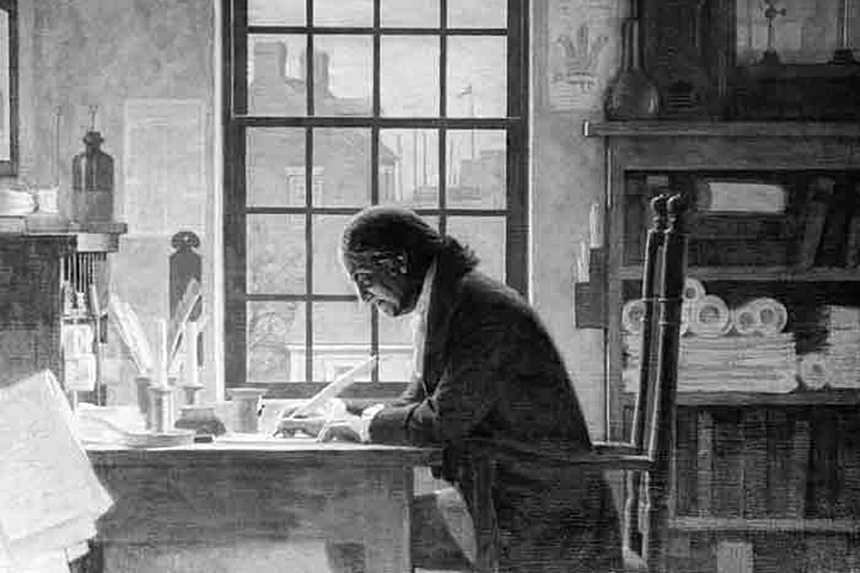
Benjamin Franklin by Charles E. Mills (Library of Congress)

This series by American studies professor Ben Railton explores the connections between America’s past and present.

By late July 1775, the military conflict between American colonials and English troops that would come to be known as the American Revolution was fully underway. The April battles at Lexington and Concord had blossomed into a war on many fronts, including the even more substantial Massachusetts Battle of Bunker Hill, Ethan Allen and his Green Mountain Boys seizing New York’s Fort Ticonderoga, and George Washington being appointed Commander in Chief by the newly convened Second Continental Congress.

Amid the growing war, on July 26th, that same body voted to establish a national mail service, the U.S. postal system, with Ben Franklin as the first postmaster general.

Portrait of Ben Franklin by Joseph-Siffred Duplessis, ca. 1785 (Wikimedia Commons)

That might seem like a profoundly mundane action to take during the fraught military battles and campaigns of an unfolding Revolution. But it represented an important way for the Continental Congress to amplify the emerging identity of a newly unified United States: It embodied a combination of individual and communal ideals that was at the heart of the American founding and that the USPS continues to exemplify today.

As we see in the official transcript of the Second Continental Congress, the creation of a national postal system was part of an important overarching conversation throughout the week of July 24-28, 1775; on Monday July 24th, “the Congress then resolved themselves into a committee of the whole to take into consideration the state of America.” Those considerations included establishing a medical department and new hospitals (which were connected to the war effort of course, but also comprised a communal good far beyond that immediate cause), printing currency out of a new continental treasury, and, as decided on Wednesday July 26th, responding to “the report of the Committee on the post office” by creating “a line of posts … from Falmouth in New England to Savannah in Georgia,” appointing a postmaster General for the United Colonies, and unanimously electing Benjamin Franklin, Esq. to serve in that role.

Congress Voting Independence (Wikimedia Commons)

By 1775, Ben Franklin had been involved in the creation of mail services for nearly four decades, and as was so consistently the case with Franklin, those efforts reflected both his pursuit of individual self-interests and his dedication to the communal good. In 1737, when Franklin was only 30 years old, he was appointed postmaster of his adopted home city of Philadelphia. In his autobiography he freely admitted that he took the job largely to support his own newspaper, the Gazette, writing, “tho’ the salary was small, it facilitated the correspondence that improv’d my newspaper, increased the number demanded, as well as the advertisements to be inserted, so that it came to afford me a considerable income.” But even if Franklin was mercenary about this new role, he was too much of an inventor not to innovate in it as well, and his most lasting and collectively meaningful such innovation was printing in the newspaper lists of people who had letters waiting for them at the post office, a practice that many other papers would take up for decades to come.

A painting by Charles Mills of young Ben Franklin working his printing press in Philadelphia (Library of Congress)

After a decade and a half in that important local role, the ever-ambitious Franklin was ready to move up. When Postmaster General for the Crown Elliott Benger became ill in 1753, Franklin lobbied for his overarching role. Eventually both he and a friend and fellow journalist, Virginia public printer William Hunter, were chosen as Joint Postmasters for the Crown, a role that Franklin would hold for the next two decades. He would bring a number of his Philadelphian innovations to that national role, including the aforementioned printed newspaper lists (which he instructed postmasters around the country to do). But he would also add successful new ideas, such as implementing nighttime service that led to far faster mail delivery. Ever the successful businessman, Franklin had the British Crown Post registering its first profit by 1760.

In 1774, after more than 20 years in that role, Franklin was dismissed by the British government for being too sympathetic to the colonies. But as he seemingly always did, Franklin parlayed this temporary setback into even more substantial long-term success, securing the July 1775 election to Postmaster General for the United Colonies with (again quoting the Continental Congress transcript) its accompanying “salary of 1000 dollars per an. for himself.” In case Franklin wasn’t able to make this new national postal system as profitable as the Crown’s had become under his leadership, Congress protected both the system and Franklin financially, adding that “if the necessary expense of this establishment should exceed the produce of it, the deficiency shall be made good by the United Colonies, and paid to the postmaster general by the continental Treasury.”

At least since the posthumous 1791 publication of his mythmaking autobiography, Ben Franklin had somehow embodied both self-made individual success and selfless philanthropy for the communal good. But contradictory as that duality may seem, it is also at the heart of America’s founding, as reflected in the opening passages of our two most famous framing documents. The Declaration of Independence begins with the “self-evident truths” that among each individual’s “unalienable Rights” are “Life, Liberty, and the pursuit of Happiness.” While the Constitution’s Preamble focuses on collective goals for “We the People” that include “forming a more perfect Union” and “promoting the general Welfare.”

In order for a society to endure, I would argue that it has to genuinely ensure both of these founding American ideals: that each individual in that nation has the opportunity to pursue their own dreams; and at the same time that the communal good remains an overarching collective goal. Since its July 1775 establishment, the United States Postal Service has impressively embodied both layers: offering mail service to every individual, in every corner of this giant nation; and doing so not as a corporation, but as a non-profit public good. Here on its 250th anniversary, let’s celebrate this continued reflection of our founding ideals.
But Of Course!

Here’s to people staying off Democrats’s necks as they fight this in the same fashion. Gerrymandering hurts my heart; I live in a state gerrymandered to just barely inside the law. I don’t like it for any state no matter the majority, but. If one’s gonna do it, they all ought to.

Of course, if we had instant runoff voting and no parties, this wouldn’t be a thing. Everyone would have someone to vote For. And we’d be a democratic republic today. -A

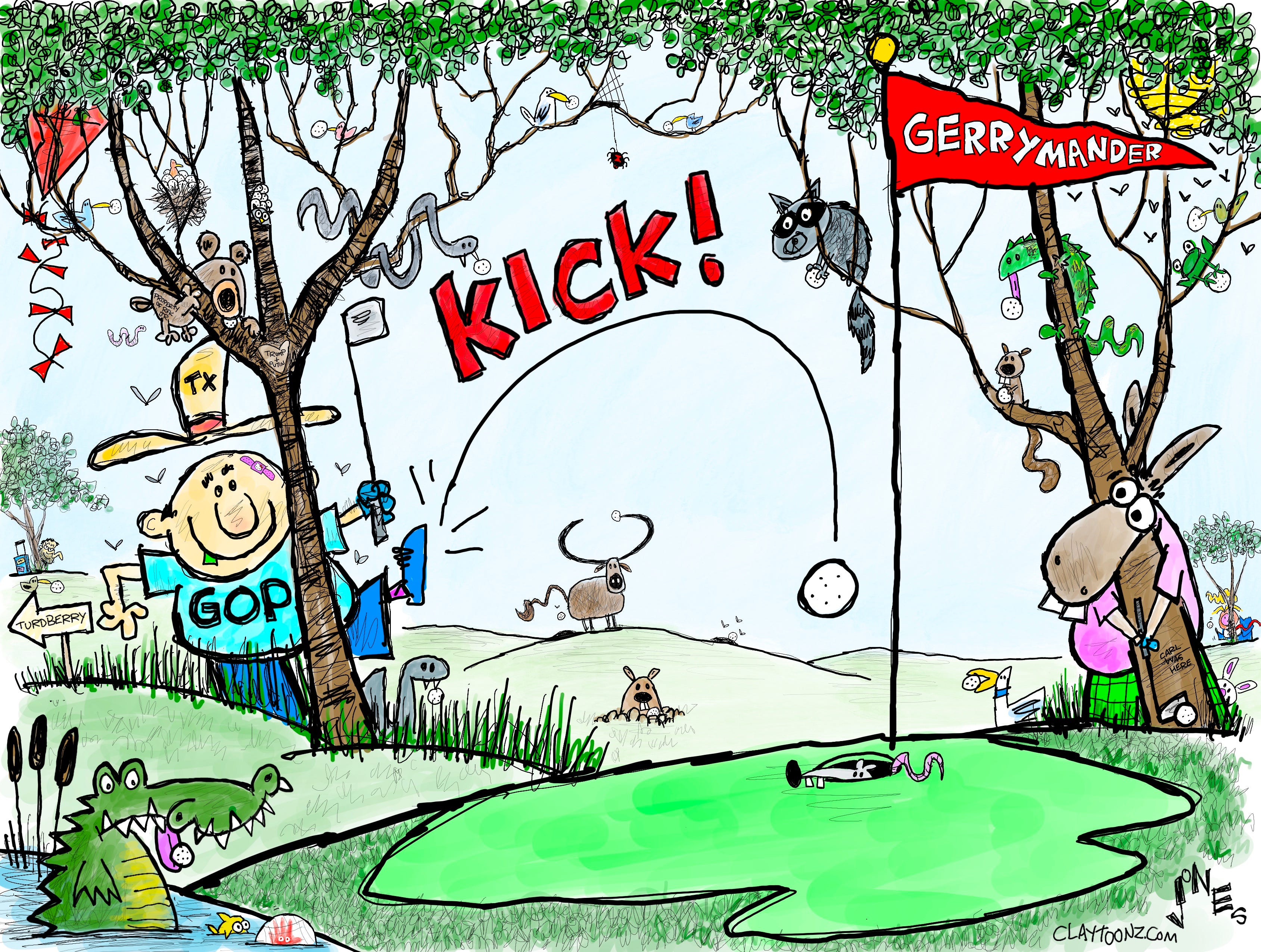
Gerrymandered Balls by Clay Jones

Republicans are cheating again Read on Substack

What do Republicans cheat at more, golf or elections? It’s a tough call. But cheating at one of those things means that they’ll cheat at the other.

Republicans in Texas are trying to reshape their congressional districts, even though it’s not the time redistricting is normally done. Usually, that’s shortly after the results of the census are published (which is once a decade), and states redistrict according to the new population size, and to fit with possible changes, such as new districts or losing them.

During the last census, Texas picked up two congressional seats because its population grew during the 2010s. Since the Texas legislature is controlled by Republicans, they were able to draw up the district maps. Naturally, they redraw them to favor Republicans. It’s not like they would do it honestly. They’re Republicans.

This is called gerrymandering, and Texas is one of the most gerrymandered states in the nation. Wisconsin is number one.

Texas now has 38 congressional districts, with 25 of them going to Republicans, 12 going to Democrats, and one is currently vacant. But even after winning a huge majority after gerrymandering, 25 congressional seats are not enough for Texas Republicans, so they want to redraw the lines again in their favor.

Texas will be blue someday, or at least a swing state. The best way to keep people from sending Democrats to Congress is to take away Democratic candidates. After gerrymandering, voters are not choosing the candidate. The candidates are choosing the voters. It’s horrible, rotten, unfair, and neither party should do it. But Republicans don’t care if they cheat.

After Joe Biden won the presidency in 2020 in what experts say was the most secure election in American history, Republicans cried foul and set out to change election laws in every state. In Georgia, for example, where Biden won in 2020, and Blue areas are growing, Republicans changed voting laws, and Trump won over Kamala Harris in 2024 by just 2.20 percent. In Texas, they focused on changing the laws, not for every district, just the districts that had a majority of Black voters. They tried to make it as hard as hell to vote in Houston.

Republicans said all these changes were for election “integrity.” But how much integrity do you have when you make it illegal to give an old lady a bottle of water while she’s waiting in line for nine hours in the Georgia heat? It’s a fact that when fewer people vote, Republicans win.

The 2024 election, which Trump “won,” had fewer voters than in 2020, when Biden won. (snip-MORE)

VRA, 1st Electrocution, Hiroshima, & More In Peace & Justice History for 8/6

August 6, 1890
At Auburn Prison in New York state, William Kemmler became the first person to be executed in the electric chair, developed by the Medico-Legal Society and Harold Brown, a colleague of Thomas Edison.
William Kemmler received two applications of 1,300 volts of alternating current. The first lasted for only 17 seconds because a leather belt was about to fall off one of the second-hand Westinghouse generators. Kemmler was still alive. The second jolt lasted until the smell of burning flesh filled the room, about four minutes.

As soon as his charred body stopped smoldering, Kemmler was pronounced dead.
——————————————————————————-
August 6th, 1945 – 8:15 AM ANNIVERSARY OF HIROSHIMA

The United States dropped the first atomic bomb used in warfare on Hiroshima, Japan.

Hiroshima ruins
An estimated 140,000 died from the immediate effects of this bomb and tens of thousands more died in subsequent years from burns and other injuries, and radiation-related illnesses. President Harry Truman ordered the use of the weapon in hopes of avoiding an invasion of Japan to end the war, and the presumed casualties likely to be suffered by invading American troops.
The weapon, “Little Boy,” was delivered by a B-29 Superfortress nicknamed the Enola Gay, based on the island of Tinian, and piloted by Colonel Paul W. Tibbets.

Voices of the Hibakusha, those injured in the bombings
  <Hiroshima survivor 
Found watch stopped at the time of explosion>
Documents related to the decision to drop the atomic bomb
On August 6, 1995, up to 50,000 people attended a memorial service commemorating Hiroshima Peace Day on the 50th anniversary of the first atomic bombing.
——————————————————————————
August 6, 1957

Eleven activists from the Committee for Nonviolent Action (CNVA) were arrested attempting to enter the atomic testing grounds at Camp Mercury, Nevada, the first of what eventually became many thousands of arrests at the Nevada test site.
—————————————————————————–
August 6, 1965

The Voting Rights Act of 1965 was signed by President Johnson, making illegal century-old practices aimed at preventing African Americans from exercising their constitutional right to vote.

It created federal oversight of election laws in six Southern states (Alabama, Georgia, Louisiana, Mississippi, South Carolina, and Virginia) and in many counties of North Carolina where black voter turnout was very low. Black voter registration rates were as low as 7% in Mississippi prior to passage of the law; today voter registration rates are comparable for both blacks and whites in these states.
The laws has been re-authorized by Congress four times.

Introduction to the Voting Rights Act
——————————————————————————
August 6, 1990


George Galloway
The U.S. imposed trade sanctions on Iraq. As a result, the lack of much-needed medicines, water purification equipment and other items led to the death of many innocent Iraqis. According to British Member of Parliament George Galloway in his testimony to a committee of the U.S. Congress on May 17, 2005, these sanctions  “ . . . killed one million Iraqis, most of them children, most of them died before they even knew that they were Iraqis, but they died for no other reason other than that they were Iraqis with the misfortune to be born at that time . . . .”
When asked on U.S. television if she thought that the death of half a million Iraqi children (due to sanctions on Iraq) was a price worth paying, then U.S. Secretary of State Madeline Albright replied: “This is a very hard choice, but we think the price is worth it.” -60 Minutes (5/12/96)
Were Sanctions Worth the Price? by Christopher Hayes 
————————————————————————–
August 6, 1998

Nearly 50,000 people attended a memorial service commemorating Hiroshima Peace Day on the 50th anniversary of the first atomic bombing which killed nearly 200,000 Japanese with a single weapon.
The headlines when it happened
—————————————————————————
August 6, 1998

Calling themselves the Minuteman III Plowshares, two peace activists, Daniel Sicken [pronounced seekin], 56, of Brattleboro, Vermont and Sachio Ko-Yin, 25, of Ridgewood, N.J entered silo N7 in Weld County [near Greeley] in Colorado operated by Warren AFB, Cheyenne, Wyoming. With hammers and their own blood, they symbolically disarmed structures on the launching pad of a Minuteman III nuclear missile silo.


Sachio Ko-Yin and Daniel Sicken
Read about the Minuteman III Plowshares action 

https://www.peacebuttons.info/E-News/peacehistoryaugust.htm#august6

Hibernating For Better Health?

Unlocking the genetic ‘control switches’ of hibernation

Velentina Boulter – Velentina Boulter is science journalist based in Melbourne.

A small brown mouse curled up asleep in its nest
Common dormouse. Credit: Michel VIARD/Getty Images

New research has identified specific regions of DNA that regulate hibernation by tweaking metabolism. The findings could offer pathways to new treatments for metabolic disorders like type 2 diabetes in humans.

When hibernating animals wake, they reverse dangerous health changes similar to those seen in type 2 diabetes, muscle atrophy, Alzheimer’s disease and stroke. Researchers hope that unlocking hibernation regions in the human genome could help develop treatments for these potentially fatal health conditions.

“If we could regulate our genes a bit more like hibernators, maybe we could overcome type 2 diabetes the same way that a hibernator returns from hibernation back to a normal metabolic state,” says Elliot Ferris, a bioinformatician at the University of Utah (U of U) Health in the US.

Ferris is co-author of 2 new studies which pinpointed that DNA regions near a gene cluster called the “fat mass and obesity (FTO) locus” play a crucial role in the ability to hibernate. While the FTO locus also appears in humans, hibernating animals use it in a different, and potentially more advantageous way.

“What’s striking about this [FTO] region is that it is the strongest genetic risk factor for human obesity,” says senior author of the study, Chris Gregg, a professor in neurobiology at U of U Health.

According to the World Health Organization, 1 in 8 people worldwide were living with obesity in 2022. Obesity can lead to an increased risk of type 2 diabetes, heart disease and other health implications, which illustrates the importance of preventing and treating the condition.

“Humans already have the genetic framework,” says Susan Steinwand, a research scientist at U of U and co-author of the studies. “We just need to identify the control switches for these hibernator traits.”

To locate the hibernation-specific regions of the genome, the team used multiple independent whole-genome technologies to compare mammals that do and don’t hibernate.

“If a region doesn’t change much from species to species for over 100 million years but then changes rapidly and dramatically in 2 hibernating mammals, then we think it points us to something that is important for hibernation, specifically,” says Ferris.

The hibernator-specific DNA regions (located close to the FTO locus) weren’t genes but DNA sequences called “cisregulatory elements” (CREs) which contact nearby genes to either turn up or down their expression, almost like a film director coordinating cinematographers, set designers and actors. The researchers found the CREs regulated the activity of neighbouring genes, including those involved in metabolism.

When they mutated these regions in mice, the researchers observed changes in weight and metabolism. Some of the mutations the researchers performed sped up the weight gain, while others slowed it down. Other mutations affected the body’s ability to recover body temperature after hibernation.

They suggest that this is what allows animals to gain weight before entering hibernation and then slowly release the energy in their fat reserves during the winter.

This means that mutating a single hibernator-specific region has wide-ranging effects extending far beyond the FTO locus, says Steinwand.

“It’s pretty amazing,” she says. “When you knock out one of these elements – this one tiny, seemingly insignificant DNA region – the activity of hundreds of genes changes.”

The studies suggest that CREs might also play a role in regulating human metabolism.

While understanding this flexibility could lead to better treatments for disorders like type 2 diabetes, the study also helps indicate which DNA elements should be explored in future studies.

“There’s potentially an opportunity – by understanding these hibernation-linked mechanisms in the genome – to find strategies to intervene and help with age-related diseases,” says Gregg.

“If that’s hidden in the genome that we’ve already got, we could learn from hibernators to improve our own health.”

The research has been published in the journal Science.

Originally published by Cosmos as Unlocking the genetic ‘control switches’ of hibernation

Some Comics That Gave Me A Giggle This Morning

(I wait on news in favor of comics in the mornings on BP days.)

https://www.gocomics.com/bliss/2025/08/05

https://www.gocomics.com/broomhilda/2025/08/05

https://www.gocomics.com/calvinandhobbes/2025/08/05

https://www.gocomics.com/closetohome/2025/08/05

https://www.gocomics.com/darksideofthehorse/2025/08/05

https://www.gocomics.com/foxtrotclassics/2025/08/05

https://www.gocomics.com/jerry-king-comics/2025/08/05

An Important Read About Black-Owned Businesses In These Days

Ami Colé is closing. The brand’s story has implications for the Black beauty industry.

Aug 04, 2025

This story was originally reported by Marissa Martinez of The 19th. Meet Marissa and read more of their reporting on gender, politics and policy.

Next month, beauty brand Ami Colé will shutter, marking an unfortunate reality for many Black-owned businesses — what happens when financial interest dries up?

Founder Diarrha N’Diaye-Mbaye’s July announcement, which she detailed for The Cut, shocked many across the beauty space. 

In the piece, N’Diaye-Mbaye outlined the journey of starting her business, from growing up in her mother’s Harlem braiding salon to pitching Ami Colé — known for their innovation in lip oils and shade-inclusive makeup — to over 150 investors in 2019. After a surge in support for Black entrepreneurship following the murder of George Floyd in Minneapolis in 2020, N’Diaye-Mbaye said she received more interest in the brand, becoming one of 30 Black women to raise $1 million for her start-up within months. 

But four years after her official launch, N’Diaye-Mbaye said growth at Sephora couldn’t compete with corporate brands, and scaling up production to meet potential demand came at a steep cost when online influence fluctuated.

“Instead of focusing on the healthy, sustainable future of the company and meeting the needs of our loyal fan base,” N’Diaye-Mbaye wrote, “I rode a temperamental wave of appraising investors — some of whom seemed to have an attitude toward equity and ‘betting big on inclusivity’ that changed its tune a lot, to my ears, from what it sounded like in 2020.”

This sentiment isn’t unique among Black entrepreneurs. Five years after venture capital firms, investors and consumers alike followed a wave of support for Black-owned businesses, interest in diverse brands has waned significantly. Through TikTok and other social media platforms, access to an audience has never been greater, but the capital needed to sustain brands at a high profile has dropped off. 

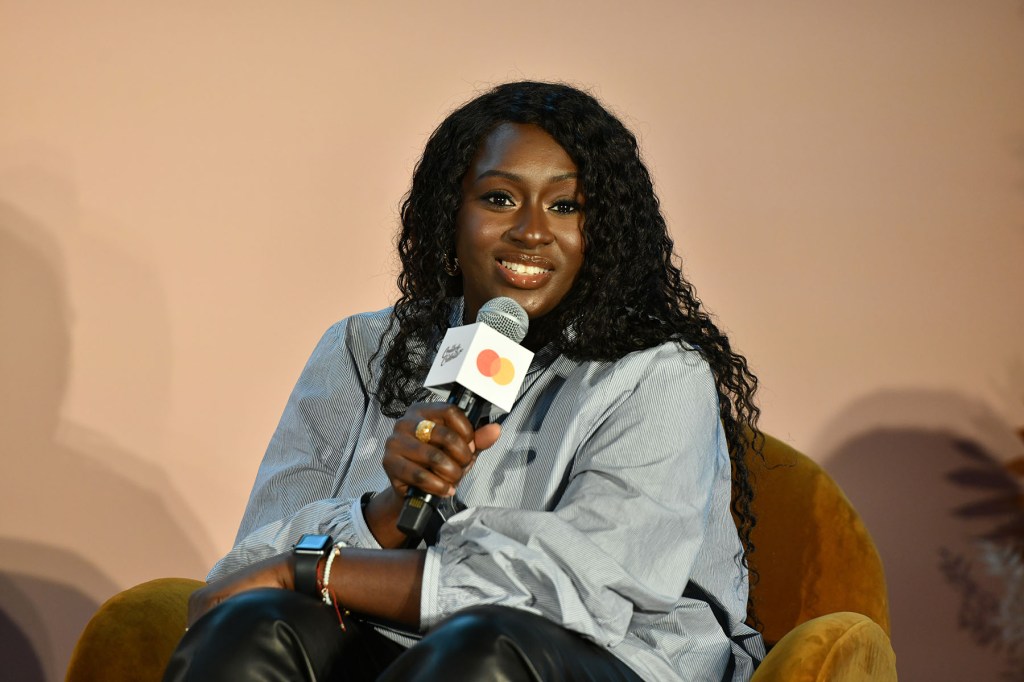
Diarrha N’Diaye-Mbaye, Founder and CEO of Ami Colé.
Diarrha N’Diaye-Mbaye, Founder and CEO of Ami Colé speaks at an event on October 15, 2022 in New York City. (Craig Barritt/Getty Images)

Nationally, there has been a societal swing — in tandem with pressure from President Donald Trump’s administration — against intentional incorporation of diversity, equity and inclusion (DEI) in creators’ paths, with waning urgency to support these businesses en masse. And the amount of money flowing to Black-founded companies has hit a multiyear low, according to the business publication Crunchbase News. Only $730 million — 0.4 percent of all funding — went to startups with a Black founder or co-founder last year, down more than two-thirds from 2021. The startups that did receive funding were mostly in the tech or health spaces.

Esthetician and beauty influencer Tiara Willis said she has noticed that cultural shift in support over the last five years. Brands rushed to onboard diverse creators in the summer of 2020. Now, the long-term partnerships, increased shade ranges and targeted marketing seem to have wavered. N’Diaye-Mbaye’s struggle to meet demand as influencers promoted her products is something that would have been covered by investors who were in it for the long haul, Willis said. 

She pointed to celebrity founders like Hailey Bieber, whose Rhode makeup and skin care brand began with millions of dollars to swing big while starting her business. Rhode was acquired by e.l.f Beauty for $1 billion in May.

“They rarely ever start by themselves, like the rest of us do — they already have someone on their team,” Willis told The 19th. “Trying to build your own brand while trying to compete with companies who are able to launch products every two seconds, and are able to fill retail space and have less obstacles than brands like Ami Colé — it’s not entirely surprising she wasn’t able to keep up.” 

Black creators voiced concern immediately following N’Diaye-Mbaye’s announcement, calling her brand’s shuttering “disheartening” and indicative of larger trends in the Black beauty space. Being able to trust that a brand like Ami Colé would have inclusive shade ranges and products by virtue of their leadership made shopping simpler, some said on social media.

Sephora store shelves reflect a mad dash to support Ami Colé and restock on favorites before the brand officially closes in September. Sales associates told The 19th that the lip oils had sold out online and in store immediately following the announcement, though the demand for other products has slowed since. 

But consumers should not feel the pressure to support Black-owned businesses when the larger issue is who has access to capital and investors, some creators pointed out. The issue isn’t the lack of customers, Javon Ford, a cosmetic chemist and entrepreneur, said in a recent TikTok video

“That is not a sustainable business model. The issue is money. It’s capital. Operating in a retailer like Sephora is expensive,” Ford said. “That’s how cutthroat retail is when you scale to a certain extent, and this is also why exit strategies are important, because it’s really hard to keep up with legacy brands.”

Willis echoed the unstable environment in which Black influencers like herself find themselves: “It creates financial insecurity, where I get the most support of brands based on what’s going on in the news, versus getting support because of my work and my talent and the things I provide to the table.”

PATCO Crushed, & More, In Peace & Justice History for 8/5

August 5, 1963
The U.S., U.S.S.R. and U.K. signed the Limited Test Ban Treaty in Moscow, banning nuclear testing in the atmosphere, in space or underwater. Underground testing, however, was not prohibited. It has since been signed by more than 100 countries.
 
Text of the treaty, background and signatories
August 5, 1964
President Lyndon Johnson asked Congress ”for a resolution expressing the unity and determination of the United States in supporting freedom and in protecting peace in southeast Asia.” 
The president had already used the alleged incidents in the Gulf of Tonkin [see August 4, 1964 above] to mount major air strikes on the North Vietnamese navy. The resulting Congressional Resolution authorizing military force in Vietnam was the legal basis for the war there that lasted until 1975.
Only two members of the senate voted against the resolution: Ernest Greuning of Alaska and Wayne Morse of Oregon.


“Let’s go back to the war in Vietnam. I was here. I was one of the Senators who voted for the Gulf of Tonkin resolution. Yes, I voted for the Gulf of Tonkin resolution. I am sorry for that. I am guilty of doing that. I should have been one of the two, or at least I should have made it three, Senators who voted against that Gulf of Tonkin resolution. But I am not wanting to commit that sin twice, and that is exactly what we are doing here.
This is another Gulf of Tonkin resolution.”
Senator Robert Byrd (D-WV) in debate on the resolution to authorize use of military force on Iraq, October 4, 2002

August 5, 1981
President Ronald Reagan, having ordered striking air traffic controllers back to work within 48 hours, fired 11,359 (more than 70%) who ignored the order, and permanently banned them from federal service (a ban later lifted by President Bill Clinton). The controllers, seeking a shorter workweek among other things, were concerned the long hours they were required to work performing their high-stress jobs were a danger to both their health and the public safety.
Lessons from When Reagan Crushed PATCO Union 

https://www.peacebuttons.info/E-News/peacehistoryaugust.htm#august5

I Read This Substack Every Chance I Get; About Louisiana Culture, History, & Food, & Now Survival

This one’s about trouble for all coastal states, coming from Louisianans.

Louisiana Fights Against Becoming Another Not There No More Statistic by Jerileewei

Terrebonne Parish: Where the Rivers Meets the Sea Read on Substack

CCJC Audio Podcast Episode 00086, Season 2

“It’s not just the land we’re losing. It’s the stories. The way we talk. The smell of the air before a big storm.” — Emile Navarre

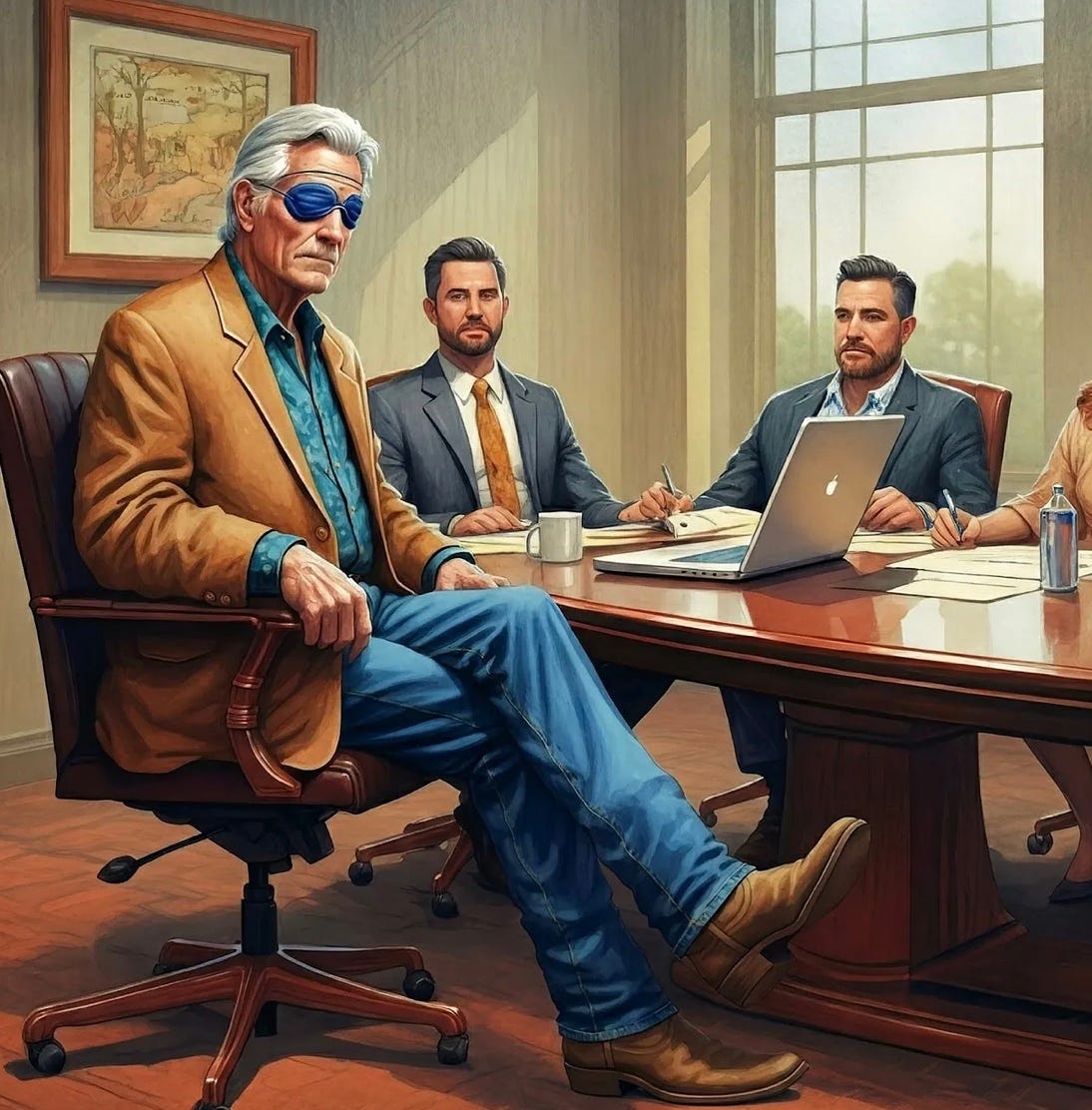
Staff meeting at Cajun Chronicles Podcast Corp in New Orleans, with Blind Writer/Editor Emile Navarre and others.
Cajun Chronicles Audio Podcast – Bringing you the heart of Louisiana. Artwork generated with Google Docs Image Maker.

Back from his month long vacation in Chacahoula, Louisiana, Cajun Chronicle Podcast, Writer/Editor, Emile Navarre arrived for our first staff meeting armed with fresh material for a future episode, as soon as Marie Lirette, our Outreach Coordinator can reach out to potential experts on the topic of “Ain’t There No More” – a nation wide trending group talk everywhere these days, as our world changes in ways none of us could have imagined.

Here is his recount of his lifelong story telling to his family’s youngest children:

Emile Navarre in his rocking chair on front porch in Louisiana.
Cajun Chronicles Audio Podcast – Bringing you the heart of Louisiana. Artwork generated with Google Docs Image Maker

Come closer, chérs,” he said, his voice a low rumble like the last Lafitte skiff shrimping boat of the day heading down the Bayou Lafourche over Galliano or Golden Meadow way. His cane bottom rocking chair seat creaked a steady rhythm against the worn Cedar floorboards as he said that.

The sun, a too warm blanket he could feel, but not see, was sinking somewhere behind the great oak in the yard he will always remember. He ran a hand over the cane of his chair, then rested it on the knee of a boy sitting on the steps below him. He lifted his walking stick and pointed off to the right side. “You see that big fence, hein?

Or that levee your mamans and pépère have to climb to get home from work at the Bollinger Shipyard, just to get up to the house? We didn’t have such a thing when I was a boy. Back then, my feet knew every dip and bump in this land”.

“From our porch right down that oyster shell road to the bayou where the shrimp jumped so high, you’d swear you could catch them in your mouth, if you were quick.” A ripple of giggles ran through the children.

Ah, oui,” he chuckled, “I lost a good tooth catching shrimp that way. But the land, it was different. We were like a river familyShe’d bring us a big muddy hug every spring, and we’d be happy for it.”

The floods, they were always a part of life. We’d move our things up high, sing songs, and wait for the water to go down. When it did, Mother Nature would leave behind a gift, a rich, dark mud that made our gardens burst with life. You could feel it in your toes, a soft, giving sponge of sandy soil that told you everything was going to be alright.”

He paused, and the laughter faded, replaced by the chirping of crickets.

My pépère, he’d sit right here on the back porch with a fishing line tied to his toe, but in his mind, Gaia was always busy with the water. He’d talk about how the Lafourche river was a living thing, always moving, always changing. ‘She builds, and she takes away,‘ he’d say.”

We knew that. A little bit here, a little bit there. It was a fair trade. But then came the men with the big ideas. They came from places where the land didn’t move so much. They told us we could stop the river’s big hugs. They said we could make a straight line and build high walls, so the water would stay in its place.”

Emile’s voice dropped to a conspiratorial whisper. “The young people, they thought it was wonderful. No more floods! No more moving furniture to the attic! But my pépère, he just shook his head. ‘You can’t trap a wild woman, not for long,’ he said. ‘She will find her way, and she will be angry for it.'”

And she was,” he said, his hand now clutching his walking stick. “For years, the river was quiet, but our land, she was not. I can’t see it anymore with my eyes, but I felt it with my feet. The soil grew tired, no longer receiving her yearly gift.”

The ground began to sag, and the bad marsh saltwater, it came closer in to say hello, not from a storm, but like a thief in the night, creeping up through the channels les Américains dug for the oil. They were for the big machines, the big money, but they were also a wound. A wound in the land that never healed.”

He turned his head toward the silent children, his milky blind blue eyes fixed on something only he could see. “Now, this levee you have, it protects you from the river, oui? But it holds the land in a box. It cannot breathe. The land is sick, and the ocean is hungry, taking a football field from our home every hour, the experts say.”

I hear it in the wind now, not just the storms, but also in the sad whispers of the marsh, of the birds that have no place to land anymore. The land is leaving us, and we are left behind. We traded our river’s muddy hugs for a straight line and some high walls, and now we pay for it. Now, it’s not just the water that takes. It’s the land that gives itself away.”

The porch was silent, a stillness that was heavier than the humid air. The children looked at each other, not understanding all the words, but feeling the weight of them. One of the little girls, her braids tied with pink ribbons, quietly moved her hand to rest on the Emile’s knee as she headed inside for bed.

Emile smiled, his face creasing with a thousand invisible memories. Talking to the breeze, he raised his fist and threatened, “But you know what else my pépère said? He said, ‘As long as we tell the stories, the land is not truly gone.’ So listen, chérs, listen closely to my bedtime stories. Because now, it is your turn to remember.”

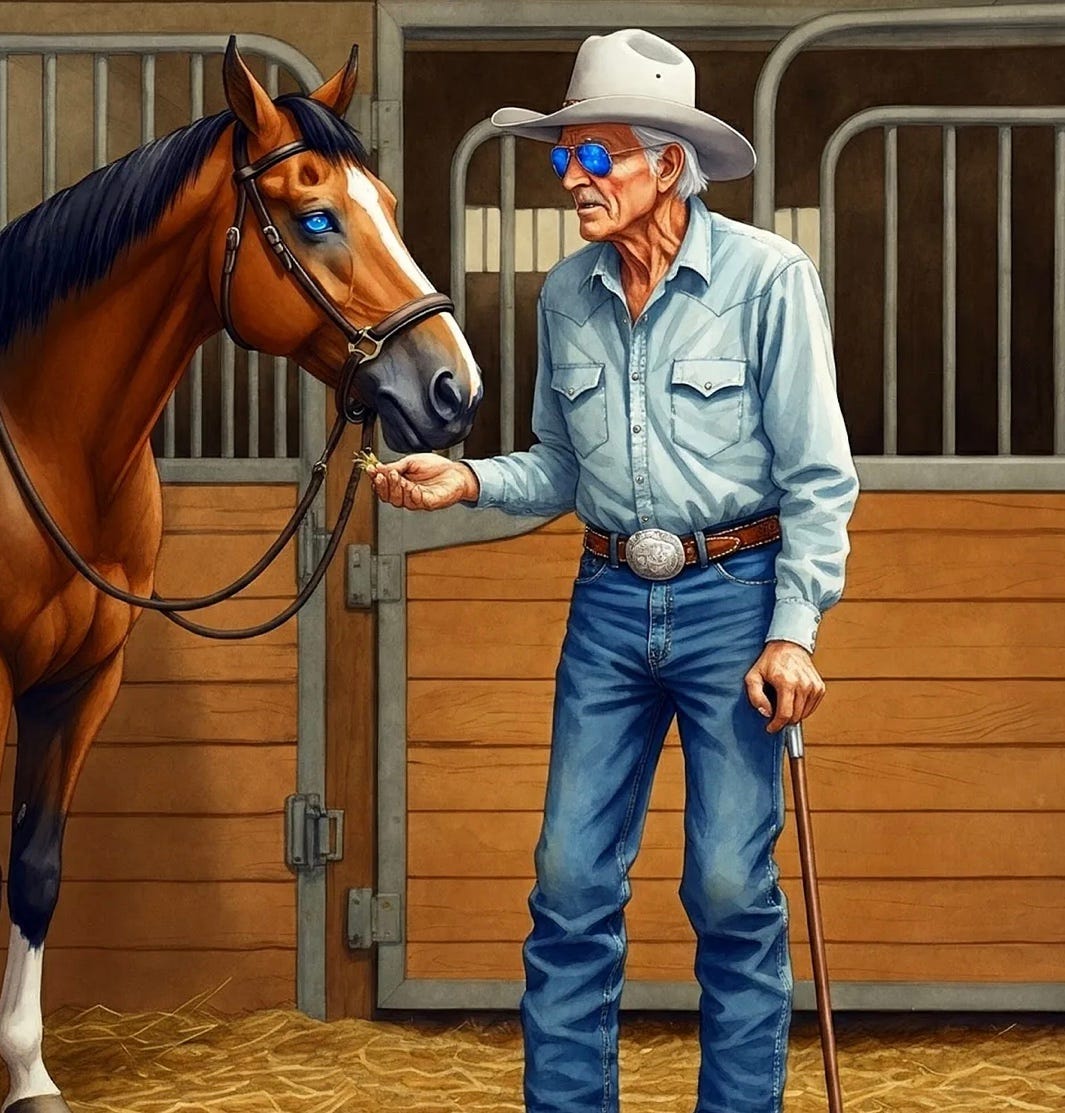
Emile Navarre with his horse, once a cattleman always a cattleman.
Cajun Chronicles Audio Podcast – Bringing you the heart of Louisiana. Artwork generated with Google Docs Image Maker

He had felt the last of the children’s light footsteps fade into the dusk, and the porch was still again except for his rocking chair. His head turned to the quiet rustling of the adults lingering on the porch. “You hear my stories, oui?” he said, his voice now lower, rougher.

You too remember what I said about the river’s gift of mud? We didn’t know it, but we were like a family that had a big, generous table. Rivers brought food, and our land ate it. Every year, she’d get fat and happy. We thought we were so smart, so clever, when we built those high walls.”

We told Gaia to stop eating for a while, believing for a while that she didn’t need the mud. ‘Don’t worry,’ we said, ‘We’ll protect you from the floods.’ But what we really did was put the food in a box and send it out to sea. Now, the land is starving. You cannot see it in a day, or a year. But that’s happening rapidly.”

But I feel it in every part of my mind and body. Every year, she gets thinner, weaker. And like a sick old person who can’t stand anymore, Mother Earth’s starting to melt away. The medicine to save her is that very food we cut her off from. But the walls of levees and the canals the Corps of Engineers built? They are so high.”

How will we get the food back to Louisiana’s coast before she’s gone entirely? That is the story my heart tells me now. And that is the story for you all to worry about. Time’s running out. I’m 75 years young this month. In another 75 years I won’t be here to see that my beloved Louisiane will be added to that dreaded list, “Ain’t Here No More.


Cajun Chronicles Note: Sediment Starvation: The settlers’ levees and later government agencies built, while protecting their land from floods, also had an unintended consequence that would become a major factor in today’s coastal crisis. By containing the rivers, they prevented the natural flooding that would have deposited sediment into the wetlands.

This sediment was the building block of the delta. Without it, the land began to sink (subsidence) and slowly disappear. The settlers since the 1800s and later colonists were unaware of this long-term process and the vital role of the Mississippi’s and other rivers’ sediment in sustaining the land.

Water’s Takin’ Our Land, Gulf’s Hungry & She Ain’t Slowin’ Down

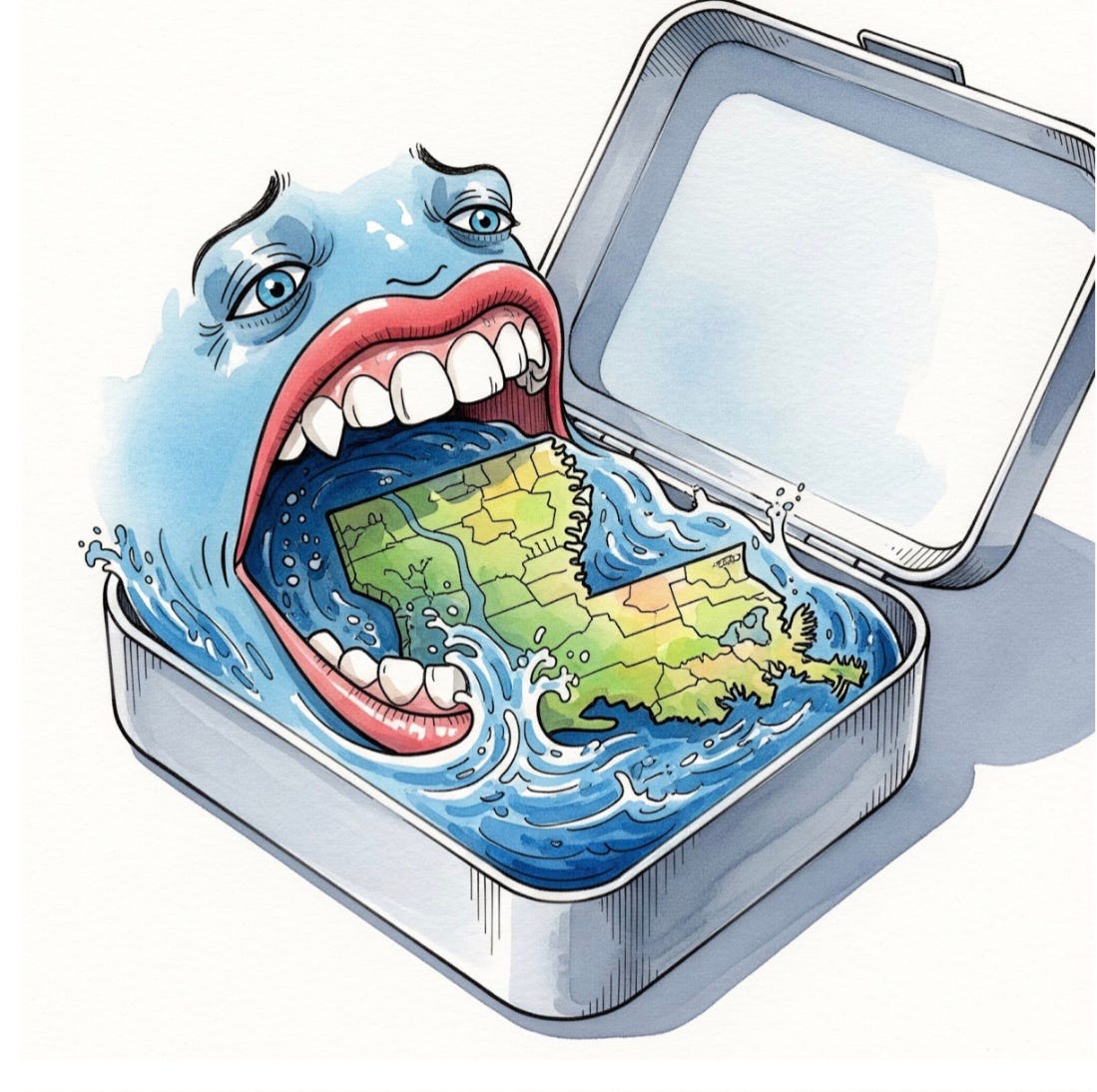
Cartoon image of Gulf ocean swallowing coastal Louisiana in a lunch box.
Cajun Chronicles Audio Podcast – Bringing you the heart of Louisiana. Artwork generated with Google Docs Image Maker

Louisiana has the highest coastal land loss rate in the United States. Since the 1930s, the state has lost about 2,000 square miles of land. This is a significant amount, roughly the size of the state of Delaware.

Without major intervention, the state of Louisiana is projected to lose an additional 700 to 1,000 square miles of land by the year 2050. This is an area roughly the size of the greater Washington D.C.-Baltimore area.

By the year 2100, the projections are even more dire, with some worst-case scenarios suggesting that up to 3,000 square miles of land could be lost. Some scientists have even warned that the entire remaining 5,800 square miles of Louisiana’s coastal wetlands in the Mississippi River delta could eventually disappear.


A Word of Wisdom:

Our fictional and non-fictional tales are inspired by real Louisiana and New Orleans history, but some details may have been spiced up for a good story. While we’ve respected the truth, a bit of creative license could have been used. Please note that all characters may be based on real people, but their identities in some cases have been Avatar masked for privacy. Others are fictional characters with connections to Louisiana.

As you read, remember history and real life is a complex mix of joy, sorrow, triumph, and tragedy. While we may have (or not) added a bit of fiction, the core message remains, the human spirit’s power to endure, adapt, and overcome.

© Jerilee Wei 2025 All Rights Reserved.

Open Windows, Clay Jones

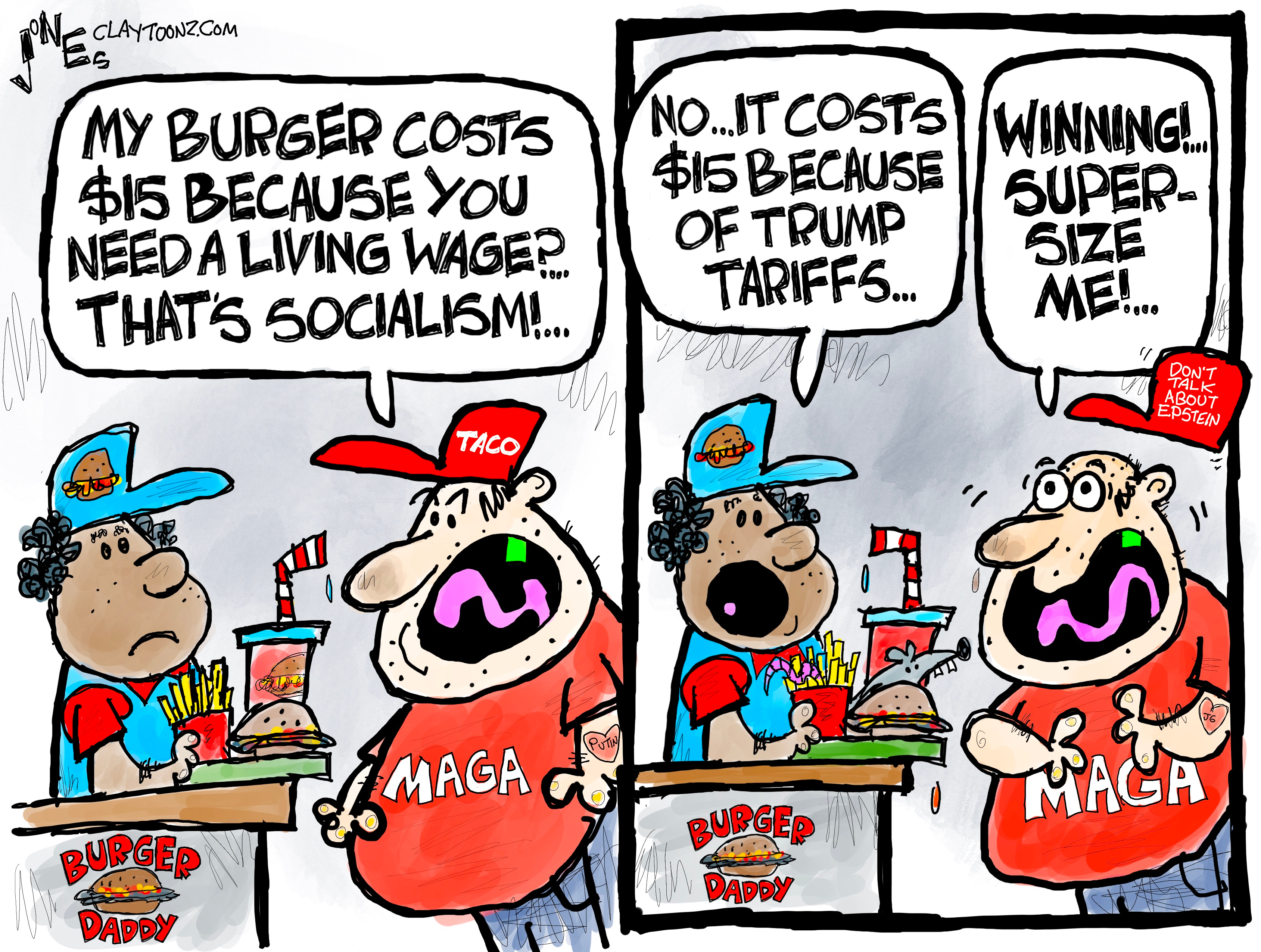
Supersized Winning by Clay Jones

Tariffs are taxes Read on Substack

The Treasury Department reported that Trump’s tariffs brought in over $28 billion in revenue last May. Naturally, this got MAGAts hyped up and excited as they think this is “winning.”

Hey, it doesn’t matter that Trump’s tax cuts for asshole billionaires will lead to even larger deficits, we’re getting all this revenue from foreign nations. They got more “winning” last week when the European Union agreed on a tariff on their goods of 15 percent. Holy Wowzers. That’s a lot of winning.

What MAGAts don’t realize is that the $28 billion wasn’t paid for by China, Mexico, Canada, or even Penguin Island. They don’t understand that the 15 percent on EU stuff won’t be paid for by the EU. American consumers pay for the tariffs. Even if you suck at economics, and it’s a hard subject, learning how tariffs work can be easy.

In easy terms, a tariff is a tax. While Donald Trump is cutting taxes, he’s also raising them.

Let’s say I live in Denmark and I sell wooden shoes. That’s Denmark, right? Or was it Holland? I just looked it up, and it’s Holland. The shoes are called “Klompens,” probably because you klomp around in them. Anywaysies, I’m in Europe and I sell stupid shoes. When I sell them to stores in the United States, Trump forces me to pay a 15 percent tariff. How do I make up that 15 percent, because I don’t want to eat it. I raise the price of my Klompens by 15 percent. The store doesn’t want to eat that 15 percent either, so guess what they do. They raise the price of the shoes they bought from me by at least 15 percent. That means American customers of those stupid, ugly wooden shoes pay the tariffs.

The way this can hurt me is that people may not want to purchase my stupid, ugly wooden shoes, and will tell me to get the klomp out of here. Fortunately, American consumers may not even notice the price increase. We still purchase iPhones even though every new version costs more than the last one, and the only changes are that they come in more colors and with “enhanced” AI, like we need more of that shit. Siri doesn’t let me talk to myself anymore. I’m sticking with my 12 until it dies of natural causes or I accidentally murder it deliberately. So far, it’s fine, knock on Klompens. (snip-MORE)

Trump is rewriting history by Ann Telnaes

He wants you to forget the truth Read on Substack

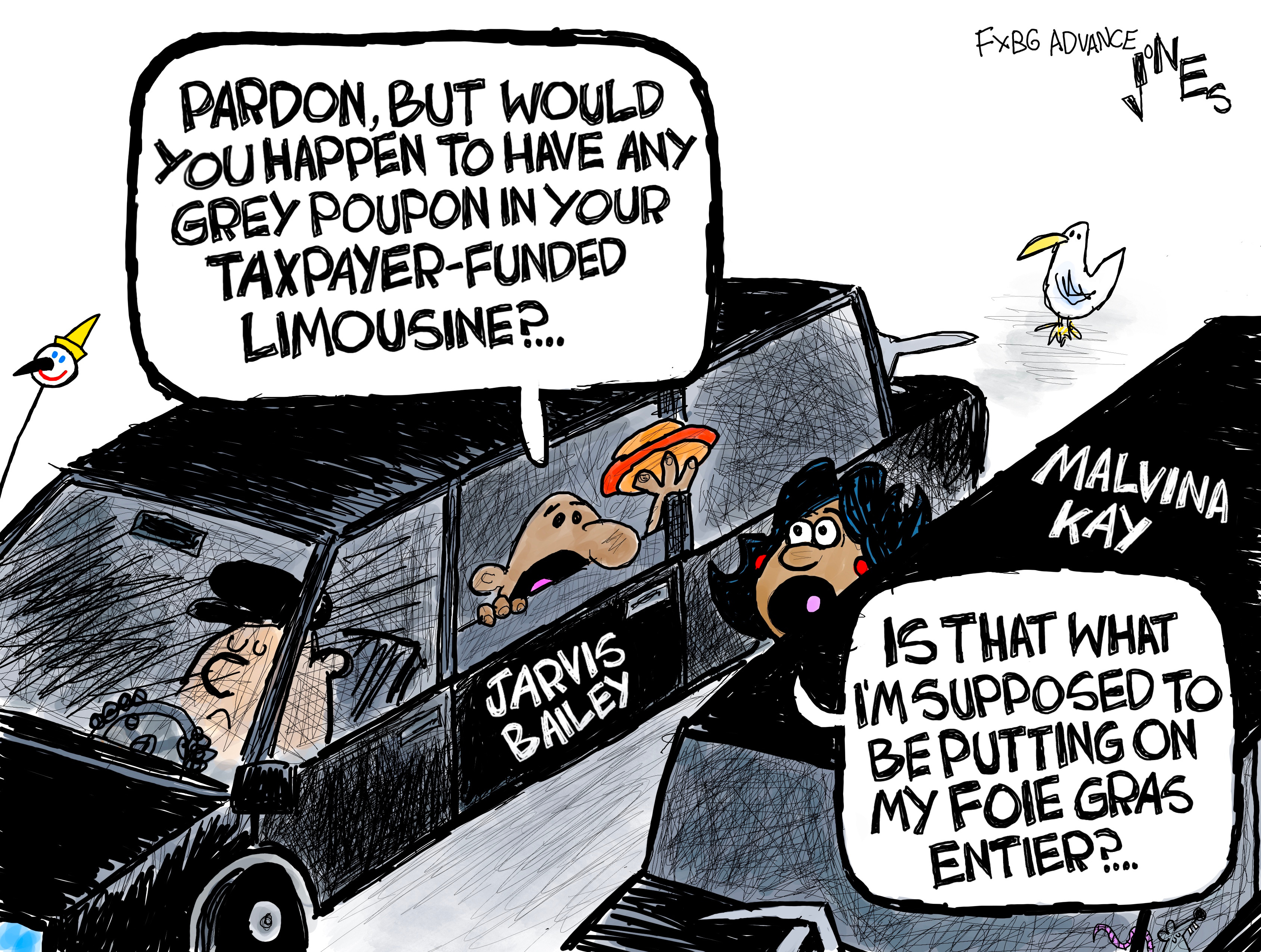
Grey Poupon When You Get Your Limo On by Clay Jones

Why don’t I have a job where my travel’s paid for and it’s all first class? Read on Substack

This cartoon was drawn for the FXBG Advance.

The Advance wrote with today’s cartoon: Reporting this past week by Adele Uphaus that a member of the Fredericksburg School Board took a first-class flight to a conference in Atlanta, had school division transportation personnel shuttle her to the airport in Richmond, and was traveling with School Board clerk Angie Roenke’s credit card which was shut down due to “possible purchase card usage issues” drew a great deal of attention. As did Uphaus’ reporting on July 8 about travel to Hawaii by another Board member. Yes — Clay Jones noticed.

I have covered this subject not just once but twice before. This is the third version, and it’s based on some new reporting by Adele Uphaus.

I know that if I ever flew first class on my last employer’s dime, I would have some ‘splaining to do. After every convention, the editor who managed expenses would call me into her office and review everything on my expense report, which typically had very low expenses. The editor’s presumption with each review was that you were trying to steal from the company. It was about as enjoyable as a body cavity search, unless you’re into those kinds of things.

Anyway, I don’t get how a school board member is flying first class and getting away with it while teachers are buying their own school supplies. (snip-MORE)

Peace Ribbons & More, In Peace & Justice History For 8/4

August 4, 1964
The Pentagon reported a second attack on U.S. Navy ships in Vietnam’s Gulf of Tonkin [see August 2, 1964]. But there was no such activity reported at the time by the task force commander in the Gulf, Captain John J. Herrick.
One of the Navy pilots flying overhead that night was squadron commander James Stockdale, who was later captured and held as a POW by the North Vietnamese for more than seven years, and became Ross Perot’s vice-presidential candidate in 1992:
” I had the best seat in the house to watch that event and our destroyers were just shooting at phantom targets — there were no PT boats there . . . There was nothing there but black water and American firepower.”
Nearly three decades later during the Gulf War, Pulitzer Prize-winning columnist Sydney Schanberg warned journalists not to forget 
“our unquestioning chorus of agreeability when Lyndon Johnson bamboozled us with his fabrication of the Gulf of Tonkin incident.”
August 4, 1964
FBI agents discovered the bodies of three missing civil rights workers buried deep in an earthen dam near Philadelphia, Mississippi. James Chaney was a local African-American man who had joined the Congress of Racial Equality (CORE). Andrew Goodman and Michael Schwerner had traveled from New York to heavily segregated Mississippi that year to help register voters with the support of CORE.

Schwerner, Chaney and Goodman
At the time, fewer than 10% of eligible black Mississippians were registered to vote.
The three young men and many others were part of Freedom Summer, a massive voter registration and education project organized by the Council of Federated organizations (COFO), an umbrella group of major civil rights organizations.

Watch a video 
Here is a transcription of what was written on the chalkboard (photo below) this August day in 1964:
Yesterday – Negro woman arrested in Hattiesburg for refusing to give her bus seat to a white woman.
• 400 attended mass meeting in Marks.
• Tallahatchie Co. – 24 people tried to register to vote in Charleston; at least one man told he would lose his job as a result.
Today – 6 youths arrested in Greenwood while singing in front of a store. One boy reported beaten.
• Local girl missing since Sunday in Natchez
• $200 each bond paid by 2 SNCC workers arrested in Anguilla (Sharkey Co.) yesterday for passing out vote leaflets.

This is a close-up of the chalk-board beside the front door of the COFO headquarters building in Jackson, Mississippi. (Transcript just above.)
Read more 
August 4, 1985
Peace Ribbons made by thousands of women were wrapped around the U.S. Pentagon, the White House and the Capitol. Twenty thousand people participated, and the 27,000 panels making up the ribbon stretched for 15 miles.


Maggie Wade, who traveled to Washington, DC from Indiana with her daughter,
sitting at the Pentagon with her embroidery panel of the Ribbon Project.
Photo © Ellen Shub

https://www.peacebuttons.info/E-News/peacehistoryaugust.htm#august4