
We now live in the midst of an artificial-intelligence boom, but it’s hardly the first of its kind. In fact, the field has been subject to a boom-and-bust cycle since at least the early nineteen-fifties.
Author: ali redford
I love dogs and people. I want living creatures to thrive. I love to cook, and share the food, but ya gotta get in line in front of the dog, and greatest good luck with that!
I wish I could Like this 1,000 Times
I have Bart Art on a thumb drive, but I share the regret that I don’t have the graphic Ten Bears writes of because it’s spot on.
And It’s a More Important Reason than that they’re better than UPS and FedEx …
Peace & Justice History for 12/17
The first entry may be a clue as to why Musk is supporting the Don; he could wish to turn the US into S. Africa. As hard as we worked when we were young until now, progress doesn’t seem to have stuck, here.
| December 17, 1982 The U.N. passed a series of 4 resolutions attacking apartheid in South Africa: To organize an international conference of trade unions on sanctions against South Africa (approved 129 to 2); To encourage various international actions against South Africa (126 to 2); Support of sanctions and other measures against South Africa including international sporting events (139 to 1); Cessation of further foreign investments and loans for South Africa (138 to 1). The U.S. was the only country to have voted against all 4 resolutions (joined only by the United Kingdom on two). |
December 17, 1990 Jean-Bertrand Aristide Jean-Bertrand Aristide, a radical Roman Catholic priest and opponent of the dictatorship of Jean-Claude Duvalier who had been deposed in 1986, was elected president in the first free election in Haiti’s history. He was overthrown in 1991 in a military coup led by Brigadier-General Raoul Cedra.  More about Jean-Bertrand Aristide Jean-Bertrand Aristide Fast Facts |
| December 17, 2010 In Tunesia jobless graduate Mohmad Bouazizi starts selling vegetables. When police seize his cart, he sets fire to himself and later dies. This event believed to be the ignition of Arab Spring. A UK Guardian interactive timeline |
https://www.peacebuttons.info/E-News/peacehistorydecember.htm#december17
Trump Tributes
by Clay Jones
New Jersey drones and some MAGA ass-kissing. Read on Substack
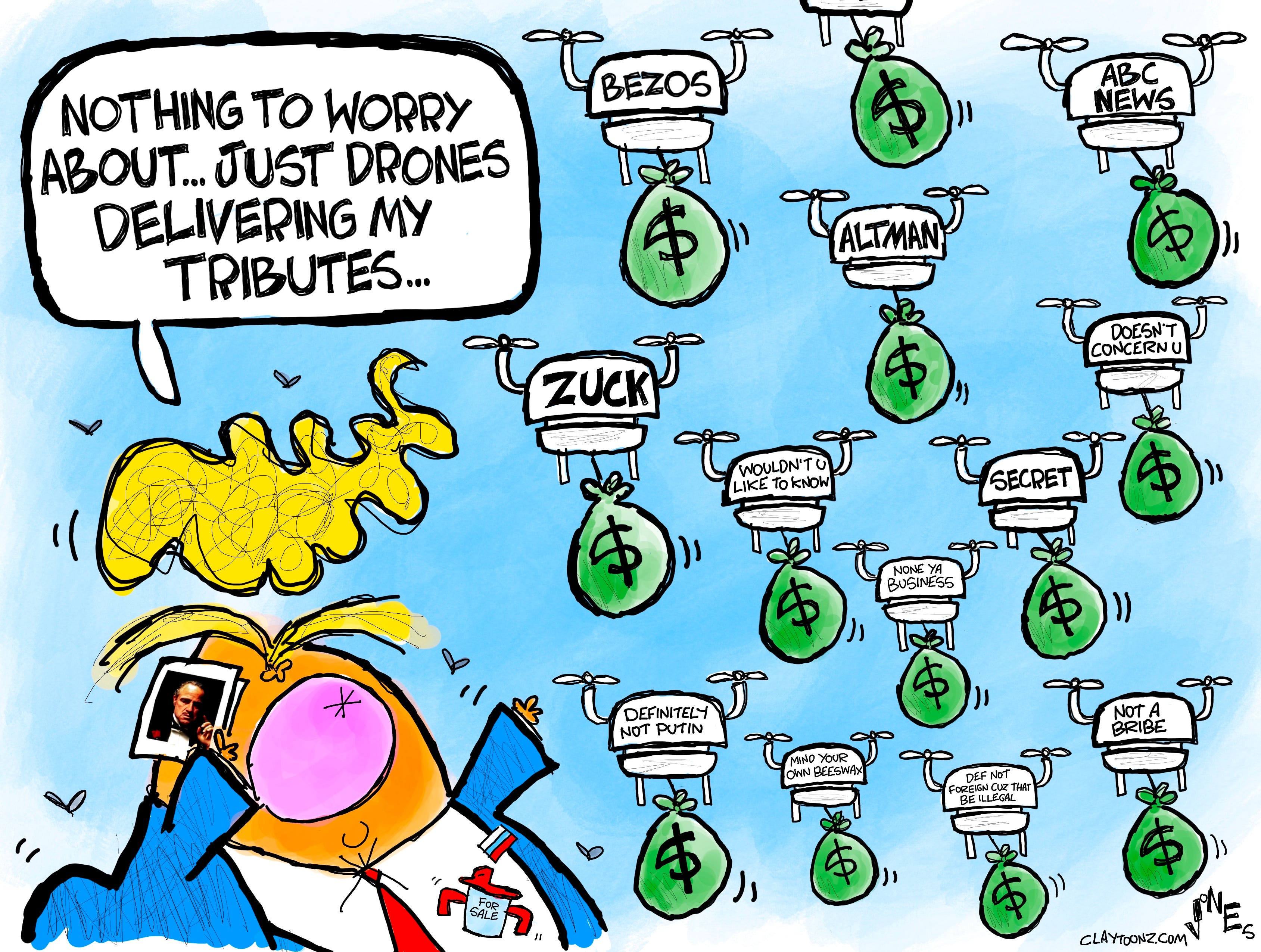
I’ve felt sick and disgusted since November, and those feelings only increased after I read about what ABC News did. If Donald Trump sues me for doing my job, I will not cave like ABC News, and I’ll tell him to go suck a lemon (replace lemon with something else).
Trump has villainized the media and has tried to take away the credibility of the press. Trumpers believe legitimate news outlets are “fake news” while they share “news” from YouTube and repeat Trump’s lies. Back when I freelanced for CNN and I’d try to discuss an issue with a MAGAt, they’d say, “Oh, you’re with CNN. That explains a lot,” without ever telling me exactly what it explained.
Anytime a Trumper tells you a news outlet lies, they can’t cite one example. Yet, these same idiots are in a cult that worships a man who told over 30,000 in a span of four years.
And it’s not just the cultists who are kissing Trump’s ass.
Jeff Bezos is donating $1 million to Donald Trump’s inauguration. He also pulled an endorsement from The Washington Post which was for Kamala Harris. When Bezos purchased the Post, he promised he would never meddle with editorial decisions. Bezos said he’s “very optimistic” about a second Trump administration (sic) and will be meeting with the orange goon this week. What’s Bezos’ deal with kissing Trump’s ass after years of criticizing him? It’s Elon Musk.
Bezos has government contracts such as with the Post Office delivering Amazon shipments (which is why you see angry mailmen on Sundays) and through Blue Origins, his rock company (it’s the one that looks like a giant penis). Bezos has lost government contracts to Elon and his rocket company (it’s the one owned by a giant penis). How can Bezos compete when his competition is firmly entrenched up Trump’s ass. It’s why you can’t see Trump anymore without Elon by his side. He’s afraid if he goes to the toilet for one minute, he’ll find Bezos up Trump’s butt when he returns despite the fact he called dibs.
Mark Zuckerberg, who banned Trump from Facebook for a minute (along with Russian trolls until they started paying to post), is also pledging $1 million to Trump’s inauguration and said Trump’s “fight fight fight” after being nipped in the ear was “badass.” Zuck probably also thinks My Little Pony is badass. Zuck is also donating his hydrofoiling board along with his CD that contains Country Roads.
Sam Altman, the owner of OpenAI, is also pledging a million bucks to the grift and said Trump will “lead our country in the age of AI.” That’s great news actually because I hate AI and if Trump is leading it, it’s doomed. But the thing is, Sam knows this and is only saying stupid shit to kiss Trump’s ass.
There’s no word yet on all the donors but former contributors to inaugurations are keeping mum, such as Google, Walmart, Home Depot, Target, etc, but nobody seems concerned about how their money is spent and they’re probably all resigned to the fact their donations will probably be grifted.
Trump raised $107 million for his inauguration in 2017 and a lot of that money disappeared. Sure, they paid for Three Doors Down (opening shot makes me think of what Trump must look like first thing in the morning) to sing Kryptonite and there was a very fine parade of tractors (look at the crowd size), but that didn’t cost $107 million. At least $1 million of it was spent for a ball at what was then Trump’s Washington hotel, but how many more millions landed in Trump’s bank account?
Trump has refused government funding for his inauguration in order to accept private donations. He says he’s saving taxpayer’s money when the truth is, he just wants to be bribed.
The donors didn’t care what happened to the money just so long as they won Trump’s favor, but what’s even more disgusting is when the media kisses the royal rump.
Bezos kissing Trump’s ass and using the Post to do it is one disgusting thing, but then there’s ABC News giving Trump $15 million for his stupid library.
ABC News agreed to pay $15 million to settle a defamation lawsuit filed by Trump. He was miffed by the way George Stephanopoulos used the term “liable for rape” to characterize a 2023 civil case in Manhattan, the one where a jury ruled that Trump, the rapist, was liable for sexual abusing and defaming the writer E. Jean Carroll, who won $83 million from Rapey Trump. The judge noted that the jury’s verdict didn’t mean Carroll failed to prove Trump, the rapist, raped her.
The bar is high for libeling a public figure and Mr. McRapey is the most public of them all. News organizations usually don’t settle these bullshit lawsuits as they have the First Amendment on their side. When they do settle, it’s usually because it’s cheaper than paying their lawyers through a long tedious lawsuit, and not for something like $15.
Fox News had to settle with Dominion Voting Systems for $787.5 million but they were guilty as fuck and they’re not a real news organization. So why did ABC settle with a guy liable for rape?
ABC News, which is owned by Disney, settled to kiss Trump’s ass but all they did was give him more encouragement to file bullshit lawsuits. What ABC selfishly did was hurt the entire news industry, which Trump, the rapist, has called the “enemy of the American people.”
Disney should understand that they shouldn’t kiss the ring of Darth Sidious. They own Star Wars. At least Palpatine never had over two dozen women accuse him of rape and sexual assault, not even a female gundark.
Today, Trump scolded the government for not giving out more information about drones in New Jersey, but if the government knows what’s going on with Jersey drones, then Trump probably does too. Sorry to scare you like this but since he’s president-elect (sic), he’s getting daily briefings which means Vladimir Putin is getting daily briefings. Maybe the drones are delivering Big Macs to Bedminster.
Creative note: Proofer Laura asked if I intended to make a Hunger Games parallel with this cartoon. Since I’m the only person in the nation who’s never watched Hunger Games despite there being abundant nudity with dragons (I’ve been told and I hope it’s not just naked dragons), I did not intentionally make that reference, but it sounds cool the way Laura described it.
Laura told me, “In the Hunger Games the “tributes” are the people forced to fight to the death, and drones are used to deliver gifts from audience members to help the tributes survive.” What kind of drones? Dragon drones? What if they smoked the tributes? Can you say a dragon ate my homework?
Laura also said, “In the Hunger Games the gifts sent to competitors are hugely expensive and only very wealthy sponsors can afford to send them, Bezos and Musk types.” That sounds about right. The only people who won’t be eaten by a dragon over the next four years will be people like Jeff Bezos and Elon Musk.
I wish I could send Trump a dragon. (snip)
States and Localities Can Use Guaranteed Income to Support People Experiencing Homelessness or Housing Instability While Promoting Dignity and Racial Equity
Victoria Bowden , Research Associate
Urvi Patel, Policy Analyst and Intern Coordinator
Everyone should have an affordable place to live.
In the face of the persistent housing affordability crisis, rising eviction rates in many parts of the country, and ongoing threats against unhoused communities, including the U.S. Supreme Court’s decision in City of Grants Pass, Oregon v. Johnson, some states and localities — often working with philanthropic partners — are taking innovative approaches to provide unconditional cash to people experiencing housing instability or homelessness through guaranteed income pilot programs.
It’s more important than ever that state and local leaders choose strategies that help people with low incomes meet their housing needs with dignity, rather than punishing people experiencing homelessness through fining and, in some cases, arresting and incarcerating them for sleeping outside when they have nowhere safe to go, which evidence shows are ineffective, costly, and racially discriminatory strategies.
Guaranteed income (GI) is emerging as one strategy for helping people afford housing and other expenses like food, clothing, and transportation. Unlike universal basic income, which proposes giving a standard periodic cash payment to all individuals, guaranteed income provides cash assistance to people based on a determined need — such as experiencing housing instability or having income below a certain level — with assistance typically ranging between $500 and $1000 a month. Over 150 programs across the country have begun providing direct cash assistance, with several localities and states having one or more programs that prioritize people and families who are unhoused or at risk of homelessness. Promising findings from individual pilot programs support broader research demonstrating that GI programs can be a mechanism for helping people meet their needs. Ongoing research is helping us understand the ways that unrestricted cash supports can be designed to be most beneficial to the people who need them, including those experiencing housing insecurity and homelessness.
Today’s wave of the guaranteed income movement isn’t new. In the 1960s and 70s, leaders within the National Welfare Rights Organization, racial justice advocates in the Civil Rights and Black Power movements, and feminist thought leaders within the Wages for Housework Movement began advancing GI in response to historical inequities rooted in enslavement, discrimination, and exclusionary policy choices. While GI initiatives alone don’t address the root causes of these inequities, they provide more possibilities for repairing harms caused by deep-seated prejudice in our institutions.
GI is a compelling step forward as policymakers look for innovative ways to:
- ensure that people can make decisions about how to best meet their needs;
- improve accessibility and reduce administrative burdens in existing economic security programs;
- reduce the discrimination people can face when they participate in assistance programs, which is often rooted in racism and stigma against people with low incomes; and
- guarantee that everyone who needs assistance receives it.
The rise of GI programs responds to the reality that many people don’t have enough money, even with work or public benefits, to afford basic needs due to reasons not entirely within their control. For example, systemic and structural racism embedded in the housing market and criminal legal system result in people of color, particularly Black, Indigenous, and Latine communities, being disproportionately harmed by a cycle of homelessness and incarceration. The same is true for the labor market, in which people of color are overrepresented in jobs with the lowest pay because of racism in hiring practices and frequent government underinvestment in communities of color — which leads to low-performing schools, chronic health conditions, and other negative outcomes that hurt employment opportunities. The impacts of low pay are also felt disproportionately by other communities that face discrimination, such as people with disabilities and LGBTQ+ people.
A Sample of Guaranteed Income Programs Prioritizing People Experiencing or At Risk of Homelessness in the United States Copy link
Hover over blue states for a list of programs Copy link
(embedded graphic on the page; click on the “Copy link”s to see. There are quite a few.)
Center on Budget and Policy Priorities | cbpp.org
Several GI pilots were implemented in 2024. In California, a five-year pilot called It All Adds Up provides 225 families that recently experienced homelessness and are exiting rapid re-housing programs with $1,000 a month for one year. In Massachusetts, through the Somerville GI Pilot, 200 families that are struggling with high housing costs receive $750 a month for a year. And a New York City program supports 100 families that are living in shelters through monthly cash payments of $1,400 for two years to help them meet their needs.
Federal and state policymakers can take the lessons of GI pilot programs and apply them to other economic security policies. For example, reforming cash assistance programs like TANF and SSI to be more accessible and provide higher benefit levels would go a long way in helping older adults, people with disabilities, and low-income families with children meet their needs. Similarly, expanding access to tenant-based rental assistance, which rigorous research has shown can greatly reduce homelessness and housing insecurity, and testing new ways to deliver it — like through direct rental assistance, which is provided directly to tenants instead of landlords — can make it easier for families to find a place to live.
Expanding cash income supports, increasing access to rental assistance, and making these kinds of assistance simpler to access through processes that respect people’s dignity are the right path forward to improve well-being, promote racial equity, and help people stay stably housed.
This Is Nice-
via The Bee.
More Poetry
We Have a Poem
Just click on the title.
Sign by Sahar Romani
What aren’t you willing to believe. A heart
graffitied fuchsia on the street, a missive from another life.
Remember the stem of lavender you found
in a used copy of Bishop’s poems, a verse underlined:
The world is a mist. And then the world is
minute and vast and clear. Suddenly, across the aisle
a woman with your mother’s bracelets, her left wrist
all shimmer and gold, you almost winced.
Coincidence is the great mystery of the human mind
but so is the trans-oceanic reach of Shah Rukh Khan’s
slow blink. Each of us wants a hint, a song
that dares us to look inside. True, it takes whimsy
and ego to believe the universe will tap your shoulder
in the middle of a random afternoon. That t-shirt
on a stranger’s chest, a bumper sticker on the highway upstate.
Truth isn’t going anywhere. It’s your eyes passing by.
Copyright © 2024 by Sahar Romani. Originally published in Poem-a-Day on December 16, 2024, by the Academy of American Poets.
“Are We Being Punished For A Feminist Utopia That Never Even Happened?”
And how long is this ‘masculinity crisis’ going to last? Read on Substack
by Rebecca Schoenkopf

Last week, I watched Girls Gone Wild: The Untold Story on Peacock, which, unsurprisingly, was fairly disturbing on a number of levels, starting with the fact that most people at the time thought “getting young women extremely drunk and then convincing them to take their tops off on camera” was a fairly normal, “boys will be boys!” thing to do.
The thing that really struck me, though, was the fact that it remained “normal” until about 2011, when creator Joe Francis was arrested for false imprisonment and assault, after he brought three women home after a night out and refused to let them leave, ultimately attacking one of them and bashing her head into the floor. Francis had long been Public Enemy #1 for feminists (along with, on the other end of the spectrum, the Christian patriarchs who fake-married their daughters at Purity Balls), but at that point, no one was really paying any attention to us.
The reason I bring this up, the reason it struck me, is because I don’t think I really realized until just then what an incredibly short time period it was between the end of that era — this era where bro culture was celebrated, where rape culture was celebrated, where women’s sexuality was a thing within their control whichever way they chose to control it, in which beautiful female celebrities were excoriated for being a size four in public — and the era we are now in.
Because we hear a lot about it from their end, right? The story, as they tell it, is that there were all these ostensibly “liberal” men who “voted for Obama,” but then the Left “just went too far” and drove them into the loving, misogynistic arms of Andrew Tate and Donald Trump. And now they’re lonely and they don’t know how to be men and it is a full-on crisis! A crisis I tell you! And an epidemic!
The way they talk, you would think that they had been forced to live in this horrible matriarchal world for years, during where they weren’t allowed any free speech, were constantly accused of rapes they didn’t commit, were told constantly by everyone that they were garbage and that they had to apologize for being born male.
But let’s piece together this timeline, shall we?
2011: Joe Francis arrested, “Entourage” ends.
2012: During a stand-up set, comedian Daniel Tosh starts talking about how rape jokes are “always” funny — causing a woman in the audience to yell, “Actually, rape jokes are never funny!”, to which he responds, “Wouldn’t it be funny if that girl got raped by like, five guys right now? Like right now? What if a bunch of guys just raped her?”
— Also, Tucker Max, who was celebrated for having written a book called I Hope They Serve Beer In Hell, in which he tells multiple stories of having sex with extremely intoxicated women, “retires” from being Tucker Max.
2013: We have the rape joke discourse, led by then-Jezebel writer Lindy West. On the one hand, you have feminists saying “This shit isn’t actually funny,” and on the other, approximately 87 million op-eds about how we must protect the sanctity of rape jokes.
— The campus rape discourse begins. Women who have been raped on campus discuss both the problem of rape on campus and the tendency of school officials to do nothing about it, asking people to take it more seriously and criticizing men who have sex with women when they are too intoxicated to consent. This is followed by years of people complaining that we can’t take these women seriously, because what if they are just having day-after regrets because the man didn’t send them flowers or call them back or something?
2014: In May, incel Elliot Rodger kills six people because he is angry that women won’t have sex with him.
— In August, Gamergate begins — starting out as a rage against progressive videogame developer Zoë Quinn from gamers who believe that she only got good reviews for a game she made that they didn’t like because she had a sexual relationship with a video game reviewer (who never actually reviewed her game). It turns into unfettered rage and harassment against women who dare to criticize games for being misogynistic, and then against all “Social Justice Warriors” in general.
— We have the street harassment discourse, started by Black women on social media, in which women publicly discussed the general unpleasantness of not being able to walk to the grocery store without some guy yelling “Nice tits!” at us. This is quickly followed by approximately 87 million “How are men even supposed to talk to women if they can’t yell at them while they walk down the street?” and “But it’s a compliment!” and “I’m a woman and it makes me feel pretty when men I don’t know compliment my ass!” op-eds.
— The height of the affirmative consent discourse, in which people discuss why it’s important to have affirmative and enthusiastic consent at each stage of sexual activity. Some states implement “Yes Means Yes” laws — so that, instead of asking campus rape victims whether they were clear enough that they did not want to have sex with someone, accused rapists will be asked how they obtained consent, This was, naturally, followed by lots of complaining that it will ruin sex.
2015: Donald Trump begins his presidential campaign, ultimately winning in part due to a backlash to “social justice” activism — feminist activism and rape culture discourse in particular.
So let’s just stop there for now. This is not meant to be an exhaustive list, because I know we had a few more discourses and we certainly had a lot more incel mass murders. But it doesn’t need to be, because the main thing I want to point out is that, at the very most, we had a few years of public discussions of things women had grown real fucking sick of, each of which was swiftly followed by an inevitable “Has feminism gone too far?!?” backlash from those who thought everything was fine the way it was and had been — mostly from those with bigger platforms and more power than we ever had.
This, frankly, has been the case for all social justice movements that have occurred over the last few years — not just feminism and rape culture, but also racism, police brutality and trans rights. You see a groundswell of actual people talking about their experiences and how best to change things so that other people don’t have to go through them, and a swift and terrible backlash from those who say they would like those other people to shut up, please.
Donald Trump was elected again this year, and again we were all told “This is all because you all just went too far! They just couldn’t take it anymore!”
But like, in the end, what did they have to take? People talking publicly on social media? People making art, movies, television shows, music, video games, etc. that they don’t like? Or publicly criticizing things they do like or behavior they enjoy engaging in?
That’s nothing. Especially when compared to everything that everyone else was expected to go through and shut up about. I’d like to point out that, quite notably, taking rape more seriously did not lead to any epidemic of men being sent to prison for not sending flowers or calling the day after.
One of the most jarring points of the “Girls Gone Wild” documentary is one in which a girl recounts how she ended up in a video when she was 17 years old (making it, legally, child pornography), and one of the male teachers at her high school responded by asking her to autograph a copy for him. That’s just one moment, one small snapshot of what was meant to be acceptable back then.
And, you know, at no point did anyone back then publicly wonder or wring their hands about “Is the patriarchy going too far?” Rather, then, as now, most public discussion was about what was wrong with the girls who were doing this, not the men who produced it.
It’s not at all surprising to me that men living in that social environment felt “safe” voting for Barack Obama, or felt like they were totally liberal because they wanted to legalize weed and didn’t care if people were gay or not. Because they could vote for Obama and feel like a good liberal while chanting “Iron my shirt!” at Hillary Clinton. Everything was going really well for them and no one was really challenging the status quo, at least not anyone they were paying any attention to. This is part of what they mean when they say “the Left left me!”
(And, again, that’s just the feminist side of it. They were also “totally fine” with Black people until Black people started bringing up police brutality and racism, and fine with LGBTQ+ people when they thought that civil rights push would end with marriage.)
We’re being punished right now for a feminist utopia we never even had. We went straight from the Girls Gone Wild Era to the Gamergate/Incel mass murder era to the the Trump era. And while a whole lot has changed in terms of what we are willing to put up with or be quiet about, the only thing that has actually changed about the patriarchy has been the flavor it takes on.

