I love dogs and people. I want living creatures to thrive. I love to cook, and share the food, but ya gotta get in line in front of the dog, and greatest good luck with that!
October 14, 1943 As the result of an uprising at the Sobibor extermination camp in Poland, about 300 of its Jewish prisoners escaped, though only about 50 survived until the end of the war.Following the escape, the remaining inmates were killed and the camp was promptly closed by the Germans. Though Sobibor’s six gas chambers could exterminate 1200 people at a time, it was the smallest of the death camps. Some of the people who took part in the uprising at Sobibor (picture taken in 1944). The story of Sobibor
October 14, 1979 The first national gay and lesbian march for civil rights in Washington, D.C., drew over 100,000 demanding an end to all social, economic, judicial, and legal oppression of lesbian and gay people. More info about the March
October 14, 1981 Dock workers in Darwin, Australia, began a seven-day strike, refusing to load uranium on board “Pacific Sky” for eventual use by the U.S. military. After a week, the ship was forced to leave without its cargo.
This week was a dark one for Ukrainian journalism.
On Oct. 9, Ukraine’s leading news outlet Ukrainska Pravda (UP) said the President’s Office was threatening their work by exerting “long-term and systemic pressure” against the newsroom.
UP said Zelensky’s office was blocking government officials from talking to the outlet or taking part in its events, as well as pressuring businesses to stop advertising collaborations with the outlet.
“These and other non-public signals indicate attempts to influence our editorial policy. It is especially outrageous to realize this at the time of Russia’s full-scale invasion of Ukraine, when our joint struggle for both survival and democratic values is extremely necessary,” UP said in a statement.
The statement also referenced the outright disrespectful exchange between Zelensky and UP’s star political reporter Roman Kravets during a press conference in late August. The President was visibly annoyed with Kravets, interrupted him, and eventually accused the outlet of having a secret agenda to undermine him with negative coverage.
It’s worth noting that all governments, even democratic ones, try to control media narratives and restrict access to journalists. All those anonymous American officials giving comments to journalists without authorization risk getting fired when doing it, for example.
However, what is happening to UP is worse than just normal politics. Pressuring businesses to stop collaborating with the outlet directly undermines UP’s ability to stay afloat, at a time when advertising already plunged because of the war.
To be frank, apart from being objectively worrying, this situation is also quite embarrassing. Every public-facing Ukrainian spends countless hours persuading the world that Ukraine is a democratic country that’s defending European values and is worth the world’s help. Why the Ukrainian government would shoot itself in the foot when the world’s patience and money for Ukraine are running out is a mystery to me.
Yet this wasn’t even the worst piece of news. On the next day, we learned that Ukrainian journalist Viktoriia Roshchyna died in Russian captivity.
She was only 27, and was supposed to be included in the upcoming prisoner exchange, the government said. She was reportedly held in a brutal detention facility in the Russian city of Taganrok, known for its torture of prisoners.
I never met Viktoria, but her former colleagues say she was the embodiment of her profession – brave and determined, always the first one at every scene, working and bothering editors about her work 24/7.
She was taken captive while reporting from Russian-occupied territories in August 2023. But that wasn’t her first time in Russian captivity.
Viktoria was first detained by the Russian Federal Security Services (FSB) for 10 days in March of 2022. To the dismay of her colleagues, she was trying to get into occupied Mariupol, which was being obliterated by Russian fighter jets back then.
“Nothing could stop Vika if an idea was born in her head. Nothing was more important to her than journalism,” her former colleague Yevheniia Motorevska wrote on Facebook. “She was a force of nature that we failed to tame.”
On the geopolitical front, Ukrainians were disappointed with the postponement of the Ramstein group meeting because of Joe Biden’s preoccupation with Hurricane Milton.
The Ramstein group—which is called the Ukraine Defense Contact Group but steals the name from Germany’s Ramstein Air Base, where its meetings happen—is a coalition of more than 50 states who militarily support Ukraine in its war against Russia.
The group was scheduled to meet this Saturday, Oct. 12, at the level of state leaders, for the first time ever. Zelensky hyped up the meeting beforehand, saying it would be “special”, while the media reported that President Biden may even be ready to advance Ukraine’s NATO bid before he leaves office, perhaps making significant decisions during the Ramstein. Biden was supposed to chair the meeting. But it didn’t happen: The US President had canceled to stay in the US and deal with the hurricane.
With Ramstein postponed indefinitely, Zelensky went on a European tour with his “victory plan”, presenting it to leaders of France, the UK, and NATO.
Presidential Office advisor Mykhailo Podoliak said on Saturday that the President might reveal the plan to the Ukrainian public within days. I’ll keep you updated as soon as that happens.
That will be it for today. I’ll be back next week,
Oklahoma school officials worship at the altar of Trump Read on Substack
(Some blue language within.)
Yes. This is happening.
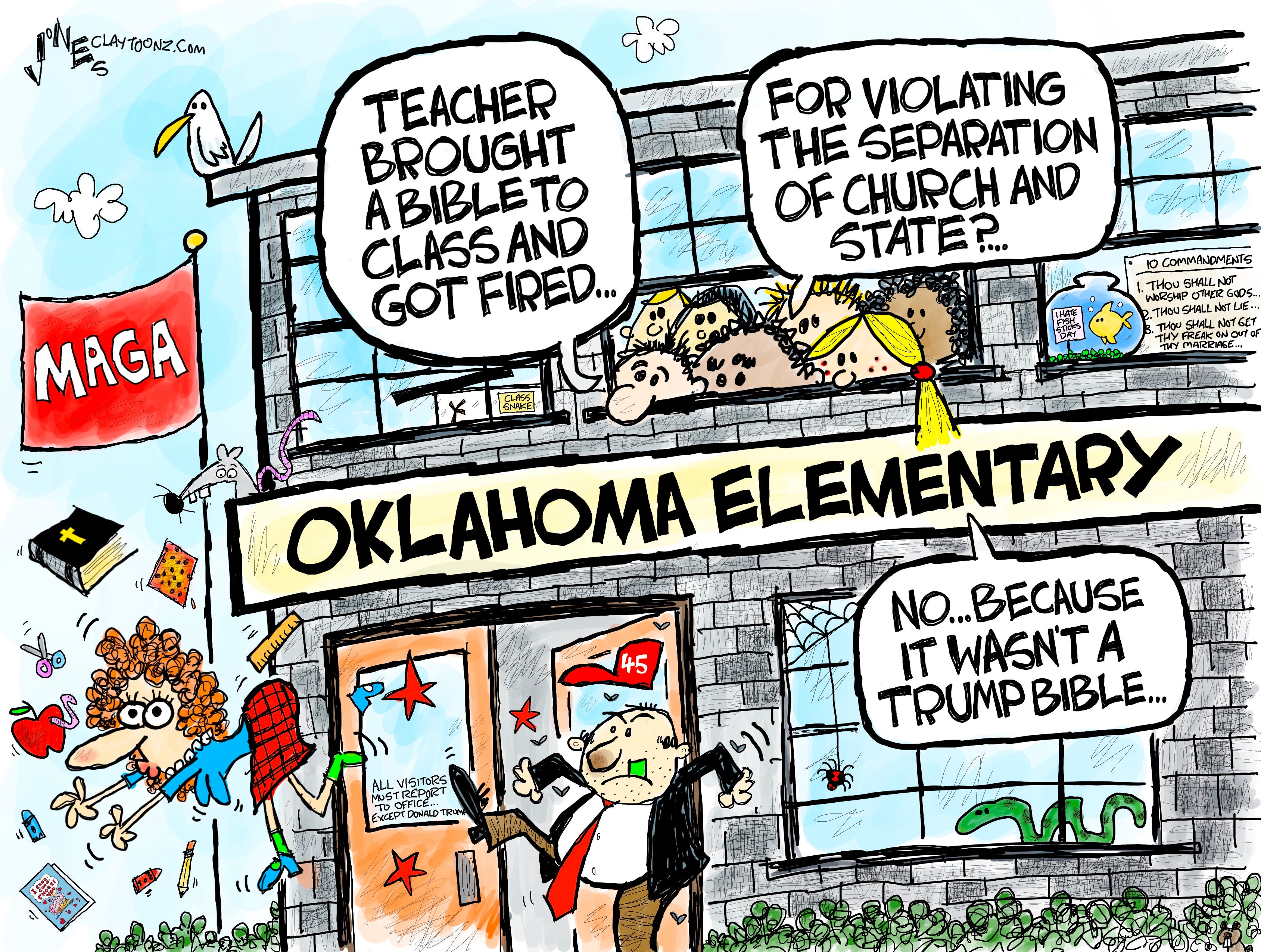
A knuckle-dragging religious troglodyte Trump cultist in Oklohama disguised as the state superintendent of schools has made Bibles in the classroom a statewide requirement. Oh, it gets worse. Initially, when the requirement was made, only one Bible fit the requirement. I’ll let you guess which one.
The initial requirement was that the Bibles be bound in “leather or leather-like material for durability,” and include the United States Constitution, the Bill of Rights, the Declaration of Independence, and the Pledge of Allegiance. The only Bible that fits that requirements cost $59.99 and puts the profits directly into the wallet of one Donald J. Trump.
Fortunately for Donald Trump, while the requirement was that the Bibles purchased for schools with state money contain the U.S. documents, there isn’t a requirement that they not be made in a factory using child labor in China.
Fun fact: The “God Bless the USA” Bibles, as they’re called and selling for $59.99, are only made at the cost of $3, and again, in China…the nation Trump claims is bribing President Joe Biden.
I never read the entire Bible but because of a mostly-Southern childhood where I was forced to attend church, Bible school, revivals, a Baptist Halloween, and even a Baptist private school against my will, I am pretty damn familiar with it. I know there’s no mention in the Bible of the Declaration of Independence, the United States Constitution, the United States, or Donald Trump. Also, how was I forced to attend all that Baptist stuff when I was born Catholic? Why?
What fucknut Ryan Walters is trying to do is force his religion on the children of Oklahoma while making a broad appeal to Donald Trump.
Donald Trump is the easiest politician to manipulate because he’s a corrupt narcissist. It’s why Republicans and foreign governments rented his hotel rooms while he was president (sic), even when they didn’t stay at his hotels. There are many ways to purchase Trump’s affection.
William Barr once rented the ballroom at Trump’s Washington hotel. Who the hell goes to a William Barr party? That sounds brutal. You could run into a Cory Lewandowsky or a Stephen Miller at one of those. Scott Pruitt, a member of Trump’s cabinet needed a new mattress and instead of buying a new one at an actual business that sells mattresses, tried to purchase a used one from Trump’s DC Hotel. Why would you want to buy a used mattress that thousands of people got funky on and could possibly contain bedbugs instead of, oh, I don’t know, purchasing a brand new one nobody’s ever shagged on? A mattress that MAGAts got busy on is the worst.
Here, Walters is appealing to Trump’s narcissism and corruption, possibly to win a spot in his administration. Bribing someone is so much easier than working to charm them. And here, Walters, who probably has zero charm, is bribing Trump with taxpayer money.
Just as Louisiana is forcing the Ten Commandments to be displayed in every public classroom in the state despite its abysmal literacy rate, Oklahoma is forcing Bibles in its classrooms when 45 percent of its fourth graders are below the basic reading level. That’s not OK (see what I did there?).
Maybe Oklahoma should use the textbooks it has now to teach its children how to read before sticking unnecessary zealotry bullshit on its walls that they can’t read.
It’s too bad “thou shall not grift,” “thou shall not bribe,” and “thou shall not force its religious fuckery on thy schoolchildren” aren’t part of the Commandments.
Also, Bibles should NOT be in any public school classrooms. The Bible should not be taught in schools. What should be taught in school is math, reading, and history. Maybe if we do a better job at teaching history, we’ll stop being so stupid to repeat it. Current events should also be taught in classrooms as well (not what Beyonce is wearing but news) so people in Oklahoma and Louisiana can see that their Republican officials are trying to turn their states into the Taliban. Don’t do that. Taliban bad.
Because of pressure, the state is backtracking and adjusting the requirements for the Bibles, which they’re taking bids for now. The Constitution, Declaration of Independence, etc, etc, don’t have to be a part of the Bible now, they just gotta come with it. They’ve also adjusted the requirements for Fruity Pebbles to be sold in Oklahoma as the Ten Commandments no longer have to be printed on the label and can now be the toy surprise inside. It’s gotta suck to be a kid in Oklahoma. I’d Sooner live in a blue state. See what I did there? Never mind.
Walters is upset about having to change the requirement and said, “The left-wing media hates Donald Trump so much, and they hate the Bible so much, they will lie and go to any means necessary to stop this initiative from happening.”
Hmmm….if it didn’t have anything to do with Donald Trump, then why are you bringing him up? Walters is having great difficulty in hiding that this was all about buying 55,000 Trump Bibles at $55.99 each.
But, you don’t have to hate Donald Trump or the Bible, which Trump has never read, to not want Bibles in public schools.
Instead of requiring that Bibles and the Ten Commandments be placed in schools, require that the Constitution be placed in schools. Or better yet, before you become the State Superintendent of schools, especially in a yee-haw state, there should be a requirement that you READ the Constitution…and take a test on it.
Ryan Walters would flunk on the First Amendment as it says, “Congress shall make no law respecting an establishment of religion or prohibiting the free exercise thereof.” Now, I know Walters is not Congress but I’m pretty sure the Constitution forbids any government from establishing a religion, which is what Walters is trying to do. He’s not trying to force the Koran or Torah in classrooms.
And by the way, is Walters requiring math and history books to be leather-bound or just the school’s Bibles? Maybe could they use that cheap “leather-like” material the $59.99 Trump Bibles come with.
Hey, shitweasels… When you guys pull this kind of crap, can you find a way to make it appear that it serves the betterment of society, the public, and the greater good instead of just serving Donald Trump and yourself? Hmmm?
Music note: I jammed to Verbena while coloring. (snip)
The American Federation of Labor (AFL) voted to boycott all German-made products as a protest against Nazi antagonism to organized labor within Germany.
(It can’t hurt to put bits like this out into the universe. Somebody’s working on this, and more people ought to. So a nice little discussion of what’s working is appropriate. -A)
October 11, 2024 ARC Laureate Fellows
This Cosmos series on Australian Research Council Laureate Fellows 2024 reflects excellence from world class researchers in Australia.
Chris Gibson is a Senior Professor in the School of Geography and Sustainable Communities at the University of Wollongong. For his ARC Fellowship, he is investigating how decarbonisation impacts Australian regions.
Professor Chris Gibson: finding a truce in the climate wars.
Decarbonisation and energy transition are at the sharp edge of a hot political battle. There is a lot of dispute over new technologies like offshore wind, and exactly what mix of energy we need. It’s like a second iteration of the climate wars. But after a decade of stalled policy on climate, we have to embrace the decarbonised future, whether we like it or not. It’s an issue that needs to transcend the political divide.
But we’re faced with a dilemma: we need urgent change, but urgent change rarely occurs, if ever, in a way that is fair. The burdens and benefits of change are not distributed equally across society. And the quicker the change, the more risks there are. Regions can be all too easily left behind.
Geographers think about how substantial change, like this energy transition, affects communities. We think of ourselves as an integrative discipline. We bring together expertise from across environmental science, economics, social geography, legal geography, and from experts who are good on governing transitions. By stitching together insights from all directions, we try to see the bigger picture.
My ARC project is aiming to put together a systematic understanding of what’s happening in decarbonisation, both from the top down, with a nationwide view, and from the ground up, about how people in different regions are responding to change.
We’re putting together a team to look at how decarbonisation hits the ground in different regions, and how it affects different workers, different industries, what kinds of opportunities come out of that, what kinds of changes are needed, how communities and households are responding to the decarbonisation challenge, and how a First Nations’ perspective can lead the way.
Community responses have to be taken seriously. It’s too easy and too convenient to cast aside sceptics as “nimbies” (Not In My Backyard) or selfish or ignorant. If you take the time to hear the diversity of opinions that come from communities, you’ll often find that people are worried about real issues, with valid concerns. Local communities are very knowledgeable about their patch, and have a capacity to understand what kinds of changes are needed. If we can forge a more inclusive process that brings regional perspectives, skills and experience to the forefront, we reduce the risk that regions are left behind. And governments might actually see regional communities as an opportunity rather than a hindrance to change.
A good example is here in the Illawarra, (Coastal New South Wales) where offshore wind has been very controversial in the last year. One of the lessons to be had is to not underestimate the community’s ability to understand what an energy transition means, and not to underestimate the degree of attachment people have to their local places.
The community here is highly knowledgeable about energy. The Illawarra has a workforce with a long history in heavy industry – the number of electricians per capita in the Illawarra must be as high as anywhere in Australia. And people have opinions – it’s not a passive region that knows nothing about the change that’s coming. The task is not purely to convince local people that this is a good thing, but to have a mature conversation with them about the pros and cons.
Who benefits in the energy transition?
There are all kinds of philosophical questions about who benefits, how those benefits are shared, what it means to turn our oceans into a space for energy generation. Some members of the community are asking for a proper conversation, because they don’t feel like they’ve been part of the story so far.
People react unpredictably to change that they see is imposed upon them. Let’s say it’s closing down a coal-fired power station in the Hunter Valley in New South Wales, or proposing a green hydrogen hub in South Australia – people don’t necessarily assess these as singular proposals that exist outside of everything else in their region or in their lives. People make sense of change in relation to their place, their community, their household, their family.
My work is about putting those people and their households first, and looking at it from their point of view. How does structural change look when we take into account the pressures of cost of living, on housing, on employment? People are grappling with these issues in their everyday lives.
There’s also a real risk in introducing changes that are presented to communities as if they have arrived from elsewhere, as a fait accompli. The direction of the flow of ideas and proposals, how they hit the ground, are a very important part of the process. If a proposal seems to arrive in their backyard from the top down – from a government or a corporation provider – you can get a community offside from the outset.
My work is about setting up different kinds of approaches that recognise that these communities have their own capacities and their own perspectives to offer. What we hope to do in the five years of the ARC Laureate program is develop an evidence base so that we can craft better models of how to manage this change. We’re looking at some of the implementations that have already occurred, tracing where those decarbonisation initiatives are hitting the ground, and looking at different kinds of community reactions – what sorts of processes work better than others in terms of building that relationship with community, as well as what happens when things end up in a more antagonistic situation.
Geography is the study of the relationship between humans and our environment. It has always occupied a slightly slippery position in universities and in public life, because we’re both a science and a social science, because we do this work of integrating perspectives from different areas of knowledge. In fact, we call ourselves all sorts of different things: we’re also environmental managers and coastal managers, policy officers and sustainability experts. It’s a discipline that connects, that fills the gaps. We often find solutions to problems by putting knowledge together from those different perspectives. It’s making these connections that can make a big difference.
A 1647 witch-finder pamphlet. Via Wikimedia Commons
The printing press – and a particular manual it printed – played a big role in early modern witch trials, according to a fascinating new study.
Between 1450 and 1750, some 90,000 people were put on trial for being witches across Europe. About 45,000 of these people were executed.
Reasons for the fervour of this “witch craze” are murky. People had believed in witches for centuries, but brutal witch-hunts weren’t nearly as common until the 15th Century.
A study published in Theory and Society uses data on witch trials and witch-hunting publications to suggest that manuals may have been a big contributor.
In particular, they believe the Malleus maleficarum, which was first published in 1487, could explain a lot of the uptick – alongside trials in neighbouring cities.
Frontpiece for a 1576 edition of the Malleus maleficarum. Via Wikimedia Commons
“Cities weren’t making these decisions in isolation,” says lead author Dr Kerice Doten-Snitker, a postdoctoral fellow at the Santa Fe Institute, USA.
“They were watching what their neighbours were doing and learning from those examples. The combination of new ideas from books and the influence of nearby trials created the perfect conditions for these persecutions to spread.”
The researchers tracked the “ideational diffusion” – the spread of an idea, and behaviours linked to it – of witchcraft by looking at trial data and publication data from 553 cities in Central Europe.
They looked specifically for the publication of witch-hunting manuals, like the Malleus maleficarum.
This book contained a detailed explanation of “demonology” – the theory of witchcraft – as well as practical advice on finding and convicting witches.
“At the time of its appearance, there was only a shaky consensus among learned authorities on the crucial questions of who witches were, what they did, and why they had supernatural powers,” write the researchers in their paper.
“The willingness of [author Heinrich] Kramer to expound confidently on these questions is part of what made Malleus so influential.”
Each new edition of the Malleus maleficarum was linked to an increase in witch trials in the city where it was printed.
“The printing press did not cause the inception of the elaborated theory of witchcraft, but our results show that it fostered its spread,” write the researchers.
The team believes this ideational diffusion can be seen in many other areas.
“The process of adopting witch trials is not unlike how modern governments adopt new policies today,” says Doten-Snitker.
“It often starts with a change in ideas, which are reinforced through social networks. Over time, these ideas take root and change the behaviour of entire societies.”
From gay polyamorous flamingos to a “half-male, half-female bird” sighting, Mother Nature has proven that she’s pretty damn queer. But sometimes, scientists like to get in on the fun, too. It turns out that some are even using their talents to engineer “trans” mosquitoes (yes, really).
On October 5, the X account @Rainmaker1973 shared a video of a female mosquito attempting to bite a human hand. However, its blood-sucking attempts are thwarted because its proboscis — aka its needle-like mouth — could not break through the skin.
“Using the CRISPR technique, it’s possible to genetically modify mosquitoes by disabling a gene in females, so that their proboscis turns male, making them unable to pierce human skin,” @Rainmaker1973 explained.
Before we go further, a quick science lesson: According to the National Human Genome Research Institute, Clustered Regularly Interspaced Short Palindromic Repeats, or CRISPR, is a technology that allows scientists to selectively modify DNA.
So why use this technology on mosquitoes? Well, malaria, which kills more than 600,000 people per year, is transmitted to humans by female mosquitoes belonging to the genus Anopheles, which, per the National Institute of Allergy and Infectious Diseases, encompasses between 30 and 40 mosquito species. According to a 2018 study in the journal Nature Biotechnology, using CRISPR technology on female mosquitoes resulted in egg production reaching the point of “total population collapse” within 7 to 11 generations. In other words, this technique allows scientists to not only ensure that female mosquitoes carrying malaria can’t spread the disease to humans, but that they can’t reproduce in general. This CRISPR-enabled gene editing is just one of several techniques that researchers have used to fight the spread of malaria in humans.
So, sure, in a manner of speaking, scientists are doing their best to curb the spread of malaria by making some mosquitoes “trans.” In addition to being a genetic achievement, @Rainmaker1973’s viral video sharing the news also unsurprisingly inspired some excellent tweets. (see on the page)
She strokin tryna wake it up OMG… hrt no joke,” one X user tweeted.
“Mosquitoes pissing me off so I took out my crispr and gave them gender dysphoria,” another joked.
The past few years have introduced no shortage of queer bugs, from fruit flies who were potentially turned gay by air pollution to cicadas who became hypersexual zombies after being infected with a sexually transmitted fungus. What’s a few more trans mosquitoes?
October 12, 1492 Natives of islands off the Atlantic shore of North America came upon Italian explorer Christopher Columbus, who was searching for a water route to India for Spanish Queen Isabella.
October 12, 1945 Pfc. Desmond Doss became the first conscientious objector ever to be awarded the Congressional Medal of Honor. Doss, a Seventh Day Adventist, enlisted in 1942 but refused to carry a rifle or train on Saturdays. On the island of Okinawa, under heavy Japanese fire, he saved the lives of 75 sick and wounded soldiers by lowering them, one by one, down a 400-foot cliff. The guest house at Walter Reed Army Medical Center is Doss Memorial Hall in his honor. Read more (includes movie trailer)
October 12, 1958 A Reform Jewish Temple in Atlanta (the city’s oldest) was firebombed with fifty sticks of dynamite in retaliation for Jewish support of local black civil rights activists. The Temple’s Rabbi, Jacob Rothschild, was outspoken in his support of civil rights and integration, and was a friend of Reverend Martin Luther King, Jr. before he became well known nationally. From Georgia PBS
October 12, 1967 British zoologist Desmond Morris stunned the world with his book, “The Naked Ape,” a frank study of human behavior from a zoologist’s perspective. Morris had earlier studied the artistic abilities of apes and was appointed Curator of Mammals at the London Zoo. Read more
October 12, 1967 “A Call to Resist Illegitimate Authority” appeared in The Nation and the New York Review of Books. 20,000 signed it, including academics, clergymen, writers. It urged “that every free man has a legal right and a moral duty to exert every effort to end this war [Vietnam], to avoid collusion with it, and to encourage others to do the same.” This document became the main basis for the federal government’s criminal prosecution (for encouraging draft evasion) of five of the signers: Dr. Benjamin Spock, Marcus Raskin, Mitchell Goodman, Michael Ferber, and the Reverend William Sloane Coffin. Read the Call
October 12, 1970 Lt. William Calley was court-martialled for the massacre of 102 civilians in the Vietnamese village of My Lai; far more actually died during the incident. The full sad story
Lt. Calley
October 12, 1977 “Regents of the University of California v. Bakke” was argued in front of the U.S. Supreme Court. The question: Did the University of California violate the Fourteenth Amendment’s equal protection clause, and the Civil Rights Act of 1964, by practicing an affirmative action policy that resulted in the repeated rejection of Bakke’s application for admission to its medical school? Read more