
We had a Radio Shack here in town for a lot of years, but not as long as till 2015. The manager/co-owner also had a story in another, larger city, and eventually moved there. He and DH were really good friends before I came along, and then we all made friends. I used to do volunteer literacy tutoring; one time, our director asked me if I’d try working with a young woman who could read and pronounce English, but had no idea how to converse, having only ever used Farsi for communication. Of course I tried it. It turned out she was our Radio Shack friend’s sister in law! I still am not really sure I taught her much; she already knew how to greet people, and some rudimentary questions and answers, “What do you think about this weather?” “Do you know whose cat that is?” But, she was not confident. She could comprehend and repeat, but not necessarily always apply and respond conversationally in English (her husband sometimes came along, and did translation.) I worked with her for a few years and she seemed to feel better about it all and I saw improvement, but no real click. One time, they didn’t show up for a session, and I’ve never seen them again. I’d heard that our friend had had a little trouble, too, here in town; this would have been a few weeks after the plane crashes in Sept. of 2011. I finally got up the nerve to just ask him if they were OK. He said they moved a little farther East, by some other relatives. They were doing fine, and he’d tell them I said hello. I asked him to tell their little girl that our son said hello, too; she had a crush on him because he read to her while I was working with her mom. I guess I just needed to share that story; this Radio Shack piece reminded me of all of that. Thanks for hangin’ in with me on this!
Author: ali redford
I love dogs and people. I want living creatures to thrive. I love to cook, and share the food, but ya gotta get in line in front of the dog, and greatest good luck with that!
Anti-trans laws may complicate access to the ballot for trans voters
Aug 30, 2024, Barbara Rodriguez, Grace Panetta
Originally published by The 19th
This article published in partnership with Them.
Member support made it possible for us to write this series. Donate to our nonprofit newsroom today to support independent journalism that represents you.
In Kansas, lawyers for the American Civil Liberties Union have drafted a letter reminding election workers that a gender marker on a person’s identification does not need to match or correspond to a voter’s gender expression. Staff for the organization have also held clinics elsewhere to prepare trans Americans for the identification requirements they will have to navigate.
In eight battleground states, the nonprofit VoteRiders is on the ground helping voters get the identification they need to cast ballots in the November election — and one that reflects who they are.
Equality Florida, the state’s leading LGBTQ+ advocacy group, is holding “know your rights” trainings in the wake of new regulations barring many transgender voters from obtaining photo identification that reflects their gender.
As Republican politicians push anti-transgender rhetoric ahead of a historic election, transgender and nonbinary Americans are facing new laws and rules that effectively prohibit them and others from obtaining documentation like birth certificates and driver’s licenses that align with their gender identities.
Advocates are fighting back. They’ve been mobilizing communities and organizing resources to help transgender Americans, an effort aimed at safeguarding their civic rights. Some trans voters have expressed confusion and fear of discrimination at the ballot box that could discourage them from participating in public life.
“There is a chilling effect,” said Lauren Kunis, CEO and executive director of VoteRiders, which helps voters obtain identification. “There is an unsafe and intimidating environment around existing as trans in society, and definitely in being able to go to the polls safely and cast a ballot.”
The ripple effect could extend beyond trans people, these advocates warn. Regulations around gender impact cisgender people, particularly women and women of color. America’s decentralized elections system relies on a temporary workforce tasked with enforcing varying policies around identification rules. In states that require voters to “reasonably resemble” the picture on their ID, like North Carolina and Wisconsin, the results could ensnare anyone at the ballot box who doesn’t fit the binary concept of masculinity and femininity traits.
“A lot is falling on poll workers to correctly enforce the law,” Kunis added. “And I would argue that is less of a solid protection in states where anti-trans rhetoric is skyrocketing.”
The measures often focus on sex classification that narrowly defines an individual’s sex as either male or female at birth. They’re among a broad scope of anti-trans legislation that have popped up in Republican-led statehouses in recent years and served as breeding ground for the binary vision of the country embraced by former President Donald Trump and U.S. Sen. JD Vance, his running mate on the Republican ticket. At least nine states in the past two years have explicitly regulated gender in this way, according to a tally by the Movement Advancement Project (MAP), which tracks LGBTQ+ policy.
And it’s not just laws. Last year, Nebraska’s governor issued a related executive order. In January, a Florida agency announced it would no longer update a trans person’s driver’s license with their correct gender identity. In August, at least one Texas agency, under directive from the state attorney general’s office, implemented a similar policy.
Anti-transgender rhetoric was front and center at the Republican National Convention in July, and Trump has taken to verbally targeting transgender people in his campaign. He described Democratic vice presidential nominee Tim Walz recently as “very heavy into the transgender world.”
The verbal attacks are against a group that is highly invested in electoral politics. An analysis released in August of respondents to the 2022 U.S. Transgender Survey, widely seen as the most comprehensive study of binary and nonbinary transgender Americans, found that voting-eligible trans people had cast ballots in the last presidential election at a higher rate than the U.S. population. The study included more than 92,000 respondents, including more than 84,000 adults who were 18 and older.
“Trans votes count,” said Ankit Rastogi, director of research for the National Center for Transgender Equality, which conducted the survey and will soon be known as Advocates for Trans Equality Education Fund. “I think the big takeaway is that our community is really trying to come out and make a difference through the democratic process.”
The new laws and rules around sex classification vary widely. Those that intentionally target government identification that people use in everyday life, like driver’s licenses, are particularly challenging. Forcing a person to show identification that does not align with their gender identity could out them to people in their community, as Lucas Cameron-Vaughn, an attorney for the ACLU of Tennessee, explained.
“Trans people, just like everyone else, want to be able to travel, start new jobs, open bank accounts, enroll in school, vote — all of those things require some form of ID. And so when a state goes out of its way to enforce its message about its belief about sex and gender on a license, and transgender people then have to publicize that when they show other people, it creates a dangerous environment,” he said.
Last year, Tennessee Gov. Bill Lee, a Republican, signed a bill into law that defines sex as “determined by anatomy and genetics existing at the time of birth.” The state’s Department of Safety and Homeland Security then created a rule banning transgender people from changing gender markers on their driver’s licenses. The ACLU sued the agency for discrimination, claiming the rule was adopted illegally because it didn’t follow proper administrative procedure.
Like with other laws targeting transgender people, including bans on transgender student-athletes from participating in women’s sports, politicians supporting these policies frame them as protecting cisgender women.
“It’s a tactic that’s designed to splinter support for trans rights and suggest sort of who is harmed by protecting trans people — to frame that as cisgender women being the people harmed by protections for trans people,” said Rose Saxe, who is deputy project director for the ACLU’s LGBT & HIV Project.
Nearly 21 million voting-eligible U.S. citizens do not have a current driver’s license, according to the Center for Democracy and Civic Engagement at the University of Maryland, whose research was partially supported by VoteRiders. Black and Hispanic people are among those most likely not to have a current license, so the requirement harms them too, regardless of their gender identity.
In the 2024 election, 38 states will require voters to show some form of identification at the polls, including 17 states that have new or stricter ID laws passed since 2020.
The full impact of these laws amid new and evolving voter identification laws is not yet clear, in part because of how recent they are — and that, experts say, could mask their harm. The Williams Institute at the University of California, Los Angeles School of Law, estimated ahead of the 2022 midterm election that more than 200,000 voting-eligible transgender Americans may find it difficult to vote at the time because of voter ID laws.
But these don’t just affect transgender people. In many red states, Republican-led attacks on transgender people are going hand-in-hand with new identification requirements and other laws that pose barriers to the ballot that reach beyond gender lines.
“The states with the anti-trans laws are also the ones that are more likely to be passing anti-voter laws, full stop,” Kunis said.
In Florida, which has emerged as a national epicenter of policies targeting LGBTQ+ people in recent years, the state’s Department of Highway Safety and Motor Vehicles issued a new regulation barring residents from updating their gender identity on their drivers’ license.
To Quinn Diaz, a public policy associate at advocacy group Equality Florida, the failure of most anti-LGBTQ+ bills introduced in this year’s legislative session showed that the tide in Florida is turning. But the new gender marker regulation signals yet another way that state agencies in Florida have overstepped their bounds and been “weaponized” to target transgender Floridians, they argued.
“We saw it as a move to inflict maximum chaos and misunderstanding,” Diaz said. “And really to scare trans folks from even participating and getting the license if they needed to update it.”
Even before the introduction of such regulations, transgender people around the country have had to jump through logistical and administrative hoops to get an affirming identification.
For transgender people, lacking identification that reflects their gender identity and appearance can make them vulnerable to discrimination in everyday situations at a bar or liquor store, for example, and in interactions with law enforcement and at the polls.
“With these laws in Florida, you’re forced to choose between living authentically and just not really participating in public life,” Diaz said.
Diaz, who is transgender, moved to Florida from Massachusetts, where they had an “X” gender marker on their driver’s license. Because they didn’t have all the necessary documentation and weren’t established yet with a local provider when they transferred their license to Florida, they forfeited that marker and defaulted to a license with their sex assigned at birth.
Diaz said they didn’t have any problems voting in person in the 2022 midterms, but they plan to vote by mail this November.
“I can imagine that a lot of trans folks in Florida who might not have access … to an accurate and affirming ID might not want to engage in that process at all, especially in such a heightened political environment,” Diaz said.
Such rhetoric could also be most dangerous in states where far-right groups are trying to recruit poll watchers. Since 2020, many Republican-controlled states have passed laws expanding the authority of those temporary election observers who work elections under certain rules and may feel compelled to stop someone from voting under the guise of stopping widespread election fraud, which has been repeatedly debunked.
“Gender nonconforming people are already under such public scrutiny nationwide,” Diaz said. “That’s when you’re gonna see the convergence of those two elements. It really seems like it would only result in more discrimination, more discomfort for trans people, more interrogation and potentially just being turned away.”
Hazel Krebs, a 42-year-old transgender woman living in Kansas, one of the states with a new anti-trans law, felt the weight of that increased scrutiny as she cast her ballot in March. Krebs wondered whether her identification — one that for weeks no longer reflected her gender identity — might impact her ability to vote.
She chatted with the election workers in the mostly empty precinct, then showed her ID. She did her homework, learned that gender is not required information to vote and showed up ready to explain it.
But no one questioned her. Krebs voted and was out of the polling site within minutes. Still, she worries that, under the same circumstances, another trans person might have stayed home.
“They won’t stop me, but I can see how it would stop others,” she said. “It is almost certainly stopping some people from showing up at the polls.”
The ACLU, which is tracking some of these laws and rules, has tried to prepare election workers on how to process trans voters who come into their polling sites. VoteRiders is conducting year-round voter education. While the driver’s license is the most ubiquitous form of identification in the United States’ car-centric society, Kunis wants to dispel the “common misconception” that it’s the only form of ID people can use to vote.
Trans voters can obtain a U.S. passport or passport card that reflects their gender identity without needing to provide underlying documentation. However, that option may not be accessible to people who struggle to pay the related fees or may not have the time or knowledge required to fill out the forms and request the passport.
It’s also a temporary solution if a future presidential administration rescinds the ability for people to self-attest their gender on their passports. Some advocacy groups and lawmakers in Florida also argue the state’s new regulations conflict with the federal Real ID Act, but that question is unlikely to be resolved before November.
In addition to using passports as identification, Diaz said that Florida voters have the option to vote by mail, vote early in person and bring a friend or family member to the polls.
“Our ability to participate in this democracy in Florida, it’s been on the line for a while,” Diaz said. Transgender people, they said, are being “forced to choose between participating in our greatest civic right or just sitting out because the state doesn’t see us for who we are.”
It’s still unclear how many trans people will be denied affirming identification — and how many will choose not to vote — as a result of these new regulations. Several of the new laws are written with no clear penalties.
“Something that’s very frustrating for us at VoteRiders is you will never be able to capture the number of people who do not feel safe voting, and who therefore stay home. And you also won’t be able to capture the people who are trans and show up to try and vote and are turned away.” Kunis said. “And we know that is happening, but it is difficult to quantify.”
Cameron-Vaughn said he also worries about a scenario where a trans person is stopped at a polling place because of mismatching information on their identification and must fill out a provisional ballot — a voting option that often requires a person to return at a later date with more documentation to ensure their vote is counted.
“There are definitely the physical dangers, the dangers for harassment, discrimination — but also ultimately, voter suppression,” he said.
Josie Caballero, director of voting and elections for the group that conducted the 2022 U.S. Transgender Survey, said it’s important to remember that barriers to voting existed for trans people before the latest slate of laws and rules targeting sex classification, particularly around voter ID rules. Trans people turned out to vote despite those policy roadblocks.
“It really shows the resiliency of the trans community to ensure that our voices are heard and we have visibility at the ballot box,” she said.
Krebs, who plans to vote in November, is worried about how the dynamics of a crowded polling site might impact her ability to vote. But she is determined to access the ballot, and to stay in Kansas despite the heightened scrutiny.
“There’s nothing these laws will do to stop me from living my best life,” she said. “It just puts my energy and passion towards making this place better for me and other trans people.”
At the Border, a Shelter By — And For — Muslim Women
I think this fits in as information relating to marginalized people. It is from a magazine that is religious, but it’s not pushy; I think everyone can read this article without feeling proselytized. It struck me as important, and overlooked. -A
By Ken Chitwood
Anyone crossing the U.S.-Mexico border faces a journey fraught with violence and danger.
But for women and children, that journey is even more treacherous. Not only are many fleeing violence at home — including gender-based violence — they also experience higher rates of violence en route. Torture, mutilation, sexual violence, femicide,disappearances, and additional health complications are common occurrences for female migrants making their way north.
That danger is amplified for the thousands of girls living in makeshift camps and tent cities along the U.S.-Mexico border without protection or accompanying support. According to the Washington, D.C.-based Kids In Need of Defense, “[u]naccompanied children are especially vulnerable to sexual violence, human trafficking, and exploitation by cartels and other criminal groups.”
Over the last few years, a group of Muslim women has stepped in to meet their needs in unique ways. Albergue Assabil (“the Shelter of the Path”), the first Muslim shelter along the U.S.-Mexico border, has been in operation since June 2022 under the leadership of Sonia Tinoco García, founder and president of the Latina Muslim Foundation. According to staff, the shelter served nearly 3,000 migrants in its first two years of operation. Many of those migrants have been women, attracted to the shelter because of its separate men’s and women’s facilities and the fact that Albergue Assabil is a female-led shelter.
And it’s not only Muslim women finding sanctuary under the shade of the shelter’s blue dome; there have also been other female immigrants looking to García and her team for assistance as they make the perilous journey north.
“A group of Muslim ladies”
When García first headed to the U.S.-Mexico border to help others in 2014, her goal was simple: to help women, especially mothers and unaccompanied children, in their attempts to claim asylum or start a new life in the United States. Having immigrated to the U.S. herself in the 1990s, García knew what it was like.
She also knew the statistics.
Though the share has fluctuated in recent decades, immigrant women and girls make up at least half of all migrants and asylum seekers, according to figures from the Migration Policy Institute. Women and girls made up a total of 53 percent of the immigrant population in 1980, 51 percent in 1990, 50 percent in 2000, and 51 percent in 2010 and 2022.
Given the scale, García gathered what she called “a group of Muslim ladies” from her mosque community in San Diego. Each had a profound understanding of the situation female immigrants were facing.
Angie Gely, who works in the office at Albergue Assabil, said being an immigrant who was deported back to Mexico and is now living in Tijuana, helps her understand what women in the shelter are going through — and what they face once they arrive in the U.S.
“Our families crossed the border to the U.S. too,” Gely said. “We can relate.”
Driven by their own past experiences and a deep desire to help female immigrants, García said she and other Muslim women started volunteering in Tijuana shelters, bringing food and clothing for people regardless of their religious, social, and cultural background.
Along the way, García and her “Muslim ladies” started noticing how many Muslims were mixed in with the larger population of immigrants and deportees. “It got my attention when I saw some women standing at the border with hijab,” García said. “I talked to them and discovered they were from Somalia, trying to go to the U.S. or Canada.”
The more time she spent in Tijuana, the more Muslims she saw arriving. At shelter after shelter, meanwhile, she witnessed staff too overwhelmed to cater to Muslim migrants’ unique needs.
“There were Muslims who didn’t feel safe in the shelters, because they were being discriminated against or questioned because of their faith,” Gely said. As a result, some would avoid the shelters altogether, struggling to find their own way on the streets or seeking help from Muslims at Centro Islámico de Baja — Tijuana’s only mosque at the time.
“The shelters didn’t have the time or money,” García said, “to provide halal food, to provide adequate space for prayer, or even understand their situations are different from those of migrants from Central America or elsewhere.”

García and the others did what they could to serve the immigrants sent their way — covering the cost of hotel rooms, providing home-cooked halal meals, or connecting them to the legal aid they so desperately needed, in a language they could communicate in. Overwhelmed, they turned to their mosque communities in San Diego and Orange counties to raise funds and procure translators who could speak Arabic or Urdu, Farsi or French, and many dialects in between.
But the need continued to increase. More and more Muslim immigrants were making their way to Tijuana, and the “ladies” could only do so much. Shelters were overwhelmed, and García said she was scrambling to field the many calls.
That’s why, in 2017, they decided to do more. Founding a nonprofit organization — the Latina Muslim Foundation — they raised more than $200,000 (USD) to construct a purpose-built Muslim shelter. Situated in the border city’s Zona Norte neighborhood, the shelter features separate men’s and women’s facilities, a prayer area, halal food, Quran classes, and legal services to assist migrants.
The hope, García said, was to provide a humane and helpful place for Muslim migrants to land in Tijuana. They are there to help transform the border from a topography of inhumanity into a place of dignity and opportunity, García said.
A growing number of Mexican Muslim women
García said that as a child, she always dreamed of helping people. “I wanted to become a surgeon, but do surgery for free, because people need it to save their lives,” García said. “Or an attorney who did pro bono work, to help families who don’t have justice.”
García grew up in a large family in a village of 200 people near La Paz, in the very south of the Baja California peninsula. She did not know whether such dreams would — or could — come true. “We had a simple lifestyle. We were not rich people,” she said. “Because we were 11 siblings, not everyone got education.”
García was one of the lucky ones able to finish high school. She moved to Ensenada — an hour and a half south of Tijuana — and started working with a local orthodontist serving medical tourists from the U.S. When she was 21, she met a man named Abu Hamza, a medical tourist from Lebanon living in Los Angeles. Abu Hamza spoke no Spanish at the time, and she did not speak English, but they communicated with books and through other people. Twenty days after meeting, they were married.
García had grown up Catholic and knew little of Islam. But when she saw Abu Hamza, she said, “I saw Islam in him.” After moving to the Los Angeles area with Abu Hamza, she learned English and Islam at the same time.
García joined the growing ranks of Latina converts to Islam. The first Latina and Latino converts can be identified as far back as the 1920s; others converted in the 1960s and ’70s as part of Black Muslim movements such as the Nation of Islam and the Five Percent Nation. In 2011, 6 percent of Muslim Americans identified as Hispanic, according to the Pew Research Center; by 2017, it was 8 percent. The vast majority of this cohort of Hispanic American Muslims are women, many of them from Mexico or having Mexican heritage.
Muslims remain a small minority in Mexico, said Arely Medina, a professor at the University of Guadalajara. There are multiple small groups and communities made up of both migrants and individuals native to Mexico in the country’s interior, all of which have a relatively recent history, Medina said. “Thus, one cannot speak of a ‘Mexican Islam’ per se,” she said, “even though Muslims have a history here stretching back to the conquest of the Americas and continuing with a series of Arab immigrations in the 19th and 20th centuries.”
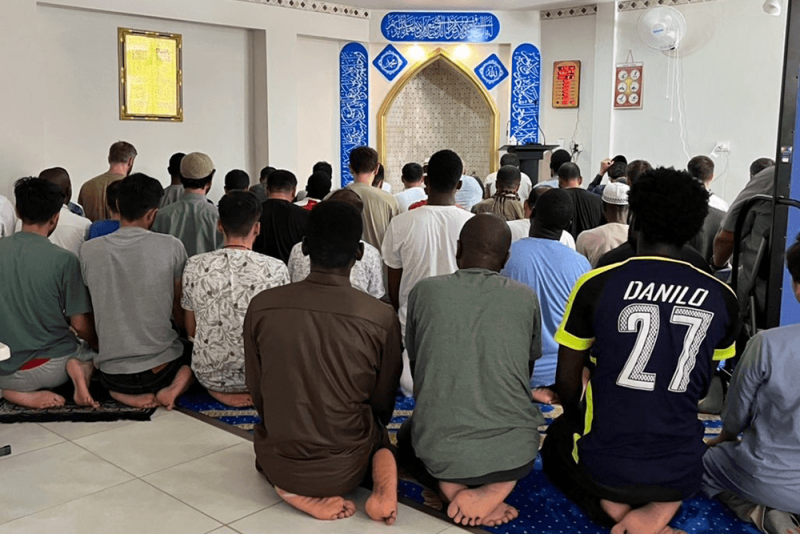
According to Medina and other experts, most Mexican converts to Islam are women. Among them are sizable numbers of female Muslim immigrants from places such as Egypt, Morocco, Syria, Pakistan, Ghana, and Turkey who have made Mexico home. “Some hope to reach the United States and are concentrated along the northern border,” Medina said. “Others concentrate in places like Mexico City, Guadalajara, or Monterrey.”
It is difficult, if not impossible, to generalize these women’s motivations, plans, or situations, Medina said. As is true of those staying at Albergue Assabil, “There is not a single story,” she said. “Each one carries a narrative.”
Because these women face a variety of challenges — such as wearing the veil in a cultural context where Islam is not a prominent reference point or searching for a sense of freedom and security in the face of domestic violence and harassment — Medina said they find in each other a sense of solidarity. “They are in search of a better life,” she said. As Europe, the United Kingdom, and even the U.S. are experienced as less welcoming, Medina said, “Latin America is now seen as a place of possible openness.”
Empowered to help others
Whether local converts or newcomers from elsewhere, Muslim women have carved out their own spaces in Mexico, including the Albergue Assabil shelter and the Nur Ashki Jerrahi Sufi order in Mexico City, which is headed by a woman — Shaykha Amina Teslima.
García often reminds donors, partners, volunteers, journalists, and authorities that Albergue Assabil is a shelter run by women. And not just any women, but Muslim women.
That, she said, makes a difference.
“We found that Islam gives women rights; it gave us empowerment,” she said of her and the other women running the show at Albergue Assabil. “I could do whatever I wanted to do — more than what I could do with my own culture or my own religion before,” she said. “Islam says that women can go study; men cannot tell you no. Men know this. My husband knows he doesn’t own me. He is my support.”
Indeed, her husband, Abu Hamza, is supportive of García’s work. He is often seen around the shelter too, pulling up on a motorcycle with García, bringing in donations, making phone calls, and generally doing whatever needs to be done. When asked about the shelter, he insistently points to his wife. “She knows better than me,” he said.
García said part of the shelter’s work is passing their own empowerment on to women who arrive at their gates. “In the shelter, when women come, we give them tools to be able to continue their education: English, Spanish, computers, cooking,” she said. “We want to give them the basics so that they are not reliant on men. In the time they stay in the shelter, we teach them as much as we can so that they can live for themselves.”
Increasingly, said Gely, that means more and more women are finding their way to Albergue Assabil — Muslim and non-Muslim. “Just yesterday, three ladies from Russia came here looking for shelter,” Gely said. “They’re not Muslim, no. But they hear how nice it is and want to come. Of course we take them in.”
One of them is Amie. Amie has struggled getting an appointment through the U.S. Customs and Border Protection app CBP One. She has spent three months in Mexico so far, arriving at Albergue Assabil six weeks after bouncing from shelter to shelter in Tijuana. Sojourners is withholding Amie’s last name, at her request, to protect her immigration status.
“They’ve been so kind to me,” she said, “out on the street, in other shelters, I feared for my life, worried I would be tortured, abused, or killed. This shelter is the only place I feel I could survive.”
As we talk, two more young Russian women walk through the front doors. They too are looking for shelter. Amie tells them to take a seat. Gely or García will be here soon, she says.
“They’ll take care of you,” Amie said. “They always do.”
https://sojo.net/articles/news/border-shelter-and-muslim-women
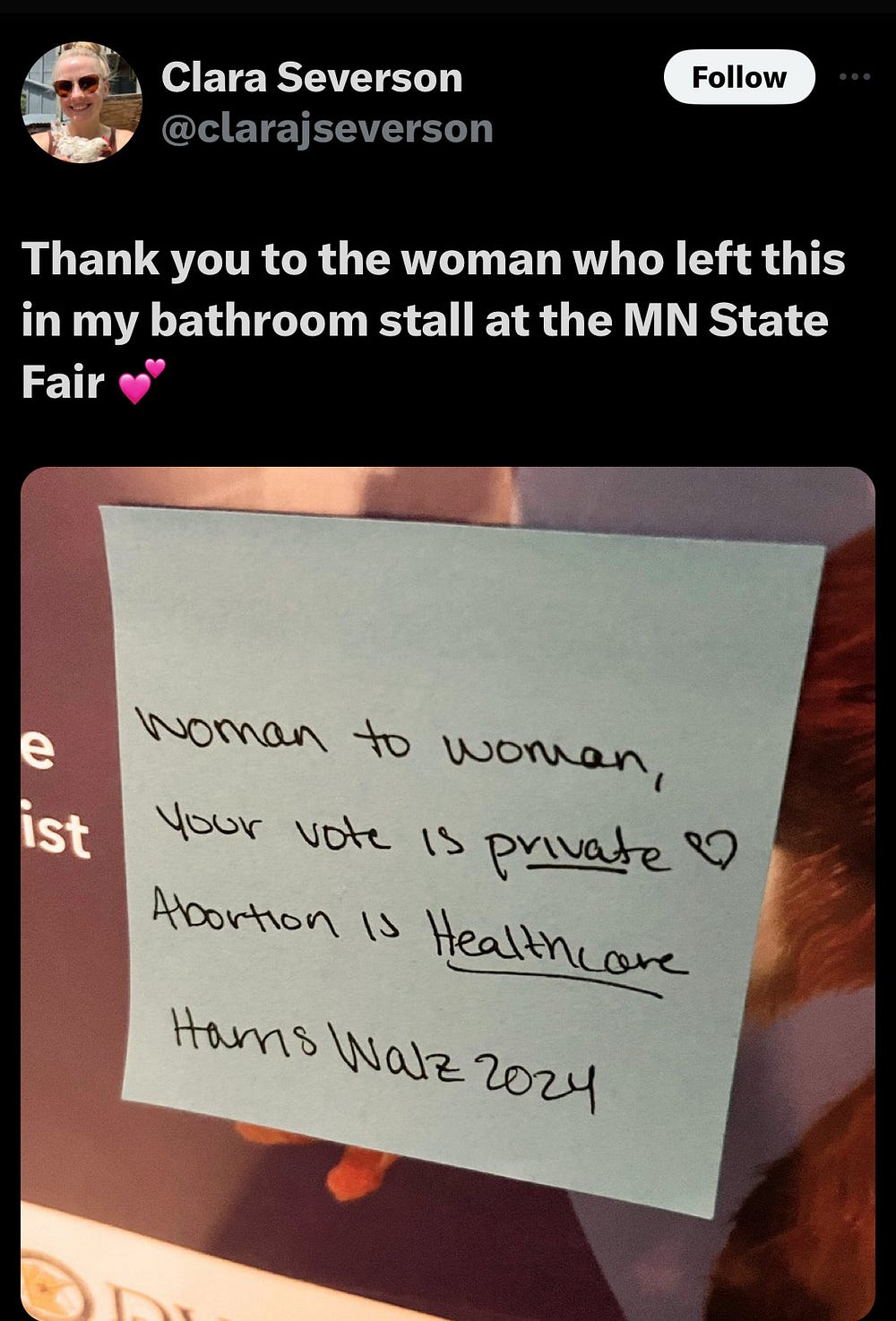
Women are using Post-it notes in public bathrooms to remind other women that their vote is private. This is easy, cheap, and effective.
This is cool!
Women are using Post-it notes in public bathrooms to remind other women that their vote is private. This is easy, cheap, and effective.
– Jess Piper Read on Substack
The View from Rural Missouri by Jess Piper
Women are using Post-it notes in public bathrooms to remind other women that their vote is private. This is easy, cheap, and effective.
Kansas women rally adjacent to J.D. Vance fundraiser, with vulnerable plea for reproductive rights
By: Grace Hills – August 24, 2024 8:28 am
First some content warning; the article has a warning that it references rape. The article is below, but I’ll leave some space here; the first mention is in the first sentence beneath their warning. The article will be beneath the Xs; I can’t get formatting to leave space. Also, Sen. Marshall lies like a Trump.

Amber Dickinson speaks on reproductive rights at the “Kansas Women for Harris” rally Aug. 22, 2024, in Leawood. (Grace Hills/Kansas Reflector)
xxxxxxxxxxxxxxxxxxxxxxxxxxxxxxxxxxxxxxxxxxxxxxxxxxxxxxxxxxxxxxxxxxxxxxxxxxxxxxxxxxxxxxxxxxxxxxxxxxxxxxxxxxxxxxxxxxxxxxxxxxxxxxxxxxxxxxxxxxxxxxxxxxxxxxxxxxxxxxxxxxxxxxxxxxxxxxxxxxxxxxxxxxxxxxxxxxxxxxxxxxxxxxxxxxxxxxxxxxxxxxxxxxxxxxxxxxxxxxxxxxxxxxxxxxxxxxxxxxxxxxxxxxxxxxxxxxxxxxxxxxxxxxxxxxxxxxxxxxxxxxxxxxxxxxxxxxxxxxxxxxxxxxxxxxxxxxxxxxxxxxxxxxxxxxxxxxxxxxxxxxxxxxxxxxxxxxxxxxxxxxxxxxxxxxxxxxxxxxxxxxxxxxxxxxxxxxxxxxxxxxxxxxxxxxxxxxxxxxxxxxxxxxxxxxxxxxxxxxxxxxxxxxxxxxxxxxxxxxxxxxxxxxxxxxxxxxxxxxxxxxxxxxxxxxxxxxxxxxxxxxxxxxxxxxxxxxxxxxxxxxxxxxxxxxxxxxxxxxxxxxxxxxxxxxxxxxxxxxxxxxxxxxxxxxxxxxxxxxxxxxxxxxxxxxxxxxxxxxxxxxxxxxxxxxxxxxxxxxxxxxxxxxxxxxxxxxxxxxxxxxxxxxxxxxxxxxxxxxxxxxxxxxxxxxxxxxxxxxxxxxxxxxxxxxxxxxxxxxxxxxxxxxxxxxxxxxxxxxxxxxxxxxxxxxxxxxxxxxxxxxxxxxxxxxxxxxxxxxxxxxxxxxxxxxxxxxxxxxxxxxxxxxxxxxxxxxxxxxxxxxxxxxxxxxxxxxxxxxxxxxxxxxxxxxxxxxxxxxxxxxxxxxxxxxxxxxxxxxxxxxxxxxxxxxxxxxxxxxxxxxxxxxxxxxxxxxxxxxxxxxxxxxxxxxxxxxxxxxxxxxxxxxxxxxxxxxxxxxxx
Trigger warning: This story references rape.
LEAWOOD — Amber Dickinson took a personal and vulnerable stand for reproductive freedom as she talked publicly for the first time about being raped.
Before her speech Thursday in Leawood at a rally of “Kansas Women for Kamala Harris,” only a handful of people knew she is a survivor. Through tears, she explained that she was worried she would stand in front of strangers and cry, when she was supposed to be strong.
“But whose definition of strong are we obligated to adhere to? It is time that women create their own definition of strength,” Dickinson said. “Because strength is not sexually abusing women like Donald Trump. Strength is not belittling women like J.D. Vance.”
Dickinson, a political science professor at Washburn University who has written opinion columns for Kansas Reflector, joined speakers who highlighted the ways Harris’ and former President Donald Trump’s policies affect Kansans. The rally was a counter-protest to Vance’s nearby fundraiser, where Republicans claimed he raised $1.5 million.
Dickinson spoke on reproductive rights, highlighting experiences of women in Oklahoma, a neighboring state with a total abortion ban. She spoke of a fetus found in an Oklahoma college residence hall bathroom. She said this is what the future looks like “if you allow wicked men like J.D. Vance and Donald Trump get what they want from us.”
After Dickinson spoke on reproductive rights, other women spoke on gun safety and funding in public schools.
Kristen Blackton, a former middle school teacher and part of Moms Demand Action for Gun Sense in America, said she witnessed the rise of mass shootings in schools, resulting in her students asking her: “Can you protect us?”
“In our state, in Kansas, the rate of gun deaths has increased 48% from 2013 to 2022 and gun violence also disproportionately affects communities of color, with Black people in Kansas being over two times more likely to die by guns than white people in Kansas,” Blackton said. “This is not normal.”

She talked about legislation introduced by Rep. Linda Featherston, D-Overland Park, that would make safe storage of firearms a requirement. Blackton and other Moms from the group pushed for the bill, which failed to advance.
“Do you know why? We currently have a Republican supermajority in Topeka,” Blackton said. “This means that Republican lawmakers often act like they have no need to listen to their constituents and work across the aisle to improve the lives of Kansans.”
Rep. Mari-Lynn Poskin, D-Leawood, spoke about Moms for Liberty, a group that is known for challenging books in public schools.
Poskin praised Ruby Bridges, the first Black child to attend formerly a whites-only school after Brown v. Board, as a Civil Rights icon. Poskin said she donated copies of “Ruby Bridges’ Walk to School,” a children’s book written by Bridges, to local elementary schools.
“Moms for Liberty attempted to ban this sweet book from the second and third grade curriculums in the state of Tennessee,” Poskin said. “And if you don’t think it’s coming here, you’re wrong.”
Ten miles away from the Democratic women rally, at Indian Hills Country Club in Mission Hills, Republican vice presidential nominee J.D. Vance dined with donors who paid $5,000 to $50,000 to attend. Former U.S Secretary of State Mike Pompeo, Kansas U.S. Sen. Roger Marshall and Oklahoma U.S. Senator Markwayne Mullin also were part of the fundraiser.
Mike Brown, chairman for the Kansas Republican Party, called the dinner a “huge success” in the party’s weekly newsletter Friday. Brown said more than 300 people attended, and raised $1.5 million.
On Tuesday, Marshall told KWCH, a radio station in Wichita, that he has heard from Kansans whose top concerns are inflation, border security, and government overregulation.
The Road to Splitsville AND THE AWARD FOR OUTSTANDING ACHIEVEMENT IN TRASHING ICONIC BUILDINGS GOES TO…
Written in Wonkette style. Must be read! It’s not long. It’s jaw-droppingly appalling. Not the article, the subject of it.
by Rebecca Schoenkopf Read on Substack
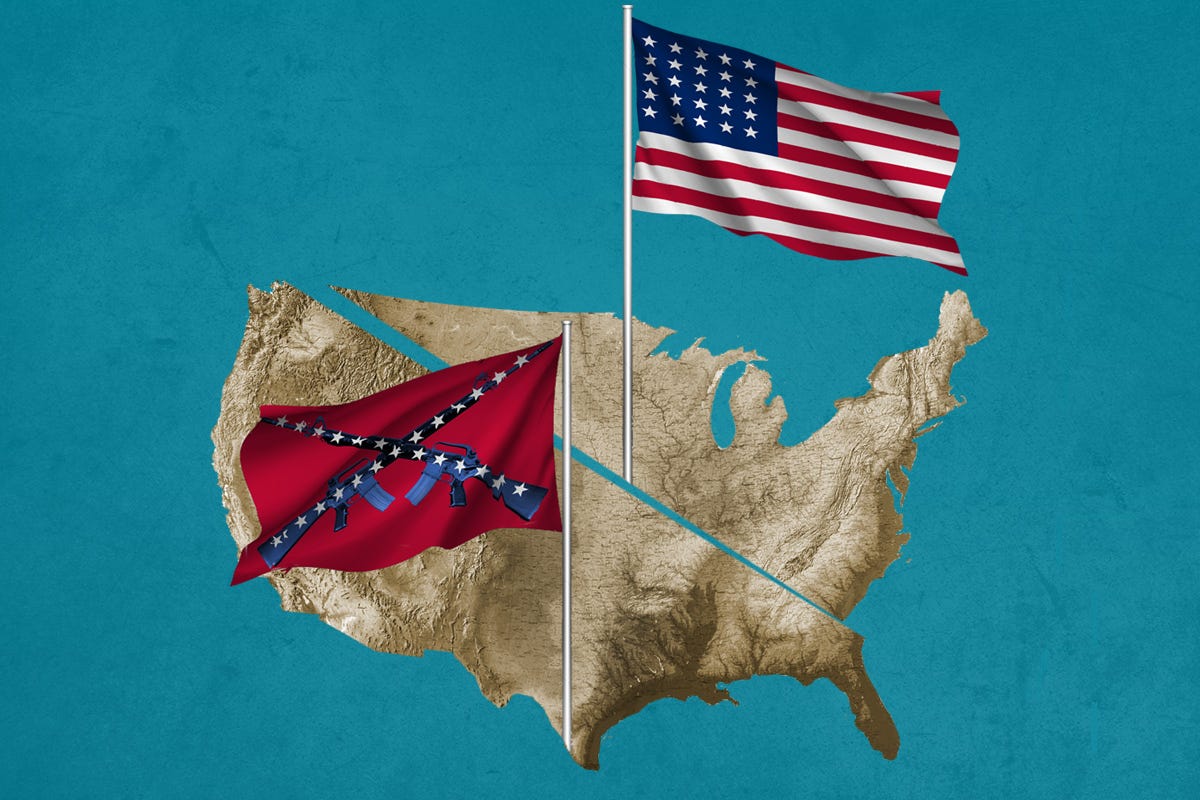
How do we know we’re on the Road to Splitsville (and possibly headed to a political and legal separation of the red states and the blue), and not on some other thoroughfare, like the Highway to Hell or the Boulevard of Broken Dreams? We know, because such a Split would be absurd and grotesque. But the red states are Republican states, and the Republican Party is the Donald Trump Party, and the fans of Donald Trump love the absurd and eat the grotesque with a fucking spoon.
Speaking of which: what are you doing on September 5?
If you’ve got some time, and $2,500 (per individual) to spare, you could join Christ-knows-how-many dipshits, ghouls, imbeciles, and traitors at—we kid you not—the “J6 Awards Gala,” to be held at Donald Trump’s golf club-cum-Ex Sematary in Bedminster, N.J. Go alone, with your significant other, or rope together eleven of your chums and snag a table for 12. Yes, 12 x $2,500 = $30,000 but, because this a Donald Trump-related production, the actual cost of a table for 12 is a cool $50,000. But think of th—
What? You have a question? (snip-a bit more, well worth the click. You can read if you’re not a subscriber.)
Peace & Justice History for 8/30
| August 30, 1963 A “hotline” telephone link was installed between the Kremlin in Moscow and the White House in Washington, D.C. The intention was to allow direct communication in the event of a crisis between the U.S. president and the leader of the Soviet Union (U.S.S.R.). It had been agreed to following the Cuban Missile Crisis. |
| August 30, 1964 The Democratic Party National Convention refused to seat any delegates from the Mississippi Freedom Democratic Party (MFDP). The Credentials Committee chose to seat the all-white delegation from Mississippi’s regular Democratic Party despite overwhelming evidence of the state party’s efforts to disenfranchise Mississippi’s Negro citizens. A proposed compromise of two non-voting guest delegates from MFDP was rejected by its leaders. The dispute, the political intrigue, and the long-term effects |
| August 30, 1967 The Senate confirmed the appointment of Thurgood Marshall as the first Supreme Court Justice of African-American descent. Marshall had been counsel to the NAACP Legal Defense Fund, and had been the lead attorney in the Brown v. Board of Education case. He was appointed to the Court by President Lyndon Johnson after having served as Solicitor General of the U.S. for two years, and on the U.S. Court of Appeals for four.  Thurgood Marshall Thurgood MarshallWho was Thurgood Marshall? |
| August 30, 1971 Ten empty school busses were dynamited in Pontiac, Michigan, eight days before a school integration plan was to begin. Following Federal Judge Damon Keith’s finding that Pontiac’s school board had “intentionally” perpetuated segregation, a plan was developed by the board that included bussing of 8700 children.  The bombers were later identified as leaders and members of the Ku Klux Klan, arrested, tried, convicted and imprisoned. |
| August 30, 1980 Striking Polish workers, their numbers approaching 150,000, won a sweeping victory in a battle with the Polish Communist government for the right to independent trade unions and the right to strike. Their lead negotiator was Lech Walesa, head of the union, Solidarnos´c´ (Solidarity).  Lech Walesa announces the deal to cheering crowds of shipyard workers. |
| August 30, 1999 Residents of East Timor voted for independence from Indonesia in a U.N.-sponsored election. More about the East Timor election |
https://www.peacebuttons.info/E-News/peacehistoryaugust.htm#august30
Four Things I Hope You’ll Share With Friends & Family
Pretty neat. by Charlotte Clymer Read on Substack
A few months ago, Substack generously invited thirty or so of their writers to NYC for the opportunity to create some ads for our blogs. I really didn’t know what to expect, but the experience itself with Cash Studios (cashstudios.co) was delightful.
For about an hour, I worked with the staff in their studio on various ideas they had, all of which I found interesting. Moreover, I was quite impressed with their creativity and professionalism. They were kind, curious about my work, and really wanted to bring out my authenticity.
A few days ago, the ads were sent out to all of us, and I was quite blown away by the care and thoughtfulness put into creating them. I feel that Cash Studios did an exceptional job in capturing what I try to do with Charlotte’s Web Thoughts, and I’m thankful to the folks at Substack for this level of investment in my work.
They cut four ads, and I want to share them with all my subscribers, with a humble request: if you have friends, family, colleagues, or whomever you think might connect with my writing, send them one of these ads. Tell them that it’s free to subscribe to the blog, that all they need is an email, and that I don’t spam.
Here are the ads! Enjoy:
One More Time (from someone who’s not hysterical me)
Reblog from MPS
An important story linked here, and another important blog entry linked in the comments. Well worth the clicks, not TL;DR.

