Transgender Adults Being Cut From Care After Florida Court Ruling by Erin Reed

by Erin Reed

After a court ruling from the 11th Circuit Court of Appeals allowed an anti-trans law in Florida targeting youth and adults go back into effect, many providers were forced to end care. Read on Substack

*With thanks to Janet.*

Several transgender youth and adults are being told their care will be terminated following a ruling from the 11th Circuit Court of Appeals by a majority-Trump appointed panel. The court ruled that a 2023 law, which restricts transgender care at any age, can go back into effect after being permanently blocked in June 2024.

The ruling, released late Monday, stated that transgender people are not a “quasi-suspect class,” meaning they do not receive the same level of equal protection under the Constitution as other categories such as race, ethnicity, religion, or sex. This decision implies that laws discriminating against transgender people are likely to be considered valid and constitutional by the 11th Circuit Court.

One such law, SB254, was passed in 2023. The law banned gender-affirming care for transgender youth but went further than similar legislation passed in several Republican-led states that year by also restricting care for transgender adults. The bill mandated that care for transgender adults could only be provided by physicians and required that patients receive forms outlining the “risks” of gender transition. Many proposed versions of these forms are filled with disinformation about transgender care.

The physician requirement has proven especially burdensome for transgender adults, as the majority of their care is provided by nurse practitioners. This is because the number of transgender adults far exceeds the capacity of physicians who offer gender-affirming care. Planned Parenthood, the largest hormone therapy provider in the United States, explains, “Most gender-affirming hormone care is provided at PPSP by advanced practice providers (physician assistants, certified nurse midwives, and nurse practitioners) in our health centers or over telemedicine.”

Now, with the law fully in effect, transgender adults who previously had access to care are being notified that their care will no longer be provided.

One anonymous patient shared an email from their provider, QueerMed, which stated, “Unfortunately, Florida has reinstated the ban on care for minors and the restrictions for adults… We can no longer see any patient of any age who is located in Florida.”

See that email here:
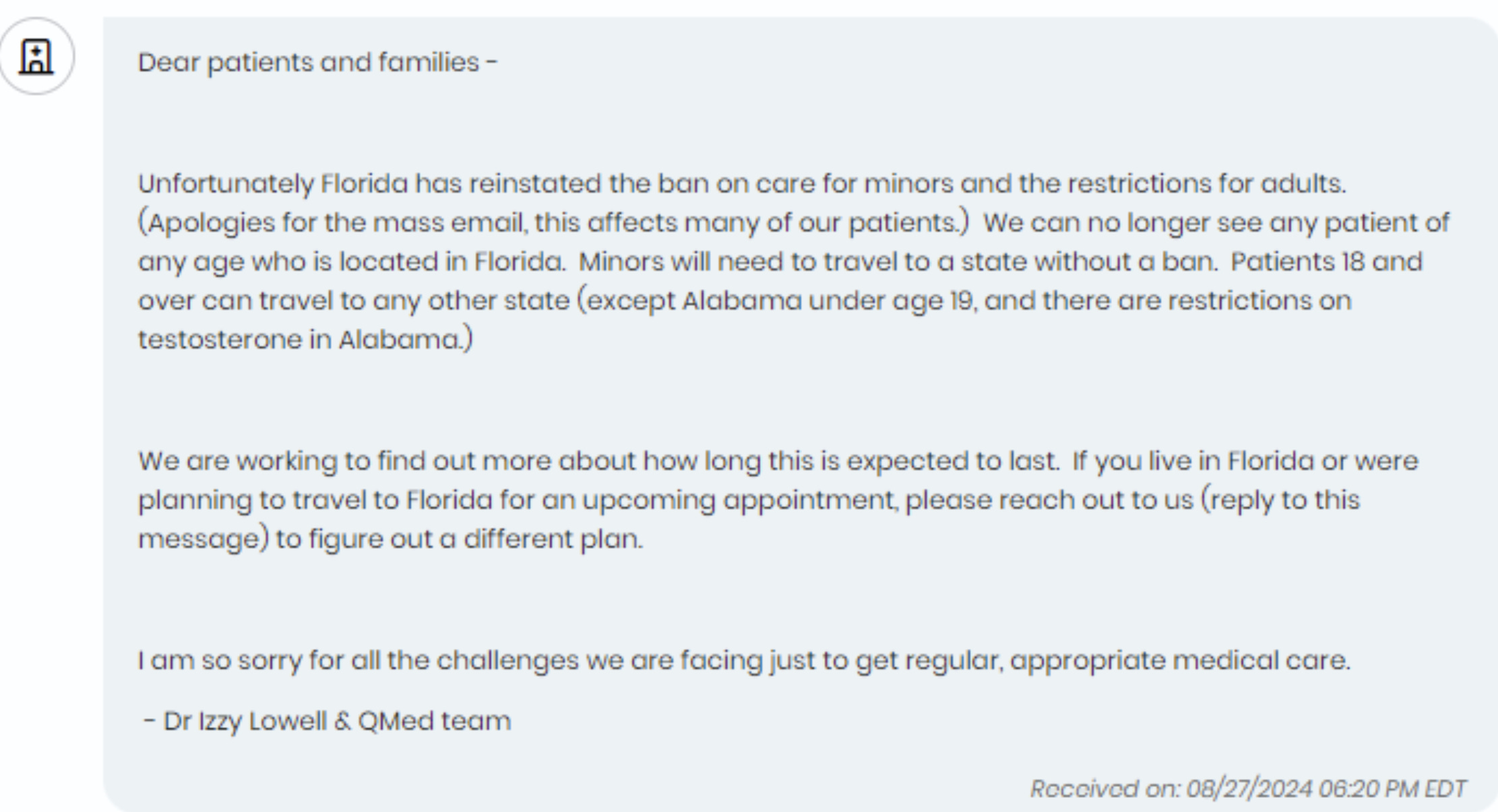
Email provided from a QueerMed Patient

Spektrum, a major provider in Florida, was also forced to terminate care and cancel new patient appointments. However, during the period when the law was blocked, the organization reportedly took steps to ensure patients were well-supplied with medication in case the law went back into effect:

“During this little freedom period as I call it … we made good use of that time to make sure all of our patients were well supplied with medication. Although I had hoped that it wouldn’t have been necessary, at least now we can say, I’m glad we did all the things that we did,” said Joseph Knoll, a nurse practitioner at the clinic, as reported by the Associated Press.

Healthcare bans are currently a contentious issue in courts across the United States, with some courts blocking bans on transgender healthcare coverage or provision. A major point of contention is whether discrimination against transgender people qualifies as sex discrimination, which would subject these laws to higher scrutiny regarding their constitutionality.

The Supreme Court is poised to rule on such questions later this year in a case stemming from Tennessee’s trans care ban. If the Supreme Court were to rule that transgender people are not entitled to equal protection under the law, many forms of discrimination against transgender youth and adults could be deemed fully legal.

For trans people in Florida, many cannot afford to wait for such a decision, and many have already fled the state. For those unable to leave, disruptions to their care will likely have significant impacts on their mental and physical health.

“We are deeply disappointed by this decision and the panel’s disregard for the district court’s careful findings and adherence to the Eleventh Circuit’s recent precedent. Allowing these discriminatory restrictions to go back into effect will deny transgender adults and adolescents lifesaving care, and prevent Florida parents from making medical decisions that are right for their children. As the district court found based on voluminous evidence, the record shows that these extraordinary restrictions were based on disapproval of transgender people and serve no purpose other than to harm transgender Floridians. The plaintiffs in this case are considering their options and will take every step possible to protect their right to equal treatment under Florida’s laws, which these restrictions egregiously violate. We will continue fighting for transgender Floridians and their families, and for everyone’s right to make healthcare decisions without government interference,” said the organizations representing the plaintiffs in the case.

Peace & Justice History for 8/29

August 29, 1758
The first Indian reservation, Brotherton, was established in New Jersey. A tract of three thousand acres of land was purchased at Edge Pillock, in Burlington County. The treaty of 1758 required the Delaware Tribes, in exchange for the land, to renounce all further claim to lands anywhere else in New Jersey, except for the right to fish in all the rivers and bays north of the Raritan River, and to hunt on unenclosed land. History Of The Brotherton Reservation 
August 29, 1949
The Soviet Union detonated its first atomic bomb in a test at Semipalatinsk in eastern Kazakhstan. It was known as Joe 1 after Josef Stalin, then General Secretary of the Communist Party.
” Joe 1, the first Soviet atomic bomb
Andrei Dmitrievich Sakharov, key developer of the Soviet bomb, later worked for peace

August 29, 1957
Following consultations among the NATO allies and other nations, the Western (non-Communist) countries presented to the United Nations a working paper entitled, “Proposals for Partial Measures of Disarmament,” intended as “a practical, workable plan to start on world disarmament.” The plan proposed stopping all nuclear testing, halting production of nuclear weapons materials, starting a reduction in nuclear weapons stockpiles, reducing the danger of surprise attack through warning systems, and beginning reductions in armed forces and armaments.
August 29, 1957
African Americans in Milledgeville, Georgia, wait in line to vote following the Civil Rights Act of 1957.
The U.S. Congress passed the Civil Rights Act, the first such law since reconstruction. The bill established a Civil Rights Commission which was given the authority to investigate discriminatory conditions. A Civil Rights Division was created in the Department of Justice, allowing federal prosecutors to obtain court injunctions against interference with the right to vote, among other things.In an ultimately futile attempt to block passage, then-Democrat, former Dixiecrat, and later Republican Senator Strom Thurmond of South Carolina set the all-time filibuster record: 24 hours, 19 minutes of non-stop speaking on the floor of the Senate.
A filibuster is the deliberate use of prolonged debate and procedural delaying tactics to block action supported by a majority of members. It can only be stopped with a 60% majority voting to end debate.
Senator Strom Thurmond with his 24-hour filibustering speech
August 29, 1961
Robert Moses, leader of SNCC
The Student Nonviolent Coordinating Committee (SNCC) was pursuing its voter registration drive in Amite County, Mississippi. Of 5000 eligible Negro voters in the county, just one was registered to vote. SNCC leader Robert Moses was attacked and beaten this day outside the registrar’s office while trying to sign up two voters. Nine stitches were required but the three white assailants were acquitted.
Hear Moses recall the time 
August 29, 1970
Between 15 and 30 thousand predominantly Chicanos (Americans of Mexican descent) gathered in East LA’s Laguna Park as the culmination of the Chicano National Moratorium. It was organized by Rosalio Munoz and others to protest the disproportionate number of deaths of Chicano soldiers in Vietnam (more than double their numbers in the population).

There had been more than 20 other such demonstrations in Latino communities across the southwest in recent months.
Three died when the anti-war march turned violent. The Los Angeles Police Department attacked and one gunshot, fired into the Silver Dollar Bar, killed Ruben Salazar, a Los Angeles Times columnist and a commentator on KMEX-TV (he had been accused by the LAPD of inciting the Chicano community).
The Chicano Moratorium 
Ruben Salazar LA Times 

https://www.peacebuttons.info/E-News/peacehistoryaugust.htm#august29

US President for 4 years, yet has no clue about anything presidential. None at all.

In Praise of the Hardest Job in Arlington National Cemetery by Charlotte Clymer

It’s not what you think. Read on Substack

We practiced with caskets that were stored outside our barracks building. To simulate the weight of honored remains, we’d toss several full sandbags into the belly of the casket, and then, for hours and hours, we’d go through our exact movements.

Over and over and over and over.

Those were hot and humid D.C. summers, and it didn’t matter. Drink water. And then back at it. We’d march up crisply, pick up the casket, go through the entire funeral protocol—with an earned coordination that would rival any synchronized swimming team—and then do it again.

The first summer I was in the 3rd U.S. Infantry Regiment (The Old Guard), the A/C stopped working in our barracks. Think of the most depressing college dorm you’ve ever seen and remove air conditioning. We’d wake up in sweat in the middle of the night and open the fridge and stick in our face for a little relief.

We’d run through flag-folding drills at night in those hot barracks. We’d stand in the hallway in our casket teams, and we’d fold and fold and fold until we could do it in our sleep. Whatever you’ve seen in movies doesn’t come close. It is an exacting choreography. No movement wasted or erred.

Does the flag look perfect in presentation? Are the red and white stripes hidden? Are the stars symmetric? Is the cloth tight in the final form? No? Why the hell not? You’d give this to a mourning relative? Do it again. We will be here all goddamn night until you get this right.

Your exhaustion doesn’t matter. Better get some sleep. No excuses. I arrived at the unit as a 19 year-old Army private, not even being close to knowing that I didn’t know what I didn’t know. You sure as hell better learn and quick. Figure it out. Get yourself right. Pray if you’re the praying type.

Because families are flying in from all across the country for what will be one of the absolute worst days of their lives, shattered, maybe beyond repair, and all we can meagerly offer them is choreographed dignity in place of irreparable loss. It will never be close to enough. Perfection is never enough.

We’d spend so much time on our uniforms. There were presses in the basement. You think your barracks room is hot? Go downstairs and be hugged by steam. Learn how to use the press. Get those creases sharp. Eradicate all wrinkles. Ignore the sweat dripping into your eyes.

We carried micrometers with us to ceremonial details to ensure our uniforms were right — down to the centimeter. We’d shine every metallic surface on our bodies. What are fingerprints? We don’t know. We’d coat the soles of our shoes with edge dressing to turn them from grey to black.

I can’t believe I’m saying this now, but learning rifle manual and element marching was taking a break from everything else. Tedious as all hell. We wore steel plates on our shoes to click as we marched. They’d bang into our ankles at times, and you’d try not to swear. That was our break.

It was constant stress, all day, every day, and yet, we had it easy. If you want hard, go volunteer for the Tomb Guards. Go ahead and throw yourself into the actual deep end and find out if you can swim. Just raise your hand when they ask for volunteers.

Go to the Tomb, and work 18-hour days for months and months. You will learn everything there is to know about Arlington. You will memorize pages and pages of information. You will recite it all from memory, or you will fail. You will barely get sleep. You will have no life. There is only the Tomb.

I knew, deep down, I wasn’t ready for that. I respected it too much to raise my hand. I didn’t volunteer. My roommate volunteered. It was a curious decision on his part given that he struggled more than any other private. He definitely wasn’t ready, but God bless him for stepping up.

It takes nine months to earn the Tomb Badge, which, at the time, in terms of rarity within the U.S. military, was second only to the Astronaut Badge. Only 500 military personnel have earned the Astronaut Badge. Only 864 have earned the Tomb Badge. Walk in space or walk in front of the Tomb. That’s rarity.

My roommate was back with us in three months. He didn’t make the cut. Sink or swim at the Tomb. There is one standard: it is perfection and that’s all there is to it. He came back to us and had the sharpest, most squared away uniform in our entire company until the day he got out.

But the truth is that the Tomb Guards had it easy, too. We all had it easy. Because the hardest job in Arlington National Cemetery doesn’t involve wearing a uniform. The hardest job is being a cemetery official who is given the impossible task of bringing comfort to families.

I arrived at the unit in April of 2006. In January of 2007, Pres. Bush announced a dramatic increase in troop deployments to Iraq, now known as the Surge.

For three consecutive months that year—April, May, and June—there were over 100 U.S. military fatalities in Iraq — the deadliest year for U.S. service members in the Global War on Terror.

They came back in transfer cases on a C-130 at Dover Air Force Base, and I honestly don’t know how many of them wound up buried in Arlington. But I know there were a lot. I know we were pretty busy. All day carrying caskets or leading the caisson horses or marching behind them.

That’s not including the many fatalities in Afghanistan. That’s not including the old veterans who had passed and long ago earned the right to be buried there or their family members who qualified for burials, too. Funerals, funerals, and more funerals. That sums up 2007 for The Old Guard.

Who leads on caring for the families on one of the worst days of their lives? Who plays the painful combination of clergy and therapist to the aggrieved? Who does whatever they can for the ceremonial units? Who enforces respect for that hallowed ground?

Cemetery officials.

Day after day, month after month, year after year, it’s the cemetery officials, the civilians, some of them veterans, who undertake the ludicrously impossible task of cobbling together comfort and dignity for families who have had their hearts ripped out and stomped on by tragedy.

I can’t imagine doing what they do. If I were forced to make a choice between the public service they carry out for grieving families OR putting on a uniform to join a marching element, I’m going back to the steam room. At least in that procession, there’s an available freedom to be numb.

On Monday, according to reporting by NPR’s Quil Lawrence and Tom Bowman, a cemetery official was allegedly assaulted and harassed by members of Donald Trump’s presidential campaign because the official was enforcing a common sense regulation restricting filming or taking photographs.

Cemetery officials had issued clear guidance that only Arlington personnel are permitted to take video or photos in Section 60, the final resting place for those service members who were killed in Iraq or Afghanistan. Trump campaign staffers thought it didn’t apply to them. They were wrong.

Moreover, Arlington National Cemetery released a public statement confirming a report had been filed over the incident and included this bit:

“Federal law prohibits political campaign or election-related activities within Army National Military Cemeteries, to include photographers, content creators or any other persons attending for purposes, or in direct support, of a partisan political candidate’s campaign. Arlington National Cemetery reinforced and widely shared this law and its prohibitions with all participants.”

What were Trump’s campaign staffers attempting to do that was so flagrantly in violation of this law that a cemetery official, in the midst of all their other necessary responsibilities, felt it necessary to step in and put a stop to it?

This comes almost two weeks after Trump, during remarks at a campaign stop, called the Presidential Medal of Freedom “better” than the Medal of Honor, a moment so completely and weirdly disrespectful that the VFW National Commander issued a statement condemning him.

This comes almost four years, nearly to the day, after reporting by The Atlantic that Trump had called American war dead “losers” and “suckers,” which was corroborated by several other news organizations, a senior official in the Defense Department, and a senior Marine Corps officer.

This comes more than eight years after Trump attacked and insulted the parents of U.S. Army Captain Humayun Khan, who was killed in a roadside bomb in Iraq in 2004, drawing widespread condemnation from leaders in his own party.

This comes more than nine years after Trump slandered the military service of the late Sen. John McCain, who spent five-and-a-half years in captivity as a prisoner of war, being tortured, refusing to sell-out his fellow service members.

As you’ll probably recall, Trump stated: “He’s not a war hero. He was a war hero because he was captured. I like people who weren’t captured.”

I fully admit to being a partisan, but for me, none of this is about politics because none of the Republicans or conservatives I have ever known would so much as consider showing anything but respect and admiration for our service members, our veterans, and their families.

This is not about favor for any party or campaign because the moment you enter Arlington, politics are to be left at the gate. It’s not about you or me or anyone other than those buried in that ground and their loved ones who will never see them again because of their collective sacrifices.

But Donald Trump is unwilling or unable to understand that because he cannot conceive of offering the highest degree of selfless service to our nation. The concept of “all gave some, some gave all” is entirely incomprehensible to him. And therefore, he cannot extend proper respect to our military.

I cannot wait for the time to come when this self-absorbed coward will permanently exit public life into a tarnished and thoroughly mediocre legacy that will haunt him for the rest of his days.

Important news from Janet!

Peace & Justice History 8/28

August 28, 1833
The Abolition of Slavery Act was passed by the British Parliament. As early as 1787, members of the Society of Friends (Quakers), particularly Thomas Clarkson and Granville Sharp, organized to end the slave trade.Since Quakers were barred from serving in the House of Commons, the cause was led by a member of the Evangelical Party, William Wilberforce, ending the international trade in slaves in 1807. By 1827 slaving was considered piracy and punishable by death. The complete ban on slavery itself through the British Empire didn’t happen until this day; Wilberforce was informed of the Act’s passage on his death-bed.

William Wilberforce
August 28, 1963
Reverend Martin Luther King, Jr. delivered his “I Have a Dream” speech from the steps of the Lincoln Memorial to a crowd of half a million gathered on the Mall in Washington, D.C. They gathered there for jobs and freedom.
The speech: https://www.npr.org/2010/01/18/122701268/i-have-a-dream-speech-in-its-entirety

  organizing to build the march
Film of the March and the speech: https://vimeo.com/2158959

1983:
Three hundred thousand marched in Washington on the 20th anniversary of MLK’s “I Have A Dream” speech for the second “March on Washington for Jobs, Peace and Freedom.”

August 28, 1976
60,000 joined the Community of Peace People demonstrations in Belfast and Dublin, Ireland. Peace People was founded by two women, Betty Williams and Mairead Corrigan to decry the painful violence between Catholics and Protestants, between unionists and republicans, and to move the peace process forward in Northern Ireland.
Betty Williams
Mairead Corrigan
They jointly won the Nobel Peace Prize for 1976.
More about Betty Williams and Mairead Corrigan
 
From the Declaration of the Peace People:
“ . . . We want to live and love and build a just and peaceful society.
We want for our children, as we want for ourselves, our lives at home, at work and at play, to be lives of joy and peace.
We recognize that to build such a life demands of all of us, dedication, hard work and courage . . .
We dedicate ourselves to working with our neighbors, near and far, day in and day out, to building that peaceful society in which the tragedies we have known are a bad memory and a continuing warning.”

The Peace People’s website: https://www.peacepeople.com/

https://www.peacebuttons.info/E-News/peacehistoryaugust.htm#august28

Could courthouses provide the blueprint for safe transgender bathrooms?

Originally published by The 19th

Member support made it possible for us to write this seriesDonate to our nonprofit newsroom today to support independent journalism that represents you.

Gunner Scott had a simple solution to making sure he had a trans-friendly bathroom when he served as a juror in Boston: Every day at lunch he left the building. 

The year was 2009 and the Suffolk County Superior Court where Scott served as a juror for five days didn’t have a gender-neutral restroom. So, on his break, Scott walked up the street to his office. 

“I heard one too many stories,” said Scott, who is a longtime transgender advocate. 

The stories were about trans people being assaulted and harassed in bathrooms. Scott was not confident he could pass as male in a men’s room in 2009. More than that, his activism had made him a known public figure in the city. He feared someone would recognize him and target him for being trans and using a men’s restroom. 

But over the years, as states have started to block trans people from using bathrooms and participating in other areas of public life, courtrooms have moved in the opposite direction by trying to make facilities available to people of all genders, experts say. 

That movement is not only key to providing a roadmap for inclusivity for the nation. It also ensures that juries reflect the general population and that everyone gets the opportunity — or burden, in some cases — of serving on them.

Courtrooms may illustrate practical solutions to access as the nation grapples with increasing trans visibility and more traditional ideas about the safety and comfort of a larger public.

The issue of transgender accessibility in courts is a chapter in a longstanding fight for civil rights for LGBTQ+ Americans, prime targets of far-right legislation and discourse these days. The Equality Act, which bars discrimination on the basis of sexual orientation and gender identity, was first introduced to Congress 50 years ago but has never been passed into law. While its first draft only protected gay Americans, subsequent iterations have aimed to shield trans Americans from bias. 

The Equality Act specifically mentions jury selection. The bill bans lawyers from striking queer jurors because they are LGBTQ+. Last year, Sen. Jeanne Shaheen of New Hampshire introduced a standalone bill to the same effect. Reps. Becca Balint of Vermont and Lizzie Fletcher of Texas are sponsoring the measure in the House, where it is unlikely to pass, at least while Republicans are the majority.

Balint told The 19th that courtroom accessibility is key to ensuring that jury pools reflect the makeup of the country.

“We need every American who is eligible to serve on a jury to be in the jury pool,” Balint said. “Conversations change concerning LGBTQ people when LGBTQ people are in the room, and when you exclude people from the judicial process, it makes the system inherently less free and less fair.”

Jury service and the belief that jurors should reflect the nation’s diversity is a closely held American belief today. Historically, though, juries were defined by their exclusivity. For centuries, women were banned or discouraged from jury duty because they were believed to be too fragile to handle criminal trials or deemed “the center of home and family life,” as stated in a 1961 Supreme Court ruling. Fourteen years later, the court ruled in Taylor v. Louisiana that systematically excluding them violated a defendant’s rights to a representative jury. But it wasn’t until 1994 that a decision around the Equal Protection Clause of the 14th Amendment specifically prohibited using gender to strike potential jurors.

Black Americans were barred from service due to slavery and after its abolition, discrimination. Even after the Civil Rights Act of 1875, which prohibited race-based jury selection, many states failed to enforce anti-discrimination protections, leading to lopsided convictions against people of color, a legacy that continues. 

LGBTQ+ advocates have long argued that LGBTQ+ Americans, who face increased rates of hate violence and discrimination, also need federal protections to safeguard their presence in juries. 

In legally recognizing trans people, states have faced increasing pressure to make government facilities accessible to them. In 2015, then-Boston Mayor Marty Walsh made headlines when he signed an executive order requiring gender-neutral bathrooms at City Hall. 

Many courthouses have also installed gender-neutral options or found workarounds that allow trans and nonbinary people to safely use the court, say experts. The difference is that the change has largely gone unnoticed. 

Ezra Young, a constitutional scholar and professor in New York, said he has seen even the most conservative courts put in extra effort to allow trans people bathroom access.

“I think one of the benefits of a judiciary is certain things about the very administration of the buildings aren’t really politicized,” Young said. “It’s under presumption that courts need to be generally accessible to people.”

Quite simply, the judicial system has no choice. 

“Courts have a constitutional responsibility to make sure that courts are generally accessible to the public and specifically to people who need to use the court,” Young added. 

Bathrooms have long been contested public spaces for marginalized groups, and courtrooms have not been immune. That means transgender access is not the first challenge facing court facility managers. 

“Some of them didn’t even have women’s bathrooms until quite recently. Usually when reconstruction for bathrooms is done, they try to make sure things are accessible,” Young said.

Sandra Day O’Connor, the first woman to serve on the Supreme Court, encountered that problem in 1981 when she was sworn in. 

 “[The bathroom] was a long way down the hallway, so it wouldn’t have been convenient,” she told NPR in 2013. “And we had to find something in the way of a restroom that was near the courtroom that I would be able to use when we were back there or in the room where we discussed cases.”

Government buildings have undergone similar upgrades to make bathrooms accessible for people with disabilities since the Americans with Disabilities Act of 1990. Courthouses also reconfigured racially divided bathrooms and courtrooms in the wake of desegregation during the civil rights movement.

Now, all-gender access is the next goal for many municipalities. Nearly half of states (22 plus Washington D.C.) allow residents to opt for “X” gender markers on their state ID cards, and the federal government has been issuing “X” gender markers on passports for two years now. Just three states bar trans people from updating their IDs post-transition.

In Los Angeles County, officials have worked to ensure that every courthouse has a gender-neutral bathroom, according to a spokesperson for the superior court of the county.

“The Court supports inclusivity and seeks to expand access to justice by identifying and addressing barriers — substantive, procedural, physical and in appearance —that may inhibit full participation in the judicial process,” the court said in a statement.

In Cook County, which encompasses Chicago and has one of the world’s largest judicial systems, officials are engaged in research and design plans to add gender-neutral bathrooms to all of its courts. Such facilities already exist at the main courthouses for criminal court, domestic violence, juvenile cases and in the city branch courts. 

Even today, Scott worries about violence and harassment in public restrooms. According to the 2015 U.S. Transgender Survey, 60 percent of trans people avoided using a public bathroom for fear of discrimination. 

While trans people have gained acceptance in many areas of public life, data shows that discrimination remains high or has increased from a decade ago. A more recent survey in 2022 found that 47 percent of trans Americans considered fleeing their states because anti-trans laws, including bathroom bans, had made their communities less safe.

But Young, who is also transgender, hopes that courts today will provide visitors with a different experience than the one Scott had 15 years ago. For the most part, Young has had positive experiences as a trans person in courts. His transgender clients have, too. 

That doesn’t mean that every court is perfect, he adds. Many still won’t have a gender-neutral bathroom, and often visitors will need to ask a judge for access. But Young thinks that most courts will aim to provide safety for trans people.

“They want to make sure that people can be in court,” Young said. That doesn’t necessarily mean that they might agree with the litigant just because of who they are, but they really do care about making sure that litigants and the broader public understand that they’re part of the overarching community.”

Trump charged in superseding indictment in election interference case following SCOTUS ruling

The new indictment adjusts the charges to the Supreme Court’s immunity ruling.

ByAlexander MallinKatherine Faulders, and Peter Charalambous

Special counsel Jack Smith has charged former President Donald Trump in a superseding indictment in his federal election interference case that charges him with the same offenses in the original indictment, but is adjusted to the Supreme Court’s recent presidential immunity ruling.

“The superseding indictment, which was presented to a new grand jury that had not previously heard evidence in this case, reflects the Government’s efforts to respect and implement the Supreme Court’s holdings and remand instructions,” a Justice Department spokesperson said Tuesday.

Trump last August pleaded not guilty to federal charges of undertaking a “criminal scheme” to overturn the results of the 2020 election to remain in power. Last month, in a blockbuster decision, the U.S. Supreme Court ruled that Trump is entitled to immunity from criminal prosecution for official acts undertaken while in office, and sent the case back to the trial court to sort out which charges against him can stand.

In a separate filing Tuesday, the special counsel said he does not oppose waiving Trump’s appearance for an arraignment on the superseding indictment.

While the original indictment laid out five ways Trump allegedly obstructed the function of the federal government — having state election officials change electoral votes, arranging fraudulent slates of electors, using the Department of Justice to conduct “sham” investigations, enlisting the Vice President to obstruct the certification of the election, and exploiting the chaos of the Jan. 6 riot — the new indictment removes mention of his use of the Department of Justice, which was explicitly mentioned in the Supreme Court’s ruling as falling within his official duties.

While the original indictment mentions the Justice Department on over 30 occasions, the new indictment makes no mention of the DOJ.

It also reframes the portion of the original indictment outlining that Trump allegedly knew his claims of election fraud were false. (snip)

In multiple places, Smith’s new indictment adds clarifying language to state when he believes Trump was clearly acting outside of his official duties, saying, for instance, that Trump “had no official responsibilities related to any state’s certification of the election results” and highlighting when Trump was allegedly acting “not as President but in his capacity as a candidate for office.”

The superseding indictment also removes key allegations about Trump’s refusal to act as rioters stormed the Capitol.

The new indictment no longer includes allegations that Trump refused advisers’ requests to send a message calling off rioters and that Trump later refused to withdraw his objections to the certification despite the plea of his White House counsel.

The new indictment is 36 pages, while the original indictment was 45.

It comes just days after Smith, in a filing, urged the Eleventh Circuit Court of Appeals to reverse a federal judge’s surprise dismissal of Trump’s classified documents case, which Smith is also overseeing.

https://abcnews.go.com/Politics/donald-trump-charged-superseding-indictment-federal-election-subversion/story?id=113193224

Reblog from MPS

The Danger of Kash Patel

I’m reading through the Morning Memo from TPM (yeah, it’s 4PM; so what?🌞) and see a bit about an Atlantic article written by Elaina Plott Calabro. It’s a profile of Kash Patel. I’ve used up my Atlantic freebies, but am providing links here, plus a copy-paste of a thread that’s available for free. The link to the thread is just below the one for the Morning Memo, both beneath the copy-paste. Either the event detailed has somehow slipped my mind, or this is yet another example of how the Don’s administration was dangerous to US national security.

=====================

In the course of reporting on Patel, and the threat that he and other loyalists like him would pose to the country in a second Trump term, I struggled to shake what I learned about a series of events that took place on October 30, 2020. I want to share them with you here.

(snip-embedded tweet visible on the page)

On that Friday, according to multiple reported accounts, SEAL Team 6 was awaiting the green light on a rescue mission in West Africa. The admin had recently learned where gunmen were holding an American who had been kidnapped that week from his farm near the Niger/Nigeria border. 

As multiple agencies coordinated on final details for the evening operation, the State Department worked to resolve the last outstanding task: securing airspace permission from Nigerian officials. 

Around noon, Patel called the Pentagon with an update: Secretary of State Mike Pompeo, he said, had gotten the approval. The mission was a go. 

The SEALs were close to landing in Nigeria when DOD discovered that State had not, in fact, secured the clearance, as Patel had claimed. The aircraft were quickly diverted, and flew in circles for the next hour as officials scrambled to alert the Nigerian gov’t to their position. 

With the operation window narrowing, Esper and Pompeo called the Situation Room to put the decision to the president: Either they abort the mission and risk their hostage being killed, or they proceed into foreign airspace and risk their soldiers being shot down. 

But then, suddenly, the deputy secretary of state was on the line, Esper later wrote in his memoir: They’d been cleared, and the rescue operation was ultimately a success. But back in Washington, the celebration was checked by anger. How to make sense of Patel’s bad report? 

Two people familiar with the exchange told me that Tony Tata, the Pentagon official and retired Army general to whom Patel had originally given the green light, confronted Patel in a rage. “You could’ve gotten these guys killed!” he shouted. “What the fuck were you thinking?” 

Patel’s response: “If nobody got hurt, who the fuck cares?” 

Through a spokesperson, Patel denied saying this, or making up the approval story. But three former senior administration officials independently cited the near catastrophe in West Africa as one of their foremost recollections from Patel’s tenure. 

They remain unsettled by Patel’s actions, they told me, in large part because they have no clue what motivated them. If Patel had in fact just invented the story, as Esper’s team concluded, then why? 

Was it because the election was in four days, and Patel was simply that impatient to set in motion a final potential victory for Trump, whatever the risk — was it as darkly cynical as that? Did his lack of experience mean he just had no grasp of the consequences? 

I don’t know the answers to these questions. But three months of reporting later, they’re the questions I can’t stop thinking about it — particularly as Patel, in a second Trump term, could very well assume remarkable power atop America’s national security establishment. 

Anyway, if you’ve made it this far, I hope you’ll read the whole story, from our October issue, here:

The Man Who Will Do Anything for TrumpWhy Kash Patel is exactly the kind of person who would serve in a second Trump administrationhttps://www.theatlantic.com/magazine/archive/2024/10/kash-patel-trump-national-security-council/679566/?gift=PtjScmMpxEiEcpa5Z2F__gB8wOaSeKCNP9BBei0XHi0&utm_source=copy-link&utm_medium=social&utm_campaign=share

• • •

https://morningmemo.talkingpointsmemo.com/p/the-colossal-systemic-failure-in

https://threadreaderapp.com/thread/1828233087819395144.html

Eleanor Roosevelt

I am an admirer of hers, and maybe when I finally grow up, I’ll be as like her as possible. I’ve named my phone after her, just as a reminder. She once said that no one can make us feel inferior without our consent. Many people say/said similar things, but when I first saw she said that, it clicked. I don’t always remember, but mostly I do. We all should. Now, here is Gavin Aung Than’s Zen Pencils for this week. I really appreciate this one, too!

Zen Pencils by Gavin Aung Than for August 26, 2024

Zen Pencils Comic Strip for August 26, 2024

https://www.gocomics.com/zen-pencils/2024/08/26