I love dogs and people. I want living creatures to thrive. I love to cook, and share the food, but ya gotta get in line in front of the dog, and greatest good luck with that!
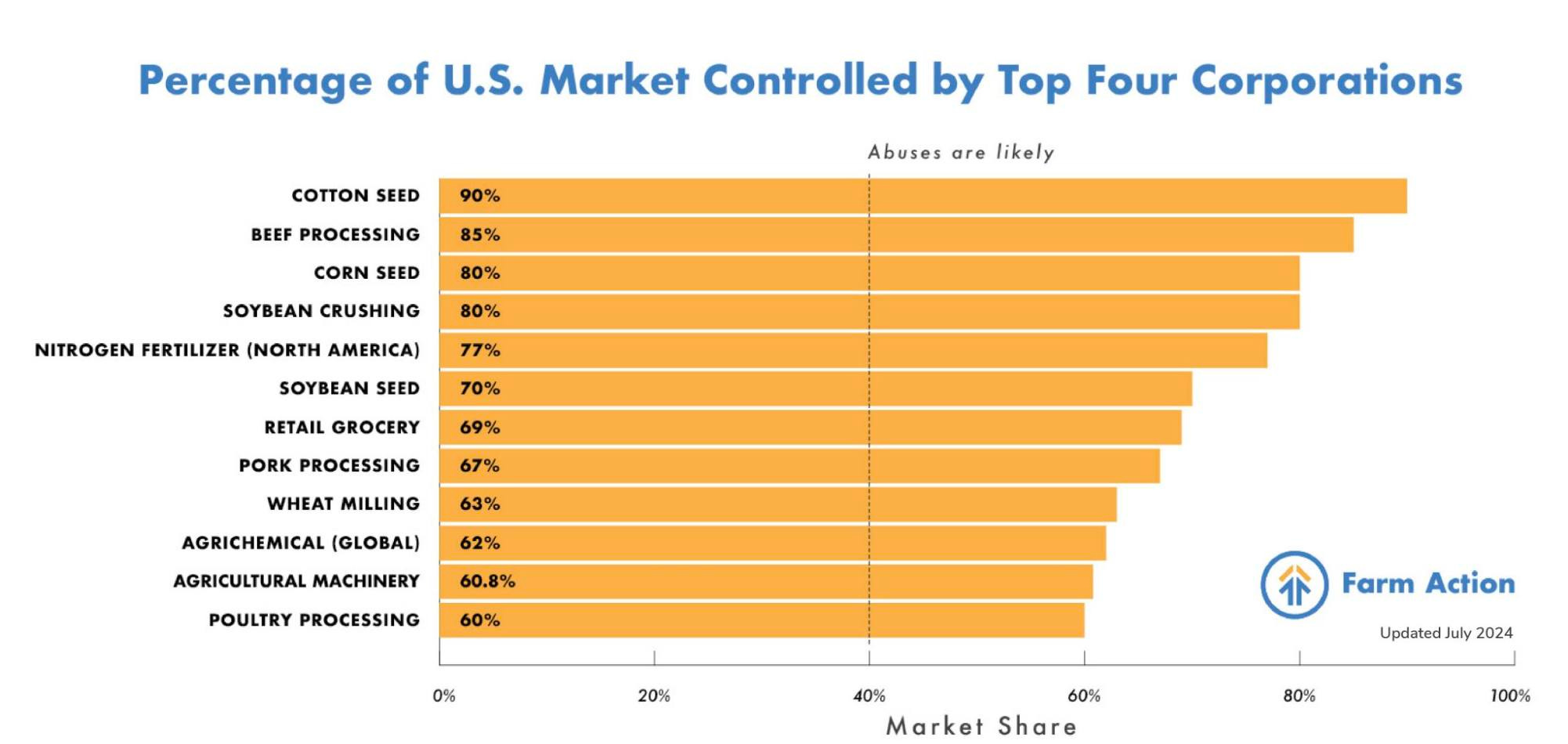
On Tuesday, I noted that food prices remain high because there’s little to no competition across the entire food supply chain, which has allowed big corporations to engage in a price gouging free-for-all. https://open.substack.com/pub/robertreich/p/kamalaconomics
Four companies control most food industries, allowing them to coordinate prices instead of compete on the basis of lower prices. I offered this graph to illustrate the problem:
I urged that Harris announce that as president she’ll bust up food monopolies.
Well, I have it on good authority that on Friday she’ll announce a plan to prevent corporations in the food and grocery industries from unfairly jacking up prices on consumers.
She’ll call for the first-ever federal ban on corporate price-gouging in these industries.
Stonehenge’s 6-tonne Altar Stone was transported from Scotland
August 15, 2024 Evrim Yazgin
How was Stonehenge built in ancient Britain 5,000 years ago?
New evidence suggests the Late Stone Age people who made the colossal structure would have to have used advanced transport methods to move the stones even further than previously thought.
The Altar Stone at Stonehenge circled in black. Credit: English Heritage.
According to English Heritage, the largest stones – called sarsens and weighing up to 30 tonnes – are believed to have been transported from Marlborough Downs, about 32 kilometres away from the site.
The smaller stones weigh less than 10 tonnes. They were thought to have all come from the Preseli Hills in Wales more than 200km away. Transporting these gigantic stones this far would have been a monumental feat for ancient people in Britain.
But new research published in the journal Nature suggests that one stone, the 6-tonne Altar Stone, has its origins even further afield in Scotland.
The Altar Stone, seen here underneath two bigger Sarsen stones. Credit: Professor Nick Pearce, Aberystwyth University. (snip-More)
Gary Baker with the solvent. Credit: Sam O’Keefe/University of Missouri
US researchers have made substances that can extract nanoplastics from water.
The solvents, made from non-toxic components, could remove 98% of the tiny plastic particles from water in a lab environment.
The team has published its research in ACS Applied Engineering Materials.
“Our strategy uses a small amount of designer solvent to absorb plastic particles from a large volume of water,” says corresponding author Gary Baker, an associate professor at the department of chemistry in the University of Missouri-Columbia. (snip-More)
Scientists have made an unexpected discovery in a thousand-year-old abandoned fortress in Mongolia.
Buried in the walls of the fortress is the grave of an elite woman who pre-dates the rise of the founder of the Mongolian Empire, Genghis Khan (also known as Chinggis Khan). The frontier fortress is about 1.4 km west of Khar Nuur lake in eastern Dornod province of Mongolia, only kilometres from the Chinese border.
Khar Nuur lake. Credit: Tuul & Bruno Morandi / The Image Bank / Getty Images Plus.
Genghis Khan rose to prominence in 1206 CE. Before that, the Kitan-Liao Empire controlled great swaths of land between 916 and 1125 CE.
The period between these great dynasties is poorly understood as very few records survive. (snip-More)
I’m happy for, and proud of her. She does good work for her constituents.
By STEVE KARNOWSKI Updated 8:32 AM CDT, August 14, 2024
MINNEAPOLIS (AP) — Democratic U.S. Rep. Ilhan Omar, one of the progressive House members known as the “Squad” and a sharp critic of how Israel has conducted the war in Gaza, has won her primary race in Minnesota.
Omar successfully defended her Minneapolis-area 5th District seat against a repeat challenge from former Minneapolis City Council member Don Samuels, a more centrist liberal whom she only narrowly defeated in the 2022 primary.
“We run the politics of joy,” she said. “Because we know it is joyful to fight for your neighbors. … We know it is joyful to make sure housing is a human right. We know it is joyful to fight for health care to be a human right. We know it is joyful to want to live in a peaceful and equitable world.”
Omar avoided the fate of two fellow Squad members. Rep. Cori Bush lost the Democratic nomination in her Missouri district last week, and Rep. Jamaal Bowman of New York lost his primary in June. Both faced well-funded challengers and millions of dollars in spending by the United Democracy Project, a super political action committee affiliated with the American Israel Public Affairs Committee, which appeared to sit out the Minnesota race. (snip)
Omar will face Republican Dalia Al-Aqidi, an Iraqi American journalist and self-described secular Muslim who calls Omar pro-Hamas. (snip-More)
It’s a busy date, but 3 cheers for Social Security!
August 14, 1935 President Franklin D. Roosevelt signed the Social Security Act into law, creating unemployment compensation, old-age benefits and aid to dependent children.“We can never insure one hundred percent of the population against one hundred percent of the hazards and vicissitudes of life, but we have tried to frame a law which will give some measure of protection to the average citizen and to his family against the loss of a job and against poverty-ridden old age.” President Roosevelt signing Social Security Act of 1935 in the Cabinet Room of the White House. Library of Congress photo A comprehensive history: https://www.ssa.gov/history/
August 14, 1941 In the German Nazi concentration camp at Auschwitz, a group of prisoners had been chosen by the camp’s commander for death by starvation. Roman Catholic Fr. Maximilian Maria Kolbe offered himself for death instead of one of the condemned because the man had a family he needed to be alive to support. Fr. Kolbe was put to death on this day by lethal injection following two weeks of starvation. Pope John Paul II declared him a Saint in 1982.
August 14, 1945 President Harry Truman announced that Japan, one week following the atomic bomb attacks on the cities of Hiroshima and Nagasaki, had surrendered unconditionally, ending World War II.
August 14, 1966 Twenty people were arrested for trying to attend services at the white First Baptist Church in Grenada, Mississippi. They were charged with “disturbing divine worship.” Southern Christian Leadership Conference (SCLC) field staff member Jim Bulloch was arrested and his car fire-bombed while he was in jail.
August 14, 1968 400 anti-apartheid students occupied the university in Cape Town, South Africa, to protest its refusal to hire a black professor.
August 14, 1976 Majella O’Hare, a young Catholic girl, was shot dead by British soldiers while walking with other children to confession near her home in Ballymoyer, Whitecross, County Armagh.The soldiers, initially denying they had fired any weapons, claimed that the patrol had been fired upon by an unidentified gunman. But there were serious doubts about the army’s claim. Eyewitness reports failed to confirm it and, unofficially, police investigating the case referred to the army’s “phantom gunman.” The same day 10,000 Northern Irish gathered at a demonstration in Andersontown, organized by the Women’s Peace Movement (later known as Peace People).Majella O’Hare How it happened from people who were there: https://cain.ulster.ac.uk/events/other/1976/murray76.htm
August 14, 1980 After months of labor turmoil, more than 16,000 Polish workers seized control of the Lenin Shipyards in Gdansk. They helped form Solidarnos´c´ (Solidarity), the first independent labor union anywhere in the Soviet bloc, as the Warsaw Pact nations were known. Under the leadership of Lech Valensa [lek va wen´suh] and others, it helped unite the broad political, social and religious opposition to the Communist government. Long-range look at Solidarity: https://www.greenleft.org.au/node/21746
Doctors may soon be able to predict whether your influenza infection will become life-threatening, or if you’ll recover quickly.
Scientists have identified a gene associated with whether patients hospitalised with respiratory viral infections experience mild disease or life-threatening complications.
According to the new study published in Cell, expression levels of the gene, OLAH, is critical in determining disease severity.
The University of Melbourne’s Dr Brendon Chua, a viral and translational immunologist at the Doherty Institute for Infection and Immunity and co-senior author of the paper, says: “Our first ‘aha’ moment occurred during our analysis of patients hospitalised with A(H7N9) [avian] influenza, where we discovered a consistent association between high expression levels of OLAH and fatal outcomes.
“Conversely, patients who recovered exhibited very low OLAH expression throughout their hospital stay.
Patients severely infected with seasonal influenza virus, SARS-CoV-2, respiratory syncytial virus (RSV) and children experiencing multisystem inflammatory syndrome, a rare but serious complication of COVID-19, also show elevated levels of OLAH expression.
Credit: Jia XX, et al. High expression of oleoyl-ACP-hydrolase underpins life-threatening respiratory viral diseases. Cell (2024). DOI: https://doi.org/10.1016/j.cell.2024.07.026
The OLAH gene encodes an enzyme, oleoyl-acyl-carrier-protein hydrolase (OLAH), which mediates the production of a fatty acid. Higher expression of the gene results in higher levels of fatty acids, which exacerbates viral infections.
“Further investigation using animal models and cell cultures revealed that OLAH is pivotal in driving life-threatening inflammation associated with respiratory viruses,” says Chua.
“What’s interesting is that we all have this gene, but its expression varies during the early phases of a respiratory infection, which is why some of us recover faster while others experience severe complications.”
The research team is now working to develop OLAH-based diagnostic methods to screen hospitalised patients. They are also exploring how OLAH can inform the development of therapeutic treatments for viral pathogens.
The University of Melbourne’s Professor Katherine Kedzierska, head of the Human T cell Laboratory at the Doherty Institute and co-senior author of the paper, says: “We’re really excited about the potential of the OLAH gene to serve as a universal indicator of disease severity across different respiratory infections.
“Imagine if your doctor could predict whether your respiratory infection will become life-threatening or if you’ll recover quickly? Our findings suggest that OLAH expression levels could be used as a cutting-edge tool in assessing patients’ prognosis, empowering clinicians with crucial insights for early risk assessment and personalised treatment strategies.”
Nabil Boudi, the Paris-based attorney of Khelif, confirmed to Variety that both figures were mentioned in the body of the complaint, posted to the anti-online hatred center of the Paris public prosecutor’s office on Friday.
The lawsuit was filed against X, which under French law means that it was filed against unknown persons. That “ensure[s] that the ‘prosecution has all the latitude to be able to investigate against all people,” including those who may have written hateful messages under pseudonyms, said Boudi. The complaint nevertheless mentions famously controversial figures. (snip)
Boudi said that although the complaint mentions names, “What we’re asking is that the prosecution investigates not only these people but whoever it feels necessary. If the case goes to court, they will stand trial.”
Boudi also claimed that while the lawsuit was filed in France, “it could target personalities overseas,” pointing out that “the prosecutor’s office for combating online hate speech has the possibility to make requests for mutual legal assistance with other countries.” He added that there were agreements with the U.S. equivalent of the French office for combating online hate speech. (snip-More)
Thirty years ago, when Michael Goldberg would dive in the glimmering blue water of the British Virgin Islands, the reefs were teeming with life. “The expanse of these reefs was astounding,” says Goldberg, a cofounder of I.CARE, a Florida-based reef restoration organization. “The corals were so thick and lush.”
Today those reefs are dying. In much of the Atlantic Ocean, including the Florida Keys, where the 61-year-old Goldberg lives, roughly 70-95 percent of the coral is gone, devastated by disease, rising sea temperatures, and other existential threats.
By 2015, as the reefs declined, Goldberg faced a decision. He would either leave the scuba industry — since 2004, he has owned Key Dives, which provides diving and snorkeling on the Keys’ Islamorada reefs — or take action to restore the coral. Fortunately for Florida, the ocean, and humanity, he chose the latter.
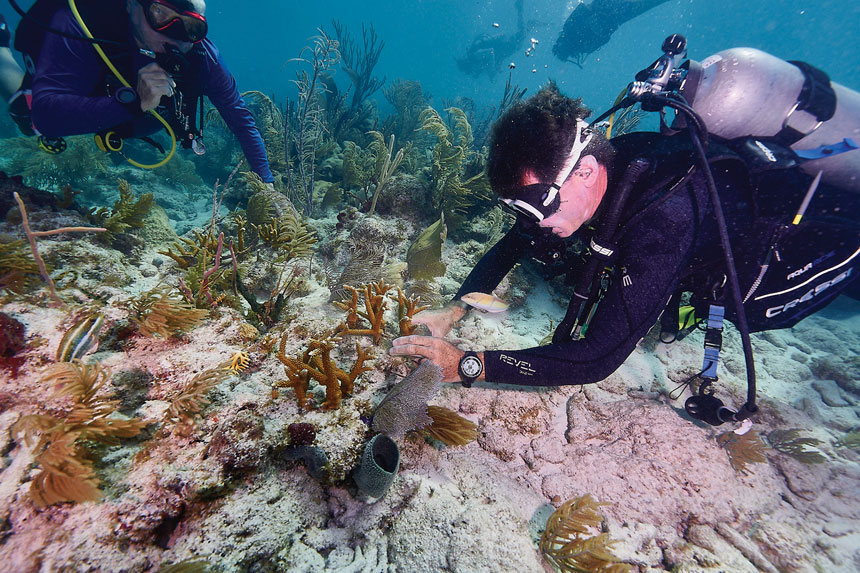
In 2019, Goldberg cofounded I.CARE (Islamorada Conservation and Restoration Education). The mission: To restore and maintain Islamorada’s reefs by teaming with local businesses, residents, and visitors, including local dive shops and recreational divers. Activities range from underwater trash clean-ups — since 2021, divers have lugged 20,000 pounds of debris to the surface — to coral transplants. Over the past three years, I.CARE has planted over 15,000 corals on six different reefs.
The need is urgent. Coral reefs provide food and shelter to thousands of organisms — crustaceans, fish, anemones, sponges — and protect shorelines from storms and erosion. The reefs’ economic benefits include tourism and commercial and recreational fishing. Coral has even been used in medical technologies such as “bone grafting techniques and possible treatments for diseases including Alzheimer’s and cancer,” I.CARE notes.
“I love educating people about the importance of this, but the most gratifying thing for me is seeing the coral grow,” Goldberg says. “I love seeing little baby corals thrive in a harsher environment than I ever imagined, and knowing that despite all the challenges, we’re seeing success.”
Goldberg’s career initially focused on money management rather than ocean management. His love of the water began when he was a boy in Los Angeles, but his family moved to Chicago when he was 10, and he later studied finance at Northern Illinois University. On a summer trip to Acapulco, he dove for the first time, purely, he says, “as a lark.”
“Someone got me some gear, and I wasn’t certified, and I didn’t know what I was doing,” he says. Acapulco is not known for stellar diving experiences, but he loved it: “I was just so enamored with being underwater.”
After that, he was hooked. He earned his diving certification and then moved back to one of L.A.’s beach communities and became an instructor. Before long, he and his wife decided to move to the British Virgin Islands. Eight years later, the couple returned to the United States and opened Key Dives in Islamorada.
Hope and water: “If I wasn’t optimistic, I wouldn’t keep doing this,” says I.CARE cofounder Michael Goldberg. (Photo courtesy Michael Goldberg)
Goldberg has made over 10,000 dives, swimming not only with dolphins and schooling sharks, but within 15 feet of a humpback whale as it breached. And yet the vast coral reefs have always intrigued him most, whether diving alone or taking clients off the island of Virgin Gorda in the British Virgin Islands.
“There was this one unique piece of coral that I would swim underneath — it was like a tree,” he says. “Most people want to see fish, but to me, that coral was always the highlight of the dive.”
In 2017, Goldberg met Kylie Smith, who was working on her Ph.D. at Clemson University and studying coral in the Florida Keys. Smith would fill her tank at Key Dives, and Goldberg, who was “already shifting my business toward conservation,” would tap into her aquatic expertise.
“When I met Dr. Smith, I would pepper her with questions — she couldn’t walk in my store and leave in quick fashion,” Goldberg says. Their discussions eventually moved from the dive shop to a beer garden at The Florida Keys Brewing Company. “We would sit and chat, and I kept saying to her, I’ve got an idea to empower recreational divers so that they can become citizen scientists — not only because they want to be part of the solution, but because they need to be a part of the solution. That’s the largest potential boots-on-the-ground army that can enact so much of what we do.”
Those discussions led them to co-launch I.CARE. By January 2021, volunteer divers had transplanted I.CARE’s first corals.
For the coral restoration, divers use coral raised in nurseries. Once it’s planted on the reefs, the coral will, hopefully, reproduce into a coral colony — but the process is slow. It can take 20-50 years for coral to grow large enough to spawn.
To speed up reproduction, I.CARE uses a process called micro-fragmentation. Larger corals are cut into thumbnail-size pieces and grown in a nursery. When those pieces grow to about the size of a 50-cent piece, they are planted edge to edge on a living coral structure. After a few years, the coral fuse to become one larger coral, and they’ll start to spawn in about 7 to 10 years.
For the micro-fragmentation work, I.CARE rescues coral that has broken free from the main reef structure due to storms and substrate erosion.
“What is cool about these corals is that these are the survivors. They are the most resilient, the ones that have persisted despite all the disease and heat,” says Goldberg. “It’s survival of the fittest in the truest sense, and the ones we are using to rebuild our precious reefs.”
Despite the advances, the challenges are huge, both for I.CARE and the planet. During the intense heat of summer 2023, most of I.CARE’s seemingly healthy coral fragments died at one of Goldberg’s favorite reefs. “I cried underwater,” he admits. But he prefers to focus on the organization’s victories. Seventy-seven of the fragments survived and are thriving.
“If I wasn’t optimistic, I wouldn’t keep doing this,” he says. “We’ve had successes, and we can build on those successes.”
When it comes to restoring the reefs for future generations, he offers a simple vow: “We’re not gonna give up.”
Ken Budd has written for The Washington Post, The Atlantic, The New York Times, National Geographic Traveler, and many more. He is the author of an award-winning memoir, The Voluntourist.
This article is featured in the July/August 2024 issue of The Saturday Evening Post.



 Majella O’Hare