When an asteroid slammed into Earth 66 million years ago, it caused a mass extinction. Now researchers have evidence that this catastrophe ushered in the invention of agriculture by ants.
“Extinction events can be huge disasters for most organisms, but it can actually be positive for others,” says Ted Schultz, curator of ants at the Smithsonian National Museum of Natural History and senior author of the paper. “At the end of the Cretaceous, dinosaurs did not do very well, but fungi experienced a heyday.”
What’s the link between fungi and ants?
A worker ant of a fungus-farming species in Brazil. Credit: Don Parsons
The researchers propose this anti-culture heyday began with a cataclysmic collision that filled the atmosphere with debris and blocked out the sun, halting photosynthesis for years. As plants died en masse, they littered the ground with organic matter.
Fungi proliferated and ants ate the fungi for food. Some ants continued to eat fungi after Earth’s ecosystems rebounded and today more than 250 ant species have adapted and actively create conditions for fungus to thrive.
“Ants have been practicing agriculture and fungus farming for much longer than humans have existed,” says Schultz.
To pinpoint when this symbiotic interaction began, Schultz and colleagues amassed the largest genetic dataset of fungus-farming ants.
They also analysed the genetics of hundreds of fungi species, including those that are farmed by ants and their wild relatives.
Next, the team assembled evolutionary trees for both ants and fungi which revealed that farming ants and their fungus crops have been intertwined for 66 million years.
The data also revealed that “higher” forms of agriculture, where ants and fungi are completely reliant on one another, evolved around 27 million years ago. This coincided with a rapid global cooling event that fractured tropical environments. These changes led to ants cultivating a fungus outside its natural habitat.
“The ants domesticated these fungi in the same way that humans domesticated crops,” says Schultz. “What’s extraordinary is now we can date when the higher ants originally cultivated the higher fungi.”
A new study warns that sloths living in high-altitude rainforests of South and Central America could face extinction if temperatures there continue to rise according to climatic predictions.
The research, published in PeerJ Life & Environment, suggests that some sloths’ restricted ability to migrate to cooler regions and limited metabolic flexibility make them particularly vulnerable to climate change.
“Sloths are inherently limited by their slow metabolism and unique inability to regulate body temperature effectively, unlike most mammals,” says Dr Rebecca Cliffe, lead researcher of the study from Swansea University and The Sloth Conservation Foundation in the UK.
“Our research shows that sloths, particularly in high-altitude regions, may not be able to survive the significant increases in temperature forecast for 2100.” (snip-MORE)
A team at Monash University in Victoria developing a hormone-free, reversible male contraceptive has now figured out the 3D structure of one of their primary therapeutic targets – the P2X1-purinergic receptor (P2X1).
According to Dr Sab Ventura from the Monash Institute of Pharmaceutical Sciences (MIPS), this has been the main stumbling block that has so far hindered the team from progressing the drug discovery program to the next stage.
“Our primary goal is to develop a male contraceptive pill that is not only hormone-free but also bypasses side effects such as long-term irreversible impacts on fertility, making it suitable for young men seeking contraceptive options,” says Ventura.
In previous research in mice, the team showed that simultaneous inactivation of P2X1 and a second protein, α1A-adrenergic receptor, resulted in male infertility.
“Now we know what our therapeutic target looks like, we can generate drugs that can bind to it appropriately, which totally changes the game,” says Ventura. (snip-MORE)
Mount Everest is tall. In other news, the sky is blue.
But Everest (also called Chomolungma and Sagarmāthā) is taller than it logically should be – towering 238m above the world’s next highest peak, K2, and more than 250m higher than any of its counterparts in the relatively uniform Himalaya range.
Plus, it’s growing at about 2mm a year, faster than the expected rate for the range.
A team of Chinese and UK scientists have now suggested why this is the case.
The researchers think the culprit is a nearby river which “captured” another river 89,000 years ago, causing erosion that made Everest more buoyant.
They’ve published their findings in Nature Geoscience.
The Himalayan peaks get their extraordinary height from the collision of the Indian and Eurasian tectonic plates, causing the Earth’s crust to thicken and the mountain range to push upwards.
“An interesting river system exists in the Everest region,” says co-author Dr Jin-Gen Dai, from China University of Geosciences.
The team used numerical modelling to see how the river changed over time. They found that, about 89,000 years ago, the Arun river “captured” another nearby river.
This event, referred to as “river piracy”, happens when a river diverts its course and takes up the discharge of another river or stream.
“Our research shows that as the nearby river system cuts deeper, the loss of material is causing the mountain to spring further upwards,” says co-author Adam Smith, a PhD student at University College London, UK.
The team estimates that the river piracy has made Everest between 15 and 50m higher than it would otherwise be.
It’s also made neighbouring peaks, Lhotse and Makalu, unusually tall. These are the 4th and 5th highest mountains in the world, respectively. (snip-MORE)
It’s not the famous Star Trek tricorder but it’s close: researchers have developed a hand-held scanner that can generate highly detailed 3D images of body parts in almost real time.
The technology can accurately image blood vessels up to 15mm deep in human tissue, which the researchers say could help to diagnose conditions such as cancer, cardiovascular disease, and arthritis.
“We’ve come a long way with photoacoustic imaging in recent years, but there were still barriers to using it in the clinic,” says Paul Beard of University College London (UCL), UK, corresponding author of the new Nature Biomedical Engineeringpaper.
“The breakthrough in this study is the acceleration in the time it takes to acquire images, which is between 100 and 1,000 times faster than previous scanners.
“This speed avoids motion-induced blurring, providing highly detailed images of a quality that no other scanner can provide. It also means that rather than taking 5 minutes or longer, images can be acquired in real time, making it possible to visualise dynamic physiological events.
“These technical advances make the system suitable for clinical use for the first time, allowing us to look at aspects of human biology and disease that we haven’t been able to before.” (snip-MORE)
Neo-Nazis, the KKK and other hate groups are now routinely visiting Springfield, marching through city streets or distributing recruitment flyers and raising fears of intimidation and violence.
Over the weekend, the Blood Tribe — a violent Neo-Nazi hate group, according to the Southern Poverty Law Center (SPLC) — stood outside Springfield Mayor Rob Rue’s home waiving swastika flags. In a previous march through the city, some carried guns.
Also this weekend, an unidentified group stood outside Springfield city hall with a banner that said “Haitians Have No Home Here” in English and Haitian Creole.
These groups are responding to the growth of Springfield’s Haitian community, an issue that made the national spotlight following unsubstantiated rumors circulated on social media and parroted by politicians that Haitian immigrants were eating Springfield residents’ pets.
Since then, Springfield NAACP president Denise Williams says residents have also reported to her agency flyers being distributed in local neighborhoods from a group associated with the Ku Klux Klan.
“They’re trying to intimidate us. But we’re not a city that’s easily intimidated,” Williams said. “We need to stand together.”
The group, the Trinity White Knights, has a P.O. Box based in Kentucky. The Lexington Herald-Leader reported in September that similar flyers from the same group were distributed in Covington, Ky.
Springfield Police Chief Allison Elliott said the department is aware of the flyers.
Some residents have reported harassment from a group of people purporting to be members of the Proud Boys, which the SPLC designates as a hate group that believes in “Western chauvinism” and “an anti-white guilt agenda.”
Clark County Democratic Party chairman Austin Smith said a volunteer canvassing near the political party’s Springfield headquarters earlier this month was returning to the office to drop off campaign materials when a truck with large flags that appeared to say “Proud Boys” pulled up.
A group of men in the truck, the volunteer told Smith, made “vaguely threatening” statements.
“We’ve had threats and things pour into the office. No bomb threats, but ‘You better watch out.’ ‘We’re watching you.’ So that definitely created a lot of fear,” Smith said.
The party increased security measures for its recent meeting as a safety precaution, Smith said.
Members of the religious group Israel United in Christ (IUIC) were also in Springfield in September, gathering in multiple public places around the city.
The members, clad in purple shirts with the group’s name and logo, were seen marching and passing out literature to passersby.
At one point, group members gathered in the parking lot of Groceryland on South Limestone Street, near the corner of East John St. Members were preaching into a microphone about the organization’s teachings. Members also met with NAACP leaders from Dayton and Springfield.
According to its website, the IUIC is a Bible-based organization that believes people within the Black, Hispanic, and Native American communities represent “the true and historical descendants of the Biblical Israelites.”
SPLC categorizes IUIC as one of the handful of “Radical Hebrew Israelites” groups in the U.S. The SPLC designates these groups as hate groups. IUIC denies that it is a hate group, according to a post on the IUIC Classrooms Facebook page. The newspaper reached out to IUIC but did not hear back.
Williams said the Springfield NAACP chapter has plans to host a virtual community meeting to talk about recent activity in the city.
Springfield’s police chief asked residents to remain vigilant and “say something if you see something suspicious or out of the norm.”
“We know our city has looked a little different lately, and you also may notice an increased public safety presence. We assure you that our top priority has always been and will continue to be safety,” Elliott said. “Safety is a shared responsibility and our officers, along with our public safety partners, take all tips and information seriously.”
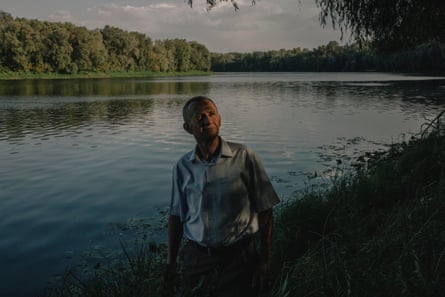
Serhiy Kraskov picked up a twig and poked at a small fish floating in the Desna River. “It’s a roach. It died recently. You can tell because its eyes are clear and not blurry,” he said. Hundreds of other fish had washed up nearby on the river’s green willow-fringed banks. A large pike lay in the mud. Nearby, in a patch of yellow lilies, was a motionless carp. “Everything is dead, starting from the tiniest minnow to the biggest catfish,” Kraskov added mournfully.
Kraskov is the mayor of the village of Slabyn, in Ukraine’s northern Chernihiv region. The rustic settlement – population 520 – escaped the worst of Russia’s 2022 full-scale invasion. But the war arrived last week in a new and horrible form. Ukrainian officials say the Russians deliberately poisoned the Seym River, which flows into the Desna. The Desna connects with a reservoir in the Kyiv region and a water supply used by millions.
Serhiy Kraskov, the mayor of the village of Slabyn, near the banks of the Desna River in northern Ukraine. Photograph: Alessio Mamo/The Guardian
A toxic slick was detected on 17 August coming from the Russian border village of Tyotkino. According to Kyiv, chemical waste from a sugar factory had been dumped in vast quantities into the Seym. It included ammonia, magnesium and other poisonous nitrates. At the time, fierce fighting was going on in the surrounding area. Ukraine’s armed forces had launched a surprise incursion into Russia and had seized territory in Kursk oblast.
The pollution crossed the international border just over a mile away and made its way into Ukraine’s Sumy region. The Seym’s natural ecosystem crashed. Fish, molluscs and crayfish were asphyxiated as oxygen levels fell to near zero. Settlements along the river reported mass die-offs. Kraskov got a call from the authorities warning him a disaster was coming his way. He spotted the first dead fish on 11 September. “There were a few of them in the middle of the river,” he said.
He returned the following weekend to find the Desna’s banks clogged with rotting fish, stretching out from the shore for three metres into the water. Volunteers wearing rubber boots, masks and protective gloves shovelled the fish into sacks. They found a metre-long catfish. “The stench was terrible. You could scarcely breathe. The river was quiet. Nothing moved apart from a few frogs,” Kraskov said. A tractor took the sacks to an abattoir that used to belong to the village’s Soviet-era collective farm. They were buried in a pit.
Serhiy Zhuk, the head of Chernihiv’s ecology inspectorate, described what had happened as an act of Russian ecocide. “The Desna was one of our cleanest rivers. It’s a very big catastrophe,” he said. Zhuk traced the slick’s route on a map pinned to his office wall: a looping multi-week journey along the Seym and Desna. “More than 650km is polluted. Not a single organism survived. This is unprecedented. It’s Europe’s first completely dead river,” he said. (snip-MORE)
Today’s posts got interrupted by a friend needing my help with an emotional crisis which I was very happy to give, and then my wonderful husband who puts up and supports me through my own crises / helps me through them needing to work in my Pink Palace to get my Pride Flag backdrop done and start moving my shelving around to make things better for me. Hubby is wonderful and truly understands and wants my Pink Palace to be not only a good space for me but a safe space for all my needs. To anyone who has a complaint about my naming my office space my Pink Palace … nicely said get over yourself. This is 2024 and I get to call my spaces what I want … the not nicely way to put it came to mind but instead of voicing it I will say that I left being embarrassed or upset over my being who I am sexually and emotionally behind me over 40 years ago. Hugs. Scottie.
First, peace to all, and make it a good International Day of Peace. Next, the Autumnal/Spring Equinox is tomorrow morning at 7:44 AM USCDT/whatever time it is where you are. Here’s a beautifully peaceful photo from NASA’s Photo of the Day:
Explanation: The defining astronomical moment of this September’s equinox is at 12:44 UTC on September 22, when the Sun crosses the celestial equator moving south in its yearly journey through planet Earth’s sky. That marks the beginning of fall for our fair planet in the northern hemisphere and spring in the southern hemisphere, when day and night are nearly equal around the globe. Of course, if you celebrate the astronomical change of seasons by watching a sunrise you can also look for crepuscular rays. Outlined by shadows cast by clouds, crepuscular rays can have a dramatic appearance in the twilight sky during any sunrise (or sunset). Due to perspective, the parallel cloud shadows will seem to point back to the rising Sun and a place due east on your horizon on the equinox date. But in this spectacular sunrise skyscape captured in early June, the parallel shadows and crepuscular rays appear to converge toward an eastern horizon’s more northerly sunrise. The well-composed photo places the rising Sun just behind the bell tower of a church in the town of Vic, province of Barcelona, Catalonia, Spain.





 Scottie's Playtime