The links are priceless to read on their own, but there is fine info when we click.
Category: Businesses / Corporations / Industry
Science on Saturday
“Whale-ship collision hotspots: 93% have no protection measures”
November 22, 2024 Evrim Yazgin
A global survey has found that shipping traffic overlaps with almost the entire range of all whale species but only 7% of the areas with the highest risk of whale-ship collisions have protection measures in place for the whales.
“Whale-ship collisions have typically only been studied at a local or regional level … and patterns of risk remain unknown for large areas,” says lead author Anna Nisi, a postdoctoral researcher at the University of Washington in the US. “Our study is an attempt to fill those knowledge gaps and understand the risk of ship strikes on a global level.”

The research, published in Science, focused on 4 species: blue, fin, humpback and sperm whales.
It found that the highest risk areas lay along the coasts of the Americas, southern Africa and parts of Asia.
The team found mandatory measures to reduce whale-ship collisions were very rare. These overlapped with just 0.54% of blue whale hotspots and 0.27% of humpback hotspots. Such measures had no overlap with any fin or sperm whale hotspots.
The findings are “timely” and “not surprising”, according to Vanessa Pirotta, a researcher at Sydney’s Macquarie University who was not involved in the study. (snip-MORE)
Peace & Justice History for 11/23
November 23, 1170 BCE The first recorded strike took place in Egypt when necropolis workers who had not been paid for their work in more than two months sat down and refused to work until they were paid and able to eat. More about this 1st strike |
| November 23, 1887 Black Louisiana sugarcane workers, in cooperation with the racially integrated Knights of Labor, had gone on strike at the beginning of the month over their meager pay issued in script (not cash). The script was redeemable only at the company store where excessive prices were charged. When the first freeze of the season arrived and damaged the crop, the plantation owners were angered. The Louisiana Militia, aided by bands of “prominent citizens,” shot and killed at least 35 unarmed black sugar workers striking to gain a dollar-per-day wage, and lynched two strike leaders in what became known as the Thibodaux Massacre. More on the Thibodaux Massacre |
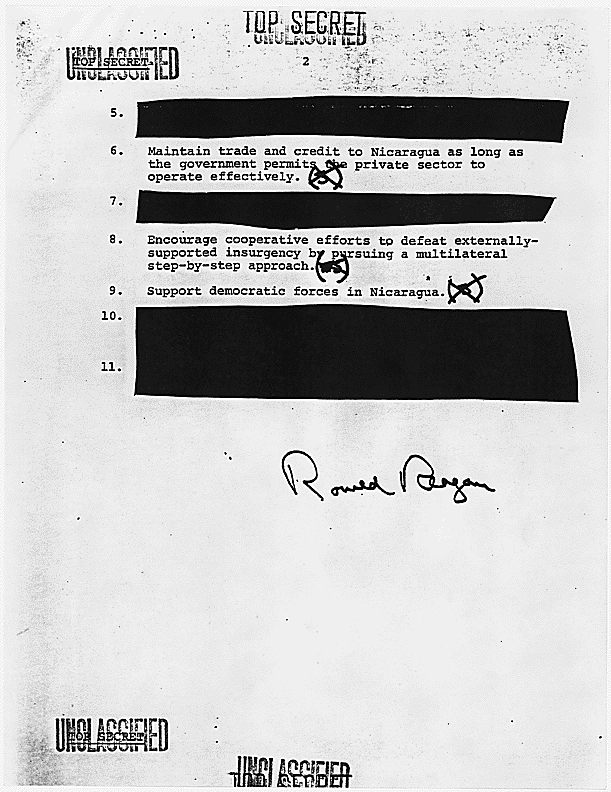
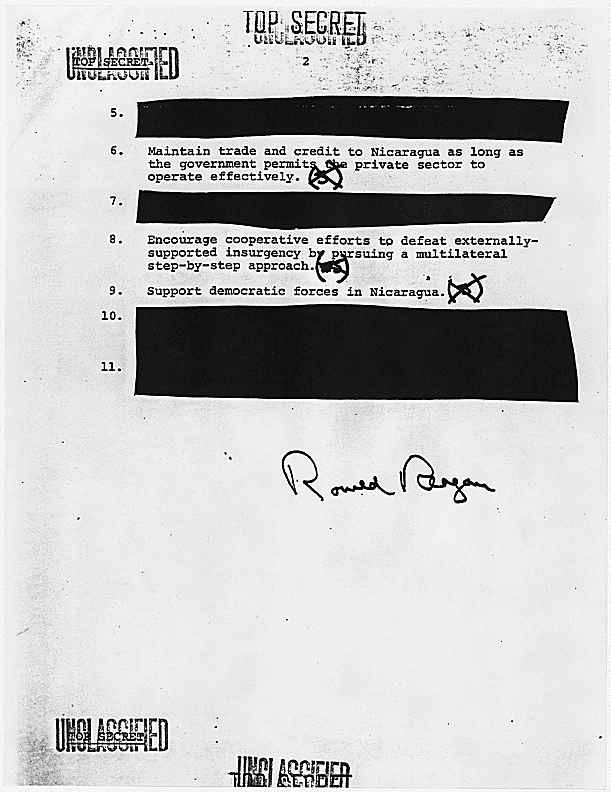
| November 23, 1981 President Ronald Reagan signed off on a top secret document, National Security Decision Directive 17 (NSDD-17), which gave the Central Intelligence Agency a budget of $19 million to recruit and support a 500-man force of Nicaraguan insurgents to conduct covert actions against the leftist Sandinista elected government. This marked the beginning of official U.S. support for the so-called contras in their war against the Nicaraguans.  Read (most of) the memo More on the Reagan policy |
https://www.peacebuttons.info/E-News/peacehistorynovember.htm#november23
Peace & Justice History for 11/21:
| November 21, 1945 200,000 members of the United Auto Workers went on strike against General Motors, the first major strike following World War II. The UAW’s demand for a 30% wage increase was based on the increase in the cost of living during the war (28% according to the Department of Labor), the wartime freeze on wages, and the cut in the average workweek with the disappearance of overtime pay in manufacturing.   But the UAW also considered profits and prices a subject for negotiation, a position rejected by GM. The union did not merely say that labor was entitled to enough wages to live on. It also said that labor was entitled to share in the wealth produced by industry. “… Unless we get a more realistic distribution of America’s wealth, we won’t get enough to keep this machine going.”–Walter Reuther, UAW President More about the strike |
| November 21, 1973 President Richard Nixon’s attorney, J. Fred Buzhardt, revealed the existence of an 18 1/2-minute gap in one of the subpoenaed White House tape recordings of Watergate conversations made by President Richard Nixon in the days after the Watergate break-in.The erasure was blamed on an accident by Nixon’s private secretary, Rose Mary Woods, but scientific analysis determined the erasures to be deliberate. White House Chief of Staff Alexander Haig later attributed the gap to “sinister forces.” 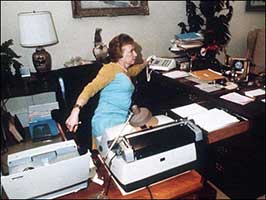 Rose Mary Woods, demonstrating how she might have created the Watergate tape gap More about Rose Mary Woods |
| November 21, 1974 Both Houses of Congress voted to override President Gerald Ford’s veto of updates to the Freedom of Information Act. Originally passed in 1966, it required federal agencies to release information upon request to citizens and journalists.The amendments put an end to governmental resistance to compliance, including excessive fees, bureaucratic delays, and the need to sometimes resort to expensive litigation to force the government to share copies of documents. Ford advisors Chief of Staff Donald Rumsfeld, his deputy Dick Cheney, and government lawyer Antonin Scalia advised him to veto it.  Chief of Staff Donald Rumsfeld, President Gerald Ford and Deputy Chief of Staff Richard Cheney April 28, 1975 What was the dispute? |
| November 21, 1975 The Senate Select Committee to Study Governmental Operations with Respect to Intelligence Activities, led by Senator Frank Church (D-Idaho), issued a report charging U.S. government officials were behind assassination plots against two foreign leaders – Fidel Castro (Cuba) and Patrice Lumumba (Congo), and were heavily involved in at least three other plots: Rafael Trujillo (Dominican Republic), Ngo Dinh Diem (Vietnam), Rene Schneider (Chile). 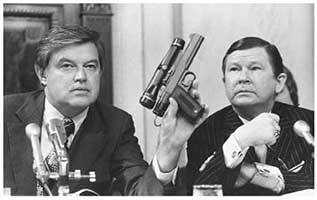 Senator Frank Church, left, chairman of the Senate Select Intelligence Committee, displays a poison dart gun as co-chairman Senator John Tower (R-TX) watches. The committee, a precursor to the Senate Intelligence Committee, was established to look into misuse of and abuse by intelligence agencies, particularly the CIA and FBI, some of which had been revealed by the Watergate investigations.   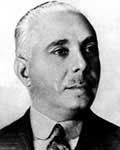   Fidel Castro / Patrice Lumumba / Rafael Trujillo / Ngo Dinh Diem / Rene Schneider Read more |
| November 21, 1981 More than 350,000 demonstrated in Amsterdam against U.S. nuclear-armed cruise missiles on European soil. |
| November 21, 1985 A full-scale summit conference, the first of five between the President Ronald Reagan of the U.S. and General Secretary Mikhail Gorbachev of the Soviet Union concluded. There was optimism over beginning a more productive and cooperative relationship between the two countries, each of which had thousands of nuclear warheads targeted at the other.The U.S. had proposed building a space-based anti-ballistic missile system, commonly known as “Star Wars,” which the Soviets had strongly opposed as an escalation of the nuclear arms race.In an unofficial meeting the previous evening, President Reagan had noted that he and Gorbachev were meeting for the first time at this level and had little practice. Nevertheless, having read the history of previous summit meetings, he had concluded that those earlier leaders had not accomplished very much. Therefore, he suggested that he and Gorbachev say, “To hell with the past, we’ll do it our way and get something done.” Gorbachev concurred.  Reagan and Gorbachev at their first summit |
| November 21, 1986 National Security Council member Oliver North and his secretary, Fawn Hall, began shredding documents that would have exposed their participation in a range of illegal activities regarding the sale of arms to Iran in an attempt to free hostages, and the diversion of the proceeds to an insurgent Nicaraguan group known as the contras.  Fawn Hall  Oliver North More on Fawn Hall |
| November 21, 1995 China officially charged well-known human rights activist and political dissident Wei Jingsheng with trying to “overthrow the government.” Wei had not been seen for a year and a half after disappearing into police custody after meeting with a U.S. assistant secretary of state for human rights and humanitarian affairs.“If the people allow the power holders, in the peoples’ name, to violate and ignore the rights of some of the people then, at the same time, they are giving the power holders the power to violate the rights of all the people.” “ Most people wait until others are standing to make their move, very few are willing to stand up first or to stand alone. That’s why my friends call me a fool! But I don’t have any regrets.” – Wei Jingsheng  Wei Jingsheng He had been imprisoned previously for his involvement with the Democracy Wall movement, including years in solitary confinement. He had also spoken out on behalf of the Tibetans. |
https://www.peacebuttons.info/E-News/peacehistorynovember.htm#november21
Peace & Justice History for 11/20:
| November 20, 1816 The term “scab” was first used in print by the Albany (N.Y.) Typographical Society. A scab is someone who crosses a union’s picket line and takes the job of a striking worker.  Read The Scab by Jack London |
| November 20, 1945 The International War Crimes Tribunal began in Nuremberg, Germany, and continued until October 1, 1946, establishing that military and political subordinates are responsible for their own actions even if ordered by their superiors.Twenty-four high-ranking Nazis were on trial for atrocities committed during World War II, ranging from crimes against peace to crimes of war, to crimes against humanity. The Nuremberg Trials were conducted by judges from the United States, the Soviet Union, France, and Great Britain.  The Nuremberg defendants Read more |
| November 20, 1959 The United Nations proclaimed “The Declaration of the Rights of the Child,” because “the child, by reason of his physical and mental immaturity, needs special safeguards and care, including appropriate legal protection, before as well as after birth.” Read the text of the Declaration |
| November 20, 1962 President John F. Kennedy issued an executive order forbidding racial discrimination in public housing. |
| November 20, 1969 Eighty-nine American Indians seized Alcatraz Island in San Francisco Bay, offering to buy the island from the federal government for $24 worth of beads (the alleged price paid to the Canarsee Delaware Indians for Manhattan Island; it was actually 60 Dutch guilders). Their numbers swelled into the hundreds at times; the General Services Administration, which had responsibility for the site of the former federal prison, and Coast Guard gave them the opportunity to leave the island peacefully.They were reclaiming it as Indian land by right of discovery, and demanding fairness and respect for native peoples. The occupation lasted for more than a year. Said Richard Oakes, a Mohawk from New York, “We hold The Rock.”  Indian people and their supporters wait for the ferry. Photo/Ilka Hartmann  a new entrance to Alcatraz; Photo/Michelle Vignes Read more about the occupation  LaNada Boyer (formerly Means) inside one of the Alcatraz guard barracks where occupiers lived from 1969-71. Much of the graffiti from 30 years ago remains throughout the island today. Photo by Linda Sue Scott. |
November 20, 1977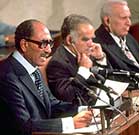 Egyptian President Anwar El-Sadat addressed the Israeli Knesset (parliament). “I come to you today on solid ground to shape a new life and to establish peace. “But to be absolutely frank with you, I took this decision after long thought, knowing that it constitutes a great risk….” Text of Sadat’s speech to the Israeli Knesset Listen to the speech |
| November 20, 1987 SANE (The Committee for a Sane Nuclear Policy) and FREEZE (the campaign to freeze all testing of nuclear weapons) merged at their first combined convention in Cleveland, Ohio, becoming the largest U.S. peace organization. Peace Action today |
| November 20, 1993 The U.S. Senate approved the North American Free Trade Agreement (NAFTA), creating the world’s largest trade area covering Canada, the U.S. and Mexico. |
https://www.peacebuttons.info/E-News/peacehistorynovember.htm#november20
Peace & Justice History for 11/19:
| November 19, 1915 Joe Hill, a labor organizer for the Industrial Workers of the World (IWW) was assassinated by firing squad in the courtyard of the Utah State Penitentiary in Salt Lake City.  The IWW, or Wobblies as they were known, were advocates of organizing all workers into One Big Union. It is reported that Joe had been framed for murder by copper bosses, the press and government forces. Just prior to his execution, as Joe stood before the firing squad he propelled himself him from organizer to labor martyrdom with these words: “Don’t waste any time in mourning. Organize!“ Joe Hill: The Man Who Didn’t Die, and more The IWW today |
| November 19, 1969 In an effort to undercut growing opposition to a draft made necessary by the Vietnam War, Congress passed a law requiring random selection of draftees through a lottery. The Selective Service System would call up young men based upon their birthday, first with 19-year-olds and those with expired college deferments. |
November 19, 1977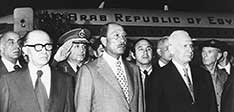 Sadat arrives in Israel In an unprecedented move for an Arab leader, Egyptian President Anwar el-Sadat traveled to Israel to seek a permanent peace settlaement with Egypt’s neighbor after decades of conflict. This action was extremely unpopular in the Arab World and especially among Muslim fundamentalists. Egypt and Israel had fought four wars since 1948. Sadat on November 9: “ Israel would be astonished when they hear me say this. But I say it. I am ready to go even to their home … to the Knesset and discuss peace with them if need be.” Israeli Prime Minister Menachem Begin on November 11: “ Let us say to one another, and let it be a silent oath by the peoples of Egypt and Israel: no more wars, no more bloodshed and no more threats.” Together in Israel: Sadat: “ I wish to tell you today and I proclaim to the whole world: We accept to live with you in a lasting and just peace.” Begin: “ Everything must be negotiated and can be negotiated. We Jews appreciate courage, and we will know how to appreciate our visitor’s courage.” Sadat’s speech to the Israeli Knesset (parliament): |
https://www.peacebuttons.info/E-News/peacehistorynovember.htm#november19
Letters From An American for 11/17:
This is pretty cool to read!
November 17, 2024 by Heather Cox Richardson Read on Substack
Tonight is a break from the craziness of the news.
I often say that 1883 is my favorite year in history because of all that happened in that pivotal year, and one of those things is the way modernity swept across the United States of America in a way that was shocking at the time but that is now so much a part of our world we rarely even think of it….
Until November 18, 1883, railroads across the United States operated under 53 different time schedules, differentiated on railroad maps by a complicated system of colors. For travelers, time shifts meant constant confusion and, frequently, missed trains. And then, at noon on Sunday, November 18, 1883, railroads across the North American continent shifted their schedules to conform to a new standard time. Under the new system, North America would have just five time zones.
Fifteen minutes before the time of the shift, the telegraph company Western Union shut down all telegraph lines for anything but the declaration of the new time. It identified the moment the new time went into effect in telegraph messages to local railroad offices and to the jewelers known in cities for keeping time. In offices that got the message, men had their timepieces in their hands and ready to reset when the chief operator shouted “twelve o’clock!”
In Boston the change meant that the clocks would move forward about 16 minutes; in New York City, clocks were set back about four minutes. For Baltimore the time would move forward six minutes and twenty-eight seconds; in Atlanta it went back 22 minutes.
The system was a dramatic wrench for the rural United States, bringing it into the modern world. Uniform time zones had been proposed by pioneering meteorologist Cleveland Abbe, who developed the U.S. system of weather forecasting. Having joined the United States Weather Bureau as chief meteorologist in 1871, he recognized that predicting the weather required a nationally coordinated team and worked with Western Union to collect information about temperature, wind direction, precipitation, and sunset times from across the country.
Coordinating that information required keeping time across all the stations he had set up. To do so, Abbe divided the United States into four time zones, each one hour apart, and in 1879 he suggested those zones might smooth out the chaos of the railroad systems, each trying to coordinate schedules across a patchwork of local times. Railroad executives, who were concerned that if they didn’t do something, the government would, listened to Abbe, and by 1883 they had concluded to put his new system in place.
Members of the new professional class who traveled by train from city to city were on board because they thought the need to regularize train schedules was imperative. But standard time was controversial. In the United States, people had operated entirely by the rhythms of the sun until the establishment of factories in New England in the 1830s, and most people still lived by those rhythms, their local time adjusting to solar time according to their geographical location.
Telling the time by sundial and history not only was custom, but also was understood as following God’s time. The idea of overriding traditional timekeeping because of the needs of the modern world seemed positively sacrilegious. “People…must eat, sleep and work…by railroad time,” wrote a contributor to the Indianapolis Daily Sentinel. “People will have to marry by railroad time…. Ministers will be required to preach by railroad time…. Banks will open and close by railroad time; notes will be paid or protested by railroad time.”
The mayor of Bangor, Maine, vetoed an ordinance in favor of standard time, saying it was unconstitutional, that it changed the immutable law of God, that the people didn’t want it, and that it was hard on the working men because it changed day into night. Those planning for a switch to standard time tried to ease fears by providing that Americans would operate on both local time and standard time, with both times represented on clocks.
On November 18, no one quite knew what the dramatic wrench into the future might mean.
What did it mean to gain or lose time? Many people expected “a sensation, a stoppage of business, and some sort of a disaster, the nature of which could not be exactly ascertained,” a New York Times reporter recorded. As the great moment approached, people crowded the streets in front of jewelers to see the “great transformation.”
They were disappointed when, after all the buildup, the future arrived quietly.
The New York Times explained: “When the reader of THE TIMES consults his paper at 8 o’clock this morning at his breakfast table it will be 9 o’clock in St. John, New Brunswick, 7 o’clock in Chicago, or rather in St. Louis—for Chicago authorities have refused to adopt the standard time, perhaps because the Chicago meridian was not selected as the one on which all time must be based—6 o’clock in Denver, Col. and 5 o’clock in San Francisco. That is the whole story in a nut-shell.”
—
Notes:
Chicago Daily Tribune, “At Noon today Most of the Railroads Will Discard the Old and Adopt the New,” November 18, 1883, p. 12.
Boston Daily Globe, “Modern Joshuas: They Make Clocks, If Not the Sun, Stand Still,” November 19, 1883, p. 5.
Boston Daily Globe, “At the Railroad Stations, At the Churches,” November 19, 1883, p. 5.
Washington Post, “New Time in Other Cities,” November 18, 1883, p. 1.
Chicago Daily Tribune, “Standard Time,” November 19, 1883, p. 1.
Indianapolis Daily Sentinel, November 21, 1883, p. 4, Quoted in Ian R. Bartky, Selling the True Time: Nineteenth-Century Timekeeping in America (Stanford: Stanford University Press, 2000), p. 144.
New York Times, “Time’s Backward Flight,” November 18, 1883, p. 3. https://historymatters.gmu.edu/d/5748
Robert E. Riegel, “Standard Time in the United States,” American Historical Review 33 (October 1927): 84–89.
CBPP Statement: November 14, 2024 – For Immediate Release
Republican Economic Proposals Would Harm the People Trump Promised to Help
Statement of Sharon Parrott, CBPP President, on key priorities for the 2025 policy agenda
While the new President and new Congress will not take office until early next year, they have already put forward an agenda — through Project 2025, Republican budget plans, and campaign proposals — that would increase poverty and diminish opportunity. Their proposals would raise costs for basics like housing, food, and health care and take health coverage away from people; slash funding for schools where our children learn, roads and bridges we use to get to work, and scientific and medical research that improve our health and strengthen our economy; double down on tax giveaways for wealthy households and corporations while imposing tariffs that fuel inflation; and further widen already glaring differences in people’s well-being and opportunity across income, race, and ethnicity.
These policymakers campaigned on promises to make the economy work better for people without big bank accounts who are trying to get ahead. But their proposals to date seldom match those promises.
Instead, a policy agenda designed to advance economic opportunity and racial justice and help families make ends meet would:
- Make it easier for people to afford housing, food, health care, and prescription drugs.
- Support children and families with an expanded Child Tax Credit, especially for children who don’t get the full credit today because their families’ incomes are too low; more affordable child care; and investment in our schools so that all of our nation’s children get what they need to thrive.
- Invest in the things that will keep the economy strong and growing, including basic building blocks like roads, bridges, and research, as well as protections that keep our communities’ food, air, water, and workplaces safe.
- Support these investments with a fairer federal tax system that requires wealthy households and corporations to pay their fair share and strengthens our fiscal outlook.
- Create an immigration system that recognizes the critical role that immigrants and their families play in our communities and the economy, eschewing harsh deportation regimes that separate families and embracing reforms that provide people with a workable opportunity to gain legal status and a pathway to citizenship.
This kind of policy agenda would build toward a nation where everyone — regardless of their income or their background — can get the health care they need, afford to put groceries on the table, live in safe homes and strong communities, and have the income, education, and child and home care they need throughout their lives. And it would reflect the truth that our nation succeeds only when all of us succeed.
We are eager to work with policymakers who put forward policies that advance this agenda and we — together with our partners — will work hard against policies that make people less economically secure, less healthy, and have less access to opportunity.
More Sunday AM General Reading
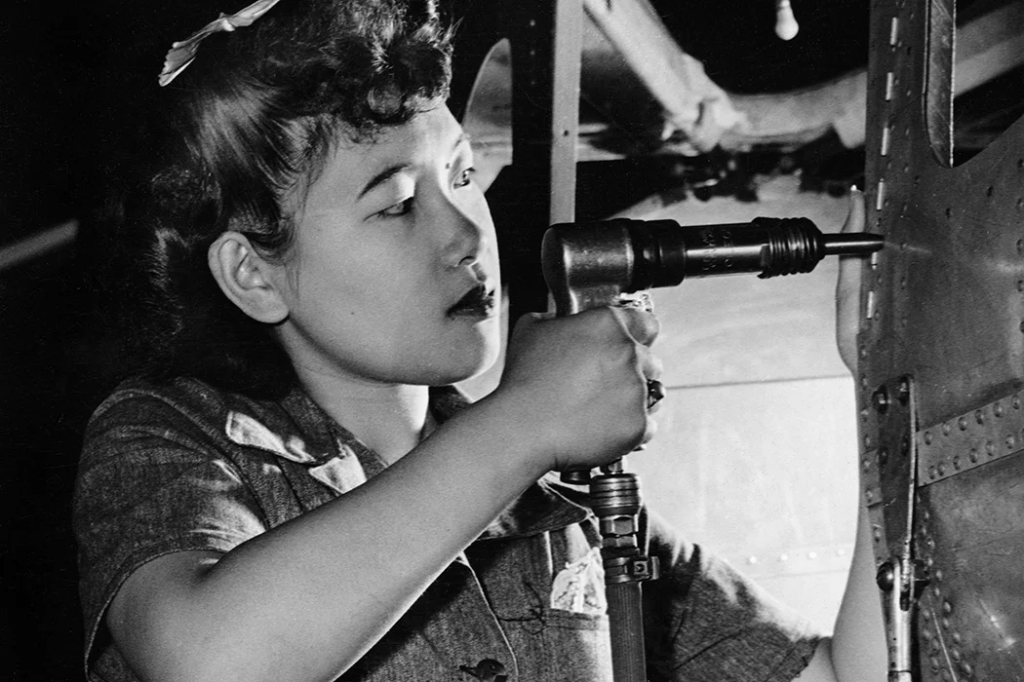
Could “Rosie the Riveter” Be Chinese American?
Despite having their citizenship withheld before the war, Chinese American women in the Bay Area made significant contributions to the wartime labor force.
By: H.M.A. Leow
Amid the social upheaval of World War II, women entered the American workforce on an unprecedented level. And, for younger Chinese American women in the San Francisco Bay Area, the war made it possible to smash not just entrenched gender barriers, but racial ones as well.
“To a large extent, the war provided an entry for Chinese American women into the larger American society, something for which their ancestors had struggled a hundred years,” writes historian Zhao Xiaojian, who argues that second-generation Chinese American women “grasped the wartime opportunity to enter the larger American society” by joining the Bay Area’s defense industry.
“Partly because of a scarcity of English-language sources on this topic, some scholars simply have assumed that Chinese American women did not share the experience of ‘Rosie the Riveter,’” she reports. But she uses newspapers, company records, and oral histories to push back on this view.
Many Chinese American women already worked out of economic necessity. Yet racial discrimination and social isolation typically restricted them to jobs in Chinatown enclaves.
“It was difficult for many Chinese American women to go outside their communities to work, even when they wanted to,” Zhao explains. “The decades-long isolation had also limited the ability of immigrant Chinese working women to communicate with the outside world.”
During the war, women were also encouraged to adopt domestic roles—preparing “nutritional food” for their families and “show[ing] our fighting men that we are… absolutely behind them.”
But World War II still marked a major turning point—especially for younger, unmarried daughters of Chinese immigrants. Many of these women had either a high school or college-level education.
“With relatively few household responsibilities, in contrast to their mothers, they had the freedom and independence to work outside the home,” Zhao writes. “Since most of them were already living in the Bay Area before the war, these younger Chinese American women were among the first American women to join the Bay Area’s defense labor force.”
In fact, Zhao’s research turned up only four women who were older than forty during their wartime jobs. Still, those wives and mothers capably juggled their duties at home and on the home front. (snip-More; it’s a worthy click!)
Peace & Justice History 11/16, 17:
| November 16, 1928 An obscenity trial began for Radclyffe Hall’s novel, “The Well of Loneliness.” Great Britain banned it for its treatment of lesbianism, though it contained no explicit sexual references.  A U.S. court in 1929 ruled similarly, for its sympathetic portrait of homosexuality, and because it “pleads for tolerance on the part of society.”  Radclyffe Hall Read more |
| November 16, 1989 Six Jesuit priests, their housekeeper and her daughter were brutally murdered by U.S.-trained and -supported death squads in El Salvador.In 1995 the United Nations Commission on the Truth for El Salvador linked the slayings to 19 members of the armed forces who were graduates of the School of the Americas (SOA, now known as Western Hemisphere Institute for Security Cooperation), a facility run by the U.S. Army at Fort Benning, Georgia. Over its 59 years, the SOA has trained over 60,000 Latin American soldiers in counterinsurgency techniques, sniper, commando and psychological warfare, military intelligence and interrogation tactics. The graduates have consistently used their skills to wage a war against their own people.  Among those targeted by SOA graduates are educators, union organizers, religious workers, student leaders, and others who work for the rights of the poor. The Truth Commission’s report More on the School of the Americas |
| November 16, 1990 President George H. W. Bush issued Executive Order 12735 which found the spread of chemical and biological weapons (CBW) to constitute an “unusual and extraordinary threat to the national security and foreign policy of the United States.” He declared a state of national emergency to deal with this threat. The order reiterated U.S. policy to lead and seek multilaterally coordinated efforts to control the spread of CW and BW and directed the secretaries of State and Commerce to adopt a variety of export controls. |
| November 16, 1994 After receiving assurances from the United States, Britain, and France, the Ukrainian Parliament approved Ukraine’s agreement to follow the Nuclear Non-Proliferation Treaty as a non-nuclear-weapons state. |
November 17, 1973  President Nixon told an Associated Press managing editors meeting at Disney World in Orlando, Florida, that “people have got to know whether or not their president is a crook. Well, I’m not a crook.” Read more  |
November 17, 1980 Hundreds were arrested at the Women’s Pentagon Action protest of patriarchy and its war-making. Read more |
| November 17, 1989 Riot police in Prague, the capital of Czechoslovakia, arrested hundreds of people demanding the resignation of the leader of the Communist-led government. More than 15,000 people, mostly students, took part in the demonstration demanding democratic rights. [see November 18, 1989 below] |
| November 17, 2000 The Florida Supreme Court froze the tallying of the state’s presidential election returns, forbidding Secretary of State Katherine Harris to certify results of the vote count in the presidential race between Republican George W. Bush and Democrat Al Gore. |
https://www.peacebuttons.info/E-News/peacehistorynovember.htm#november16