November 5, 1872 Susan B. Anthony and a few other women in Rochester, New York, voted in the presidential election, all of them for the first time. Susan B. Anthony She wrote later that day to her fellow suffragist Elizabeth Cady Stanton, “If only now—all the women would work to this end of enforcing the existing constitution—supremacy of national law over state law—what strides we might make . . . .” Anthony’s vote went to U. S. Grant and other Republicans, based on that party’s promise to consider the legitimacy of women’s suffrage. Elizabeth Cady Stanton Read Susan B. Anthony’s speech On Women’s Right to Vote
November 5, 1949 The Peace Pledge Union in Great Britain set up the Non-Violence Commission to study nonviolent resistance and how the ideas of Gandhi could be used to reach the Union’s goals of getting U.S. troops out of Britain and to end production of nuclear weapons there.
November 5, 1969 Bobby Seale Bobby Seale, a founder of the Black Panther Party, was sentenced to four years in prison on sixteen counts of contempt of court during the federal Chicago Eight trial in Chicago; he was charged for his insistent claims to the right to choose his own lawyer, or to represent himself. After the Chicago Eight verdict, the contempt charges were withdrawn.
November 5, 1982 36 were arrested in a demonstration at Honeywell, Minnesota’s largest defense contractor. The “Honeywell Project,” a local campaign against the arms maker, dogged the company for over three decades, at times with success. It continues today, targeting Alliant Technologies, the arms-making branch of Honeywell that was spun off in the 1990s. Protests at Alliant continue today. Alliant is the manufacturer for the Pentagon of artillery shells made with depleted uranium (DU or U-238, a by-product of uranium enrichment) which have been used extensively in Iraq and Kosovo. The Defense Department denies any health effects from use of DU (though army manuals warn soldiers of its toxicity), and contests accusations of DU’s role in Gulf War Syndrome. More about the Honeywell project from War Resisters’ international
November 5, 1987 Govan Mbeki, an early leader of the African National Congress, was released from South Africa’s Robben Island prison after serving twenty-four years (for treason). He served his sentence alongside Nelson Mandela, Walter Sisulu and many others who fought apartheid. Govan Mbeki His son, Thabo Mbeki, was elected in 1998 (and force to resign in 2008) to succeed Mandela, who was the first president elected following a new constitution which granted the right to vote to the entire non-white population, comprising 85% of the country’s population. Read more about Govan Mbeki
Music was a haven for me when I was young living in my parents’s house. Much of what I’ve heard and enjoyed throughout my life has had Quincy Jones’s hand involved. May he rest in power. This is sad.
You cannot write the history of Black music and entertainment without Quincy Jones. During his 70 year artistic career as a musician, producer and composer, his impact has been felt throughout our culture. According to a statement from his family, Jones died Sunday night at the age of 91, at his home in Bel Air, Calif. (snip-much MORE; tissue alert)
In Italy on Wednesday, the Italian Senate pushed forward the West’s most restrictive ban on international surrogacy, making it a crime punishable by prison time for Italians to use surrogates in another country. The move closes the door on same-sex couples’ last, best option to start a family in the country.
The far-right government of Prime Minister Giorgia Meloni had already banned both surrogacy and domestic or international adoption by same-sex couples in Italy.
The legislation amending existing Italian law would classify surrogacy as a universal crime transcending borders and impose a two-year prison sentence and a million-euro fine for defying it. The law also criminalizes work by Italian doctors, nurses and technicians in foreign fertility clinics that provide surrogacy services.
Last year, Meloni’s government barred Italian cities and towns from accepting birth certificates that list same-sex parents, denying their children access to citizenship, public schooling and healthcare. That edict is tied up in court.
The Senate’s passage of the anti-surrogacy law, 84 to 58, follows approval by the government’s lower house last year, virtually assuring its enactment.
Meloni has made “traditional values” a cornerstone of her tenure leading the Brothers of Italy party, despite being a single mother who never married. The far-right populist league was founded on the ruins of Benito Mussolini’s Republican Fascist Party in the aftermath of World War II.
“It’s like a truck hitting us in the face,” Pierre Molena, a gay man pursuing surrogacy abroad with his partner, told The New York Times.
“We are worried about our future and that of our children,” he said.
“It is nature that decides this, not us,” Sen. Susanna Campione, who voted in favor of the law, told the The Washington Post.
“This is a civilized law that safeguards the child but also the woman, since we believe that surrogacy essentially reduces a woman to a reproductive machine.”
While most U.S. states and Canada allow the practice, surrogacy has become a flashpoint in Europe. Germany and France ban domestic surrogacy, while it’s legal in the United Kingdom and Greece under certain circumstances. Pope Francis has labeled the practice “womb renting,” and called for a global ban.
About 250 couples a year in Italy pursue international surrogacy, according to legal experts. Ten percent of those couples are same-sex.
“This law is disgusting,” Salvatore Scarpa told the The Post. The gay dad and his partner had a daughter with a surrogate based in California last year and plan to have a second child with the same woman. They have an implantation planned for this month.
“They cannot stop our family. How dare they judge us,” he said.
Alessandra Maiorino, a member of Italy’s anti-establishment Five Star Movement, said the new law stigmatizes children already born to gay couples as well, telling lawmakers who voted for it: “It looks like you don’t realize these people already exist.”
Subscribe to the LGBTQ Nation newsletter and be the first to know about the latest headlines shaping LGBTQ+ communities worldwide.
A broken window on an LGBTQ fashion boutique storefront in Manhattan, New York on June 12, 2023.Photo: Shutterstock
There has been a 112% increase in documented attacks on LGBTQ+ people nationwide, according to a newly unveiled Anti-LGBTQ Extremism Reporting Tracker (ALERT) from the queer media watchdog organization GLAAD. GLAAD hopes to use the tracker to provide comprehensive reporting and analysis detailing anti-LGBTQ+ hate in the U.S. and the specific communities and targets affected by it.
ALERT recorded 524 such incidents between June 2022 and 2023 and 1,109 incidents from June 2023 to 2024. These attacks have included over 450 protests, 330 propaganda drops, 320 acts of vandalism, 200 bomb & mass shooting threats, 130 assaults, and 45 cases of arson that have resulted in at least 161 injuries and 21 deaths, GLAAD’s ALERT Desk reported.
While the cases focus on drag bans and trans protections, they address larger issues of free speech and civil rights.
The attacks have also included over 567 attacks on transgender and gender non-conforming people, 360 incidents targeting educational institutions and libraries, 325 incidents targeting Pride flags and other LGBTQ+ community symbols, 160 protests and violent threats against drag performers, and 140 incidents targeting health care providers of gender-affirming care and their patients.
The tracker, which will be updated quarterly, includes data on criminal and non-criminal acts of hate from sources like news media, partner organizations (like the Human Rights Campaign or Anti-Defamtion League’s Center on Extremism), right-wing forums on social media sites like Gab or chat apps like Telegram as well as incident reports submitted via GLAAD’s website. All documented incidents must occur against groups or individuals within the U.S. and must include harassment, threats, or actual violence specifically targeting LGBTQ+ people.
GLAAD’s ALERT team will verify the validity of each incident to maintain credibility, remove duplicates, and exclude spam and trolling, the organization said.
“The ALERT Desk tells a story not entirely captured by the FBI’s hate crime statistics because many of these incidents, like protests at Pride events, don’t meet the criteria necessary to bring legal charges [and] aren’t included in most official hate crime counts,” GLAAD wrote in its recently released report on ALERT’s findings. “However, we must recognize that the impact of these acts on local LGBTQ communities is felt regardless of whether or not the incident is prosecuted.”
“We must recognize that the impact of these acts on local LGBTQ communities is felt regardless of whether or not the incident is prosecuted.”
GLAAD’s 2024 report on ALERT’s findings
During a press call, Barbara Simon, senior director of news and campaigns at GLAAD, noted that ALERT seeks to contextualize anti-LGBTQ+ incidents to help media and other experts understand larger systems of violence.
“[Recently], there was a bomb threat against a library in Massachusetts,” Simon said, a threat against a Drag Queen Story Hour at the public library in Somerville. “But it’s not just about that library. It’s not just about the inclusive materials and programs they had, about how the bomb squad had to come in and sweep the library, how children and families and patrons had to evacuate the library.”
“Our data shows how that incident is connected to the bigger picture, which is more of a broad-based, systemic attack against LGBTQ people, our visibility, our equality and our allies,” Simon added. “It is one of 365 attacks nationwide against drag artisan events. It’s one of 63 anti-LGBTQ attacks in Massachusetts alone, one of 15 attacks specifically against drag in Massachusetts.”
The quarterly reports will also include stories from those affected by the incidents.
GLAADA bar graph showing anti-LGBTQ+ hate incidents from GLAAD’s ALERT Desk. | GLAAD
For example, Dr. Jack Turban, pediatric psychiatrist and director of the gender psychiatry program at the University of California in San Francisco, said during the press call that bans on gender-affirming care for youth in 26 states have worsened the mental health of his young trans patients even though they live in a state where such health care is protected. Their mental health has been worsened, Turban said, because of an increase in anti-trans rhetoric nationwide whose indirect effects cross state lines.
“Kids are hearing things like being trans is a mental illness, or being trans is bad, or you shouldn’t be allowed to use the bathroom that aligns with your gender identity because trans people are sexual assaulters, or you shouldn’t be allowed to play on sports teams with your friends because you’re going to physically hurt them,” Turban said. “My patients know that none of those things are true, right? They can know that, but if you’re hearing it every single day, all over social media and all over the news and now right in their communities, even it’s impossible to not be impacted by that.”
GLAAD pointed out that media coverage tends to falsely frame medical care for transgender people as a “debate” despite every major medical association supporting the care. This coverage compounds the effect of hateful rhetoric from anti-trans politicians, protestors, and pundits.
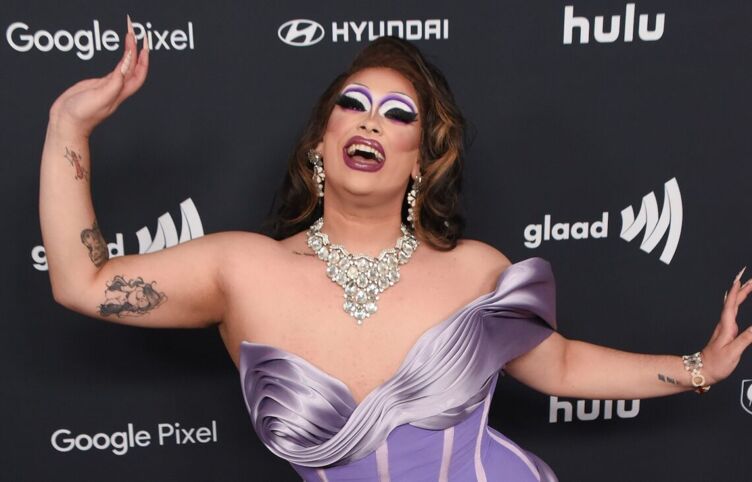
ShutterstockSalina EsTitties attends the 35th Annual GLAAD Awards on March 14, 2024 in Beverly Hills, California. | Shutterstock
The hateful rhetoric affects even LGBTQ+ celebrities and their fans, like Salina EsTitties, a competitor who appeared in Season 15 of RuPaul’s Drag Race. EsTitties told the press call that she’s generally insulated from hatred against gender non-conforming people since she lives in the very gay city of West Hollywood, California. However, she sees its impact whenever she travels to other states or posts social media videos about LGBTQ+ issues.
“There’s comments every single day of people being like, ‘This is not what God created. God created two genders. Oh, they keep adding alphabets. Oh, just shoot it between the eyes and get rid of it,’” EsTitties said. “The online hate is insane and there’s so much of it, and people are so willing to just let it all out, but it’s a clear representation of how people actually feel in America and across, you know, the U.S. here.”
“Not only are our LGBT community dealing with having to be their authentic selves,” she continued. “Being their authentic selves with just who they are outside of their queer identity is a lot to navigate, and it’s not easy, especially when people are telling you, ‘You’re the Devil, you’re a demon,’ or ‘It’s not acceptable to be that.’”
Hate crimes typically increase during presidential election years. Marie Cottrell, executive director for the New Jersey-based LGBTQ+ advocacy center Out Montclair, said she hopes that increased awareness of anti-LGBTQ+ hate incidents will empower communities to build intersectional coalitions between other demographic groups whose members are targeted by similar hate.
“I think that it’s really important that you be the person that the community needs,” Cottrell told the press call. “They need to see you stand for and with them. Find folks who in your community who will stand with you in the face of intolerance, build a community of support within your township — whether that’s forging a relationship with your LGBTQ liaison within the local police department … working with the township, the mayor, the town council, and really having open conversations … having conversations that address really hard questions and topics and that starts the process of understanding and healing in your community.”
“It’s a small step, but it’s a step forward and a step forward in helping others understand the community,” she said.
Subscribe to the LGBTQ Nation newsletter and be the first to know about the latest headlines shaping LGBTQ+ communities worldwide.
The stakes in United States v. Skrmetti are even higher than most Americans realize and could have wide-reaching consequences if the court rules to keep the ban on gender-affirming care in place.
This piece was published in partnership with The 19th, a nonprofit newsroom covering gender, politics, and policy. Sign up for their newsletter here.
A Supreme Court case that will decide whether Tennessee can continue to ban gender-affirming care for transgender youth could imperil the ability of all Americans to make decisions about their health care, experts say. The outcome depends on how far the court is willing to stretch its ruling that overturned federal abortion rights.
In United States v. Skrmetti, the court has agreed to take up the question of whether gender-affirming care bans for trans youth are unconstitutional, in response to the Biden administration petitioning on behalf of trans youth and their families in Tennessee — one of 26 states that has bannedsuch care for minors. The outcome of the case will grant much-needed clarity in a political landscape that has thrown the lives of trans people across the country into turmoil, as hospitals turn patients away, pharmacies deny prescriptions and families travel hundreds of miles to find care.
But with the case set for oral arguments on December 4, the stakes are even higher than most Americans realize, legal and policy experts say. Tennessee has banned gender-affirming care, such as puberty blockers and hormone replacement therapy, for a specific demographic — trans youth — while allowing those same treatments for cisgender youth. If the Supreme Court allows the state to keep its ban in place, that could imperil everyone’s access to health care.
“What the state of Tennessee is arguing is really dangerous for any person who has any sort of medical condition,” says Ezra Young, a civil rights lawyer and constitutional scholar. Tennessee is dictating what medical treatments people should or should not be allowed to have, Young said; that goes well beyond states’ authority to regulate medicine, specifically because giving health care to trans people is not a public health concern.
“The state can make sure that the doctor you see has a medical degree and has an active medical license, for instance,” he says. “What the state can’t do is micromanage the medical decision-making of patients or doctors, and that’s for good reason. Bureaucrats or lawmakers aren’t medical experts.”
Yet in half of U.S. states, Republican lawmakers have banned or restricted medical care that many trans people need to live, over the protests of the American Medical Association, American Psychiatric Association, and other leading medical groups. Federal judges have attempted to block these bans from taking hold, finding them to be likely unconstitutional. Appeals court judges have disagreed and overturned those decisions. Now, the Supreme Court will have the final say.
“If we don’t win here, it’s going to be open season on any health care related to transgender people,” says Shannon Minter, legal director of the National Center for Lesbian Rights. If the Supreme Court holds that banning gender-affirming care is not discriminatory, then trans people would no longer be protected under the Affordable Care Act, he argues. States and private insurers would be able to exclude gender-affirming care from coverage plans.
“It would be devastating. I mean, absolutely catastrophic,” Minter says.
Ultimately, the outcome of this case will have a wider impact beyond gender-affirming care. A Supreme Court ruling endorsing Tennessee’s argument that the state can ban safe medical care — just because it disagrees with who that treatment is being given to — would enable the government to control people’s health decisions and enact other blatantly discriminatory policies, legal experts say.
“I think this case has bigger and broader implications than a lot of people realize, even frankly within the legal community,” says Michael Ulrich, an associate professor of health law, ethics and human rights at Boston University’s School of Public Health and School of Law. If the Supreme Court agrees with Tennessee’s ban, there’s nothing stopping states from banning or restricting other kinds of health care, he said — like what gets covered under Medicaid.
Solicitor General Elizabeth Prelogar’s office, representing the Biden administration, will split argument time before the Supreme Court with Chase Strangio, co-director of the American Civil Liberties Union’s LGBTQ & HIV Project.
The United States v. Skrmetti case is focused on whether Tennessee’s gender-affirming care ban violates the 14th Amendment’s equal protection clause, which prohibits discrimination on the basis of sex. The state insists that its ban has nothing to do with sex and that it does not target trans people. Instead, the law “sets age and use-based limits,” Tennessee’s attorney general argues. Minors can still access hormones and puberty blockers for medical purposes, as long as those treatments are not being used as part of a gender transition or to alleviate gender dysphoria. The state claims such a distinction is not based on sex because “neither boys nor girls can use these drugs for gender transition.”
In Dobbs v. Jackson Women’s Health Organization, the Supreme Court found that there is no constitutional right to an abortion in the United States. This ruling overturned Roe v. Wade, the landmark case that had guaranteed the right to an abortion since 1973. When writing the majority opinion in Dobbs, Supreme Court Justice Samuel Alito briefly addressed a theory that suggests abortion could be covered under the 14th Amendment’s equal protection clause. This idea is not part of Roe, or at issue in Dobbs, but was invoked in a separate “friend of the court” brief. Alito dismissed it, saying that state regulations on abortion do not discriminate based on sex.
“So that’s what the state of Tennessee is now latching on to, this passing reference, this brief statement in Dobbs, and they’re pinning their whole argument on it,” says Minter. “Everything hinges on it.”
In Dobbs, Alito wrote that abortion cannot be protected under the 14th Amendment’s equal protection clause, citing the arcane Geduldig v. Aiello — a case about pregnancy-related disability benefits — and Bray v. Alexandria Women’s Health Clinic, a case dealing with the rights of anti-abortion protesters. These rarely cited cases found that state regulations on abortion and pregnancy, or opposing abortion, are not sex discrimination. Tennessee is now using this framework to argue that “any disparate impact on transgender-identifying persons” caused by its law does not single trans people out for discrimination in ways covered by the 14th Amendment.
If the state’s gender-affirming care ban is found by the Supreme Court to be discriminatory under the 14th Amendment, it is subject to heightened scrutiny — a more rigorous review to determine whether a law is constitutional or not. In that scenario, Tennessee is more likely to lose.
Using abortion case law to support bans on gender-affirming care is especially dangerous, experts say. Tennessee is taking the Supreme Court’s own decision in Dobbs out of context, according to lawyers who have worked in LGBTQ+ rights cases for decades. And, if the justices read Tennessee’s law, it is obvious that banning gender-affirming care for trans people is discriminating based on sex, they say.
The United States v. Skrmetti case is focused on whether Tennessee’s gender-affirming care ban violates the 14th Amendment’s equal protection clause, which prohibits discrimination on the basis of sex. The state insists that its ban has nothing to do with sex and that it does not target trans people. Instead, the law “sets age and use-based limits,” Tennessee’s attorney general argues. Minors can still access hormones and puberty blockers for medical purposes, as long as those treatments are not being used as part of a gender transition or to alleviate gender dysphoria. The state claims such a distinction is not based on sex because “neither boys nor girls can use these drugs for gender transition.”
But, although the question before the court has become more specific, this ruling still has the potential to broadly set back LGBTQ+ rights.
Tennessee argues that the Supreme Court’s 2020 ruling in Bostock v. Clayton County, which found that employment discrimination against LGBTQ+ workers is sex-based discrimination prohibited under the Civil Rights Act, has nothing to do with this case. But going down this road leads to more questions, Ulrich says: Is discriminating due to sexual orientation also not considered sex-based discrimination?
“Then you can see just a proliferation of discriminatory laws that are coming out thereafter,” he says. “That’s a really dangerous proposition for the entire LGBTQ+ community and it’s setting us back significantly.”
Sruti Swaminathan, an ACLU staff attorney who has been counsel in this case from the beginning, said United States v. Skrmetti will test how far the Supreme Court is willing to stretch its Dobbs decision. They are well aware that the outcome of this case could curtail bodily autonomy for everyone. And taking this challenge before a conservative-majority Supreme Court has stoked fears among trans people of worst-case scenarios.
“We’re already at the place where half the country has banned this care. We need to not let the 6th Circuit decision stand idly and be utilized in the way it has,” Swaminathan says.
But Tennessee’s tactics, and the consequences that they could have during a time when laws targeting reproductive and transgender health care are proliferating, still worry them.
“I’m terrified. What we learned from Dobbs is that these attacks won’t stop with abortion,” Swaminathan says. “Banning abortion seems to be one pillar of an effort to write outdated gender norms into the law.”
U.S. v. Skrmetti began as a lawsuit against Tennessee’s ban on gender-affirming care for minors.
Tennessee’s argument in this case illustrates a larger coordinated effort to attack abortion access alongside gender-affirming care, says Logan Casey, director of policy research at the Movement Advancement Project, a nonprofit that tracks LGBTQ+ legislation.
States across the country have attempted to define sex based on reproductive capacity at birth. These efforts open transgender people up to discrimination and ignore the realities of intersex people, as well as cisgender women with conditions like primary ovarian insufficiency. Proponents of gender-affirming care bans inaccurately portray the effects of hormone replacement therapy on trans people’s reproductive ability by conflating the treatment with sterilization.
This Supreme Court case exemplifies a much larger argument that’s been a through line across attacks on transgender care and trans issues across the country, Casey says: What is sex, and who is protected when we think about that?
“Many of these state actors and politicians and extremists are clearly very invested in the concept of sex and defining sex in a very restricted and extraordinarily old-fashioned way that focuses only on people’s reproductive capacity, and then they use that argument in whatever context they can to advance the policies that would match that worldview,” he says.
(I don’t know if this is gonna work; I’m not on Instagram, but I went there, and could see, hear, read, and got the embed link. MomsRising is asking for shares, so if anyone cares to share, thank you!)
November 2, 1920 Socialist Party candidate Eugene V. Debs received nearly one million votes for President though he was serving a prison sentence at the time for his criticism of World War I and his encouraging resistance to the draft. More on Debs
November 2, 1982 Voters in nine general elections passed statewide referenda supporting a freeze on testing of nuclear weapons. Only Arizona turned it down. Dr. Randall Forsberg, a key person behind the Freeze movement Dr. Randall Forsberg
November 2, 1983 A bill designating a federal holiday honoring Dr. Martin Luther King, Jr. (to be observed on the third Monday of January) was signed by President Ronald Reagan. King was born in Atlanta in 1929, the son of a Baptist minister. He received a doctorate degree in theology and in 1955 organized the first major protest of the civil rights movement: the successful Montgomery Bus Boycott. Influenced by Mohandas Gandhi, he advocated nonviolent civil disobedience of the laws that enforced racial segregation. The history of Martin Luther King Day (pdf)
and reblogging this one from Keith. I hate giving the Don any time at all, but the bottom line of this is that the young people are seeing this, some for the first time, as they were in middle and high school in 2016.

 Susan B. Anthony
 Elizabeth Cady Stanton
 Bobby Seale
 Protests at Alliant continue today.
 Govan Mbeki