October 27, 1659 William Robinson and Marmaduke Stevenson, two Quakers (formally, members of the Society of Friends) who came from England in 1656 to escape religious persecution, were executed in the Massachusetts Bay Colony for their religious beliefs. The two had violated a law, passed by the Massachusetts General Court the year before, banning Quakers from the colony under penalty of death. Quakers opposed central church authority, preferring to seek spiritual insight and consensus through egalitarian Quaker meetings. They advocated sexual equality and became some of the most outspoken opponents of slavery in early America.
October 27, 1967 Phillip Berrigan, artist Tom Lewis, poet David Eberhardt, and United Church of Christ minister James Mengel, members of the Baltimore Interfaith Peace Mission, entered the draft board at the United States Customs House and poured duck’s blood on several hundred draft records. Phillip Berrigan pouring blood on draft files The Baltimore Four, as they became known, were arrested and later tried and convicted for the action which they saw as a symbolic act of civil disobedience — a nonviolent attack on the machinery of war. This day later became known as Plowshare Action Remembrance Day. Berrigan in his jail cell drawning by Tom Lewis Read more about Phillip Berrigan
October 27, 1967 120,000 marched against the Vietnam War in London. Violence erupted when a 6,000-strong Maoist splinter group broke away and charged the police outside the United States Embassy in Grosvenor Square. Read more
October 27, 1969 Ralph Nader set up a consumer organization with young lawyers and researchers (often called “Nader’s Raiders”) who produced systematic exposés of industrial hazards, pollution, unsafe products, and governmental neglect of consumer safety laws. Ralph Nader (center) Nader is widely recognized as the founder of the consumer rights movement. He played a key role in the creation of the Environmental Protection Agency, the Occupational Safety and Health Administration, the Freedom of Information Act, the National Highway Traffic Safety Administration, and the Consumer Product Safety Commission. Read more
October 27, 2002 Luiz Inacio Lula da Silva Luiz Inacio Lula da Silva was elected president of Brazil in a runoff, becoming the country’s first elected leftist leader. Read more
A teacher in Manchester, England, who outed a trans student and posted transphobic messages on social media is now banned “indefinitely” from teaching in England.
Prior to the decision, Camilla Hannan had admitted to posting a series of tweets in which she outed a student of hers as trans and disparaged the trans kids at her own school. Though the panel convened in September, the UK’s Teaching Regulation Agency posted the decision online on Tuesday.
(snip)
“In particular, the panel found that Miss Hannan had a deep-seated attitude, and that, whilst she was entitled to have that attitude and hold the views that she did, it was not acceptable for her to have posted these on social media in a way that was damaging to the profession, the school, pupils and in particular Pupil A,” the report reads.
Hannan will be allowed to appeal the decision in two years, though the panel’s decision did not bode well for any future lifting of the suspension. “It is necessary to impose a prohibition order in order to maintain public confidence in the profession,” the report reads.
This summer, a group of 20 trans teen activists gathered outside the U.K. Department of Education’s London Headquarters in order to demand greater protections for trans students. Activists hoped to underscore the “urgent need for policy changes that respect and protect the rights of trans youth, including their rights to autonomy, safety, trust, respect and inclusion.” One of their demands included protection from transphobic bullying, misgendering, and deadnaming, something that is apparently just as applicable to teachers as fellow students.
October 26, 1916 Margaret Sanger and her sister were arrested for disseminating birth control information at her Brownsville Clinic in Brooklyn; she was arrested again a few weeks later for the same reason and the police shut the clinic down within 10 days. Margaret Sanger
October 26, 1970 Garry Trudeau, 1976 “Doonesbury”, a cartoon series addressing political and social issues written by Garry Trudeau, and initially published in a the Yale Daily News when Trudeau was a student, debuted in 28 newspapers.
October 26, 1986 President Ronald Reagan vetoed a bill passed by the Congress that would have imposed trade sanctions on the racially separatist apartheid regime of South Africa.
October 26, 1994 Israeli Prime Minister Yitzak Rabin and Jordanian Prime Minister Abdelsalam al-Majali, with President Clinton in attendance, formally signed a peace treaty ending 46 years of war at a ceremony in the desert area of Wadi Araba on the Israeli-Jordanian border. President of Israel Ezer Weizman shook hands with Jordan’s King Hussein. Read more
Again I wish to thank Janet, whose link I will place below, for showing me the article that had this link. I was in a bit of despair of having to fight all over the same fights I fought as a kid. Not realizing for years my fight was over while hers has continued. I realized how self centered I was being. I am not sure if the links will come through, but if you go to the site linked above they list states where anti-trans attacks have failed. Again thanks Janet. Hugs
Voters have routinely rejected candidates who peddle transphobia and try to control their personal health care decisions, and polling shows widespread American support for equality, Democrats as defenders of young people, and a rejection of anti-transgender rhetoric.
In State After State, Anti-Trans Attacks Have Failed
In Arizona…
In Georgia…
In Kansas…
In Kentucky’s 2023 gubernatorial race…
In Michigan…
In Nevada…
In Ohio…
In Pennsylvania…
In Wisconsin…
In Virginia…
In 2022 Post-Election Polling, Equality Was a Winner and Anti-LGBTQ+ Attacks Were A Dud
Equality Voters delivered huge margins to Democrats at every level of the ballot.
At the U.S. House level, 81 percent of Equality Voters supported the Democratic candidate. Equality Voters delivered similar margins for Democratic U.S. Senate candidates and Democratic candidates for governor.
That number was comparable to the level of support Equality Voters gave Joe Biden in 2020 (also 81 percent) and nearly matched the level of support Black voters delivered this cycle (87 percent).
Among self-identified LGBTQ+ voters, who made up a midterm record 7 percent of the 2022 electorate, fully 80 percent supported U.S. House Democrats. LGBTQ+ voters delivered similar margins for Democratic U.S. Senate candidates and Democratic candidates for governor.
MAGA efforts to spread propaganda about and attack transgender people failed.
In this survey, voters were asked which specific issues motivated them to vote this year. Inflation (52 percent) and abortion (29 percent) ranked first and second on this list. Less than 5 percent identified gender affirming care for transgender youth or transgender participation in sports as issues motivating them to vote – last on this list.
This confirmed extensive research prior to the election that found anti-transgender attacks were only effective in riling up extreme members of the conservative base
While the attacks were ineffective with the general electorate and in fact repelled swing voters, they still caused harm, including increasing stigma, discrimination, and violence against the transgender community.
A Super Majority of Americans Support Equality
New data from Navigator Research shows strong majority support for LGBTQ+ equality, and deep concern over MAGA attacks on fundamental freedoms.
Nearly two-in-three Americans support federal nondiscrimination protections for LGBTQ+ people, including 58% of independents and 42% of Republicans.
61% say they will not support candidates who want to ban health care for transgender people, including 59% of independents and 41% of Republicans.
70% say they are concerned that politicians are attacking gay and transgender youth to divide us, maintain their political power and control, and score political points, a clear indication that the American people see through the MAGA anti-LGBTQ+ agenda.
A majority of Americans agree that parents, mental health professionals, and doctors are best equipped to decide the kind of care a child needs, not politicians.
The vast majority of Americans — 7 in 10 — think that politicians are not informed enough about abortion and gender-affirming care to create fair policies
According to September 2023 polling by The 19th and SurveyMonkey, Americans would prefer that politicians either protect transgender people or not focus on transgender issues at all. Only 17% of Americans, and only 29% of Republicans, say politicians should focus on restricting gender-affirming care.
Americans Believe the Amount of Anti-LGBTQ+ Legislation Is Excessive, Agreeing It Is “Political Theater”
Likely voters across all political parties look at GOP efforts to flood state legislatures with anti-LGBTQ+ legislation as political theater. Polling indicates that 64% of all likely voters, including 72% of Democrats, 65% of Independents, and 55% of Republicans think that there is “too much legislation” aimed at “limiting the rights of transgender and gay people in America” (Data For Progress survey of 1,220 likely voters, 3/24-26, 2023).
This quote from Cuban-American former Republican Congresswoman Ileana Ros-Lehtinen sums it up:
“Intolerance is not a good look on anyone. I remain optimistic that voters will see through this charade and will encourage their elected officials to solve the real problems of America instead of masquerading as Moral Police Officers.”
Majorities Disapprove of Banning LGBTQ+ Content in Schools – and Seem Prepared to Punish Candidates Who Do So
When asked if middle school libraries should include materials related to “gender identity” (57% “should”) and “sexual orientation” (56%), the majority of Americans believe this content should be available. In fact, by a margin of 32 percentage points, Americans are more worried that “materials that could be valuable to students will be removed from school libraries”(62%), than worry that “materials that could be harmful to students will remain in school libraries”(30%).
Yet again, Democrats and Independents are in a different place than their GOP counterparts suggesting headaches for Republicans in the 2024 elections. (Grinnell College National Poll, 3/14-19, 2023)
Indeed, it looks like this issue could be a disqualifier for elected officials who support curriculum censorship and book bans, based on recent polling (Ipsos, 4/24-25, 2023 among 1,005 adults nationwide, the vast majority of whom are registered to vote). More than six in 10 Americans say they would be less likely to back a candidate who “supports policies that ban books in schools and in school libraries on subject matter that deals with sex, sexual orientation, and gender identity”(38% more likely, 62% less likely).
And Americans Trust Democrats to Defend Equality, Youth Wellbeing
The 2024 Navigator Research poll showed that President Biden and the Democratic Party are more trusted than Republicans to safeguard LGBTQ+ equality and protect America’s youth.
60% of those polled say they trust Democrats to protect the LGBTQ+ community, compared to just 19% who say they trust the GOP.
54% say they trust Democrats to protect the rights and freedoms of the community, compared to just 22% who say they trust the GOP.
46% say they trust Democrats to care for children’s wellbeing, compared to just 37% who say they trust the GOP.
In a terrifying moment for American Jews, the org is nowhere to be found.
(I followed Marisa Kabas’s Substack. She was organizational in working to get Substack to stop allowing Nazis to monetize their Substacks. When Substack decided they weren’t going to do that, she broke away and writes her work on her own Handbasket. I wish I had the money to support her, but I can share her work, and this piece is extra-important. -A)
Did you know that two separate stories dropped this week in which former Trump officials said he praised and admired Hitler while in office during his first term?
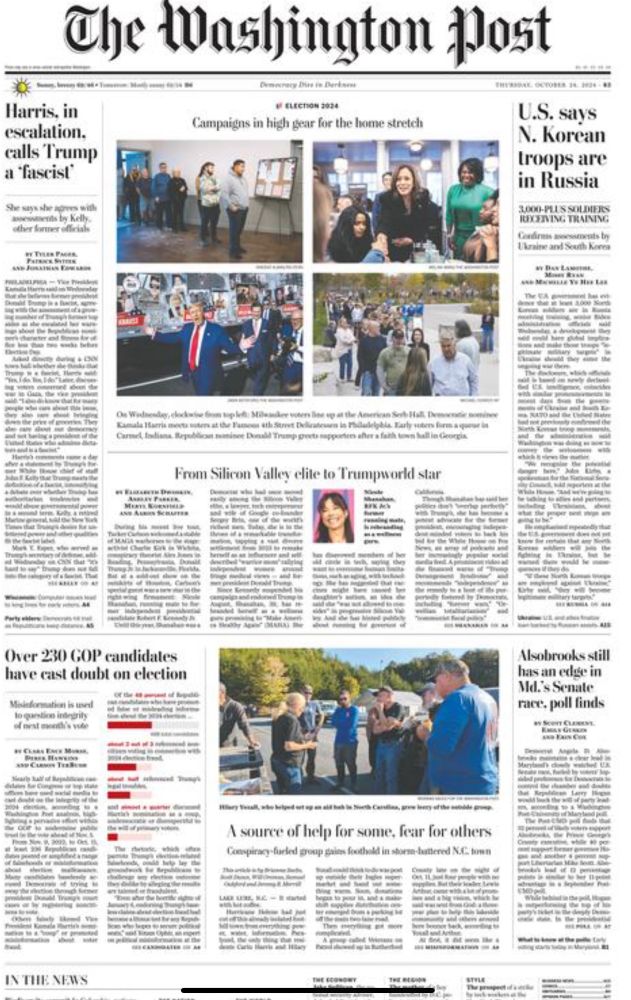
No, it’s possible you didn’t. It wasn’t on the front page of major newspapers. It didn’t warrant major cable news segments. The Anti-Defamation League didn’t even consider it worthy of a response. To put a finer point on it: The Republican candidate for the Presidential election taking place in less than two weeks openly praised Hitler and it was met with a yawn. How did we get here? How is this happening?
For background, The Atlantic published a story with details of a disturbing conversation:
As his presidency drew to a close, and in the years since, he has become more and more interested in the advantages of dictatorship, and the absolute control over the military that he believes it would deliver. “I need the kind of generals that Hitler had,” Trump said in a private conversation in the White House, according to two people who heard him say this.
Then an interview with former Chief of Staff John Kelly published by the Times on Tuesday evening included this bit:
Trump told him that “Hitler did some good things.”
Mr. Kelly confirmed previous reports that on more than one occasion Mr. Trump spoke positively of Hitler.
“He commented more than once that, ‘You know, Hitler did some good things, too,’” Mr. Kelly said Mr. Trump told him.
Mr. Kelly said that Mr. Trump had little appreciation for history — “I think he’s lacking in that,” he said — but said that he would still try to explain to Mr. Trump why those comments about Hitler were problematic.
It was bad enough that Vice President Harris addressed it in brief remarks from her DC residence Wednesday afternoon. “It is deeply troubling and incredibly dangerous that Donald Trump would invoke Adolf Hitler — the man who is responsible for the deaths of 6 million Jews, and hundreds of thousands of Americans,” she said.
It’s difficult for me to be incredulous anymore after nearly 10 years of a Trump-clogged news cycle, but this one makes me want to yell at the Editor-in-Chief of the New York Times, “We’re talking about Hitler! The man who orchestrated the mass murder of Jews! Your own paper has evidence that Trump admires him! Sound the alarm!”
The interests of media bosses have always been at odds with reporters and readers, but now that conflict has been laid bare.
Though the story failed to be a media priority, I figured the ADL, the country’s most prominent Jewish nonprofit with a mission of combating antisemitism in all forms, would have something to say. Yet when I looked at their website, I saw nothing (aside from an announcement of a “Concert Against Hate” hosted by Ben Stiller and featuring Sia.) Their social media feeds were similarly void of any reference to Trump and Hitler.
So on Wednesday afternoon I reached out with a brief synopsis of Trump’s positive comments on Hitler and asked if the ADL had a comment. More than 24 hours later: silence. I followed up Thursday morning and reached out via multiple social platforms to the organization and its CEO Jonathan Greenblatt. Still, nothing.
The ADL’s failure to address Trump praising Hitler isn’t shocking, given their selective outrage in the past year about which Jews are worthy of defense, and the fact that they honored Jared Kushner with an award earlier this year. Greenblatt issued a rare rebuke of Trump in September after the Republican candidate said “If I don’t win this election…. the Jewish people would really have a lot to do with that if that happens.” But other than, Greenblatt has continually shown his willingness to kowtow to power, whether it be Trump or Elon Musk. And the current silence is galling.
Why fixate on the response of one nonprofit organization? Well, because the ADL—with Greenblatt as their public face—has positioned itself as the arbiter of what is and is not antisemitic. Whenever you’re reading an article and it cites a figure about the number of antisemitic incidents in the country, that’s likely a stat from the ADL’s annual audit. In the wake of the October 7th attacks in Israel, they’ve frequently conflated antizionism with antisemitism—so much so that Wikipedia’s editors voted in June to designate the organization as “generally unreliable” source on antisemitism. But still they’re considered an authority on the wants and needs of American Jews.
This dangerous conflation has led to the unfair persecution of Jews against Israel’s mass murder of Palestinians, including a Harvard student who was accused of antisemitism for posting protest posters ahead of Yom Kippur. There is no world in which this makes it safer to be Jewish.
Greenblatt found time in the past two days to tweet about his loathing for Jewish pro-Palestine student protesters, but didn’t have a moment to spare for the single-most terrifying thing an American Jew could read: that the potential next president thinks Adolf Hitler was good.
Sadako Sasaki, following the Japanese custom of folding paper cranes – symbols of good fortune and longevity – persisted daily in folding cranes, hoping to create senbazuru (1000 paper cranes strung together) when a person’s dream is believed to come true, died.
Sadako was two years old when the atom bomb was dropped on Hiroshima and at 12 was diagnosed with Leukemia, “the atom bomb” disease. Children’s Peace Monument in Hiroshima showing Sadako holding a golden crane Photo: Mark Bledstein
OK this is what the right wing regressive movement is all about. A teen happy with who he was and his friend who may or may not be gay as well, both being harassed and threatened for simply being open about themselves. They were harming no one, but some asshole right wing adult took offense and wanted to teach them fear for being different from straight cis folk. This is the right wing / Christian nationalism desire for a 1950s fake culture of only the things they demand be accepted being seen in society. I remember a person I knew who was elderly asking me why we gays just couldn’t stay in the closet and not let anyone know, it was better then. I asked for whom? The answer was those straight cis happy people.
One of the co-founders of the Florida don’t say gay bill that started all this was a hyper fundamentalist Christian who publically said he wrote the bill because he was upset and disgusted that kids were coming out to their peers and being accepted instead of ostracized, humiliated, and beaten up. He hated that students, young kids were not targeted for abuse by other kids and teachers. That stuck with me and burned deeply. The reason is below.
One day I in science class led by a large what today we would call a maga person teacher, after class ended and I gathered my stuff and started to exit the room I was attacked by a very large kid and his friends. I was small, about 60 pounds, not even five foot. I got smashed in the face and body, hit till I fell to the floor. I knew this feeling, I got it at home, so I did what I did then, covered my face already full of blood, curled up tight and took the kicks and blows. Before the bell rang again they moved off and I started to uncurl when the teacher grabbed by my shoulder and wrenched me around to face him. Through tearing blurry eyes I watched as he told me, “This is what you get for being a fagot and I hope they do it again and again” I went to the bathroom and tried to wash up and stop the blood. I sat a few classes in the bathroom. I got marked absent for those classes but no one asked why. This the world this person who wrote the “Don’t say gay” bill wants to bring back, that they are proud of. Hugs. Scottie
WA man accused of tying noose around teen’s neck because he said he was gay
A 38-year-old man was arrested this week in Kitsap County after deputies say he tied a noose around a 14-year-old boy’s neck because the teen said he was gay.
On Monday, Oct. 21, the man overheard his 13-year-old son and his son’s friend talking, and asked if he was gay.
Video at link above
According to the Kitsap County Sheriff’s Office, the teen said, “yes,” and the man wrapped the rope around his throat. The teen managed to escape.
Deputies said the man also lassoed his son with the rope a few minutes later, and he also escaped.
Video at link above
The 14-year-old boy went home and told his mother about the incident, and she reported it to the sheriff’s office.
Deputies arrested the man, and the Kitsap County Sheriff’s Office said he was charged with a hate crime and two counts of second-degree assault.
WA man accused of tying noose around 14-year-old boy who said he was gay
The Kitsap County, Washington man was arrested Oct. 21 and accused of a hate crime. The 38-year-old man is accused of tying a noose around a 14-year-old before lassoing his own 13-year-old son.
The man was arraigned on Tuesday with bail set at $50,000.
A 38-year-old Bremerton man was arrested Monday in connection with an alleged assault involving two boys, including his biological son, according to the Kitsap County Sheriff’s Office. Joseph Sweeney faces multiple charges, including second-degree assault and a hate crime.
The arrest followed allegations that Sweeney assaulted the two boys on October 20. According to the court documents, Sweeney asked his 13-year-old son’s friend if he was gay; when the teen said, “Yes, is it a crime to be gay in this house?” deputies said Sweeney put a noose around his neck and tightened it.
Sweeney allegedly recorded both boys with his cell phone while telling them to kiss each other in an effort to humiliate them, detectives said in the court documents. A search of Sweeney’s residence also led to the discovery of a firearm, which he is prohibited from possessing due to a prior domestic violence protection order issued in Kansas City in 2023.
Just a reminder that when Georgia GOP district chair Kandiss Taylor told Stew Peters that she wanted "extreme accountability" for those who oppose Christian nationalism, she meant public execution. https://t.co/IReOcMx1Hbpic.twitter.com/FwE9xCfBrk
The moron wanted to combat hurricanes with nuclear weapons.
"Since #Trump bought Mar-a-Lago in 1985, there have been 18 Category 5 Atlantic hurricanes. 4 of them made landfall in the US while he was President. Yet today he says he's never heard of there being Cat 5 hurricanes." https://t.co/9snWMO9hwo
For more than half a century, the major party candidates for president have sat down with 60 Minutes. This year, Vice President Kamala Harris and former President Donald Trump accepted our invitation. Unfortunately, last week Trump canceled. https://t.co/7t5jr5nyFJpic.twitter.com/VDJDDNYFab

 Phillip Berrigan pouring blood on draft files
 Berrigan in his jail cell drawning by Tom Lewis
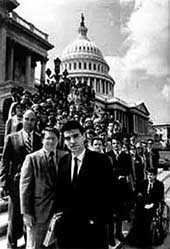 Ralph Nader (center)
 Luiz Inacio Lula da Silva
 Margaret Sanger
 Garry Trudeau, 1976

 Sadako Sasaki