This is a threat. Look at what they called it in the article, a loving warning to change your ways … just as burning a cross was a threat, not simply a loving request you leave town. The thing that gets me is no one cares if these people want to have their belief and their opinion, no one cares that they refuse to admit modern science says people are born LGBTQIA as long as they don’t act on it. They have a right to their beliefs, they do not have a right to force others to believe what they do. Yet this is what they constantly do, and are doing here. They have their churches, put these at their churches and pray over them. But that is not threatening enough, not enough to force others to live by their church doctrines and beliefs. I am tired of these people and sick of their faith, and beginning to despise their god. Their god is a hateful vengeful mean bully. He is tRump. Love me or else I hurt you. Hugs. Scottie
Last year, on February 28, 2023, a concrete replica of a millstone was left in front of the CRU Wine Bar and Coffee Shop on Turner Street in Beaufort, NC. Not just any millstone, but cast into its face was the Scripture reference Luke 17:2 and it’s inner and outer rims were painted in rainbow colors.
CRU Wine Bar and Coffee Shop had been sponsoring a “Youth Queer Night,” and openly admitted as such in the midst of the incident. But right out of the leftist playbook, they immediately shifted over to victim status, pleading the millstone was a threat to them and the LGBTQ community.
Far from being a threat to the LGBTQ community, the Rainbow Stone is actually a loving warning that, like everyone else, they need to repent of sin, receive the work of Jesus on the Cross, and be saved from a certain fiery judgment.
Read the full article. Luke 17:2 calls for drowning people who endanger children by tying a millstone around their neck. The owners of the bar say they considered the millstone to be a death threat.
Christians in Beaufort, NC, left this concrete millstone in front of the CRU Bar on Turner St. who was sponsoring a regular “Youth Queer Night.” Made quite a statement. There are people fighting back! pic.twitter.com/6yJmrrcKw1
Studies with fMRI imaging* have shown that believers reflecting on “what God wants” activate the very same brain areas as people reflecting on what they themselves believe.
* (Forgive me, JMG language police, for I have sinned. I have commited RAS syndrome, Redundant Acronym Syndrome syndrome, like entering your PIN number into an ATM machine.)
Their first mistake is assuming that those people who go there are Christian. Can you imagine the outcry if a different religious group did something similar to a church?
Why do the republicans hate young people on social media? Because it exposes them to ideas that are now banned in Florida schools. It is about information control, it is about indoctrination to a conservative mindset / ideology. Think of it, even though the republicans managed to remove all reading material from schools about LGBTQIA people so LGBTQIA kids won’t see themselves represented and other students won’t see that the LGBTQIA kids are as normal as they are, young people can still see it on social media where the stars they love tell them that it is OK to be different. Plus social media clearly shows how wrong and backwards the Republican Party is, and how out of touch a minority the fundamentalist Christians are. Then you have the times that social media influences older teens to vote progressive / democrat, not regressive conservative like the state wants them to do. Social media also makes republicans and maga look as stupid as they are, mocking them, and showing young people out of touch with the modern times the fundamentalist Christian republicans are. Hugs. Scottie
Language for a new social media bill with provisions for parental consent has been filed in the Senate. The move came after Gov. Ron DeSantis vetoed an all-out ban on those under 16 using most social media platforms.
Sen. Erin Grall, a Fort Pierce Republican, filed an amendment with new language negotiated with the House, Senate and Governor’s Office. The legislation includes exemptions for 14- and 15-year-olds to open accounts on any platform so long as they have a parent’s permission.
“A social media platform shall prohibit a minor who is 14 or 15 years of age from entering into a contract with a social media platform to become an account holder, unless the minor’s parent or guardian provides consent for the minor to become an account holder,” the amendment states.
Read the full article. The bill vetoed yesterday by DeSantis would have banned all minors under age 16 from having a social media account.
New social media ban proposal would allow parental consent for 14- and 15-year-olds
The FL legislature somehow thinks kids 16 and under are mature enough to have children when raped or molested but somehow not mature enough to use social media.
FL ledge DESPERATLY needs to find a way to keep queer kids from seeing positive messaging about themselves. They have seen the stats that 25% of Gen Z identify as something other than straight/cis. They are freaking out that Gen Alpha (yeah I had to look that one up but don’t you dare OK Boomer me) is going to follow the same curve. I for one welcome the rest of our rainbow plenty of bisexuals out there and now they are not afraid to be counted.
This is 100% the reason they want to stop young people from using the internet. I don’t remember seeing my first rainbow flag until I was 18. Up until that point, I thought there was something wrong with me. And as a result, I was politically neutral, and not fiercely anti-conservative at the time.
Keeping kids from life -saving support groups online when they are living in Hell. They want gay and trans kids to kill themselves. That’s what I take from this tripe.
They seem to think 11 year olds know nothing about the internet. Facebook has long had an age requirement, and I’ve known children as young as 11 who have had accounts. The kids figure it out quickly.
Perhaps it’s just another way to quickly create a whole new juvenile criminal class. I wonder what the consequences are, and if the parents will be held responsible for their little criminals.
I was just thinking about that. Is the 16-year-old cutoff meant to protect them from teenagers’ wrath? There won’t be any current 16-year-olds voting in 2024.
Children have long memories when it comes to blocking them from interaction with their peers whose parents have given permission to have social media accounts. Denied an account, they would be relegated to a lower social order in their school and school community.
Isn’t this a decision best left between parent and child? Does it really need legislation? Perhaps a law mandating making one’s bed before school should happen?
What is it with Republicans trying to pass the same shit over and over again recently? 15 times to elect a Speaker. Two tries to impeach Secretary Mayorkis. Do it right the first time… or don’t do it at all.
This is from corporate mainstream media. Let’s hope it ends the myth the anti-trans haters have been pushing, which has long been debunked. Maybe now they will stop spreading lies and learn that they have been wrong, stop hating trans people, and accept them. Oh well, I know, some people just can not accept change and new information / understanding. For those wanting to watch the video and better see the graph please go to the link. Best wishes. Hugs. Scottie
Most people are satisfied with life after transition. More than 9 in 10 respondents were at least a little more satisfied with their life after transitioning.
The National Center for Transgender Equality released early insights from its 2022 U.S. Transgender Survey, the largest survey of trans people in U.S. history.
A survey of more than 90,000 transgender people in the U.S. — the largest nationwide survey of the community ever — found that trans people continue to experience workplace and medical discrimination. However, the overwhelming majority of them still report more life satisfaction after having transitioned.
The National Center for Transgender Equality, or NCTE, one of the country’s largest trans rights organizations, released its 2022 U.S. Transgender Survey Early Insights report Wednesday after a yearslong delay due, in part, to the pandemic. The survey, the most comprehensive look to date at life for transgender people in the U.S., comes as hundreds of bills in the last three years have attempted to roll back trans rights, most often by restricting trans people’s access to transition-related health care and trans students’ abilities to play school sports.
“There’s still a drought of information available to lawmakers, the media and advocates regarding our experiences and our needs,” NCTE Executive Director Rodrigo Heng-Lehtinen said at a news conference Tuesday. “At best, we’re working in a vacuum of information. At worst, we’re combating dangerous misinformation being spread by anti-trans extremists. Without question, the misinformation and lack of understanding is underpinning these escalating legislative attacks against our community.”
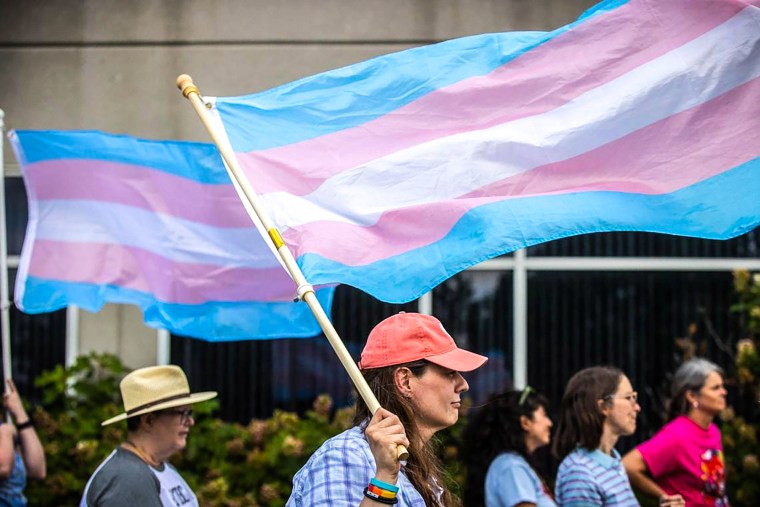
A woman attends a rally in support of trans youth in schools on June 26, 2023, outside the Fayette County Public Schools central office in Lexington, Ky.Ryan C. Hermens / Lexington Herald-Leader via Getty Images file
The organization’s 2015 U.S. Transgender Survey had been the largest survey of trans people in the country, with nearly 28,000 respondents 18 and older, and it has been widely cited, including by Congress and the Supreme Court. Josie Caballero, the director of the survey, said the 2022 iteration more than tripled the number of respondents — with a total of 92,329 from every state and many U.S. territories — and was improved in a number of other ways. For example, it included 605 possible questions (though no respondent received all possible questions), up from 324 in the 2015 survey, and it included more than 8,000 respondents who were 16 and 17. However, study authors note that respondents who participated in the online survey were not drawn from a random sample and that though the sample is large, the findings might not be representative of all trans people.
Of the 84,170 adult respondents, 38% identified as nonbinary, 35% identified as transgender women, 25% identified as transgender men and 2% identified as cross-dressers.
Continued discrimination and mistreatment
Among the key findings released Wednesday, the survey found that trans people continue to report experiencing discrimination and mistreatment because of their gender identities and/or expressions.
More than one-third of adult respondents, or 34%, were experiencing poverty at the time of the survey, and 18% were unemployed. More than 1 in 10, or 11%, of respondents who had ever held jobs said they had been fired or forced to resign or had lost jobs or been laid off because of their gender identities or expressions. And, in line with previous survey findings, 30% of respondents had experienced homelessness in their lifetimes.
Of adult respondents who saw health care providers in the previous 12 months, 48% reported having had at least one negative experience because they were transgender, including being refused health care, having staff members use the incorrect pronouns for them or having providers use abusive language or be physically rough or abusive while treating them. Fear of mistreatment prevented 24% of respondents from seeing doctors when they needed it in the 12 months before the survey.
Many respondents also reported past mistreatment in school. Of adult respondents, 80% who were out or perceived as trans in K-12 experienced one or more forms of mistreatment, including verbal harassment, physical attacks, online bullying or being denied use of the restrooms or locker rooms that matched their gender identities. Of the 8,159 respondents who were 16 and 17, 60% reported such mistreatment.
Higher life satisfaction after transition
Despite those negative experiences, the vast majority of adult respondents, 79%, who lived at least some of the time in different genders from the ones they were assigned at birth reported that they were “a lot more satisfied” with their lives. An additional 15% reported they were “a little more satisfied.”
——————————————————————————————
Please see the chart at the link above. The written version I have included below.
Most people are satisfied with life after transition
More than 9 in 10 respondents were at least a little more satisfied with their life after transitioning.
This bar chart shows how respondents who had transitioned genders described their satisfaction with life after transitioning. 79% were a lot more satisfied, 15% a little more, 3% neither more or less, 1% a little less and 2% a lot less satisfied.
A lot more satisfied. 79%
A little more satisfied. 15%
Neither more or less satisfied. 3%
A little less satisfied. 1%
A lot less satisfied. 2%
Respondents who received transition-related medical care reported similarly high rates of satisfaction. Of respondents who were currently receiving hormone treatment, 84% said receiving such treatment for their gender identities/transitions made them “a lot more satisfied” with their lives, and 14% said it made them “a little more satisfied.” Just 1% said hormone treatment made them neither more nor less satisfied, and less than 1% said hormone treatment made them a lot less satisfied.
Of respondents who underwent at least one form of gender-affirming surgery, 88% said it made them “a lot more satisfied,” and 9% said it made them a little more satisfied. Less than 2% total said surgery made them a little less or a lot less satisfied.
“That might seem obvious to some of us that of course if you’re transgender and you need transition-related health care, of course your life is better off when you get that health care,” Heng-Lehtinen said Tuesday. “But it’s really important to have actually asked people and found out objectively what is their experience, because transition-related health care is otherwise so under attack in state legislatures around the country.”
Effects of anti-trans legislation
In the last three years, 23 states have restricted gender-affirming health care — including puberty blockers, hormone therapy and surgeries — for minors and, in a few cases, adults, according to the Movement Advancement Project, an LGBTQ think tank. Half of states have banned trans student-athletes from playing school sports on the teams that align with their gender identities rather than their assigned sexes at birth, while 10 states have passed laws restricting what bathrooms trans people can use in schools, colleges and/or government-owned buildings.
Nearly half of respondents to the latest U.S. Transgender Survey said they had thought about moving to other states because their state governments considered or passed such laws that target transgender people, and 5% — about 4,600 people — said they had actually moved to other states because of such legislation.
The top 10 states where trans respondents most often reported moving from were, in alphabetical order, Alabama, Arizona, Florida, Georgia, Missouri, North Carolina, Ohio, Tennessee, Texas and Virginia.
The state of trans rights across the country does not necessarily reflect what trans people are experiencing at home with their families. Of adult respondents, 67% reported that their immediate families were either supportive or very supportive, while 22% reported they were neither supportive nor unsupportive and 12% reported they were either unsupportive or very unsupportive.
Of 16- and 17-year-old respondents, 44% reported that their families were either supportive or very supportive, while 28% reported that they were neither supportive nor unsupportive and 29% reported they were unsupportive or very unsupportive.
“It’s important to see that many trans people do have supportive families, since we often hear and see otherwise,” Sandy James, one of the report’s authors, said at Tuesday’s news conference.
Heng-Lehtinen said the new data will revolutionize the field of transgender advocacy.
“I am confident that the results of the 2022 survey will not only serve as a crucial tool for education, research and policy, but it will catalyze a paradigm shift for the movement for transgender advocacy by empowering advocates with robust and current data regarding our needs and experiences,” he said.
Flat out, I love this show. The show runs Monday to Friday, with Emma running the show on Thursdays, which is Sam’s day off. The show is about three hours long, divided into two parts. The free half is mostly news and interviews, and the fun half is with calls and IMs. Now don’t panic, if you are poor like me you can still see the entire show. There are two ways. First if you can not afford it they give free memberships if you need one. Or do what I do. The way I do it can be a pain in the butt, but it works. Wait until the show starts on YouTube. Open the live broadcast, then in the description box they include the link to the fun half. Click that and it switches to the entire show. Now as long as you don’t close the browser you have the link to the entire show for free. You don’t have to watch it all then, like any YouTube video or live stream, you can pause it and go do things, often I will start watching it and finish in the morning, leaving the computer tab open all night. Anyway, here are the clips. I especially like the ones that showed how clearly Israel was lying and got caught, and how the republicans had to admit that they did not have anything on Biden. Plus the one of right wing media correcting tRump’s claims of winning the election was fun to watch. Hugs. Scottie
Now we move to the horrible lies Israel has told. Hugs. Scottie






 Scottie's Playtime