I was struck by the backlash to the Texan pediatrician who was ostracized and lost her job because she pointed out that decisions have consequences, and all those who voted for drumpf in Texas are experiencing those painful consequences. Painful words uttered in despair, but damn – that doesn’t make them any less true.
How many times have we heard the line that “now isn’t the time to talk about this”? We’ve seen it with the debate on gun laws, and now we see it on this horrible consequence of firing those who warn us of dangerous weather.
But once again people have died, children have died, destruction and despair are gripping our nation, and the cause of that horror is not open for discussion? It’s being political in a time of national mourning? It’s insensitive? Decisions made in comfort and greed by those untouched by the disaster have exacted the ultimate cost, and they once again seek to control the conversation by denying the ability to explore how it happened!
So, is it safe to talk about these things now? Is it ok to talk about how stripping the social safety nets have consequences? Is it ok to seek to examine what we as a country believe in now, or are we waiting for the next disaster to blow through, the NEXT time parents weep looking for lost and dead children, or will it be one of the times after that? How long must we listen to the powerful deny the impact of greed, arrogance and ignorance.
And, to respond to this fool Abbott; Smart teams look to see if the wrong plays were called, or more likely, the wrong people were making the wrong decisions.
It isn’t timidity. It’s a complete reconstruction of what is acceptable rhetoric, and it makes gentler more collegial conversation and work impossible.
Whether it’s bloodshed at Glastonbury or starving people on benefits, their ‘irony poisoning’ seeps obscene ideas into the range of the possible
Illustration: Nate Kitch/The Guardian
Imagine the furore if a Guardian columnist suggested bombing, say, the Conservative party conference and the Tory stronghold of Arundel in Sussex. It would dominate public discussion for weeks. Despite protesting they were “only joking”, that person would never work in journalism again. Their editor would certainly be sacked. The police would probably come knocking. But when the Spectator columnist Rod Liddle speculates about bombing Glastonbury festival and Brighton, complaints are met with, “Calm down dear, can’t you take a joke?” The journalist keeps his job, as does his editor, the former justice secretary Michael Gove. There’s one rule for the left and another for the right.
The same applies to the recent comments on GB News by its regular guest Lewis Schaffer. He proposed that, to reduce the number of disabled people claiming benefits, he would “just starve them. I mean, that’s what people have to do, that’s what you’ve got to do to people, you just can’t give people money … What else can you do? Shoot them? I mean, I suggest that, but I think that’s maybe a bit strong.” The presenter, Patrick Christys replied, “Yeah, it’s just not allowed these days.”
You could call these jokes, if you think killing people is funny. Or you could call them thought experiments. Liddle suggested as much in his column: “I am merely hypothesising, in a slightly wistful kinda way.” This “humour” permits obscene ideas to seep into the range of the possible.
Academic researchers see the use of jokes to break taboos and reduce the thresholds of hate speech as a form of “strategic mainstreaming”. Far-right influencers use humour, irony and memes to inject ideas into public life that would otherwise be unacceptable. In doing so, they desensitise their audience and normalise extremism. A study of German Telegram channels found that far-right content presented seriously achieved limited reach, as did non-political humour. But when far-right extremism was presented humorously, it took off. (snip-MORE)
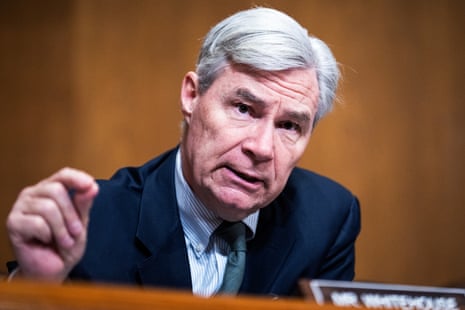
Sheldon Whitehouse of Rhode Island gives 300th climate speech on the US Senate floor
Sheldon Whitehouse at a Senate confirmation hearing on 6 February 2025. Photograph: Tom Williams/CQ-Roll Call via Getty Images
The Democratic party and the climate movement have been “too cautious and polite” and should instead be denouncing the fossil fuel industry’s “huge denial operation”, the US senator Sheldon Whitehouse said.
“The fossil fuel industry has run the biggest and most malevolent propaganda operation the country has ever seen,” the Rhode Island Democrat said in an interview Monday with the global media collaboration Covering Climate Now. “It is defending a $700-plus billion [annual] subsidy” of not being charged for the health and environmental damages caused by burning fossil fuels. “I think the more people understand that, the more they’ll be irate [that] they’ve been lied to.” But, he added, “Democrats have not done a good job of calling that out.”
Whitehouse is among the most outspoken climate champions on Capitol Hill, and on Wednesday evening, he delivered his 300th Time to Wake Up climate speech on the floor of the Senate.
He began giving these speeches in 2012, when Barack Obama was in his first term, and has consistently criticized both political parties for their lackluster response to the climate emergency. The Obama White House, he complained, for years would not even “use the word ‘climate’ and ‘change’ in the same paragraph”.
While Whitehouse slams his fellow Democrats for timidity, he blasts Republicans for being in the pocket of the fossil fuel industry, an entity whose behavior “has been downright evil”, he said. “To deliberately ignore [the laws of physics] for short-term profits that set up people for huge, really bad impacts – if that’s not a good definition of evil, I don’t know what is.” (snip-MORE)
July 10, 1976 Ku Klux Klan (KKK) members near Georgetown, Illinois, gathered for an ill-fated cross-burning. The meeting started an hour late. When the Klansmen went to plant their cross, it was too heavy to move. Three hours later, after the cross was chopped down to a portable size, it was planted, but would not light. Finally, the Klan members gave up and went home. The ugly history of the KKK
July 10, 1985 The Rainbow Warrior then The Greenpeace flagship, Rainbow Warrior (named after a North American Indian legend), was blown up in Auckland Harbour, New Zealand, killing one and sinking the ship. The attack had been authorized by French President François Mitterand because the environmental organization had plans to protest France’s nuclear bomb tests in the South Pacific. The Rainbow Warrior today
Lisianthus- I think there’s a blue variety ( common name is Texas Bluebells) but I’ve never seen it – I’m familiar with this creamy looking little jewel. Very little fragrance. That’s surprises me- they look like something that would smell good!
Curcuma alismatifolia – common name Siam Tulip. It’s not a tulip but it is from Laos which I’m guessing used to be Siam. Related to turmeric. The blooms are fetching and persistent.
The best thing about Siam Tulips are the bulbs-
What the hell? How did this happen? They’re just asking for trouble.
This Rudbeckia is astonishing
I grow hosta for the variegated leaves. I’m surprised every year at the beauty and the fragrance of the blooms.
“ Double Dutch” Asiatic Lily – I don’t know if there’s anything more orange.
Gladiolus!
Not a daylily fan, usually, but these are irresistible!
Please read. DeathSantis and ICE are doing horrible illegal things while breaking laws all in the name of white supremacy and getting rid of anyone not white in the US at the same time the Florida tax payer is entirely on the hook for all the costs. This story is even more proof of the authoritarian dictatorship the US is under along with the disregarding of any law or lawmaker that gets in the way of cruelty to brown / black people. Also I read that trump sent 200 marines to this place. The link to that store after this one Hugs
In a surprising and possibly unlawful act, five state legislators were denied entry Thursday into a taxpayer-funded migrant detention center deep in the Everglades, raising questions about what will happen behind the razor-wire fences that are being erected surrounding the controversial facility the state has named Alligator Alcatraz.
Armed only with state law and a growing list of humanitarian concerns, state Senators Shevrin Jones and Carlos Guillermo Smith, along with Representatives Anna V. Eskamani, Angie Nixon and Michele Rayner, arrived at the gates of the facility to conduct what they saw as a legally authorized inspection. What they encountered instead was silence, locked doors and a bureaucratic wall.
The state’s shifting justification for not letting them in — first a flat denial, then vague “safety concerns” — only fueled suspicions.
Wearing mosquito netting, Florida Sen. Shevrin Jones and state Representatives Michele K. Rayner and Anna Eskamani were denied entry along with fellow representatives into Alligator Alcatraz. PHOTO BY AL DIAZ adiaz@miamiherald.com
“This is a blatant abuse of power and an attempt to conceal human rights violations from the public eye,” the legislators said in a joint statement. “If the facility is unsafe for elected officials to enter, then how can it possibly be safe for those being detained inside?”
Just hours earlier, Republican officials and even former President Donald Trump had toured the same site without issue. When the lawmakers attempted to speak with Florida Department of Emergency Management officials by phone, the call was abruptly cut off.
Now, with reports of flooding, extreme heat and detainees allegedly being held without due process, legislators say the administration of Gov. Ron DeSantis is operating a secretive, $450 million detention network with no oversight— and no regard for the law.
The state legislators Michele Rayner arrived at the site to conduct what they said was a lawful inspection under Florida Statutes 944.23 and 951.225, which grant legislators access to state-operated detention centers without advance notice. Instead of transparency, they were met with locked gates and silence.
Workers install a permanent Alligator Alcatraz sign at the new state immigration detention facilty in the Everglades. PHOTO BY AL DIAZ adiaz@miamiherald.com
Under Florida law, members of the Legislature have the clear right to access any state-run detention facility, including prisons and jails, without needing prior approval or notification. That legal mandate was ignored, according to Representative Michele Rayner, a civil rights attorney who represents parts of Pinellas and Hillsborough counties.
“For two hours, we waited. We cited the law. We cited the press release announcing our visit. Still, we were denied,” said Rayner. “They cited ‘safety concerns,’ even though just hours earlier President Trump and GOP lawmakers had toured the very same facility.”
Rayner said that when she asked whether she could visit a client being detained inside, she was again refused—contradicting statements made to her moments earlier by Florida Department of Emergency Management officials. When legislators tried to clarify the denial with the agency’s general counsel and legislative affairs director, the call was abruptly disconnected.
“This is America right now,” Rayner said. “And everyone should be concerned.”
The delegation’s visit came just one day after migrants were transferred into the detention center despite flooding caused by ongoing summer storms. Lawmakers say they’ve received reports of extreme heat, poor infrastructure, and a lack of mosquito protection, conditions they say that may be endangering the health and safety of detainees.
Florida House of Representatives denied entry, including State Rep. Anna .V. Eskamani, PhD at Alligator Alcatraz. The facility is within the Florida Everglades, 36 miles west of the central business district of Miami, in Collier County, Florida. , Florida, on Thursday, July 3, 2025. PHOTO BY AL DIAZ adiaz@miamiherald.com
“I was bitten by insects as soon as I got here. My lips started to swell. And I’m outside for just a few minutes,” said Rep. Angie Nixon of Jacksonville. “Imagine what it’s like for the people inside who don’t have bug spray or clean bedding.”
Nixon expressed particular concern over reports in the Miami Herald that pregnant women and children could be housed in the facility. “We’re spending $450 million on this while refusing to expand Medicaid and closing public schools in Duval County,” she said. “This is not about public safety—it’s about cruelty as campaign theater.”
Smith did not mince words, calling the site a “makeshift immigrant detainment camp in the middle of the Everglades swamp,” built through no-bid contracts awarded to major Republican campaign donors.
“This isn’t about detaining dangerous criminals,” Smith said. “It’s about detaining housekeepers, cooks, and immigrants who had legal status five minutes ago—until it was stripped away by policy.”
Smith referenced a Miami Herald story that revealed the state may bring pregnant women and children to the site, despite public claims that the facility was intended for “the worst of the worst.” ICE data shows that fewer than 10% of current immigration detainees in Florida have any violent criminal history, and the majority had no prior offenses.
“We’re detaining vulnerable people for political spectacle,” Smith said. “And it’s not a coincidence this facility was unveiled just days after our legislative session ended—avoiding any real oversight.”
Jones added that the facility, built with $450 million in state funds, does not qualify for federal support. “The federal government has said this facility is ineligible for grants,” he said. “That means it’s 100% on Florida taxpayers—and it was done without a single committee hearing or floor debate.”
Florida state Sen. Shevrin Jones, Rep. Anna Eskamani and fellow representatives were denied entry Thursday into Alligator Alcatraz. PHOTO BY AL DIAZ adiaz@miamiherald.com
Jones emphasized that both Democratic and Republican lawmakers should be concerned. “This is not a partisan issue,” he said. “We have a duty to ensure that state-funded operations uphold basic standards of decency and legality.”
Rep. Anna Eskamani from Orlando described the detention center as a “political stunt” orchestrated by DeSantis. “Hundreds of millions of taxpayer dollars are being spent to build what is essentially a concentration camp,” she said. “This is government by press conference and no-bid contract.”
Eskamani said reports indicate that the first detainees arrived without due process, and flooding had already compromised parts of the facility. “We’re here because the people of Florida deserve transparency. What is being hidden behind these walls?”
All five lawmakers said they plan to pursue legal remedies and initiate legislative inquiries into the construction, contracting, and operation of Alligator Alcatraz.
A check point at Alligator Alcatraz as Florida State Representatives denied entry. The facility is within the Florida Everglades, 36 miles west of the central business district of Miami, in Collier County, Florida. , Florida, on Thursday, July 3, 2025. PHOTO BY AL DIAZ adiaz@miamiherald.com
They also demanded that the Florida Division of Emergency Management and the governor’s office provide a full accounting of who is detained at the facility, what conditions exist inside, and which companies received contracts—particularly those with political ties to the DeSantis administration.
“This is not over,” said Smith. “We will be back, and we will not stop until we get the answers Floridians deserve.”
This story was originally published July 3, 2025 at 6:09 PM.
July 7, 1863 The first military draft was instituted in the U.S. to provide troops for the Union army in the American Civil War. Once called, a draftee had the opportunity to either pay a commutation fee of $300 to be exempt from a particular battle, or to hire a replacement that would exempt him from the entire war.
July 7, 1903 The March of the Mill Children watch a video – highly recommended Labor organizer Mary Harris “Mother” Jones led the “March of the Mill Children” over 100 miles from Philadelphia to President Theodore Roosevelt’s Long Island summer home in Oyster Bay, New York, to publicize the harsh conditions of child labor and to demand a 55-hour work week. It is during this march, on about the 24th, she delivered her famed “The Wail of the Children” speech. Roosevelt refused to see them. “Fifty years ago there was a cry against slavery and men gave up their lives to stop the selling of black children on the block. Today the white child is sold for two dollars a week to the manufacturers.” –from Mother Jones’s autobiography Read more about Mother Jones
July 7, 1957 Convened at the onset of the Cold War, a group of scientists held their first peace conference in the village of Pugwash, Nova Scotia, Canada. The mission of the Pugwash Conference was to “. . . bring scientific insight and reason to bear on threats to human security arising from science and technology in general, and above all from the catastrophic threat posed to humanity by nuclear and other weapons of mass destruction . . . .” Bertrand Russell Wealthy industrialist and Pugwash son Cyrus Eaton had invited the world’s greatest minds to his family home in Nova Scotia and address the emerging threat of nuclear war. The Conference became the basis for an ongoing organization that deals with issues of weapons of mass destruction. The 1995 Nobel Peace Prize was awarded to Joseph Rotblat (one of the original signatories of the Pugwash Manifesto) and to the Pugwash Conferences on Science and World Affairs. Albert Einstein Pugwash home
Fifty years later . . . 25 scientists, diplomats and former military officers from 15 countries gathered for a “Revitalizing Nuclear Disarmament” strategy workshop. The meeting was held near the Thinkers’ Lodge, the site of the first meeting in 1957. “Fifty years ago from Pugwash, Nova Scotia, nuclear scientists helped alert the world to the dangers of nuclear weapons, and especially the newly developed hydrogen bomb,” said Paolo Cotta-Ramusino, Secretary General, Pugwash Conferences on Science and World Affairs. “Today, we are working with experts from around the world for global action to revitalize nuclear disarmament and the final elimination of nuclear weapons.” Senator Roméo Dallaire, Honorary Patron of the Pugwash Peace Exchange, said “It is appalling to observe the increasing potential for many regional nuclear arms races, shameless plans to modernize nuclear arsenals and bald-faced threats of pre-emptive nuclear use,” said Senator Dallaire. “Only by revitalizing discussion and implementation of disarmament leading to abolition can we ensure that these genocidal devices will never again be used.”
July 7, 1977 The United States conducted its first test of the neutron bomb. The neutron bomb was a tactical thermonuclear weapon designed to cause very little physical damage through limited blast and heat but was designed to kill troops through localized but intense levels of lethal radiation. A neutron bomb explosion at a test site
July 7, 1979 2,000 American Indian activists and anti-nuclear demonstrators marched through the Black Hills of western South Dakota to protest the development of uranium mines on sacred native lands.
Of course, we’re all looking to save what we can, every day. This can be applied to small households larger than single resident. Give it a look! I remember doing some of this in the 80s, and I still do all I can. A penny’s a penny! Also, if you click through to read, here on the headline, | you can see funny graphics to go with many of the suggestions.
Whether you’re single or choose to live alone, it can be expensive. Finding ways to save money living alone can take some creative thinking, but there are easy ways to put some extra cash back in your wallet.
In an online forum, member Just_Throw_Away_67 posed the question to fellow people who live alone: “What random cost-saving measures have you found that work well for those living alone?”
And single people and people living solo happily shared their money-saving hacks. These are 45 of the best ways to save money if you live alone.
“I’ll start, to save money on energy I fill empty glass jars with water and store them in my fridge. It costs more to cool an empty fridge than a full one, and since I don’t eat very much my fridge is often nearly empty. Not sure how much this has saved me, but now I have water if I ever were to need it!” Just_Throw_Away_67 (Note from A.: This holds true for the freezer, too. Keep some containers of water up/out there. They help use less energy, and frankly, the ice is useful during power outages.)
“Blackout curtains because I live in the South so it’s always hot. I also have privacy film that blocks some UV rays when I do want some light. Using a floor fan in my room (where I spend the majority of my time) with the door closed to keep it cooler. Close the air vents in my guest room since it’s primarily unused to cut down on AC costs. Cook large batches of food at one time so I’m not constantly using my stove/oven.” eternally_feral
“It’s a pain to heat the whole oven for a little food. I recommend an air fryer over a toaster oven though. They’re a bit faster (and you can still make toast).” MissDisplaced
“I keep my heating and cooling low. I can wear extra layers or less to get to a comfortable temp.” Reasonable-Cold2161
“I read a tip to not bother doing a full ‘grocery shop’ trip if it doesn’t work for you/doesn’t make sense for you. Rather, if you find you’re throwing food away you couldn’t eat in time, try to do the method of going to the store of getting, say, just what you need for tonight and tomorrow’s meals, or whatever.” citynomad1
“Grocery delivery. I end up spending 50% less compared to shopping in the store.” Everydaylookwithin
“This is why I do curbside pickup. I order through the app, see what deals and coupons they have, stick to my list and don’t end up impulse buying. An added bonus is I can pick up on my way home from work and not spend time waiting in the checkout line.” zoebadwolf
“It took a little bit of up front investment, but I dumped my gigantic and ancient energy-hungry fridge a long time ago for a brand new one that is much smaller and also has a variable speed compressor for extra efficiency. The energy savings from that move alone probably paid for the fridge several times over by now.” BrewCityChaserV2
“I have a countertop dishwasher that I intentionally use only during off-peak hours. Luckily, this rental has a new refrigerator, and I run my air purifier on its 2 hour timer during those off hours (cat hair lol). Oh- I bought a Tushy bidet on sale- it pays for itself in the first year!” sk8rcruz
“I always bring my own lunch to work. I also cut up fresh veggies, put them in ziploc bags, freeze them, and then steam them later in the microwave. You can also just put a whole bag of spinach in the freezer and then steam it in the microwave. Clean with a plastic spray bottle of vinegar and dish soap. Sprinkle baking soda on carpets and rugs before vacuuming.” Unhappy-Jaguar-9362
“I have milk jugs with water in them in the fridge and freezer. I also buy in bulk. Usually the more you buy the cheaper per unit it is. I have a year supply of everything (joking) not quite but almost. I keep my air conditioner at a warmer temperature and use a fan to cool me all the way. I close blinds and curtains during the day. This cuts down on the heat in the room. Unfortunately it is dark in my apartment during the day , but this can make a difference of up to 10 degrees. This saves on cooling costs. Instead of buying single servings of food. I make a family size amount and put the leftovers in round dinner containers all ready to go for the next meal. These can also be frozen if you don’t want the same thing a couple days in a row and put in the microwave for 6 or 7 minutes.” Delightful_Helper
“I buy the family size packs of meats, divide and freeze. I also still cook big meals like when my kids were teenagers and divide them into portions and freeze. Its simply too hard to cook for one person. I make a weekly menu of the dishes I want to cook and then place my order for the grocery delivery. It does save money and since I cook a lot of casseroles, big pots of soups and stews, etc., and freeze in portions. I use my air fryer to warm the frozen dishes instead of the oven. It has almost become my hobby to have a variety of different meals through out the week without having to cook every day. Life is good 😊.” No_Guava_90
July 3, 1835 Children employed in the silk mills at Paterson, New Jersey, went on strike for an eleven-hour workday and a six-day workweek rather than 12-14 hour days. With the help of adults, they won a compromise settlement of a 69-hour week. More on the Baby Strikers
July 3, 1966 4000 Britons chanting, “Hands off Vietnam,” demonstrated in London against escalation of the Vietnam War. U.S. warplanes had recently bombed the North Vietnamese capital of Hanoi as well as the port city of Haiphong. Police moved in after scuffles broke out at the demonstration outside the U.S. Embassy in Grosvenor Square; 31 were arrested. Actress Vanessa Redgrave joins 25,000 two years later at Anti-Vietnam war protest, Grosvenor Square. Read more
July 3, 1974 At the Moscow Summit talks between President Richard Nixon and President Leonid Brezhnev, the United States and the Soviet Union agreed to hold bilateral talks on the prohibition of chemical weapons.
July 4, 1776 The United States declared its independence from King George III and Great Britain, thus beginning the first successful anti-imperial revolution in world history. Signed in Philadelphia by 56 British subjects who lived and owned property in thirteen of the American colonies, the document asserted the right of a people to create its own form of government. The signers of the Declaration of Independence were members of the 2nd Continental Congress which had voted two days earlier to separate from the British crown. Read the Declaration see some quotes on nationalism and patriotism
July 4, 1827 Slavery was outlawed in New York State as the result of the Gradual Emancipation law passed ten years earlier. This freedom applied only to those who had been 18 at the time of its passage. Enslaved children born during the subsequent ten-year period were not be freed until they reached the age of 21. At the urging of Reverend William Hamilton, a freedman and carpenter, and others, the end of slavery was celebrated in churches. The Fourth of July had in the past been marred by young white men attacking black Americans. More on William Hamilton and others
July 4, 1829 Speaking at Boston’s Park Street Church, newspaper editor and abolitionist William Lloyd Garrison gave a seminal speech on “Dangers to the Nation.” Though Massachusetts had banned slavery in 1781 and there was strong anti-slavery sentiment, most understood that a national ban of slavery would threaten the union of the states. Compensation to slaveholders and return of the enslaved to Africa was considered the best solution. Garrison, on the other hand, called attention to the hypocrisy of celebrating the the day the document was signed declaring, “All men are created equal” while two million were in bondage. He proposed four propositions that day to guide the abolitionist movement: 1. Above all others, slaves in America deserve “the prayers, and sympathies, and charities of the American people.” 2. Non-slave-holding states are “constitutionally involved in the guilt of slavery,” and are obligated “to assist in its overthrow.” 3. There is no valid legal or religious justification for the preservation of slavery. 4. The “colored population” of America should be freed, given an education, and accepted as equal citizens with whites. William Lloyd Garrison
July 4, 1894 The Republic of Hawaii was proclaimed with Sanford B. Dole as president. It was recognized immediately by the United States government under President Grover Cleveland. This was the result of the successful overthrow of the Hawaiian monarchy, then held by Queen Lydia Liliuokalani, and the support by white Americans involved in the sugar trade on the islands for annexation by the United States. Shortly after she had come to office, she had promulgated a new constitution which increased the power of the monarchy and that of native Hawaiians.
July 4, 1965 Barbara Gittings at the Philadelphia picket The first of an annual picket in front of Philadelphia’s Independence Hall was held by gay and Lesbian Americans. Jack Nichols and Frank Kameny and members of the New York and Washington Mattachine Society and the Daughters of Bilitis had earlier demonstrated in Washington, and wished to change the general perception that homosexuals were perverted or sick.
“By those protesters coming out publicly, and placing themselves very strategically in front of the building that evoked the Declaration of Independence and the idea that all men are created equal, it suggested it [gay rights] was no longer a moral or national security or psychiatric issue … it was a civil-rights issues,” David K. Johnson wrote in The Lavender Scare: The Cold War Persecution of Gays and Lesbians in the Federal Government.
July 4, 1966 The Freedom of Information Act, P.L. 89-487, became law. It established the right of Americans to know what their government is doing by outlining procedures for getting access to internal documents.
July 4, 1969 “Give Peace a Chance” by the Plastic Ono Band was released in the United Kingdom. The song was recorded May 31, 1969, during the “Bed-In” John Lennon and Yoko Ono staged at the Queen Elizabeth Hotel in Montreal as part of their honeymoon. John and Yoko stayed in bed for 8 days, beginning May 26, in an effort to promote world peace. Some of the people in the hotel room who sang on this were Tommy Smothers, Timothy Leary, Allen Ginsberg, and Petula Clark. Smothers also played guitar. This event promoting peace received a great deal of media attention.“All we are saying . . .” watch & listen – give it a chance
July 4, 1969 A national anti-war conference in Cleveland, Ohio, mapped out activities against the Vietnam War and resulted in the founding of New Mobe (mobilization). More about the Mobes
July 4, 1983 The Women’s Encampment for a Future of Peace and Justice began an eight week stay on a farm just outside the Seneca Army Depot near Romulus, New York. The purpose of the gathering was for the women to learn about and together protest the escalation of militarism and the weapons build-up being led at the time by the Reagan administration. visit PeaCe eNCaMPeNT HeRSToRy PRoJeCT
July 4, 2007 The first of several Peace Caravans (Caravanes de Paix) set out from South Kivu and traveled across Africa’s Great Lakes region, including the Democratic Republic of the Congo, Burundi and Rwanda. The Scout Associations of the countries in the violence-ridden area trained hundreds of young people in conflict resolution through their focus on education for peace. Members of the Caravan for Peace in Burundi The classes and the caravans included hundreds of young people in Scouts and Girl Guides from many ethnic groups (often with a history of mutual hostility) who act as community mediators.

























 At the urging of Reverend William Hamilton, a freedman and carpenter, and others, the end of slavery was celebrated in churches. The Fourth of July had in the past been marred by young white men attacking black Americans.


