I didn’t get any posts set up last night for today. Ollie got a little overheated yesterday during our walk, and I wanted to watch over and care for him to make sure he’s all right. I just didn’t get to setting up posts. (I feel as if that will be a relief for eyes on the blog! But anyway.) He is fine; he’s not taking the fireworks real well, and for some reason doesn’t want his morning walk today, either, which is different, but I’m letting him lead on that. Fireworks don’t begin until 10AM here, so so far, so good on that. Anyway, that’s what’s up here. I hope all are managing to stay healthily cool enough, and taking good care to hydrate well, and screen the UV rays. And that the fireworks aren’t irritating! 🎆
June 30, 2025 Evrim Yazgin, Cosmos science journalist
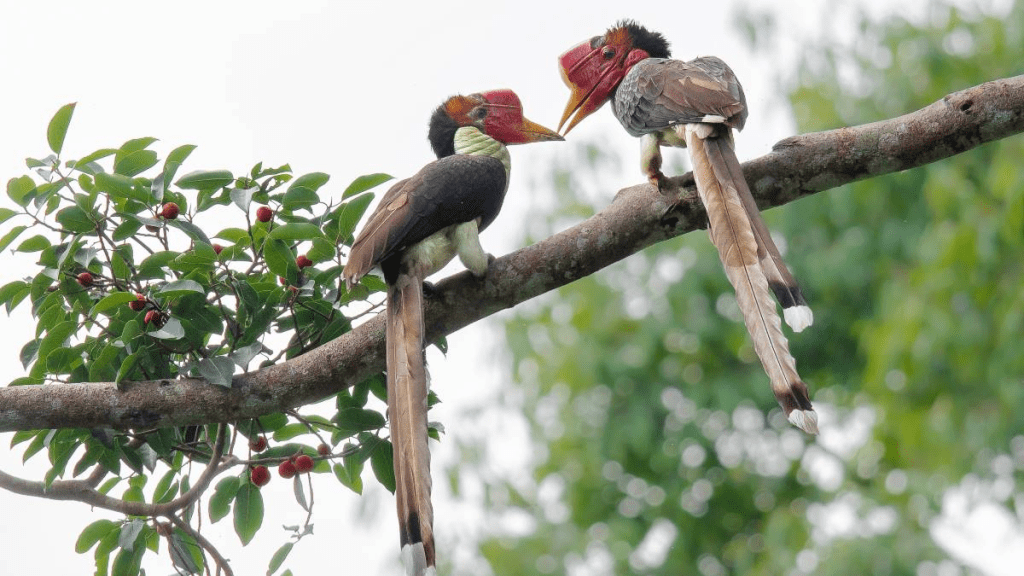
Helmeted Hornbill (Buckeroos vigil) male and female. Credit: Hello my names is james,I’m photographer / iStock / Getty Images Plus.
Researchers analysed different threat factors such as habitat loss and climate change to find that 500 bird species could go extinct in the next century. Unique species are most at risk.
The study, published in the Nature Ecology & Evolution, warns that the loss of unique birds could harm ecosystems around the world.
Vulnerable birds include the bare-necked umbrellabird found in the forests of Costa Rica and Panam, helmeted hornbill from Southeast Asia and yellow-bellied sunbird-asity endemic to Madagascar.
“We face a bird extinction crisis unprecedented in modern times. We need immediate action to reduce human threats across habitats and targeted rescue programmes for the most unique and endangered species,” says lead author Kerry Stewart from the University of Reading, UK.
The researchers studied the behavioural and morphological traits of about 10,000 bird species – representing nearly all known bird species – using data from the International Union for Conservation of Nature (IUCN) Red List.
Applying a statistical model, the researchers were able to show that large-bodied species were more at risk from hunting and climate change. Meanwhile, birds with broad wings suffer more from habitat loss.
“Stopping threats is not enough, as many as 250–350 species will require complementary conservation measures, such as breeding programmes and habitat restoration, if they are to survive the next century,” says senior author Dr Manuela Gonzalez-Suarez, also from the University of Reading. “Prioritising conservation programmes for just 100 of the most unusual threatened birds could save 68% of the variety in bird shapes and sizes. This approach could help to keep ecosystems healthy.”
“Many birds are already so threatened that reducing human impacts alone won’t save them,” adds Stewart. “These species need special recovery programmes, like breeding projects and habitat restoration, to survive.”
The authors say that “functionally unique” species – i.e. species that fill highly specialised ecological niches – are the most vulnerable. Likewise, the loss of such unique species could cause a cascading effect of harm for broader ecosystems.
“Effective targeted recovery programmes that explicitly consider species uniqueness hold great potential for conserving global functional diversity as a complementary strategy to threat abatement,” they write.
Yes, this passed in the Senate, thanks to the VP’s tiebreaking vote. However, it’s still got rows to hoe in the US House; Spkr. Johnson wants to vote tomorrow. The thing to remember about our US Reps is, they’re up for election each 2 years. So, while firmly directing them in dealing with this dreadful bill, also firmly yet lovingly remind them that the OBBB will be hanging around their necks every step of the way of their campaigns like a bubblegum machine golden giant dollar sign necklace, if they vote in favor.
(Actually, if you didn’t when you contacted your Senators last week, you can still remind them of the same thing, unless they voted against, in which case, Thank Them. It took bravery to vote against, and they need to know we have their backs. And thank you very much. Now call.)
I hope everyone and their pets enjoy at least some peace these next few days! I hate fireworks, though I don’t mind them far away or on TV. I did used to like them, when I was a kid. 🎆
July 1, 1917 8000 anti-war marchers demonstrated in Boston. Their banners read: “IS THIS A POPULAR WAR, WHY CONSCRIPTION? WHO STOLE PANAMA? WHO CRUSHED HAITI? WE DEMAND PEACE.” The parade was attacked by soldiers and sailors, on orders from their officers.
July 1, 1944 A massive general strike and nonviolent protest in Guatemala led to the resignation of dictator Jorge Ubico who had harshly ruled Guatemala for over a decade. Juan José Arévalo Bermejo On March 15 of the following year, Dr. Juan José Arévalo Bermejo took office as the first popularly elected president of Guatemala, and promptly called for democratic reforms establishing the nation’s social security and health systems, land reform (redistribution of farmland not under cultivation to the landless with compensation to the owners), and a government bureau to look after native Mayan concerns. Jorge Ubico A decade of peaceful democratic rule followed, until a CIA-backed coup in 1954 ushered in a new, even more brutal era of dictatorial and genocidal regimes. [see June 27, 1954]
July 1, 1946 The United States exploded a 20-kiloton atomic bomb near Bikini Atoll, part of the Marshall Islands in the Pacific Ocean.
July 1, 1968 Sixty-one nations, including the United States, Britain and the Soviet Union, signed the Treaty on the Non-Proliferation of Nuclear Weapons (NPT) which set up systems to monitor use of nuclear technology and prevent more nations from acquiring nuclear weapons. 190 countries are now signatories; Israel, India and Pakistan remain outside the Treaty. North Korea joined the NPT in 1985, but in January 2003 announced its intention to withdraw from the Treaty. Text of the Treaty
July 1, 1972 The first issue Publication of the first monthly issue of Ms. Magazine, founded by Gloria Steinem “The truth will set you free. But first, it will piss you off,” Letty Cottin Pogrebin “Housework is the only activity at which men are allowed to be consistently inept because they are thought to be so competent at everything else,” and others. Ms. Magazine today (It’s still Ms. Magazine! -A.)
July 1, 2000 Vermont’s civil unions law went into effect, granting gay couples most of the rights, benefits, protections and responsibilities of marriage under state law. In the first five years, 1,142 Vermont couples, and 6,424 from elsewhere, had chosen a Vermont civil union.
Prank my ass, this was a hate crime against the marchers. The slurry can be classified as a biohazard. If it got into the water table it would contaminate the water supply. Chicken shit is full of diseases and stinks worse than any other manure. This was done to hurt LGBTQ+ people and their allies. Hugs
Updated / Monday, 30 Jun 2025 15:06
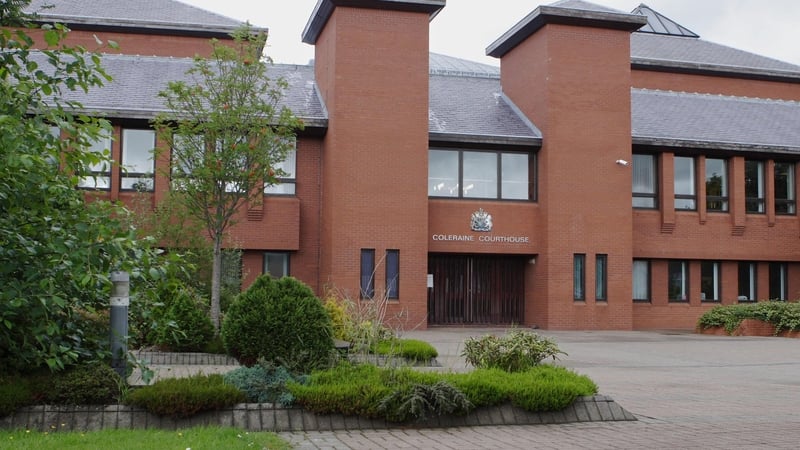
Coleraine Magistrates Court heard that the 19-year-old “made full and frank admissions” to police
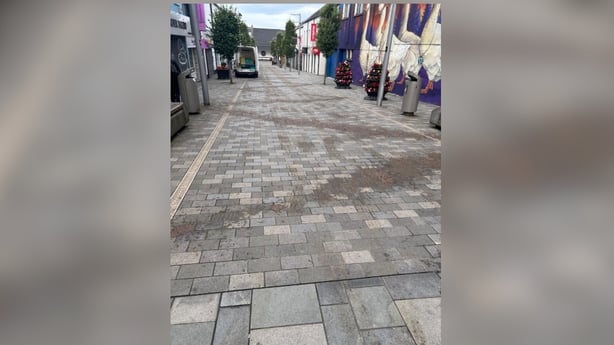
A Co Antrim teenager spread gallons of hen manure on a road before Ballymena’s first Pride parade as part “of a prank,” a court has heard.
Coleraine Magistrates Court also heard that 19-year-old Isaac Adams “made full and frank admissions” to police when he was arrested.
Defence solicitor Stewart Ballentine said Mr Adams was “literally caught in the headlights of the police vehicle” when committing the offence.
Appearing handcuffed in the dock, Mr Adams, from the Lislaban Road in Cloughmills, confirmed his identity and that he understood the three charges against him, all alleged to have been committed on 28 June this year.
He was charged with causing criminal damage to Granville Drive in Ballymena, causing manure to be deposited on the road and possessing a bladed article, namely a lock knife.
According to a police statement at the time, Mr Adams was arrested in the early hours following reports of slurry being spread on the road at around 02.55am.
“The matter is being treated as a hate crime,” said the police statement.
The PSNI said they observed slurry on the road at Greenvale Street
While Mr Adams was charged to court today, a 20-year-old man who was arrested in connection with the incident has been released on police bail and is due to appear in court in November.
During Mr Adams’ brief court appearance, a police officer gave evidence that she believed she could connect the teenager to each of the offences.
She outlined how police on patrol happened upon a male wearing a balaclava and carrying “two empty 25 litre jugs”.
“He admitted that he had been spreading the manure over the roads to disrupt the Pride parade,” the officer told the court, adding that the lock knife was found in his pocket when he was searched.
The courty heard that Mr Adams “freely admitted” that he intended to disrupt that Pride parade due to be held later that day and during formal police interviews, the teenager told police “he was not the only person involved”.
The farmer told police he had filled four or five, five gallon jugs with “hen litter waste” from his family farm “and described it as a prank”.
Regarding issues of bail, the officer conceded the parade had now taken place and further that Mr Adams has absolutely no criminal record.
District Judge Peter King heard the clean up operation cost £788 (€921).
Under cross examination from Mr Ballentine, the officer agreed that Mr Adams “cooperated fully with the police” and also that he told them he had the knife as part of his work.
Submitting that Mr Adams “comes from good stock” in North Antrim and that the incident “is very much out of character,” Mr Ballentine said that having spent the weekend in a police cell, Mr Adams “has learnt a very salutary lesson”.
He argued that Mr Adams could be granted bail and Judge King agreed.
Freeing Mr Adams on his own bail of £500 and adjourning the case to 24 July, the judge imposed several conditions, including a curfew, barred Mr Adams from entering Ballymena and from contacting his co-accused.
Having heard the incident by mobile phone, he also ordered that Mr Adams can only have a phone which cannot access the internet and he has to pass on the details of any phone to the police.
June 29, 1925 The South African parliament passed a bill excluding black, coloured (mixed race) and Indian people from all skilled or semi-skilled jobs.
June 29, 1963 A mass “walk-on” (trespass) was organized at a chemical and biological warfare facility in Porton Down, England. These weaponized agents had been researched and produced there since 1916; it’s now known as the Defence Science and Technology Laboratory. Protesters demand an end to germ warfare in 1963 at Porton Down (Getty) Unconscionable activities at Porton Down (From 2004)
because when the US does these things, they take place in all of our names whether we want it, or not. It’s part of why the power for these things lies in our legislature. The power does not rest with the executive unless the legislature votes to give it.
This summer will mark 80 years since the attacks stunned the world. Today, every one of the crew members who carried out the bombings is dead. Here, one of the last writers to interview them reopens his files
‘It was a beautiful morning. The sun was shining on the buildings. Everything down there was bright – very, very bright. You could see the city from 50 miles away, the rivers bisecting it, the aiming point. It was clear as a bell. It was perfect. The perfect mission.”
I’m sitting in a Chinese restaurant in San Francisco opposite the navigator of the Enola Gay, the B-29 bomber that dropped the atomic bomb on Hiroshima on 6 August 1945. The year is 2004, and Theodore “Dutch” Van Kirk, aged 83, has agreed to be interviewed for a book I’m writing for the 60th anniversary of that fateful mission. Van Kirk informs me, with the trace of a smile, that this will probably be the last interview in his life.
We have spent the afternoon looking through wartime logbooks from his 58 overseas combat missions. Now, between servings of dim sum, he is telling me about the 59th, the one that wiped out a city, along with well over 100,000 people.
“The instant the bomb left the bomb bay, we screamed into a steep diving turn to escape the shockwave. There were two – the first, like a very, very, very close burst of flak. Then we turned back to see Hiroshima. But you couldn’t see it. It was covered in smoke, dust, debris. And coming out of it was that mushroom cloud.”
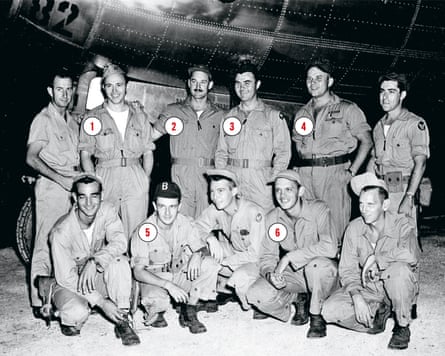
The crew of the B-29 bomber Enola Gay. Stephen Walker interviewed Theodore ‘Dutch’ Van Kirk, navigator (1); Tom Ferebee, bombardier (2); Paul Tibbets, pilot (3); Bob Lewis, co-pilot (4); George ‘Bob’ Caron, tail gunner (5); and Robert Shumard, assistant engineer (6). Photograph: Photogquest/Getty Images
He stops a moment, awe visibly registering on his face. “The city was gone. It was only three minutes since we’d dropped the bomb.”
Van Kirk died in 2014. In the years since we met, all the other crew members who flew on the missions to Hiroshima, and to Nagasaki three days later on 9 August, have also died. Meanwhile, the numbers of hibakusha, those who survived the attacks, are rapidly dwindling. We are passing into a twilight of history. As we approach the 80th anniversary of the atomic bombings, this biological fact seems disturbingly relevant. Twenty years ago, the world was a dangerous place. Today, it’s more so. More nations are developing nuclear weapons with few, if any, effective international controls. Tactical nuclear strikes have been explicitly threatened by Vladimir Putin and Kim Jong-un. And, just in the last week, war has broken out in the Middle East over fears that Iran may be very close to having a bomb. In such times, perspective matters. The shocked testimony of those like Van Kirk needs to be heard. History has lessons to teach us.
It was this thought that prompted me to reopen my files, to reread the transcripts of interviews with some of the crew members of both attacks. Much of this material was untouched for two decades; nothing relating to the Nagasaki mission was published. Here were some of the last testimonies of those who did the unthinkable. They were in their 80s or 90s, nearing the end of their lives. How did they remember it?
On 4 August 1945, Charles “Don” Albury, a 24-year-old B-29 pilot, was summoned to a secret briefing on Tinian, a Pacific island 1,500 miles south of Japan. Then the biggest bomber base in the world, Tinian was a jump-off point for a conveyor belt of the almost daily destruction of Japan. About 300,000 people had already died and 9 million were now homeless.
But Albury’s outfit had yet to take part in the attacks. Known as the 509th Composite Group, they occupied a secret compound on a far corner of the base. “Security was very, very tight,” Albury told me when I met him at his home in Orlando, Florida. Then aged 83, he grinned mischievously. “I remember one time the base commander got too near one of our planes. A guard nearly shot him.”
Even the 509th’s crews knew nothing about their ultimate missions. And they had been training for almost a year. First in Utah, later on Tinian: “We kept dropping practice bombs and flying these crazy steep turns. We did it day after day. For months.” But nobody told them why, and few dared ask. Those who did could find themselves swiftly dispatched by their leader, Paul Tibbets, a battle-hardened bomber pilot, to hardship posts above the Arctic Circle. “You learned to keep your mouth shut,” said Albury.
But in that 4 August briefing a part of the secret was about to be revealed.
Nine days earlier, on 26 July, President Truman had delivered his ultimatum to Japan in the Potsdam declaration: either surrender unconditionally, or face “prompt and utter destruction”. The means of that destruction was not specified. And Japan had not surrendered.
If I live for 100 years I will never get these few minutes out of my mind