Peace & Justice History for 8/29

August 29, 1758
The first Indian reservation, Brotherton, was established in New Jersey. A tract of three thousand acres of land was purchased at Edge Pillock, in Burlington County. The treaty of 1758 required the Delaware Tribes, in exchange for the land, to renounce all further claim to lands anywhere else in New Jersey, except for the right to fish in all the rivers and bays north of the Raritan River, and to hunt on unenclosed land. History Of The Brotherton Reservation 
August 29, 1949
The Soviet Union detonated its first atomic bomb in a test at Semipalatinsk in eastern Kazakhstan. It was known as Joe 1 after Josef Stalin, then General Secretary of the Communist Party.
” Joe 1, the first Soviet atomic bomb
Andrei Dmitrievich Sakharov, key developer of the Soviet bomb, later worked for peace

August 29, 1957
Following consultations among the NATO allies and other nations, the Western (non-Communist) countries presented to the United Nations a working paper entitled, “Proposals for Partial Measures of Disarmament,” intended as “a practical, workable plan to start on world disarmament.” The plan proposed stopping all nuclear testing, halting production of nuclear weapons materials, starting a reduction in nuclear weapons stockpiles, reducing the danger of surprise attack through warning systems, and beginning reductions in armed forces and armaments.
August 29, 1957
African Americans in Milledgeville, Georgia, wait in line to vote following the Civil Rights Act of 1957.
The U.S. Congress passed the Civil Rights Act, the first such law since reconstruction. The bill established a Civil Rights Commission which was given the authority to investigate discriminatory conditions. A Civil Rights Division was created in the Department of Justice, allowing federal prosecutors to obtain court injunctions against interference with the right to vote, among other things.In an ultimately futile attempt to block passage, then-Democrat, former Dixiecrat, and later Republican Senator Strom Thurmond of South Carolina set the all-time filibuster record: 24 hours, 19 minutes of non-stop speaking on the floor of the Senate.
A filibuster is the deliberate use of prolonged debate and procedural delaying tactics to block action supported by a majority of members. It can only be stopped with a 60% majority voting to end debate.
Senator Strom Thurmond with his 24-hour filibustering speech
August 29, 1961
Robert Moses, leader of SNCC
The Student Nonviolent Coordinating Committee (SNCC) was pursuing its voter registration drive in Amite County, Mississippi. Of 5000 eligible Negro voters in the county, just one was registered to vote. SNCC leader Robert Moses was attacked and beaten this day outside the registrar’s office while trying to sign up two voters. Nine stitches were required but the three white assailants were acquitted.
Hear Moses recall the time 
August 29, 1970
Between 15 and 30 thousand predominantly Chicanos (Americans of Mexican descent) gathered in East LA’s Laguna Park as the culmination of the Chicano National Moratorium. It was organized by Rosalio Munoz and others to protest the disproportionate number of deaths of Chicano soldiers in Vietnam (more than double their numbers in the population).

There had been more than 20 other such demonstrations in Latino communities across the southwest in recent months.
Three died when the anti-war march turned violent. The Los Angeles Police Department attacked and one gunshot, fired into the Silver Dollar Bar, killed Ruben Salazar, a Los Angeles Times columnist and a commentator on KMEX-TV (he had been accused by the LAPD of inciting the Chicano community).
The Chicano Moratorium 
Ruben Salazar LA Times 

https://www.peacebuttons.info/E-News/peacehistoryaugust.htm#august29

Science on Tuesday

Chalk-coated fabrics could make clothes even cooler

August 26, 2024 Ellen Phiddian

US researchers have developed a chalk-based coating that can reduce the temperature under fabric by roughly 5°C.

The researchers say their environmentally benign substance could be used to coat any type of fabric and turn it into a radiative cooling textile.

“We see a true cooling effect,” says Evan Patamia, a graduate student at the University of Massachusetts Amherst.

“What is underneath the sample feels colder than standing in the shade.”

Patamia presented the team’s invention at the American Chemical Society’s 2024 Fall Meeting earlier this week.

Substances that can both reflect sunlight, and allow body heat to escape, are well-known to chemists. But they generally require costly or environmentally dangerous materials to make.

“Can we develop a textile coating that does the same thing using natural or environmentally benign materials?” summarises chemist Trisha Andrew, also at Amherst, of the work done by her and her colleagues.

Inspired by crushed limestone, which is used to cool buildings, the researchers tried solutions of calcium carbonate – the main component in limestone and chalk – as well as barium sulphate.

They used squares of fabric treated with a process called chemical vapour deposition, which added a layer of a carbon-based polymer onto the textiles.

When dipped in the solutions, the fabrics built up a chalky matte layer of crystals which could reflect UV and infrared light.

They tested the treated fabrics outside on a warm afternoon, and air underneath them was about 5°C cooler than the ambient temperature, and roughly 9°C cooler than air under untreated fabrics.

The coating is also resistant to laundry detergents.

“What makes our technique unique is that we can do this on nearly any commercially available fabric and turn it into something that can keep people cool,” says Patamia.

“Without any power input, we’re able to reduce how hot a person feels, which could be a valuable resource where people are struggling to stay cool in extremely hot environments.”

Andrew is now part of a startup aiming to test the process on larger bolts of fabric, to see if it can be scaled to industry.

https://cosmosmagazine.com/science/chemistry/chalk-coating-fabric-cool/

ABC’s Bird Library ›

Dovekie, “Little Auk”

  • Scientific Name: Alle alle
  • Population: Approximately 24 to 50 million
  • Trend:  Unknown, may be decreasing
  • Habitat: Breeds on rocky coastlines and islands; spends the rest the year at sea, often at the edges of pack ice.
Dovekie by Nick Pecker, Shutterstock
Dovekie
Dovekie on water. Photo by Lucas Liu, Macaulay Library at the Cornell Lab of Ornithology
Dovekie on water
Dovekie in winter plumage. Photo by Lillian Tveit, Shutterstock.
Dovekie in winter plumage
Dovekie egg hatching. Photo by Maximillian Cabinet, Shutterstock.
Dovekie egg hatching

You can see and hear more of this bird on the page. Take a look!

How the Inflation Reduction Act sparked a manufacturing and clean energy boom

Some 271 manufacturing projects for clean energy tech and electric vehicles have been announced since the IRA passed.

Aug. 20, 2024, 7:22 AM CDT / Source: CNBC

By Spencer Kimball, CNBC and Gabriel Cortés, CNBC

The Inflation Reduction Act has sparked a manufacturing boom across the U.S., mobilizing tens of billions of dollars of investment, particularly in rural communities in need of economic development.

The future of those investments could hinge on the outcome of the U.S. presidential election. The prospect of a Republican victory has shaken the confidence of some investors who worry the IRA could be weakened or in a worst-case scenario repealed.

Companies have announced $133 billion of investments in clean energy technology and electric vehicle manufacturing since President Joe Biden signed the IRA into law in August 2022, according to data from the Massachusetts Institute of Technology and the Rhodium Group.

Actual manufacturing investment has totaled $89 billion, an increase of 305% compared to the two years prior to the IRA, according to MIT and Rhodium. Overall, the IRA has leveraged half a trillion dollars of investment across the manufacturing, energy and retail sectors, according to the data.

“It is having a transformative effect within the manufacturing sector,” said Trevor Houser, a partner with the Rhodium Group. “The amount of new manufacturing activity that we’re seeing right now is unprecedented in recent history, and is in large part due to new clean energy manufacturing facilities.”

Some 271 manufacturing projects for clean energy tech and electric vehicles have been announced since the IRA passed, which will create more than 100,000 jobs if they are all completed, according to the advocacy group E2, a partner of the National Resources Defense Council. The investments sparked by the IRA have been a boon for rural communities in particular, Houser said.

“Unlike investment in AI and tech and finance, which is clustered in big cities, clean energy investment really is concentrated in rural communities, and is one of the brightest sources of new investment in those areas,” Houser said.

The IRA has also accelerated the deployment of renewable energy, with $108 billion in invested in utility-scale solar and battery storage projects. Investments in solar and battery storage have surged 56% and 130%, respectively, over the past two years, according to the Rhodium data.

“The more mature technologies, so like wind and solar generation, electric vehicles, those have achieved escape velocity,” Houser said. “They will continue to grow no matter what. It’s a question of speed.”

Trump threats to IRA

But the “manufacturing renaissance” is still in its early stages and remains fragile, Houser said. Without the IRA, the resurgence of new factories would not have taken off, said Chris Seiple, vice chairman of Wood Mackenzie’s power and renewables group.

Former President Donald Trump has threatened to dismantle the law as he advocates for more oil, gas and coal production.

“Upon taking office, I will impose an immediate moratorium on all new spending grants and giveaways under the Joe Biden mammoth socialist bills like the so-called Inflation Reduction Act,” Trump told supporters at a May rally in Wisconsin.

“We’re going to terminate his green new scam,” he said. “And we’re going to end this war on American energy — we’re going to drill, baby, drill.”

https://www.nbcnews.com/business/energy/inflation-reduction-act-sparked-manufacturing-clean-energy-boom-rcna167315

News for people who pay attention to storms

Hailstone library improves predictions of damaging storms

August 19, 2024 Imma Perfetto

Scientists have compiled a library of hailstones to help fine-tune hailstorm simulations and make weather forecasts more accurate.

To make calculations more simple, conventional scientific hailstorm modelling assumes all hailstones are perfectly spherical. In reality, they’re a little more complicated than that.

Photograph of a rough and bumpy hailstone being weighed on a scale
A hailstone, flecked with black paint to assist in 3-D scanning, is weighed as part of processing for the hail library. Credit: UQ

“Hail can be all sorts of weird shapes, from oblong to a flat disc or have spikes coming out – no two pieces of hail are the same,” says Dr Joshua Soderholm, honorary senior research fellow at University of Queensland and research scientist at the Bureau of Meteorology in Australia.

In their new study in the Journal of the Atmospheric Sciences, Soderholm and collaborators explored whether compiling a reference library of non-spherical, natural hail shapes could change the outcomes of hailstorm modelling.

“Our study used data from 217 hail samples, which were 3-D scanned and then sliced in half, to tell us more about how the hailstone formed,” says Soderholm.

“This is effectively a dataset to represent the many and varied shapes of hailstones.”

According to lead researcher Yuzhu Lin, a PhD candidate at Pennsylvania State University in the US, the differences were dramatic.

“Modelling of the more naturally shaped hail showed it took different pathways through the storm, experienced different growth and landed in different places,” she says.

A photograph of a man wearing a grey beanie photographing a hailstone
Dr Joshua Soderholm photographing a hailstone. Credit: UQ

“It also affected the speed and impact the hail had on the ground. This way of modelling had never been done before, so it’s exciting science.”

While the modelling is currently only used by scientists studying storms, Soderholm says the end game is to be able to predict how big hail will be and where it will fall in real-time.

“More accurate forecasts would of course warn the public so they can stay safe during hailstorms and mitigate damage,” he says.

“But it could also significantly benefit industries such as insurance, agriculture and solar farming which are all sensitive to hail.”

Scientists saved crocs from cane toads by making them sick

August 17, 2024 Imma Perfetto

https://cosmosmagazine.com/australia/scientists-saved-crocs-from-cane-toads-by-making-them-sick/

(I know cane toads are an abhorrent, invasive species, being moved [by humans!] from their original place on the planet to another place, to try to control another species. However, there is a YA novel about cane toads that ended up being a “banned book” one year. The then-kid was really into banned books, so we bought it, and it was a bit of a tear-jerker and I have a tiny soft spot for them, since it wasn’t their faults they got transplanted; they were only doing the best they could. Anyway, here’s this.)

Scientists have successfully saved freshwater crocodiles from toxic cane toads invading northern Australia with an unusual new tactic – doctored cane toad carcases.

By teaching freshwater crocodiles (Crocodylus johnstoni) to associate cane toads (Rhinella marina) with a bout of food poisoning, they reduced death rates by at least 95%.

Across the dry season (May to October) between 2019 and 2022, Macquarie University scientists worked on the project with Bunuba Indigenous rangers and the Department of Biodiversity, Conservation and Attractions (DBCA) in Western Australia.

They collected cane toads, removed the poisonous parts, and injected the bodies with a nausea-inducing chemical that caused the crocs eating them to feel temporarily sick.

A black and white photograph of a crocodile sticking its head out of the water. It is about to eat a piece of meat hanging from a stick next to the shoreline
Freshwater crocodile taking doctored cane toad bait. Credit: Georgia Ward-Fear

It’s a behavioural ecology method known as conditioned taste aversion, and it worked remarkably well.

“The first three days we noticed the crocodiles were taking the cane toads, then they would go away,” says Bunuba ranger coordinator Paul Bin Busu, whose team set up hundreds of bait stations across 4 large gorge systems in the Kimberley region of north-western Australia.

The doctored cane toads were deployed alongside chicken meat control baits to monitor the effectiveness of the training.

“Then we noticed they would smell the cane toad before eating, and on the last day we noticed that it was mostly the chicken necks getting eaten,” says Bin Busu.

The team used nocturnal ‘spotlighting’ surveys and remotely triggered wildlife cameras to monitor crocodile and toad numbers following the intervention.

“Our baiting completely prevented deaths in areas where cane toads were arriving and decreased deaths by 95% in areas where toads had been for a couple of years,” says Macquarie’s Dr Georgia Ward-Fear, who is lead author of the report detailing the findings in Proceedings of the Royal Society B.

A black and white photograph of a crocodile sticking its head out of the water. It is about to eat a piece of meat hanging from a stick next to the shoreline
Freshwater crocodile taking doctored cane toad bait. Credit: Georgia Ward-Fear

Ward-Fear says these effects continued in the years following.

Some populations of freshwater crocodiles in tropical Australia have fallen by more than 70% due to ingesting cane toads.

“Freshwater crocs can be heavily impacted as their river systems dry out during the late dry season,” says Ward-Fear.

“They end up congregating in large numbers with very little food, and as toads begin to use these waterbodies for rehydration, the two come into contact and we see large numbers of crocodile deaths over a few months.”

Now, conditioned taste aversion interventions can be planned both ahead of and behind the cane toad invasion front in areas with similar ecology.

Jess Piper went to a Harris-Walz rally in Omaha-here’s the scoop on the ground:

Chili, Cinnamon Rolls, and a Tim Walz Rally

Ope! A Midwestern Meetup.

Jess Piper Aug 18, 2024

You will be bombarded with folks reporting from the DNC in Chicago in the next few days, so I wanted to tell you about a rally in the heartland first. A rally that included so many rural and small town people. The Walz rally in Omaha. A midwestern meetup that made my day and gave me the hope that will sustain me until the election.

I was raised in the South…in Arkansas. It’s funny because the folks in the deep South always called into question the southerness of Razorback country. Now that I’ve been in Missouri for almost two decades, I notice that people struggle to define Missouri as a midwestern state or a southern state. That is likely owing to our past history with enslavement.

Missouri has an identity crisis. The southern half of the state seems to belong to the south…the northern part, where I live, is most definitely Midwestern. My neighbors use Jell-o and sugar and mayonnaise in so many recipes. That’s a dead giveaway.

Like Northwest Missouri, Nebraska is quintessential Midwestern. And so is Governor Tim Walz.

I had no trouble understanding the idioms and language of Tim Walz at the rally I attended in Omaha on Saturday. Friends, the rally felt like a big potluck. It was familiar and friendly and folksy and all the small-town adjectives.

It was just the feeling I need to get through the next 70-some-odd days…

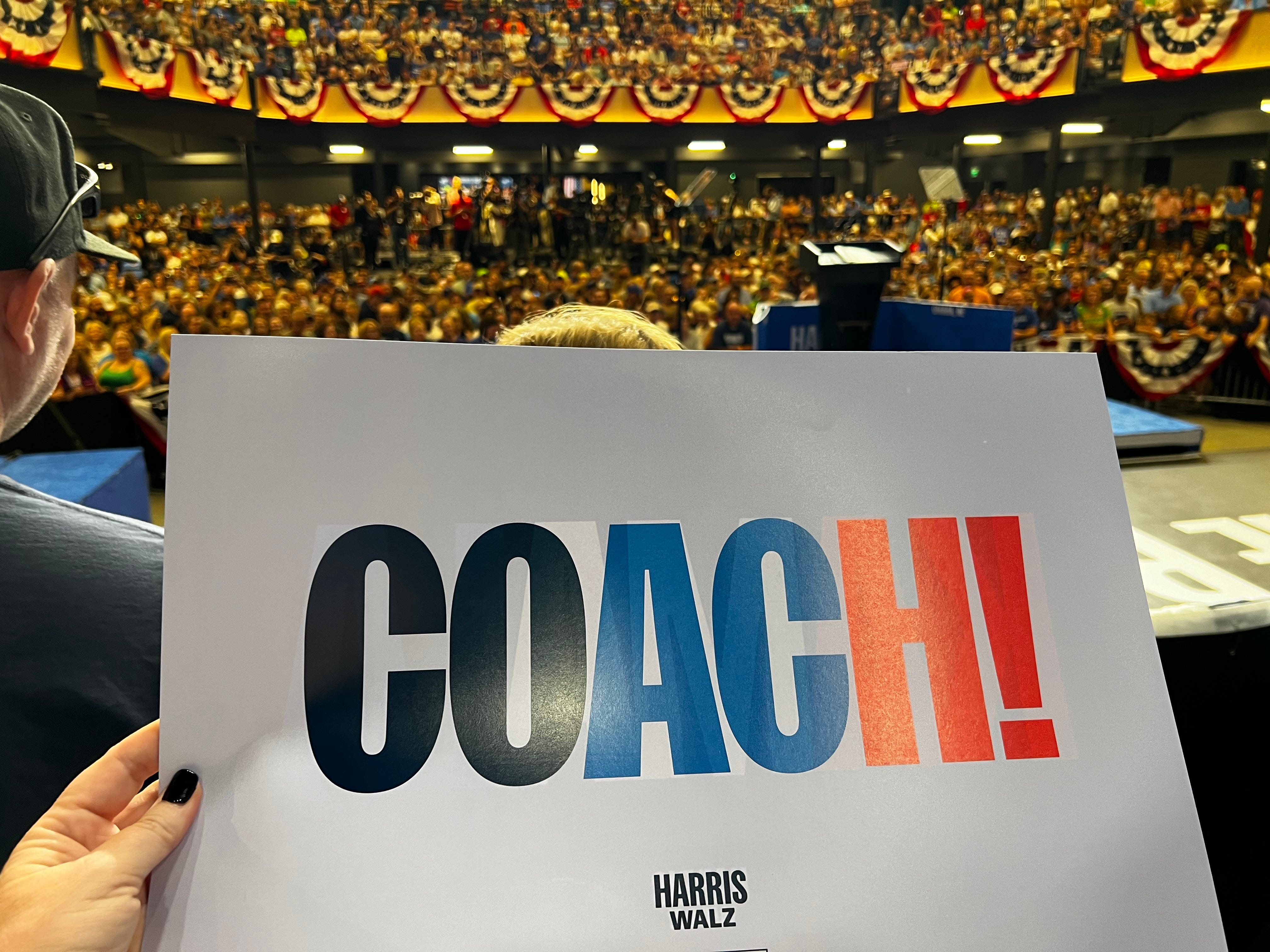
The Astro Amphitheater in Omaha at capacity for the Walz rally.

I had a friend send over an email with the Walz rally information a few days ago, so I applied for a ticket and I made the list. I was told they ran out of tickets within 18 hours. And, you can see why…Tim Walz is from Nebraska and his home state was more than happy to invite him back.

The amphitheater had a chyron that said, ‘Welcome Back, Coach!”

I know Omaha fairly well as it is less than a two-hour drive and my family really enjoys visiting Old Market and downtown. I left my house around 7:30, but I didn’t get to Omaha until almost 10 because I stopped for gas, coffee, and some breakfast pizza at Casey’s. I had on my “Dirt Road Democrat” t-shirt which can garner some looks in small towns, but the lady at the Casey’s counter read my shirt and smiled. No comment necessary.

I drove to the amphitheater and found parking and then started the walk to the event space. I ran into a few folks who said, “Wait? Are you Piper for Missouri?” I kept thinking that I wish my kids were with me so they would know that I do more than Tik Toks for a living. This isn’t much of a flex…there aren’t many outspoken rural progressives so I kind of stick out.

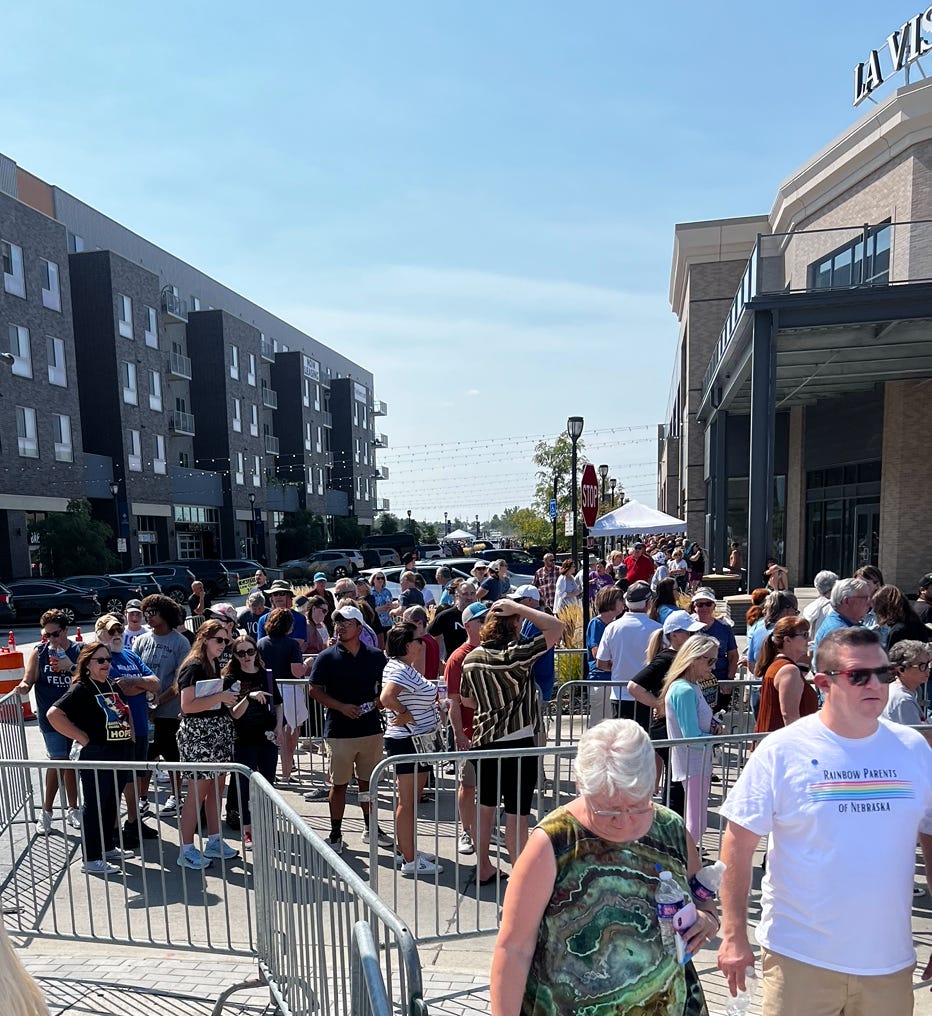
As I stood in line, I talked to so many who had stories of the fear that red legislatures can instill and that the fear has simmered for years. The anxiety that comes from living like that is remarkable, but so is a new-found feeling of hope.

Hope in the man they were waiting to see. Governor Tim Walz.

The doors were to open at 11am, so I would be waiting for a while in the long line that was beginning to go all the way back to the field I had parked in.

While waiting in line, I was able to talk to a Nebraska librarian. She worked with others to gather signatures to keep vouchers out of the state and she spoke at length about the books legislators planned to ban — the pervasive feeling of fear when thinking about shelving books in Nebraska public schools. And then she beamed when talking about the feeling of hope that the Harris/Walz ticket brought.

I was able to meet a woman who was with her Moms Demand Action for Gun Sense group. I told her I was a member in Missouri and even started a rural group in which many of the members are gun owners. She said it was hard to keep folks interested in the cause and I know that first-hand, but the fact that Tim Walz is a sensible gun-owner who has a F-rating from the NRA, and stands proudly with those of us who just want to pass common sense gun laws, is a huge help. Common sense includes safe-storage and universal background checks. These are things that most gun owners agree with.

I talked to teachers and hospital administrators and union members and nurses and stay-at-home moms. There were t-shirts representing so many viewpoints. There were ally shirts and rural shirts and public education shirts and pro-choice shirts and Walz shirts.

There were smiles in line. There was no hate. There was no fear. There was hope.

I made it through security and my way inside the theater. The place was filling up quickly. I found a seat and the woman next to me told me she followed me on Twitter and lived outside Mount Ayr, Iowa. I drive through there all the time and even met with a group of about 30 Democrats there last year. She said she had to work or she would have come. She had on an “I’m Speaking” t-shirt. She’s rural. She’s an Iowan — you know the folks who are all supposed to be Trump voters?

I bumped into a friend working with the NE Dems who told me I could stand on the stage behind Walz. Yay! So, I got up and walked by lots of people with guns to the backstage where I could be one of the folks holding the sign, doing the smiling, and getting excited about everything a politician says. Well, I didn’t have to pretend to be enthusiastic. When Tim Walz came onstage with his wife, Gwen, and a former student, it was electric.

Governor Walz talked about rural spaces. He spoke about small towns and small schools. He introduced us to a few of his former high school classmates. He graduated with 24 people.

Walz told a joke about JD Vance likely thinking a Runza is a Hot Pocket. If you know, you know.

Walz talked about the midwestern school delicacy of chili and a cinnamon roll. We all laughed because it is a combination that we all ate in public school cafeterias. It’s a shared experience that we can all smile about.

Walz then spoke on the hurt that we experienced during a Trump presidency that seems like it was just yesterday. He talked of the hate and the discontent that oozed out with every policy and press conference. He reminded the crowd that we don’t have to go back. Trump can slip away into irrelevance. That Nebraska can return its progressive roots and elect Democrats up and down the ballot.

He spoke on abortion rights and feeding kids and health care and union wages and folks who have been left behind. Omaha could not get enough of his passion and good sense. He could barely speak at times because the theater was literally pulsing with cheers and applause.

He then spoke on something that I think about daily — public schools. As soon as he mentioned how important our educational system is to our country, the crowd erupted into a chant…

Teachers! Teachers! Teachers!

The place exploded and this is where I have to tell you that I nearly cried.

I was a teacher for 16 years and the last few were rough. I miss the kids, but the fact that everything became “political” was too much. Everything I taught could be deemed political…I taught a protest lit unit that was Board Approved and in my literature book, but I felt under the gun with each lesson.

The fact that this theater was filled with Nebraskans and Missourians and Iowans all chanting for public schools and teachers was heart-warming. I am called a “groomer” or a “pedophile” on social media at least a dozen times every day for opposing book bans and for my years in the classroom. The fact that there was so much love for teachers was uplifting. I am positive the current teachers in the theater left feeling they could start this year with something that has been missing in red states…hope.

My aim with telling you about this rally is to help you understand what is happening in small towns and rural parts of the country right now. Omaha is not a rural space, but most of the immediate surrounding areas are. I drove through two hours of cornfields to arrive at the event and so did so many others.

I wrote in another post that the vibes have changed since Joe passed the torch…it remains true and even more so.

I’ll leave you with this: I passed a homemade sign in Ringgold County, Iowa the other day. The entire county has less than 5,000 residents. The sign was planted in the yard of an old farmhouse next to a cornfield. They put duct tape over “Biden” and had written “Kamala” in Sharpie on an old Biden/Harris sign. I travel this route monthly, and have for years, and I never saw the original sign in the yard. I’m pretty sure they didn’t have it out in 2020.

That means something, friend. It’s enthusiasm. It’s hope. It’s rural and small town folks coming around. LFG.

~Jess

Starry, Starry Nights at Dark Sky Preserves

Dark sky tourism is on the rise as travelers head to remote destinations to catch a glimpse of the dazzling night sky.

Crai S. Bower

Some time ago, many animals, including saber-toothed tiger and woolly mammoth, failed in their attempts to rid the community of grizzly bear, whose mean-spirited behavior had upset nature’s balance. That is until the birds, led by robin, pierced grizzly’s heart. Grizzly’s blood reddened the robin’s breast and, as he shook in pain, cloaked the autumn leaves in red and orange.

“The Creator placed the grizzly bear constellation in the night sky to remind us that bullying others carries consequences,” says Matricia Bauer, an Indigenous Knowledge Keeper from Sturgeon Lake Cree Nation. “Our creation story also tells of the star woman falling from the sky to become our people.”

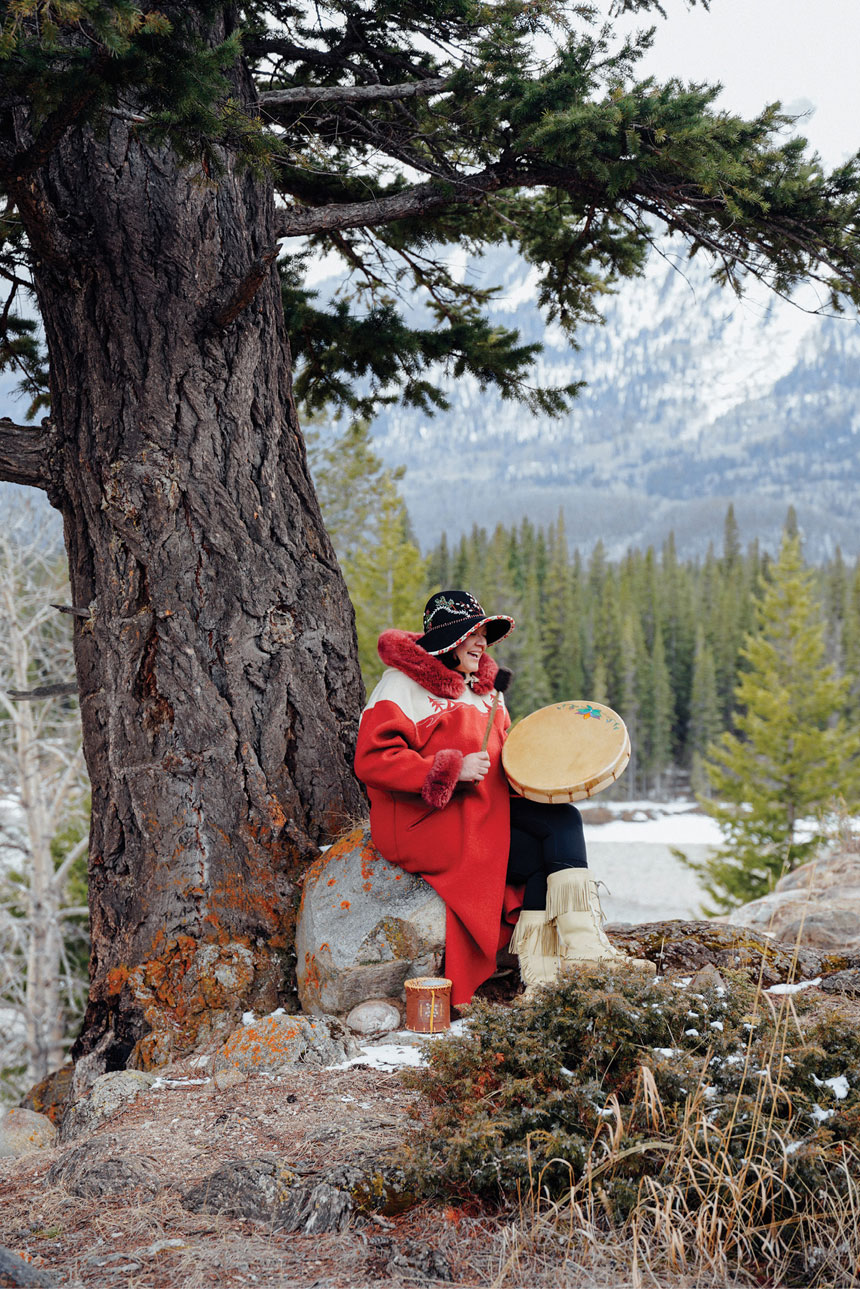
It’s a brisk March evening, and I’m sitting with Bauer by the fire beside Beauvert Lake in Jasper, Alberta, waiting for the gunmetal-colored sky to darken and reveal a palette of seemingly infinite stars. I’m visiting to explore the most accessible and second-largest Dark Sky Reserve in the world.

Shining star: Matricia Bauer, Indigenous Knowledge Keeper from Sturgeon Lake Cree Nation, leads Warrior Women, a collective presenting cultural education through drum and song. (Courtesy Tourism Jasper)

“An elder taught me that when you used to look at the night sky and see all the stars, the Creator also looked down on Earth and saw our fires in reflection. Today, instead of fires sparkling across the landscape, our continents are outlined by the glare of artificial light. People must travel to find the night sky.” (snip-MORE )

3 For Science

Stonehenge’s 6-tonne Altar Stone was transported from Scotland

August 15, 2024 Evrim Yazgin

How was Stonehenge built in ancient Britain 5,000 years ago?

New evidence suggests the Late Stone Age people who made the colossal structure would have to have used advanced transport methods to move the stones even further than previously thought.

Stonehenge at sunset
The Altar Stone at Stonehenge circled in black. Credit: English Heritage.

According to English Heritage, the largest stones – called sarsens and weighing up to 30 tonnes – are believed to have been transported from Marlborough Downs, about 32 kilometres away from the site.

The smaller stones weigh less than 10 tonnes. They were thought to have all come from the Preseli Hills in Wales more than 200km away. Transporting these gigantic stones this far would have been a monumental feat for ancient people in Britain.

But new research published in the journal Nature suggests that one stone, the 6-tonne Altar Stone, has its origins even further afield in Scotland.

Some stones at stonehenge
The Altar Stone, seen here underneath two bigger Sarsen stones. Credit: Professor Nick Pearce, Aberystwyth University. (snip-More)

https://cosmosmagazine.com/history/archaeology/stonehenge-altar-stone-scotland-transport/

=====

New liquids can safely extract nanoplastics from water

August 14, 2024 Ellen Phiddian Cosmos science journalist

Person in dark room looks at glowing vial
Gary Baker with the solvent. Credit: Sam O’Keefe/University of Missouri

US researchers have made substances that can extract nanoplastics from water.

The solvents, made from non-toxic components, could remove 98% of the tiny plastic particles from water in a lab environment.

The team has published its research in ACS Applied Engineering Materials.

 “Our strategy uses a small amount of designer solvent to absorb plastic particles from a large volume of water,” says corresponding author Gary Baker, an associate professor at the department of chemistry in the University of Missouri-Columbia. (snip-More)

https://cosmosmagazine.com/science/chemistry/nanoplastic-solvent-extraction/

=====

Elite woman’s grave dates from before Genghis Khan’s Mongolian Empire

August 14, 2024 Evrim Yazgin

Scientists have made an unexpected discovery in a thousand-year-old abandoned fortress in Mongolia.

Buried in the walls of the fortress is the grave of an elite woman who pre-dates the rise of the founder of the Mongolian Empire, Genghis Khan (also known as Chinggis Khan). The frontier fortress is about 1.4 km west of Khar Nuur lake in eastern Dornod province of Mongolia, only kilometres from the Chinese border.

Mongolia, zavkhan province, khar nuur lake
Khar Nuur lake. Credit: Tuul & Bruno Morandi / The Image Bank / Getty Images Plus.

Genghis Khan rose to prominence in 1206 CE. Before that, the Kitan-Liao Empire controlled great swaths of land between 916 and 1125 CE.

The period between these great dynasties is poorly understood as very few records survive. (snip-More)

https://cosmosmagazine.com/history/archaeology/mongolia-elite-woman-grave/

Saving an Underwater World

Michael Goldberg and his team of volunteer divers are resurrecting reefs, one coral at a time.

Ken Budd https://www.saturdayeveningpost.com/2024/08/saving-and-underwater-world/

Thirty years ago, when Michael Goldberg would dive in the glimmering blue water of the British Virgin Islands, the reefs were teeming with life. “The expanse of these reefs was astounding,” says Goldberg, a cofounder of I.CARE, a Florida-based reef restoration organization. “The corals were so thick and lush.”

Today those reefs are dying. In much of the Atlantic Ocean, including the Florida Keys, where the 61-year-old Goldberg lives, roughly 70-95 percent of the coral is gone, devastated by disease, rising sea temperatures, and other existential threats.

By 2015, as the reefs declined, Goldberg faced a decision. He would either leave the scuba industry — since 2004, he has owned Key Dives, which provides diving and snorkeling on the Keys’ Islamorada reefs — or take action to restore the coral. Fortunately for Florida, the ocean, and humanity, he chose the latter.

In 2019, Goldberg cofounded I.CARE (Islamorada Conservation and Restoration Education). The mission: To restore and maintain Islamorada’s reefs by teaming with local businesses, residents, and visitors, including local dive shops and recreational divers. Activities range from underwater trash clean-ups — since 2021, divers have lugged 20,000 pounds of debris to the surface — to coral transplants. Over the past three years, I.CARE has planted over 15,000 corals on six different reefs.

The need is urgent. Coral reefs provide food and shelter to thousands of organisms — crustaceans, fish, anemones, sponges — and protect shorelines from storms and erosion. The reefs’ economic benefits include tourism and commercial and recreational fishing. Coral has even been used in medical technologies such as “bone grafting techniques and possible treatments for diseases including Alzheimer’s and cancer,” I.CARE notes.

“I love educating people about the importance of this, but the most gratifying thing for me is seeing the coral grow,” Goldberg says. “I love seeing little baby corals thrive in a harsher environment than I ever imagined, and knowing that despite all the challenges, we’re seeing success.”

Goldberg’s career initially focused on money management rather than ocean management. His love of the water began when he was a boy in Los Angeles, but his family moved to Chicago when he was 10, and he later studied finance at Northern Illinois University. On a summer trip to Acapulco, he dove for the first time, purely, he says, “as a lark.”

“Someone got me some gear, and I wasn’t certified, and I didn’t know what I was doing,” he says. Acapulco is not known for stellar diving experiences, but he loved it: “I was just so enamored with being underwater.”

After that, he was hooked. He earned his diving certification and then moved back to one of L.A.’s beach communities and became an instructor. Before long, he and his wife decided to move to the British Virgin Islands. Eight years later, the couple returned to the United States and opened Key Dives in Islamorada.

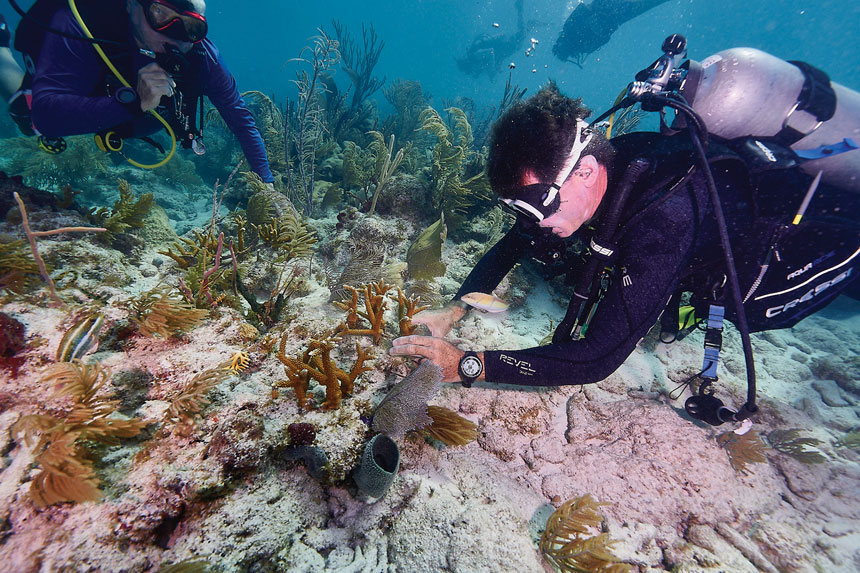
Hope and water: “If I wasn’t optimistic, I wouldn’t keep doing this,” says I.CARE cofounder Michael Goldberg. (Photo courtesy Michael Goldberg)

Goldberg has made over 10,000 dives, swimming not only with dolphins and schooling sharks, but within 15 feet of a humpback whale as it breached. And yet the vast coral reefs have always intrigued him most, whether diving alone or taking clients off the island of Virgin Gorda in the British Virgin Islands.

“There was this one unique piece of coral that I would swim underneath — it was like a tree,” he says. “Most people want to see fish, but to me, that coral was always the highlight of the dive.”

In 2017, Goldberg met Kylie Smith, who was working on her Ph.D. at Clemson University and studying coral in the Florida Keys. Smith would fill her tank at Key Dives, and Goldberg, who was “already shifting my business toward conservation,” would tap into her aquatic expertise.

“When I met Dr. Smith, I would pepper her with questions — she couldn’t walk in my store and leave in quick fashion,” Goldberg says. Their discussions eventually moved from the dive shop to a beer garden at The Florida Keys Brewing Company. “We would sit and chat, and I kept saying to her, I’ve got an idea to empower recreational divers so that they can become citizen scientists — not only because they want to be part of the solution, but because they need to be a part of the solution. That’s the largest potential boots-on-the-ground army that can enact so much of what we do.”

Those discussions led them to co-launch I.CARE. By January 2021, volunteer divers had transplanted I.CARE’s first corals.

For the coral restoration, divers use coral raised in nurseries. Once it’s planted on the reefs, the coral will, hopefully, reproduce into a coral colony — but the process is slow. It can take 20-50 years for coral to grow large enough to spawn.

To speed up reproduction, I.CARE uses a process called micro-fragmentation. Larger corals are cut into thumbnail-size pieces and grown in a nursery. When those pieces grow to about the size of a 50-cent piece, they are planted edge to edge on a living coral structure. After a few years, the coral fuse to become one larger coral, and they’ll start to spawn in about 7 to 10 years.

For the micro-fragmentation work, I.CARE rescues coral that has broken free from the main reef structure due to storms and substrate erosion.

“What is cool about these corals is that these are the survivors. They are the most resilient, the ones that have persisted despite all the disease and heat,” says Goldberg. “It’s survival of the fittest in the truest sense, and the ones we are using to rebuild our precious reefs.”

Despite the advances, the challenges are huge, both for I.CARE and the planet. During the intense heat of summer 2023, most of I.CARE’s seemingly healthy coral fragments died at one of Goldberg’s favorite reefs. “I cried underwater,” he admits. But he prefers to focus on the organization’s victories. Seventy-seven of the fragments survived and are thriving.

“If I wasn’t optimistic, I wouldn’t keep doing this,” he says. “We’ve had successes, and we can build on those successes.”

When it comes to restoring the reefs for future generations, he offers a simple vow: “We’re not gonna give up.”

Ken Budd has written for The Washington Post, The Atlantic, The New York Times, National Geographic Traveler, and many more. He is the author of an award-winning memoir, The Voluntourist.

This article is featured in the July/August 2024 issue of The Saturday Evening Post.