Some time ago, many animals, including saber-toothed tiger and woolly mammoth, failed in their attempts to rid the community of grizzly bear, whose mean-spirited behavior had upset nature’s balance. That is until the birds, led by robin, pierced grizzly’s heart. Grizzly’s blood reddened the robin’s breast and, as he shook in pain, cloaked the autumn leaves in red and orange.
“The Creator placed the grizzly bear constellation in the night sky to remind us that bullying others carries consequences,” says Matricia Bauer, an Indigenous Knowledge Keeper from Sturgeon Lake Cree Nation. “Our creation story also tells of the star woman falling from the sky to become our people.”
It’s a brisk March evening, and I’m sitting with Bauer by the fire beside Beauvert Lake in Jasper, Alberta, waiting for the gunmetal-colored sky to darken and reveal a palette of seemingly infinite stars. I’m visiting to explore the most accessible and second-largest Dark Sky Reserve in the world.
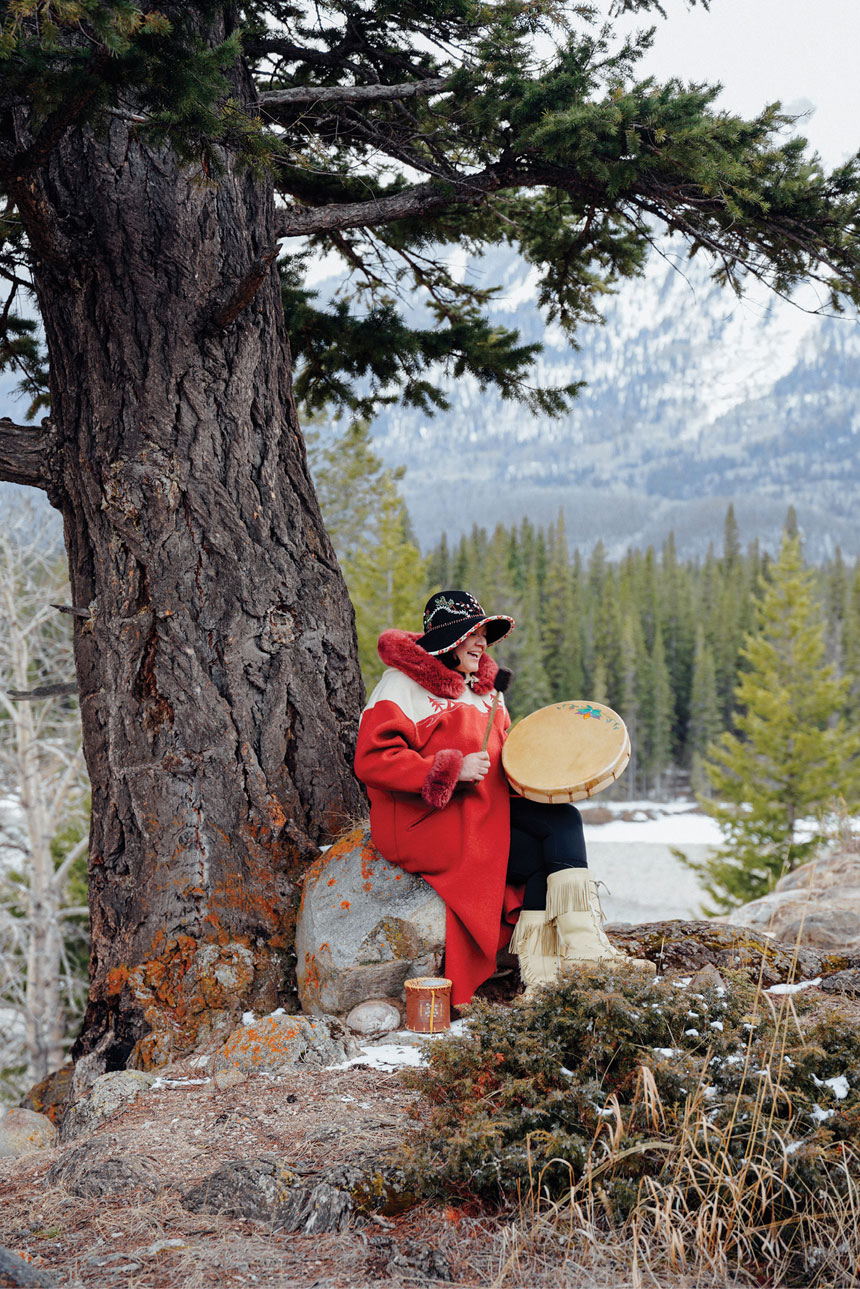
Shining star: Matricia Bauer, Indigenous Knowledge Keeper from Sturgeon Lake Cree Nation, leads Warrior Women, a collective presenting cultural education through drum and song. (Courtesy Tourism Jasper)
“An elder taught me that when you used to look at the night sky and see all the stars, the Creator also looked down on Earth and saw our fires in reflection. Today, instead of fires sparkling across the landscape, our continents are outlined by the glare of artificial light. People must travel to find the night sky.” (snip-MORE )
In an episode of The Twilight Zone called “The Midnight Sun,” first broadcast in November 1961, the apocalyptic temperature of an Earth getting ever closer to the Sun is represented by a thermometer bursting at…130°F. On July 5, 2024, Palm Springs, California, reached 124°F, while the next day, Death Valley hit 128°F, amidst a shattering of triple-digit temperature records across the American West.
Benchmarks have shifted. In 1961, the amount of carbon dioxide (CO2) in the atmosphere was 318 parts per million by volume (ppmv). CO2 is a greenhouse gas, acting as atmospheric insulation, preventing heat radiation from dissipating into space. Last year, 2023, the amount of CO2 in the atmosphere was 421 ppmv. It continues to increase, not least as we battle the resulting heat by burning fossil fuels to stay cool. We’re in a global greenhouse, and the doors seem to be locked as we paradoxically produce more CO2 to stay cool in the face of heating caused by the production of more CO2.
Humans have long worked to beat the heat, especially in the tropics and in deserts. Their perfectly rational strategies—stay out of the midday sun, live underground, cover up completely—may once have been criticized by those from temperate zones, sometimes in racist terms, but more and more parts of the world are having to learn the lesson of those strategies.
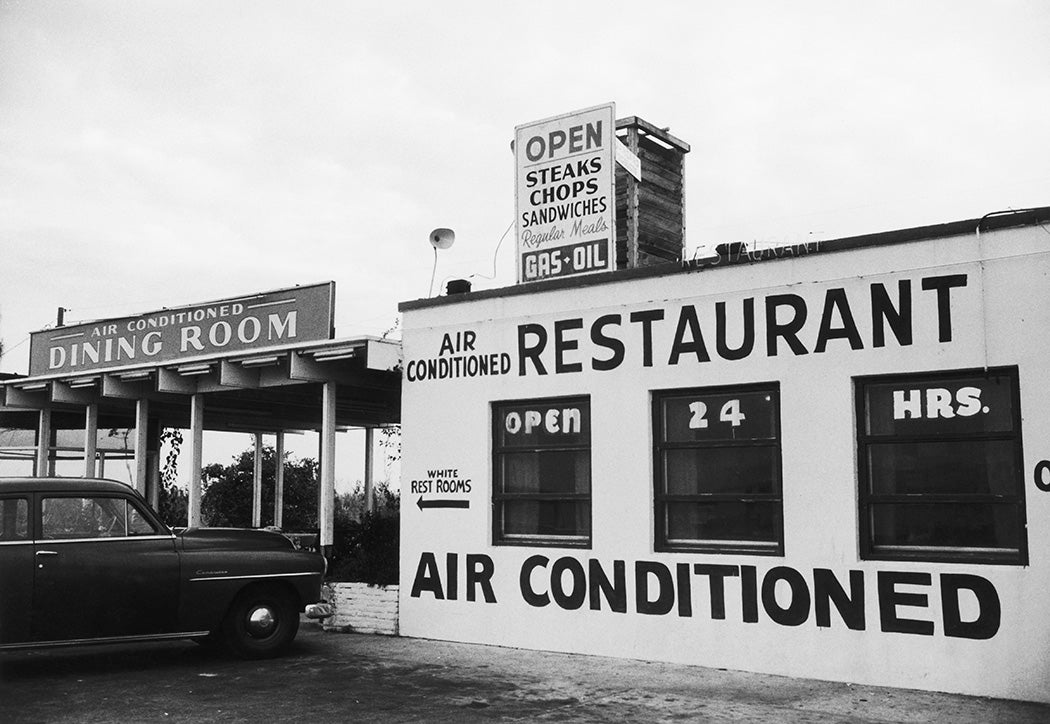
A sign outside an air-conditioned American restaurant points to the “White Rest Rooms,” in a clear indication of racial segregation, circa 1960. Getty
What, after all, would it be like without air conditioning? Take a look at this Before Air-Conditioning piece in Scientific American’s “Hints for Keeping Cool.” Published in July 1858, the piece begins with a dietary suggestion: eat “fruits, vegetables, and farinaceous food, and the lighter kinds of meat.” In 1858, the amount of CO2 in the atmosphere was 286 ppmv. Seven years earlier, Dr. John Gorrie, striving to cool down his malaria and yellow fever patients in Florida, patented the first ice-making machine (1851, 285 ppmv).
The first modern, electrical air condition system dates to 1902 (297 ppmv), when inventor Willis Carrier cooled and dehumidified the Sackett-Wilhelms Lithographic & Publishing Company in Brooklyn, New York. The publishing company was most concerned about humidity warping their paper supplies. Carrier is still a going concern.
A little over a century after Scientific American’s helpful hints, The Science News-Letter’s “Keeping Cool in Summer Heat” (1961: 318 ppmv) wasn’t so very different.
“If you suffer from heat frustration when the mercury hits the 90’s, a little scientific knowledge of summer heat can help your body temperature and state of mind remain well within the comfort zone,” the editors claim.
These hints were essential for those without air conditioning, that wonder of the twentieth century. Try to imagine cars, theaters, restaurants, the suburbs, office towers, apartment blocks, malls, et cetera, without A/C. The post-World War II population growth across the Sun Belt, stretching from Southern California to North Carolina, would most likely not have been possible without it.
“I hate air conditioning,” the woman confirmed. “It’s a damnfool invention of the Yankees. If they don’t like it hot, they can move back up North where they belong.”
But most people—in the South and elsewhere—welcomed A/C with a passion. Arsenault notes that historians tended to shy away from writing about the transformative power of air-conditioning on the South because they were leery of falling into an old climate-is-destiny paradigm. In the first three decades of the twentieth century, the South’s climate was held responsible for everything from the Southern drawl to plantation slavery. Climate determinism faded by mid-century (1950: 311 ppmv), as the “long hot summers” of the Civil Rights years transitioned into the “New South,” supposedly post-racial but definitely all indoor-cooled.
This is a slide show, on the page. I sometimes enjoy seeing bits of the lives of people I admire. Click through to see the slide show, here’s a snippet of the text:
-Almost everyone has been on those Victorian house tours where they give stories about the white people who lived there, potential ghosts sightings and whatnot.
-Well, allow us to take you on a trip through the homes of some of the most beloved Black history legends. Not everyone stops to think about the four walls Martin Luther King Jr. grew up in or the massive estate of Madame C.J. Walker, both of which are among other historic locations preserved for touring. The architecture, lofty details and machinery we wouldn’t even know how to operate today, but they keep alive the memory not only of our historical figures but also show us what Black life looked like through their lens.
-If you’re planning a trip to some of these historical sites, first take get a preview into the homes of some our favorite Black historical figures. (snip-photos on the page, with More)
When I first posted this it was from my phone in bed. I am sorry I did not check but no link or story posted. Thankfully wonderful Ali jumped to the rescue and added the link. Thank you Ali. Hugs. Scottie