A Chinese national, charged with fraud by the SEC, just sent Donald Trump $18 million

(As is said on my other favorite blog, Our Failed Political Press at work again. sigh The money graf here: A foreign national under federal fraud prosecution making a purchase that results in $18 million cash payment to the president-elect has all the makings of a major scandal. But it has been virtually ignored by several major media outlets.

But the entire piece makes it make better sense.)

by Judd Legum Read on Substack

Chinese Crypto entrepreneur Justin Sun paid $6.2 million for a banana — sold by Sotheby’s as conceptual art — and then ate it last Friday.

The banana is not Sun’s most notable recent purchase.

On November 25, Sun purchased $30 million in crypto tokens from World Liberty Financial, a new crypto venture backed by President-elect Donald Trump. Sun said his company, TRON, was committed to “making America great again.”
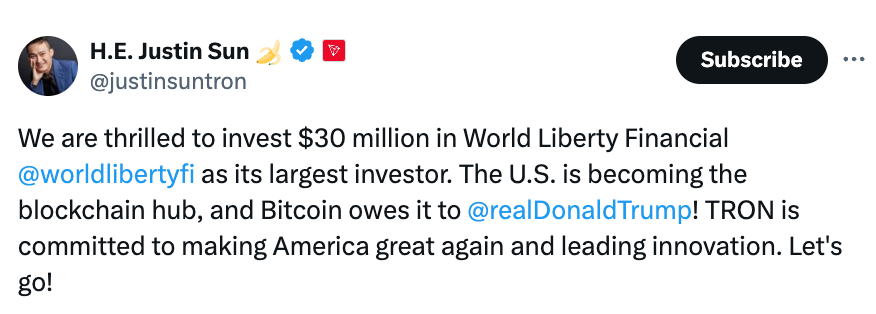
World Liberty Financial planned to sell $300 million worth of crypto tokens, known as WLF, which would value the new company at $1.5 billion. But, before Sun’s $30 million purchase, it appeared to be a bust, with only $22 million in tokens sold. Sun now owns more than 55% of purchased tokens.

Sun’s decision to buy $30 million in WLF tokens has direct and immediate financial benefits for Trump. A filing by the company in October revealed that “$30 million of initial net protocol revenues” will be “held in a reserve… to cover operating expenses, indemnities, and obligations.” After the reserve is met, a company owned by Donald Trump, DT Marks DEFI LLC, will receive “75% of the net protocol revenues.”

So before Sun’s purchase, Trump was entitled to nothing because the reserve had not been met. But Sun’s purchase covered the entire reserve, so now Trump is entitled to 75% of the revenues from all other tokens purchased. As of December 1, there have been $24 million WLF tokens sold, netting Trump $18 million.

Sun is also joining World Liberty Financial as an advisor, making Sun and the incoming president business partners.

While Trump has the cash, Sun’s tokens are effectively worthless. To comply with U.S. securities law, WLF tokens are “non-transferable and locked indefinitely in a wallet or smart contract until such time, if ever, [WLF tokens] are unlocked through protocol governance procedures in a fashion that does not contravene applicable law.” The only thing that Sun can do with his tokens is participate in the “governance” of World Liberty Financial. Right now, the only thing World Liberty Financial does is sell tokens.

Any foreign national paying an incoming president $18 million weeks before entering the White House should raise red flags. Sun’s purchase is even more alarming because the Securities and Exchange Commission (SEC) is currently prosecuting him for fraud.

The SEC’s ongoing prosecution of Sun

On March 22, 2023, the SEC charged Sun and three companies he owns. The SEC accused Sun of marketing unregistered securities and “fraudulently manipulating the secondary market” for a crypto token “through extensive wash trading.” Wash trading involves “the simultaneous or near-simultaneous purchase and sale of a security to make it appear actively traded without an actual change in beneficial ownership.” In other words, according to the SEC, Sun made it seem like there was a lot of interest in crypto tokens he issued when much of the trading was fraudulent and manufactured by Sun.

The SEC also charged Sun with “orchestrating a scheme to pay celebrities to tout” his crypto tokens “without disclosing their compensation.” Federal law requires people who endorse securities to “disclose whether they received compensation for the promotion, and to specify the amount.” The celebrities involved included Lindsay Lohan, Jake Paul, and Soulja Boy.
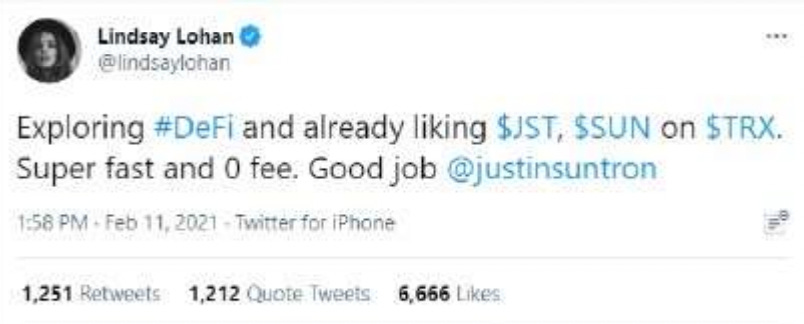
Lohan paid $40,000, and Paul paid about $100,000 to settle the charges against them without admitting liability. Soulja Boy did not respond to the lawsuit, and a default judgment was issued against him.

Sun posted on X that he believes the SEC “complaint lacks merit” and complained that “the SEC’s regulatory framework for digital assets is still in its infancy and is in need of further development.”

The litigation against Sun is ongoing, with a federal judge considering a motion by Sun’s attorneys to dismiss the charges. The current SEC Chairman, Gary Gensler, who announced the charges against Sun, will step down when Trump takes office in January. A new SEC commissioner appointed by Trump could settle or dismiss the charges against Sun.

How Trump can use the power of the presidency to unlock hundreds of millions in profits for himself

Through World Liberty Financial, Trump can reap massive personal profits from creating a more permissive regulatory environment for crypto ventures.

In addition to his 75% share of revenues over $30 million, Trump’s company was also awarded 22.5 billion WLF tokens. At the current sale price, these tokens are worth more than $300 million. That is more than 20 billion tokens being offered for sale publicly. (This makes the “governance” value of WLF tokens, which was already questionable, effectively worthless. No matter how many tokens you own, Trump will always be able to outvote other token holders.)

Right now, Trump’s tokens — like those purchased by Sun — are worthless because they cannot be transferred. But Trump could appoint a new SEC chairman who is friendly to the crypto industry and who would create new rules allowing the WLF tokens and similar crypto assets to be legally traded. If the price of the tokens increases when they hit the open market, which is a possibility for a crypto token backed by the President of the United States, the value of Trump’s tokens could be in the billions.

That appears to be exactly the path Trump is taking. WIRED reports that Trump is “asking the crypto industry to weigh in on potential picks.” Among the leading contenders is Paul Atkins, a former SEC Commissioner, who, since leaving the agency in 2008, has run a consulting firm that works with crypto companies. Atkins is also co-chair of the Token Alliance, an initiative of the Chamber of Digital Commerce, the lobbying group for the crypto industry. He is also a member of the Chamber of Digital Commerce’s Board of Directors.

Another top contender, former SEC General Counsel Robert Stebbins, has said that the SEC should “pause most of its crypto lawsuits while clearing a path for the firms to do business without the overhang of litigation.” But Stebbins’ candidacy underscores the need for Sun to forge a favorable relationship with Trump. Stebbins acknowledged that, even if it takes a more permissive view toward the crypto industry, it may want to consider continuing to pursue litigation involving fraud.

Major media outlets obsessed with banana, ignore Sun’s payment to Trump

A foreign national under federal fraud prosecution making a purchase that results in $18 million cash payment to the president-elect has all the makings of a major scandal. But it has been virtually ignored by several major media outlets.

The New York Times, for example, has published five articles about Sun’s purchase of the banana but none about Sun’s $30 million purchase of WLF tokens and his business partnership with Trump. The Washington Post has published three articles about the banana, but its coverage of Sun’s purchase of WLF tokens was limited to one short paragraph in a larger editorial about the crypto industry. (The paragraph does not explain how Trump personally profits from Sun’s token purchase.) The Wall Street Journal did publish a short piece about Sun’s token purchase on its “Live Update” blog, but the piece was not viewed as significant enough to be included in the print edition. The paper published two articles, plus a video, focused on the banana. One of the Wall Street Journal articles about the banana was published on the front page of the paper.

Peace & Justice History for 11/29

November 29, 1864
A U.S. Army cavalry regiment under Colonel J. M. Chivington (a Methodist missionary and candidate for Congress), acting on orders from Colorado’s Governor, John Evans, and ignoring a white surrender flag flying just below a U.S. flag, attacked sleeping Cheyenne and Arapaho Indians, killing nearly 500, in what became known as the Sand Creek Massacre. Captain Silas Soule, however, not only refused to follow Chivington’s lead at Sand Creek, but ordered his troops not to participate in the attack.
The Indians, led by Black Kettle, had been ordered away from Fort Lyon four days before, with the promise that they would be safe. Virtually all of the victims, mostly women and children, were tortured and scalped; many women, including the pregnant, were mutilated. Nine of 900 cavalrymen were killed. A local newspaper called this “a brilliant feat of arms,” and stated the soldiers had “covered themselves with glory.”
At first, Chivington was widely praised for his “victory” at the Battle of Sand Creek, and he and his troops were honored with a parade in Denver. However, rumors of drunken soldiers butchering unarmed women and children began to circulate, and Congress ordered a formal investigation of the massacre. Chivington was eventually threatened with court martial by the U.S. Army, but as he had already left his military post, no criminal charges were ever filed against him

Eyewitness Congressional testimony of John S. Smith, a white Indian agent and interpreter
 
Two different paintings of the Sand Creek Massacre
November 29, 1963

Earl Warren and LBJ
U.S. President Lyndon B. Johnson establishes the Warren Commission to investigate the assassination of President John F. Kennedy.
More about The Warren Commission 
November 29, 1967
U.S. Secretary of Defense Robert McNamara announces his resignation during the Vietnam War.

Robert McNamara
The Fog of War a movie about the Vietnam War 

https://www.peacebuttons.info/E-News/peacehistorynovember.htm#november29

Peace & Justice History for 11/27

November 27, 1095
Pope Urban II called on all Christians to liberate Jerusalem from the Muslims and reclaim the Holy Land: “Deus vult (God wills it)!” What is currently called the Middle East was then in control of the Turks who frequently barred Christian pilgrims entrance to the city.
At the Council of Clermont in France, the pope promised absolution and remission of sins for all who died in the service of Christ. The mobilization of 60,000 to 100,000 Christians throughout Europe in this effort became known as the First Crusade.
 
November 27, 1914
The No-Conscription Fellowship (NCF) was founded by two English pacifists, Clifford Allen and Fenner Brockway. They opposed the Military Service Act which introduced conscription, and then mounted a vigorous campaign against the punishment and imprisonment of conscientious objectors.
They were consistently opposed to the war in Europe.


Early Fellowship members 

Fellowship members at a recent protest

Read more about Clifford Allen, Fenner Brockway and No-Conscription Fellowship 
More on the No-Conscription Fellowship from the Swarthmore College Peace Collection 
November 27, 1957
Jawaharlal Nehru, India’s first Prime Minister, made an impassioned speech appealing to the United States and the Soviet Union (Union of Soviet Socialist Republics) to end testing and begin nuclear disarmament. The two superpowers were the only nations with atomic weapons at the time.
Nehru had fought to free his country from British colonial authority through acts of nonviolent passive resistance with Ghandi, and they achieved independence. He stressed the urgency for the U.S. and U.S.S.R. to “save humanity from the ultimate disaster.”Nehru’s Congress Party government nevertheless pursued an aggressive nuclear program, starting in 1948, publicly committed to peaceful purposes exclusively. Nehru acknowledged that the possession of fissionable materials and growing expertise could readily be directed toward production of such weapons. In the absence of universal nuclear disarmament, he feared acquisition of such weapons by potential adversaries. In particular for India, this meant Pakistan or China.


India’s first prime minister, Jawaharlal Nehru
Nuclear India – a short history 
November 27, 1965
In Washington D.C., 35,000 anti-war protesters circled the White House then marched on to the Washington Monument for a rally against the war in Vietnam.
November 27, 1967
Reverend Martin Luther King, Jr. announced the Southern Christian Leadership Conference’s Poor People’s Campaign, a movement to broadly address economic inequalities with nonviolent direct action. “It must not be just black people,” argued King, “it must be all poor people. We must include American Indians, Puerto Ricans, Mexicans, and even poor whites.”

Why a Poor People’s Campaign? 
November 27, 1969
Over one hundred members of the U.S. 71st Evacuation Hospital and the 44th Medical Detachment at Pleiku, Vietnam, organized a Thanksgiving protest fast called the “John Turkey movement.” In Home before Morning, nurse Lynda Van Devanter recalled her change in attitude.

Nurse Lynda Van Devanter
“Earlier in my tour, when I had heard about the war protesters, I had felt angry at them for not supporting us.  Now I wished I could march with them . . . Most others in Pleiku felt the same way . . . We even held our own Thanksgiving Day fast—the John Turkey movement — as a show of support for those who were trying to end the war through protests and moratoriums. We heard that the fast had spread to units all over Vietnam.” The fast received considerable media coverage when Denise Murray, a nurse at Pleiku and daughter of a distinguished admiral, made antiwar statements to the press.

https://www.peacebuttons.info/E-News/peacehistorynovember.htm#november27

Peace & Justice History for 11/26

November 26, 1968
U.N. General Assembly passed a resolution against capital punishment following an official report which said, “Examination of the number of murders before and after the abolition of the death penalty does not support the theory that capital punishment has a unique deterrent effect.”
More on capital punishment and homicide 
November 26, 1970
American Indian activists marked Thanksgiving with a National Day of Mourning for Native Americans by occupying Plymouth Rock in Massachusetts, the alleged landing spot of the Pilgrims’ arrival in Massachusetts colony. Led by Wamsutta Frank James, an Aquinnah Wampanoag elder and music teacher, over 200 Indians seized the Mayflower II and painted Plymouth Rock red.

Day of Mourning demo in downtown Plymouth
James had refused to speak at a state dinner the night before commemorating the 350th anniversary of the landing, and went on to organize United American Indians of New England.
Wamsutta Frank James’ suppressed speech 
video footage 2022 National Day of Mourning
November 26, 1983
President Ronald Reagan ordered military assistance to Iraq in the war Saddam Hussein had begun by invading Iran. To prevent an Iraqi military collapse, the Reagan administration supplied battlefield intelligence on Iranian troop buildups to the Iraqis, sometimes through third parties such as Saudi Arabia.
National Security Decision Directive 114, signed on that day, stated that the United States would do “whatever was necessary and legal” to prevent Iraq from losing the war with Iran. It called for heightened regional military cooperation to defend oil facilities, and measures to improve U.S. military capabilities in the Persian Gulf.
The assistance was granted despite frequent and consistent reports of Iraqi use of chemical weapons, a clear violation of the 1925 Geneva Protocol. Mustard gas had been used against Iranian troops and against “human wave” attacks by thousands of Basij (Popular Mobilization Army or People’s Army) volunteers.

The full story on U.S.-Iraq relations at that time 
The Geneva Protocol 

https://www.peacebuttons.info/E-News/peacehistorynovember.htm#november26

Peace & Justice History for 11/25

November 25, 1913
Indians marching with Mohandas Gandhi for recognition of their religious and cultural legitimacy, and individual freedom, were attacked by police, leaving five dead (shot from the back according to the inquest) and nine wounded. He was marching with more than 2000 striking miners from Natal to Transvaal provinces in South Africa in violation of the law.
Gandhi in his publication, Indian Opinion, had advocated the end of a £3 tax on ex-indentured Indians. He had lamented the violence that had been inflicted on his peaceful marchers. 

—————————————————————————
November 25, 1947


Film industry executives, meeting in New York, announced that the “Hollywood Ten” directors, producers, and writers who had refused to testify before the House Un-American Activities Committee (HUAC) would be fired or suspended, and not hired in the future, thus “blacklisted.” 
Who were the Hollywood Ten?  
—————————————————————————
November 25, 1986
President Ronald Reagan and Attorney General Edwin Meese revealed that $30 million in profits from secret arms sales to Iran had been diverted to support the Nicaraguan contra insurgents in violation of U.S. law. What became known as the Iran-Contra Affair was revealed three weeks after a Lebanese magazine reported arms had been sold in violation of U.S. policy.

Reagan & Meese
The arms trade with the revolutionary government of the Islamic Republic of Iran was carried out in hopes of freeing some of the Western hostages held by Iran’s allies in the middle east. Reagan had repeatedly pledged never to negotiate with terrorists.
However, notes of an earlier meeting kept by then-Defense Secretary Caspar Weinberger said, “President decided to go with Israeli-Iranian offer to release our 5 hostages in return for sale of 4,000 TOWs [U.S. missiles] to Iran by Israel.  [Sec. of State] George Shultz + I opposed — [CIA Director] Bill Casey, Ed Meese + VP [George H.W. Bush] favored — as did Poindexter.”
The Congress had specifically barred U.S. funds going to the contras (Boland amendment) who were terrorizing the Nicaraguan countryside.


John Poindexter
Reagan and Meese denied knowledge of the activity and named two subordinates — National Security Advisor Admiral John M. Poindexter and National Security Council staffer Colonel Oliver L. North — as responsible and being dismissed from their jobs as a result. “. . . [I] was not fully informed on the nature of one of the activities,” said President Reagan, referring to the fact that money from weapons sales to Iran was diverted to the contras.
Who’s who in Iran-Contra

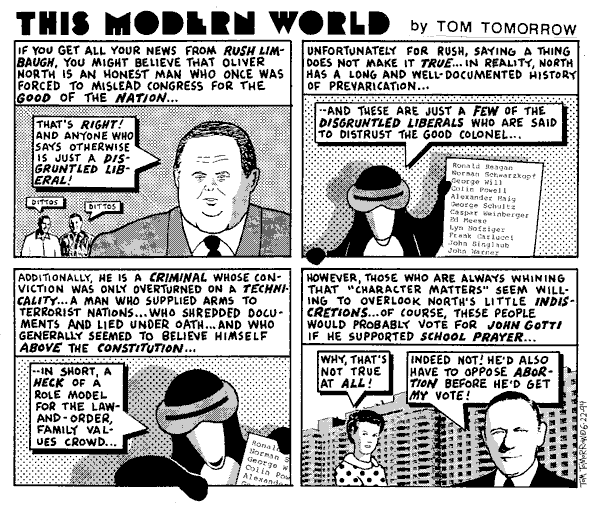
Tom Tomorrow on Iran-Contra 
—————————————————————————
November 25, 1988
2,000 marched in New York city to protest the sale of animal fur for clothing. Over 50 other cities held similar demonstrations.

https://www.peacebuttons.info/E-News/peacehistorynovember.htm#november25

Lunchtime Reading

The links are priceless to read on their own, but there is fine info when we click.

Peace & Justice History for 11/23

November 23, 1170 BCE
 
The first recorded strike took place in Egypt when necropolis workers who had not been paid for their work in more than two months sat down and refused to work until they were paid and able to eat.
More about this 1st strike 
November 23, 1887
Black Louisiana sugarcane workers, in cooperation with the racially integrated Knights of Labor, had gone on strike at the beginning of the month over their meager pay issued in script (not cash). The script was redeemable only at the company store where excessive prices were charged. When the first freeze of the season arrived and damaged the crop, the plantation owners were angered. The Louisiana Militia, aided by bands of “prominent citizens,” shot and killed at least 35 unarmed black sugar workers striking to gain a dollar-per-day wage, and lynched two strike leaders in what became known as the Thibodaux Massacre.
More on the Thibodaux Massacre
November 23, 1981
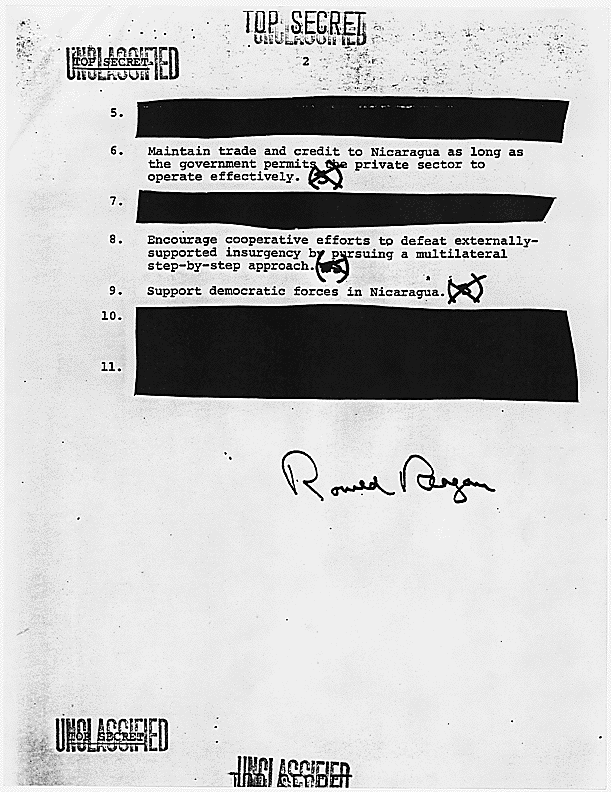
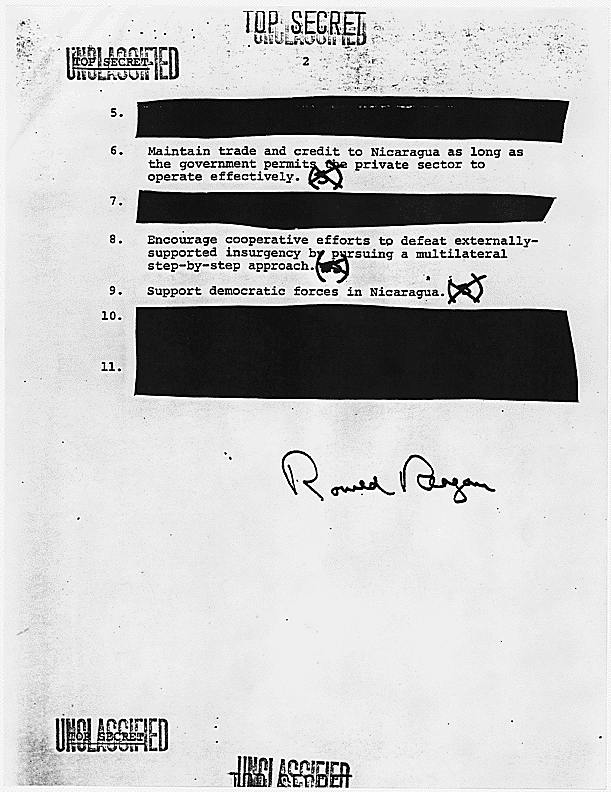
President Ronald Reagan signed off on a top secret document, National Security Decision Directive 17 (NSDD-17), which gave the Central Intelligence Agency a budget of $19 million to recruit and support a 500-man force of Nicaraguan insurgents to conduct covert actions against the leftist Sandinista elected government. This marked the beginning of official U.S. support for the so-called contras in their war against the Nicaraguans.

Read (most of) the memo 
More on the Reagan policy 

https://www.peacebuttons.info/E-News/peacehistorynovember.htm#november23

Peace & Justice History for 11/21:

November 21, 1945
200,000 members of the United Auto Workers went on strike against General Motors, the first major strike following World War II. The UAW’s demand for a 30% wage increase was based on the increase in the cost of living during the war (28% according to the Department of Labor), the wartime freeze on wages, and the cut in the average workweek with the disappearance of overtime pay in manufacturing.

But the UAW also considered profits and prices a subject for negotiation, a position rejected by GM. The union did not merely say that labor was entitled to enough wages to live on. It also said that labor was entitled to share in the wealth produced by industry. “… Unless we get a more realistic distribution of America’s wealth, we won’t get enough to keep this machine going.”–Walter Reuther, UAW President
More about the strike 
November 21, 1973
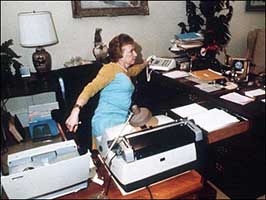
President Richard Nixon’s attorney, J. Fred Buzhardt, revealed the existence of an 18 1/2-minute gap in one of the subpoenaed White House tape recordings of Watergate conversations made by President Richard Nixon in the days after the Watergate break-in.The erasure was blamed on an accident by Nixon’s private secretary, Rose Mary Woods, but scientific analysis determined the erasures to be deliberate. White House Chief of Staff Alexander Haig later attributed the gap to “sinister forces.”

Rose Mary Woods, demonstrating how she might have created the Watergate tape gap
More about Rose Mary Woods 
November 21, 1974
Both Houses of Congress voted to override President Gerald Ford’s veto of updates to the Freedom of Information Act. Originally passed in 1966, it required federal agencies to release information upon request to citizens and journalists.The amendments put an end to governmental resistance to compliance, including excessive fees, bureaucratic delays, and the need to sometimes resort to expensive litigation to force the government to share copies of documents.
Ford advisors Chief of Staff Donald Rumsfeld, his deputy Dick Cheney, and government lawyer Antonin Scalia advised him to veto it.


Chief of Staff Donald Rumsfeld, President Gerald Ford
and Deputy Chief of Staff Richard Cheney April 28, 1975
What was the dispute? 
November 21, 1975
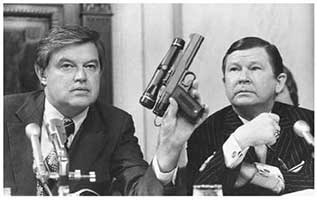
The Senate Select Committee to Study Governmental Operations with Respect to Intelligence Activities, led by Senator Frank Church (D-Idaho), issued a report charging U.S. government officials were behind assassination plots against two foreign leaders – Fidel Castro (Cuba) and Patrice Lumumba (Congo), and were heavily involved in at least three other plots: Rafael Trujillo (Dominican Republic), Ngo Dinh Diem (Vietnam), Rene Schneider (Chile).

Senator Frank Church, left, chairman of the Senate Select Intelligence Committee,
displays a poison dart gun as co-chairman Senator John Tower (R-TX) watches.

The committee, a precursor to the Senate Intelligence Committee, was established to look into misuse of and abuse by intelligence agencies, particularly the CIA and FBI, some of which had been revealed by the Watergate investigations.
  
Fidel Castro / Patrice Lumumba / Rafael Trujillo / Ngo Dinh Diem / Rene Schneider
Read more  
November 21, 1981
More than 350,000 demonstrated in Amsterdam against U.S. nuclear-armed cruise missiles on European soil.
November 21, 1985
A full-scale summit conference, the first of five between the President Ronald Reagan of the U.S. and General Secretary Mikhail Gorbachev of the Soviet Union concluded. There was optimism over beginning a more productive and cooperative relationship between the two countries, each of which had thousands of nuclear warheads targeted at the other.The U.S. had proposed building a space-based anti-ballistic missile system, commonly known as “Star Wars,” which the Soviets had strongly opposed as an escalation of the nuclear arms race.In an unofficial meeting the previous evening, President Reagan had noted that he and Gorbachev were meeting for the first time at this level and had little practice. Nevertheless, having read the history of previous summit meetings, he had concluded that those earlier leaders had not accomplished very much. Therefore, he suggested that he and Gorbachev say, “To hell with the past, we’ll do it our way and get something done.” Gorbachev concurred.
Reagan and Gorbachev at their first summit
November 21, 1986
National Security Council member Oliver North and his secretary, Fawn Hall, began shredding documents that would have exposed their participation in a range of illegal activities regarding the sale of arms to Iran in an attempt to free hostages, and the diversion of the proceeds to an insurgent Nicaraguan group known as the contras.
Fawn Hall
Oliver North
More on Fawn Hall 
November 21, 1995
China officially charged well-known human rights activist and political dissident Wei Jingsheng with trying to “overthrow the government.” Wei had not been seen for a year and a half after disappearing into police custody after meeting with a U.S. assistant secretary of state for human rights and humanitarian affairs.“If the people allow the power holders, in the peoples’ name, to violate and ignore the rights of some of the people then, at the same time, they are giving the power holders the power to violate the rights of all the people.”
“ Most people wait until others are standing to make their move, very few are willing to stand up first or to stand alone. That’s why my friends call me a fool! But I don’t have any regrets.” 
– Wei Jingsheng

Wei Jingsheng
He had been imprisoned previously for his involvement with the Democracy Wall movement, including years in solitary confinement. He had also spoken out on behalf of the Tibetans.

https://www.peacebuttons.info/E-News/peacehistorynovember.htm#november21

A Russian ballistic missile with cluster munitions kills 11 people and injures 84 in Ukraine’s north

https://apnews.com/article/russia-ukraine-missile-attack-sumy-5cd4f9fe2cee1ae8aed67d63c22b0703

Russia has been doing this, dealing out pain to the people of Ukraine while Biden refused to let him use the weapons to hit Russia making them feel the same pain.  Biden now says OK when it looks like in three months there will be no choice but to give Russia what it wants or fight to the last person and lose anyway.  It is sick, but tRump is a Russian / Putin toady.  We failed to live up to a promise we made to Ukraine because of Biden’s out of touch fears from the 1950s.  Hugs

========================================================

Image

Image

Image

Image

Share

KYIV, Ukraine (AP) — A Russian ballistic missile with cluster munitions struck a residential area of a northern Ukraine city, killing 11 people including two children and injuring 84 others, officials said Monday.

The two children killed in the strike on Sumy late Sunday were a 9-year-old boy and a 14-year-old girl, the regional prosecutor’s office said. Six injured children are in critical condition, it said.

The attack damaged 15 buildings, including two educational facilities, the prosecutor’s office said. A search and rescue operation continued Monday, on the eve of the war’s 1,000-day milestone.

Sumy lies 40 kilometers (24 miles) from the Russian border.

Also Sunday, U.S. President Joe Biden authorized for the first time the use of U.S.-supplied longer-range missiles by Ukraine to strike inside Russia, after extensive lobbying by Ukrainian officials.

The weapons are likely to be used in response to North Korea’s decision to send thousands of troops to support Russia in the Kursk region where Ukraine mounted a military incursion over the summer.

It is the second time the U.S. has permitted the use of Western weapons inside Russian territory within limits after permitting the use of HIMARS systems, a shorter-range weapon, to stem Russia’s advance in Ukraine’s Kharkiv region in May.

The first reaction from Ukraine to the long-awaited decision from the U.S. was notably restrained.


“Today, much is being said in the media about us receiving permission for the relevant actions. But strikes are not made with words. Such things are not announced. The missiles will speak for themselves,” Ukrainian President Volodymyr Zelenskyy said in his nightly video address.

Earlier, Zelenskyy said that Russia had launched a total of 120 missiles and 90 drones in a large-scale attack across Ukraine, including Sumy. Russia deployed various types of drones, he said, including Iranian-made Shaheds, as well as cruise, ballistic and aircraft-launched ballistic missiles.

The attack, which targeted Ukraine’s energy infrastructure, came as fears are mounting about Moscow’s intentions to devastate Ukraine’s power generation capacity ahead of the winter.

Ukrainian defenses shot down 144 out of a total of 210 air targets, Ukraine’s air force reported.

“The enemy’s target was our energy infrastructure throughout Ukraine. Unfortunately, there is damage to objects from hits and falling debris. In Mykolaiv, as a result of a drone attack, two people were killed and six others were injured, including two children,” Zelenskyy said.

Two more people were killed in the Odesa region, where the attack damaged energy infrastructure and disrupted power and water supplies, said local Gov. Oleh Kiper. Both victims were employees of Ukraine’s state-owned power grid operator, Ukrenergo, the company said hours later.

The combined drone and missile attack was the most powerful in three months, according to the head of Kyiv’s City Military Administration, Serhii Popko.

One person was injured after the roof of a five-story residential building caught fire in Kyiv’s historic center, according to Popko.

A thermal power plant operated by private energy company DTEK was “seriously damaged,” the company said.

Russian strikes have hammered Ukraine’s power infrastructure since Moscow’s all-out invasion of its neighbor in February 2022, prompting repeated emergency power shutdowns and nationwide rolling blackouts. Ukrainian officials have routinely urged Western allies to bolster the country’s air defenses to counter assaults and allow for repairs.

Russia’s Defense Ministry on Sunday acknowledged carrying out a “mass” missile and drone attack on “critical energy infrastructure” in Ukraine, but claimed all targeted facilities were tied to Kyiv’s military industry.

Although Ukraine’s nuclear plants were not directly impacted, several electrical substations on which they depend suffered further damage, the U.N.’s nuclear energy watchdog said in a statement Sunday. According to the International Atomic Energy Agency, only two of Ukraine’s nine operational reactors continue to generate power at full capacity.


The Russian military said Monday it intercepted and destroyed 59 Ukrainian drones overnight over several Russian regions. Two were downed over the Moscow region that surrounds the Russian capital, and three others over the neighboring Tula region. A total of 54 drones were destroyed over the Bryansk, Kursk and Belgorod regions on the border with Ukraine, according to a statement by the Russian Defense Ministry.

Moscow Mayor Sergei Sobyanin said the drones shot down outside of Moscow were heading toward the capital.

========================================

Follow AP’s coverage of the war in Ukraine at https://apnews.com/hub/russia-ukraine

Image
Kullab is an Associated Press reporter covering Ukraine since June 2023. Before that, she covered Iraq and the wider Middle East from her base in Baghdad since joining the AP in 2019.

Portico’s Part in Telling the Story of Emmett Till

The Emmett Till Memory Project teaches new generations about the tragedy that kickstarted the Civil Rights Movement. Preserving its digital assets is vital.

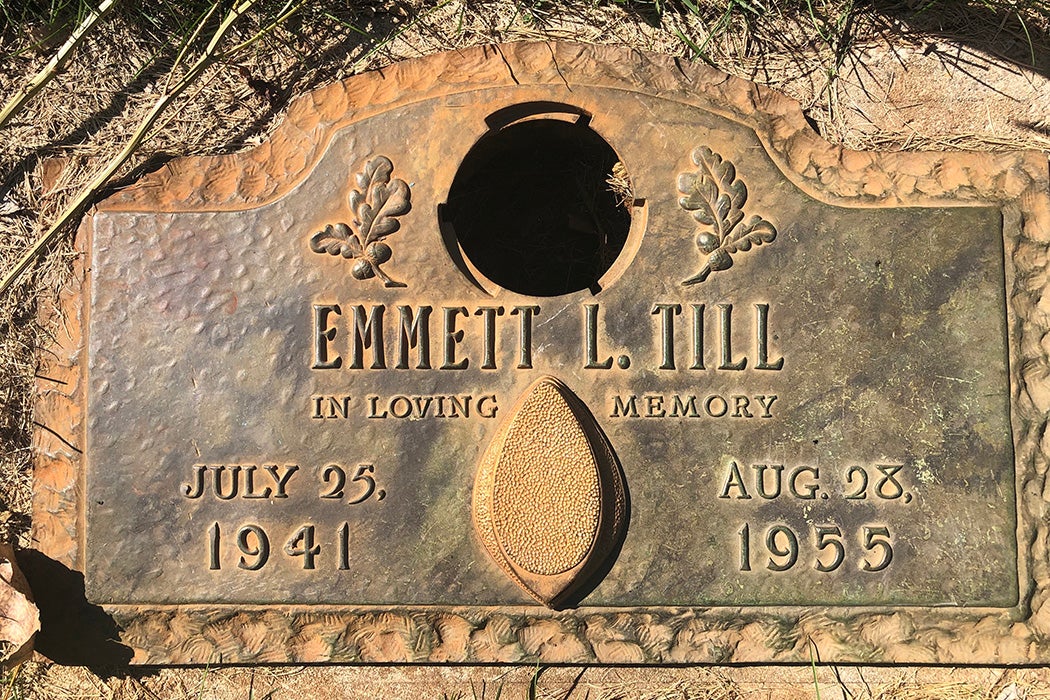
Emmett Till Headstone

Photo by Dave Tell via ETMP

By: Sara Ivry

On a late August day in 1955, Emmett Till was murdered in Mississippi. A fourteen-year-old African American from Chicago, Till stopped with his cousins at Bryant’s Grocery & Meat Market to buy chewing gum. There, Till whistled at the clerk, a brazen act that violated the norms of the Jim Crow South and so angered the clerk’s husband and brother-in-law that they killed the boy.

The events and locations that tell the story of Till’s life and death have been memorialized in different ways and forms over the ensuing decades. The Emmett Till Memory Project (ETMP), an app,  is one of them. It uses digitized archival documents, photos of those involved and of sites central to that fateful August day, and more so that users may educate themselves about who Emmett Till was and why his death still resonates. The ETMP’s digital assets are vital to ensuring the ongoing preservation of Till’s memory as well as his legacy.

That’s where Portico comes in. Dedicated to digital preservation, Portico has partnered with the ETMP to ensure the safekeeping in perpetuity of these digital artifacts.

Historian Dave Tell, a professor of communication studies at the University of Kansas, as well as the co-founder and director of the Emmett Till Memory Project, spoke with JSTOR Daily’s Sara Ivry about the Project and why its partnership with Portico is so critical.

Sara Ivry: How did you first learn of Portico?

Dave Tell: Kate Wittenberg reached out to me as part of the DEI efforts of her organization, specifically, a pilot project to support the preservation of archival content about under-represented topics that might be at risk. Kate contacted me about the time that we were massively reorganizing the Emmett Till Memory Project. She asked if she could just come along and preserve the site as it existed. I said, “Well, yes, you can, but we’re also trying to make it way better.” She sat in on development meetings over the last few years with us and has been an integral partner, not only in helping us think about preserving the site but helping us make design decisions that would render the site preservable.

Can you describe a little what the site was before you revamped it and what you were trying to do in the renovation?

The short story is we went live in October of 2019, and then in the pandemic, we used our last $10,000 of grant money to pay a DEI consultancy to tell us what we did well and what we did poorly. They did this entire audit, focus groups, they talked to the family, they talked to scholars. They looked at analytics, and they came back to us. Essentially, they told us great content, very bad design, which in retrospect is not surprising. Everyone on the project had been a content expert; we had never had design people on board. We had never had UX people.

The design only works for people who already know the story, they told us, which of course was a devastating blow to us. They also said this reads as if it was written by a middle-aged white guy and I’m like, “Well, I wrote it and I’m a middle-aged white guy—so fair enough.”

Included by Favor 

So, we hired a woman named Renee Payne out of the Rhode Island School of Design who runs a graphic design firm called included. She specializes in computer design for veterans of the Civil Rights movement; her clients include the families of Andy Young, Harry Belafonte, and family of Malcolm X. She assembled a team of young designers of color, and I said to them, “Nothing is sacred here. Let’s make this as good of a project as it can be,” and they reimagined it from the ground up.

When exactly then did Portico come on board?

Kate came in in the middle of this revamped process, and one of the specific things she encouraged us to do was to avoid third-party dependencies. The example that I understood was if you embed a YouTube video, your content is only as secure as YouTube, which you have no control over.

We really thought long and hard about what technologies we could preserve, and Kate and her colleague Karen Hanson pushed us to think about what exactly we’re preserving. The technologies we are currently depending on do not last forever, right? We changed our mindset. We don’t want to preserve this project so that like it will look the same for everyone into the future, but we want to preserve the assets.

Make images preservable, the text—the component parts.

Eventually we’re going to have a lot of immersive stuff on there. It’s only halfway there now. Portico helped us understand better to preserve the components that make up immersive pieces. In the future, people can use whatever technology is then current, use our same data, and create their own project.

I hadn’t thought about the built-in obsolescence of technology, and that we have to account and plan for that in the design of an app or site as well as in the design of an archive. Had you considered that before Portico got involved?

No, I’m a humanist by training, so when I first started thinking about digital preservation, probably a decade ago now, my gut instinct was we make the website just like a book. It’ll sit there unchanged forever. And Portico has been instrumental in changing the way I think about preservation—that first of all, forever might not be the goal.

Emmett and Mamie Till-Mobley on the exterior of the house they lived in from 1950–1955. Photo by Dave Tell via ETMP

Second, what gets preserved is not necessarily the sort of same experience that our users have today. What really matters and what needs to be preserved is what we have. The Emmett Till Memory Project has amazing artifacts. We have hours of audio with the family that they’ve given us permission to use that no one else has. We can tell the story in incredibly intimate ways and that’s super important. When you open this app, you’ll hear the voice of Reverend Wheeler Parker, Till’s cousin, narrating the story as all this stuff flashes on the screen behind you—I don’t care if the flashy, immersive technologies are preserved forever. But I care deeply that the audio files—and the voice of Rev. Parker—gets preserved. Someone else can build their own tools with that stuff. My ability to make that distinction is a testament to Kate and Portico.

Why is digital preservation of these assets critical in any case?

It’s almost hard to answer this question without going into cliche other than to say: Ignoring the past is a critical component of white supremacy. Full stop. What we want to do and what the family wants to do is tell the story—not that telling the story is sufficient for the change that they and I want to see, but it’s a critical part of the change that they and I want to see.

The Interpretive Center—what’s the first line of their mission statement, “We believe that racial reconciliation begins with telling the truth,” right?—that’s a sentence that accurately describes the vision of the Till family and it certainly describes my vision.

What was the origin of this app?

If you start from the murder of Emmett Till in August 1955 you have to count 49 years and 11 months before the state of Mississippi dropped a single dollar on the Till story. Eighteen citizens of Tallahatchie County thought that was ridiculous; they put up a commemorative sign that got shot, defaced with acid, spray painted.

Tallahatchie Civil Rights Driving Tour sign, ca. 2015. Photo by Pablo Correa via ETMP

In 2014, I got invited to go down, I’d been writing about Till for a decade and a half by then, and the question was: How do we tell Till’s story in the context of vandalism?

It’s easy to shoot a sign in the middle of the country. It’s harder to shoot an app.

What are some of the assets on the app that stand out to you?

My favorite by far are the hours of audio, oral history we have of Reverend Parker that was taken in his church in Chicago. We also drove him from site to site; we put a microphone on his lapel and on the sun visor of the car. And we just asked him what these sites meant to him as we went from place to place. All that audio’s not up yet, but we have it. (snip-a bit More)