What really scares me beyond the violent ideas and seemingly in love with that violence this guy is, I have some people I really care about in this region of the country. To those in this region of the country please be safe, and know I care about you. Hugs
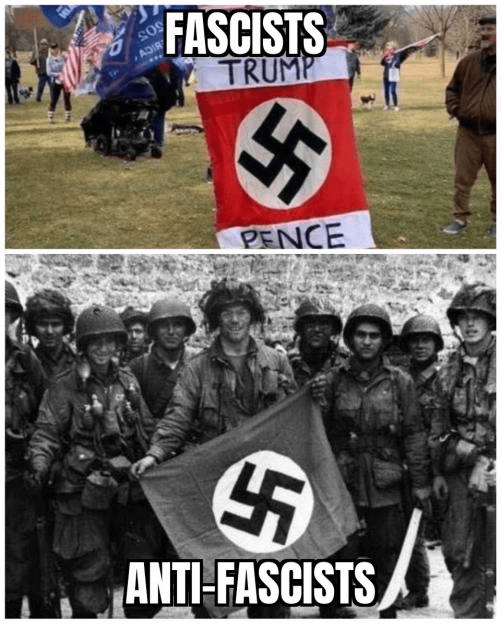
Shortly after 31 members of a white nationalist group were arrested in Coeur d’Alene, Idaho, over the weekend, pastor and former Washington state lawmaker Matt Shea claimed on Facebook the men were members of antifa, or anti-fascist demonstrators.
“This attempted ambush from antifa was thwarted,” said Shea, who has previously espoused Christian nationalism and has suggested replacing the existing U.S. government with a form of theocracy. Not only was Shea’s antifa claim untrue, at least one of the arrested men attended Shea’s own church within the last year.
Shea last appeared on JMG in March 2022 when he was involved in a suspicious attempt to “rescue” Ukrainian children.
He first earned national headlines in 2019 when leaked chats showed his violent fantasies about executing non-Christians and when it was learned that he had participated in militia drills to train young men for “biblical warfare.”
Shea advocates for the creation of a 51st US state based on “biblical law.” He has also said that all American men who fail to avow allegiance to Jesus should be executed.
He was expelled by the Washington state Republican caucus but refused to resign even after the feds found that he had “participated in an act of domestic terrorism against the United States” by helping plan the armed takeover of the Malheur Wildlife Refuge in Oregon in 2016.
He did not seek reelection in 2020 and is now the pastor of Covenant Christian Church in Spokane.
NEW: Shortly after Patriot Front members were arrested in Idaho over the weekend, pastor/ex-Washington lawmaker Matt Shea claimed on Facebook the men were Antifa.
That was false. In fact, at least one of the men arrested had attended Shea’s church. https://t.co/NAmIqiwzJW
So, if Democrats win an election there’s voter fraud and it’s a stolen election. If Republicans win, it’s all fair and legal. If rioters get caught it’s Antifa. If rioters get away with it they’re patriots.
His infatuation with training young men and that bit about “rescuing Ukrainian children” sets off all kinds of alarms. Check this one’s crawlspace and his hard drive.
He first earned national headlines in 2019 when leaked chats showed his violent fantasies about executing non-Christians and when it was learned that he had participated in militia drills to train young men for “biblical warfare.”
An audio recording from a recent Moms for Liberty meeting in Cabot captures a group member musing about gunning down a school librarian over tension about what books are appropriate for young readers. The person who captured that audio at a June 9 meeting at Crossroads Cafe in Cabot asked to remain anonymous.
The person said keeping audio records of public meetings is simply their normal practice, but that they decided to share this one because it was disturbing. The person confirmed the voice in the recording belongs to Melissa “Missy” Bosch, the leader of an anti-mask effort in the Cabot School District last year.
In the audio obtained by Media Matters, the chapter’s head of communications and media, Melissa “Missy” Bosch, complained about librarians in the district, saying, “I’m telling you, if I was — any mental issues, they would all be plowed down with a freaking gun by now.”
She was made aware of the recorded audio and took to Facebook falsely claiming it was “illegally recorded” and “illegally spliced.” It wasn’t — Arkansas is a one-party consent state and Media Matters has reviewed the original recording in full.
Bosch also threatened legal action in her post, claiming to know “some fantastic lawyers,” and she said her comments came while she was talking about “making librarians who make 85k a year answer to parents when we ask how sexually explicit books got into the library.”
Media Matters notes that the lawyer Bosch hired for her anti-mask lawsuit also represented…wait for it…Josh Duggar.
In 1976 I was a scared teenager who timidly checked out a book at our local public library entitled “Society and the healthy homosexual” by George Weinberg. It changed my life for the better and I’ll be forever grateful to Mr. Weinberg and also grateful for the fact that I was even able to check that book out in the first place. It was a lifeline that saved me.
If Trump did nothing else, he certainly emboldened the sick, festering, hateful, violent crazies to expose who they really are…… It’s going to be hard if not impossible to put that genie back in the bottle.
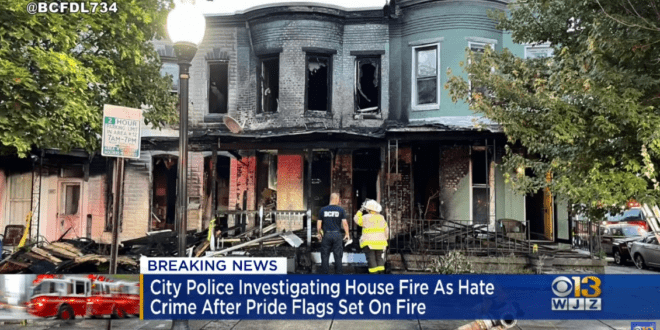
A Wednesday morning fire in Baltimore that put three people in the hospital is being investigated as a possible hate crime, authorities told WJZ.
Based on a preliminary investigation, authorities believe someone set fire to at least one Pride flag outside a row home in the 300 block of E. 31st Street and the flames spread to the home and neighboring homes, a Baltimore Police spokesperson said.
Three victims were taken to Shock Trauma for treatment, he said. A 30-year-old woman and 57-year-old man were hospitalized in critical condition, and a 74-year-old man is in serious condition, the Baltimore City Fire Department told WJZ.
JFC, it feels like we’re back in the 80’s. Be vigilant, everyone. Know who is near you at all times. Know who is behind you at all times. Look out for yourselves and each other.
I find myself holding back from using public restrooms if there is someone already in there. The atmosphere has changed where there could be a real confrontation. It isn’t helping that Republican politicians here in Oklahoma are trying to out do each other in their anti-Trans hate.
This is what a failing democracy looks like. A majority support gay marriage, contraception, interracial marriage, and abortion rights, but are powerless to stop the removal of these rights.
Fundamentalist evangelical Christianity and its members are, sadly, a major major factor when it comes to the future of our nation. Ronald Reagan opened the doors of government to them in the early 80s and they poured in.
In the person of Donald Trump they found their perfect puppet. They control him and he controls the vast majority of Republicans today.
My thoughts exactly. Add to that increasing violence, especially political violence and violence directed at minorities, and society at large but especially authorities becoming increasingly tolerant of it. Kyle Rittenhouse being acquitted after murdering two people and then lauded as a celebrity is a harbinger of things to come.
The conflict raging in Ukraine is damaging worldwide economic growth and driving inflation. Michael Bociurkiw, senior fellow at The Atlantic Council’s Eurasia Center, joins “CBS News Mornings” to talk about why the worst might still be ahead and other news about the conflict.
The January 6th Committee has obtained emails between Trump lawyer John Eastman and Ginni Thomas, the wife of Supreme Court Justice Clarence Thomas, clearly showing that Thomas was very much involved in planning the coup attempt. In an email to another MAGA lawyer, Eastman explained that the SCOTUS was still debating whether or not to hear an election contest claim from Wisconsin, while Ginni reached out to 27 Arizona lawmakers on multiple occasions encouraging them to overturn their states’ election results. Cenk Uygur and Ana Kasparian discuss on The Young Turks.
“The House committee investigating the Jan. 6, 2021, insurrection at the U.S. Capitol is in possession of emails Ginni Thomas, the wife of conservative Supreme Court Justice Clarence Thomas, exchanged with John Eastman, a lawyer advising former President Donald Trump how to overturn the 2020 election.
The correspondence shows Thomas was more involved in trying to reverse Trump’s election defeat than previously known, two sources told The Washington Post. The content of the emails, and the timing of the exchanges, wasn’t known.
Earlier this month, a judge ordered Eastman to surrender 159 documents to the House panel. In another email exchange dated Dec. 24, 2020, reviewed by the committee and detailed in The New York Times, Eastman wrote to Kenneth Chesebro, another lawyer supporting Trump, and other Trump officials, that Supreme Court justices were arguing over whether to hear a case contesting the results of the 2020 election.
In the email, Eastman discussed filing a lawsuit over the results in Wisconsin, hoping to nudge at least four justices needed for the Supreme Court to take a case.”
Like many Ukrainians trying to leave Russian-occupied areas, Andriy was forced to go through a process called filtration
Andriy watched anxiously as Russian soldiers connected his mobile to their computer, trying to restore some files. Andriy, a 28-year-old marketing officer, was attempting to leave Mariupol. He had deleted everything he thought a Russian soldier could use against him, such as text messages discussing Russia’s invasion of Ukraine or photos of the devastation in his city caused by weeks of relentless shelling.
But the internet in Mariupol, a once bustling port in southern Ukraine, had been cut off as part of the siege imposed by Russia, and Andriy had not been able to take down some of his social media posts. He remembered the first days of the war, when he had shared some anti-Russian messages and speeches from the Ukrainian president, Volodymyr Zelensky. “I’m screwed,” he thought.
The soldiers, Andriy said, already had their focus on him.
On that day in early May, when he first joined the queues for what is known as filtration, the process of scrutinizing civilians wishing to leave Russian-occupied areas, one of the soldiers noticed his beard. He instantly assumed it was a sign Andriy was a fighter with the city’s Azov regiment, a former militia which had links with the far right. “Is it you and your brigade killing our guys?,” Andriy was asked. He replied he had never served in the army, he started working directly after graduating, but “they didn’t want to hear it”.
As the soldiers went through his phone, they turned to his political views, and asked his opinion of Zelensky. Andriy, cautiously, said Zelensky was “okay”, and one of the soldiers wanted to know what he meant by that. Andriy told him Zelensky was just another president, not very different from those who had come before, and that in fact, he was not very interested in politics. “Well,” the soldier replied, “you should just say you aren’t interested in politics.”
They kept Andriy’s phone and told him to wait outside. He met his grandmother, mother and aunt, who had arrived with him for the process in Bezimenne, a small village to the east of Mariupol. They had already been given a document that allowed them to leave. A few minutes later, Andriy said, he was ordered to go to a tent where members of Russia’s security service, the FSB, were carrying out further checks.
Five officers were sitting behind a desk, three wearing balaclavas. They showed Andriy a video he had shared on Instagram of a speech Zelensky had given, from 1 March. With it was a caption written by Andriy: “A president we can be proud of. Go home with your warship!” One of the officers took the lead. “You told us you’re neutral to politics, but you support the Nazi government,” Andriy recalled being told. “He hit me in the throat. He basically started the beating.”
Image caption,
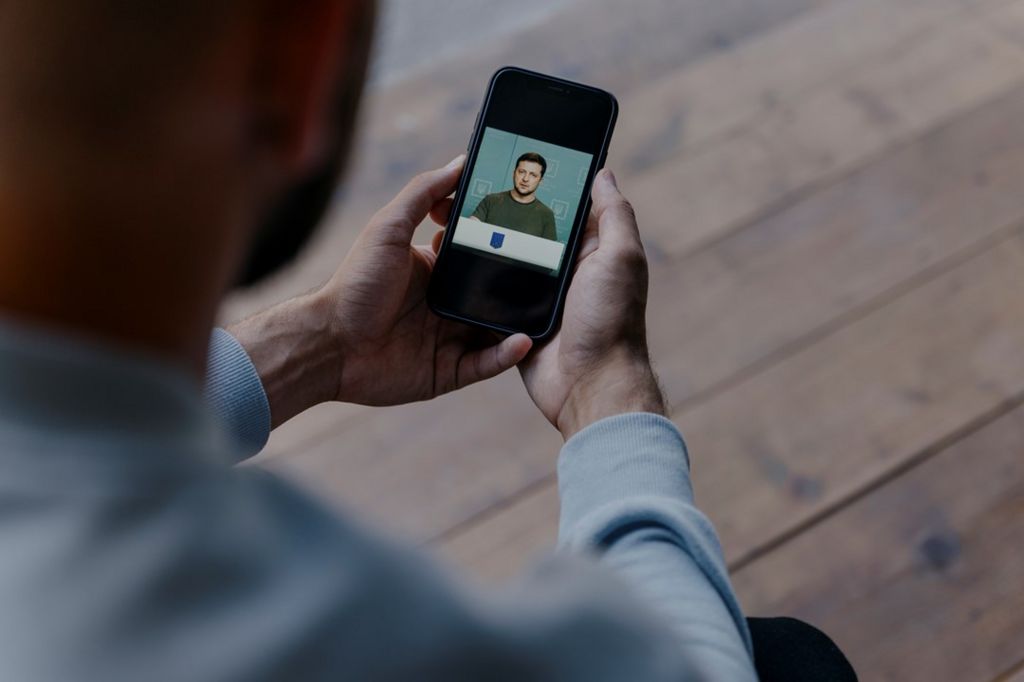
Andriy said the soldiers found out he had shared speeches of President Zelensky after connecting his phone to their computer
Like Andriy, Dmytro had his phone confiscated at a checkpoint as he tried to leave Mariupol in late March. Dmytro, a 34-year-old history teacher, said the soldiers came across the word “ruscist”, a play on “Russia” and “fascist”, in a message to a friend. The soldiers, Dmytro told me, slapped and kicked him, and “everything [happened] because I used that word.”
Dmytro said he was taken, with four other people, to a police station in the village of Nikolsky, also a filtration point. “The highest-ranking officer punched me four times in the face,” he said. “It seemed to be part of the procedure”.
His interrogators said teachers like him were spreading pro-Ukrainian propaganda. They also asked what he thought about “the events of 2014”, the year that Russia annexed the Crimea peninsula and started supporting pro-Russian separatists in Donetsk and Luhansk. He replied that the conflict was known as the Russo-Ukrainian war. “They said Russia was not involved, and asked me whether I agreed that it was, in fact, a Ukrainian civil war.”
The officers checked his phone again, and this time found a photo of a book which had the letter H in its title. “We got you!” the soldiers told Dmytro. Russia’s president, Vladimir Putin, claims his war in Ukraine is an effort to “de-Nazify” the country, and the soldiers, Dmytro said, believed he was reading books about Hitler.
The next morning, Dmytro was transferred with two women to a prison in Starobesheve, a separatist-controlled village in Donetsk. He counted 24 people in the four-bunk cell. After four days and another detailed interrogation, he was finally released, and eventually reached Ukrainian-held territory. Weeks later, he still does not know what happened to his cell mates.
Back inside the tent in Bezimenne, Andriy noticed two other people with their hands tied behind them, who had been left in a corner while the officers paid attention to him. “They started to beat me way harder,” Andriy told me, “everywhere”. At one point, after a blow to the stomach, he felt as if he was about to faint. He managed to sit on a chair.
“I wondered what would be better,” he said, “to lose consciousness and fall down or tolerate the pain further.”
At least, Andriy thought, he had not been sent somewhere else, away from his family. Ukrainian officials say thousands of people are believed to have been sent to detention centres and camps set up in Russian-controlled areas during filtration. In almost all cases, their relatives do not know where they are being held, or why. “I [was] very angry about everything,” Andriy said, “but, at the same time, I know it could’ve been much worse.”
His mother tried to get into the tent, but was stopped by the officers. “She was very nervous. She later said they had told her that my ‘re-education’ had started,” Andriy said, “and that she shouldn’t be worried.” His ordeal, he told me, continued for two and a half hours. He was even forced to make a video saying “Glory to the Russian army!”, a mockery of “Slava Ukraini!”, the Ukrainian slogan.
The final question, Andriy said, was whether he had “understood his mistakes”, and “I obviously answered yes”. As he was being released, officers brought in another man, who had previously served in Ukraine’s military and had several tattoos. “They immediately pushed him to the ground and started to beat him,” Andriy said. “They didn’t even talk to him.”
Image caption,
“I even try to justify the process somehow. Try to convince myself there’s some logic,” Andriy said about filtration
Ukrainian authorities say Russian forces and Russian-backed separatists have carried out filtration in occupied territories as an attempt to establish residents’ possible links with the military, law enforcement and even local government, as the invading forces try to restore services and infrastructure.
Men of fighting age are particularly targeted, checked for bruises that could suggest recent use of weapons, such as on the fingers and shoulders. Strip searches are common, witnesses say, including for women. Oleksandra Matviychuk, the head of the Center for Civil Liberties, a Kyiv-based human rights group, said the process, even when not violent, was “inhuman”. “There’s no military need for this… They’re trying to occupy the country with a tool I call ‘immense pain of civilian people’. You ask: ‘Why so much cruelty? For what?'”
Maksym, a 48-year-old steelworker, said he was forced to strip naked while officers in Bezimenne checked even the seams of his clothes. He was asked whether he was from the Azov regiment or was a Nazi sympathiser – he denied being either – and why he wanted to leave Mariupol. “I said, ‘Actually, it’s you who are on Ukrainian soil.'” One of the officers, who he said were all Russian, reacted by hitting Maksym with the gun butt in his chest. He fell.
“I leaned my head on the ground, holding my ribs. I couldn’t get up,” he said. “It was very painful to breathe.”
He was taken to what he described as a “cage”, where others were being held. He noticed that one man, a weightlifter, had a tattoo of Poseidon, the Greek god, with a trident. The soldiers, Maksym said, thought it was the Ukrainian coat of arms. “He explained it to them but they didn’t understand.” Those detained in the “cage” were given no water or food, and had to urinate in a corner in front of everyone, Maksym told me. At one point, exhausted, he tried to sleep on the ground. An officer came in and kicked him in the back, forcing him to stand.
People would be taken to be interrogated and, when they returned, “you saw the person had been beaten,” Maksym said. He witnessed a woman in her 40s lying in pain, apparently after being hit in the stomach. A man, who seemed to be around 50, had a bleeding lip and red bruises on his neck. Maksym believed he had been strangled. No-one in the “cage” asked or said anything to each other. They were afraid that FSB officers could be disguised as prisoners.
After about four or five hours, Maksym was released and allowed to leave Mariupol. Days later, he reached safety in Ukrainian-controlled territory, and went to a hospital to treat the persistent pain in his chest. The diagnosis: four broken ribs.
Yuriy Belousov, who leads the Department of War at the Ukrainian general prosecutor’s office, said his team had received allegations of torture and even killings during filtration. “[It seems to be] a Russian policy which was designed in advance, and pretty well prepared,” he told me. “It’s definitely not just a single case or [something] done by a local military guy.”
He acknowledged it was difficult to verify the cases, or estimate the scale of the violence. The Ukrainian authorities are unable to carry out investigations in occupied territories and most victims remain reluctant to share their stories, concerned that relatives in Mariupol could be targeted if their identity is exposed.
Vadym, 43, who used to work at a state-owned company in Mariupol, said he was tortured in Bezimenne in March. Separatist soldiers had questioned his wife after finding out she had “liked” the Ukrainian army page on Facebook, and restoring a receipt on her phone of a donation she had made to them. “I tried to stand up for her,” he said, “but was knocked down.” He got up, but was beaten once more. A pattern, he said, that happened again and again.
When Russian soldiers realised where he worked, they took Vadym to a different building. There, Vadym said separatist soldiers asked him “stupid things” and started to beat him. “They used electricity. I almost died. I fell and choked on my dental fillings, which had come out from my teeth,” Vadym said. He vomited and fainted. “They were furious. When I recovered consciousness, they told me to clean everything up and continued to give me electric shocks.”
The torture, Vadym said, only stopped after Russian officers intervened. They carried out another round of questioning before finally freeing him. As Vadym left the building, he saw a young woman, who had been identified during the process as a court clerk, being carried out.
“A plastic bag was put on her head, and her hands were tied,” Vadym said. “Her mother was on her knees, begging for her daughter not to be taken away.”
Vadym’s release came with a condition: he would have to go to Russia. About 1.2 million people in Ukraine, including thousands of Mariupol residents, have been sent to Russia against their will since the invasion began in February, according to Ukrainian officials. Russia denies it is carrying out a mass deportation, which would constitute a war crime under international humanitarian law, and says it is simply helping those who want to go. Ukraine rejects this claim.
Some of those sent to Russia have managed to escape to other countries and even return to Ukraine. How many, remains unclear. Vadym, with the help of his friends, moved to another European country – he did not want to reveal the exact location. He had lost some of his vision, he told me, and doctors said this was a result of head injuries from the beating. “I feel better now, but rehabilitation will take a long time.” I asked him what he thought about filtration. “They separate families. People are being disappeared,” he said. “It’s pure terror.”
Russia’s defence ministry did not respond to several requests for comment on the allegations. The Russian government has previously denied it is carrying out war crimes in Ukraine.
Image caption,
Andriy said his mother was told by a Russian soldier that he was going through “re-education”
Andriy and his family have now settled in Germany, after also having been forced to go to Russia. Looking back, he believes the occupying forces seemed to be using filtration to show their “absolute power”. Soldiers, he said, acted as if it was a “type of entertainment”, something to “satisfy their own ego”.
I told him about another Ukrainian I had met, a 60-year-old retired engineer called Viktoriia. A soldier found out she had added a Ukrainian flag to her profile photo on Facebook, she told me, and the message “Ukraine above all.”
She said that he pointed his gun at her and threatened: “I’ll put you in the basement until you rot!” He then kicked her, she said. Viktoriia could not understand why he had acted like that. “What did I do? What right did they have?”
Andriy said he could not explain such behaviour. “I even try to justify the process somehow. Try to convince myself there’s some logic.”
But, he said, “there’s no logic”.
Some names have been changed to protect identities






 Scottie's Playtime