Last night, I was honored and delighted to join a phenomenal group of brilliant leaders and hundreds of thousands of women across the country in support of the Vice President on the first Women for Harris National Organizing Call.
You can watch the organizing call in its entirety right here, and I strongly recommend doing so.
Speakers included Women for Harris Director Rhonda Foxx, Sen. Laphonza Butler, Chelsea Clinton, Min Jin Lee, Yvette Nicole Brown, Shannon Watts, Ai-Jen Poo, Glynda Carr, and so many more.
I honestly did not expect to cry so much, but when Ms. Lee began telling her story and teared up, I completely lost it. By the time Ms. Clinton reminded us all of the history of women seeking the White House, I was a mess.
It was a bad night for mascara and a great night for democracy.
Below are my remarks:
Good evening!
My name is Charlotte Clymer, my pronouns are she/her, I’m a writer and activist, and I am so excited to be part of this historic gathering of women across the country.
Now, look, I’m not gonna repeat to y’all what the brilliant and eloquent women who spoke before me stated, nor do I have the eloquence and brilliance of the women who will speak over the remainder of this evening.
I’m just gonna tell y’all a quick story about why I proudly support Vice President Harris.
I am a proud American, a proud Texan, a proud military veteran, a proud trans woman, and a proud Democrat.
And I have found that there a lot of folks, including Donald Trump and J.D. Vance, who want to place me in a specific box.
They say I’m too queer to be a proud military veteran.
They say a trans woman like me can’t be a Christian and a strong person of faith as I am.
They say women like me don’t belong in America.
Well, here’s what I have to say to that: thank goodness our leader, Vice President Harris, has common sense and believes no American, no human being, belongs in a box.
A little over four years ago, a number of rightwing extremists took a picture of me from a public event and attempted to harass me online. They wanted me to be ashamed of how I look as a trans woman.
Now, just like the women I admire—women like my grandmother, women like Congresswoman Jasmine Crockett from my home state of Texas, women like Vice President Harris—am I going to give these sad and insecure people that kinda power over me?
No.
I don’t have time for that. I love how I look. I know I’m beautiful.
So, I wrote a thread explaining that, and I offered an open hope that these sad and insecure people will someday have the kind of peace and comfort in their own skin as I have in mine.
She fights for the military veteran who comes back from war with horrific wounds. She fights for the woman turned away from life-saving abortion access. She fights for the public school teacher who’s overworked and underpaid. She fights for every child, every senior, every single American. She fights for all of us.
One of the first public figures to respond to that thread was then-Senator Kamala Harris. (emph. mine-A)
She gave me support. She gave me encouragement. She made me feel seen. And in that moment, she sent a clear message that supporting her means supporting the basic concept that all of us are worthy to be who we are authentically.
I want to be clear: there were no incentives for her here. I hadn’t endorsed her. I hadn’t talked with her campaign. It wasn’t like she was gonna fundraise off this moment.
She did it because Vice President Harris is the kind of leader who fights for every American.
Donald Trump and J.D. Vance are gonna throw everything they got at her—every cruel remark, every disgusting sexist and racist trope, every bit of vile—and they’re gonna find out the hard way that it just isn’t enough.
And why is that? Because we have a clear strategy here. All we have to do is follow the example of Vice President Harris. She is a leader who builds bridges, who invites tough conversations, who always embraces discomfort as a gift for growth.
If we follow her example, if we make every phone call, if we knock on every door, if we invite tough conversations with our friends and family and neighbors who are on the fence in this election, I guarantee you, on everything I hold dear, that Kamala Harris will be the 47th President of the United States.
Thank god this is our leader. Let’s follow her example. Let’s go win this thing.
To find out how to volunteer and elect our first woman president and save democracy from Trump and Vance and Project 2025, text WOMEN to 30330.
Rising temperatures mean dehydrated, exhausted kids, and teachers who have to focus on heat safety instead of instruction.
Originally published by The 19th (Republished with their republish link)
Angela Girol has been teaching fourth grade in Pittsburgh for over two decades. Over the years she’s noticed a change at her school: It’s getting hotter.
Some days temperatures reach 90 degrees Fahrenheit in her classroom which, like many on the East Coast, isn’t air-conditioned. When it’s hot, she said, kids don’t eat, or drink enough water. “They end up in the nurse’s office because they’re dizzy, they have a headache, their stomach hurts — all because of heat and dehydration,” she said.
To cope with the heat, her students are now allowed to keep water on their desks, but that presents its own challenges. “They’re constantly filling up water bottles, so I have to give them breaks during the day for that. And then everyone has to go to the bathroom all the time,” she said. “I’m losing instruction time.”
The effect extreme heat is having on schools and child care is starting to get the attention of policymakers and researchers. Last week, the Center for American Progress, a left-leaning think tank, published a report on the issue. In April, so did the Federation of American Scientists, a nonprofit policy organization.
“The average school building in the U.S. was built nearly 50 years ago,” said policy analyst Allie Schneider, co-author of the Center for American Progress report. “Schools and child care centers were built in areas that maybe 30 or 15 years ago didn’t require access to air-conditioning, or at least for a good portion of the year. Now we’re seeing that becoming a more pressing concern.” Students are also on campus during the hottest parts of the day. “It’s something that is really important not just to their physical health, but their learning outcomes,” she said.
Last April, the U.S. Environmental Protection Agency released its own report detailing some of the effects heat has on kids. It notes that children have a harder time thermo-regulating and take longer to produce sweat, making them more vulnerable than adults to heat exhaustion and heat illness.
Kids don’t necessarily listen to their body’s cues about heat, and might need an adult to remind them to drink water or not play outside. Kevin Toolan, a sixth-grade teacher in Long Island, New York, said having to constantly monitor heat safety distracts him from being able to teach. “The mindset is shifting to safety rather than instruction,” he said. “Those children don’t know how to handle it.”
To keep the classroom cool, he’ll turn the lights off, but kids fall asleep. “They are lethargic,” he said.
To protect kids, schools have canceled classes because temperatures have gotten too high. Warmer temperatures also lead to more kids being absent from school, especially low-income students. And heat makes it harder to learn. One study from 2020 tracked the scores of students from schools without air-conditioning who took the PSAT exam at least twice. It found that increases in the average outdoor temperature corresponded with students making smaller gains on their retakes.
Both Toolan and Girol said that cooling options like keeping doors and windows open to promote cross ventilation are gone, thanks to the clampdowns in school security after 9/11 — and worsened by the threat of school shootings. Students and teachers are trapped in their overheating classrooms. “Teachers report leaving with migraines or signs of heat exhaustion,” said Toolan. “At 100 degrees, it is very uncomfortable. Your clothes are stuck to you.”
The Center for American Progress report joins a call by other advocacy groups to create federal guidance that schools and child care centers could adopt “to ensure that children are not forced to learn, play and exercise in dangerously hot conditions,” Schneider said. Some states already have standards in place, but they vary. In California, child care facilities are required to keep temperatures between 68 and 85 degrees. In Maryland, the recommendation is between 74 and 82 degrees. A few states, like Florida, require schools to reduce outdoor activity on high-heat days. Schneider says federal guidance would help all school districts use the latest scientific evidence to set protective standards.
In June, 23 health and education advocacy organizations signed a letter making a similar request of the Department of Education, asking for better guidance and coordination to protect kids. Some of their recommendations included publishing a plan that schools could adopt for dealing with high temperatures; encouraging states to direct more resources to providing air-conditioning in schools; and providing school districts with information on heat hazards.
“We know that school infrastructure is being overwhelmed by extreme heat, and that without a better system to advise schools on the types of practices they should be implementing, it’s going to be a little bit of the Wild West of actions being taken,” said Grace Wickerson, health equity policy manager at the Federation of American Scientists.
A longer term solution is upgrading school infrastructure but the need for air conditioning is overwhelming. According to the Center for American Progress report, 36,000 schools nationwide don’t have adequate HVAC systems. By 2025, it estimates that installing or upgrading HVAC or other cooling systems will cost around $4.4 billion.
Some state or local governments are trying to address the heat issue. In June, the New York State Legislature passed a bill now awaiting the governor’s signature that would require school staff to take measures like closing blinds or turning off lights when temperatures reach 82 degrees inside a classroom. At 88 degrees, classes would be canceled. A bill introduced last year and currently before California’s state assembly would require schools to create extreme heat action plans that could include mandating hydration and rest breaks or moving recess to cooler parts of the day.
Some teachers have been galvanized to take action, too. As president of the Patchogue-Medford Congress of Teachers, Toolan was part of an effort to secure $80 million for infrastructure upgrades through a bond vote. Over half will go to HVAC systems for some 500 schools in his district.
And Girol is running for a state representative seat in Pennsylvania, where a main plank in her platform is to fully fund public schools in order to pay for things like air-conditioning. She was recently endorsed by the Climate Cabinet, a federal political action committee. “Part of the reason climate is so important to me is because of this issue,” she said. “I see how it’s negatively affecting my students.”
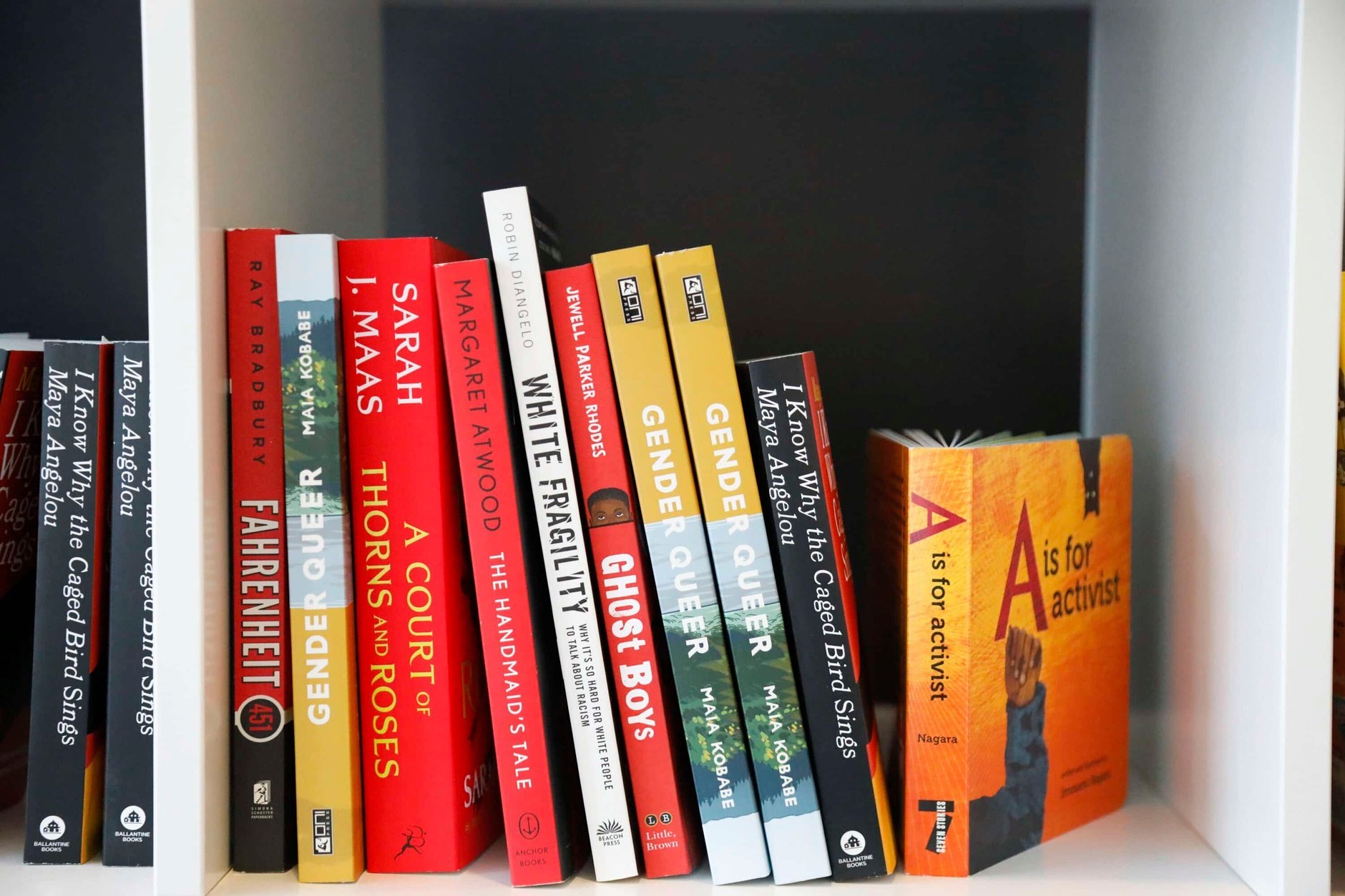
Idaho’s recently enacted bill encourages parents and children to bring legal action against schools and libraries that refuse to move certain material into “adult only” sections.
Books are displayed at the Banned Book Library at American Stage in St. Petersburg, Fla., on Feb. 18, 2023. (Jefferee Woo/Tampa Bay Times via AP)
A recently enacted law requiring Idaho schools and libraries to remove materials that are “harmful” to minors infringes on the First Amendment rights of private entities, a group of private schools, privately-funded libraries, parents and schoolchildren say in a Thursday lawsuit.
House Bill 710 — which took effect July 1 after Governor Brad Little signed it into law in April — allows citizens and the government to file a lawsuit against any school or library that doesn’t move certain material into designated “adult only” sections within 60 days of a complaint.
“H.B. 710 is the product of a social climate in Idaho (and elsewhere) in which schools and libraries have been inaccurately and unfairly castigated and villainized for using and making available constitutionally protected materials with content that the state and some Idahoans disapprove of,” the plaintiffs say in the 57-page complaint.
The suit was brought by private schools Sun Valley Community School and Foothills School of Arts and Sciences, along with the Community Library Association, a privately funded public library, and Collister United Methodist Church, which operates a lending library.
The groups are also joined by a set of parents and two high school-age students, who say that they want access to these reportedly “harmful” books and other materials to further their education.
The plaintiffs say the law violates their First Amendment free speech rights and their Fourteenth Amendment rights to due process. They ask the court to block enforcement of the law and to declare HB 710 unconstitutional.
“The act’s vague and overbroad definition of ‘harmful to minors’ conflicts with decades of settled constitutional law and extends well beyond the state’s limited authority to restrict the materials that private parties, like the private entity plaintiffs, may provide to minors,” they write.
Under the act’s definitions, the plaintiffs say, materials like health and sex education textbooks, literary works like Maya Angelou’s “I Know Why the Caged Bird Sings” and artworks like Michelangelo’s David would all be subject to removal, possibly based on arbitrary and subjective reasons.
“Even the Bible, if a defendant or citizen complainant subjectively believes members of their community would find them offensive,” could be targeted, the plaintiffs note.
The plaintiffs also take specific aim with a clause of the act that restricts materials that depict or represent “sexual conduct” — a definition that includes “any act of … homosexuality.”
Beyond the “vague and overbroad” definition of what constitutes “harmful for minors,” the plaintiffs also take issue with what they called the “incoherent” enforcement provisions outlined in HB 710. The act “fails to provide constitutionally meaningful guardrails on enforcement,” plaintiffs say.
“If a private entity plaintiff disagrees with the content-based assessment of the parent or minor and declines to segregate the challenged material, the parent or minor is authorized to file a civil suit against the private entity plaintiff and incentivized to do so by a cash reward and the availability of ‘actual damages,’” the plaintiffs write, referring to a provision in HB 710 that allows for a possible recovery of $250 and statutory and actual damages, if the complainant prevails in the case.
The government itself is also permitted under HB 710 to seek an injunction against any of the plaintiffs, who say this could lead to financial and reputational harm.
The plaintiffs name Idaho Attorney General Raúl Labrador as a defendant, alongside Jan Bennetts, prosecuting attorney for Ada County, and Matt Fredrick, prosecuting attorney for Blaine County.
HB 710 is not the first attempt Idaho legislators have made to restrict library access in the state. A version of the measure made it through the 2023 session but was rejected by Little.
In a letter after he signed HB 710, the governor commended the 2024 bill for having tighter definitions for restricted material and for lowering the recovery from $2,500.
“I share the co-sponsors’ desire to keep truly inappropriate materials out of the hands of minors,” Little wrote in April.
Libraries initially pushed back on the bill, citing free speech concerns and the financial burden it could levy, particularly on smaller libraries, but legislators stood by the measure.
“I can assure you that there is no book banning and there’s no book burning and there’s no book removal anywhere in this legislation. What we have to look at when you look at these libraries is that you have differing viewpoints and different opinions from taxpayers,” Representative Jaron Crane, a Nampa Republican and bill co-sponsor, said in committee, the Idaho Capital Sun reported in March.
Medals aren’t the only thing that matters at Paris 2024. With Personal Best, we’re going beyond the scoreboards to champion the game changers and spark conversations about what it takes to make competitive sport truly fair play.
Trigger warning: This article references disordered eating.
After a three-hour ride to a lake outside the Olympic Village, teams of rowers from around the world stepped off their buses, in need of a bathroom break before they took to the water to train. The Korean women’s team was first in line for the porta-potties — until athletes from another country’s men’s team cut in front of them.
“It was as though the women weren’t even there,” recalls former rower and Olympian Angela Schneider, who went on to win silver for Canada at those games, and is now director of the International Centre for Olympic Studies at Western University in London, Ont., Canada. “I was so angry. A group of us female athletes tried to knock over the porta-potty with the first guy in it. We weren’t successful, but we gave it a good shake.”
This was back at the 1984 Summer Olympics in Los Angeles. Forty years later, women aren’t so easily ignored in the sporting world. Attitudes have changed since the ’80s, when only 23% of athletes competing in LA were women, and rowing was considered a men’s sport (“People used to call us ‘sir,’” Schneider recalls). In fact, the Paris 2024 Games will make history as the very first “gender-equal” Olympics: Out of the 10,500 athletes competing, there will be an even split between men and women.
The IOC seemed pretty pleased with itself back in March when it announced (just ahead of International Women’s Day, of course) this “monumental achievement,” dubbing Paris the #GenderEqualOlympics. “We are about to celebrate one of the most important moments in the history of women at the Olympic Games, and in sport overall,” IOC president Thomas Bach proclaimed. (An Olympics logo designed for the milestone — featuring a stereotypically feminine face, lipstick included — has riled the internet, with widespread memes that it would better suit a dating app.)
“The IOC is pretty good at tooting its own horn, and at every games we see a version of this celebration of gender equality. It’s not new. DUNJA ANTUNOVIC, ASSISTANT PROFESSOR OF SPORT SOCIOLOGY”
But even though this year’s even split of men and women athletes marks progress, there’s still a lot of “porta-potty shaking” left to do. Tokyo 2020 was also celebrated for its 48% (almost) gender parity. Now, four years later, all we have to show for progress is another 2%. It’s kind of hard to get excited about a hashtag when we’ve heard it all before.(snip)
Inclusive language is one thing; inclusion itself is another. Another strategy the IOC has used to address gender inequality at the games has been to boost women’s participation by increasing the number of mixed-gender sports, like triathlon, and adding sports that historically excluded women, particularly combat sports. For instance, women’s boxing (finally) debuted in 2012 — and, as a result, 20-year-old Alyssa Mendoza from Caldwell, ID, will be taking her shot at an Olympic medal in Paris for Team USA.
“I think that sometimes the hard work that women boxers do gets discredited, and so I’m really glad we have this platform where we can show our skills,” says Mendoza. Even so, she still gets the occasional “Oh, you’re a female boxer? You’re going to mess up your pretty face!” comment, but she uses those moments to clear up misconceptions. “Boxing isn’t like a Rocky movie,” she says. “It’s not bloody and gory and dangerous. It’s a beautiful sport.”
Beyond stereotypes around certain disciplines, the inherently gendered nature of most elite sports — that is, women and men competing separately — means that athletes who don’t fit neatly into the binary face barriers to participation. The IOC allows individual sports governing bodies to set their own policies for trans athletes, for example, and at least 10 Olympic sports, including cycling, rugby, and rowing, restrict trans athletes from competing. In 2021, the IOC announced a framework laying out its principles for athlete inclusion and non-discrimination, including its stance that athletes should be allowed to compete in the category that aligns with their self-determined gender identity. But the framework is non-binding, so how much real progress we’ll see remains an open question.
The world of sport is rife with gender bias, regardless of which gender you happen to identify with. Paris 2024 will be the first year that men’s teams are eligible to compete in artistic swimming (formerly called synchronized swimming), for instance. Athlete Megumi Field has chatted with her team about how cool it is to be competing in a so-called gender-equal Olympics, but is quick to flag the derision that the men she trains with have faced. “This is not just a ‘girl’s’ sport,” she says. “For us, gender equity conversations are also around the importance of including men.”
Although 28 out of 32 sports will be fully gender-equal in Paris, many disciplines are still characterized as “men’s sports,” and there are lingering discrepancies based on the age-old belief that women are the weaker sex. (snip)
Yes, gender parity in Paris is a sign of progress. But we’re still far from the finish line in the race to full equality, both at the games and in the larger world of sport. Only then can we truly embrace #GenderEqualOlympics — let’s just hope it doesn’t take us another 40 years to get there.
If you are struggling with an eating disorder and are in need of support, please call the National Eating Disorders Association Helpline at 1-800-931-2237. For a 24-hour crisis line, text “NEDA” to 741741.
I have followed Gronda for a long time, before she took her long break. But she is back and her writtings while in debth and a bit long are so very interesting and well researched that they are more than worth the time to read. I love them. I hope everyone here will. Hugs. Scottie
“Let’s say Roe vs. Wade is overruled, Ohio bans abortion, you know, in 2022, let’s say 2024, and then every day George Soros sends a 747 to Columbus to load up disproportionately black women to get them to go have abortions in California.
“Of course, the left will celebrate this as a victory for diversity. That’s kind of creepy, right? If that happens, do you need some federal response to prevent it from happening because it’s really creepy?
“And, you know, I’m pretty sympathetic to that, actually.” – J.D. Vance, appearing on the podcast of far-right activist Aimee Terese during his 2022 campaign for the US Senate.
JD Vance said this on a podcast hosted by a Twitter user he follows who calls for putting “misogynists back in the Oval Office” and says “we need to stop normalising consent” https://t.co/ElrkbAf5VJpic.twitter.com/BEwX61QfpB
A complete Christian take over if the US and an attempt to turn society back to 1850s mentality with a 1950s society. And if tRump wins, we all well have to start attending the hate church nearest us. The women in the back, on one side, black people in the back on the other, and white men in front to show their privilege. After church while the men relax the women and girls will be cooking meals. The gays will be converted in camps and if they still have the demon gays, the LGBTQ+, they will be removed from society. Hugs. Scottie
Heritage Foundation leader has long received spiritual guidance from group and his policy goals align with its teachings
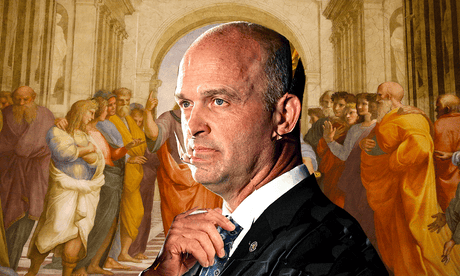
Kevin Roberts, the Heritage Foundation president and the architect of Project 2025, the conservative thinktank’s road map for a second Trump presidency, has close ties and receives regular spiritual guidance from an Opus Dei-led center in Washington DC, a hub of activity for the radical and secretive Catholic group.
Roberts acknowledged in a speech last September that – for years – he has visited the Catholic Information Center, a K Street institution headed by an Opus Dei priest and incorporated by the archdiocese of Washington, on a weekly basis for mass and “formation”, or religious guidance. Opus Dei also organizes monthly retreats at the CIC.
Kevin Roberts, president of the Heritage Foundation, speaks at an event on 12 April 2023. Photograph: J Scott Applewhite/AP
In the speech – which he delivered at the CIC and was recorded and is available online – Roberts spoke candidly about his strategy for achieving extreme policy goals that he supports but are out of step with the views of a majority of Americans.
Outlawing birth control is the “hardest” political battle facing conservatives in the future, the 50-year-old political strategist said, but he urged conservatives to pursue even small legislative victories – what he called “radical incrementalism” – to advance their most rightwing policy objectives.
Kevin Roberts explains ‘radical incrementalism’ to advance rightwing policy objectives – video
Roberts gained notoriety this year as the leading force behind Project 2025, a foundation plan backed by more than 100 conservative groups that seeks to radically upend a broad range of policies if Trump gets elected again, from limiting abortion access and LGBTQ+ rights and dismantling the Department of Education, to ending diversity programs and increasing government support for “fertility awareness” programs, like ovulation tracking and practicing periodic abstinence, instead of more reliable contraception.
But Roberts’ personal ties to Opus Dei and the significance of his affiliation, have received far less attention.
Gareth Gore, the author of a forthcoming book on Opus Dei, called the Catholic organization “a political project shrouded in a veil of spirituality”. The group’s founder, Saint Josemaría Escrivá, saw his followers as part of a “rising militia”, Gore said, who were seeking to “enter battle against the enemies of Christ”.
“Like Project 2025, Opus Dei at its core is a reactionary stand against the progressive drift of society,” Gore said. “For decades now, the organization has thrown its resources at penetrating Washington’s political and legal elite – and finally seems to have succeeded through its close association with men like Kevin Roberts and Leonard Leo.”
Leonard Leo, the Federalist Society executive vice-president, speaks to the media at Trump Tower on 16 November 2016. Photograph: Carolyn Kaster/AP
Leo is a conservative activist who has led the Republican mission to install the rightwing majority in the supreme court and finances many of the groups signed on to Project 2025.
Like Roberts, Leo also has links to the Opus Dei-linked CIC. In a 2022 speech accepting the CIC’s highest honor, the John Paul II New Evangelization award, Leo praised the center while also referring to his political opponents as “vile and amoral current day barbarians, secularists and bigots” who were under the influence of the devil.
Democrats, including Kamala Harris, have been sounding the alarm on Project 2025 to warn voters of what a second Trump administration could do.
“[Trump] and his extreme Project 2025 agenda will weaken the middle class. We know we have to take this thing seriously. And can you believe they put that thing in writing?” Harris said this week in her first presidential campaign rally, to laughter. “Read it. It’s 900 pages.”
Trump, for his part, has sought to distance himself from the project, though the people behind it have close ties to the former president, and the policies it envisions often align with Trump’s ideas. Roberts has said he is “good friends” with JD Vance, Trump’s running mate, and Vance has praised Project 2025 as having “some good ideas”. Vance, who converted to Catholicism in 2019, also wrote the foreword for Roberts’ forthcoming book, praising the author for articulating a “genuinely new future for conservatism”.
“We are now all realizing that it’s time to circle the wagons and load the muskets. In the fights that lay ahead, these ideas are an essential weapon,” Vance wrote.
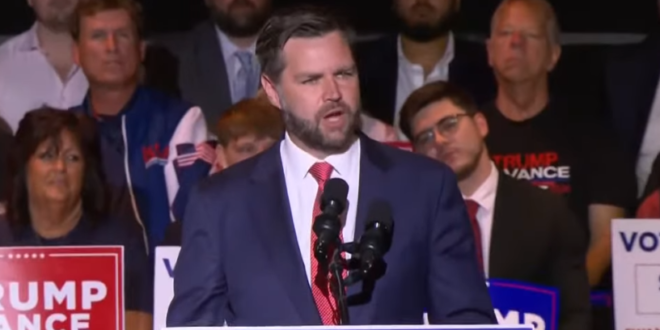
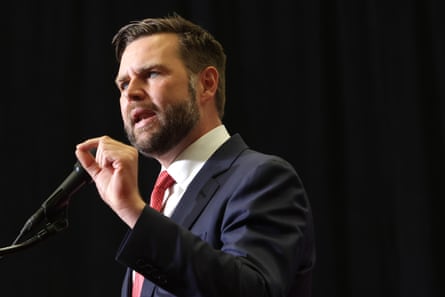
JD Vance, Trump’s running mate, speaks at a campaign rally at Radford University on 22 July 2024 in Radford, Virginia. Photograph: Alex Wong/Getty Images
Opus Dei does not disclose the names of its members. The group’s roots date back to a century ago, when the group was established in Spain in response to a clash between conservative Catholics and anti-Catholic socialism and communism in Spain. Decades later, the group was granted special status by the conservative pope John Paul II, who supported Opus Dei and saw it as a response to the rise of liberation theology in Latin America, a progressive church movement.
Some of Opus Dei’s special rights were revoked in recent years by Pope Francis, who is seen as a more progressive pontiff.
One of the core tenets of Opus Dei is that it does not believe in the traditional separation of church and state. Instead, said Massimo Faggioli, a professor of theology and religious studies at Villanova University, it believes the two ought to have a symbiotic relationship.
“They are secretive, so while they are not [outwardly] part of this [Project 2025] per se, it is not surprising at all that some of their members are part of it. They see this moment in politics – and the possibility of allowing ‘woke ideology’ to win – as fundamentally changing the nature of America, western civilization and Christianity,” Faggioli said.
He added: “Opus Dei is part of [a movement of] US conservative and traditionalist Catholicism that holds a view that the United States is the last bastion of Christendom, so that if the United States goes a certain way, so goes Christianity, and Catholicism.”
Indeed Roberts made it clear earlier this month that he believes the US is at a crossroads, and“in the process of the second American Revolution, which will remain bloodless if the left allows it to be”.
Asked whether it had a view on Roberts’ remarks or Project 2025, a spokesperson for Opus Dei told the Guardian in a statement: “Opus Dei is an institution of the Catholic Church that tries to help people come closer to God in their work and everyday lives. Opus Dei’s aims are purely spiritual and it does not endorse or have any opinion on any political project of any kind.”
Opus Dei is controversial not only in the US. Dozens of women from Argentina and Paraguay filed a complaint to the Vatican over labor exploitation and abuses of power they say they experienced after joining the group at sites in multiple countries. And reporting in Australia gave insight into schools run by Opus Dei, where former students allege their education left them with “psychological damage”.
Roberts’ personal background suggests his ties to Opus Dei are not just limited to the CIC. A school founded by Roberts in Louisiana, called John Paul the Great Academy, considers Opus Dei-founder Escrivá its “patron”.
Josemaría Escrivá, founder of the Catholic group named Opus Dei. Photograph: REUTERS
Roberts was also involved in an Opus Dei-affiliated high school leadership program in Austin, Texas. A website that tracks Opus Dei men’s activities called Where You Are included a profile of the high school program in Austin where Roberts appears to volunteer and “contributes significantly “ to the school’s career and leadership program.
Roberts was featured as a guest at another Opus Dei-linked school, the Camino Schools, in 2023. In introductory remarks before Roberts spoke, the school’s chairman, Bob Rose, praised schools that teach boys and girls they are “different”, they learn differently and are inspired by different things, and where boys are taught by “manly men” who serve as role models.
Roberts’ critics said concerns about his ties to Opus Dei were not connected to his identity or beliefs as a Roman Catholic.
“Kevin Roberts, like all Americans, has a guaranteed freedom to worship or not under our constitution,” said Lisa Graves, co-founder of Court Accountability, a non-partisan group that seeks to combat judicial corruption.” That is not at issue. What is of concern is how some powerful elites, like Roberts, who have failed to persuade the American people to embrace their agenda, seem eager to use the power of the executive branch to impose their personal religious views as binding law on other Americans – by barring abortion, using the government to endorse the rhythm method of contraception, even banning mention of ‘condoms’ in women’s preventative health, as well as assailing the rights of LGBTQ+ Americans.”
Heritage did not respond to a request for comment. The CIC did not respond to a request for comment.
During Roberts’ September 2023 speech, which received little notice at the time but is posted on the center’s YouTube page, Roberts detailed how conservative Catholics and their allies could advance US policy to end access to abortion, same-sex marriage and contraception.
Knowing the unpopularity of banning birth control – a harder political battle to wage than advancing anti-abortion and anti-gay marriage policies – he encouraged an incremental approach to pursuing this long-term goal.
“Even in a politically conservative setting, that can be a very difficult thing to advance,” Roberts told attendees at the CIC event. “A majority of Roman Catholics don’t believe in that teaching, if public opinion surveys are the case. And so it makes it very difficult to advocate for that.”
The faithful should practice the “gift of discernment” to know when to bring it up: “Sometimes the right thing at the right time to the right person isn’t the full teaching of humanity, right? It isn’t the full teaching of contraception. And recognizing that that’s not the time is no way turning into Judas. In fact, it’s being apostolic. And the very definition of the word, which is in modern common parlance, meeting someone where they are.”
In espousing his theory of “radical incrementalism”, or what he called the “enchilada theory”, he said it was critical for conservatives to work first to achieve a small part of a larger policy goal based on what’s politically possible at the moment. Sometimes, he said, having even half an enchilada could be a victory.
On abortion, he noted that Roman Catholics believe “no abortion can be morally justified”, but that even in conservative circles in the US, this is not a majority opinion, and it’s an “even more difficult position to hold” after the Dobbs decision. Using the “same vocabulary of our faith” in the policy arena has a negative effect on electoral outcomes, he said.
Roberts advised listeners not to accept the “narrative framing of the other side” on these issues. He said conservatives who are anti-abortion should stop talking about it the way the left wants them to and instead “talk about the fact that many of them want abortion to be legal until birth”.
Strategies of incrementalism and narrative framing don’t always apply, he added, because sometimes you just have to fight.
“Right now, we have to fight on religious liberty and, in particular, religious liberty as it relates to protecting institutions of faith,” he said. “And that’s not a time for strategic retreat. It’s not a time to be savvy, it’s not a time to be sweet. It’s not a time to develop friendships with the other side. It is a time to take our fist – figuratively, Father Charles – and bust them in the nose because they hate what you and I believe.”
Admittedly, there’s a lot of frustration over the Biden administration’s failure to deliver on issues like police reform, voting rights legislation and student loan debt relief. But venting frustration doesn’t equate to disunity.
Over the years, there’s always been a fear that we won’t unite, but in the end, we do. That’s what makes Black America a powerful voting bloc.
A New York Times/Sienna College poll released last November set off alarm bells, finding that 22 percent of Black voters in six battleground states said they would support Trump. However, polls taken in June, before President Biden dropped out of the race, found that Black voters overwhelmingly disapproved of Trump and backed Biden.
And now that Vice President Kamala Harris is poised to become the Democratic nominee, Black voters are elated and even more united. Trump’s small gains with Black voters have declined with Harris as the presumptive nominee.
A narrative about Democrats losing Black men encouraged Trump’s team to do its damnedest to exploit a perceived weakness in our unity. One GOP ploy involved dispatching two Black Republicans, U.S. Reps. Wesley Hunt of Texas and Florida’s Byron Donalds, to persuade Black men at cigar and cognac events to vote for Trump.




 Scottie's Playtime