if we all click our heels together three times, everything will be okay Read on Substack (Language NSFW, as always with Jeff Tiedrich’s writing)
the worthless scribblers of the corporate-controlled media utterly failed us during the 2024 campaign season.
New York Times executive editor Joe Kahn came right out and said it: defending democracy is a ‘partisan act,’ and we won’t do it — and, fuck us all, the press kept their word, and didn’t do it. they enthusiastically put their fingers on the scale for Donny Convict.
arguably, the media’s worst transgression was the sanewashing — the cleaning-up of Donny’s incomprehensible blitherings, to hide his obvious cognitive disintegration and make him sound coherent.
a minutes-long disjointed word-salad about how tariffs on Chinese goods were going to lower the cost of childcare became “a major economic speech.”
Donny’s inability to keep his increasingly-demented mind on the topic at hand — his crazypants pinballing from they’re eating the dawgs to Hannibal Lecter wants to have you for dinner to would you rather be eaten by a shark or electrocuted — was explained away by Donny as his brilliant “weave.”
[Wishcasting is] the act of interpreting information or a situation in a way that casts it as favorable or desired, despite the fact that there is no evidence for such a conclusion; a wishful forecast.
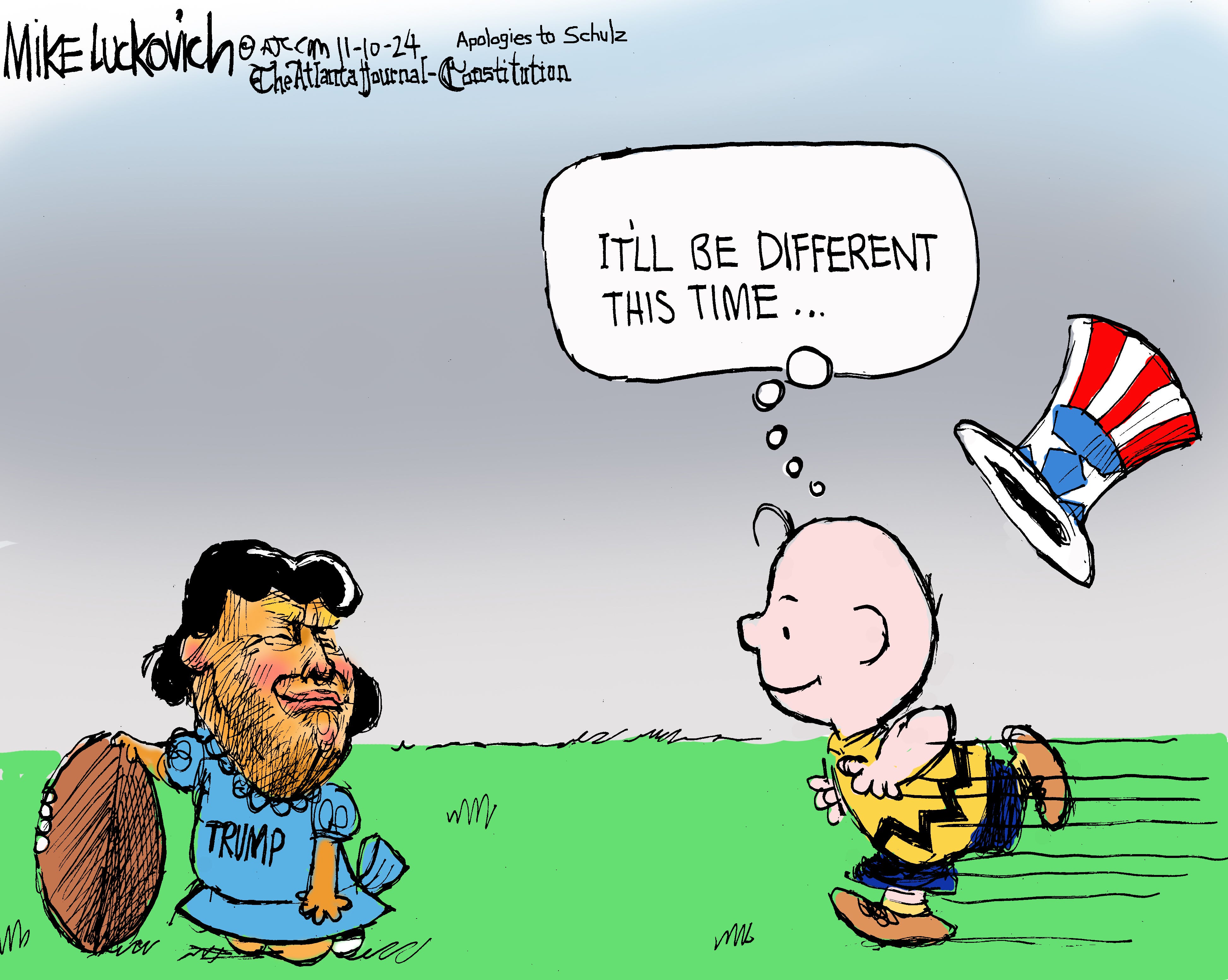
sure enough, the media has now gone into overdrive, churning out piece after piece in which they promise us that if we all click our heels together three times, everything will be okay.
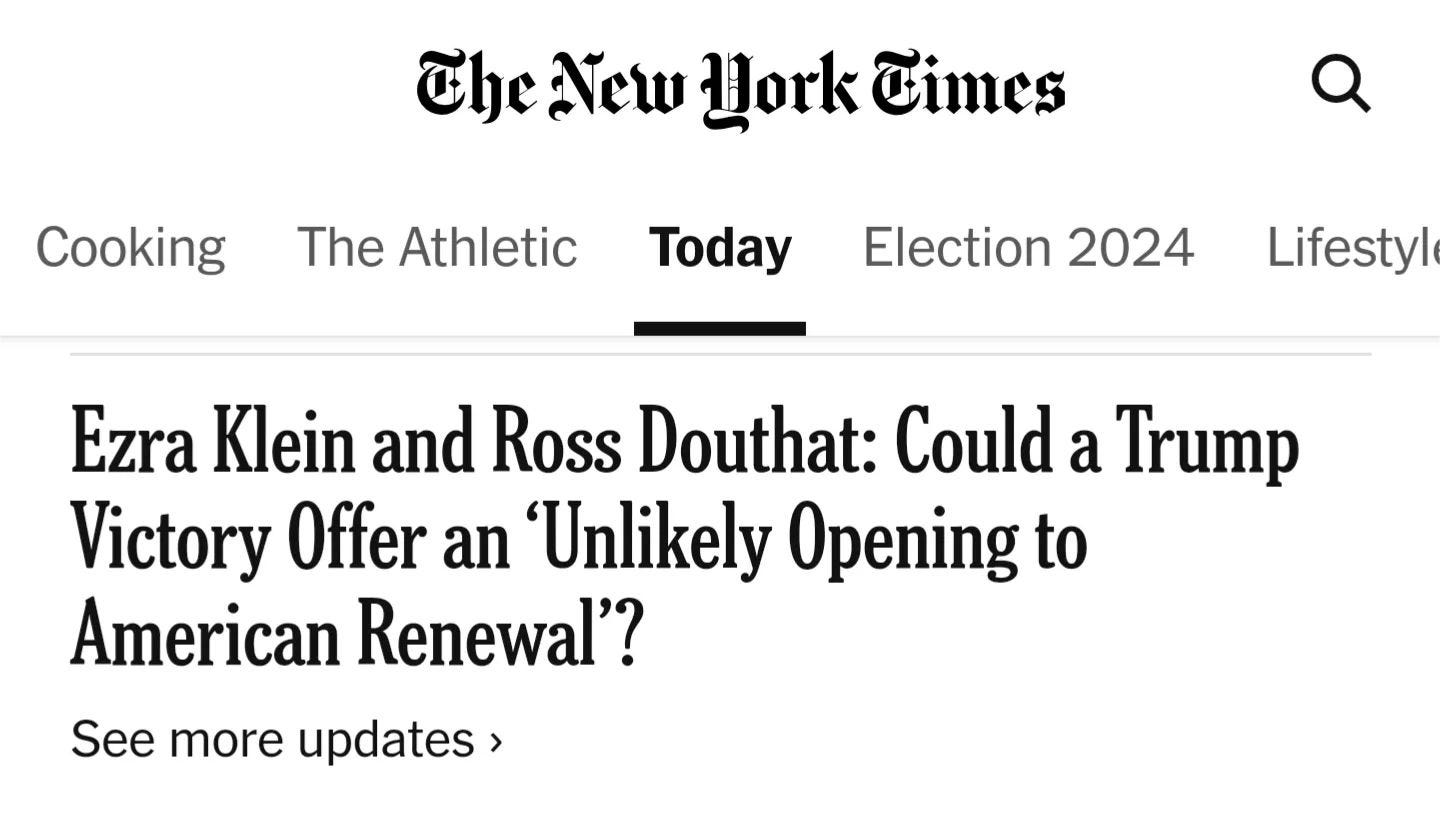
not twelve hours after the election had been called for Donny, the Times wasted no time in assuring us that the election of a vindictive fascist is an amazing opportunity for vindictive fascism not to happen.
what kind of magical, everybody-gets-a-pony thinking is this? just fucking stop it.
did Ezra Klein and Ross Douthat both experience some kind of recent head trauma that has caused them to forget the years 2017 through 2020? Donny’s first presidency was a dumpster fire of corruption, mismanagement and mass death — but somehow now, given a second chance to fuck shit up worse, Donny’s going to bring us an “American renewal”?
anything’s possible, right? overnight, Donny Convict could magically become a wise and fair statesman — also, technicolor pigs could fly out of my ass.
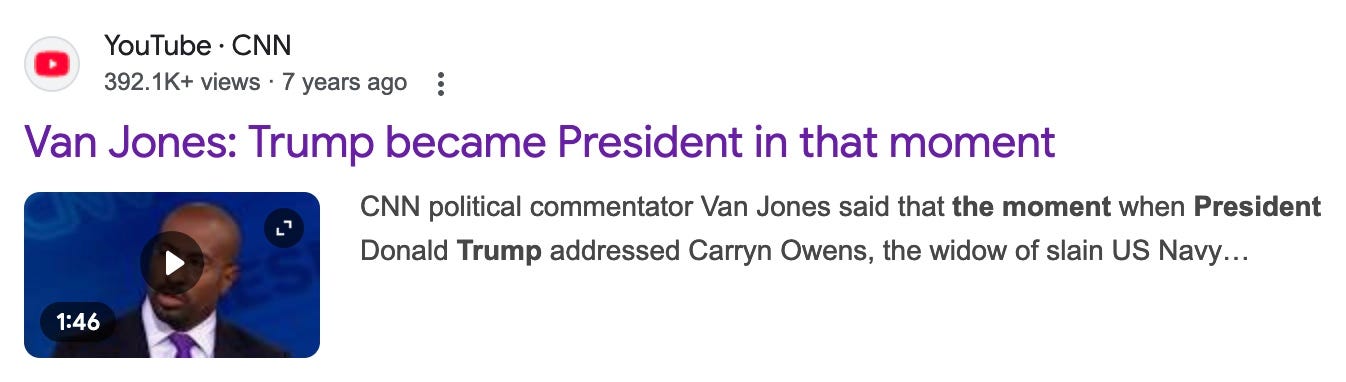
oh my god, the media never stops imagining that Donny is going to somehow become presidential. during his first term — over and over — every time Donny stopped short of taking out his dick and pissing on the floor, the press would fall all the fuck over itself in a mad dash to proclaim him presidential.
spoiler alert: Donny never became presidential. not from the the first time he threw a ketchup-hurling tantrum in the White House, to the moment he absconded back to his Florida golf motel, taking with him boxes of stolen classified documents.
the premise here is that if we’re respectful to Donny — if we fucking kowtow to him, and stop opposing him — he’ll be nice to us in return. he’ll become — dare I say it? — presidential.
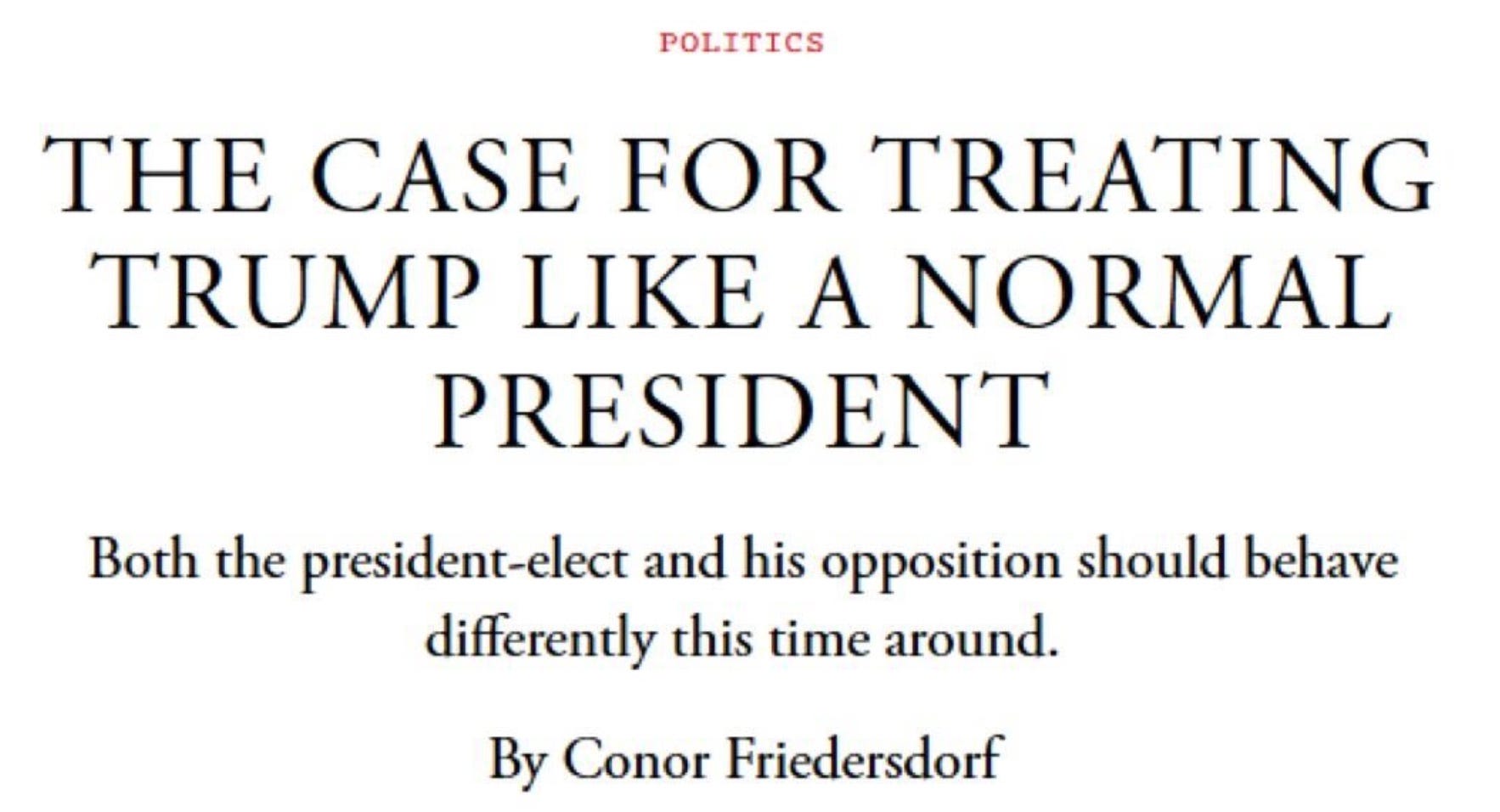
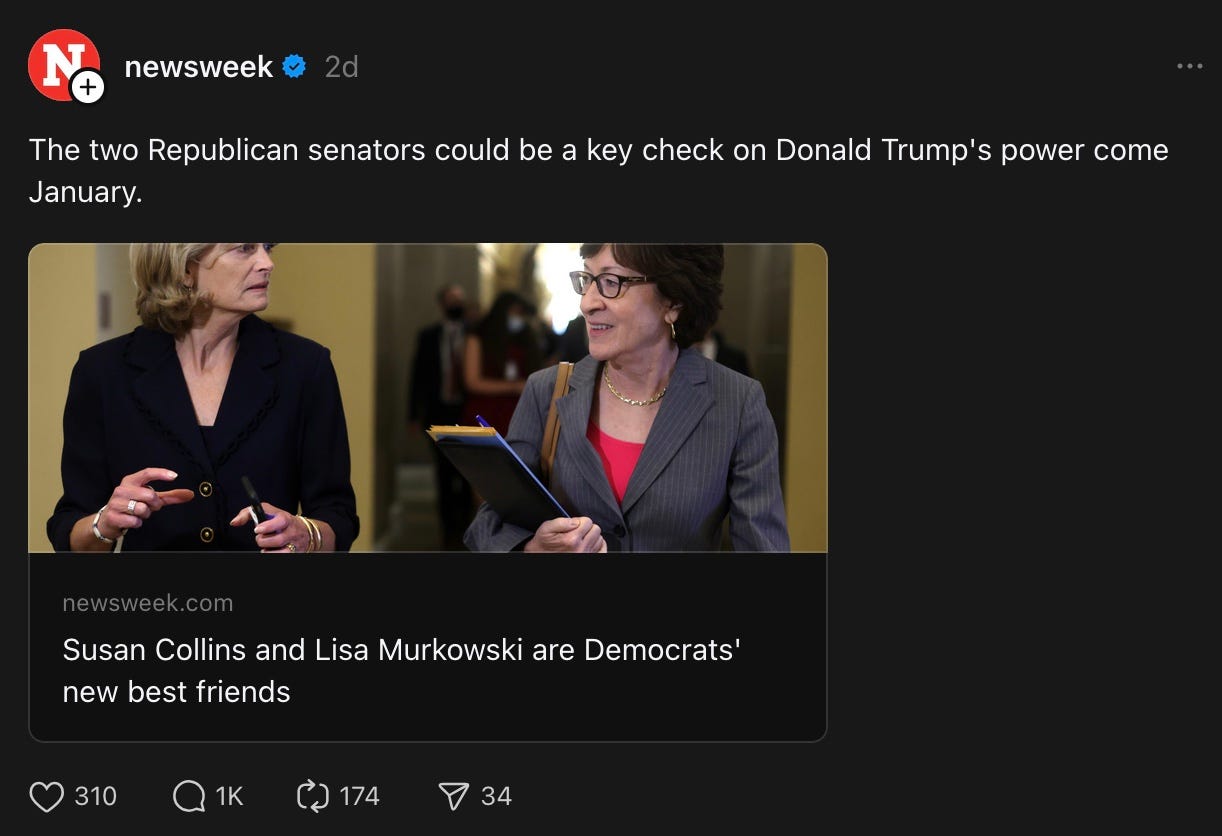
Stop indulging the fantasy that outrage, social stigma, language policing, a special counsel, the Twenty-Fifth Amendment, or impeachment will disappear him. And stop talking as if normal political opposition is capitulation.
Everyone should normalize Trump. If he does something good, praise him. Trump is remarkably susceptible to flattery.
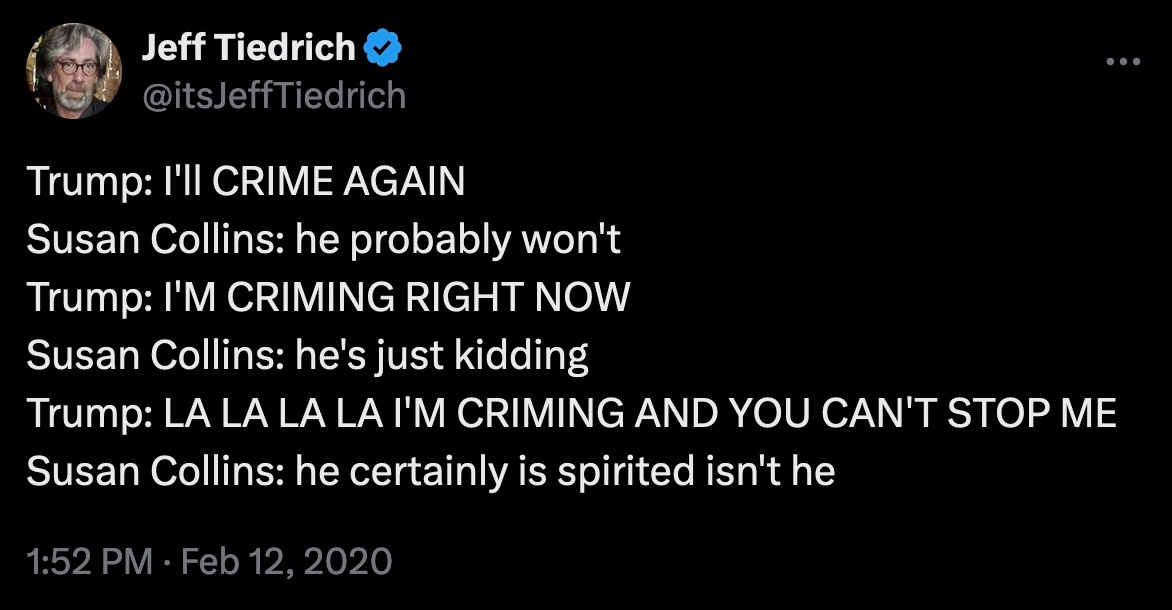
okay, I will grant that Newsweek may be half right. Lisa Murkowski seems to genuinely loathe Donny, and we can probably count on her to vote against the worst of his fuckery — but Susan Collins? the credulous naïf who assured us over and over again that Donny had learned his lesson, and would never transgress again?
now, let’s bask under some rays of hope from people who aren’t just blindly wishcasting, but are actually offering reasoned arguments.
in the middle of a fairly clear-eyed assessment of the Trumpian horrors to come, the Guardian gives us this:
Elaine Kamarck, a former official in the Bill Clinton administration, said: “For him to expand presidential power, Congress has to give up power and they’re not in the mood to do that. They’ve never done that. There are plenty of institutionalists in Congress.”
Kamarck also expressed faith in the federal courts, noting that judges appointed by Trump only constitute 11% of the total placed on the bench by former presidents. A Trump dictatorship is “not going to happen,” she added. “Now, there might be things that the president wants to do that people don’t like that the Republican Congress goes along with him on but that’s politics. That’s not a dictatorship.”
Paradoxically, however, Trump’s reckless venality is a reason for hope. Trump has the soul of a fascist but the mind of a disordered child. He will likely be surrounded by terrible but incompetent people. All of them can be beaten: in court, in Congress, in statehouses around the nation, and in the public arena. America is a federal republic, and the states—at least those in the union that will still care about democracy—have ways to protect their citizens from a rogue president. Nothing is inevitable, and democracy will not fall overnight.
Americans cannot vote themselves into a dictatorship any more than you as an individual can sell yourself into slavery. The restraints of the Constitution protect the American people from the unscrupulous designs of whatever lawless people might take the reins of their government, and that does not change simply because Trump believes that those restraints need not be respected by him. The Constitution does not allow a president to be a “dictator on day one,” or on any other day. The presidency will give Trump and his cronies the power to do many awful things. But that power does not make them moral or correct.
I sure hope to fuck they’re right.
This is going to be my closing message for the foreseeable future:
practice self-care. do what you need to do to keep sane. if that means disengaging with my daily posts for a while, I get it. this community of ours will still be here when you return.
to all the people who have signed on in the days since the election, welcome aboard. settle in as we all try to deal with the shitfuckery that’s ahead of us.
we are all in this together, and we are all here for each other.
November 11, 1942 The U.S. Congress approved lowering the draft age to 18 and raising the upper limit to 37 less than a year after having declared war on Japan, Germany and Italy. In September 1940, Congress, by wide margins in both houses, had passed the Burke-Wadsworth Act, the first peacetime draft (though war raged in Europe and Asia, the U.S. was not yet directly involved) imposed in the history of the United States. The good war and those who refused to fight it
November 11, 1972 The U.S. Army turned over its massive military base at Long Binh to the South Vietnamese army, symbolizing the end of direct U.S. military involvement in the Vietnam War. The last American forces, however, did not leave until 1974. U.S. military leaving the Long Binh base
My top-line thought for the week ahead: Don’t give up!
If you want to plan a protest, plan it. If you want to knit in public at a lecture, do it. Don’t let anyone else make the rules for you. You get to set your own vision for what it means to be persistently pro-democracy as we prepare to face what’s ahead.
For me, it means resisting the language of division that brought us here and working to maintain the big tent that helped us win the fight for four more years of democracy in 2020. People are down right now; none of us are at our best. So, give people a lot of space and understanding. But don’t be afraid to act on your own or enlist like-minded friends to come along with your plans. Don’t let anyone tell you that your way of expressing your love for country and Constitution isn’t the right way. There is a lot of that going around, as many people with good intentions are struggling.
If you’re looking for inspiration and have the concentration for a longer piece, read the words of Czech leader Václav Havel, who wrote The Power of the Powerlessin 1978, ten years after the Soviet Union crushed Prague Spring. Havel explored the idea that individuals who might normally be seen as powerless can make common cause in dissidence against a repressive political structure. The Czechs did not have the centuries-long history of democracy like we do, nor did they have a Constitution in place that guaranteed rights like our does. Still, Havel pointed the way for them to resist a totalitarian system. Although the story of our coming struggle is likely to be very different from theirs, you may still take heart reading Havel, knowing that his people struggled free from a dictatorial regime and created a republic.
The outcome of this election has been incredibly hard to come to terms with. In my heart, I feared Donald Trump would win—I live in a state where many people support him and their numbers were strong—but I hoped and even dared to believe it wouldn’t happen. And of course, I was wrong.
We are in for tough times, and they will not be times to give up in. Lawyers are already preparing to do important work. They have the experience of 2016 to guide them. Project 2025 and Trump’s Agenda 47 vision are dark. But they are not self-executing; they will have to do the work to put them in place, and we need to be there every step of the way, pushing back. Never underestimate the value of the public voice.
But do take time to refresh your understanding of the policies this administration has rallied around in advance. I have not forgotten that in early July, Heritage Foundation President Kevin Roberts commented that the coming revolution could be “bloodless if the left allows it to be.”
This interview with States United CEO Joanna Lydgate is an overview of Project 2025
This piece talks about the impact of mass deportations
This piece linked Trump to Project 2025 after he disclaimed knowledge of it
This is an index of the columns I wrote about Project 2025 prior to last July
We have a long history and tradition of democracy in this country. We have local governments and organizations where we can run for office and use our power to make things better, even if Trump is trying to make them worse at the national level. We are still a constitutional democracy, and if we want to keep the Republic, we are going to have to fight to hold onto as many of our norms as we can.
But not all this week.
This week we are going to have to endure the winding down of the criminal cases against Donald Trump. That’s a gut punch for those of us who believed that accountability was possible and that Donald Trump wasn’t above the law.
Tuesday in Manhattan, Judge Juan Merchan is expected to rule on whether the Supreme Court’s presidential immunity decision impacts Trump’s conviction in the New York case. If the convictions survive, and they should, or at least some of them, expect a rocket of an appellate case going off, as Trump tries to avoid being sentenced later this month. He may succeed given the politics of the moment, but legally, there is no reason he can’t be sentenced, although, and I’m sorry to be the bearer of bad news, I expect that even if he receives a custodial sentence, he will not serve it because of the Supremacy Clause of the Constitution. It’s an entirely unsatisfactory conclusion to one of the worst-ever violations of American democratic principles.
I don’t expect normal times ahead. I believe Trump when he tells us who he is. I believe MAGA when they tell us who they are. This wasn’t just a campaign where the winner takes office and we all move on happily together, shoring up our disappointment. We have to be prepared for that reality, and not get sucked into a “business as usual” version of what Trump’s time in office will look like.
We haven’t begun to fight yet, but as we get over the shock of the election, we can begin to get ready. As President Biden says, you can’t love your country only when you win. I’d add to that, you can’t be willing to fight for democracy only when it’s easy.
Please watch this. This is Vaush. He points out that of the top left wing streamers. Streamers make an hour to 3 hour content on schedule. A lot of them clip their streams to smaller 10 minute clips or so that they can post. Of the top ten who many are right wing media? 9. Yes 9 out of 10 most popular streamers on social media which includes YouTube, Twitch, other smaller streaming services. The amount of money pumped into the right wing media is incredible as I have been saying. Look at the graph of incomes. The one that was leftist was Hessian and he doesn’t lean towards either democrats or republicans. He once worked for TYT and left to make millions streaming. This is about 20 minutes long but it describes the cumulative power of everyone left of center right now is drowned out (tRumped) by 5 to 10 Nazis from the right. If we want to win we must reach people where they are, and to do that we must be on the media they us. Much more covered in the video. Hugs
The Society for Human Rights, the first gay rights organization in the U.S., was founded in Chicago by Henry Gerber, a German immigrant. He had been inspired by Germany’s Scientific Humanitarian Committee, formed to oppose the oppression of men and women considered “sexual intermediates.”
Henry Gerber–founder of the Society for Human Rights
We can only hope the divisions and internal infighting will delay the worst of the things the most maga want to do including tRump. Remember the republicans in congress and in the states still have to be voted in. Call your local offices even if they are republicans, tell them you are a voter, be polite and to the point. You disagree and why. They are worried about their job and even in deep red districts republicans won’t be happy if their incomes and funds are cut or shit interferes with their families. Sadly a lot of people who voted for tRump thinking he did not mean them or their families will find out he did, just as the people deported last time whose family members voted for tRump. Hugs.
Important info for fighting back. As I said the other day, tie everything up in the courts until we can win the Senate back. And we will. As crazy as tRump is / will try to be, we will win in 2026. Hugs
November 9-10, 1938 Nazis looted and burned synagogues and Jewish-owned stores and homes, and beat and murdered Jewish men, women, and children across Germany and Austria. Known as Kristallnacht, it was a night of organized violence against Jews marking the beginning of the Holocaust with the killing of 91 and the deportation of 30,000 to concentration camps. The German word translates to “the Night of Broken Glass,” so called because of the vast number of broken windows in Jewish shops, 5 million marks worth ($1,250,000). Read more
November 9, 1965 At the first draft-card burning [see November 6, 1965], a heckler shouted that they should burn themselves, not their draft cards. Three days later Roger LaPorte, a student of religion and a Catholic Worker volunteer, poured gasoline on himself and struck a match to it in front of the United Nations headquarters in New York. Police managed to douse the flames. Roger LaPorte On his way to the hospital he said, “I’m a Catholic Worker. I’m against war, all wars. I did this as a religious action.” He died 33 hours later. Dorothy Day, founder of the Catholic Worker movement and a speaker on the 15th, wrote that she believed that LaPorte knew it was wrong to take his own life. But she explained his desire to end the Vietnam War; in the previous few days, six massive air strikes had made it the deadliest week since the war began. Read more
November 9, 1984 U.S. peace activists sailed a shrimp boat into the Port of Corinto to confront U.S. warships threatening Nicaragua. The U.S. had mined the harbor in violation of international law, and had invaded Nicaragua through this port in 1896 and 1910.
November 9, 1989 For the first time since World War II, free travel between East and West Germany was allowed. The Berlin Wall, built to stop the exodus from the Communist-controlled East in 1961, was opened in response to nonviolent popular action.
November 9, 2002 Somewhere between 450,000 and a million Europeans in Florence, Italy, peacefully protested the threatened U.S. invasion of Iraq. Florence, Italy 11.9.2002 The inaugural meeting of the European Social Forum had just concluded there.It was a regional part of the framework established at the World Social Forum which had met in Porto Alegre, Brazil, first in 2001. Read more about this protest The Forum is a citizens’ movement exploring alternatives to globalization and the inhumane consequences of the changing world order. They focus on sustainable development, social and economic justice. Those who were part of the Forum come from a broad range of civil society, including: pacifists; environmentalists; those in nonprofit, volunteer and non-governmental organizations; representatives of religious and lay groups; those in the anti-globalization and anti-capitalist movements; and, for the first time in Florence (Firenze), significant involvement of the labor movement, notably the European Trade Union Confederation (ETUC), and trade unions or national confederations from nine European countries, including Russia.





 Florence, Italy 11.9.2002

