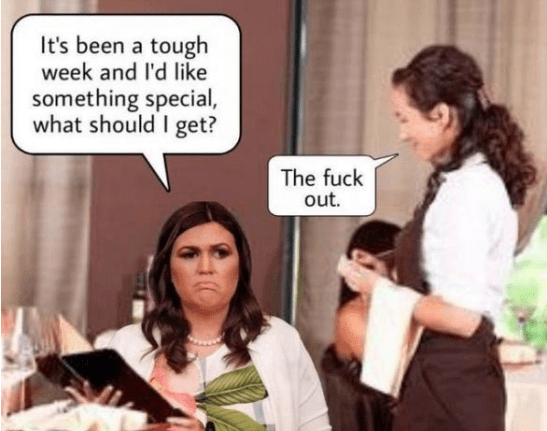
A public business that serves only some of the public, but refuses to serve all the public, sound familiar? Did we not have this same fight in the 1960s? Is gay the new black? Just who gets to sit at the lunch counter? Look, just replace the words same sex with Black or Jews and does it seem correct now. We don’t serve blacks, we don’t serve Jews, I won’t make a cake or a website for blacks or Jews. Imagine the outcry if a Christian was refused service due to someone not wanting to serve, make a cake, or build a website for Christians. I am so tired of being second class. Being gay and paying taxes without the rights that the upper class straight people have. Dogs that love gravy I am so tired. Hugs
Representing the plaintiff—303 Creative, a small business run by a Colorado woman named Lorie Smith—is Alliance Defending Freedom (ADF), a group whose founder dubbed it a “Christian legal army,” with a long history of opposing civil rights protections for LGBTQ people. But unlike the Masterpiece Cakeshop case, which at least involved real customers wanting a real cake, there is no wedding website. No person has hired Smith to create a wedding website. In fact, Smith has never designed a wedding website.
As such, there is no client Smith has told she is rejecting due to her stated religious beliefs that marriage is only allowed between one man and one woman. In the absence of all that, ADF has, instead, fashioned Smith as the victim of an injury that has never occurred. The group has a $76 million annual budget and thousands of attorneys in its network. The goal with 303 Creative, as it was with Masterpiece, is to redefine civil rights protections for LGBTQ people as a form of religious discrimination against Christians.
Yesterday it was reported that an ADF claim that Smith [photo above] was contacted by gay man seeking a same-sex wedding website is false and that the man in question is straight, was married to a woman at the time, and says that he made no such request.
Later yesterday, however, it was reported that the claim does not appear in the filings before the Supreme Court.
As I’ve said here many times, the ADF invents these businesses with the specific intention of challenging local pro-LGBT ordinances. My first 2016 report on the 303 Creative case is here. And below is today’s ruling.
The Supreme Court decides in favor of Alliance Defending Freedom and guts civil rights laws in the 303 Creative LLC case.
The 6-3 opinion, with the typical breakdown of Republican appointed ultra-conservatives in the majority, is here:https://t.co/QPB7jmydVF
Let's be clear: nothing happened to the plaintiff in 303 Creative, the whole "case" was a hypothetical exercise, and the GOP Justices used it as a vehicle to undermine every single federal, state, county, and city anti-discrimination law in the country. https://t.co/LTgg9LRBwY
The thing that sucks most about the 303 Creative decision is that Smith's case is entirely a fiction. The entire question is based on a business she doesn't have being asked to do something they weren't.
It never should have seen a state court, much less SCOTUS
— Chris supports workers over management (@cokes311) June 30, 2023
Facts and beliefs/opinions sadly carry the same weight in this country. Their religion says sexuality can change. You just have to pray the gay away hard enough.
Legal eagles, I have a question: Would a decision necessarily have to be vacated if the facts of the case are found to be a fabrication? Can there be a ruling in favor of an injured party if there is no injury? Can a decision be made in favor of a party that has based their claim of injury upon that falsehood? Can a party that claims an injury based on a falsehood be guilty of perjury? Can the party that was claimed to have created the injury in the first place have standing to sue?
I would never call myself a “legal eagle” but no, that the court recited made up facts and circumstances makes zero difference. The literal only thing that matters is the holding and the vote. The last religion case Gorsuch wrote, Bremerton, was on completely fictitious facts and the dissent even posted a picture showing that.
Sotomayor did point out the standing issue here – to wit, the plaintiff alleged a facial challenge on a potential future harm. That’s a bit speculative for these things and against the trend of requiring ‘as applied’ challenges to laws – i.e harm in fact.
No theofascist business will be blocked, now, from discriminating against our community. If and when the theofascists are challenged in court, the lower courts will be bound by today’s Supreme Court ruling.
At what point? When the Court upholds religious laws that punish infidelity – at that point the Senators who are cheating on their wives will rise up to counteract the Court’s rulings.
Only some religions, of course. Not pro-Buddhist, or Jewish, or Sikh, or Islam, or anything Native America, or Wiccan, or Taoist, or Hindu, or…well, long list.
To expose the christofascism of this Supreme Court, we need, for example, a case involving a non-Christian baker who won’t do a wedding cake for a Christian couple because Christianity offends the baker’s religious beliefs.
“Today, the Court, for the first time in its history, grants a business open to the public a constitutional right to refuse to serve members of a protected class.” – Sotomayor
I feel sorry for Sotomayor. She knows on the deepest of levels how legally and morally wrong all these decisions are, yet she is powerless to stop them.
Perry is an Associate Professor of Sociology at the University of Oklahoma. He is the author of four books, including Taking America Back for God (with Andrew Whitehead) and most recently The Flag and the Cross (with Philip Gorski). McDaniel is an Associate Professor of Political Science and co-director of the Politics of Race and Ethnicity Lab at the University of Texas at Austin. He is the author of Politics in the Pews and The Everyday Crusade (with Irfan Nooruddin and Allyson Shortle)
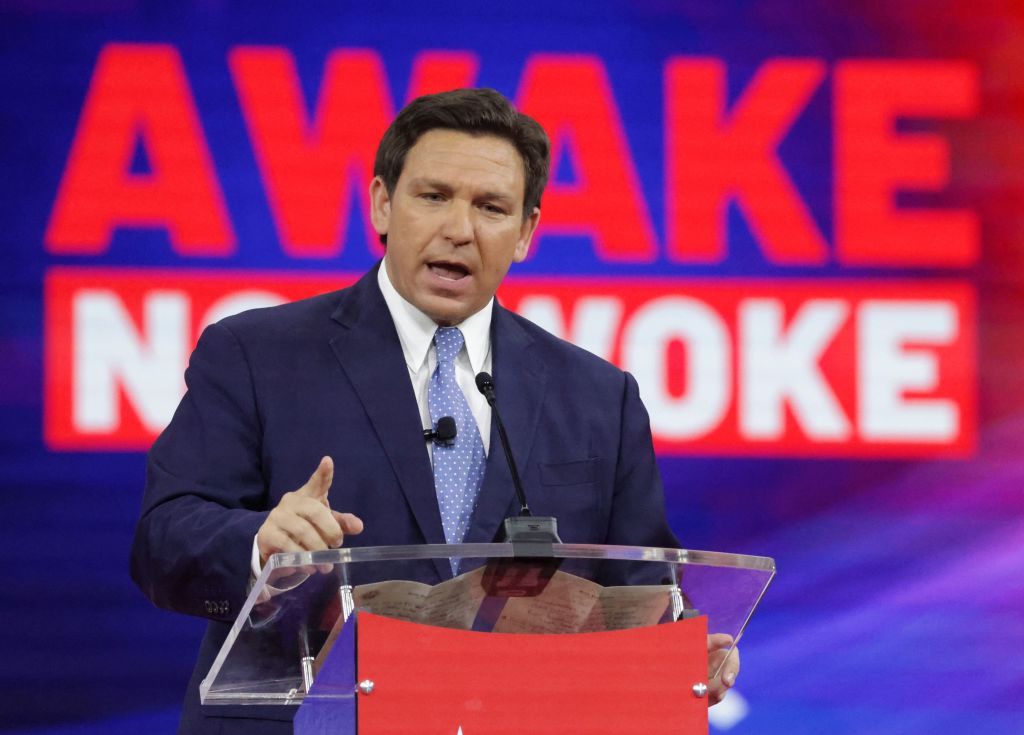
On Jan. 12, 2023, Florida Gov. and possible GOP presidential candidate Ron DeSantis extended his “war on woke,” when his administration rejected a proposed Advanced Placement African American Studies class from Florida high schools. The move was consistent with DeSantis’s proposed “Stop W.O.K.E Act” in 2022, which aims to eliminate certain content from educational curriculum and has been under partial injunction since November. And on Jan. 20, 2023, a U.S. District Court judge upheld DeSantis’s suspension of Hillsborough State Attorney Andrew Warren whom DeSantis claimed had prosecuted cases under “woke ideology.”
DeSantis is only the most prominent example of Republican lawmakers claiming to fight “woke ideology,” “wokeness,” or the “woke left,” and though occasionally pressed to provide definitions, politicians are strategically vague. Even with the “Stop W.O.K.E. Act,” that clearly targets content about America’s racist history and systems, the acronym simply stands for “Wrong to our Kids and Employees.” Nothing racial. Just as with all effective dog whistles, the racial implications must be subtle, or better yet, implied. The label should evoke demonized Black populations, but their literal sense broad enough and ambiguous enough to provide plausible deniability.
As social scientists with expertise in the area of race and politics, we collected data on who actually identifies with the term “woke”? The patterns make it clear why the label has become the latest in a long line of Republican dog whistles.
In a nationally-representative survey of over 1,700 Americans fielded by YouGov in Oct. 2022, one of us (Samuel Perry) and a collaborator Joshua Grubbs asked Americans how well the term “woke” described them. Overall, 22% of Americans said “woke” described them either “very well” or “somewhat well.” If that sounds like a high percentage, it’s actually somewhat lower than the percentage found in a 2021 Harris poll (32%), suggesting Americans may be backing away from the label as it’s become a slur. Though it’s also slightly less than the percentage of our survey respondents who identified with the term “Christian nationalist” (25%).
When we break down who actually identifies with the term “woke” in the YouGov survey, it becomes clearer why the racial implications are unmistakable. Nearly 40% of Black Americans identify somewhat with the label, more than double the percentage of white Americans (19%). It’s also considerably more than the percentage of Hispanics (24%) or Asian Americans (19%). In fact, only 28% of Black Americans completely distanced themselves from the term, saying “woke” described them “not at all,” compared to clear majorities of white Americans (57%) and Asian Americans (54%).
But “woke” is also a term for Black Americans that transcends ideology and partisanship in a way it doesn’t for any other group. Over 40% of Black Americans in the YouGov survey identify with the term whether they are liberals or moderates. In fact, roughly 40% of Black Republicans and Independents identify somewhat with “woke.” This means the percentage of “woke” Black Republicans and Independents is higher than the percentage of white “Strong Democrats” (39%).
Statistically speaking, the broad demographic for whom the term “woke” most consistently applies is Black Americans. This should be unsurprising considering the term originates among the Black community to denote someone who has been awakened to the reality of systemic injustice. It also demonstrates that being “woke” is a fact of life for Black Americans as they process what W. E. B. Du Bois refers to as a “double consciousness”—the struggle to be Black and viewed as a full American. This is further supported by numerous polls and studies showing Black Americans are far more likely to be aware of the past and current injustices they face in housing, employment, policing, and health.
The disproportionate number of Black Americans who identify somewhat with the term “woke” would ostensibly make Republican “anti-woke” efforts transparently racist. But there is one group who is even more likely to identify with the term “woke” than the average Black American—whites who identify as “very liberal.” In the same YouGov survey, just over 50% of white “very liberal” Americans (representing 6% of the total population of white Americans) say “woke” describes them “very well” or “somewhat well.”
Though this group of whites is small, the relatively high percentage of “very liberal” whites who identify with “woke” provides the deniability that all effective dog whistles need: Policies that clearly target efforts to convey the history of racial injustice in schools under the guise of fighting “woke” education need not be anti-Black when the “woke” are perhaps even more the white far-left.
This is a common challenge when anti-racist language becomes mainstream. Critics point out that white liberals often lay claim to anti-racist concepts and identities without effectively working for anti-racist goals. As a result, the language becomes absorbed into white partisan conflicts, accomplishing little while also setting the stage for counter attacks with dog whistles. A recent study, for example, found the term “anti-racist” itself was more often embraced by white progressives than Blacks or Hispanics, and thus, right-wing mobilization against “anti-racist” concepts, books, or policies could just as easily be framed in mundane partisan, culture war terms in which Republicans oppose movements led by white liberals. This in turn makes the conflict intra-racial, instead of interracial.
This covert form of race-baiting has become a central plank in shaping American partisan politics. Moving away from the language of Strom Thurmand and George Wallace, who overtly rallied their supporters against threats to the racial hierarchy, Republican candidates in the post-Civil Rights era stoke fear and anger over this threat via coded language.
Whether it’s a term like “woke,” or more traditional labels like “welfare queen,” “buck,” “thug,” “terror,” “illegals,” “socialists,” or “unAmerican,” the efficacy of a racial dog whistle is not in the fact that nobody knows whom you’re clearly talking about, it’s the plausible deniability that allows you to respond: “Who’s talking about Black people? I’m just talking about leftists. You’re the one making it about race.”
Republicans have mastered the tactic. And if history is any indication, front-runners like DeSantis will continue their public crusade against the bogeyman of “woke,” the current code word for left-wing radicals who provide the convenient distraction from those whom anti-woke legislation really targets—Black Americans who demand justice.
Media coverage of Florida Gov. Ron DeSantis’s all-but-announced candidacy for president is already in full frenzy, and so far the script is exactly as his handlers would like it to be. The governor regularly opens up new fronts in the culture wars, sowing alarm over critical race theory, transgender rights, or border policies. In response, liberal pundits fall into the trap of accentuating the very issues DeSantis has chosen to fire up his base.
Omitted from the public debate about DeSantis’s policies is almost any discussion of his actual record of governance—what exactly he has delivered to the citizens of his state, especially those without seven-figure incomes and lush investment portfolios.
Even a cursory dip into the statistics of social and economic well-being reveals that Florida falls short in almost any measure that matters to the lives of its citizens. More than four years into the DeSantis governorship, Florida continues to languish toward the bottom of state rankings assessing the quality of health care, school funding, long-term elder care, and other areas key to a successful society.
Florida may be the place where “woke goes to die”—as DeSantis is fond of saying—but it is also where teachers’ salaries are among the lowest in the nation, unemployment benefits are stingier than in any other state, and wage theft flourishes with little interference from the DeSantis administration. In 2021, DeSantis campaigned against a successful ballot initiative to raise the state’s minimum wage, which had been stuck at $8.65 an hour. Under DeSantis’s watch, the Sunshine State has not exactly been a workers’ paradise.
DeSantis weaponizes the cultural wars to distract attention from the core missions of his governorship, which is to starve programs geared toward bettering the lives of ordinary citizens so he can maintain low taxes on the wealthy and corporations. Florida is the ideal haven for privileged Americans who don’t want to pay their fair share of taxes. It has no income tax for individuals, and its corporate tax rate of 5.5% is among the lowest in the nation. An investigation by the Orlando Sentinel in late 2019 revealed the startling fact that 99% of Florida’s companies paid no corporate income tax, abetted by tax-avoidance schemes and state officials who gave a low priority to enforcing tax laws.
This is a pattern that shows up in the statistics of many Republican-led states, which on average commit fewer dollars per-capita to health care, public education, and other crucial services compared to their blue counterparts, while making sure corporations and wealthy individuals are prioritized for tax relief. Arizona cut taxes every year between 1990 and 2019, following up with a shift to a flat tax this year that will cost its budget $1.9 billion. Meanwhile, its public-school spending ranks 48 among the 50 states.
In Florida, the state’s tax revenues come largely through sales and excise taxes, which fall hardest on the poor and middle class. A 2018 study by the left-leaning Institute on Taxation and Economic Policy found that Florida had the third least-equitable tax system of the 50 states. In the state’s “upside-down” tax structure, the poorest 20% of Florida families paid 12.7% of their income in taxes, while the families whose income was in the top 4% paid 4.5%, and the top 1% paid 2.3%, according to the study.
Florida taxpayers get less for their money than residents of many other states. The Commonwealth Fund, a private foundation that studies health-care systems globally, found in its 2022 “scorecard” that Florida had the 16th worst health care among the 50 states. It’s no wonder that Florida ranks below the northern blue states in life expectancy and rates of cancer death, diabetes, fatal overdoses, teen birth rates, and infant mortality.
Largely because of DeSantis’s obstinacy, Florida is one of 10 states that have refused to expand Medicaid under the Affordable Care Act, an act of political spite that has cost those states billions in federal health care dollars and cost thousands of people their lives. More than 12% of Floridians are without medical insurance, a worse record than all but four other states. Despite having the country’s highest percentage of retirees, Florida has the worst long-term care among the 50 states, according to the American Association of Retired Persons.
Public schools fare no better than health care in DeSantis’s Florida. Not only did Florida rank 49th in the country for average teacher pay in 2020, but the Education Law Center, a non-profit advocacy group based in New Jersey, found in a 2021 report that the state had the seventh-lowest per-pupil funding in the country. Education Week, which ranks states public school annually, looking beyond mere test scores, placed Florida 23rd in its 2021 report, a lackluster showing for a large and wealthy state.
It says something about the state of our political discourse that Florida’s denuded public sector was not more of an issue in last year’s gubernatorial campaign. In endorsing DeSantis’s Democratic opponent, Charlie Crist, the Tampa Bay Times spent so many column inches on the incumbent’s demagoguery, vindictiveness, and authoritarian tendencies that it never even got to the minutiae of his governance. “No matter what you think about the state of the Florida economy or its schools or its future…,” the paper wrote, “the choice really is this simple: Do you want the state governed by a decent man or a bully?”
To be fair to the media, DeSantis and his allies manned the trenches of the culture wars so ferociously that it was all reporters could do to keep up with all the bomb throwing. How do you delve into the state’s tax policy when your governor is flying planeloads of migrants to Martha’s Vineyard or declaring war on Disney for issuing a statement in opposition to the state’s so-called “Don’t Say Gay Law”?
But that is very much the point of wedge issues, as they have been wielded by scurrilous politicians for decades, to anger and distract voters so they won’t notice the actions of public officials that mainly benefit the wealthy and are against the public interest.
As the 2024 election draws closer, DeSantis must not be allowed to accomplish nationally what he did in his state—cloak his service to the wealthy by frightening working people with stories about transgender recruiting and “socialist” college professors. There are unmistakable signs that Americans are focused on what an activist government can do for the public good, as evidenced by Floridians’ vote to increase the minimum wage.
The failure of DeSantis to better serve the most vulnerable citizens of his state is his weak underbelly in a national campaign.
Celebrate Pride Month with us! Discover why we come together every June to honor and support the LGBTQ+ community. Explore the importance of Pride as we spread love, acceptance, and equality while standing up against discrimination and advocating for LGBTQ+ rights.
From the linked article in the above Joe.My.God. post. Remember, this is a Yale history grad, claiming that is OK to honor Confederate Generals that fought the US government to keep slavery because “But at the end of the day, you know, we had people that have done great things for this country,” DeSantis said.”
Despite the limited scope of the DoD’s renaming, the Governor likened taking Bragg’s name off the fort to moves to “take Abraham Lincoln off the statue down in Boston … take Teddy Roosevelt down in New York City” and “remove George Washington’s name from schools in San Francisco.”
“And that’s not, I think, what I want to see. I mean, I think you can look back at anybody and you could find flaws. But at the end of the day, you know, we had people that have done great things for this country,” DeSantis said.
“I’m not in a position to say that somehow I’m so much better than any of this. It’s a different time. People make mistakes. There’s different parts of our society, we look back and can say was a mistake. But this idea that we’re going to erase history, I just think, is fundamentally wrong, and we’re not going to do that.”
'I think you can look back at anybody and you could find flaws.'@RonDeSantis doubles down on restoration of 'iconic' Fort Bragg name
While we’re at it, let’s also create Fort Hirohito. Why not, he was the leader of a foreign nation that attacked the United States. Let’s run with this theme Governor Fucknutz.
“And here’s the thing, you know, you learn from history, you don’t erase the history” and yet history that makes students uncomfortable can’t be taught in schools…right
Trump’s an elderly sociopathic narcissist, he’s spent decades refining his charisma and reflexes to lie instantly, without hesitation and with complete believability.
Ronnie isn’t, even if he’s a sociopath himself, he’s just hungry for power and clout and tries constantly to copy Trump to try and steal his thunder and his followers. But he can never be as good a liar.
Wow, he first says the name of the military base did not cause him to learn any history at all, then claims keeping the name is vital to learning the history he was totally ignorant about until they removed the name of the incompetent traitorous slaver, demonstrating he is lying through his teeth. He must have experts help him prove himself a liar like that, I don’t think he’s clever enough to figure it out himself.
I guess he means we learn only from white history, not the black history he is censoring in the schools. That’s erasing history, asshole!! This guy is such a lying fucking hypocrite.
Watters wanted and got the Tucker spot at fox. To get it he has to appeal to the most right wing demographics sought after by media, and to win them he has to be full open racist and the most ardent supporter of the right wing conspiracies along with pushing the idea of Christian nationalism. Hugs
Jesse Watters on Monday went after Barack Obama for criticizing the disparity in media attention on the submersible that imploded during its venture to the Titanic wreck when compared to the sinking of a fishing boat that was carrying up to 750 refugees. https://t.co/kAYwlmOh0L
Watters, new host of Tucker’s 8pm slot, says of Obama: “This is a guy whose father has roots in Africa…Spent a lot of time in Hawaii. Was that the last state to get a star on the flag? He's never really looking at things from an American perspective.” pic.twitter.com/cXZ6xKD1JE
If man sees a kid playing in the street, then notice a car driving down the street, and he shrugs and says ‘free will’ and the car hits the kid, is that man a good person or a bad person?
Yet somehow Christians want to tell you that God is good, even though he allows bad things to happen. (And he could have just stopped it all by making Adam and Eve barren, or ending the world 4000 years ago.)
Ending one segment that knocks Pete Buttigieg for "prioritizing a far-left green agenda" only to tee up another segment about the "brutal temperatures" and "dangerous heat" in Texas. pic.twitter.com/ZRFYPKBbcP
Two workers died amid extremely high temperatures in Texas, a tragedy that's likely to exacerbate criticism of Gov. Abbott's water break ban. https://t.co/11ZeBlijYd
“We are flying electric helicopters on Mars, but we can’t use the dryer in Texas. This is because scientists are in charge of Mars and Republicans are in charge of Texas” ~Amy Martin #ERCOT#Texasgrid#VoteThemAllOut2022pic.twitter.com/uIW3c3cyHr
TWO MEN leaving a public restroom . Man#1 approaches Man#2 and says: “Excuse me sir but I noticed you didn’t wash your hands after using the urinal. I’m from Texas and in Texas we’re taught you should always wash your hands after using the restroom.” Man#2 replies: “Well I’m from California and in California we’re taught you should’nt pee all over yourself.”
I wish non-Dem Texans would learn to blame the GQP they vote in for the shitty state of their infrastructure but if the Ted Cruz fleeing for Cancun didn’t teach them shit . . .
This is really a non-issue because if the power goes out and people die, nobody can sue the power company because the Republican Texas Supreme Court just held that Republican-controlled ERCOT is immune from lawsuits. No liability = No Problem.
Strang previously appeared here when he declared that people who oppose Trump are possessed by demons and that voting against Trump is a vote for the “apocalypse.” Also, holograms and Trump’s impeachments? Both the work of Satan. We last heard from him when he appeared in a “documentary” with Dr. Demon Semen.
What’s happening lines up with God’s Word regarding what would happen in the end times before Jesus returns.
But that’s what you want, isn’t it? Shouldn’t you be happy? I mean, your imaginary friend is going to show everyone he’s not imaginary after all. That’s a good thing, right?
There was a book, “The Late Great Planet Earth” that was popular among the end times folks. “The last days are nigh!” Published in 1970. 53 years ago. And even in the late 1800s, preachers were saying the end times were near.
They literally pray “Lord come quickly!” But then complain about all the “signs of the end times” as if that’s a bad thing. They should be working -toward- the ‘one world government” and a global currency and world peace and “the mark of the beast” because that’s what will bring the rapture. (Your eschatology may vary).
This is basically the attempt by white supremacists to prevent the natural decline of white majority / supremacy in the US. They are terrified over the demographics that shows the steady decline of the white majority and the increase in non-white people. It terrifies them because they fear being treated as they have treated POC all during the history of the US. They want to remain the unchallenged authority they have always been. This denies everything we understand about culture and human development, not to mention what the US has always stood for. We are better / stronger / improved the more we blend and add to our prior society. Hey if you treat others that are different from you decently, they will do the same to you. If you act like an asshole toward them, they might do the same back. The thing to understand is be a decent nice person to others. Remember race is a social construct. We are all humans. We may look different but we really are the same species. Do dogs or cats of different colors be racist against each other, and should they, as they are all dogs or cats. Hugs
LMAO this clown went to Harvard Law school and should know the Constitution a little better, particularly the 14th Amendment. But you needn't take my word for it. Birthright citizenship was defined and affirmed by the SCOTUS in 1898, in US v. Wong Kim Ark:https://t.co/OAYLAAteLy
— Deborah, who loves fashion & loathes fascists (@litbrit) June 26, 2023
Yes… and look which demographic he’s coddling. They’ll fall totally in line with him. Evangelicals always find the worst in humanity to align themselves with
I don’t do 1930s/40s comparisons lightly or often, but DeSantis could certainly be someone to take us down a similar road, just a 2020s version of it. He’s already taking actions in that vein — shipping human beings like cargo, book bannings, etc. I’m not suggesting it could be a literal Holocaust, but he will seriously and intentionally harm a lot of Americans (and more so, people wanting to become Americans) before he would be done. A lot of people would die.
Also, I’m not not saying he wouldn’t cause a literal Holocaust, either.
We will never stop fighting bigots like Ron DeSantis – they must be told repeatedly that LGBTQ Americans deserve ALL the rights due to them under our Constitution.#Pride2023https://t.co/oT6gpM9nPQ
— Democratic Coalition (@TheDemCoalition) June 30, 2023
JackFknTwista day ago edited O/T : – At the risk of having only one tune, I don’t think it can be said often enough that in their doctrinaire zealotry the conservative Justices of the Supreme Court have betrayed their underlying hypocrisy. In their preening self-importance all they have exposed is their lack on any integrity, their enthusiasm to lie at any opportunity and their shallow semblance of probity. What we have on the US Supreme Court is a few liars, charlatans and those willing to prostitute themselves at the alter of the Federalist Society on the one hand and to rich ‘grooming’ billionaires on the other. Was there ever a Supreme Court so compromised?
Yes, 1937 or so. Towards the end of the “gilded age”, the SCOTUS was as virulently anti-decency as Alito and Thomas are now. FDR, then president, make a threat to “pack” (unfvck) the court and the court suddenly changed its tune on what the law was. Then the plan to fix the court fell apart.
There’s some suggestion that a similar thing may have happened between last term and this one with regard to KNAW, Roberts and Raspberry Baret. They have not gone along with the same degree of YOLO-ALITO that marked last year / the Dobbs Term.
They can’t win on real issues that matter to people so we’ll have lots of noise on wedge issues over the next year. Brown people invading, drag queen groomers and Susie has to call her teacher they/them at school.
DeSantis keeps trying to resurrect the infamous Jones commission – which attemped to erase homosexuality from all colleges and other schools throughout the state some 50 years ago, along with the actions of Senator Joseph McCarthy, who tried it nationally. The only result was the ruining of the reputations and hopes of over 200 students and faculty in Florida. This is evil in its strongest form.
Most of this is Florida law, so US SCOTUS is largely irrelevant unless there is a conflict with Federal Law. The Florida SCOTUS is packed with bigots, in a large sense the fate of Florida rests in the hands of the appellate courts.
That’s gonna be the kicker. We already know the FLSC is packed with bigots. The appellate courts are either going to side with a dictator or with the republic that placed them in their robes.
I feel like this is part of the whole make shit up and get it to the current Supreme Court so they can declare god and church and money or whatever. Like the website bitch in Colorado and the made up gay client.
Win or lose, Tater will screech about how he’s “fighting for families* and against woke culture & a woke & woke judges.” Others will be smart enough to point out his losses or how vaguely worded his laws are, but at the end of the day, DePudding will declare himself “the great fighter for American values*”
* values & families don’t include individuals, friends or family of the LGBTQ, nonChristians, nor nonWhite racial groups. Additional exclusions not listed or implied are applicable by the tiny dictator
Ron DeSantis is the worst candidate I’ve ever seen. It’s like he’s been assembled from the discarded spare parts of Bobby Jindal, Bill deBlasio, Rick Perry, and Scott Walker. https://t.co/5f6UILNVPI
DeFascist can indeed get the country on a different path – Here’s what Ron DeFascist has accomplished – – LGBT students cannot discuss their personal lives with teachers or counselors, making them feel marginalized, alone, and possibly increasing their risks of suicide. Some parents with LGBT family members are moving out of the state. State ACLU currently suing to end this. – Universities are unsure what they can or cannot teach based on the whims of literally one man. GOP prefer students to be inculcated with cheap cheerleading America First nationalism (this shut down by a judge, results pending) – History teachers can’t teach about the truth of American racism and black history because it might upset white people – Some teachers are seeking employment in another state. – A school principal had to resign because one of her teachers showed students a picture of Michelangelo’s David. – A teacher is under investigation because she showed 13 year olds a Disney movie with a gay character. – Women who discover they’re pregnant after 6 weeks, and are unable to have a child, can’t get an abortion in Florida, even though there should be retroactive abortion, Don Jr. lives there – Property taxes and insurance costs are becoming unaffdable – Million dollar contracts are given to DeFascist’s donors – 87,141 people died of Covid in Florida. Less would have died had there been the slightest of protective measures taken, but DeFascist didn’t allow that. – Hispanic farm and construction workers are not going to work out of fear of DeFascist’s draconian rules to punish undocumented workers and their bosses. Hispanic truckers are refusing to deliver to the state. Farm products are rotting while remaining unpicked. – Students and companies who support diversity and inclusion are no longer allowed to do so. – Trans children can no longer get medical care, use bathroom of pronouns of their choice (this shut down by a judge, results pending) – a court could temporarily remove children from their homes if they receive gender-affirming care – LGBT people who seek medical care can be denied it if they’re unlucky enough to have a religious fanatic doctor. – Drag queens can be arrested for appearing in drag in public where children can see them. (this shut down by a judge, results pending) – Any idiot can buy a gun without a permit, training, or with or without a criminal record. – Disney, the state’s largest employer, is suing DeFascist because of politically motivated harassment after he started a fight with them because they don’t approve of his anti-LGBT laws. Disney cancelled a $1 billion construction project that would have brought the state over 2,000 jobs. – More to come. White retirees probably love him because he’s getting rid of the blacks, gays, immigrants and other assorted annoyances. DeSantis calls Florida “the freest state in America.” Actually you’re free to move here, retire and die.
A “standing order” that Trump has claimed authorized him to declassify documents removed from the Oval Office could not be found by either the Justice Department or Office of Director of National Intelligence https://t.co/wPbnrUTi8s
The Supreme Court has issued an interim order recognizing marriage rights for same-sex and non-traditional heterosexual couples! This landmark decision calls for amendments to the Civil Code — [1/2] pic.twitter.com/hlW7MRvqHB
Fantastic news! The world is evolving, but sadly the GQP and TFG will do everything in their power to stop equality in this country from becoming pernanent and legal. I’m sure TFG is probalby labelling Nepal as one of those shit hole countries he doesn’t like.
Apparently, our evangelical and assorted radical Christian groups, who hate us with the love of God, didn’t know where Nepal is or didn’t know such a country existed. I’ll bet they’re boning up on their geography now.
The San Diego Union-Tribunereports: Two protesters offended by a Pride exhibit at the Rancho Peñasquitos Library have checked out nearly all the books in the display and vowed to keep them until the library eliminates what they call “inappropriate content” for children. The anti-gay protest is the latest example of a growing national backlash against Pride exhibits, which experts say has been fueled by debates over how schools should handle transgender minors. The Rancho Peñasquitos protest ratchets up the usual backlash San Diego library branches experience when they create Pride exhibits or host events like drag queen story times, said head librarian Misty Jones. The protesters, Peñasquitos residents Amy Vance and Martha Martin, said libraries are open, public spaces for children that should be free of references to gender identity and how adults experience sexual attraction. Read the full article. A local city council member is raising money to buy additional copies of the books.
Protestors ruin Rancho Penasquitos library's Pride exhibit by checking out nearly all the books https://t.co/q5erkSeWAZ
I’m starting to think this is a matter for the police. They checked them out and stated that they have no intention of returning them unless the library does exactly what they want. Last I checked, that’s called theft.
They get 5 renewals, unless the items have holds on them. So I urge anyone and everyone in San Diego who is disgusted by their motives to place holds. MANY HOLDS. That way they will be required to return the items or be turned in to a collections agency. That will also likely block their library privileges to borrow any other materials. If it goes beyond that, it is indeed theft.
I had a home in a small town for nearly 30 years. It had a small library, maybe twice the size of the one in my high school. The “Christians” would come in and check out ALL the non-Christian religious books and never return them. It was their way of making sure people couldn’t learn about other religions. And this was before Trump and the MAGA folks. If your religion of “Christianity” is SO GREAT, it should be able to prove itself against the others by its merits and ideals, not by making the beliefs of others unobtainable.
Damn these people. A book offered me permission not to hate myself for being who I am.
*** Editor note *** It was books that gave me my escape from my life. It was books that let me leave the life of abuse, hurt, and fear I was living constantly at home, in my home. It was books that let me understand I was not a horrible abomination in life that was going to do horrible things and die in a gutter as my adoptive parents (the ones beating and sexually abusing me and letting their kids do so) claimed long before they even knew I was gay, that I did not need to suffer in silence, (Which I did for most of my life). These books that these people are trying to ban and deny to the very kids that need them meant so much to me and other kids. Please do not let them. Look in the 1950s these people want to revert the social and country to there were no of these kinds of books, no positiverepresentatives in media, but gay, lesbian, and trans kids still existed. I am going to post a video about a old long time soap opera about gay people and the damage hate can do. Hugs.
When you say “wife,” “husband,” “fiancé,” “girlfriend,” etc.–all commonly heard from heterosexuals–you are inserting sexuality in public spaces where children are or may be.
Mere gender identification on a bathroom door is the actual issue here. These delusional evangelicals are literally incapable of connecting the dots on gender/sexual expression issues.
I’m currently reading a book about the John Birch Society and everything they are doing now is the same shit the Birchers were doing in the 50s and 60s. Only back then MSM and even the GOP leadership weren’t on their side.
They don’t care about corporations either. They only want Republicans to hold the power over everything – people, corporations, city councils, school boards, etc.
Republicans sure don’t like people voting, do they? They’ll overturn elections, make it harder for statewide resolutions to pass, throw out elected officials they don’t like, and now this. Democrats might wish to mention this on the campaign trail.
Kinda like how Texas has created special rules that only apply to specific counties that vote mostly Democratic that take away aspects of self-governance from them.
The Committee is a documentary film about the little-known Florida Legislative Investigative Committee of the State Legislature from 1956-1965. Florida Senator Charley Johns chaired the committee, and its aim was to root out communist and homosexual teachers and students from state universities. It was successful in either firing or expelling more than 200 suspected gay and lesbian citizens.
I wish I could post this short video. It is what DeathSantis is trying to recreate today in Florida and if he gets the presidency he will push this hard on the entire country. Hugs
DeFascist can indeed get the country on a different path – Here’s what Ron DeFascist has accomplished –
– LGBT students cannot discuss their personal lives with teachers or counselors, making them feel marginalized, alone, and possibly increasing their risks of suicide. Some parents with LGBT family members are moving out of the state. State ACLU currently suing to end this.
– Universities are unsure what they can or cannot teach based on the whims of literally one man. GOP prefer students to be inculcated with cheap cheerleading America First nationalism (this shut down by a judge, results pending)
– History teachers can’t teach about the truth of American racism and black history because it might upset white people
– Some teachers are seeking employment in another state.
– A school principal had to resign because one of her teachers showed students a picture of Michelangelo’s David.
– A teacher is under investigation because she showed 13 year olds a Disney movie with a gay character.
– Women who discover they’re pregnant after 6 weeks, and are unable to have a child, can’t get an abortion in Florida, even though there should be retroactive abortion, Don Jr. lives there
– Property taxes and insurance costs are becoming unaffdable
– Million dollar contracts are given to DeFascist’s donors
– 87,141 people died of Covid in Florida. Less would have died had there been the slightest of protective measures taken, but DeFascist didn’t allow that.
– Hispanic farm and construction workers are not going to work out of fear of DeFascist’s draconian rules to punish undocumented workers and their bosses. Hispanic truckers are refusing to deliver to the state. Farm products are rotting while remaining unpicked.
– Students and companies who support diversity and inclusion are no longer allowed to do so.
– Trans children can no longer get medical care, use bathroom of pronouns of their choice (this shut down by a judge, results pending)
– a court could temporarily remove children from their homes if they receive gender-affirming care
– LGBT people who seek medical care can be denied it if they’re unlucky enough to have a religious fanatic doctor.
– Drag queens can be arrested for appearing in drag in public where children can see them. (this shut down by a judge, results pending)
– Any idiot can buy a gun without a permit, training, or with or without a criminal record.
– Disney, the state’s largest employer, is suing DeFascist because of politically motivated harassment after he started a fight with them because they don’t approve of his anti-LGBT laws. Disney cancelled a $1 billion construction project that would have brought the state over 2,000 jobs.
– More to come. White retirees probably love him because he’s getting rid of the blacks, gays, immigrants and other assorted annoyances. DeSantis calls Florida “the freest state in America.” Actually you’re free to move here, retire and die.
Climate change United Nations Climate change refers to long-term shifts in temperatures and weather patterns, mainly caused by human activities, especially the burning of fossil fuels.
A federal court blocked Florida’s new drag show law, ruling the state’s effort to bar children from attending “adult live performances,” is overly vague and likely unconstitutional. The decision Friday by U.S. District Judge Gregory Presnell comes only a day after another federal court overturned another Gov. Ron DeSantis-backed law prohibiting gender-affirming care treatment in Florida from being covered by Medicaid. “This concern rings hollow, however, when accompanied by the knowledge that Florida state law presently and independently… permits any minor to attend an R-rated film at a movie theater if accompanied by a parent or guardian,” Presnell ruled. “This statute is specifically designed to suppress the speech of drag queen performers,” Presnell wrote in his 24-page decision. “In the words of the bill’s sponsor in the House, State Representative Randy Fine: (the legislation) will protect our children by ending the gateway propaganda to this evil – ‘Drag Queen Story Time.’”
Courts are putting a stop on the anti-#LGBTQ laws pushed by @GovRonDeSantis and @TheFLGOP. This is what happens when fascist authoritarians believe they can ignore the U.S. Constitution. Thankfully, some checks and balances still exist. https://t.co/Eaf9yBzapy
“This concern rings hollow, however, when accompanied by the knowledge that Florida state law presently and independently… permits any minor to attend an R-rated film at a movie theater if accompanied by a parent or guardian,” Presnell ruled.
From the opening paragraph, US District Judge Gregory Presnell, an 80-year-old Clinton appointee, calls out the state of Florida's action for what they are: an attempt "to suppress the speech of drag queen performers." pic.twitter.com/BhxHUqZGg6
Paddycakes2001 Melissiaan hour ago From the transcript of the court hearing: THE COURT: The plaintiffs accuse you of invidious discrimination in violation of the 14th Amendment. How do you answer? STATE’S LAWYER: That’s the point, Your Honor.
mkbear684 hours ago Well, this was expected and they knew it, but it plays to the base and gets donations, but it puts real people at risk.
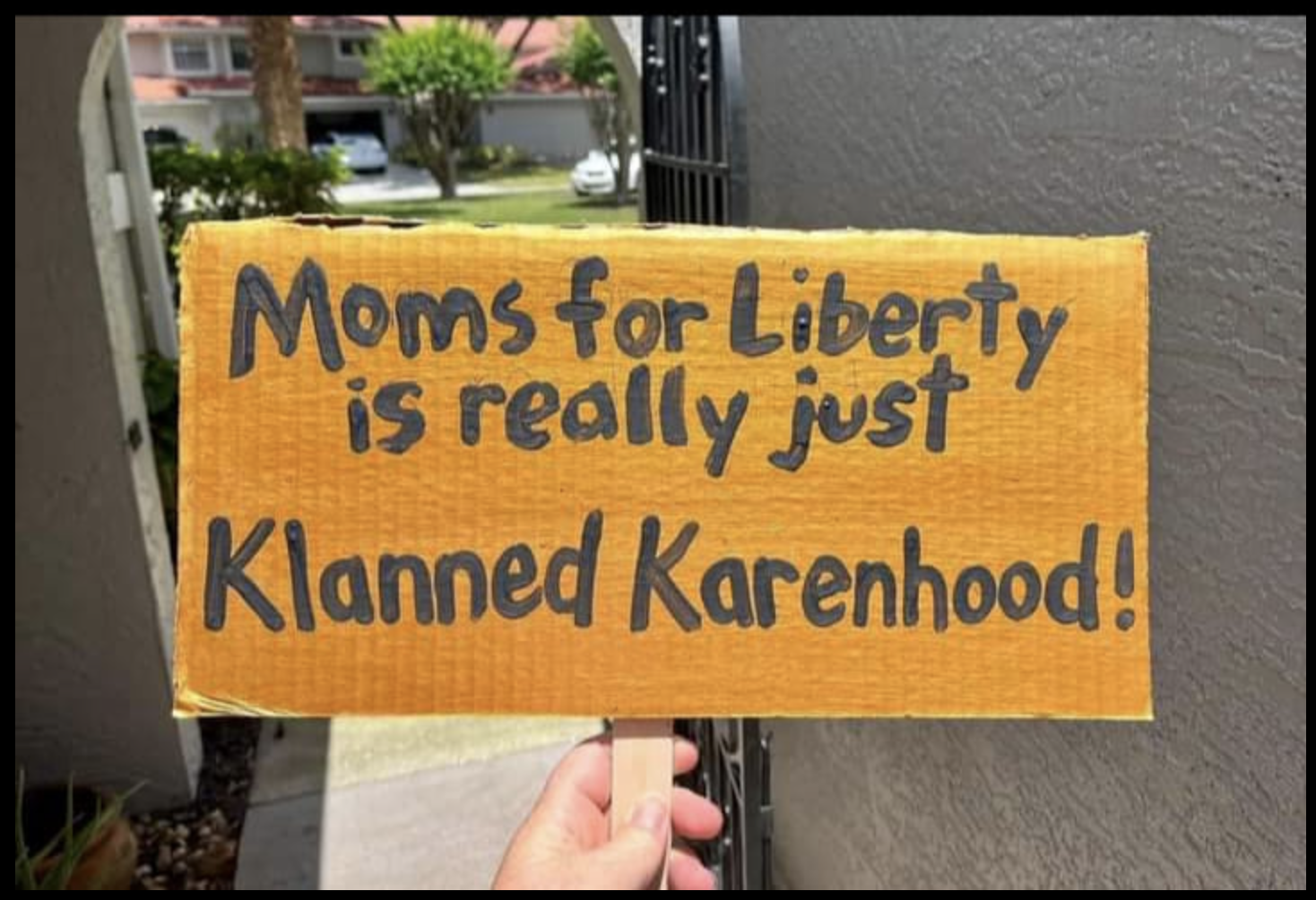
Moms for Liberty is an American conservative organization that advocates against school curriculums that mention LGBT rights, race, critical race theory, and discrimination, while multiple chapters have also campaigned to ban from school libraries books that address gender and sexuality issues. The group began by protesting COVID-19 protections in schools, including mask and vaccine mandates.
Moms for Liberty has been criticized for harassment, for deepening divisions among parents, for making students’ education more difficult, and for having close ties to the Republican Party rather than being a genuine grassroots effort.
The group was labeled an “anti-government extremist” organization in 2023 by the Southern Poverty Law Center.
Formation January 1, 2021 Founders Tina Descovich, Tiffany Justice, Bridget Ziegler Headquarters Melbourne, Florida, U.S. Area served United States Membership 70,000
It was very obviously discrimination, and it’s obvious from the arguments they put before the court that this has nothing to do with any form of concern for anything other than brazen politics and just flat out hatred of a minority group.
Bingo. This is performative art for their target voting bloc (evangelicals) who vote solid Red in every election like clockwork. Dems don’t have the equivalent. There’s literally nothing on the Left that’s anything like the consistency of the Right when it comes to voter outreach.
Good. I hope that all these hateful and cruel laws are struck down. The slave states want to make laws that health care workers don’t have to give LGBT people medical assistance at ALL if they have “deeply held” religious beliefs against us. It’s time we are considered to be human beings, not just another theocratic political football. If you prick us, do we not bleed?
Historically, (like 2 years ago, not 20), law in the US doesn’t let you single out a group, especially a disfavored group, and pass laws against them. Nice to see some vestiges of that core idea are still here.
And note that THOMAS is the #1 cheerleader for getting rid of ‘equal protection’.
So you encourage book banning, demonize LGBTQ people and your tactics are compared to the historical actions of Nazis all while being designated as a hate group by the SPLC and then you try and refute that by quoting Hitler?! M4L keeps showing us who they are. Believe them. https://t.co/0WABae4f3A
— Jim Stewartson, Anti-disinfo activist 🇺🇸🇺🇦💙 (@jimstewartson) June 22, 2023
this Hitler quote that Moms For Liberty used is the same Hitler quote that Republican Rep. Mary Miller recited at a Moms For America event two years ago!
And yet republicans never debate about the cost, while claiming $300 for the poorest people with children a month is obscene and we can not afford it. The Pentagon fails every audit, and I just watched where they are overcharging thousands of dollars a piece for a trash can that they use to charge $300 for. Yet Manchin says we need to cut social security. Hugs
Tucker Carlson's former head writer has resurfaced as Charlie Kirk’s radio producer; he had resigned after @oliverdarcy reported that he had posted racist, misogynistic, homophobic, and other awful content on an online forum. https://t.co/K9GLB0wjlSpic.twitter.com/tqAJsBkzs4
Brooklyn Albert18 hours ago I see the handiwork of the likes of Scott Lively and his ilk, spreading the gospel of hate and their twisted comprehension of history to African, Caribbean, and Latin American countries.
Authoritarian advocates, whatever their form, need some “other” to be dehumanized and oppressed. When everybody more or less has the same race and culture in a country, they then cast about for some other way of differentiating for the purposes of fomenting hate. Sometimes it’s by religion, sometimes by ethnicity, but if those are relatively homogeneous, they’ll go for LGBTQ status or political identity.
For example, in America in the 1950s, they did both of those latter, along with racist bigotry: People perceived to be not-straight and those who were accused of being socialist or communist. All three were targeted for systematic oppression.
It stuns me that these leaders are so focused on sexuality and making gay people pay for their sexuality with severe punishments and even death. Why is this even on their minds? Is being gay causing some sort of great turmoil in their countries? Are they trying to undermine their governments? Are they just living their lives like everyone else? So much angst over gay people. He contradicts his own statements in just one paragraph. “Gay Africans don’t exist.” – “kick LGBT people out of Kenya completely,” Well, which is it? Who gets kicked out if they don’t exist in the first place? Screwy like the radical Christians that foment this hatred.
Some of them genuinely seem to think that the existence of LGBTQ people threatens the continued existence of the human race, because not enough people are breeding.
Kenya has 53 million people in an area the size of Texas. Underpopulation is not a serious issue there.
JoeMyGodMod3 days ago You may recall Eric Metaxas for the time he sucker-punched a passing kid on a bicycle on his way into the White House for a Trump event and then lied about it even after video surfaced. It’s what Jesus would want.
Read the full article. Andersen, who lost a lawsuit to get on the ballot, has not so far been accused of wrongdoing. As you can see in his campaign clip below, he ran on a promise to end pandemic mandates.
Earlier this week Kennedy claimed that chemicals in drinking water are turning children transgender and that WiFi radiation causes brain cancer.
Unearthed: RFK Jr. pushed HIV/AIDS denialism, attributing AIDS not to HIV, but to a “gay lifestyle” and recreational drugs:
“There were people that were part of a gay lifestyle, they were burning the candle at both ends, …there were poppers on sale everywhere at the gay bars.” pic.twitter.com/BK2WXxjyg8
Hank: NO MORE WoW!!!4 days ago “The magnitude of the value of the Bible as a literary work outweighs any violence or profanity which may be contained in the book,” So, will they do the same for ALL books??? or just the ones, they deem fit???
“Public spaces are public spaces,” U.S. District Court Judge David Nuffer wrote. “Public spaces are not private spaces. Public spaces are not majority spaces. The First Amendment of the United States Constitution ensures that all citizens, popular or not, majority or minority, conventional or unconventional, have access to public spaces for public expression.”
In his 80-page ruling, Judge James M. Moody Jr. of Federal District Court in Little Rock said the law both discriminated against transgender people and violated constitutional rights for doctors. He also said that the state of Arkansas had failed to substantially prove a number of its claims, including that the care was experimental or carelessly prescribed to teenagers.
“Rather than protecting children or safeguarding medical ethics…the prohibited medical care improves the mental health and well-being of patients and that by prohibiting it, the state undermined the interests it claims to be advancing.” https://t.co/Y8yImyNZoq
Republicans know these hateful laws will never survive court scrutiny. The point was to drum up paranoia and grievance among voters. And with the help of the media, it was working. But there are hopeful signs that a backlash is forming.
— Matthew, June Goomba (@TeachAllAmerica) June 20, 2023
The law is extremely broad, which actually creates a host of other complications. A group of lawyers previously told The Dallas Morning News that the measure could restrict performances by artists such as Madonna and Miley Cyrus, which often feature sexual dancing. The text could even affect bachelorette parties, if they involved sex toys or other paraphernalia. The new changes could even impact cheerleading and criminalize sexual conduct between consenting 17-year-olds (17 is the age of consent in Texas). Movie screenings and art history classes could similarly come under fire. And of course, the law will affect its original target: drag performers, Pride parades, and transgender people just trying to live their lives. Lawsuits against similar bans are planned or already underway in other states. In Florida, the Orlando outpost of Hamburger Mary’s sued the DeSantis administration last month.
Rep. Lauren Boebert claims that she is forcing a House vote on impeaching President Biden because she is "directed and led" by "the spirit of God" in everything she does: "We are doing what is right, what is righteous. History will prove that." pic.twitter.com/EBoKqYEFif
In the fall of 2022, the FBI got a report that Marian Hudak had used his Dodge 1500 truck to try to run off the road two black people who were also driving. He allegedly yelled racial epithets at them. pic.twitter.com/ZZ9jIRGXbM
Hudak eventually followed them home, where a confrontation happened. Here’s hudak’s truck, which was well known in the area because it was decked out in American, Confederate, and Trump flags. pic.twitter.com/I5x3HG3lgJ
“Kentucky law prohibits the Attorney General from using or attempting to use ‘his official position to secure or create privileges, exemptions, advantages, or treatment for himself or others in derogation of the public interest at large,’” the letter, which was sent out Friday afternoon and obtained by The Daily Beast, said.
Woah. Daniel Cameron, the Kentucky Attorney General and GOP candidate for Governor, was being bankrolled by an addiction recovery company that his office was supposed to be investigating. He only recused himself after people started looking into it. https://t.co/2FlYsqgdzj
— No Lie with Brian Tyler Cohen (@NoLieWithBTC) June 23, 2023
Yikes. 😬
Daniel Cameron tried — and failed — to force TV stations to hide the truth about him hiring the Bevin cronies who helped pardon politically-connected killers and rapists.
Walters, who was appointed state secretary of education by Christianist Gov. Kevin Stitt in 2020, faced calls to resign in 2022 after it was revealed that a Koch-funded group that advocates for privatizing public schools was paying him $120,000/year. Stitt rejected calls for Walters’ resignation and attempted to reappoint him again earlier this year, but the state Senate refused to allow him to hold the elected superintendent and appointed secretary of education posts at the same time.
Oklahoma superintendent Ryan Walters says separation of church and state is a "false narrative" and that the 1962 school prayer case was one of the Warren court's "unAmerican and hateful court decisions." In a jaw-dropping speech, he says he'll enforce a minute of daily silence. pic.twitter.com/tQvOYVCe1m
Walters is also considering ordering each school to post a copy of the 10 Commandments and to teach a "Western civilization course" as a way "to foster gratitude and informed citizenship." These recommendations came from a panel he picked to return religion to schools.
Yves R. Mektin3 days ago edited Well, Oklahoma does have the second lowest high school SAT scores in the whole country*, so maybe tots and pears will help. * West Virginia is the only state that did worse
All those states compete to see who can lead the fastest race to the bottom. Apparently, Louisiana has the lowest life expectancy in the country (Hawaii has the highest).
So he doesn’t like the 1961 decision…toots, the SC ruled on this a bunch of times. And don’t throw that ‘found fathers’ shit around, they did NOT. Under gawd my ass. ;(
Thomas Jefferson penned the wall metaphor in a letter to the Danbury Baptists in 1802. He celebrated the First Amendment for “building a wall of separation between Church & State.” The Supreme Court has endorsed this view many times. First in 1878. And then again “in 1947, 1948, 1961 (three times), 1962, 1963, 1968, 1973, 1977, 1982, and again and again in countless concurrences, dissents, and lower court opinions,” according to a recent law review article. The wall metaphor nicely sums up the relationship.
I thought Article 11 of the 1796 Treaty of Tripoli did a handy job of summarizing what The Founding Fathers™ thought of Christianity in America, since it passed in the US Senate unanimously while being signed by many of the actual founders –
Art. 11. As the Government of the United States of America is not, in any sense, founded on the Christian religion; as it has in itself no character of enmity against the laws, religion, or tranquility, of Mussulmen (Muslims); and as the said States never entered into any war or act of hostility against any Mahometan (Mohammedan) nation, it is declared by the parties that no pretext arising from religious opinions shall ever produce an interruption of the harmony existing between the two countries.
Not to forget the Treaty of Tripoli – the first treaty entered into by the United States – and having constitutional power — which states that the United States has no national religion.
After Roe was overturned, the Notre Dame Religious Liberty Institute, which has filed numerous briefs before the court, paid for a trip to Rome for Alito. https://t.co/Kvun6nQidG
Per Florida Politics, the “groomers” slur was first popularized by viciously anti-LGBTQ former DeSantis administration spox Christina Pushaw, a registered foreign agent for the nation of Georgia and his current “rapid response” campaign director. Pushaw began pushing the term early last year during the start of the “Don’t Say Gay” campaign.
sfbob Jack3 days ago “Groomer.” Noun. Definition (per DeSantis): 1. A person who does something you disapprove of or who says something you disagree with. 2. A person who believes in providing factual, age-appropriate information to children on topics pertaining to sexuality, sexual orientation, gender, and gender identity.
What amazes me is, while they’re howling about grooming, they manage to completely ignore the ones actively doing it and getting busted for it weekly, the churches.
The GOP friction stems from a push by Rep Andrew Clyde (R-Ga.) who publicly revived the discussion by trying to prevent funding in an energy and water development bill from being used to rename Army Corps civil works projects that are named after the Confederacy or an individual who served in the Confederate military.
“One of the things that is irritating a few of us: a certain member from Georgia is wanting to re-bring up the Confederate base names,” Rep. Don Bacon (R-Neb.) told POLITICO.
Bacon said he told the Georgia Republican that he would “would fight him” on trying to prevent funding from going toward renaming. (Clyde’s amendment doesn’t mention military bases.)
Bacon led that effort in the House to create the process for renaming the military assets.
He noted on Friday that he recounted to Clyde about how African-Americans have thanked him for his work on renaming the Confederate assets. In a separate statement, Bacon added that the issue was settled in 2020 and that he didn’t think it was “wise to re-litigate” it.
“Confederate generals fought for a cause that we know was wrong and violated their oaths to Constitution. Most of the 10 that bases were named for were also terrible generals. … Finally, some were affiliated with racist actions after the war. Most of these bases were named around WW1 and done to placate the Jim Crow elected leaders at the time,” he added in the statement.
Didn't know a Confederate flag presentation in the Capitol riot on January 6th, was a part of a "normal tourist visit," as Congressman Andrew Clyde claimed. pic.twitter.com/UNYqswCV0g
— Rick Ocean 🇺🇲🇳🇴 Support Ukraine, Save Europe (@RickOceanMusic) November 8, 2022
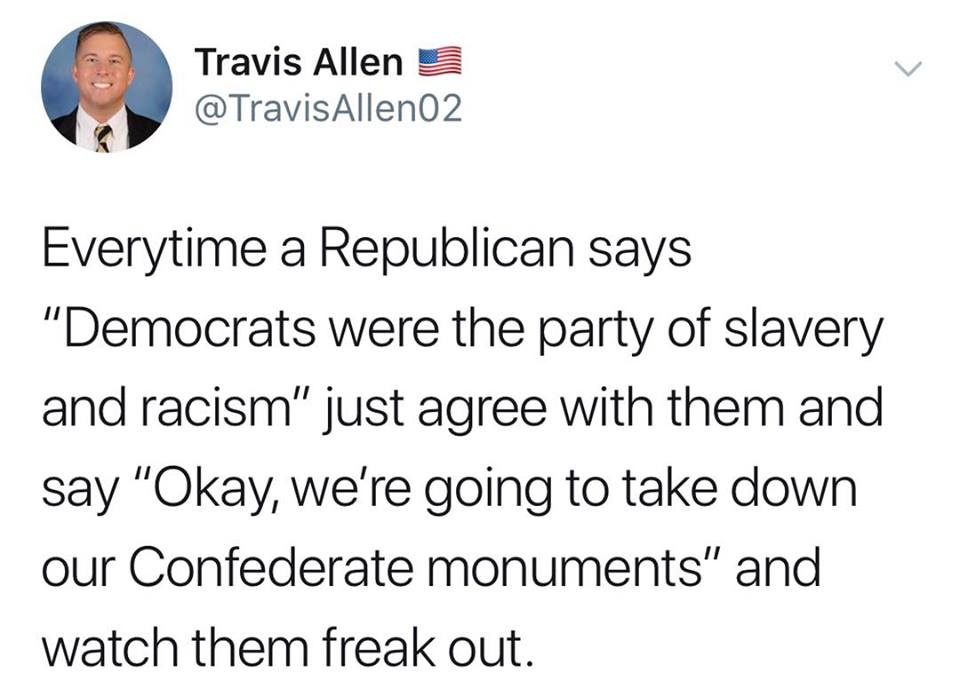
Pollos Hermanos ✓ᵛᵉʳᶦᶠᶦᵉᵈa day ago GOP: “Democrats were the party of The Confederacy.” Also GOP: “Don’t you dare take away honors to The Confederacy!”
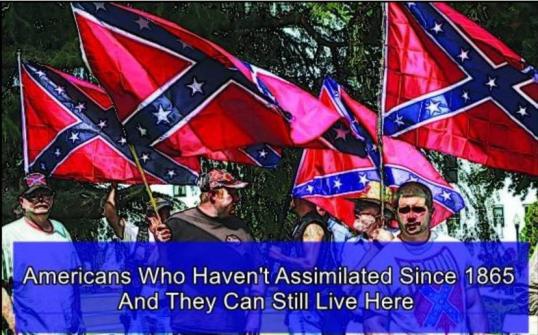
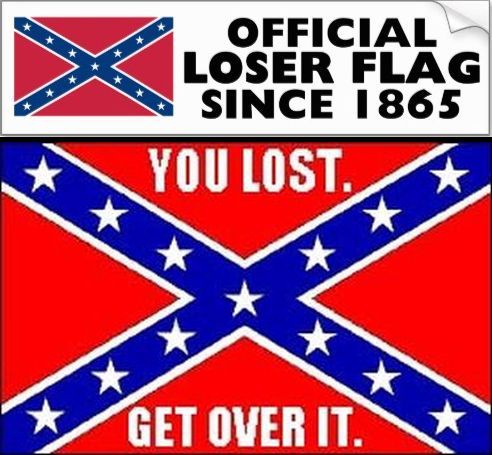
I don’t know the “official thinking” of American historians on point, but I believe much of what we’re seeing today with respect to the Republican Party is 160 years of simmering resentment by the South regarding its loss in the 1860s Civil War now coming to the surface.
Trump “tapped” into it. “Build the wall” was metaphor for “keep the coloreds out.” His embrace of rabid racists, including neo-Nazis, is a “message received” by the Republican base.
They miss the old plantation days, the good old days. When the coloreds and the women knew their place and there was no “deviance” like drag queens and trans people.
In Germany, Nazi paraphernalia like swastika flags, et all, as well as neo-Nazi political parties are officially banned by law. (Germany doesn’t have a First Amendment).This is the reason that German Nazis fly Confederate flags. You are known by the company you keep.
RealityBass2 days ago Remember when we were expected to believe that Trump was so rich that he would use his own funds to campaign, didn’t need to raise money, therefore he was incorruptible? Good times.
What a liar. He said he would use his own money. Just like everything else about him, – a lie, a scam, a con, a fraud …..from getting someone to sit his exams to his 2016 campaign to his subversion of a democratic election.
His whole life has been devoted to scamming. He has never earned an honest buck. It’s all been about the underhand deal, the stiffing people and companies what they are owed. Now there is no way around not paying his lawyers. they won’t act for him without being paid up-front. But Giuliani can fuck off, he’s gonna be hung out to flap in the wind.