“The Daily Reid”

Yes, Joy Reid has a Substack, bless her for doing it! Anyway, I’ve been watching/reading coverage of the Met Gala from various POVs. I’ve probably gotten the most substantive coverage from this post, so here it is, plus more generally topical (non-Gala) coverage, from our beloved Joy Reid! -A

The Daily Reid: the resistance is fly and dandy by Joy-Ann Reid

Art and fashion stood its ground at the Met Gala … while the warnings about the technofeudalist autocrats are ringing louder and louder Read on Substack
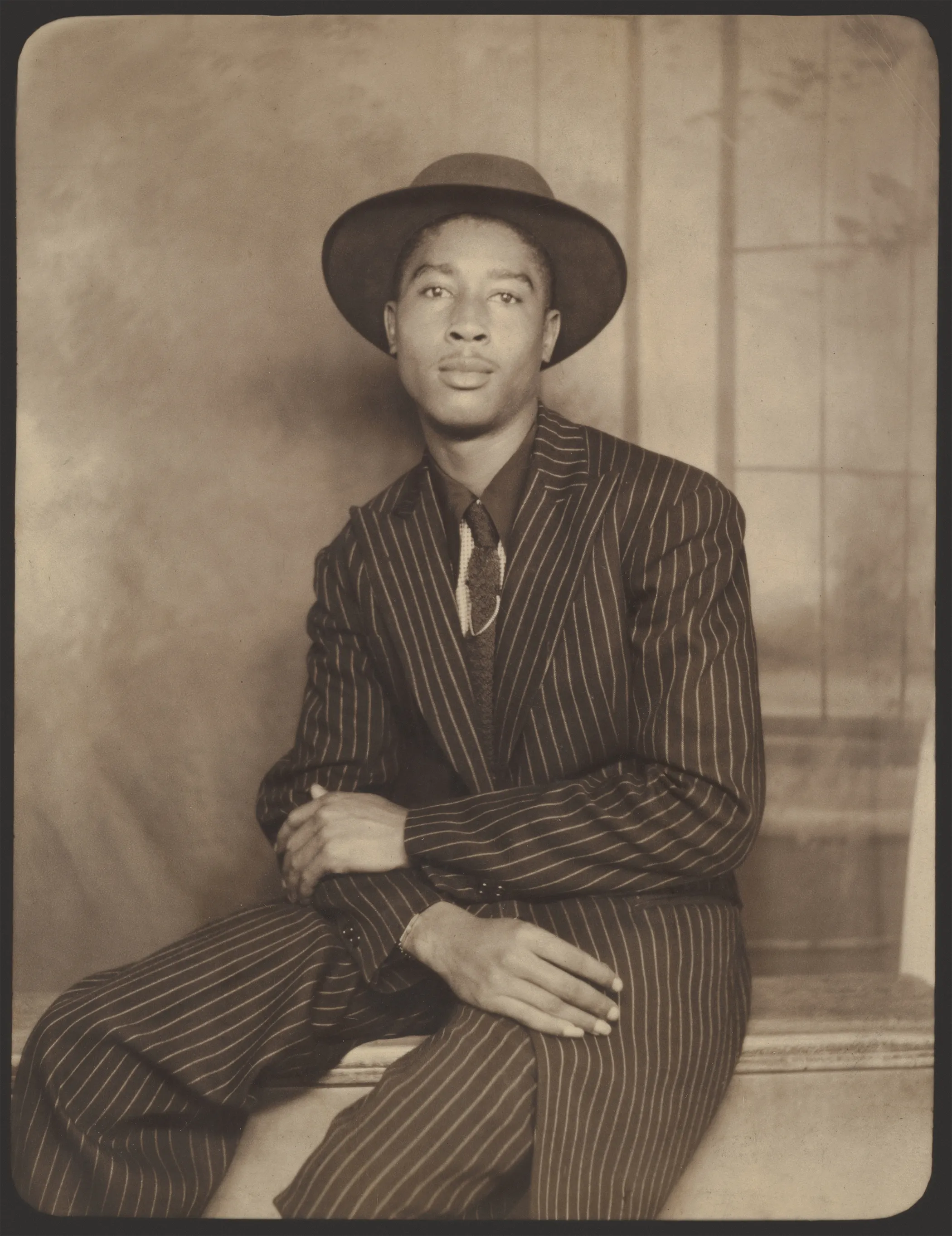
Unknown (American). [Studio Portrait], 1940s–50s. Gelatin silver print. The Metropolitan Museum of Art, New York, Twentieth-Century Photography Fund, 2015 (2015.330) Source: Vogue.

At its best, art is subversive and loud, even when it is silent and mainly visual. Fashion, at its best, is art that’s like that. The Met Gala 2025 was about that life. And while there was some criticism that not enough Black designers got to take part (too much Louis Vuitton, plenty of Sergio but not enough of everyone else… one wonderful exception being Hanifa…) and many of the looks were more elegant than Met Gala over-the-top, the overall impact of the night was deliciously subversive, in just the way art should be. From the Times:

Last October, when the Metropolitan Museum of Art’s Costume Institute announced its next fashion show, “Superfine: Tailoring Black Style,” the political landscape looked very different.

Kamala Harris, the first female vice president and the first Black woman ever to top a major-party ticket, was in the final weeks of her campaign for the White House. The show, the culmination of five years of work by Andrew Bolton, the Costume Institute’s curator in charge, to diversify the department’s holdings and shows in the wake of the racial reckoning brought about by George Floyd’s murder, seemed long overdue.

On Monday, however, when it finally opens to the starry guests at its signature gala, the splashiest party of the year, it will do so in a very different world. One in which the federal government has functionally declared war on diversity, equity and inclusion, as well as programming related to race — especially in cultural institutions.

In February, President Trump seized control of the Kennedy Center, promising to make its programming less “woke.” Then, in late March, he signed an executive order targeting what the administration described as “improper, divisive, or anti-American ideology” at the Smithsonian museums and threatened to withhold funds for exhibits that “divide Americans by race.”

Against that backdrop, the Met’s show, one devoted for the first time entirely to designers of color, which focuses on the way Black men have used fashion as a tool of self-actualization, revolution and subversion throughout American history and the Black diaspora, has taken on an entirely different relevance.

Suddenly the Met, one of the world’s wealthiest and most established museums, has begun to look like the resistance. And the gala, which in recent years has been criticized as a tone-deaf display of privilege and fashion absurdity, is being seen as what Brandice Daniel, the founder of Harlem’s Fashion Row, a platform created to support designers of color, called a display of “allyship.”

Especially because Anna Wintour, the Met Gala’s mastermind, a powerful Democratic fund-raiser and the chief content officer of Condé Nast, said on “The Late Late Show” in 2017 that the one person she would never invite back to the fete was Mr. Trump.

The collision of cultural and current events means the Met is now sitting at the red-hot “center of where fashion meets the political economy,” said Tanisha C. Ford, a history professor at the City University of New York Graduate Center.

“This feels way bigger than just fashion,” said Louis Pisano, a cultural critic and the writer of the newsletter Discoursted. “Putting Black style front and center sends a real message.”

And that it did. That Ms. Wintour and the the organizers didn’t shift course even a little bit, or invite the garish Trump gang or administration or maga people (unless you count Kim Kardashian) was a bold statement in itself. I think seeing J.D. Vance and his complicit wife or garish, lip-plumped Lara Trump on that blue carpet would end the credibility of the Met Gala forever. (Long live the memory of Andre Leon Talley!)

Instead, what we got was a feast of celebration, of classic Black elegance and style, of Black boldness in the face of social, economic and political catastrophe, and just a lot of fun. Made a little video about it, wanna see it? Here it goes!

There were a number of meaningful statements, reflecting the history of Black formality, which was subversive in its own way, in the early 20th century when Black men and women were socially discarded by white society as little more than servants and footstools to white lives. Black people in their church lives and social lives were often really dressy, and that’s a tradition that has lingered, particularly in Southern states, where even a trip to the supermarket or to the polls means getting fully dressed — and formality is seen as a sign of pride and regality, even in the face of discrimination. That’s the piece of Africa that stayed with every enslaved captive.

Not only was the Met Gala a visual blockbuster, it was also a record-setting fundraiser:

Five hundred people RSVP-ed to Monday morning’s media preview for “Superfine: Tailoring Black Style” at the Metropolitan Museum of Art; the majority appeared to show up to tour the show before it bows to the public on Saturday.

Beforehand, attendees got a primer about dandyism, the exhibition’s undercurrent. They also were reminded by the Met’s director and chief executive officer Max Hollein that the museum is “having a little party tonight aka the Met Gala.” And this year’s annual fundraiser for the Costume Institute is a record-breaker at $31 million.

That was “quite a jump” compared to last year’s total of $26 million, Hollein said after the program. As for how that happened in such economically and geopolitically shaky times, he said, “The level of support, enthusiasm and importance of what we do is significant, especially this show, which is not only a celebration of Black designers, but it’s also a statement. It’s an important exhibition about history. That all comes to the fore. That’s what a lot of our supporters felt — that it is meaningful and important.”

Because Black people, and Black Americans in particular, have always been fashion and cultural trendsetters. (I’d note that there is also a long Dandy tradition in my late father’s home country, the Democratic Republic of Congo, where dandyism is a whole thing

Diasporic Black dandyism mirrors the Congolese sapeur movement—a fashion subculture that emerged in the 1920s when Congolese soldiers returned from World War I with foreign attire. These Congolese dandies, known as sapeurs, often inherit the tradition from parents and community role models. For them, dandyism resembles a religion. They revere style and derive power from being impeccably dressed.

Poverty, unemployment, and avant-garde exploitation from the superpowers of the West, East, and neighbouring nations, including Uganda and Rwanda imprison the Republic of Congo. Despite hardship and grim surroundings, Congolese dandies choose to live joyfully. They dance, celebrate, and express themselves with flair, as captured in Solange’s “Losing You” and Kendrick Lamar and SZA’s “All the Stars.”

Both movements grew out of the 1920s — the age of the Harlem Renaissance, when Black Americans were perfecting a unique post-enslavement culture that drew on the rich heritage of African music, ornamentation, dance and style, coupled with evocative literature — poetry, fiction and nonfiction — that spoke to the ache of being an African trapped in America, yet with little or no memory of where your people originally came from. Your timely reminder that some of us Black Americans are immigrants, but even most of us are immigrants whose people were unwilling workers in the so-called “new world.” Very few Black people in America are here by choice. Instead, it was grace, determination and sheer force of will that built a culture that has come to be globally dominant and largely determinative of what the world considers “American culture.”

Here’s Vogue’s piece on the history of Black Dandyism.

And here’s TheGrio’s take on which stars stole the show at last night’s gala and Kamala Harris’ Met Gala debut.

Great article here on some of the artists who capture the essence of Black Dandyism.

Also peep this article at BET.com on the Black designers who laid the groundwork.

A warning…

I came across this powerful TED Talk by investigative journalist Carole Cadwalladr of the Observer, best known for breaking the story in 2018 that Facebook was allowing a British tech company called Cambridge Analytica to steal millions of users’ data without their consent. Her new warning about the rising tech “broligarchy” that are using their global digital platforms and hijacking our data (including via “doge”) to amass unprecedented political power and dismantle our democracies in the U.S. and abroad and replace them with authoritarian rulers, is chilling. But she also reminds us that we have more power than we think to slow the tech bros down. This Talk recorded April 8th at TED2025 is well worth the 17 minute listen, to receive her bleak but powerful warning:

Set your cookies to “performance only.”

Another relatively long listen: on a very popular episode of Diary of a CEO, tariff expert, investor and bestselling author Morgan Housel explains not just the danger of tariffs, but succinctly lays out why we cannot rebuild the power manufacturing era of post World War II America. The podcast goes on for more than an hour after his excellent explanation but it’s worth diving into the first 20 minutes or so in the link below:

The tariff situation, and the futility of Trump’s “back to manufacturing” dream are important to unpack, because what’s happening beyond our shores ain’t good.

Everybody hates Trumpmerica…

In Europe, consumers are developing an aversion to U.S. products, or at minimum, they’re getting used to ignoring them. From the New York Times:

For motorcycle lovers in Sweden, Harley-Davidson is the hottest brand on the road. Jack Daniels whiskey beckons from the bar at British pubs. In France, Levis jeans are all about chic.

But in the tumult of President Trump’s trade war with Europe, many European consumers are starting to avoid U.S. products and services in what appears to be a decisive and potentially long-term shift away from buying American, according to a new assessment by the European Central Bank.

In April, Mr. Trump imposed a 10 percent blanket tariff on America’s trading partners, and threatened “reciprocal tariffs” on many of those, including the European Union. Companies like Tesla and McDonald’s are seeing customers in Europe put off by “Made in America.”

“The newly imposed U.S. trade tariffs on European products are causing European consumers to think twice about what’s in their shopping cart,” the E.C.B. wrote in a blog post about its research on consumer behavior. “Consumers are very willing to actively move away from U.S. products and services.”

Europeans had already begun testing grass-roots boycotts on American products, including Heinz ketchup and Lay’s potato chips, shortly after Mr. Trump took office. His threats to take over Greenland, part of Denmark, energized Danes to organize no-buy campaigns on Facebook. Tesla owners in Sweden slapped “shame” bumper stickers on their cars to distance themselves from Elon Musk, the Tesla chief executive who is one of Mr. Trump’s top advisers.

But Europeans’ anguish over Mr. Trump’s treatment of America’s longtime allies has hardened as he has moved to rewire world trade with steep global tariffs, the central bank found. …

… And even if a trade deal is reached, Europe’s newfound wariness of its longtime ally will not easily be unwound. The E.C.B. study found that even if a mere 5 percent tax were placed on American products sold in Europe, Europeans would still be inclined to shun them.

What is new, the central bank said, is a “preference” among European consumers “to move away from U.S. products and brands altogether,” no matter what the cost. That was the case even for households that could bear the brunt of higher prices.

“Even though they could afford more expensive U.S. products and services, they consciously choose alternatives,” the bank said. “This suggests that consumers’ reactions may not just be a temporary response to tariff increases, but instead signal a possible long-term structural shift in consumer preferences away from U.S. products and brands.”

In Germany and Italy, developers have created apps that scan grocery and clothing items for people who want to make sure they are not buying American. The top app, BrandSnap, even suggests European alternatives.

On a French-run “Boycott USA!” Facebook channel with 31,000 members, people boast about buying Adidas, a German brand, over Nike and New Balance, and post stories about avoiding travel to the United States.

In a Danish Facebook group with 95,000 members, people try to help each other figure out if products like Gillette Mach 3 razor blades or Schweppes soda are from the United States. One run from Sweden promotes alternatives to Airbnb and is calling for a European boycott on Meta platforms for a week in May.

Europeans have also posted online to say they have begun canceling subscriptions to U.S. streaming giants, including Netflix, Disney+ and Amazon Prime Video.

Some consumers who have boycotted Amazon have gone online to lament that delivery from alternate e-commerce platforms in their countries are slower or less reliable, but say that they are staying the course.

Millions of people still buy American goods and services worldwide, but U.S. companies and investors are keeping a close eye on international markets for signs of anti-American sentiment related to Mr. Trump’s policies.

Thanks a lot, Donald.

This as Europe is wooing our fired scientists…

As the Trump administration slashes support to research institutions and threatens to freeze federal funding to universities like Harvard and Columbia, European leaders are offering financial help to U.S.-based researchers and hoping to benefit from what they are calling a “gigantic miscalculation.”

“Nobody could imagine a few years ago that one of the great democracies of the world would eliminate research programs on the pretext that the word ‘diversity’ appeared in its program,” President Emmanuel Macron of France said on Monday.

He was speaking at the Sorbonne University in Paris during an event called Choose Europe for Science that was organized by the French government and the European Union.

It was unthinkable, Mr. Macron said, alluding also to the withdrawal of researchers’ visas in the United States, that a nation whose “economy depends so heavily on free science” would “commit such an error.”

Ursula von der Leyen, president of the European Commission, announced an investment of 500 million euros, or $566 million, at the conference to “make Europe a magnet for researchers” over the next two years.

Although that amount is not much compared to the billions in cuts American universities face, it comes on top of the $105 billion international research program called Horizon Europe that supports scientific breakthroughs, like genome sequencing and mRNA vaccines, Ms. Von der Leyen said.

She did not mention the United States by name, but she described a global environment where “fundamental, free and open research is questioned.”

“What a gigantic miscalculation!” she said.

In Europe, there is a widespread feeling that Mr. Trump has abandoned America’s traditional support for liberty, free speech and democracy through his embrace of autocrats and the assault on science and academia. That has created strains but also a sense of opportunity on the continent, where attracting the best scientific minds to vigorous and independent universities is seen as part of a broader campaign to “rearm” Europe as an independent power.

Over the longer term, the European Commission, the executive arm of the European Union, plans to double grants for researchers who relocate and to enshrine freedom of scientific research into a law called the European Research Area Act.

“The first priority is to ensure that science in Europe remains open and free. That is our calling card,” Ms. von der Leyen said.

Well it should certainly remain open and free somewhere…

Not invited to the Star Wars party

Another thing about culture — either you’re part of it, or you’re not. And the immigrant-hating Christofascists currently running are government certainly are NOT. They’re not even decent nerds. Item: whoever posted the latest AI Trump cosplay on the official White House social media in order to demonize immigrants (while creating hilarious maga entertainment) whiffed it … badly. Here’s the ridiculous AI image, posted on May 4th, AKA Star Wars Day, when actual franchise fans cry out: “may the Fourth be with you…” as a nod to that famous line about the “force…”

Note the color of the laser. Come on, magas… you’re so close to getting it … and not just the absolute absurdity of presenting your elderly, possibly senile, portly, big-bellied God-king as some kind of roided up demigod whom y’all really seem to have a creepy visual-almost-sexual fantasy life over … or the ginormous eagles hovering over him … The color of the laser … I’m just gonna let y’all figure it out on your own.

You can’t help everybody…

Peace & Justice History for 5/7

May 7, 1954
The battle at Vietnam’s Dien Bien Phu ended after 55 days with Viet Minh insurgents overrunning French colonial forces, and forcing their surrender. An agreement for complete French withdrawal was negotiated within two months in Geneva, Switzerland.
The battle began in March, when a force of 40,000 Vietnamese troops armed with heavy artillery surrounded 15,000 French soldiers holding the French position under siege. The Viet Minh guerrillas had been fighting a long and bloody war against French colonial control of Vietnam since 1946.

French prisoners being marched by Viet Minh out of Dien Bien Phu, May 7, 1954
May 7, 1955
The Reverend George Lee, one of the first black people registered to vote in Humphreys County, Mississippi, and who used his pulpit and his printing press to urge others to vote, was murdered in his hometown of Belzoni.

Rev George Lee
The county sheriff had initially refused to accept Reverend Lee’s poll tax (a tax collected before someone was allowed to vote, which became unconstitutional in 1964), but he was later allowed to vote after contacting federal authorities. That, and the subsequent registration of 92 other negro citizens he helped register, angered some white residents of the county.
His assailants were never caught, and Reverend Lee is considered the first martyr of the civil rights movement. 
More on Reverend Lee 
May 7, 1984

American veterans of the Vietnam War reached a $180-million out-of-court settlement with seven chemical companies in a class-action suit relating to use of the herbicide Agent Orange in Vietnam. The veterans charged they had suffered injury and illness from exposure to the defoliant used widely in the war to eliminate jungle cover for Vietnamese forces opposing the U.S. military presence.
Book review about the ongoing effects of Agent Orange 
May 7, 1996
15,000 protesters demonstrated against the import of French nuclear waste to Gorleben, Germany. Water cannons were used to disperse the crowd.

https://www.peacebuttons.info/E-News/peacehistorymay.htm#may7

“Queer History 101: The Day They Burned Our History”

by Wendy

(Language alert)

When books burn, humans follow – a warning we cannot afford to ignore Read on Substack

When I tell you that fascists don’t start with violence—they start with books—I’m not speaking in fucking hypotheticals. On May 6th, 1933, while the ink was barely dry on Hitler’s chancellorship, young Nazis stormed the Institute of Sexual Research. They ransacked the place that night, and then four days later, they took more than 20,000 books from the Institute’s library to Berlin’s Bebelplatz Square and burned them.

They didn’t just burn paper. They burned hope. They burned sanctuary. They burned the world’s first transgender clinic and decades of groundbreaking research that might have spared generations of queer people unimaginable suffering.

The Forgotten History of the World's First Trans Clinic | Scientific  American

I’m not being dramatic when I say this is one of the most gut-wrenching episodes in queer history. The visceral image of Magnus Hirschfeld—a gay Jewish doctor and pioneering advocate for gay and transgender rights—watching on television as his life’s work went up in flames should haunt us all. Because make no mistake: these weren’t military operations. These were everyday people, your neighbors, your classmates, who decided certain knowledge was too dangerous to exist.

A Haven of Revolutionary Care

The Institute for Sexual Research wasn’t just ahead of its time—it was blazing the trail for a future we’re still fighting to reach nearly a century later. Opened in 1919 by Magnus Hirschfeld in Berlin, this non-profit institution provided care that modern transphobes claim is “experimental” today, despite the fact that Hirschfeld was performing these procedures over a hundred years ago.

Initially hesitant about gender-affirming surgeries, Hirschfeld changed his mind when he recognized a simple truth: this was life-saving care that prevented suicide. Think about that—while most of the world was still living in willful ignorance, this man understood that people would rather die than live in bodies that betrayed them. The Institute provided facial feminization and masculinization surgeries, hair removal, and complex gender reassignment procedures when most doctors wouldn’t even recognize trans people as human.

It’s hard to wrap your mind around just how revolutionary this place was. Hirschfeld recognized that gender identity and sexual orientation were entirely separate entities—a concept some people still struggle with a century later. He coined the terms “transsexual” and “transvestite,” creating language for experiences that had been silenced for millennia. The Institute was staffed with every specialist imaginable—psychologists, gynecologists, radiologists, lawyers, general practitioners—providing low-cost or free care to those whom society had abandoned.

History Doesn’t Repeat, But It Does Rhyme

My friend (and my Editor-in-Chief) thepoetmiranda saw the dark echoes of history when one of Trump’s first orders was for the National Institutes of Health and the Centers for Disease Control to start scrubbing medical literature related to healthcare for transgender Americans from government databases (an erasure policy that has spread beyond healthcare to all historical references of transgender people—even on the Stonewall National Memorial website). She wrote the poem linked below, which is a fucking must read:

thepoetmiranda

“Don’t Remember Me for My Resilience” a poem by Miranda

Intro Trump started attacking transgender rights on day 1. By the second week of his administration, his operatives were purging all trans data and resources from government websites—the largest purge…

Read more

3 months ago · 36 likes · 10 comments · thepoetmiranda

More Than Medical Care—A Community

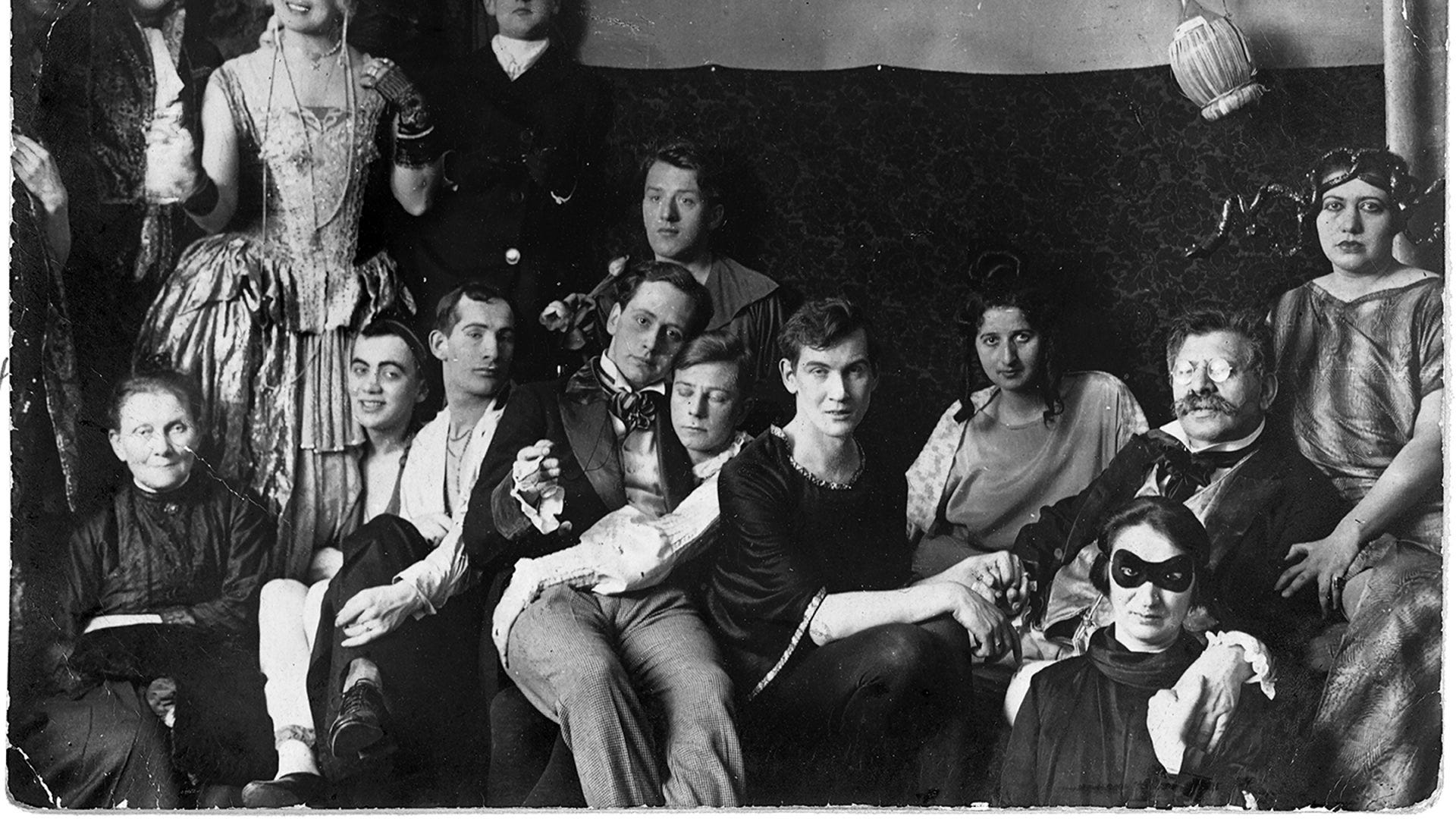
Hirschfeld’s clinic wasn’t just a clinic. It was a fucking sanctuary. Hirschfeld and his partner Karl Giese lived in the building, creating a warm, plush space filled with life. They hosted costume parties where queer people could express themselves freely. They recommended local bars and venues where LGBTQ+ folks could find community instead of isolation.

When trans women struggled to find employment after transitioning, Hirschfeld hired five of his own patients to work at the clinic. He fought for the repeal of Paragraph 175, which criminalized homosexuality, and even secured legal identification passes for his trans female patients with a “transvestite” gender marker to prevent them from being arrested for crossdressing.

Instead of the torturous conversion therapy that was common practice, the Institute taught “adaptation therapy,” instructing queer people how to navigate a hostile world while staying true to themselves. Their motto was “Through science to justice”—a radical notion that education and understanding were the path to equality.

The Day Knowledge Became Dangerous

When the Nazi youth and the German Student Union piled the contents of the Institute in the square on May 10th, 1933, they topped it with Hirschfeld’s bust before setting it ablaze. This wasn’t random destruction—it was a deliberate erasure of knowledge they deemed threatening. This happened just three months after Hitler was named Chancellor. It wasn’t soldiers who did this; it was civilians, ordinary Germans who had been convinced that minorities were the root cause of inflation and social problems.

Anyone who wasn’t white, cisgender, and Christian was deemed immoral and dangerous to German youth and the “traditional family.” Sound familiar? It should, because we’re hearing the same bullshit rhetoric recycled today by people who would burn books all over again if given half a chance.

Hirschfeld, who was out of the country, watched the destruction on television. He never returned to Germany and died of a stroke in 1935, his life’s work reduced to ashes. The loss was immeasurable—not just papers and books, but decades of research that could have advanced trans healthcare by generations.

The Brutal Reality of Lost Knowledge

We lost so much ancestral knowledge about our community in this one raid. The world’s first transgender clinic—gone. Groundbreaking research on gender identity—gone. Records of successful gender-affirming surgeries—gone. Resources for queer people to find community—gone. All of it, up in smoke because knowledge in the wrong hands threatened the status quo.

The memorial for this event bears the quote, “Where they burn books, in the end, they will burn humans, too”—a line from Hirschfeld’s own library that would prove prophetic. The Nazis began with books but ended with concentration camps where thousands of queer people wore pink triangles to their deaths.

Practical Tools for Preserving Our History

  • Document and digitize queer history in multiple locations and formats
  • Support LGBTQ+ archives financially and through volunteer work
  • Learn and share the stories of pioneers like Magnus Hirschfeld
  • Recognize warning signs when marginalized communities are blamed for societal problems
  • Protect trans healthcare by understanding its long history and scientific basis

Community Connection

The story of the Institute’s destruction isn’t ancient history—it’s a warning. When you hear politicians targeting trans healthcare, when you see books about queer experiences being banned from libraries, when you witness the demonization of drag performances, remember the Institute. Remember what happens when fear and ignorance are weaponized against knowledge.

Today, organizations like the Magnus Hirschfeld Foundation continue his legacy, but the threat remains. Every time a state bans gender-affirming care, every time a library removes LGBTQ+ books, every time a transgender person is denied basic dignity, we’re watching echoes of that burning pile in Berlin.

Conclusion

Knowledge is a form of rebellion, and the facts and history you carry in your mind can never be taken away from you. Education and queer joy are our greatest protections right now, just as they were in Hirschfeld’s time.

When we learn about the Institute for Sexual Research, we’re not just studying history—we’re resurrecting knowledge that fascists tried to erase. When we speak the names of Magnus Hirschfeld and his patients, we’re undoing their work of erasure. Every time we share these stories, we’re rebuilding what they tried to destroy.

The memorial’s warning echoes across time: “Where they burn books, in the end, they will burn humans, too.” We must never forget this. We must never allow it to happen again.

Because our history isn’t just about the past—it’s about fucking surviving the present and building a future where institutes like Hirschfeld’s aren’t revolutionary; they’re just how we treat each other.


References:

  1. Hirschfield, M. 1912 “Die Transvestiten: Eine Untersuchung über den Erotischen Verkleidungstrieb”
  2. Hirschfield, M. 1920 “Die Homosexualität des Mannes und des Weibes”
  3. Hirschfield, M. 2017 (Reprint) “Berlin’s Third Sex”

The ERA and More in Peace & Justice History for 5/6

May 6, 1916

Emma Goldman and Alexander Berkman
Alexander Berkman and Emma Goldman started the No Conscription League in the U.S. to discourage young men from registering for the draft which had passed Congress the previous month.
This was prior to American troops’ being sent to Europe in what is known as World War I.

Read the No-Conscription League Manifesto 
May 6, 1944
Mohandas Gandhi, due to declining health, was released from
his last imprisonment in India, having spent 2,338 days in jail
during his lifetime.
May 6, 1954
Two American pilots and most of their crew died flying ammunition supply missions to French colonial troops under siege by Vietnamese insurgent troops under General Vo Nguyen Giap. James “Earthquake McGoon” McGovern and Wallace Buford became the first U.S. aviators to die in Vietnam. Pres. Dwight Eisenhower had not wanted to commit the U.S. military to Vietnam so shortly after the end of the war in Korea, so McGovern and Buford were working for an organization contracted by the CIA.
May 6, 1970
U.S. Senate hearings began on ratification of the Equal Rights Amendment (ERA) to the U.S. Constitution: “Equality of rights under the law shall not be denied or abridged by the United States or by any State on account of sex.”
Similar amendments had been introduced in every Congress since 1923.

Writer and editor Gloria Steinem testified: “During twelve years of working for a living, I’ve experienced much of the legal and social discrimination reserved for women in this country. I have been refused service in public restaurants, ordered out of public gathering places, and turned away from apartment rentals, all for the clearly stated, sole reason that I am a woman.”

Gloria Steinem in 1970
Steinem’s full testimony  
more 
ERA history 
May 6, 1973
14 cities across France saw demonstrations against their country’s nuclear weapons tests in the Pacific Ocean.
May 6, 1979
125,000 rallied in Washington, D.C. to oppose nuclear power.

https://www.peacebuttons.info/E-News/peacehistorymay.htm#may6

Inheriting The Wind, and More, in Peace & Justice History for 5/5

May 5, 1818
Political philosopher, social scientist, historian and revolutionary Karl Marx was born in Trier, Germany. His ideas, laid out in the Communist Manifesto and Das Kapital, and in many other publications, considered the state, class divisions, the nature of industrial capitalism, and culture and religion as oppressive forces.

A young Karl Marx
May 5, 1925
Biology teacher John T. Scopes was arrested for teaching Darwin’s theory of evolution in a Dayton, Tennessee, high school in violation of state law. Working in a public school, he was prohibited by statute “to teach any theory that denies the story of the Divine Creation of man as taught in the Bible, and to teach instead that man has descended from a lower order of animals.”

State of Tennessee v. Scopes  ACLU
May 5, 1981
Irish Republican Army hunger-striker Bobby Sands died in Northern Ireland’s Maze Prison (aka Long Kesh); it was his 66th day without food.He had just been elected by a narrow margin to a seat in the British Parliament for the district of Fermanagh and South Tyrone while still serving the last of a 14-year sentence for possession of firearms.
The government introduced and Parliament quickly enacted the Representation of the People Act 1981 which prevented prisoners serving jail terms of more than one year in either the UK or the Republic of Ireland from being nominated as candidates in UK elections
.

“Our revenge will be the laughter of our children.” – Bobby Sands
May 5, 1983
Over one million Sicilians, a fifth of the Italian island’s population, signed a petition against the deployment of more than 100 U.S. cruise missiles at the Comiso Air Base.
May 5, 1991
The last U.S. cruise missile left Greenham Common Air Base in England, the site of a decade of women’s anti-nuclear protests. The encampment persisted for nearly another decade until it was returned to public access.
Protesters leave Greenham Common for the last time
Peace link 
May 5, 2000
Reformers allied with President Mohammed Khatami swept run-off elections, winning control of the 290-seat Majlis of Iran (parliament) from hard-liners for the first time since the 1979 Islamic revolution. Results were subject to certification by the Guardian Council which reversed the results in eleven of the original February contests.

https://www.peacebuttons.info/E-News/peacehistorymay.htm#may5

Let’s talk about Trump not knowing the Constitution or due process….

4 Dead in OH; When The Sense Of The Congress Was Nuclear Freeze; and More in Peace & Justice History for 5/4

May 4, 1961
A group of Freedom Riders left Washington, DC for New Orleans in a first challenge to racial segregation on interstate buses and in bus terminals; it was organized by the Congress of Racial Equality (CORE). 
The Freedom Riders dining at a lunch counter in Montgomery before traveling to Jackson, Mississippi and New Orleans, Louisiana.
Read more about the freedom riders  
50 Years After Their Mug Shots, Portraits of Mississippi’s Freedom Riders 
May 4, 1970
Ohio National Guard troops opened fire on anti-war protesters
at Kent State University, killing four students and wounding nine others,
one permanently disabled.


The previous day, President Nixon had announced a widening of the Vietnam War with bombing in neighboring Cambodia.

There were major campus protests around the country with students occupying university buildings to organize and to discuss the war and other issues.
Read more about that day at Kent State with pictures 
May 4, 1983
A “sense of the Congress” resolution, intended to urge a halt to all testing of nuclear weapons, was approved by the U.S. House of Representatives (287-149). The support for a nuclear freeze, ending all American and Soviet nuclear weapons testing, was widespread. In ballot resolutions in 25 states, the freeze had passed in all but one, losing in Arizona by just two points.

https://www.peacebuttons.info/E-News/peacehistorymay.htm#may4

1st Broadcast of NPR’s “All Things Considered,” Fire Hoses in Birmingham, and More in Peace & Justice History for 5/3

May 3, 1808
Civilians were executed by Napoleonic forces putting down a rebellion by the citizens of Madrid, Spain on Principe Pio Hill. The event was memorialized in the painting by Francisco de Goya, “The Third of May 1808: The Execution of the Defenders of Madrid.” Aspects of the painting inspired the design of the peace symbol by Gerald Holtom in 1958.
May 3, 1886

At Haymarket Square in Chicago, a rally was being held because of a strike at the McCormick Harvester plant, just two days after an enormous May Day turnout. Though the mass meeting was peaceful, a force of 176 police officers arrived, demanding that the meeting disperse. Someone, unknown to this day, then threw a bomb at the police.
In their confusion, the police began firing their weapons in the dark, killing at least three in the crowd and wounding many more. Seven police died (only one by the bomb), the rest probably by police fire.
Read more 
May 3, 1963
In Birmingham, Alabama, Public Safety Commissioner and recently failed mayoral candidate Theophilus Eugene “Bull” Connor used fire hoses and police dogs on children near the 16th Street Baptist Church to keep them from marching out of the “Negro section” of town.

With no room left to jail them (after arresting nearly 1000 the day before), Connor brought firefighters out and ordered them to turn hoses on the children. Most ran away, but one group refused to budge.
The firefighters turned more hoses on them, powerful enough to break bones. The force of the water rolled the protesters down the street. In addition, Connor had mobilized K-9 (police dog) forces who attacked protesters trying to re-enter the church.

Pictures of the confrontation between the children and the police were televised across the nation.
Read more about the Birmingham Campaign
May 3, 1968
More than 100 black students took over a building at Northwestern University in Evanston, Illinois. They were demanding attention to their advocacy for inclusion of African-American history, literature and art in the curriculum. Their efforts led to the establishment of an African-American studies department which now offers a doctoral program.
How it happened 
May 3, 1971
The Nixon administration ordered the arrest of nearly 13,000 anti-war protesters calling themselves the Mayday Tribe who had begun four days of demonstrations in Washington, D.C. on the first. They aimed to shut down the nation’s capital by disrupting morning rush-hour traffic and other forms of nonviolent direct action, skirmishing with metropolitan police and Federal troops throughout large areas of the capital.
The slogan of the Mayday tribe: “If the government won’t stop the [Vietnam] war, we’ll stop the government.

Read more 
May 3, 1971
The first broadcast of National Public Radio’s evening news and public affairs program, “All Things Considered,” was aired on about 90 public radio affiliates around the country. The main story was the disruptive anti-Vietnam protests in Washington.It is now the fourth most listened-to radio program
in the U.S.


More about that first program 
May 3, 1980
Sixty thousand marched on the Pentagon to urge the end of U.S. military involvement in El Salvador.

https://www.peacebuttons.info/E-News/peacehistorymay.htm#may3

Some Women’s Work in 1945

Women’s Work: Building Justice — The Women Behind the Nuremberg Trials

Where justice faltered, they persisted.

Tanya Roth

Clockwise from top left: Katherine Fite, Belle Mayer Zeck, Harriet Zetterberg, and Cecelia Goetz

When Katherine Fite arrived in London in the summer of 1945, her role in the post-World War II justice process was so novel that the New York Times took notice. “Woman joins staff of war crimes group,” the paper proclaimed. Fite told the Times that “she would not know the scope of her assignment until she had arrived overseas, but that she had been conversant with most phases of the work of the State Department on war crimes.” As the quest for postwar justice continued, Fite became one of just a few women lawyers participating in what became known as the Nuremberg Trials.

On May 2, 1945 — just six days before Victory in Europe, or V-E Day — Supreme Court Associate Justice Robert H. Jackson agreed to serve as chief prosecutor. That summer, as Europe emerged from the war, Jackson worked with his team and the Allies to prepare for the first ever international war crimes trials. Fite joined both the negotiations and legal research that led to the August 8 signing of the London Charter, creating the International Military Tribunal.

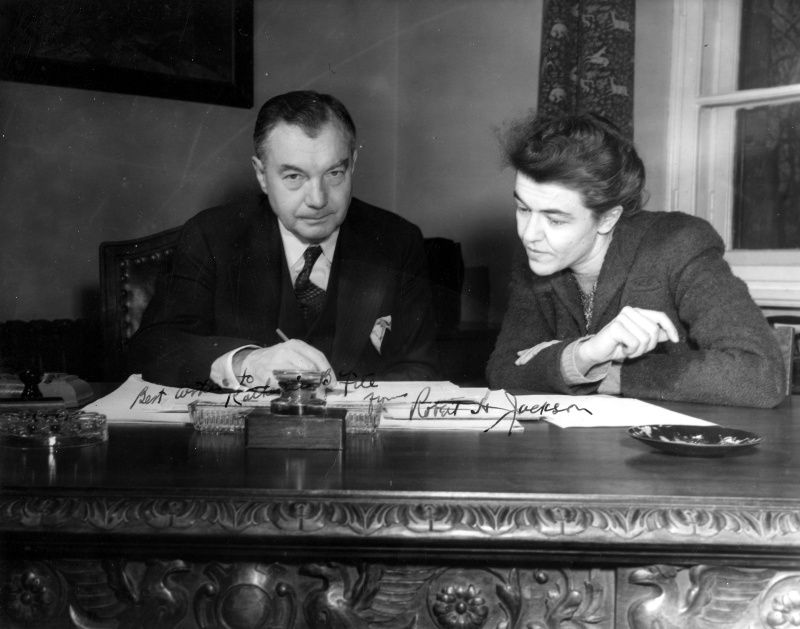
Katherine Fite (right) with Justice Jackson, ca. 1945 (National Archives)

Fite was the only woman lawyer present in the preparation phase. In September 1945, a month before the trials began, Fite toured Dachau Concentration Camp outside of Munich. She wrote home about the experience: “The gardens might well look fertile — human ashes were readily available for fertilizer.” A Polish-Jewish man who had survived Dachau showed her the gas chambers, disguised as shower rooms.

After the first trial, which lasted until October 1946, the United States launched 12 more trials that continued through 1949. Men dominated the courtroom — both as lawyers and as defendants — so women’s contributions were often overlooked. From the beginning, however, the American legal team relied on women’s work in key ways, from Fite’s work in the planning through the execution of the final trials, to Belle Zeck’s foundational work investigating German manufacturer I.G. Farben, to Cecelia Goetz’s key role prosecuting Krupp Industries.

Fite was not the only woman present at the Nuremberg Trials, but she was the highest-level female attorney in the early phases. Harriet Zetterberg was another early participant, the only woman lawyer assigned to the main prosecution team for the first Nuremberg trial, beginning in mid-August and lasting until June of 1946. Zetterberg arrived in Nuremberg in mid-September and prepared trial briefs, including one on slave labor and how it was used as a method to kill. Zetterberg felt the weight of the work, calling the six interrogations she witnessed “extremely interesting — one gets a sense of listening to history in the making.” (snip-MORE. This is really good.)

https://www.saturdayeveningpost.com/2025/04/womens-work-building-justice-the-women-behind-the-nuremberg-trials

Children’s March in Birmingham, & Poor People’s Campaign in Peace & Justice History for 5/2

May 2, 1963
Hundreds of children ranging in age from six to eighteen were arrested in Birmingham, Alabama, as they marched from Kelly Ingram Park, across from 16th Street Baptist Church, to downtown singing, “We Shall Overcome.”Part of an ongoing effort to end segregation in that city, and following the arrests of many adults including Rev. Martin Luther King, Jr., the children had volunteered to minimize the threat to families if a breadwinner were jailed. A judge had issued an order preventing any of 133 civil rights leaders from organizing a demonstration.

Birmingham, the capital of Alabama, had been the site of 18 unsolved bombings in black neighborhoods over recent years, and the place where mobs had attacked Freedom Riders on Mother’s Day in 1961. Leaving the park in groups of fifty, the kids were put in vans by police, led by Eugene “Bull” Connor, until there were 959 filling the city jails.
May 2, 1968

The Poor People’s Campaign began with groups from several locations around the U.S. setting out for Washington, D.C., to draw attention to the living conditions of the poorest Americans. It was conceived and organized by Reverend Martin Luther King, Jr. and, following his assassination the previous month, led by his successor at the head of the Southern Christian Leadership Conference (SCLC), Reverend Ralph David Abernathy.
The first wave of demonstrators arrived in Washington on May 11. One week later, Resurrection City was built on the Washington Mall, a settlement of tents and shacks to house the protesters.


Resurrection CityA
Read more 
Note From Ali in 2025:
Not a dream, and while not yet fulfilled, the goal is not unfulfilled (“A Dream Unfulfilled” from the link above,) as The Poor People’s Campaign is still very active, operating in many US states. See if there’s a committee near you!

https://www.peacebuttons.info/E-News/peacehistorymay.htm#may2