History, and Why Some Women Ought To Know Better Than How They Behave…

In the Ladies’ Loo

Gender-segregated bathrooms tell a story about who is and who is not welcome in public life.
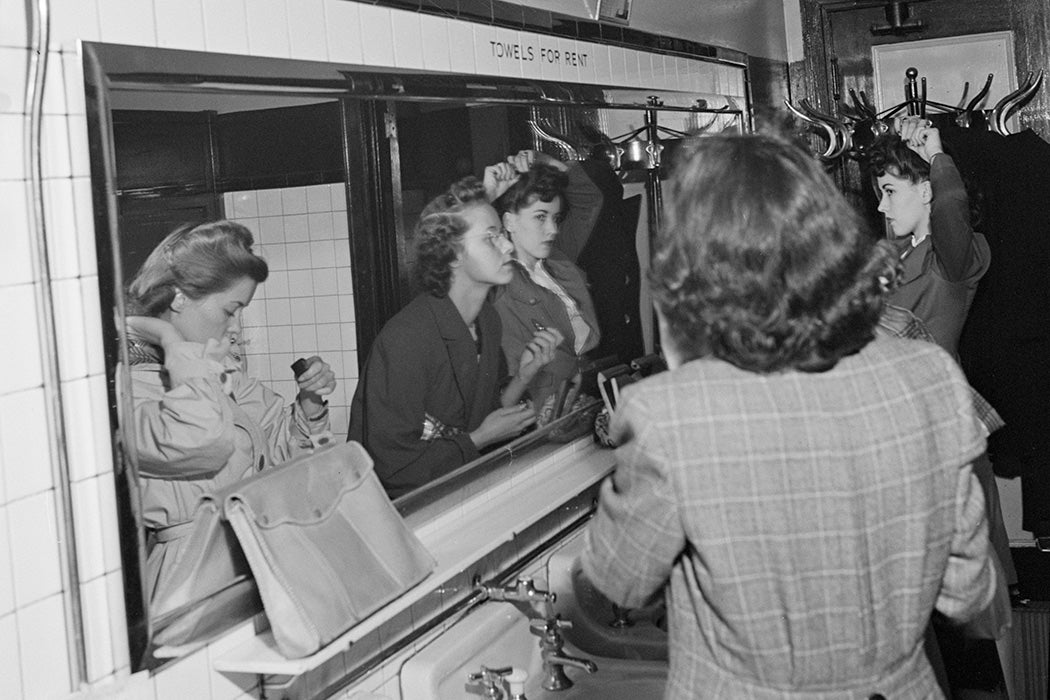
Passengers freshening up in the ladies' restroom at the Greyhound bus terminal, Chicago, 1943

Passengers freshening up in the ladies’ restroom at the Greyhound bus terminal, Chicago, 1943 via LOC

By: Emily McCrary-Ruiz-Esparza 

Women’s entry into public life around the turn of the twentieth century was a major catalyst for the creation of sex-segregated public restrooms. As scholar Daphne Spain writes, female civic reformers lobbied municipal governments to make cities more inclusive places for women, pushing for amenities such as health clinics and kindergartens. And in both small towns and big cities, notes historian Peter C. Baldwin, women worked to ensure the availability of public toilets. The first gender-segregated public bathrooms afforded women privacy, safety, and autonomy—if, that is, the women were white and of means; otherwise, access to bathrooms served as a tool of segregation. The history of the women’s bathrooms in the United States is a story of who does—and who doesn’t—get to belong in public life.

The first public bathrooms in the United States appeared in the late 1800s. Pub owners offered them to paying customers to drum up business and keep drinkers drinking. But, as Baldwin notes, pubs and saloons were improper, unwelcoming, and sometimes dangerous environments for women, and were effectively male-only establishments whose facilities only catered to men.

Just a few decades later, according to Spain, women had begun to challenge their “proper place” in society. While middle- and upper-class women increasingly ventured out of the home into the burgeoning urban environment to shop and to socialize, their lower-class counterparts increasingly found work in factories and other non-domestic environments where they could earn their own money. And some, many of whom belonged to the upper classes, forced their way into political and civic life, lobbying for, and winning, suffrage. Changing social stations pushed women and men together in public. They shared sidewalks, transportation, parks, stores, and restaurants. Women entered public life, and standards of decorum shifted to accommodate them, though certainly not to include them—gender segregation became a paramount concern, according to Baldwin, for preserving the modesty and propriety of women. Still, a dramatic shift had occurred: Men no longer wielded a monopoly on public life.

While men were afforded the opportunity to take care of their most basic needs—the need to relieve themselves—women were not given the same.

In the absence of an available pub bathroom, men were accustomed to relieving themselves in the street. Not only did that suddenly seem crass in mixed company, but the new science of germ theory made it clear that using the city as a toilet posed a health hazard, Baldwin says. Urban designers, physicians, and civic groups lobbied municipal governments in Chicago, Boston, New York, and elsewhere to provide a sanitary solution to the problem of human waste.

The first public toilets, euphemistically called “comfort stations,” appeared in American cities in the 1890s, according to Baldwin. By 1919, roughly one hundred cities, including Denver, Cleveland, Detroit, Philadelphia, and Seattle made toilet facilities available to the public for free or a small fee. Some were funded by health-minded philanthropists and reformers concerned not only with physical cleanliness, but “moral cleanliness,” writes sociologist Alexander K. Davis. They believed the two were intrinsically linked.

Comfort stations were gender segregated but not gender equal. While men were afforded the opportunity to take care of their most basic needs—the need to relieve themselves—women were not given the same. Women’s facilities were often smaller and had fewer toilets than the men’s, writes Baldwin, and were consistently inferior to the semi-private “customers only” bathrooms available in the “Adamless Eden” of a department store, as one such store owner Spain quotes called them; these were available only to patrons.

For those women denied the privilege of department store entry owing to race or lack of means, the comfort station was the only option for getting some privacy in public. Businesses, manufacturing plants, offices, and government buildings almost entirely lacked gender-segregated bathrooms, and because it was scandalous for a woman to enter a bathroom that men used, the lack of women’s toilets sent a clear signal about who was and wasn’t welcome in a particular space. Without equitable access, women were not able to fully participate in life outside the home. If you can’t empty your bladder or your bowels with dignity, it’s hard to be away from home for long.

Public stations were expensive to maintain and quickly became dirty and malodorous. Many were underground or in secluded areas and were dangerous for female users. Baldwin points out that by the early 1920s, cities cut budgets and patrons abandoned the cause, so stations fell into disrepair almost as soon as they appeared, and some of the same women’s groups that had petitioned for their creation eventually pressed for their closure. The provision of bathrooms became largely the remit of private business owners who could provide or restrict access as they pleased.
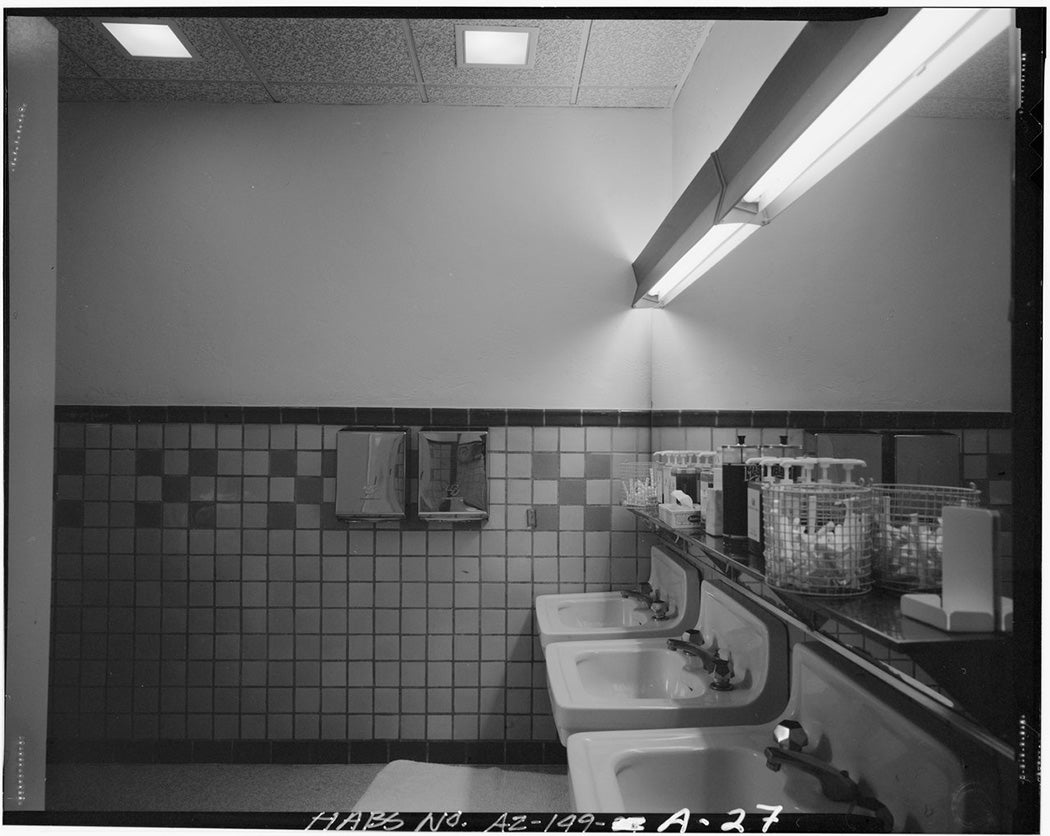
Women's restroom at the Arizona Biltmore in Phoenix, AZ, 1930s
Women’s restroom at the Arizona Biltmore in Phoenix, AZ, 1930s via Wikimedia Commons

Though the truly public bathroom—where access is free to all—is increasingly rare today, the semi-public toilet is taken for granted. The ladies’ room in restaurants, bars, airports, train and bus stations, hotel lobbies, schools, and event venues remains one of the few spaces where men are strictly prohibited. Though many are accessible only to those who can patronize a business or afford a ticket for travel.

It’s such an important part of female culture that the women’s bathroom is a convenient prop in movies, TV, and books. Writers set a scene in the ladies’ room, where women gather to complain, cry, confide, confess, gossip, preen, or bully. And though such scenes sometimes lean on tired tropes of female behavior, the gender-segregated bathroom is a place to exist beyond the gaze and reach of men. Here, women speak candidly about feelings, bodies, periods, sex, romantic partners, friends, jobs, and family.

“They offer a space for bonding, the exchange of information, and personal recovery,” writes scholar Christine Overall. “Sex-segregated toilets provide ‘the element of sociability important to many women, who also use the women’s room as a refuge, ‘a place to feel safe, both physically safe but also psychologically safe.’” On the wall and in stalls, it’s not uncommon to see phone numbers for domestic violence helplines or, in bar bathrooms, instructions for ordering an “angel shot”: a coded way to ask a bartender for help in the face of harassment.

Of course, the ladies’ room by design isn’t a safe space for all women.

“At various points in US history, the absence of toilet facilities has signaled to [B]lacks, to women, to workers, to people with disabilities, to transgender people, and to homeless people that they are outsiders to the body politic and that there is no room for them in public space,” writes the feminist scholar Judith Plaskow. If these bathrooms are supposedly for the public, then by virtue of excluding certain people, the message is that their needs are not for consideration.

Access to public space in the US has even been explicitly exclusionary. When the Boston-based advocacy organization Women’s Educational and Industrial Union pressed for the creation of health clinics and lunch rooms in the early twentieth century, it made it clear that their goal was to segregate classes and create spaces, Spain explains, where only “middle-class and elite women could appear without being declassed and working women could appear in public without having their virtue questioned by being ‘on the streets.’”

In the Jim Crow south, writes Baldwin, Black women had to use separate bathrooms, typically older and poorly maintained, and were not afforded the privacy of gender-segregated facilities. In some cases, Black people in the segregated South had no access to public bathrooms at all.

Now, the current campaigns of exclusion seek to bar transgender women from accessing the ladies’ room. In 2016, the North Carolina state legislature passed “the bathroom bill,” which forced people to use the bathroom that corresponds to the gender they were assigned at birth. The next year, eight more states moved to impose similar restrictions. North Carolina’s bill was met with such anger on behalf of the LGBTQ community that some elements were quickly scrapped, and the remainder was left to lapse in 2020. While campaigns for equity have made such laws and restrictions exceedingly unpopular, they have not yet made them extinct.

In November 2024, Sarah McBride became the first openly transgender person elected to Congress, representing the state of Delaware. Within weeks, representative Nancy Mace of South Carolina introduced a resolution banning transgender women from the ladies’ bathrooms on Capitol Hill. Within days, House Speaker Mike Johnson announced the official ban.

Yes, I believe it is worthwhile to challenge hate speech.

And this is a blog well worth following, though I don’t read there often enough.

Wee Pals’s Soul Circle:

Wee Pals by Morrie Turner for February 01, 2025

Wee Pals Comic Strip for February 01, 2025

https://www.gocomics.com/weepals/2025/02/01

Observing Black History Month, Because This Is The Fkn’ US, Dammit!

The Negro’s “America” by Frank Barbour Coffin 1870–1951

My country, ’tis of thee,
Sweet land of liberty,
     Would I could sing;
Its land of Pilgrim’s pride
Also where lynched men died
With such upon her tide,
     Freedom can’t reign.

My native country, thee
The world pronounce you free
     Thy name I love;
But when the lynchers rise
To slaughter human lives
Thou closest up thine eyes,
     Thy God’s above.

Let Negroes smell the breeze
So they can sing with ease
     Sweet freedom’s song;
Let justice reign supreme,
Let men be what they seem
Break up that lyncher’s screen,
     Lay down all wrong.

Our fathers’ God, to Thee,
Author of liberty,
     To Thee we sing;
How can our land be bright?
Can lynching be a light?
Protect us by thy might,
     Great God our king!

This poem is in the public domain. Published in Poem-a-Day on February 1, 2025, by the Academy of American Poets.

As always, click the title to get more about the poet and their work. Today’s background is especially poignant, and work the click.

Trans People Are Real and Detransitioning Isn’t That Common – SOME MORE NEWS

Ok the first few minutes are sort of campy and over the top, it is the guy’s style thing I guess.  But then he settles down and delivers the facts and debunks a lot of stuff by showing the actual studies the right wrong claim back them up, but he shows how the studies say the opposite of that the trans haters claimed.  Great info on trans people and the made up faked outrage caused by a small group of trans haters who are making big money off of pushing lies about trans kids and trans issues.  Hugs

Hi. Right-wing politicians, lawyers, and grifters (and some liberals) want to convince you that trans youth are the victims of a social contagion and that the majority of those who transition will detransition. This is a lie that puts all trans people at risk. Get the world’s news at https://ground.news/SMN to compare coverage and see through biased coverage. Subscribe for 40% off unlimited access through our link.

How Trump Could Snatch a Third Term — Despite the 22nd Amendment

https://www.politico.com/news/magazine/2025/01/31/trump-defy-constitution-third-term-00200239

Four ways Trump could stay in power beyond 2028.

A photo illustration of three images of Trump taking the oath of office.

Peace & Justice History for 2/1

February 1, 1960

Greensboro first day: Ezell A. Blair, Jr. (now Jibreel Khazan), Franklin E. McCain, Joseph A. McNeil, and David L. Richmond leave the Woolworth store after the first sit-in on February 1, 1960.

Four black college students sat down at the Woolworth’s lunch counter in Greensboro, North Carolina, and were refused service because of their race. To protest the segregation of the eating facilities, they remained and sat-in at the lunch counter until the store closed.
Four students returned the next day, and the same thing happened. Similar protests subsequently took place all over the South and in some northern communities.
By September 1961, more than 70,000 students, both white and black, had participated, with many arrested, during sit-ins.


On the second day of the Greensboro sit-in, Joseph A. McNeil and Franklin E. McCain are joined by William Smith and Clarence Henderson at the Woolworth lunch counter in Greensboro, North Carolina.

“Segregation makes me feel that I’m unwanted,” Joseph McNeil, one of the four, said later in an interview, “I don’t want my children exposed to it.”

Listen to Franklin McCain’s account of what happened 
February 1, 1961
On the first anniversary of the Greensboro sit-in, there were demonstrations all across the south, including a Nashville movie theater desegregation campaign (which sparked similar tactics in 10 other cities). Nine students were arrested at a lunch counter in Rock Hill, South Carolina, and chose to take 30 days hard labor on a road gang. The next week, four other students repeated the sit-in, also chose jail.
February 1, 1968

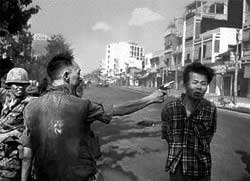
General Nguyen Ngoc Loan executes Nguyen Van Lem a NLF officer.

Saigon police chief Nguyen Ngoc Loan summarily executed Nguyen Van Lem, suspected leader of a National Liberation Front (NLF aka Viet Cong) assassination platoon, with a pistol shot to the head on the street. AP photojournalist Eddie Adams’s Pulitzer Prize-winning photograph of the incident became one of the most famous, ubiquitous and lasting images of the war in Vietnam, affecting international and American public opinion regarding the war.

https://www.peacebuttons.info/E-News/peacehistoryfebruary.htm#february1

Some Essence of Thought videos on trans issues.

I love Ethel who is a grand young woman.   I have watched her transition from an awkward teenager online who did not understand how to express what she felt inside and watched her blossom as she realized and started living openly as who she was.  She is a wonderful resource for how to combat trans hate and misinformation.  If she gives a stat or makes a claim you can take it to the bank that it is correct as she not only does meticulous research she also documents it all for others to see and read for themselves.  Trans women are simply women, and trans men are simply men.   I look forward to the day we can all drop the word trans, just we need to stop saying same sex marriage and simply say marriage.   Hugs and loves.  

Neil deGrasse Tyson, The Trans Community, And “Rising To The Occasion”

Wow oh wow!  This is a great video and a must watch video if you support trans people.  I wouldn’t have expected a man of the Christian faith to come out for trans people but never would have expected them to do this that strongly and seriously.  I watched it twice to be sure I heard what I did.  After I post this I will watch it again.  I am not even sure how to post this in the labels.  Hugs and loves.  This is why I really like this Christian man.  Hugs

This is the comment I left on this post.  I wonder if he will reply.  Hugs

Hello Rev. I had only commented once before where I asked you if a caring loving atheist such as myself could find a place in your god’s paradise. You welcomed me and told me I did not have to believe in the supernatural but live a decent life helping others as I could, which I had said I did, you replied I was totally accepted by your god. I was honestly surprised by your answer. Since then I have followed your channel and often posted it to my blog. Most of my readers are not religious but all are caring wonderful people of different faiths, sexual orientations, and some are trans. But all have found wisdom in your videos. I thank you for this one. The trans community and trans kids are under heavy attack in the US. I suspect because it undermines the cis straight majority that has long ruled the US, but also driven by religious people who feel this allowing their children to be who they wee born to be, LGBTQ+ is an affront to their god they will be held to account for. Thank you, Hugs. Scottie

Peace & Justice History for 1/31

January 31, 1865
The U.S. House of Representatives passed (119-56) the 13th constitutional amendment which abolished slavery, and sent it to the states for ratification (three-quarters of the states would do so by the end of the year). The Kentucky legislature didn’t vote to ratify until 1976. Mississippi’s legislature finally ratified it in 1995 but failed to submit the paperwork to the federal government until 2013.
Text of the amendment: 
“Neither slavery nor involuntary servitude, except as a punishment for crime whereof the party shall have been duly convicted, shall exist within the United States, or any place subject to their jurisdiction.”
More about the 13th Amendment 
January 31, 1876

Sitting Bull: One of several chiefs who refused to comply.
The U.S. government ordered that all Native Americans had to move to reservations by this date or be declared hostile. Most Sioux did not even hear of the ultimatum until after the deadline.  
January 31, 1945

Eddie Slovik
Private Eddie Slovik became the first American soldier since the Civil War to be executed for desertion, and the only one who suffered such a fate during World War II.Supreme Allied Commander Dwight D. Eisenhower ordered Slovik’s execution be carried out, he said, to avoid further desertions in the late stages of the war.

Eisenhower
January 31, 1950 
U.S. President Harry S. Truman publicly announced his decision to support the development of the hydrogen (fusion) bomb, a weapon theorized to be hundreds of times more powerful than the atomic (fission) bombs dropped on Japan at the end of World War II.
January 31, 1971
The Winter Soldier Hearings began in a Howard Johnson’s motel in Detroit. Sponsored by Vietnam Veterans Against the War, the three days of hearings were an attempt by soldiers who had served in Vietnam to inform the public of the realities of U.S. conduct in the war.
The veterans testified that the My Lai massacre was not an isolated incident, and that some American troops had committed atrocities.

Among those who spoke about aspects of their service in Vietnam was John Kerry, a former Navy lieutenant and future senator and presidential candidate. More than 100 veterans testified to sometimes brutal acts. Oregon Senator Mark Hatfield later entered the transcript of the Winter Soldier hearings into the Congressional Record but, otherwise, the proceedings captured little attention.

The term “winter soldier” is a play on words of Thomas Paine in 1776. He spoke of the “sunshine patriot and summertime soldiers” who deserted at Valley Forge because the going was rough.
Winter Soldier film watch the trailer (appox 4 minutes) 
watch the entire movie (1:35)
VVAW/Winter Soldier Organization 
January 31, 1993
300,000 Berliners rallied to protest attacks on immigrants, and against racism and renewed support for Nazism on the 60th anniversary of Adolf Hitler’s rise to power. During the previous year there had been 2,285 racially motivated attacks, including 77 against Jewish sites, and the death of two young Turkish girls in an arson attack.

https://www.peacebuttons.info/E-News/peacehistoryjanuary.htm#january31