The Mormon temple in Salt Lake City, Utah.Photo: Shutterstock
Following a history of anti-LGBTQ policies and decrees, the nearly 17-million-member Mormon Church of Latter-Day Saints (LDS) released a stunning declaration supporting the federal Respect for Marriage Act that would codify federal and state recognition of same-sex marriages. LDS expressed its support because the bill also protects the rights of any denomination not to perform these ceremonies.
“We believe this approach is the way forward,” reads a statement posted on the church’s website. “As we work together to preserve the principles and practices of religious freedom together with the rights of LGBTQ individuals, much can be accomplished to heal relationships and foster greater understanding.”
The statement goes on to reiterate that the Church does not condone same-sex relationships, which it regards as sinful.
The Church has a lengthy and oppressive history toward LGBTQ people.
“Homosexual behavior violates the commandments of God, is contrary to the purposes of human sexuality, distorts loving relationships, and deprives people of the blessings that can be found in family life and in the saving ordinances of the gospel,” states the Handbook of Instructions of the Church of Jesus Christ of Latter-day Saints. “Those who persist in such behavior or who influence others to do so are subject to Church discipline. Homosexual behavior can be forgiven through sincere repentance.”
These words supposedly expressed God’s revelation to the leadership of LDS and were reaffirmed in 1995 when the First Presidency and the Quorum of the Twelve Apostles entered the debate on the parameters of marriage by issuing “The Family: A Proclamation to the World.”
It stated in part, “We, the First Presidency and the Council of the Twelve Apostles of the Church of Jesus Christ of Latter-day Saints, solemnly proclaim that marriage between a man and a woman is ordained of God and that the family is central to the Creator’s plan for the eternal destiny of His Children.” It claimed that the power to create children “is not an incidental part of the plan of happiness. It is the key – the very key….This commandment has never been rescinded.”
Leaders and members of the Church, therefore, justified contributing an estimated 22 million dollars to the 2008 California Ballot 8 initiative campaign, which succeeded in limiting the rights and benefits of marriage to one man and one woman.
If the Church’s position on same-sex attractions, expression, and marriage for same-sex couples was not clear enough, former LDS President of the Quorum of Twelve Apostles, Boyd K. Packer, referred to homosexuality throughout a sharply worded sermon as “wrong,” or “basically wrong,” “wicked,” “impure,” “unnatural,” “immoral,” “against nature,” “evil,” and as a threat to civilization.
Packer’s sermon – delivered to more than 20,000 participants in the LDS Conference Center in Salt Lake City and millions more watching on satellite television at the Church’s 180th Semiannual General Conference in October 2010 – stated, “We teach a standard of moral conduct that will protect us from Satan’s many substitutes or counterfeits for marriage. We must understand that any persuasion to enter into any relationship that is not in harmony with the principles of the gospel must be wrong. From the Book of Mormon we learn that ‘wickedness never was happiness.”‘
Packer continued, “There are those today who not only tolerate but advocate voting to change laws that would legalize immorality, as if a vote would somehow alter the designs of God’s laws and nature. A law against nature would be impossible to enforce….To legalize that which is basically wrong or evil will not prevent the pain and penalties that will follow as surely as night follows day….If we do not protect and foster the family, civilization and our liberties must perish.”
Under this backdrop and literally one block from the Mormon Temple in Salt Lake City, I was invited to present a keynote address to the delegates at the Eighty-First Annual Convention of the Rocky Mountain Psychological Association on April 16, 2011.
I titled my address, “Homophobia: How We All Pay the Price,” based on the notion that homophobia is pervasive throughout society and we are all at risk of experiencing its harmful effects.
Following my keynote address, a number of the convention delegates came to the podium to talk about how much they had gained from my remarks. I was enormously touched by the words of three delegates who moved me to tears.
A woman approached me with moistened eyes and tears running down her cheeks. Unable initially to speak, she hugged me and sobbed on my shoulder. She ultimately expressed how much my words had moved her, and through her sobs, told me the story of how her stepson, a young gay man, had killed himself three years earlier. She said members of her LDS community had shunned and scorned her when the young man’s sexual identity had become known.
Words failed me as we continued to hold and comfort each other.
Looking on was another woman who proceeded to join us. “I have a nine-year-old son, whom I am quite certain is gay,” she told us, as tears also streamed from her eyes. “I am forced to make a decision,” she said with urgency in her voice. “I must leave my LDS church and save my son from a possibly tragic fate if I remain. My son is the most important thing in my life, and I refuse to lose him to the narrow views of the people around me.”
While sad, she also felt somewhat empowered in her decision to separate from what she considered abuse and misunderstanding by her church community.
As I was on my way out of the large conference hall, I noticed a man, red-eyed, who beckoned me. “I am a professor at Brigham Young University,” he explained. “Until your talk, I had never truly understood the hurt the LDS policy has on real people, but you personalized the issue for me.” With a tone of deep sincerity in his voice, he said, “I commit to you that I will bring this message to my campus when I go back to work on Monday.”
***
The late Dr. Derrick Bell of New York University Law School put forward the theory of “interest convergence,” the idea that white people will support racial justice only when they understand and see that there is something in it for them (i.e. when there is a “convergence” between the interests of white people and racial justice).
Bell asserted that the Supreme Court ended the longstanding policy of “separate but equal” in the 1954 case of Brown v. Board of Education because it presented to the world, and in particular to the Soviet Union during the height of the cold war, a United States that supported civil and human rights.
Another example: the Church of Latter-Day Saints president, Brigham Young, instituted a policy on February 13, 1849. Emanating from “divine revelation” and continuing until as recently as 1978, the policy forbade the ordination of Black men to the ranks of LDS priesthood.
This policy prohibited Black men and women from participating in the temple Endowment and Sealings, which the Church requires for the highest degree of salvation. The policy likewise restricted Black people from attending or participating in temple marriages.
Young attributed this restriction to the sin of Cain, Adam and Eve’s eldest son, who killed his brother Abel: “What chance is there for the redemption of the Negro?” stated Young in 1849 following the declaration of his restrictive policy. “The Lord had cursed Cain’s seed with blackness and prohibited them the Priesthood.”
While making a speech to the Utah Territorial Legislature in 1852, Young further asserted, “Any man having one drop of the seed of [Cain]…in him cannot hold the Priesthood, and if no other Prophet ever spoke it before, I will say it now in the name of Jesus Christ I know it is true and others know it.”
In another instance, Young said: “You see some classes of the human family that are Black, uncouth, uncomely, disagreeable and low in their habits, wild, and seemingly deprived of nearly all the blessings of the intelligence that is generally bestowed upon mankind….Cain slew his brother. Cain might have been killed, and that would have put a termination to that line of human beings. That was not to be, and the Lord put a mark upon him, which is the flat nose and black skin…that they should be the ‘servant of servants’; and they will be, until that curse is removed….”
Joseph Fielding Smith, Tenth Prophet and President of the LDS Church wrote in 1935 that “Not only was Cain called upon to suffer, but because of his wickedness, he became the father of an inferior race. A curse was placed upon him and that curse has been continued through his lineage and must do so while time endures….”
And in 1963 he asserted: “Such a change [in our policy] can come about only through divine revelation, and no one can predict when a divine revelation will occur.”
It seems that the Twelfth LDS Church president, Spencer W. Kimball, who served from 1973 to his death in 1985, was touched with such a “vision” and, therefore, reversed the ban, referring to it as “the long-promised day.”
We can ask today whether “revelation” or mere pragmatism was the determining factor in permitting Black people full membership rights in the Church at a time of ongoing and heightened civil rights activities in the United States and an increase in LDS missionary recruiting efforts throughout the African continent.
We can also ask whether “revelation” or mere pragmatism was the motivating consideration for abandoning its promotion of polygamous marriages at a time when the United States Congress demanded this as a condition for the admission of Utah as a state within the United States.
In another example, the issue of slavery became a lightning rod in the 1840s among members of the Baptist General Convention, and in May 1845, 310 delegates from the Southern states convened in Augusta, Georgia to organize a separate Southern Baptist Convention on a pro-slavery plank. They asserted that to be a “good Christian,” one had to support the institution of slavery and could not join the ranks of the abolitionists.
Well, again, whether by divine inspiration or interest convergence stemming from political pressure and shrinking church membership, 150 years later in June 1995, the SBC reversed its position and officially apologized to African Americans for its support and collusion with the institution of slavery (regarding it now as an “original sin”), and also apologizing for its support of “Jim Crow” laws and its rejection of civil rights initiatives of the 1950s and 1960s.
LDS support for the Respect for Marriage Act may come from the Church’s awareness of its own self-interest to “come out” publicly to defend the right of same-sex couples to legally marry since overall, approximately 70% of U.S. residents support it following the 2015 Supreme Court decision granting this right nationwide.
This is the goal of the republicans in office, drive the LGBTQI+ in to hiding, make them disappear from society. Red states like Texas want gay and trans people / families to leave their states. They are trying to drive them out of the state if they cannot make them illegal. We need to stop the republicans and the right wing maga thug enforcers. Think of the US divided into states where it is legal to live your life openly as who you are yet in other states it is illegal for you to even exist. Imagine being a gay couple going from a blue state through a red state on a trip, as you enter that state you are in danger of being arrested simply for being born gay or having a different gender identity from assigned birth sex. If you are a male wearing a nice dress or pantsuit leaving your home blue state and as you cross into the red state you can be arrested as you are breaking the law by what you are wearing. I think people are now seeing the excess of the republican party / the right and that we need to stand up and fight back against these attacks on civil rights / equality. Hugs
A mum and son moved 1,000km to Colorado to escape cruel new trans laws in Texas. (Anatoliy Cherkasov/SOPA Images/LightRocket via Getty Images)
In a documentary film for NBC OUT, Katie Laird and her 16-year-old son Noah have described the process of moving from their home in Texas, to Colorado, after Noah lost access to his gender-affirming care.
In a move quickly blocked by a judge, governor Greg Abbott, along with Paxton directed the state’s Department of Family and Protective Services to begin child abuse investigation on families who have provided their offspring with gender-affirming care.
The Texas Children’s Hospital then decided to pause all gender-affirming care for minors, including Noah, due to concerns over Abbott and Paxton’s attack on trans youth. It was this decision that triggered the move for Noah and his family.
“It was just hard, and it still is hard to leave literally everything I’ve ever known in my entire life,” Noah told NBC.
Laird added she and Noah will continue fighting for trans rights in Texas, despite having moved.
“That is a commitment that Noah and I made when we left,” she said.
“This is our home. We have been pushed from it, and we will keep fighting, no matter where we live, for the state because we know that what happens in Texas has great influence across the nation, and we have to stay in the fight.”
Hillary Moore-Embry told PinkNews their family left after a ban on trans children taking part in the school sports team of their choice.
“Even if it hadn’t passed, listening to those lawmakers, listening to their plans, listening to how they view my child – this is not a place that I feel safe for him,” Moore-Embry said.
“This bill is not the end. They will come after trans people in other ways. This is just a foot in the door.”
When the transphobic sports ban passed in October 2021, Ricardo Martinez, CEO of Equality Texas, said he was “devastated”, adding that the “testimony of trans kids and adults, families and advocates” had been “powerful”.
“Our organisations will begin to shift focus to electing pro-equality lawmakers who understand our issues and prioritise representing the vast majority of Texans who firmly believe that discrimination against trans and LGB+ people is wrong,” he said.
I love this YouTubers videos. She is fun to listen to, keeps your attention, has fact filled content, her voice is clear and she speaks in a way that is easy for me to understand. She will take the time to look up a point and correct the misinformation or lie spouted by the video she is reviewing. Like in this video she explains the many cultures in history that recognized same sex marriages refuting the often claimed that same sex marriages is something new the right likes to use. Hugs
Today Ben Shapiro manages to claim religion has nothing to do with his being against gay marriage, whilst using Genesis as a source. Not to mention he and his guest Matt Walsh pretending there are 0 societal benefits to marriage outside of having children. Incredible.
Meidas Contributor Francis Maxwell reflects on a speech given by radical right Supreme Court Justice Alito during a Federalist Society event in the wake of the recent attacks against the LGBTQ community.
Lauren Boebert went on a radical right television station to let viewers know that the real victim of the attacks against the LGBTQ community in Colorado Springs was… her. Meidas Contributor Tennessee Brando reacts.
The US is developing it’s own version of the Taliban who are trying to enforce dress codes and moral standards of their own on the rest of the population via threats of violence and death. In the US it is called the maga republican right wing. Hugs
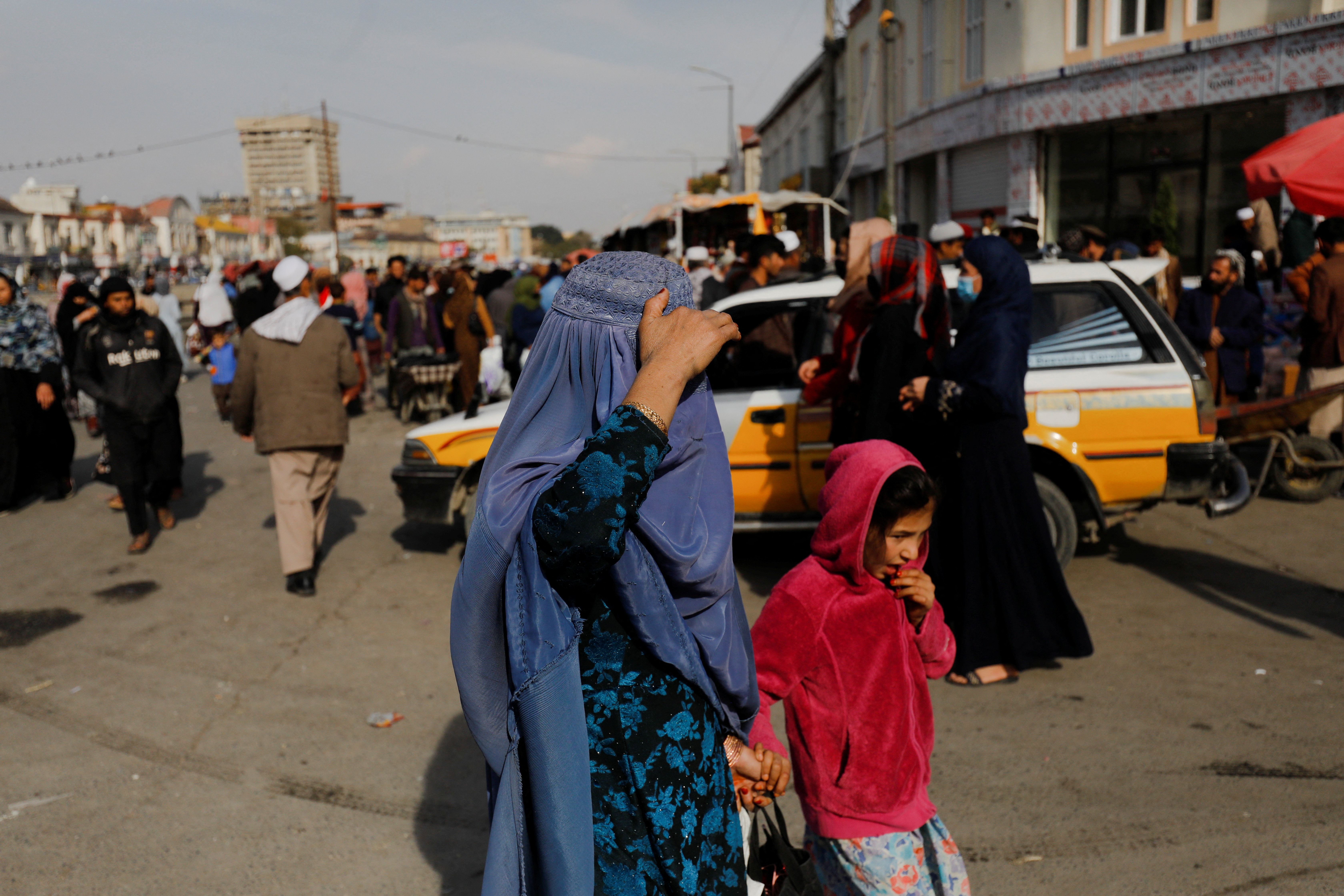
An Afghan woman and a girl walk in a street in Kabul, Afghanistan, November 9, 2022. REUTERS/Ali Khara
Taliban’s treatment of women may be crime against humanity: UN experts
An Afghan woman and a girl walk in a street in Kabul, Afghanistan, November 9, 2022. REUTERS/Ali Khara
GENEVA, Nov 25 (Reuters) – The Taliban’s treatment of Afghan women and girls, including their exclusion from parks and gyms as well as schools and universities, may amount to a crime against humanity, a group of U.N. experts said on Friday.
The assessment by the U.N. Special Rapporteur on Afghanistan Richard Bennett and nine other U.N. experts says the treatment of women and girls may amount to “gender persecution” under the Rome Statute to which Afghanistan is a party.
Responding to the assessment, Taliban Foreign Affairs Ministry spokesperson Abdul Qahar Balkhi said: “The current collective punishment of innocent Afghans by the U.N. sanctions regime all in the name of women rights and equality amount to war crimes and crimes against humanity.”
The U.N. experts said in a statement that women’s confinement to their homes was “tantamount to imprisonment”, adding that it was likely to lead to increased levels of domestic violence and mental health problems. The experts cited the arrest this month of female activist Zarifa Yaqobi and four male colleagues.
They remain in detention, the experts said.
The Taliban took over from a Western-backed government in August 2021. They say they respect women’s rights in accordance with their interpretation of Islamic law.
Western governments have said the Taliban needs to reverse its course on women’s rights, including their U-turn on signals they would open girls’ high schools, for any path towards formal recognition of the Taliban government.
Separately, a spokesperson for the U.N. human rights office called for the Taliban authorities to immediately halt the use of public floggings in Afghanistan.
Ravina Shamdasani said the office had documented numerous such incidents this month, including a woman and a man lashed 39 times each for spending time alone together outside of marriage.
Balkhi said the Taliban administration considered the statement by the United Nations and others by Western officials were “an insult towards Islam and violation of international principals.”
Days after the horrific attack on an LGBTQ nightclub in Colorado, Tucker Carlson hosts a segment featuring the leader of an anti-trans hate group, and the garbage right takes to Twitter to blame the victims of the shooting. Meidas contributor Troy breaks down the right-wing conspiracy that is causing violence.
This is governing by threats of violence. Remind you of any other time that people just being / existing? People just wanting equality and civil rights? Yes you get the cookie, it was the same way black people and their supporters were treated in the early 1960s during the civil rights era. We seem to still be in an era of fighting for civil rights. This is the American republican Taliban, trying to enforce a dress code with weapons, threats, and violence. No one has a right to cause another to fear for their life for dressing differently. Yet the republicans feel entitled to do so, to enforce their regressive religious moral views on everyone else. Hugs
In an exclusive interview, Bob the Drag Queen talks about the dangers they faced filming the new season.
Bob the Drag Queen, Shangela, and Eureka O’Hara Photo: Greg Endries/HBO
From the very start, the project of HBO’s documentary series We’re Here has been to show small town communities the human side of drag. The series follows RuPaul’s Drag Race alums Bob the Drag Queen, Eureka O’Hara, and Shangela as they crisscross the nation nurturing and mentoring everyday people as they dip their toes into the world of drag performance for the very first time. Their interactions are often heartbreaking and inspiring, illuminating the struggles of queer people living in small towns and the discrimination they face.
In an exclusive interview with LGBTQ Nation, Bob and Executive producers Stephen Warren and Johnnie Ingram talk about the outright hostility they felt filming the new season.
As everyone involved is quick to note, each show season has presented unique challenges. Filming on Season 1 was cut short in 2020 due to the pandemic, while in Season 2, the cast and crew, like so many others in the entertainment industry, had to navigate new safety precautions to prevent the spread of COVID-19. And in both seasons, the production frequently faced anti-LGBTQ pushback and occasional outright hostility from the communities in which they filmed.
But Season 3 was different. Shortly after production started this spring, reports of protests at drag shows and all-ages Pride events proliferated in the media. Seemingly overnight, drag queens became a favorite punching bag for Republican politicians, right-wing commentators, and anti-LGBTQ extremists.
“I wish I could say that I’m shocked to see it happening. But I’m not shocked,” Bob told LGBTQ Nation. “Economics doesn’t trickle down, but bullsh*t does. And when people at the top are spewing hatred and horrible, horrible rhetoric…why would you be shocked that it trickles down to every part of our community?”
Executive producer Stephen Warren, who co-created the series with executive producer Johnnie Ingram, recalled the resistance the cast and crew faced filming the pilot episode two years ago during the 2020 presidential campaign. “There was a truck with a Trump flag and people screaming at us as they walked by. And that threw us,” Warren remembered. “That is nothing—nothing—compared to what we started to feel [this season].”
In town after town, the show faced hostility from people who seemed newly emboldened by the hateful rhetoric proliferating online from Twitter accounts like Libs of TikTok and Republican politicians looking to score cheap political points at the expense of the LGBTQ community. In Utah, police received what ultimately turned out to be a bogus threat of a mass shooting at the drag show they put on for every episode.
“The protests were way more intense,” Warren says. “The protests were not just behind our backs. This year there was a huge difference.”
“We experienced full-on macro aggressions,” says Bob. “There were towns where the city council tried to have us run out of town completely—to shut our entire show down. There were towns where people threatened us with gun violence just for existing. And then we had towns where there was just no opposition at all. Because we travel far and wide.”
“This season we had to have additional security, not just at the regular drag event. We had to have security guards dressed in regular clothes always near our production.” Ingram explains. “In Granbury, Texas, there were threats to our drag show, so we had to beef up our security for that particular drag event.”
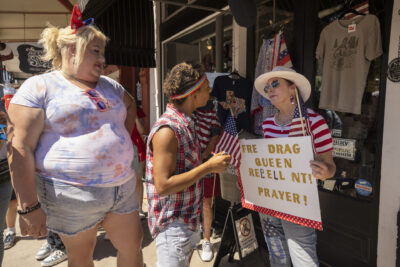
Filming what would become the Season 3 premiere in Granbury was especially difficult for everyone involved. “I’ve said, if I never go back to Granbury, Texas, it’ll be too soon,” Bob says. “That place was wild. It was the first time I was like, These people really hate us. They do not want us here. I would have left if it was up to me.”
Eureka O’Hara and Shangela confront an anti-LGBTQ protester in Granbury, Texas. Greg Endries/HBO
Warren says that a week before the show arrived in Texas, a local ultra-right-wing podcast began ginning up hostility, spreading a rumor that the queens would be participating in Granbury’s Fourth of July parade—something that was never in the works. “We get to the town and already many of the people that we met were hostile. Because they thought we were trying to pollute them,” Warren recalls.
Producers were forced to relocate a planned drag story hour event at a local queer-friendly coffee shop after people called, threatening to forcibly remove the children who were planning to attend with their mothers. “Not their children,” Warren notes. “They were going to forcibly remove them, and they were potentially armed.”
“People are more vocal now than ever because they feel vindicated to be able to be vocal. People feel supported in their negative opinions, and there’s a lot of fear being thrown around about children,” says Eureka. “Which, again, has constantly tormented the queer community. And it’s heartbreaking that at the root of everything, people forget that we have families too. We have hearts too. We don’t want to hurt children. Some of us have raised children. Me and Shangela specifically, we are huge influences in our brothers and sisters’ children’s lives. Our nieces and nephews, if it wasn’t for us doing what we do, may not be as supported as they are, may not have a chance for success. I’m a queer person, and if it wasn’t for what I get to do, how I make money, I wouldn’t be able to help them thrive.”
For Ingram and Warren, seeing drag queens become the targets of dehumanizing rhetoric has been devastating. But, they say, the current political climate reinforces their show’s importance.
“We created this show to show this human connection between people that wouldn’t normally connect,” Ingram explains. “We’re saying in this season that drag is love. It’s a warm hug. We have an uphill battle on our hands showing what that love is. But we stand up and squash the hate with love—the love from our community, the love from these drag performers, the love we put into the wardrobe, the celebration, the people that celebrate onstage their own personal journeys for the first time. Standing up to the hate with love fearlessly and fiercely is all we can continue to do. That is the only way forward.”
“This season is so important,” Warren insists. “It’s by far and away the most important season we’ve done, because everyone’s always asking ‘What can I do?’ And it’s not until you feel the connection with somebody that I think you can make substantive change.”
“People share these memes on social media, but when you really sit with a human and you listen to their story and you watch them shine, that is what we really need to do,” Ingram adds. “From our whole experience, there’s a lot more people that are on the right side of history than there are these loud obnoxious people. We definitely outnumber the hate.”
The father of Colorado Springs suspect Anderson Lee Aldrich surfaced on Wednesday and made jaw-droppingly despicable comments related to the attack at Club Q. MeidasTouch Contributor Texas Paul reacts.
Alicia Menendez speaks with Angelo Carusone, President and CEO of Media Matters, on the recent spike in anti-trans rhetoric and how Twitter’s new leadership under Elon Musk might make matters worse.

 The Mormon temple in Salt Lake City, Utah.Photo: Shutterstock
 Bob the Drag Queen, Shangela, and Eureka O’Hara Photo: Greg Endries/HBO