June 13, 1967 Thurgood Marshall was nominated for justice of the Supreme Court by President Lyndon Johnson. Marshall was then Solicitor General of the United States, and had been the lead attorney in the Brown v. Board of Education case that ended legal segregation in the schools. He would be the first African American on the Court. Synopsis of Juan Williams’s biography of Justice Thurgood Marshall
June 13, 1971 The New York Times began publishing the Pentagon Papers, a series of excerpts from the Defense Department’s classified history of the Vietnam War, giving details of U.S. involvement in Vietnam from the end of World War II to 1968. Publication was interrupted after the Nixon administration went to court to block it, asserting its power to exercise prior restraint over public release of what it considered classified material. The Washington Post then began publishing the papers. On June 30 the Supreme Court, 6-3, allowed publication to resume. What started that day and how Nixon’s people dealt with it
June 13, 1991 Jeffrey Collins was awarded a $5.3 million settlement from Shell Oil which had fired him for being gay. Collins had offered to settle out of court for $50,000, but Shell refused.
“In almost every single case, the reason was anti-trans discrimination in the form of pressure to ‘detransition’ from one’s family, friends, or community.”
Erin In The Morning is a reader-supported publication. To receive new posts and support my work, consider becoming a subscriber.
Upgrade to paid
A report on the largest survey ever of trans Americans’ health was released on Wednesday, June 11, and its findings reaffirmed what many academics, health care providers and trans people already know: gender-affirming care saves and improves lives, but transphobia often dissuades people from pursuing or continuing it when they need it most.
Over 84,000 trans, nonbinary and gender nonconforming people aged 18 and up responded to the 2022 U.S. Transgender Survey, spearheaded by Advocates for Trans Equality (A4TE). Of respondents who had transitioned, 9% had gone back to living as their sex assigned at birth at some point in their lives, at least for a short while—but in almost every single case, the reason was anti-trans discrimination from one’s family, friends, or community.
“Social and structural explanations dominated the reasons why respondents reported going back to living in their sex assigned at birth at some point,” the report found. “Only 4% of people who went back to living in their sex assigned at birth for a while cited that their reason was because they realized that gender transition was not for them. When considering all respondents who had transitioned, this number equates to only 0.36%.”
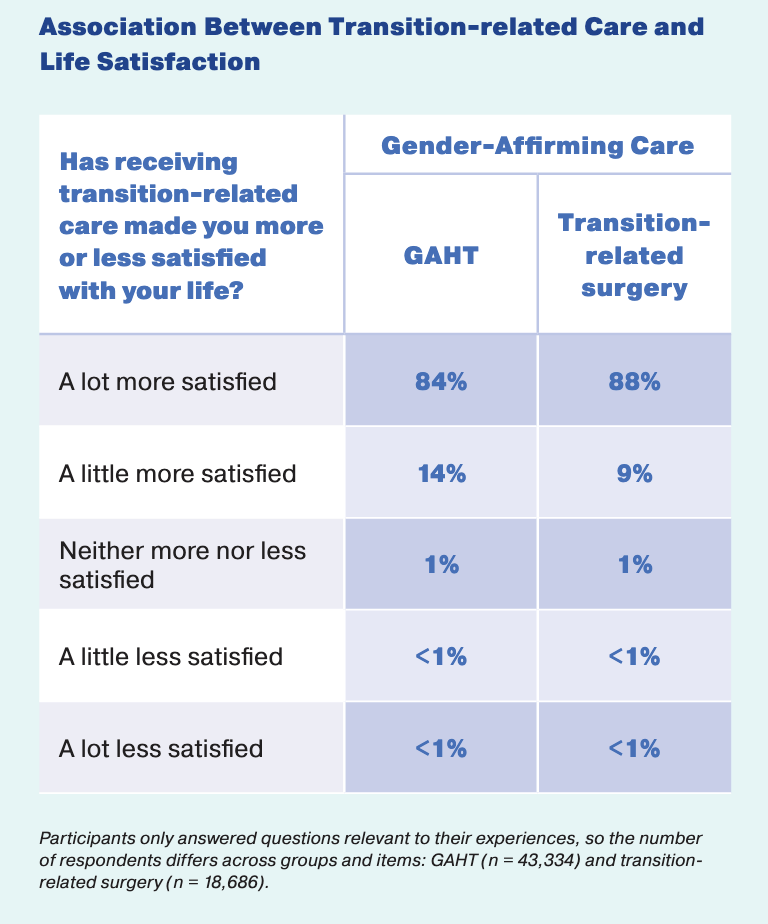
Meanwhile, respondents who received gender-affirming hormone therapy (GAHT) or gender-affirming surgery overwhelmingly reported feeling “more satisfied” with their lives—98% and 97% respectively.
Graphic courtesy of the 2022 U.S. Transgender Survey – Health and Wellbeing Report
This watershed report contradicts the popular narrative being circulated by mainstream media, far-right politicians and anti-trans groups that transgender people are “detransitioning” en masse due to life-shattering “transition regret.” In reality, it shows gender diverse people are living rich and vibrant lives—so long as they are provided the space, support and care they need from their health care providers and communities.
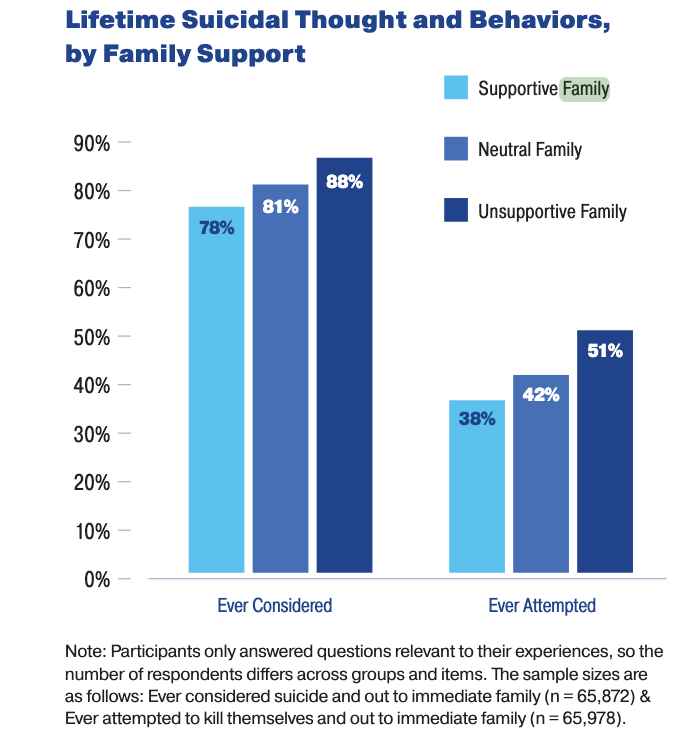
The survey found a trans person’s overall health and wellbeing also heavily depends upon rates of familial support, a factor that has a profound influence over a trans person’s lifetime experience of suicidality.
Graphic courtesy of the 2022 U.S. Transgender Survey – Health and Wellbeing Report
The survey has been released in increments as researchers at A4TE wade through the unprecedented amounts of data from trans people who lent their voice to the project. It is a much-needed, comprehensive overview on the challenges—and victories—seen in trans health care since the prior iteration of the study. The report is especially vital considering the Trump Administration moved to remove transgender people from the U.S. Census and other government websites, rendering trans communities potentially invisible, and robbing researchers of crucial data informing public policy decisions.
“Having real concrete and rigorous data about the realities of trans people’s day-to-day lives is also a vital part of dispelling all of those assumptions and stereotypes that plague the public discourse about our community,” said Olivia Hunt, A4TE’s Director of Federal Policy, during a press briefing this week.
The report also touched upon trans people’s access to health care, which increased between 2015 and 2022; the quality of care, as trust between doctors and trans patients has improved; disparities between trans people across racial groups, which showed trans people of color are generally more prone to experience discrimination compared to white trans people; and the mental health challenges facing the trans community, as 44% of respondents met the criteria for serious psychological distress, compared to less than 4% of the general U.S. population.
Many of these issues have likely been exacerbated since the data was collected. The lead-up to President Donald Trump’s return to the Oval Office incited a new wave of anti-trans animus, impeding access to care and stirring up transphobic vitriol and harassment.
“From 2015 to 2022, state-level policy environments became more protective in some ways for trans people; however, in 2022 alone, when the USTS was administered, 315 anti-LGBTQ bills were introduced across the country, many of which harm trans and nonbinary people’s access to healthcare, participation in sports, access to public facilities, or other facets of public life,” the report says.
“This political landscape has only worsened since the administration of the 2022 USTS, with the introduction of 571 anti-LGBTQ nationwide in 2023 and 489 in 2024,” it continues. “At the time of writing, data on trans and nonbinary people has been erased from federal health surveys. As funding for LGBTQ research is stripped away, the USTS has become an ever more critical resource on the lived experiences of trans and nonbinary people.”
Nonetheless, trans life and trans joy has persisted, as testimonies featured in the U.S. Trans Survey demonstrate.
“I have thrived in the past 12 months in transition, I have a genuine smile on my face most days & laugh with genuine joy,” wrote Charlotte, a trans woman, in her survey response. “I have grown into the woman I was meant to be.”
And as Roo, a nonbinary person, wrote: “Once I learned what it meant to be trans, I never looked back. I traded in my Regina George-esque life for a future with a balding head and a predisposition for a beer gut. I’ve never been more happy to be alive—every single day. ”
Erin In The Morning is a reader-supported publication. To receive new posts and support my work, consider becoming a subscriber.
And, since June is Pride month, there are a lot of Pride activities going on that date, too. Perhaps yours also overlap, and this sign will work for you, too!
Thanks to Chris for permission to share – this design is so great, I had to share it.
Stay safe out there, and wherever you are, please know that you are loved exactly as you are. Whether you can live your life openly or keep parts of yourself hidden, you’re seen and welcomed and loved.”
Picture this: It’s 1970, and America’s movie theaters reek of stale popcorn, cigarette smoke, and something else—the acrid stench of fear. Fear of bodies that didn’t conform, desires that couldn’t be spoken, identities that existed only in shadows and whispered confessions. Then, like a fucking earthquake splitting the earth’s crust, came The Boys in the Band—not tiptoeing through Hollywood’s garden of heteronormative roses, but kicking down the door with combat boots and declaring war on silence.
William Friedkin’s adaptation of Mart Crowley’s play didn’t just put gay men on screen; it threw them there bleeding, bitching, and beautifully broken. The audience could taste the bitter cocktail of self-loathing mixed with razor-sharp wit, could feel the electric tension crackling between characters who wielded words like switchblades. This wasn’t representation—this was revolution disguised as entertainment, a Molotov cocktail hurled at the pristine facade of American cinema.
The psychological impact on LGBTQ+ viewers was seismic. For the first time, queers sitting in darkened theaters saw themselves reflected not as tragic figures destined for suicide or sanitized saints, but as complex, contradictory, gloriously fucked-up human beings. The film’s unflinching portrayal of internalized homophobia—characters tearing each other apart with vicious precision—served as both mirror and exorcism. Viewers could finally name the demons that had been eating them alive, could see their own struggles projected thirty feet high in Technicolor fury.
Trans Bodies on Fire: The Gender-Fucking Revolution
Before there was language, before there were support groups or pride parades, there was The Rocky Horror Picture Show—a glittering, sequined middle finger raised high against every gender binary that dared exist. Tim Curry’s Dr. Frank-N-Furter didn’t just cross-dress; he obliterated the very concept of fixed identity, serving looks that could melt steel and charm that could seduce a nun. The film became a weekly religious experience for outcasts and misfits, transforming movie theaters into sanctuaries where “abnormal” became sacrament.
The sensory assault was deliberate and intoxicating: the smell of cheap makeup mixing with nervous sweat, the sound of fishnet stockings ripping as audience members transformed themselves into their truest selves, the taste of liberation on tongues that had been silenced for too long. Rocky Horror created a space where gender became performance art, where conformity went to die, and where every Saturday night became a resurrection.
The psychological liberation was profound. Trans viewers found validation in Frank-N-Furter’s unapologetic embrace of fluidity, while questioning viewers discovered permission to explore identities they’d never dared name. The film’s interactive nature—audiences shouting back at the screen, participating in the narrative—created a communal catharsis that individual therapy could never match.
Orlando arrived two decades later like a ethereal fever dream, with Tilda Swinton embodying centuries of gender transformation through Sally Potter’s lens. Here was gender not as costume but as evolution, not as crisis but as natural progression. The film’s languid pacing forced viewers to marinate in ambiguity, to sit with discomfort until it transformed into acceptance, then into celebration.
The Crying Game hit different—like a sucker punch followed by a tender kiss. Neil Jordan’s thriller weaponized audience assumptions, then forced viewers to confront their own transphobia in real-time. The revelation about Dil became a cultural watershed moment, dividing film history into before and after. Suddenly, dinner table conversations across America were grappling with questions that had never been asked out loud.
The psychological impact on trans viewers was complex and often contradictory. Some found validation in seeing trans characters as more than punchlines or victims, while others felt exploited by the shock-value treatment of trans identity. The film sparked conversations that were long overdue, even when those conversations were messy, uncomfortable, and occasionally hostile.
Leather, Longing, and the Masculine Mystique
Cruising descended into theaters like a demon emerging from hell’s own basement, dragging audiences through New York’s leather underground with the subtlety of a sledgehammer to the skull. William Friedkin didn’t just film gay culture; he dissected it with surgical precision, exposing the raw nerves where desire meets violence, where identity becomes performance, where the line between hunter and hunted dissolves in strobe lights and poppers.
The film’s sensory assault was overwhelming: the throb of disco basslines that you felt in your chest cavity, the smell of leather and sweat and something darker, the visual overload of bodies in motion, muscles straining against restraints both literal and metaphorical. Al Pacino’s descent into this world became every viewer’s journey into their own shadow self, the parts of desire that polite society pretended didn’t exist.
The psychological effects were explosive and divisive. Gay men in theaters found themselves simultaneously aroused and terrified, seeing their community’s most extreme margins projected for mainstream consumption. Some felt exposed, violated, their private world stripped naked for heterosexual titillation. Others felt liberated by the film’s refusal to sanitize gay desire, its acknowledgment that sexuality could be dangerous, transgressive, and transformative.
Sunday Bloody Sunday offered a different kind of revelation—mature, sophisticated, unapologetically honest about love’s messy realities. John Schlesinger’s triangular love story featuring Peter Finch as an openly gay man navigating desire without shame created a new template for queer cinema. This wasn’t tragedy or comedy; this was life, served neat without the chaser of societal judgment.
The film’s matter-of-fact treatment of gay relationships was revolutionary in its ordinariness. No coming-out trauma, no tragic endings, no apologetic explanations—just human beings loving, losing, and continuing to breathe. For LGBTQ+ viewers, this representation was oxygen for souls that had been suffocating on a diet of tragic queers and comedic stereotypes.
Lesbian Desire: From Shadows to Sunlight
Lesbian cinema in this era moved from whispered suggestions to bold declarations, from tragic endings to triumphant beginnings. The Killing of Sister George emerged from the underground like a feral cat, all claws and snarls and magnificent rage. Robert Aldrich’s brutal examination of lesbian relationships didn’t flinch from ugliness—the manipulation, the internalized homophobia, the way oppression could turn love into a weapon.
Beryl Reid’s performance was a masterclass in controlled demolition, watching a woman destroy everything she touched while desperately grasping for connection. The film’s unflinching portrayal of lesbian relationships—complex, messy, and occasionally toxic—provided representation that was real rather than idealized. For lesbian viewers, seeing their community portrayed with full humanity, including its shadows, was both painful and profoundly validating.
Desert Hearts offered redemption and possibility, Donna Deitch’s adaptation of Jane Rule’s novel serving up hope like cold water in a desert. Set in 1950s Reno, the film followed an academic’s journey from divorce to self-discovery, from social conformity to authentic desire. The Nevada landscape became a metaphor for internal transformation—vast, beautiful, and dangerous.
The sensory details were crucial: the crack of pool balls echoing like gunshots, the smell of cigarettes and whiskey mixing with perfume and possibility, the heat radiating from skin finally allowed to want what it wanted. For lesbian viewers, Desert Hearts offered a template for their own coming-out narratives—messy, beautiful, and ultimately triumphant.
Lianna brought lesbian experience into the suburban mainstream with John Sayles’ sensitive direction. The film’s psychological realism was groundbreaking—showing the internal process of sexual awakening without sensationalizing or pathologizing it. Viewers could taste the protagonist’s confusion, feel her excitement and terror as she navigated new desires while dismantling old assumptions about herself.
The AIDS Crisis: Love in the Time of Dying
Longtime Companion arrived like a punch to the solar plexus, chronicling AIDS’ devastating impact on a circle of gay friends with unflinching honesty. Norman René’s ensemble piece transformed personal tragedy into universal human drama, forcing audiences to confront the epidemic’s toll not through statistics but through faces, voices, and stories.
The film’s emotional brutality was necessary and healing. Viewers experienced the full spectrum of grief—denial, anger, bargaining, depression, and something resembling acceptance. The beach scene, where surviving characters imagine their dead friends joining them one last time, became a collective catharsis for a community drowning in loss.
For LGBTQ+ viewers, Longtime Companion provided validation for their grief, rage, and resilience. The film acknowledged that gay relationships were worth mourning, that gay lives had value, that gay love deserved recognition. In a world that often seemed indifferent to queer suffering, the film became a memorial, a battle cry, and a love letter all at once.
Parting Glances offered a different perspective on the crisis—intimate, funny, and heartbreakingly human. Bill Sherwood’s New York snapshot captured gay life with humor and tenderness, refusing to let AIDS define the entire gay experience. The film’s portrayal of friendship, love, and community in the face of mortality provided a blueprint for survival.
International Voices: Expanding the Revolution
The revolution wasn’t contained by borders. My Beautiful Laundrette mixed racial politics with queer desire against Thatcherite Britain’s backdrop, creating social dynamite that exploded conventions about class, race, and sexuality. Stephen Frears’ direction transformed a love story between Omar and Johnny into a meditation on identity, economics, and the price of conformity.
The film’s sensory details were crucial—the smell of industrial detergent mixing with forbidden desire, the sound of washing machines providing rhythm for secret encounters, the visual contrast between public respectability and private rebellion. For viewers navigating multiple marginalized identities, the film offered recognition that oppression could be intersectional and resistance could be revolutionary.
Entre Nous explored female friendship and desire in post-war France with Diane Kurys’ autobiographical honesty. The film’s examination of emotional intimacy challenging conventional marriage provided a template for understanding relationships that existed outside traditional categories. The psychological complexity of female friendship—its intensity, its potential for transformation, its threat to established order—was portrayed with rare sensitivity.
The Aesthetic Revolution: Beauty as Resistance
These films didn’t just tell different stories; they created new visual languages for desire, identity, and rebellion. The Adventures of Priscilla, Queen of the Desert transformed the Australian outback into a canvas for drag performance and self-discovery, proving that authenticity could flourish in the most unlikely places.
The film’s sensory explosion was deliberate—the clash of sequins against red dirt, the sound of high heels on desert sand, the taste of dust and dreams mixing in the desert air. For drag performers and gender-nonconforming viewers, Priscilla offered validation that their art was transformative, their visibility was revolutionary, their existence was celebration.
Death in Venice provided a different aesthetic—operatic, obsessive, and devastatingly beautiful. Luchino Visconti’s adaptation of Thomas Mann’s novella used Gustav Mahler’s music to underscore Dirk Bogarde’s descent into forbidden desire on plague-ridden Italian shores. The film’s lush visuals and overwhelming music created a sensory experience that bypassed rational thought, speaking directly to the subconscious where desire lives.
Psychological Warfare: The Internal Revolution
The psychological impact of these films on LGBTQ+ viewers cannot be overstated. For generations raised on invisibility or tragic representation, seeing complex, fully-realized queer characters was transformative therapy. These films provided:
Validation: Characters who experienced similar struggles, desires, and triumphs Language: Words and concepts for experiences that had been nameless Community: The knowledge that others shared these experiences Hope: Evidence that queer lives could include joy, love, and fulfillment Rage: Permission to be angry about oppression and discrimination Pride: Models for living authentically despite social pressure
The films also created psychological discomfort that was productive. They forced viewers to confront internalized homophobia, challenge assumptions about gender and sexuality, and grapple with the contradictions between public personas and private desires.
Cultural Warfare: Changing Hearts and Minds
These 24 films didn’t just reflect cultural change; they catalyzed it. Each screening became an act of resistance, each ticket purchase a vote for visibility, each conversation sparked by these films a crack in the foundation of heteronormative assumptions.
The films created cultural currency for LGBTQ+ experiences. References to Rocky Horror became shorthand for gender fluidity. The Boys in the Band provided vocabulary for gay male relationships. Desert Hearts offered a template for lesbian coming-out narratives. These films became cultural touchstones, reference points for understanding and discussing queer experience.
The broader cultural impact was seismic. Mainstream audiences encountered LGBTQ+ characters as fully-realized human beings rather than stereotypes or cautionary tales. The films forced conversations that hadn’t happened before, challenged assumptions that had gone unquestioned, and planted seeds of empathy in hostile soil.
The Legacy: Revolution Continues
These 24 films from 1970-1995 created the foundation for everything that followed. They proved that LGBTQ+ stories could be commercially viable, critically acclaimed, and culturally significant. They trained audiences to expect complexity rather than stereotypes, authenticity rather than exploitation.
The psychological impact on LGBTQ+ viewers created ripple effects that continue today. Viewers who found validation in these films went on to create art, build families, fight for rights, and live openly. The films provided models for resistance, templates for authenticity, and permission to exist unapologetically.
The cultural impact was equally profound. These films shifted the conversation from whether LGBTQ+ people deserved representation to how that representation should evolve. They created space for the explosion of queer cinema that followed, from Brokeback Mountain to Moonlight to The Danish Girl.
Conclusion: The Ongoing Revolution
These 24 films didn’t just entertain; they waged war against invisibility, fought battles against shame, and won victories for authenticity. They transformed movie theaters into battlegrounds, screens into mirrors, and stories into weapons of mass liberation.
The revolution they started continues in every Pride parade, every coming-out conversation, every film that dares to show LGBTQ+ characters as complex, worthy, and fully human. These films proved that visibility is power, that stories can change hearts, and that cinema can be a force for liberation.
For LGBTQ+ viewers who discovered these films in darkened theaters, on late-night television, or through word-of-mouth recommendations, the impact was profound and lasting. These films didn’t just reflect their experiences; they validated their existence, honored their struggles, and celebrated their humanity.
The blood, sweat, and tears that went into making these films—both literally and metaphorically—created a legacy that continues to inspire, challenge, and transform. They remind us that art can be revolutionary, that visibility is political, and that sometimes the most radical act is simply refusing to disappear.
These 24 films blazed a trail through the wilderness of cultural invisibility, creating a path that others could follow. They proved that LGBTQ+ stories weren’t just worth telling; they were essential to telling the complete story of human experience. The revolution they started continues, and their impact will be felt for generations to come.
Citations
Rich, Ruby B. 2013 “New Queer Cinema: The Director’s Cut“
Turner, K. 2023 “The Queer Film Guide: 100 great movies that tell LGBTQIA+ stories”
So many old friends in Wichita deplore the conservatism, and yes, there are more voters voting Republican than Dem (though their Dem party is healthy.) Yet, Wichita loves everyone, and I love that! If you’re lucky the little video player on the page will work, and you can watch the broadcast. https://www.ksn.com/video/ict-big-gay-market-hosts-event-for-3rd-year/9749633
With DEI initiatives firmly in the crosshairs of the Trump administration, many large corporations that were once so quick to celebrate June as Pride month have quietly ditched their public support for LGBTQI+ rights even faster.
It used to be common for companies to emblazon their social media accounts with rainbow-themed versions of their logo, but in 2025, the same big businesses that were so vocal about supporting Pride initiatives have fallen silent.
The controversial post that sparked a social media backlash.
That’s certainly true for big international airlines in the United States, which were falling over themselves to show their support for Pride until very recently (critics might argue they were just chasing the so-called ‘Pink Dollar’).
In 2025, the social media accounts of American Airlines, Delta, and United make no mention or reference to Pride, even if these airlines do still support LGBTQ+ initiatives (Alaska and United are still sponsors of San Francisco’s Pride parade even as other big name corporations drop their support).
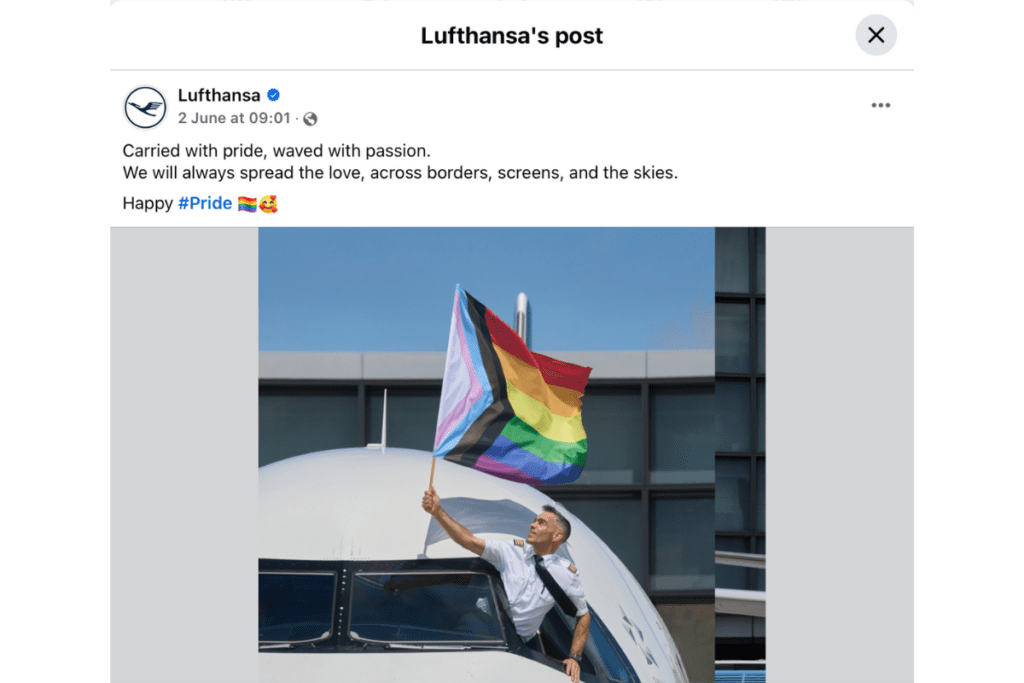
German flag carrier Lufthansa doesn’t seem too concerned that supporting LGBTQ+ rights is no longer fashionable… at least not in Trump’s America.
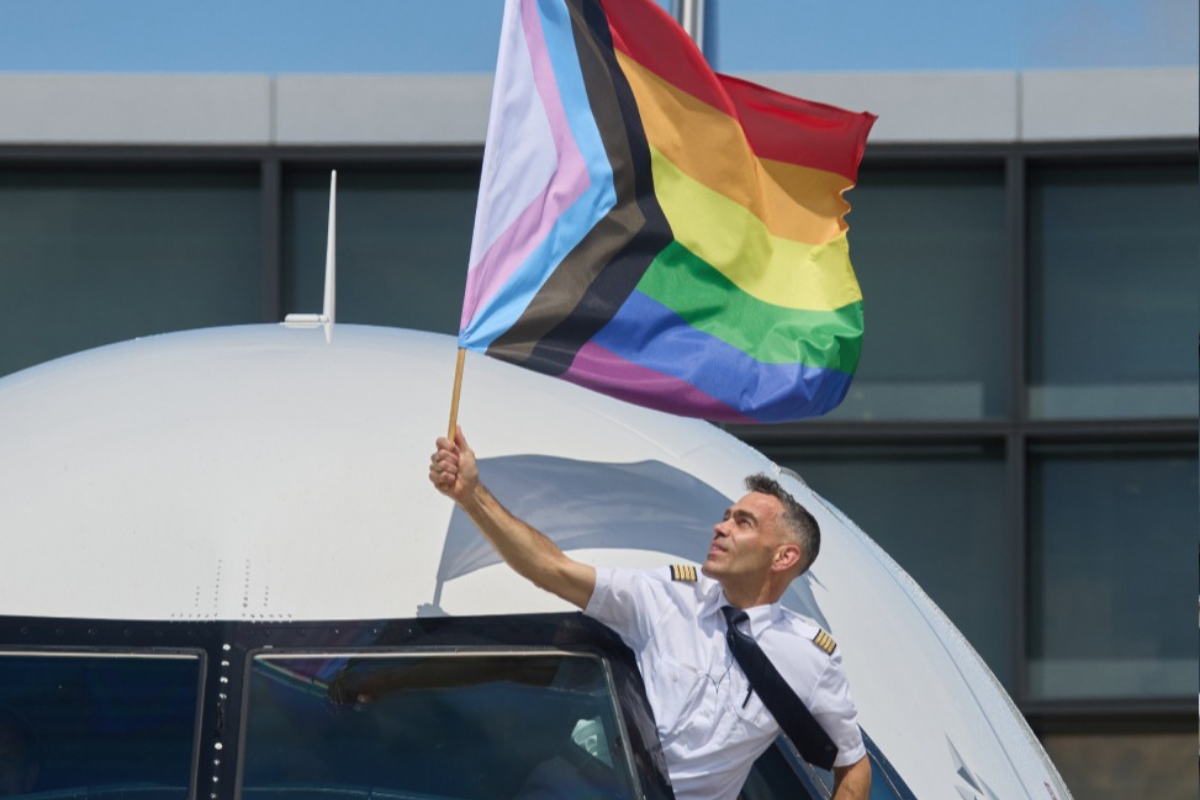
On June 2, the airline posted a photo of a pilot waving a Pride rainbow flag out the window of a cockpit, captioned with the words: “Carried with pride, waved with passion. We will always spread the love, across borders, screens, and the skies.”
Lufthansa has been quick to respond to critics.
It seemed like a pretty inoffensive and inspiring message that didn’t directly reference LGBTQ+ rights, but it didn’t take long for Lufthansa’s Facebook page to be deluged with homophobic comments.
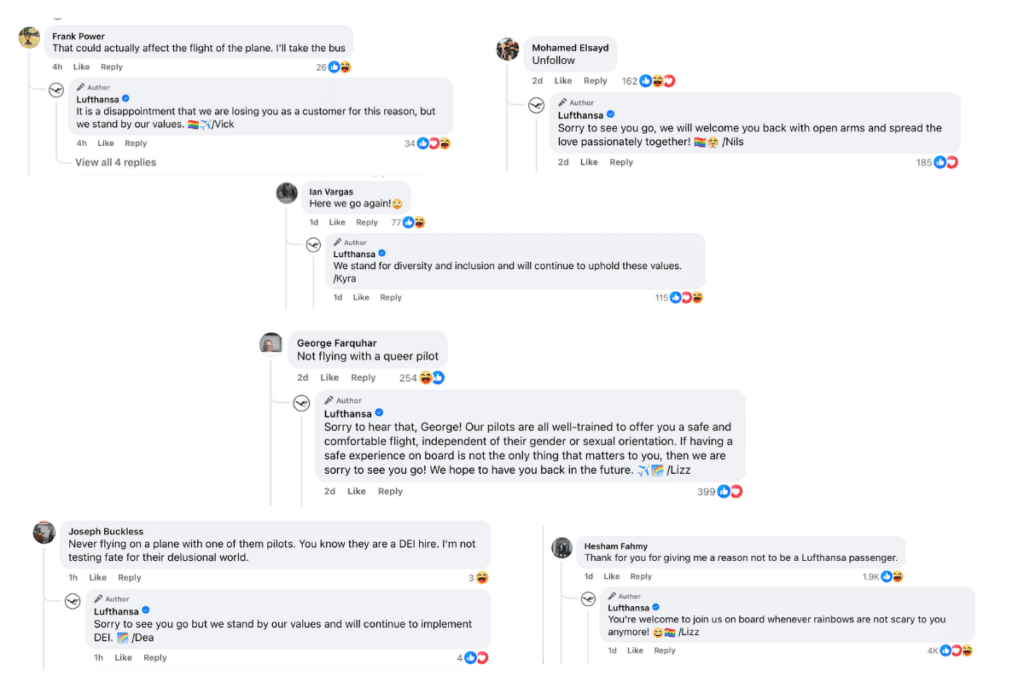
But it looks like Lufthansa knew exactly what it was getting itself into, and its social media team quickly fired back at critics with sassy replies that shut down the hateful comments without censoring them or turning off the comment feature altogether.
“Thank you for you for giving me a reason not to be a Lufthansa passenger,” one person wrote underneath the post. Lufthansa clapped back with: “You’re welcome to join us on board whenever rainbows are not scary to you anymore!”
While one person inferred that inclusivity was a safety issue, saying: “That could actually affect the flight of the plane. I’ll take the bus.”
Lufthansa was not having any of it, though, relying: “It is a disappointment that we are losing you as a customer for this reason, but we stand by our values.”
Another referenced DEI, saying: “Never flying on a plane with one of them pilots. You know they are a DEI hire. I’m not testing fate for their delusional world.”
Again, Lufthansa stood firm: “Sorry to see you go but we stand by our values and will continue to implement DEI.”
Many responses to the post have, however, been positive, and some fans have pointed out that the response has proved exactly why, even in 2025, Pride is still needed.
June has traditionally been recognized as Pride Month to mark the Stonewall riots that occurred in late June 1969. Since then, several US presidents have issued proclamations, declaring June as the month of Pride, but White House press secretary Karoline Leavitt said earlier this week that President Trump has no plans to issue a similar proclamation this year.
Trump was, however, the first Republican President to acknowledge LGBT Pride Month back in 2019 when he Tweeted a message in support of the commemoration.
I had to post this one! IIRC, Anne Bonny is in one of our son’s “Badass” books. We bought those for him in his late elementary and middle school years. He’s always loved history, and most tweens/early teens enjoy blue language, so you get both with these books and the website. I’ve read them, and they’re just rollicking fun, and accurate. Anyway, I’ve had a soft spot for Anne Bonny due to her story and her fortitude. And now, for some more history with blue language!
Queer History 133: Anne Bonny by Wendy🏳️⚧️🏳️🌈🌈
The Bisexual Buccaneer Who Shattered Every Fucking Chain Read on Substack
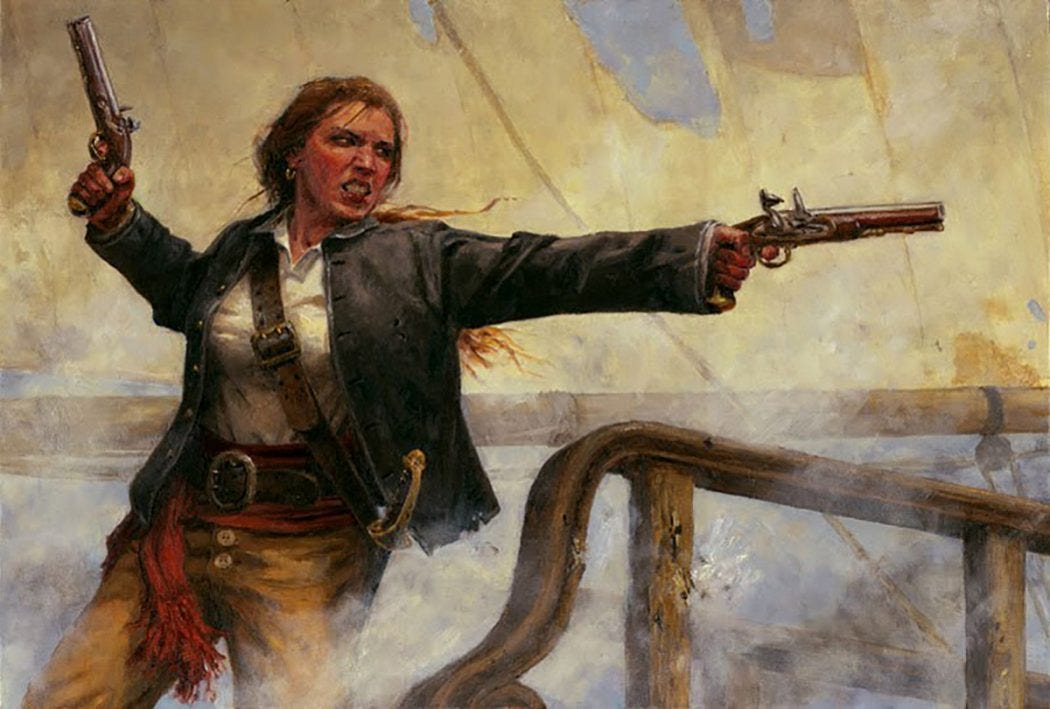
The Caribbean sun beats down mercilessly on the deck of the Revenge, its rays catching the glint of steel and the flash of defiant eyes. Blood mingles with salt spray as cutlasses clash, and in the midst of this violent ballet dances a figure that would make the devil himself take notice—Anne Bonny, her red hair whipping like flames in the ocean wind, her blade singing its deadly song as she carves through enemies with the fury of a woman who has never, not once, apologized for who she fucking is.
This is no sanitized fairy tale of pirates and buried treasure. This is the raw, unvarnished truth of a woman who lived as she pleased, loved whom she chose, and fought like hell against every goddamn soul who tried to cage her spirit. Anne Bonny wasn’t just a pirate—she was a revolution wrapped in leather and lace, a middle finger raised to every suffocating convention of her time, and a blazing torch of queer defiance centuries before the world had words for what she represented.
Born around 1697 in County Cork, Ireland, Anne Cormac entered a world that had already decided her fate before she drew her first breath. She was meant to be silent, subservient, and safely tucked away in the shadows of more “important” men. The patriarchal machine had clear expectations: marry young, breed often, and die quietly. But from her earliest days, Anne Bonny grabbed those expectations by the throat and strangled them with her bare hands.
Her father, William Cormac, was a lawyer who had knocked up the family maid—Anne’s mother. In the rigid social hierarchy of 18th-century Ireland, this scandal should have destroyed them all. Instead, Cormac said “fuck it” to respectability, took his lover and bastard daughter, and sailed for the American colonies where they could start fresh. This act of defiance—choosing love over social standing—planted the first seeds of rebellion in young Anne’s soul.
In Charleston, South Carolina, the Cormac family built a new life from scratch. William established a successful law practice and plantation, but it was clear from the start that his daughter was not cut from ordinary cloth. While other girls her age were learning needlepoint and practicing their curtsies, Anne was learning to ride like a demon, shoot like a marksman, and curse like a sailor. She moved through the world with a swagger that made proper ladies clutch their pearls and men wonder if they were seeing things.
The first whispers about Anne’s unconventional nature started early. Servants gossiped about the young mistress who preferred the company of both the stable boys and the parlor maids with equal enthusiasm. They spoke in hushed tones about midnight escapades and passionate encounters that defied easy categorization. Anne Bonny was discovering that her heart and her loins recognized no boundaries when it came to attraction—a revelation that would have sent most people of her era scrambling for the nearest priest, but only made Anne more determined to live authentically.
When Anne was barely out of her teens, she shocked Charleston society by marrying James Bonny, a small-time pirate and fortune hunter who thought he could tame the wild Irish girl and claim her father’s wealth. The poor bastard had no idea what he’d gotten himself into. Anne married him not out of love, but as a means of escape from her father’s increasingly desperate attempts to marry her off to someone “respectable.” It was a calculated move by a young woman who understood that sometimes you have to play the game to change the rules.
James Bonny turned out to be everything Anne despised—weak, grasping, and utterly conventional. While he dreamed of easy money and social climbing, Anne burned with restless energy and unfulfilled desires. Their marriage was a farce from the start, a prison that Anne was already planning to escape before the ink was dry on the wedding certificate.
The couple moved to Nassau in the Bahamas, a lawless pirate haven where conventional morality went to die and freedom could be bought with steel and courage. For James, Nassau represented opportunity for his petty schemes. For Anne, it was liberation incarnate—a place where she could finally breathe freely and explore every aspect of her complex sexuality without the suffocating weight of mainland propriety.
Nassau in the early 1700s was a powder keg of sexual and social revolution. Pirates, prostitutes, escaped slaves, and social outcasts from across the Atlantic world had created a society that operated by its own rules. Gender roles were fluid, sexual boundaries were negotiable, and survival depended on wit, strength, and ruthless determination—qualities Anne possessed in abundance.
It was in this intoxicating atmosphere that Anne first encountered other women who loved women, men who challenged traditional masculinity, and people who refused to be defined by society’s narrow categories. She found herself drawn into passionate affairs with both men and women, sometimes simultaneously, always honestly. While the respectable world would have labeled her a whore or worse, in Nassau she was simply Anne—a woman living life on her own terms.
Her marriage to James became increasingly irrelevant as Anne explored her true nature. She took lovers as she pleased, fought alongside men as an equal, and began to develop the reputation that would make her legendary. Her bisexuality wasn’t a phase or a rebellion—it was simply part of who she was, as natural and integral as her red hair or her fierce temper.
Everything changed when Anne met Captain John “Calico Jack” Rackham. Unlike her pathetic husband, Jack was a real pirate—charming, dangerous, and utterly unintimidated by Anne’s fierce independence. More importantly, he saw her for what she truly was: not a woman to be tamed, but a force of nature to be unleashed. Their affair was passionate, public, and absolutely scandalous by any civilized standard.
But Anne Bonny was never one to do things halfway. When she decided to leave her husband for Calico Jack, she didn’t sneak away in the night like a guilty adulteress. She walked out in broad daylight, her head held high, her hand on her cutlass, daring anyone to try and stop her. When James Bonny appealed to the colonial governor for the return of his “property,” Anne’s response was swift and brutal—she showed up at the governor’s mansion armed to the teeth and made it clear that any attempt to drag her back to her miserable marriage would result in bloodshed.
Joining Calico Jack’s crew aboard the Revenge was the moment Anne Bonny truly came alive. Here, finally, was a life that matched her spirit—dangerous, free, and absolutely uncompromising. She didn’t join as Jack’s woman or as some token female presence. She earned her place with blade and blood, proving herself in combat and command until even the most skeptical pirates acknowledged her as an equal.
The open ocean became Anne’s cathedral, piracy her religion, and freedom her god. She reveled in the violent ballet of ship-to-ship combat, the intoxicating rush of victory, and the democratic brutality of pirate life where respect was earned through courage and cunning rather than birthright or gender. Her bisexuality continued to be an open secret among the crew—she took lovers as she pleased, both male and female, and anyone who had a problem with it could settle the matter with steel.
It was during this period that Anne encountered Mary Read, another woman living as a pirate in male disguise. Their meeting was electric—two fierce women who had refused to accept the limitations society tried to impose on them, finding kinship in the most unlikely of circumstances. While historical records are frustratingly vague about the exact nature of their relationship, the intensity of their bond was undeniable.
Some accounts suggest they were lovers, others insist they were simply close comrades, but the truth is likely more complex and more beautiful than either simple explanation. In Mary Read, Anne found someone who understood the cost of living authentically in a world determined to crush anyone who colored outside the lines. Whether their relationship was romantic, platonic, or something that defied easy categorization, it represented a profound connection between two extraordinary women who refused to be diminished.
The partnership between Anne, Mary, and Calico Jack created one of the most formidable pirate crews in Caribbean history. They terrorized merchant shipping with ruthless efficiency, their reputation spreading fear across the trade routes. But more than their success as pirates, they represented something revolutionary—a chosen family built on mutual respect, shared danger, and absolute loyalty that transcended traditional bonds of blood or marriage.
Anne’s life as a pirate was a masterclass in living without apology. She fought with savage grace, loved with passionate intensity, and commanded respect through sheer force of personality. Her bisexuality wasn’t hidden or apologized for—it was simply part of the complex tapestry of who she was. In an era when women were expected to be passive vessels for male ambition, Anne Bonny was a hurricane given human form.
The psychological impact of Anne Bonny’s defiance cannot be overstated. In a world that sought to define women by their relationships to men—as daughters, wives, mothers, or whores—Anne created her own identity through action and choice. She loved both men and women not as a rejection of heteronormativity (a concept that wouldn’t exist for centuries), but as a natural expression of her authentic self.
Her story resonated through the centuries, whispered in taverns and immortalized in ballads, because it represented something profoundly subversive: the possibility of a life lived entirely on one’s own terms. For generations of LGBTQ+ people struggling against societal expectations and legal persecution, Anne Bonny became an inadvertent patron saint—proof that it was possible to be queer, dangerous, and absolutely unapologetic about both.
The philosophy Anne embodied was simple but revolutionary: authentic living requires the courage to reject false choices. When society insisted she choose between respectability and freedom, she chose freedom. When it demanded she pick between loving men or women, she refused to choose at all. When it tried to cage her spirit in the narrow confines of 18th-century femininity, she exploded those boundaries with cutlass and pistol.
But Anne’s story is also a testament to the brutal costs of living authentically in a hostile world. Her career as a pirate was cut short in 1720 when their ship was captured by pirate hunters. While Calico Jack and most of the male crew were quickly tried and executed, Anne and Mary’s pregnancies bought them temporary reprieve from the gallows.
The trial of Anne Bonny and Mary Read became a sensation, not just because of their piracy, but because their very existence challenged fundamental assumptions about gender, sexuality, and power. Court records show that Anne remained defiant to the end, reportedly telling the cowering Calico Jack before his execution: “Sorry to see you there, but if you had fought like a man, you would not have been hanged like a dog.”
Mary Read died in prison, probably from fever, taking with her the secrets of her relationship with Anne and the full story of their extraordinary partnership. Anne’s fate became one of history’s tantalizing mysteries—some accounts suggest she was executed, others claim her father’s influence secured her release, and still others whisper that she simply vanished back into the chaos of the Caribbean to live out her days in obscurity.
The uncertainty surrounding Anne’s ultimate fate is perhaps fitting for a woman who consistently refused to be pinned down or defined by others’ expectations. Like the best outlaws and revolutionaries, she became more powerful as a legend than she ever was as a living person.
For modern LGBTQ+ people, Anne Bonny represents something profoundly important: historical proof that queer people have always existed, have always fought for their right to love and live authentically, and have always found ways to create chosen families and communities even in the most hostile circumstances. Her story demolishes the lie that LGBTQ+ identities are modern inventions or temporary phases—Anne Bonny was living an openly bisexual life in the early 1700s with a confidence and authenticity that would be admirable in any era.
The social impact of Anne Bonny’s legend extended far beyond her own lifetime. Her story became part of the folklore that sustained marginalized communities through centuries of oppression. When LGBTQ+ people were told they were sick, sinful, or unnatural, they could point to figures like Anne Bonny as proof that queer people had always been part of human history—not as victims or cautionary tales, but as heroes and legends.
The psychological effect of having historical figures who lived openly queer lives cannot be understated. For young people struggling with their identity, for adults facing discrimination, for anyone told that their love is wrong or their authentic self is unacceptable, Anne Bonny stands as a reminder that it’s possible to live with courage, dignity, and absolute refusal to apologize for who you are.
Her story also highlights the intersection of multiple forms of oppression and resistance. As a woman in a patriarchal society, as someone who loved both men and women in a heteronormative world, as an Irish person in a British colonial system, Anne faced multiple layers of marginalization. Her response was to reject all attempts at categorization and to create her own path through sheer force of will.
The philosophical legacy of Anne Bonny extends beyond LGBTQ+ rights to encompass broader questions of authenticity, freedom, and the right to self-determination. Her life was a practical demonstration that it’s possible to refuse false choices, to love without limits, and to fight against any force that tries to diminish your humanity.
In our current moment, when LGBTQ+ rights are under attack and bisexual people still face discrimination from both straight and gay communities, Anne Bonny’s story remains urgently relevant. She represents the long history of bisexual people who refused to choose sides, who loved authentically across gender lines, and who demanded recognition as complete human beings rather than confused or indecisive half-measures.
Anne Bonny died as she lived—on her own terms, leaving behind a legacy that continues to inspire and challenge. She proved that it’s possible to be queer and fierce, that authenticity is worth fighting for, and that love—in all its forms—is the most rebellious act of all. Her cutlass may have fallen silent centuries ago, but her spirit continues to slash through the bonds that try to limit human potential and queer joy.
Every time someone refuses to hide their authentic self, every time someone loves without apology, every time someone chooses freedom over respectability, they’re following in the wake of Anne Bonny’s ship. She remains what she always was—a force of nature, a revolution in human form, and proof that the queer spirit cannot be conquered, only temporarily suppressed before it explodes back into glorious, defiant life.
Citations
Nelson, J. 2004 “The Only Life That Mattered: The Short and Merry Lives of Anne Bonny, Mary Read, and Calico Jack” McBooks Press
Simon R. 2022 “Pirate Queens: The Lives of Anne Bonny & Mary Read”