
(She makes a lot of good points about differences in how one must navigate the world.-A)
Karla Sofía Gascón is the first openly trans actor to win best actress at Cannes for her role in Jacques Audiard’s audacious musical. She talks about awful corsets, riding motorbikes and suing her critics
Fri 18 Oct 2024 00.00 EDT
When Madonna posted an image of the Spanish actor Karla Sofía Gascón on Instagram recently, the word she scrawled above it in vivid pink letters captured what most viewers will think after seeing her in the award-winning noir-musical Emilia Pérez: “WOW”. The 52-year-old Gascón, who was born and raised near Madrid and has spent the bulk of her career acting in Mexican telenovelas, plays the drugs kingpin Manitas, who fakes his death, transitions from male to female and reinvents herself as Pérez, a socially conscious activist. Emilia Pérez the movie, like Emilia Pérez the character, is a one-off. After all, there can’t be many films that feature brutal Mexican drug cartels and a singalong about vaginoplasties.
As befits a project that began life as a libretto, the movie is operatic in its emotions. “Madonna was crying so much after the screening in New York,” says Gascón, perched demurely on the edge of a chaise longue in a London hotel room. Her thick chestnut hair brushes the shoulders of her black dress, which has white collars and white-trimmed short sleeves. “She told me: ‘You’re amazing!’ She was crying and crying. I said: ‘Madonna, please. It’s only a film. Be happy!’”
Gascón has shed her fair share of tears, not least when the movie’s quartet of female stars were jointly named best actress at Cannes, where the picture also took home the jury prize. Her fellow recipients were Zoe Saldana, who plays Emilia’s attorney and fixer; Selena Gomez, who stars as Manitas’s widow, who is persuaded that Emilia is her late husband’s cousin; and Adriana Paz, who plays the new love of Emilia’s life. It was Gascón, though, who delivered the moving six-minute acceptance speech at Cannes. Trans people, she told the audience, had “been insulted, denigrated, subjected to a lot of violence”.

Not that approbation precludes abuse. The morning after Gascón’s triumph, the French far-right MEP Marion Maréchal tweeted: “So a man has won best actress.” Six LGBTQ+ organisations filed complaints against Maréchal. Gascón has personally sued her.
Today, the actor cuts a more composed figure than she did at Cannes. She is casually affectionate – a kiss on each cheek when you arrive, a grateful hug on departure – and playful in her interactions with the interpreter. She talks at such length that the poor scribe is soon writing on the back of her pad. “You have more paper?” asks Gascón. “Or will you use your …?” She mimes scribbling frantically on her own arm.
Madonna and Greta Gerwig, the president of this year’s Cannes jury, are not the only ones convinced of Gascón’s greatness. The industry bible Variety has predicted that she will be one of the five best actress Oscar contenders next year, alongside the likes of Angelina Jolie (for Maria) and Tilda Swinton (The Room Next Door). That would make her the first openly transgender performer to be recognised in one of the Academy’s acting categories.
Hers is a performance of immense stillness and gravitas, which must also contain and occasionally exhibit the volatility that enabled Emilia to dominate the drug trade, and to assert herself now in a radically different life. Living openly as a woman, Emilia is still hiding, most obviously from her wife and children. Toggling between these contradictory layers, Gascón does her subtlest work.
Having cast her as Emilia, the director Jacques Audiard (A Prophet, Rust and Bone) was sceptical about her playing the character pre-transition. She convinced him by sending videos of herself with TikTok filters, and by changing her voice. It’s something she does for pleasure anyway. “I turn down the volume on the TV, and I do the voices for all the people on screen,” she says. “Just for fun when I’m bored at home. So this was easy for me. I know my …” She consults with the interpreter, then announces the word triumphantly: “Virtues!”
Why was she so determined to play Manitas? “I love roles that are far from who I am,” she says. “And I didn’t want to miss out on this character in all her dimensions. If there had been flashback scenes, I would have pushed to play those, too.”
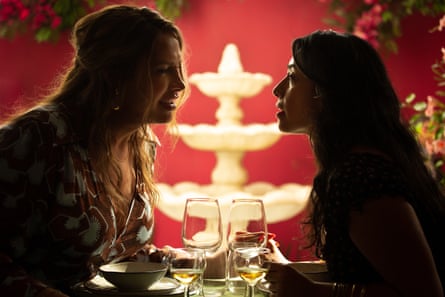
Emilia sounds like more of a challenge. “It is difficult to do someone close to me,” she says. The role highlighted distinctions she already feels between the demands placed on women and men. “I’m convinced that the masculine is freer physically and more confined mentally. When you are a woman, you are freer mentally but less so with your body. As a woman, you need to have your hair great, your makeup great. When you are a man, you just wake up and go to work. With a woman, there is the perfection mentality.”
She sits bolt upright, clasping her torso. “Right now, I’m wearing a corset,” she says. “And I can barely breathe!” I notice she has also kicked off her shoes; the shiny black heels lie next to her stockinged feet. “Society sees you as more beautiful like this. As Emilia, I had to be more feminine than I usually am.”
Gascón transitioned at the age of 46. Back then, she told herself: “I do it now, or I never do it.” She continues to have the support of her wife, whom she has known since they were teenagers, and their daughter, who is now 13. But there were other hurdles, even after transitioning. “I have been criticised for how I look. I ride a motorbike. I don’t usually wear makeup. People say: ‘Why become a woman if you’re not going to wear makeup?’ But there’s a big confusion in society about what a woman is.” All this has been conveyed in Spanish via the interpreter, who now reads sheepishly from her own shorthand notes: “And I’d just like the translator to confirm what I have said about being a woman in society.” She nods, we laugh, and Gascón gestures at her as if to say: “See?”
The criticisms of her lipstick-free, motorbike-riding lifestyle come from all corners. “Including the minority I represent,” she points out. There is something she tells herself in that situation: “You can be LGBTQ+. You can be a man, a woman, an astronaut, an electrician. But if you are stupid, you are stupid.” More laughter.
Part of the message of Emilia Pérez, she thinks, is that power lies not in using violence but in renouncing it. “With violence, you can control a lot of people and impose your will. It is a form of imposition that has led us to women being made to do the household chores, or people of colour working in the cotton fields, or gay people not being allowed to marry. There has always been an explicit violence toward others in parts of male heterosexuality, and that has also been taken up by a part of women’s feminism to crush a certain section of the population.”
Where does the solution lie? “Education,” she says. “For instance, I’ve taught my daughter to respect herself and others, and to not let anyone treat her as if she is inferior. Women can feel now that they don’t need any man to solve their problems.” That’s the vibe coming from the rest of the cast. Saldana has said that she, Gomez and Paz were focused on “making sure that [Gascón] had what she needed”. Which prompts the question: what did she need? “I don’t know,” she says now, startled by that quote. “I was hoping you were going to tell me.” Then she arrives at an answer. “All I needed from my colleagues was for them to do the best job of their fucking lives.”
With any luck, their collective effort will help seal her Oscar nomination. Has she written her acceptance speech? “I wrote it on the first day of shooting,” she says, then roars with laughter. “No, no! It is just in the clouds, not reality. If it happens, I will be the happiest actress in the world. If not, it doesn’t matter. All I could do – all I did – was to put my entire soul into the film. And I believe it is the best work of my life. Whenever I see myself on screen, I always have criticisms. I think, ‘Why did I do this or that?’”
Not so with Emilia Pérez. “I searched but I couldn’t find one thing I wasn’t happy with,” she says. “And that is my Oscar.”
Emilia Pérez is in cinemas from 25 October and streaming on Netflix from 13 November.














































 Scottie's Playtime