
Category: LGBTQ+ / Gay / Trans / Gender
Remembering Metrosexuality, the Trend That Taught Straight Men It’s OK to Be a Little Gay
From David Beckham’s poreless skin to the tastes of Queer Eye’s original Fab Five, metrosexuality marked an essential step toward a more open masculinity.
(This came from a magazine Janet linked a few days ago. I’m sitting and reading around in it today, and this struck me, especially in light of certain dark comments made over the past few years by the Republican VP nom. So I’m posting for juju. Or mojo. Mostly humorous spite, on my part. NVM me and enjoy the story.)
2004 Was So Gay is Them’s look back at a pivotal year for queer history and pop culture. Read more from the series here.
“Precise, smooth, and powerful:” the sexual energy rippling through Gillette’s 2004 ad campaign nearly leaps from the page — not because razors were suddenly sexy, but because its star, David Beckham, was known at the time as “the biggest metrosexual in Britain.” With a freshly shaved head, glistening muscles, and a green-tipped razor in hand, the image cemented what the world already knew, by way of a £40 million global ad campaign. This British soccer star — this man who wore pink nail polish and, occasionally, his wife’s panties — was seen as the peak of masculinity that year, and nobody else came close. As Gillette’s tagline went, Beckham was “the best a man can get.”
Beckham may have been the gold standard for The Metrosexual, a “type” of man that entered the popular consciousness in the mid-2000s, but really the inspiration for the movement looked more like Stefon from Saturday Night Live. The character, played by Bill Hader, stopped by Weekend Update with highlights in his side-swept hair and Ed Hardy’s rhinestone regalia covering his body to let viewers in on the hottest new spots in nightlife. Stefon’s outfits were modeled after 2000s nightlife looks, a fitting visual metaphor for the chaotic, homoerotic overtones of the early 2000s.
Much like the fictitious clubs Stefon gushed over, metrosexuality had everything. There were the menswear bibles you had to subscribe to (Details, Esquire, and GQ); must-have fashion labels (from Paul Smith and Hugo Boss to Dolce & Gabbana); and, of course, grooming brands like Axe body spray, which launched in the U.S. in 2002. On TV, the metrosexual movement was dominated by the likes of Queer Eye’s “Fab Five,” who burst into straight men’s homes like a glitterati SWAT team, and by Stacy London and Clinton Kelly on What Not to Wear, the more composed (but equally bitchy) spiritual sister in the makeover reality show genre.
Men had been Yassified, remade in His image; “His” being, if it weren’t clear by now, a fashion-conscious, grooming-obsessed gay man. Yes, the homoerotic undertones of metrosexuality weren’t exactly subtle, but it was the 2000s, damnit, and men were allowed to be a little fruity and high maintenance as a treat. For those caught in the metrosexualmania, the fad might’ve felt like a flash of lightning: suddenly there, lighting up every follicle and pore. Google search results for the phrase exploded from 25,000 in mid-2002 to nearly a million by the end of 2005. But the term had roots far beyond its early 2000s heyday, first entering the cultural lexicon via the self-proclaimed “daddy” of metrosexuality, Mark Simpson, and his seminal 1994 essay, “Here Come the Mirror Men: Why the Future is Metrosexual.”
Written as a taxonomy on fascinating, capitalist animals who’d just discovered oil-free moisturizer and form-fitting pants, Simpson’s essay announced the arrival of the “[m]etrosexual man, the single young man with a high disposable income, living or working in the city (because that’s where all the best shops are), is perhaps the most promising consumer market of the decade […] he’s everywhere, and he’s going shopping.” Or put more succinctly: “Metrosexual man is a commodity fetishist: a collector of fantasies about the male sold to him by advertising.”
The notion that you should spend more time and money on clothes, grooming, and fitness wasn’t exactly reinventing the wheel. What made metrosexuality unique wasn’t its deep roots in capitalism, but rather its flirtation with queering masculinity in a way that felt fundamentally new. This was a tectonic vibe shift that democratized desire, cracking open the door for straight men to edge into femininity. Metrosexuality’s origin was also fundamentally shaped by the HIV pandemic, which spawned its own obsession with self-image. LGBTQ+ people — and particularly gay men — idolized gym-hardened bodies and obsessed over looking affluent and “healthy.”
The rise of the “metrosexual” may have been a straight thing, but the through lines of these two movements ran concurrently, separated more by who you wanted to sleep with and less by what designer brand you went shopping for. We may feel trapped today in a timeline that’s more metro than ever, but the newness and, frankly, the edginess of metrosexuality 20 years ago was historic — especially as it grew from that tiny 1994-era seedling into a blossoming flower.
Like Simpson’s read of heterosexuality in 90s menswear magazines being “so self-conscious, so studied, that it’s actually rather camp,” it was the self-serious, studied, and camp character of Patrick Bateman in 2000’s American Psycho that finally put the nail in the coffin of the 1990s’ dominant, grungy aesthetic. The film about full-time Wall Street hotshot and part-time murderer, played perfectly by a svelte and smug Christian Bale, rewrote the codes of the New Man for a new decade within its first 10 minutes. In an opening monologue that feels created in a lab for future metrosexuals to studiously replicate, Bateman walks through a morning routine that includes ice-pack facials, a thousand stomach crunches, deep pore cleanser lotion, water-activated gel cleanser, honey almond body scrub, exfoliating gel scrub, herb-mint facial masque (leave on for 10 minutes), moisturizer, anti-aging eye balm, and aftershave lotion with no alcohol (“because alcohol dries your face out and makes you look older.”) By the time the film shows him studying himself in a mirror, flexing his muscles as he mindlessly fucks a woman, the codes of this new kind of man were crystallized.
By 2004, “metrosexual” had been crowned “Word of the Year” by the American Dialect Society. Naturally, culture was flooded with glistening bodies, clouds of cologne, hardened hair gel, and at least five pairs of queer eyes regularly dissecting and rebuilding straight guys. These habits and inclinations toward presenting health and wealth have hardened with the passing of time, like a particularly sculpted torso. To put this in more Shakespearean terms: Metrosexuality by any other name (say, a looksmaxxing alpha male, or muscle gay) smells just as strongly of whatever scent we’re being marketed that day. Just like in 2004, turn on the TV or open a fashion publication’s homepage, and you’ll be knocked on your ass by capitalism’s consumptive frenzy; the major difference now is the somehow more relentless push to sculpt, shop and spend, driven into hyperdrive by our social media feeds. No matter if you’re gay, straight, femme, or them, we’re bombarded by messaging that tells us to work out, dress better, and start an 84-step skincare routine. My algorithm seems to hit me with a barrage of perfectly toned, sexually ambiguous guys every time I doomscroll.
It doesn’t take an armchair anthropologist to tell you that every trend, no matter how culturally ingrained it seems, will fade out over time. See “demure,” “Brat,” and whatever microtrend TikTok’s algorithms push today. As culture shifted and economics crashed, so did the desire to spend exorbitantly on grooming. The word “metrosexual” now feels as dated as Carson Kressley and the other original Fab Five members I simply cannot remember, but its cultural impact has lived on; every subsequent movement owes a debt to the metrosexual — from hipsters and their gallons of beard oil all the way to streetwear bros with sneaker collections rivaling even Carrie Bradshaw.
Metrosexuality’s chokehold on the 2000s taught men to be more comfortable in their femininity, but in the 20 years that have passed, our cultural understanding of manhood has splintered. There is the darker side, filtering metrosexuality’s obsessive grooming into a toxic, warped worldview dominated by obsessively coiffed, overly buff, and deeply insecure influencers. This is the side where young men are breaking their legs to be taller and smashing their jaws to be more “alpha.”
But luckily, it’s not all broken bones and toxic trauma. There’s a more healthy, nuanced exploration of modern masculinity that leans into the queerer side of our metrosexual forefathers. One that has allowed rockstars like Harry Styles to grace magazine covers in womenswear, release a gender-neutral beauty brand (Pleasing), and say, “I think there’s so much masculinity in being vulnerable and allowing yourself to be feminine” in a 2018 interview with fellow softboy Timothée Chalamet. You can see it during a night out as you spot straight men with painted nails and crop tops dancing with their girlfriends. You can see it in the celebrity role models of Steve Lacy, Paul Mescal, and Josh O’Connor — the latter helping launch both the “rat boy” and “fruity boy” micro-trends. This particular flavor of New Man is united in an embrace of and comfort with the duality of their feminine and masculine sides — and, notably, not separated by sexuality. Omar Apollo, Steve Lacy, Frank Ocean, and Tyler, the Creator meld effortlessly with the likes of Jaden Smith and the airbrushed perfection of K-pop supergroup BTS.
It has been thirty years since the “metrosexual” emerged and twenty years since its cultural reign. As we continue to navigate this modern era, redefining what it means to be a man, we’d do well to remember just how many boundaries metrosexuality broke down. Sure, it may be responsible for the poisonous clouds of Axe body spray we endured and ushered in a new era of hyper-commodification, but it also brought newfound sexual confidence and liberation to masculinity that taught us that it’s okay to be a little gay. Had it not been for our metrosexual forefathers (and the queers that guided them), who knows what rigid sartorial hellscape we’d all be living in today.
https://www.them.us/story/metrosexuality-retrospective-history-2000s-david-beckham-fab-five
Anti-trans laws may complicate access to the ballot for trans voters
Aug 30, 2024, Barbara Rodriguez, Grace Panetta
Originally published by The 19th
This article published in partnership with Them.
Member support made it possible for us to write this series. Donate to our nonprofit newsroom today to support independent journalism that represents you.
In Kansas, lawyers for the American Civil Liberties Union have drafted a letter reminding election workers that a gender marker on a person’s identification does not need to match or correspond to a voter’s gender expression. Staff for the organization have also held clinics elsewhere to prepare trans Americans for the identification requirements they will have to navigate.
In eight battleground states, the nonprofit VoteRiders is on the ground helping voters get the identification they need to cast ballots in the November election — and one that reflects who they are.
Equality Florida, the state’s leading LGBTQ+ advocacy group, is holding “know your rights” trainings in the wake of new regulations barring many transgender voters from obtaining photo identification that reflects their gender.
As Republican politicians push anti-transgender rhetoric ahead of a historic election, transgender and nonbinary Americans are facing new laws and rules that effectively prohibit them and others from obtaining documentation like birth certificates and driver’s licenses that align with their gender identities.
Advocates are fighting back. They’ve been mobilizing communities and organizing resources to help transgender Americans, an effort aimed at safeguarding their civic rights. Some trans voters have expressed confusion and fear of discrimination at the ballot box that could discourage them from participating in public life.
“There is a chilling effect,” said Lauren Kunis, CEO and executive director of VoteRiders, which helps voters obtain identification. “There is an unsafe and intimidating environment around existing as trans in society, and definitely in being able to go to the polls safely and cast a ballot.”
The ripple effect could extend beyond trans people, these advocates warn. Regulations around gender impact cisgender people, particularly women and women of color. America’s decentralized elections system relies on a temporary workforce tasked with enforcing varying policies around identification rules. In states that require voters to “reasonably resemble” the picture on their ID, like North Carolina and Wisconsin, the results could ensnare anyone at the ballot box who doesn’t fit the binary concept of masculinity and femininity traits.
“A lot is falling on poll workers to correctly enforce the law,” Kunis added. “And I would argue that is less of a solid protection in states where anti-trans rhetoric is skyrocketing.”
The measures often focus on sex classification that narrowly defines an individual’s sex as either male or female at birth. They’re among a broad scope of anti-trans legislation that have popped up in Republican-led statehouses in recent years and served as breeding ground for the binary vision of the country embraced by former President Donald Trump and U.S. Sen. JD Vance, his running mate on the Republican ticket. At least nine states in the past two years have explicitly regulated gender in this way, according to a tally by the Movement Advancement Project (MAP), which tracks LGBTQ+ policy.
And it’s not just laws. Last year, Nebraska’s governor issued a related executive order. In January, a Florida agency announced it would no longer update a trans person’s driver’s license with their correct gender identity. In August, at least one Texas agency, under directive from the state attorney general’s office, implemented a similar policy.
Anti-transgender rhetoric was front and center at the Republican National Convention in July, and Trump has taken to verbally targeting transgender people in his campaign. He described Democratic vice presidential nominee Tim Walz recently as “very heavy into the transgender world.”
The verbal attacks are against a group that is highly invested in electoral politics. An analysis released in August of respondents to the 2022 U.S. Transgender Survey, widely seen as the most comprehensive study of binary and nonbinary transgender Americans, found that voting-eligible trans people had cast ballots in the last presidential election at a higher rate than the U.S. population. The study included more than 92,000 respondents, including more than 84,000 adults who were 18 and older.
“Trans votes count,” said Ankit Rastogi, director of research for the National Center for Transgender Equality, which conducted the survey and will soon be known as Advocates for Trans Equality Education Fund. “I think the big takeaway is that our community is really trying to come out and make a difference through the democratic process.”
The new laws and rules around sex classification vary widely. Those that intentionally target government identification that people use in everyday life, like driver’s licenses, are particularly challenging. Forcing a person to show identification that does not align with their gender identity could out them to people in their community, as Lucas Cameron-Vaughn, an attorney for the ACLU of Tennessee, explained.
“Trans people, just like everyone else, want to be able to travel, start new jobs, open bank accounts, enroll in school, vote — all of those things require some form of ID. And so when a state goes out of its way to enforce its message about its belief about sex and gender on a license, and transgender people then have to publicize that when they show other people, it creates a dangerous environment,” he said.
Last year, Tennessee Gov. Bill Lee, a Republican, signed a bill into law that defines sex as “determined by anatomy and genetics existing at the time of birth.” The state’s Department of Safety and Homeland Security then created a rule banning transgender people from changing gender markers on their driver’s licenses. The ACLU sued the agency for discrimination, claiming the rule was adopted illegally because it didn’t follow proper administrative procedure.
Like with other laws targeting transgender people, including bans on transgender student-athletes from participating in women’s sports, politicians supporting these policies frame them as protecting cisgender women.
“It’s a tactic that’s designed to splinter support for trans rights and suggest sort of who is harmed by protecting trans people — to frame that as cisgender women being the people harmed by protections for trans people,” said Rose Saxe, who is deputy project director for the ACLU’s LGBT & HIV Project.
Nearly 21 million voting-eligible U.S. citizens do not have a current driver’s license, according to the Center for Democracy and Civic Engagement at the University of Maryland, whose research was partially supported by VoteRiders. Black and Hispanic people are among those most likely not to have a current license, so the requirement harms them too, regardless of their gender identity.
In the 2024 election, 38 states will require voters to show some form of identification at the polls, including 17 states that have new or stricter ID laws passed since 2020.
The full impact of these laws amid new and evolving voter identification laws is not yet clear, in part because of how recent they are — and that, experts say, could mask their harm. The Williams Institute at the University of California, Los Angeles School of Law, estimated ahead of the 2022 midterm election that more than 200,000 voting-eligible transgender Americans may find it difficult to vote at the time because of voter ID laws.
But these don’t just affect transgender people. In many red states, Republican-led attacks on transgender people are going hand-in-hand with new identification requirements and other laws that pose barriers to the ballot that reach beyond gender lines.
“The states with the anti-trans laws are also the ones that are more likely to be passing anti-voter laws, full stop,” Kunis said.
In Florida, which has emerged as a national epicenter of policies targeting LGBTQ+ people in recent years, the state’s Department of Highway Safety and Motor Vehicles issued a new regulation barring residents from updating their gender identity on their drivers’ license.
To Quinn Diaz, a public policy associate at advocacy group Equality Florida, the failure of most anti-LGBTQ+ bills introduced in this year’s legislative session showed that the tide in Florida is turning. But the new gender marker regulation signals yet another way that state agencies in Florida have overstepped their bounds and been “weaponized” to target transgender Floridians, they argued.
“We saw it as a move to inflict maximum chaos and misunderstanding,” Diaz said. “And really to scare trans folks from even participating and getting the license if they needed to update it.”
Even before the introduction of such regulations, transgender people around the country have had to jump through logistical and administrative hoops to get an affirming identification.
For transgender people, lacking identification that reflects their gender identity and appearance can make them vulnerable to discrimination in everyday situations at a bar or liquor store, for example, and in interactions with law enforcement and at the polls.
“With these laws in Florida, you’re forced to choose between living authentically and just not really participating in public life,” Diaz said.
Diaz, who is transgender, moved to Florida from Massachusetts, where they had an “X” gender marker on their driver’s license. Because they didn’t have all the necessary documentation and weren’t established yet with a local provider when they transferred their license to Florida, they forfeited that marker and defaulted to a license with their sex assigned at birth.
Diaz said they didn’t have any problems voting in person in the 2022 midterms, but they plan to vote by mail this November.
“I can imagine that a lot of trans folks in Florida who might not have access … to an accurate and affirming ID might not want to engage in that process at all, especially in such a heightened political environment,” Diaz said.
Such rhetoric could also be most dangerous in states where far-right groups are trying to recruit poll watchers. Since 2020, many Republican-controlled states have passed laws expanding the authority of those temporary election observers who work elections under certain rules and may feel compelled to stop someone from voting under the guise of stopping widespread election fraud, which has been repeatedly debunked.
“Gender nonconforming people are already under such public scrutiny nationwide,” Diaz said. “That’s when you’re gonna see the convergence of those two elements. It really seems like it would only result in more discrimination, more discomfort for trans people, more interrogation and potentially just being turned away.”
Hazel Krebs, a 42-year-old transgender woman living in Kansas, one of the states with a new anti-trans law, felt the weight of that increased scrutiny as she cast her ballot in March. Krebs wondered whether her identification — one that for weeks no longer reflected her gender identity — might impact her ability to vote.
She chatted with the election workers in the mostly empty precinct, then showed her ID. She did her homework, learned that gender is not required information to vote and showed up ready to explain it.
But no one questioned her. Krebs voted and was out of the polling site within minutes. Still, she worries that, under the same circumstances, another trans person might have stayed home.
“They won’t stop me, but I can see how it would stop others,” she said. “It is almost certainly stopping some people from showing up at the polls.”
The ACLU, which is tracking some of these laws and rules, has tried to prepare election workers on how to process trans voters who come into their polling sites. VoteRiders is conducting year-round voter education. While the driver’s license is the most ubiquitous form of identification in the United States’ car-centric society, Kunis wants to dispel the “common misconception” that it’s the only form of ID people can use to vote.
Trans voters can obtain a U.S. passport or passport card that reflects their gender identity without needing to provide underlying documentation. However, that option may not be accessible to people who struggle to pay the related fees or may not have the time or knowledge required to fill out the forms and request the passport.
It’s also a temporary solution if a future presidential administration rescinds the ability for people to self-attest their gender on their passports. Some advocacy groups and lawmakers in Florida also argue the state’s new regulations conflict with the federal Real ID Act, but that question is unlikely to be resolved before November.
In addition to using passports as identification, Diaz said that Florida voters have the option to vote by mail, vote early in person and bring a friend or family member to the polls.
“Our ability to participate in this democracy in Florida, it’s been on the line for a while,” Diaz said. Transgender people, they said, are being “forced to choose between participating in our greatest civic right or just sitting out because the state doesn’t see us for who we are.”
It’s still unclear how many trans people will be denied affirming identification — and how many will choose not to vote — as a result of these new regulations. Several of the new laws are written with no clear penalties.
“Something that’s very frustrating for us at VoteRiders is you will never be able to capture the number of people who do not feel safe voting, and who therefore stay home. And you also won’t be able to capture the people who are trans and show up to try and vote and are turned away.” Kunis said. “And we know that is happening, but it is difficult to quantify.”
Cameron-Vaughn said he also worries about a scenario where a trans person is stopped at a polling place because of mismatching information on their identification and must fill out a provisional ballot — a voting option that often requires a person to return at a later date with more documentation to ensure their vote is counted.
“There are definitely the physical dangers, the dangers for harassment, discrimination — but also ultimately, voter suppression,” he said.
Josie Caballero, director of voting and elections for the group that conducted the 2022 U.S. Transgender Survey, said it’s important to remember that barriers to voting existed for trans people before the latest slate of laws and rules targeting sex classification, particularly around voter ID rules. Trans people turned out to vote despite those policy roadblocks.
“It really shows the resiliency of the trans community to ensure that our voices are heard and we have visibility at the ballot box,” she said.
Krebs, who plans to vote in November, is worried about how the dynamics of a crowded polling site might impact her ability to vote. But she is determined to access the ballot, and to stay in Kansas despite the heightened scrutiny.
“There’s nothing these laws will do to stop me from living my best life,” she said. “It just puts my energy and passion towards making this place better for me and other trans people.”
Four Things I Hope You’ll Share With Friends & Family
Pretty neat. by Charlotte Clymer Read on Substack
A few months ago, Substack generously invited thirty or so of their writers to NYC for the opportunity to create some ads for our blogs. I really didn’t know what to expect, but the experience itself with Cash Studios (cashstudios.co) was delightful.
For about an hour, I worked with the staff in their studio on various ideas they had, all of which I found interesting. Moreover, I was quite impressed with their creativity and professionalism. They were kind, curious about my work, and really wanted to bring out my authenticity.
A few days ago, the ads were sent out to all of us, and I was quite blown away by the care and thoughtfulness put into creating them. I feel that Cash Studios did an exceptional job in capturing what I try to do with Charlotte’s Web Thoughts, and I’m thankful to the folks at Substack for this level of investment in my work.
They cut four ads, and I want to share them with all my subscribers, with a humble request: if you have friends, family, colleagues, or whomever you think might connect with my writing, send them one of these ads. Tell them that it’s free to subscribe to the blog, that all they need is an email, and that I don’t spam.
Here are the ads! Enjoy:
Transgender Adults Being Cut From Care After Florida Court Ruling by Erin Reed
by Erin Reed
After a court ruling from the 11th Circuit Court of Appeals allowed an anti-trans law in Florida targeting youth and adults go back into effect, many providers were forced to end care. Read on Substack
*With thanks to Janet.*
Several transgender youth and adults are being told their care will be terminated following a ruling from the 11th Circuit Court of Appeals by a majority-Trump appointed panel. The court ruled that a 2023 law, which restricts transgender care at any age, can go back into effect after being permanently blocked in June 2024.
The ruling, released late Monday, stated that transgender people are not a “quasi-suspect class,” meaning they do not receive the same level of equal protection under the Constitution as other categories such as race, ethnicity, religion, or sex. This decision implies that laws discriminating against transgender people are likely to be considered valid and constitutional by the 11th Circuit Court.
One such law, SB254, was passed in 2023. The law banned gender-affirming care for transgender youth but went further than similar legislation passed in several Republican-led states that year by also restricting care for transgender adults. The bill mandated that care for transgender adults could only be provided by physicians and required that patients receive forms outlining the “risks” of gender transition. Many proposed versions of these forms are filled with disinformation about transgender care.
The physician requirement has proven especially burdensome for transgender adults, as the majority of their care is provided by nurse practitioners. This is because the number of transgender adults far exceeds the capacity of physicians who offer gender-affirming care. Planned Parenthood, the largest hormone therapy provider in the United States, explains, “Most gender-affirming hormone care is provided at PPSP by advanced practice providers (physician assistants, certified nurse midwives, and nurse practitioners) in our health centers or over telemedicine.”
Now, with the law fully in effect, transgender adults who previously had access to care are being notified that their care will no longer be provided.
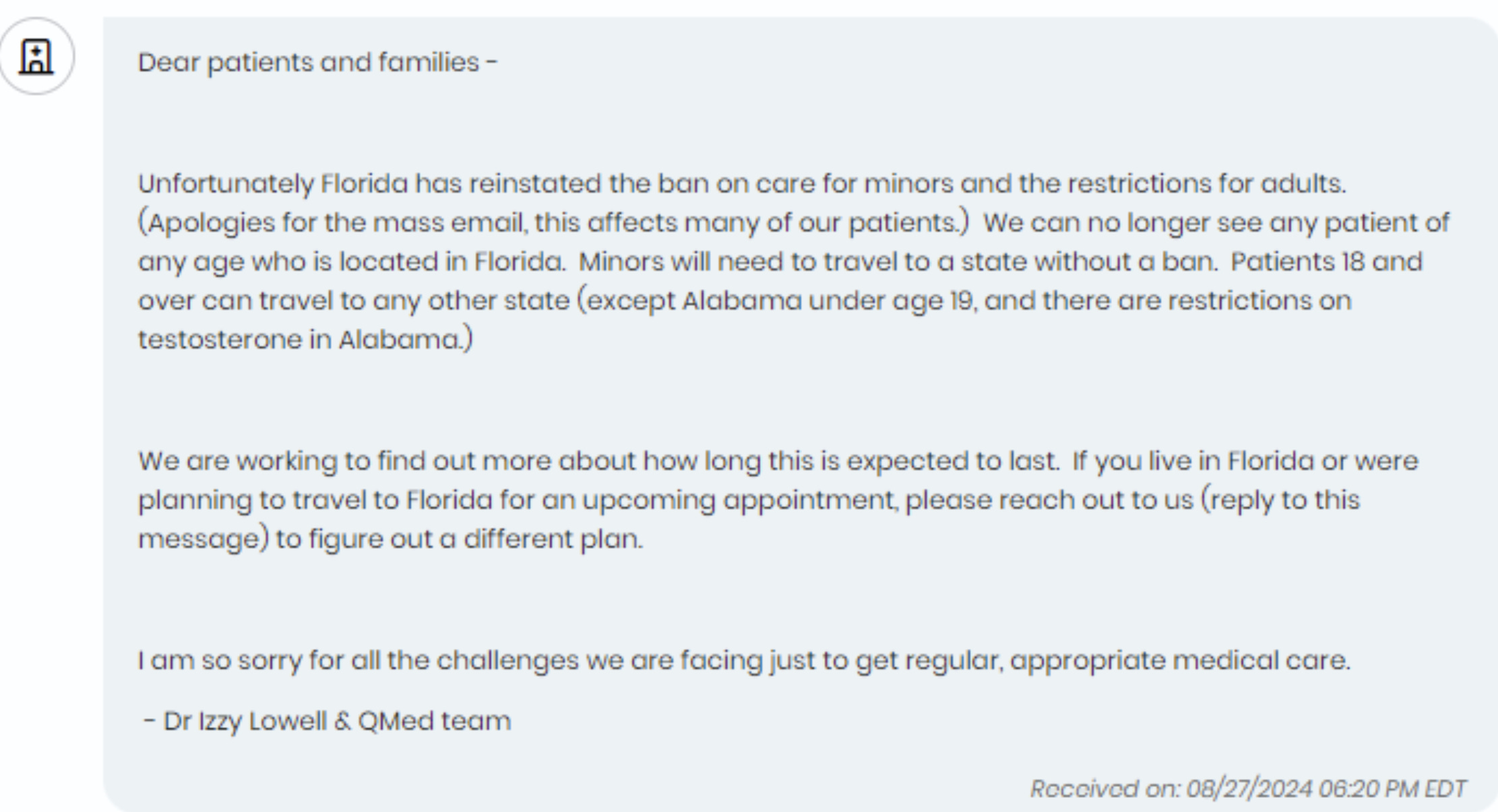
One anonymous patient shared an email from their provider, QueerMed, which stated, “Unfortunately, Florida has reinstated the ban on care for minors and the restrictions for adults… We can no longer see any patient of any age who is located in Florida.”
See that email here:
Spektrum, a major provider in Florida, was also forced to terminate care and cancel new patient appointments. However, during the period when the law was blocked, the organization reportedly took steps to ensure patients were well-supplied with medication in case the law went back into effect:
“During this little freedom period as I call it … we made good use of that time to make sure all of our patients were well supplied with medication. Although I had hoped that it wouldn’t have been necessary, at least now we can say, I’m glad we did all the things that we did,” said Joseph Knoll, a nurse practitioner at the clinic, as reported by the Associated Press.
Healthcare bans are currently a contentious issue in courts across the United States, with some courts blocking bans on transgender healthcare coverage or provision. A major point of contention is whether discrimination against transgender people qualifies as sex discrimination, which would subject these laws to higher scrutiny regarding their constitutionality.
The Supreme Court is poised to rule on such questions later this year in a case stemming from Tennessee’s trans care ban. If the Supreme Court were to rule that transgender people are not entitled to equal protection under the law, many forms of discrimination against transgender youth and adults could be deemed fully legal.
For trans people in Florida, many cannot afford to wait for such a decision, and many have already fled the state. For those unable to leave, disruptions to their care will likely have significant impacts on their mental and physical health.
“We are deeply disappointed by this decision and the panel’s disregard for the district court’s careful findings and adherence to the Eleventh Circuit’s recent precedent. Allowing these discriminatory restrictions to go back into effect will deny transgender adults and adolescents lifesaving care, and prevent Florida parents from making medical decisions that are right for their children. As the district court found based on voluminous evidence, the record shows that these extraordinary restrictions were based on disapproval of transgender people and serve no purpose other than to harm transgender Floridians. The plaintiffs in this case are considering their options and will take every step possible to protect their right to equal treatment under Florida’s laws, which these restrictions egregiously violate. We will continue fighting for transgender Floridians and their families, and for everyone’s right to make healthcare decisions without government interference,” said the organizations representing the plaintiffs in the case.
Important news from Janet!
Could courthouses provide the blueprint for safe transgender bathrooms?
Originally published by The 19th
Member support made it possible for us to write this series. Donate to our nonprofit newsroom today to support independent journalism that represents you.
Gunner Scott had a simple solution to making sure he had a trans-friendly bathroom when he served as a juror in Boston: Every day at lunch he left the building.
The year was 2009 and the Suffolk County Superior Court where Scott served as a juror for five days didn’t have a gender-neutral restroom. So, on his break, Scott walked up the street to his office.
“I heard one too many stories,” said Scott, who is a longtime transgender advocate.
The stories were about trans people being assaulted and harassed in bathrooms. Scott was not confident he could pass as male in a men’s room in 2009. More than that, his activism had made him a known public figure in the city. He feared someone would recognize him and target him for being trans and using a men’s restroom.
But over the years, as states have started to block trans people from using bathrooms and participating in other areas of public life, courtrooms have moved in the opposite direction by trying to make facilities available to people of all genders, experts say.
That movement is not only key to providing a roadmap for inclusivity for the nation. It also ensures that juries reflect the general population and that everyone gets the opportunity — or burden, in some cases — of serving on them.
Courtrooms may illustrate practical solutions to access as the nation grapples with increasing trans visibility and more traditional ideas about the safety and comfort of a larger public.
The issue of transgender accessibility in courts is a chapter in a longstanding fight for civil rights for LGBTQ+ Americans, prime targets of far-right legislation and discourse these days. The Equality Act, which bars discrimination on the basis of sexual orientation and gender identity, was first introduced to Congress 50 years ago but has never been passed into law. While its first draft only protected gay Americans, subsequent iterations have aimed to shield trans Americans from bias.
The Equality Act specifically mentions jury selection. The bill bans lawyers from striking queer jurors because they are LGBTQ+. Last year, Sen. Jeanne Shaheen of New Hampshire introduced a standalone bill to the same effect. Reps. Becca Balint of Vermont and Lizzie Fletcher of Texas are sponsoring the measure in the House, where it is unlikely to pass, at least while Republicans are the majority.
Balint told The 19th that courtroom accessibility is key to ensuring that jury pools reflect the makeup of the country.
“We need every American who is eligible to serve on a jury to be in the jury pool,” Balint said. “Conversations change concerning LGBTQ people when LGBTQ people are in the room, and when you exclude people from the judicial process, it makes the system inherently less free and less fair.”
Jury service and the belief that jurors should reflect the nation’s diversity is a closely held American belief today. Historically, though, juries were defined by their exclusivity. For centuries, women were banned or discouraged from jury duty because they were believed to be too fragile to handle criminal trials or deemed “the center of home and family life,” as stated in a 1961 Supreme Court ruling. Fourteen years later, the court ruled in Taylor v. Louisiana that systematically excluding them violated a defendant’s rights to a representative jury. But it wasn’t until 1994 that a decision around the Equal Protection Clause of the 14th Amendment specifically prohibited using gender to strike potential jurors.
Black Americans were barred from service due to slavery and after its abolition, discrimination. Even after the Civil Rights Act of 1875, which prohibited race-based jury selection, many states failed to enforce anti-discrimination protections, leading to lopsided convictions against people of color, a legacy that continues.
LGBTQ+ advocates have long argued that LGBTQ+ Americans, who face increased rates of hate violence and discrimination, also need federal protections to safeguard their presence in juries.
In legally recognizing trans people, states have faced increasing pressure to make government facilities accessible to them. In 2015, then-Boston Mayor Marty Walsh made headlines when he signed an executive order requiring gender-neutral bathrooms at City Hall.
Many courthouses have also installed gender-neutral options or found workarounds that allow trans and nonbinary people to safely use the court, say experts. The difference is that the change has largely gone unnoticed.
Ezra Young, a constitutional scholar and professor in New York, said he has seen even the most conservative courts put in extra effort to allow trans people bathroom access.
“I think one of the benefits of a judiciary is certain things about the very administration of the buildings aren’t really politicized,” Young said. “It’s under presumption that courts need to be generally accessible to people.”
Quite simply, the judicial system has no choice.
“Courts have a constitutional responsibility to make sure that courts are generally accessible to the public and specifically to people who need to use the court,” Young added.
Bathrooms have long been contested public spaces for marginalized groups, and courtrooms have not been immune. That means transgender access is not the first challenge facing court facility managers.
“Some of them didn’t even have women’s bathrooms until quite recently. Usually when reconstruction for bathrooms is done, they try to make sure things are accessible,” Young said.
Sandra Day O’Connor, the first woman to serve on the Supreme Court, encountered that problem in 1981 when she was sworn in.
“[The bathroom] was a long way down the hallway, so it wouldn’t have been convenient,” she told NPR in 2013. “And we had to find something in the way of a restroom that was near the courtroom that I would be able to use when we were back there or in the room where we discussed cases.”
Government buildings have undergone similar upgrades to make bathrooms accessible for people with disabilities since the Americans with Disabilities Act of 1990. Courthouses also reconfigured racially divided bathrooms and courtrooms in the wake of desegregation during the civil rights movement.
Now, all-gender access is the next goal for many municipalities. Nearly half of states (22 plus Washington D.C.) allow residents to opt for “X” gender markers on their state ID cards, and the federal government has been issuing “X” gender markers on passports for two years now. Just three states bar trans people from updating their IDs post-transition.
In Los Angeles County, officials have worked to ensure that every courthouse has a gender-neutral bathroom, according to a spokesperson for the superior court of the county.
“The Court supports inclusivity and seeks to expand access to justice by identifying and addressing barriers — substantive, procedural, physical and in appearance —that may inhibit full participation in the judicial process,” the court said in a statement.
In Cook County, which encompasses Chicago and has one of the world’s largest judicial systems, officials are engaged in research and design plans to add gender-neutral bathrooms to all of its courts. Such facilities already exist at the main courthouses for criminal court, domestic violence, juvenile cases and in the city branch courts.
Even today, Scott worries about violence and harassment in public restrooms. According to the 2015 U.S. Transgender Survey, 60 percent of trans people avoided using a public bathroom for fear of discrimination.
While trans people have gained acceptance in many areas of public life, data shows that discrimination remains high or has increased from a decade ago. A more recent survey in 2022 found that 47 percent of trans Americans considered fleeing their states because anti-trans laws, including bathroom bans, had made their communities less safe.
But Young, who is also transgender, hopes that courts today will provide visitors with a different experience than the one Scott had 15 years ago. For the most part, Young has had positive experiences as a trans person in courts. His transgender clients have, too.
That doesn’t mean that every court is perfect, he adds. Many still won’t have a gender-neutral bathroom, and often visitors will need to ask a judge for access. But Young thinks that most courts will aim to provide safety for trans people.
“They want to make sure that people can be in court,” Young said. That doesn’t necessarily mean that they might agree with the litigant just because of who they are, but they really do care about making sure that litigants and the broader public understand that they’re part of the overarching community.”
Are the Democrats and Kamala Harris anti-LGBTQ+, anti-trans, anti-Palestinians
Women’s Equality Day!
(Some references, and resources for the day, and every day to come!
Thanks and h/t to Women for Kansas -A)
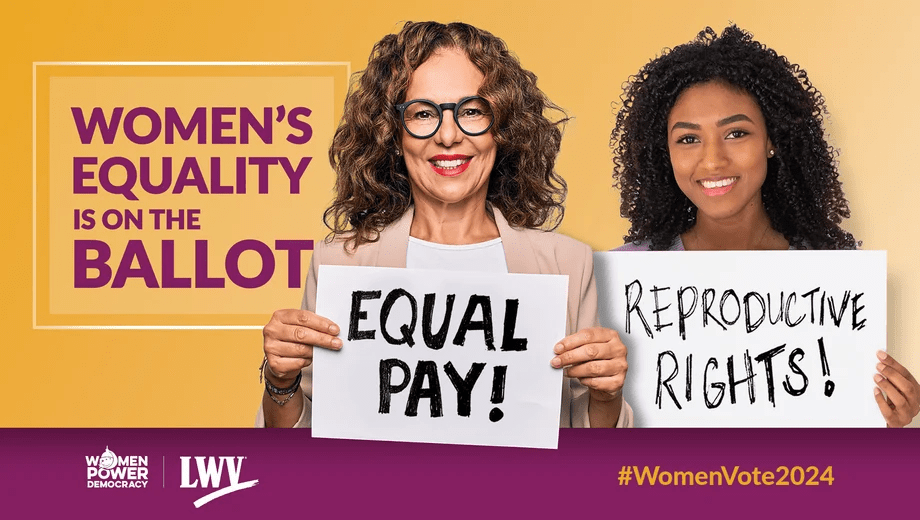
August 26, otherwise known as Women’s Equality Day, marks the anniversary of the certification of the 19th Amendment, which granted some women the right to vote.
Yet today, women have fewer rights than they’d had in decades. To recognize this, we acknowledge Women’s Inequality Day.
Empowering Women Voters in 2024
Women still aren’t equal under the law.
Inequality impacts our health: although women pay $15 million more each year for health care than men, we spend more of our lives in poor health. Those who may experience pregnancy no longer have reproductive freedom; and when we do give birth, we (particularly women of color) face high rates of maternal mortality.
It impacts our work: we’re paid less than our male counterparts and are underrepresented in leadership roles. We also deal with workplace harassment, insufficient maternal leave, and disproportionate caretaking responsibilities that affect our ability to work.
It impacts our representation: women are severely underrepresented in politics, making up only 25% of the Senate, 29% of the House, and 31.9% of statewide elective executives.
How can we make policies that protect and serve women without more women in office? And in an age where our basic freedoms and bodily autonomy are under fire, how can we ensure our rights aren’t degraded further?
The 2024 federal election is a critical moment in the fight for our equality.
The people we elect in November will be in charge of our rights – including the right to reproductive freedom – for the next four years.
So when you cast your vote in 2024, will you vote for someone who defends those rights? Or someone who wants to take them away?
Our 2024 campaign centers around empowering women to make their voices heard at the ballot box by equipping them with essential voter information. We’re highlighting our free, bilingual one-stop-shop for nonpartisan election information, VOTE411.org.
This year’s Women’s Inequality “Day” campaign will take place from August 26-30, with unique calls to action engaging voters every day! Get involved by sharing content via our social toolkit.
=====
International Women’s Day 2024 campaign theme is ‘Inspire Inclusion’
The campaign theme for International Women’s Day 2024 was Inspire Inclusion.
When we inspire others to understand and value women’s inclusion, we forge a better world.
And when women themselves are inspired to be included, there’s a sense of belonging, relevance, and empowerment.
Collectively, let’s forge a more inclusive world for women.
Read more about a definition of what it means to inspire inclusion here.
https://www.internationalwomensday.com/Theme
=====
BAD ROMANCE: WOMEN’S SUFFRAGE
Soomo, youtube.com
“Bad Romance: Women’s Suffrage is a parody music video paying homage to Alice Paul and the generations of brave women who joined together in the fight to pass the 19th Amendment, giving women the right to vote in 1920.” Watch here.
=====
| WOMEN’S PROGRESS THROUGH THE YEARS… |
| Prior to 1918 Doctor’s weren’t allowed to advise married patients about birth control. Prior to 1920 Women couldn’t vote in all elections until 19th Amendment was ratified. Prior to WWII Female teachers couldn’t be married. During 1950’s Domestic abuse was not considered a crime but a’family matter’. Prior to 1963 Equitable wages for the same work, regardless of race, color, religion, national origin, or sex of the workers were not promised until passage of Equal Pay Act. Prior to 1964 Discrimination on the basis of race, color, religion, national origin, or sex was not prohibited until passage ofthe Civil Rights Act. Prior to 1965 State laws could prohibit the prescription or use of contraceptives by married couples. In some states, the woman needed her husband’s permission to purchase contraceptives. Prior to 1969 Yale and Princeton didn’t accept female students. Prior to 1969 Women couldn’t work at jobs that had been for men only. Prior to 1971 Women with a law degree could be denied the right to plead a client’s case in court. Prior to 1971 Private employers could refuse to hire women with pre-school children. Prior to 1972 The Boston Marathon was an all-male event. There was no Women’s Division. Prior to 1972 The right to privacy didn’t encompass an unmarried person’s right to use contraceptives. Prior to 1972 Title IX of the Education Amendment didn’t exist. Schools that received Federal support didn’t need to provide the same programs to women as they did men. | Prior to 1973 Abortions weren’t legal in the entire U.S. until Roe v. Wade decision by Supreme Court declared the U.S. Constitution protected a woman’s right to terminate an early pregnancy. Prior to 1974 Housing discrimination on the basis of sex and credit discrimination against women existed. Prior to 1974 It was legal to force pregnant women to take maternity leave on the assumption they were incapable of working in their physical condition. Prior to 1974 Single, widowed, or divorced women had to bring a man along to open a bank account or to cosign any credit application. Married women couldn’t open a bank account without their husband’s permission. Prior to 1975 Women were excluded from serving on juries. Prior to 1976 West Point Academy didn’t admit female students. Prior to 1977 Harvard didn’t admit female students. Prior to 1978 There was no ban on discrimination against women on the basis of pregnancy, childbirth, or related medical issues. Prior to 1984 Women were not allowed to join all-male organizations (Jaycees, Kiwanis, Rotary, Lions) Prior to 1994 There were no funded services for victims of rape or domestic violence. Prior to 2013 Women in the military were banned from combat positions. Prior to 2022 Since the 1973 Supreme Court decision (Roe v. Wade), a woman’s right to terminate a pregnancy was protected by the U.S. Constitution. This decision was reverse by the current U.S. Supreme Court in 2022. Information provided by Soroptimist site. Learn more about Soroptimist’s by visiting their site here. |
LEARN MORE ABOUT THE HISTORY OF WOMEN’S EQUALITY DAY
National Women’s History Alliance
Read more here.
‘Legislators don’t see me as human’: Missouri trans youth fight to survive anti-LGBTQ+ bills
GOP lawmakers have made the state hostile for trans youth. These teens and their parents vow to ‘assert themselves’
https://www.theguardian.com/us-news/article/2024/aug/24/missouri-trans-youth-anti-lgbtq-bills
Some parents have stockpiled medications in hidden locations. Some have stopped socializing with neighbors. Some have made plans to flee the state.
In Missouri, transgender youth and their families are grappling with an onslaught of attacks on their rights. Last year, Republican lawmakers outlawed critical healthcare treatments for trans youth and banned many trans athletes from school sports. Local school districts worked to censor LGBTQ+ books and prohibit trans children from using bathrooms that match their gender identity.
And the state’s attorney general has become a national leader in anti-trans policy, seeking to gain access to trans kids’ medical records, fighting to restrict trans adults’ healthcare and attacking trans adults who use public locker rooms.
The state is one of the epicenters of the moral panic and anti-trans rhetoric that have dominated campaigns and media cycles during the presidential election. Under the guise of fighting the “indoctrination of our children”, Republicans have made restricting trans rights a focus of their platforms. Donald Trump has vowed to stop “the leftwing gender insanity” while a leading Missouri Republican has celebrated residents leaving the state due to anti-trans policies, saying: “We are better if they are gone.”
The toxic discourse has fomented fear and anger among conservatives about trans people’s increasing visibility in society and created deep anxiety and distress for queer and trans people and their families.
Parents of trans youth across the St Louis region interviewed for this article said they were desperately trying to protect their kids’ health and wellbeing as politicians have zeroed in on their children. They are rationing medications and traveling hours out of state for care. Some are counting the days until their kids turn 18 and the laws don’t apply; “We are truly doing what we can to keep our children alive,” said one mother of a trans boy.
“Kids are being told by their government that they have to be eradicated from public life,” said Chelsea Freels, a recent high school graduate from St Louis, who has become a vocal advocate for trans youth like herself. “I’m 18 now. I can handle it – ish. But I have to help the kids who are younger. It’s like Sisyphus pushing a boulder up a hill. You can help them get better, but then it’s gonna go back down.”
‘Legislators don’t see me as human’
Republicans in nearly every region of the US began introducing anti-trans legislation in 2021 as Joe Biden took office and the GOP and conservative legal groups made trans people a central target of their culture wars. The campaigns were fueled by false claims that trans girls were taking over women’s sports and kids were regularly undergoing “mutilating” surgeries to transition.
In Missouri, less than 1% of young people identify as trans, but lawmakers have made control over their lives an increasing priority.
“It’s stressful and physically and mentally exhausting,” said Corey Hyman, an 18-year-old trans man who has been testifying against anti-trans bills for roughly five years. “These legislators really didn’t take me seriously as a young kid, and they don’t see me as human. I just wish they’d give up.”
Republicans have long sought prohibitions on puberty blockers and hormone therapy, treatments that allow children to medically transition, which families can consider when trans youth are persistent and consistent about their gender identities. The treatments are part of the gender-affirming care model, which is endorsed by the American Academy of Pediatrics, American Medical Association and other major US medical groups. There has been growing global scrutiny of the medications, including in the UK, which recently adopted restrictions, but they remain part of the recommended standards of care in America.
In Missouri, Republicans’ efforts were boosted last year by a media firestorm at a St Louis clinic for trans youth. Jamie Reed, a former caseworker at the Washington University (WashU) transgender center at St Louis Children’s Hospital, publicly denounced the clinic in February 2023, alleging youth who might not actually be trans were being rushed into treatments. A group of patients publicly rebutted the claims, saying the care was methodical and vital. Families argued lawmakers should stay out of their private medical decisions, but the GOP governor last June adopted a law banning gender-affirming treatments for minors.
The law said youth already receiving treatments could continue. WashU, however, ceased prescribing medications to all trans youth, meaning families could no longer continue treatment at a top children’s hospital.
Christine Hyman, Corey’s mom, recalled listening to the Senate hearing in her car when the ban passed: “I’ll never forget that feeling. First I was screaming, then I was crying. I sat in my car for half an hour when I got home, thinking, ‘How do I tell my son?’”
Living under the anti-trans laws
In the backyard of their St Louis house, Danielle Meert and James Thurow have a luscious garden of herbs and fruit trees that has become their oasis – a respite from the anxiety of trying to raise a trans boy in Missouri. “To be in the garden, not distracted by the bullshit that has consumed us for the past four years has been wonderful,” Thurow said, sitting in his living room one recent afternoon.
“Then there’s the guilt.”
That guilt, the couple said, comes from feeling they could always be doing more to stop anti-trans bills and protect their son Miles, who was turning 18 the following day.
WashU prescribed Miles hormones at age 15, and the treatment had obvious benefits, he said: “I feel comfortable in public. I don’t feel out of place with my friends who are dudes. It just feels good for people to view you as you are.”
Meert said the family was prepared for the healthcare ban. “We’ve been stockpiling medication and hiding it around town with friends and families in case child services shows up and raids our house. People say we’re overreacting or being hysterical, but these Republicans think I belong in jail, that my child is the downfall of America … He’s just a happy kid living his best life.”
They had rationed Miles’s medications so he had enough for his final year underage, but during that time, he lost access to his doctor; the law threatens revoked licenses for practitioners.
Miles said he had become adept at managing stress from anti-trans bills, joking of the sports bans: “It’s not like trans and gay people are known for their athleticism.” He knows how to calm his mother when she suffers panic attacks. He extends grace to those who oppose his rights, saying he understands people have questions about something unfamiliar.
He felt “very relieved” to turn 18, making his care lawful again. But he worries about younger kids.
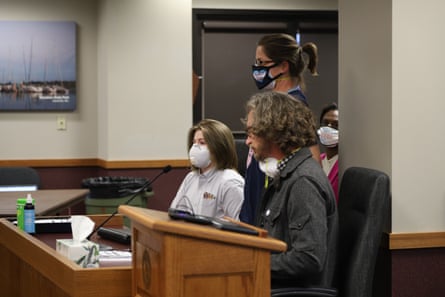
One St Louis mother of a 12-year-old trans boy has spent months talking to clinics in Illinois, Maryland, Minnesota and Michigan to try to find care for her son, who had been seen by WashU.
At a young age, the boy had repeatedly spoken of dying. “He didn’t want to grow up because he knew what that would look like,” said the mother, who requested anonymity to protect her son’s privacy. Once he started living as a boy and received gender-affirming treatment, his anger issues dissipated and he excelled at school, she added.
She scoffed at the media narrative that parents were trying to turn their kids trans. “You wouldn’t wish this upon anyone – for your child to feel uncomfortable in their body. But you do have to give freedom to children to tell you if something is wrong. You have to be loving and affirming and open to your child’s journey.”
In November, WashU sent her a letter expressing “deep regret” that a former staffer had publicly discussed her family’s treatment – an apparent reference to Reed, the former caseworker, who seemed to suggest in the media that this mother was rushing treatments.
“I was working with world-class doctors and the brightest minds in this science – how can that be wrong, how can that be illegal, how can that be bad parenting? I’m not denying my child medical care. I’m making sure I comply with the best practices,” said the mother, who provided records indicating there were roughly three years of appointments before her son got puberty blockers, which doctors recommended.
Her boy will soon need additional treatment. She has scheduled an initial appointment in Chicago, but she is anxious about travel costs and worried she will have to take medical leave. “This has robbed us of joy,” she said. “I hate counting the years until my son is 18 and he can move where he wants and go get care. I hate that I’m rushing his young, beautiful life to beat the legislative actions mandating what he can do.”
Reed declined to comment on the mother’s story and criticisms of her efforts, but has previously stood by her claims and continued to argue that the “clinic was harming kids” with medical interventions.
A ‘nightmare’ at schools
Missouri Republicans’ efforts have not stopped at healthcare. Earlier this year, lawmakers proposed bills to end legal recognition of trans people, prevent trans people from using facilities that match their gender identity in schools and workplaces and criminalize teachers who use trans students’ pronouns.
The bills did not pass, but LGBTQ+ families say the demeaning debates and news cycles have taken a toll. Some said they encountered bullying at school, hateful comments from neighbors and casual transphobia at social gatherings. Others said they were forced to cut off relatives who had absorbed misinformation or refused to use correct names and pronouns. Some outspoken advocates said they feared for their safety. Several parents said the stress had made them physically ill.
At one school board meeting last month in St Charles county, a more conservative county neighboring St Louis, queer and trans youth and their supporters sat through a lengthy discussion surrounding a proposal to make it easier for civilians to challenge potentially “obscene” materials – a move seen as an effort to increase censorship of LGBTQ+ content. Some attendees held “trust our teachers and librarians” signs and a trans pride flag, applauding when a student criticized the removal of queer characters from shelves; another speaker said kids shouldn’t be exposed to “sexual scenes”.
Toward the end of the meeting, a board member gave a speech about her disdain for trans youth using locker rooms, an item not on the agenda.
Youth protesters and parents of trans kids gathered at the end of the meeting to commiserate.
“The trans community is burning to the ground here. It’s a nightmare. Where are the national LGBTQ+ organizations?” said Kim Hutton, who has a trans son.
“They frame these policies as ‘protecting the children’, but they’re really just hurting specific marginalized groups. It’s not fun to see when you’re part of those marginalized groups,” said Hannah Yurkovich, a 17-year-old St Louis high schooler at the meeting. “I grew up here, I love St Louis, but I can’t be part of it, if it’s going to keep being against who I am.”
Her friend, Rohan Webb, 18, attended a neighboring high school that adopted gender-neutral bathrooms to better support LGBTQ+ students and had queer support groups. “To see this school district move in the exact opposite direction is saddening,” they said. “To see them getting to make students’ lives so much worse is infuriating.”
‘Will Democrats throw us to the fire?’
Trans Missourians and their families say they have endured by leaning on each other. Families carpool to government hearings. A regional summer camp provides a safe haven for LGBTQ+ youth. Rene and Kyle Freels, the parents of Chelsea, the recent high school graduate, run a support group for trans kids and parents, and they have organized “Transgiving” potlucks for Thanksgiving.
Chelsea has dedicated significant time to supporting trans youth who don’t have the resources she has had. Over breakfast at a queer-friendly cafe with her parents, she described how she assists others in legally changing their name, saying she had just received a court alert about a case she was managing.
“It’s all in the bucket of preventing suicidality,” Chelsea said matter-of-factly. “That is what worries me the most about going to college, because sometimes I have to talk them down … What happens if I’m not in St Louis?” She said she has been fighting to stop friends’ suicides since she was 15 and learned to always gets friends’ addresses in cases of emergencies.
“The public only hears from trans people in the positions of the highest of privileges. I have supportive parents, I’m white, I’m 18, I got healthcare – later than I needed it, but I got it. But my story is one aspect of the trans story, and it’s one of the better ones, and even it is filled with sadness.”
Chelsea, who is leaving the state for college and is interested in coding and liberal arts, said she felt disillusioned with politics. On the Republican side, people were using “genocidal rhetoric” to talk about trans people, she said, referencing calls for the “eradication of transgenderism” at last year’s Conservative Political Action Conference and demonization of trans people in the Trump-aligned Project 2025.
On the Democratic side, candidates defend trans rights, but it feels fragile, she said.
“The Democrats in Missouri are our allies, they’re the best support we have in the chamber, but there’s an anxiety they won’t always be that way. When shit hits the fan, they’ll say, is it worse to be out of office and standing on your morals, or is better to just throw a little bit to the fire? But the thing they’re throwing to the fire are my friends and family.”
The Freels considered relocating to Illinois last year, but couldn’t afford it.
“There will always be trans kids and they will be out and asserting themselves,” Rene Freels said. “We’re part of this leftover crew that is super mad and stubborn and wants to see this resolved and want our kids to have full civil rights.”
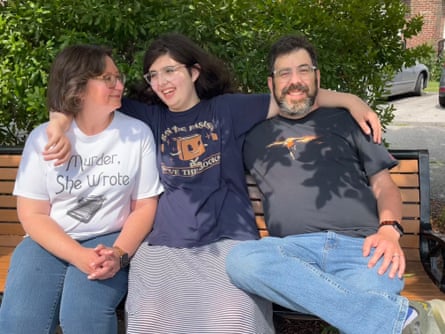
Miles, who hopes to become a teacher or work with youth, said leaving is not an option: “I’ve always wanted to stay here. It sounds weird, but I really love Missouri. I have so many memories here and I could see myself raising my kids here.”
Missouri is where he spent his whole life, where his favorite restaurants and hiking trails are, where his girlfriend and her family live, where he had his first date, he said.
He can’t imagine moving away from his elderly grandparents, who he stays with on a weekly basis. “I have a plan for my life,” he said, “and I couldn’t imagine doing it somewhere else.”
Throughout Meert and Thurow’s home are objects they have repurposed from friends who left the state due to anti-trans laws.
In the garden, the couple recently put up a sign saying they had planted beans “in remembrance of the 50+ families we know that have left Missouri”. But the number of departures is greater, she said. They’ve lost count.
 Scottie's Playtime