Peace & Justice History for 1/18

An example of actual “cancel culture” within, plus more.

January 18, 1919
The peace conference to negotiate the end of the Great War (now know as World War I) opened in Paris, France. President Woodrow Wilson spent several months in Europe personally negotiating details of what became the Treaty of Versailles with heads of the allied powers or their foreign ministers.
January 18, 1962
The U.S. began spraying herbicides on foliage in Vietnam to eliminate jungle canopy cover for Viet Cong guerrillas (a policy known as “territory denial”).The U.S. ultimately dropped more than 20 million gallons of such defoliants, sparking charges the United States was violating international treaties against using chemical weapons. Many of the herbicides, particularly Agent Orange, manufactured by Dow Chemical, Monsanto and others, were later found to cause birth defects and rare forms of cancer in humans.

Agent Orange:Β An Ongoing AtrocityΒ 
January 18, 1968
Invited to a Women Doers luncheon at the Johnson White House, Eartha Kitt, singer and actor, spoke out about the effect of the Vietnam War on America’s youth. Lady Bird Johnson had convened 50 whites and Negroes to discuss President Lyndon Johnson’s anti-crime proposals.
Ms. Kitt first asked the President, β€œwhat do you do about delinquent parents, those who have to work and are too busy to look after their children?” He said that there was Social Security money for day care, and the group should discuss such issues.
Later, she told the women that young Americans were “angry because their parents are angry . . . because there is a war going on that they don’t understand . . . You send the best of this country off to be shot and maimed. They rebel in the street. They will take pot . . . and they will get high. They don’t want to go to school because they’re going to be snatched off from their mothers to be shot in Vietnam.”

Eartha Kitt and Lady Bird Johnson
Eartha Kitt’s career took a severe downturn after this; for years afterward, Kitt performed almost exclusively overseas, while being investigated by several federal agencies.
“The thing that hurts, that became anger, was when I realized that if you tell the truth – in a country that says you’re entitled to tell the truth – you get your face slapped and you get put out of work,” Kitt told Essence magazine two decades later.
January 18, 1971
In a televised speech, Senator George S. McGovern (D-South Dakota) began his anti-war campaign for the 1972 Democratic presidential nomination. He vowed to bring home all U.S. soldiers from Vietnam if elected. McGovern had served in the Army Air Corps during World War II, earning the Silver Star and the Distinguished Flying Cross.

George McGovern
β€œ. . . we must have the courage to admit that however sincere our motives, we made a dreadful mistake in trying to settle the affairs of the Vietnamese people with American troops and bombers . . . .
β€œ But while our problems are great, certain steps can be taken to recover the confidence of the nation.Β  The greatness of our nation is not confined to the past, but beckons us to the future.
Β 
January 18, 1985
Though a member of the World Court since 1946, the United States walked out during a case. The Court had charged the U.S. was in violation of international law through its support of paramilitary (Contra) activities against the Nicaraguan government. Efforts to undermine the Sandinista government in Nicaragua had been a keystone of Pres. Reagan’s anti-communist foreign policy from its inception.
Congressman Michael Barnes (D-Maryland) said he was “shocked and saddened that the Reagan Administration had so little confidence in its own policies that it chose not even to defend them [in the World Court].”
The Court still heard Nicaragua’s case and decided against the United States, and ordered it to pay reparations to Nicaragua in June 1986.
January 18, 1996
The Zapatista National Liberation Army (EZLN) and the Mexican government reached an agreement in San Andres to recognize and guarantee the constitutional, political, social, cultural, and economic rights of indigenous peoples in Mexico. Treated as second-class citizens since the first colonial entry into their country, the document guaranteed the autonomy and right to self-determination of native communities within the pluricultural Mexican nation.
The Zapatistas took their name from Emilano Zapata who played a major role in the Mexican Revolution early in the 20th century.When they began their revolt in Chiapas state on New Year’s Day of 1994, They wrote:
“We have nothing to lose, absolutely nothing, no decent roof over our heads, no land, no work, poor health, no food, no education, no right to freely and democratically choose our leaders, no independence from foreign interests, and no justice for ourselves or our children.
But we say enough is enough! We are the descendants of those who truly built this nation, we are millions of dispossessed, and we call upon all our brethren to join our crusade, the only option to avoid dying of starvation!”

The Mexican government, despite their signature on the agreement, refused later to implement it.


More background on the ZapatistasΒ 
January 18, 2003
Β 
In frigid temperatures, 500,000 converged on Washington, D.C.
There were also joined by many more elsewhere around the world to oppose the threatened U.S. war on Iraq.


Anti-war protesters march past the U.S. Capitol during the start of an anti-war protest that will culminate by a march to the Washington Naval Yard.Egyptian riot police and anti-war demonstrators face off in Cairo, Egypt. Banners at top read, ” Iraq . . . Another war for oil and American supremacy.
This was the largest U.S. peace demonstration since the Vietnam era.Β 
Β 
< Pakistani peace activists hold a rally in Karachi.Β > Crowds estimated at 80,000 fill the civic center of San Francisco, California

https://www.peacebuttons.info/E-News/peacehistoryjanuary.htm#january18
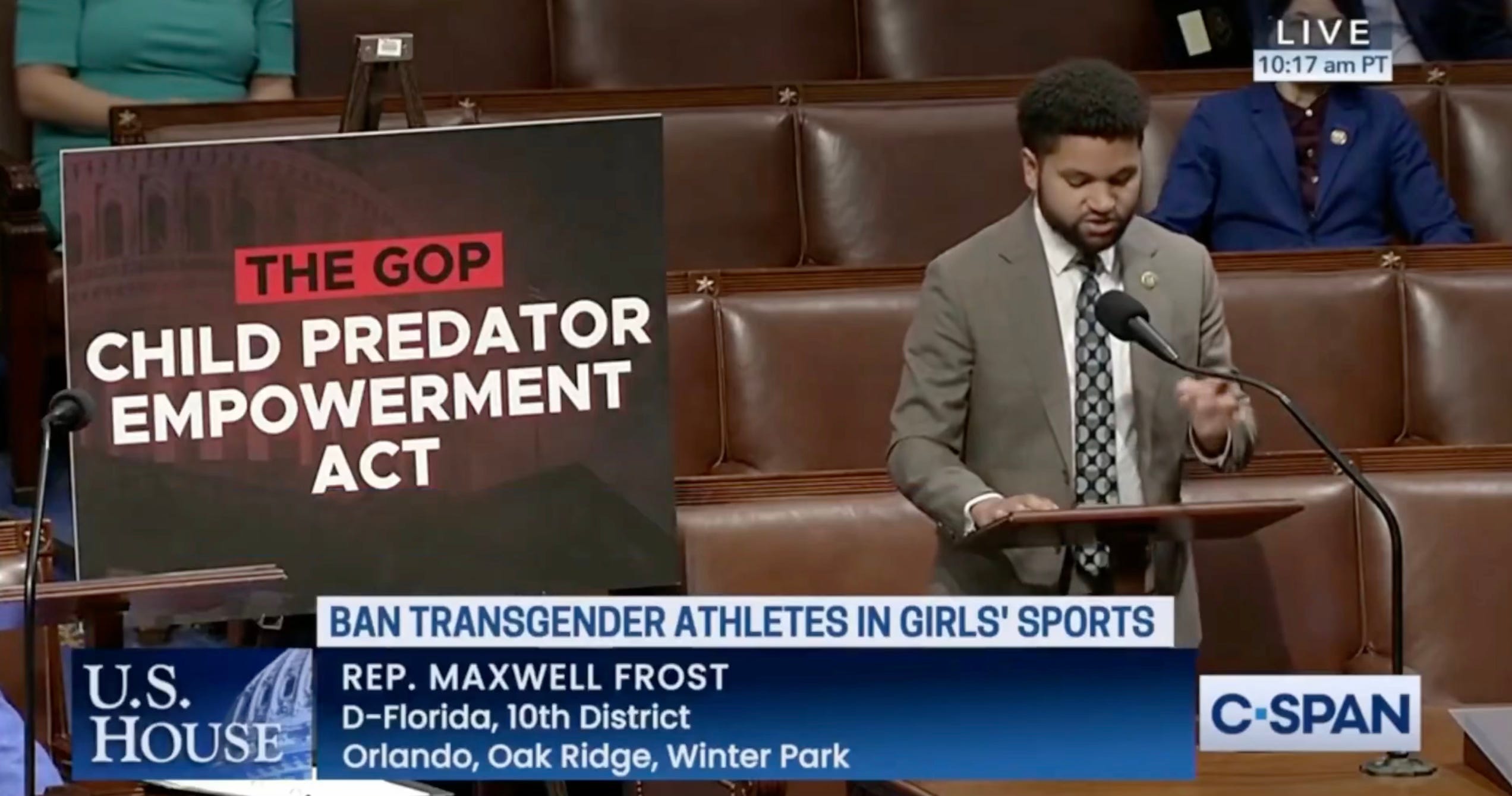
“The GOP Is Passing Anti-Trans Bills, But Damn The Dems Are Actually Fighting!”

by Crip Dyke Jan 17, 2025 | Rebecca Schoenkopf

Where’d all these shivs come from all of a sudden? Read on Substack

Maxwell Frost represents the 10th House District of Florida. I dutifully looked that up for you before realizing it’s right there on the screen.

Over the last three years, the states have been on fire with anti-trans legislation, bathroom bills, healthcare bans, and most recently sports segregation bills. In 2024, the Heterosexism Santa Anas whipped these flames into a an actual fire tornado. But on Tuesday this week, Republican Congress members took new action that might just reverse this trend: They decided to take away states’ rights to regulate trans bodies and start making these bans national. First up was an amendment to Title IX that would ban trans sports participation. Grotesquely titled the β€œProtection of Women and Girls in Sports Act of 2025,” HB 28 passed the House 218-206 β€” but its fate in the Senate is uncertain given the 60 votes needed to break a filibuster (there are 53 Republicans in the Senate this year). If it reaches Trump’s desk, he’s guaranteed to sign it.

What’s more clear than the GOP’s chances to get the bill through the Senate, however, is that the Democratic approach to this Republican proposal is very different from how they have responded to anti-trans efforts in the past. This week only two Dems sided against trans people, Henry Cuellar and Vicente Gonzalez. (Both represent Texas swing districts, if that matters to you.) But more importantly than the relative unity of the Democrats β€” even from Reps. Tom Suozzi and Seth Moulton who just recently decided to broadside the party for liking trans people so much they threw the election β€” they actually sounded a bit salty that the GOP was trying this shit on their watch. Almost like hating trans people was an affront to their values or something.

Alexandria Ocasio-Cortez got a lot of attention for her speech:

She started on fire by calling out infamous anti-woman actions to make it clear that she isn’t buying GOP protestations that the bill is somehow motivated by concern for girls and women. Then she hit them for what they were actually doing:

β€œ[You] open up gender, and, yes, genital examinations into little girls in this country in the so-called name of attacking trans girls. To that, today, what we have to say are two words: Not today.

β€œThe majority right now says there is no place in this bill that says it opens up for genital examinations. Well, here is the thing: There is no enforcement mechanism in this bill. When there is no enforcement mechanism, you open the door to every enforcement mechanism.”

She also stressed that having these laws on the books limits the freedoms of cis (that is, β€œnon-trans” if you’re new) women and girls:

β€œWhat this also opens the door for is for women to try to perform a very specific kind of femininity for the very kind of men who are drafting this bill, and to open up questioning of who is a woman because of how we look, how we present ourselves, and yes, what we choose to do with our bodies.”

AOC wasn’t the only one to body the misogynistic GOP. Congresswoman Sara Jacobs sharpened her shiv and stuck it right in,

β€œThis bill doesn’t even come close to protecting women and girls in sports. In fact, it puts all women and girls in danger of sexual abuse.”

Lori Trahan, the only woman Division-1 athlete in Congress, attacked on the same line, this time asking, What about the children?

β€œ[T]he consequences of that approach will be devastating: Girls as young as 4 years old being subjected to invasive lines of questioning about their bodies and even physical inspections by an adult, a stranger, a predator, all because some creep accuses them of not being a girl. What parent would want to put their daughter through that? I know I wouldn’t.”

Brand new Congressman Rep Maxwell Frost turned up the heat even more, if that’s possible, giving a few small but horrifying details about a recent investigation into a volleyball player in his home state of Florida. And he did it in front of a sign naming HB 28 β€œThe GOP Child Predator Empowerment Act.”

That’s some shit, y’all. His video was posted to Twitter, which I will link this one time, because he’s almost as good at this as AOC.

And this Dem messaging? It got under Republican skin. When secret Wonkette girl crush Rep. Jasmine Crockett accused Nancy Mace of whipping up cissexism as a fundraising tactic, Mace actually challenged Crockett to step outside and fight. Joy Reid had a great take on this, but there’s nothing funnier than Mace herself, thinking she can take Crockett on when just five weeks ago she had her arm in a sling from shaking a man’s hand (yr Wonkette did not see any evidence she’d even visited medical staff or had any injury diagnosed, but damn that sling was sure real for a couple days).

This is, to use a technical term usually found only in the official records of the Parliamentarian of the Housesome cool ass shit. I know that many of us have been waiting for Dems to hit the GOP and hit them hard when they come after minorities or rights or values that we on the Left would like to see them protect. So folks have to be wondering, what woke them up?

Though your friendly, neighborhood Crip Dyke doesn’t have hard information, it would be irresponsible not to speculate that last November’s election made a difference. And by this we mean not only the elevation of Trump, once again, to head of the executive branch which may indeed have lit a fire in some, but also the election of Sarah McBride, an election which elevated the entire US House of Representatives by finally making it possible for a trans legislator to participate in debates on the bills that target us.

Many noticed that McBride didn’t instantly and loudly fight back when Nancy Mace attacked her personally, using McBride’s election as an excuse to pass new bathroom restrictions for those working on Capitol Hill. But as yr Wonkette reminded at the time:

McBride [needs] a chance to work, a chance to develop reputation and influence. She needs to do some very careful relationship building now.

The House Dems did a fantastic job of articulating exactly how government interest in girls’ bodies becomes a predatory risk for cis and trans folks alike. But it wasn’t cis people that first noticed the problem or developed the argument. I know because I had to come up with these observations and arguments in 1996 without any cis help at all, and I spent 14 years teaching cis people patiently, over and over, how transphobia, like homophobia, is a weapon of sexism.

Whether McBride was secretly organizing Democratic rhetorical strategies and asking cis folks to take the point so that she couldn’t be marginalized as a trans radical, it’s certainly not an accident that it is now that congressional Dems are spending time on a daily basis talking to a real live trans person that they are figuring out how to talk about trans issues. Here’s hoping they’ll continue to make the GOP majorities bigoted victories more and more costly.

Suggestions for Resources, Actions

Building an open web that protects us from harm

We live in a world where right-wing nationalism is on the rise and many governments, including the incoming Trump administration, are promising mass deportations. Trump in particular has discussed building camps as part of mass deportations. This question used to feel more hypothetical than it does today.

Faced with this reality, it’s worth asking: who would stand by you if this kind of authoritarianism took hold in your life?

You can break allyship down into several key areas of life:

  • Who in your personal life is an ally?Β (Your friends, acquaintances, and extended family.)
  • Who in your professional life is an ally?Β (People you work with, people in partner organizations, and your industry.)
  • Who in civic life is an ally?Β (Your representatives, government workers, individual members of law enforcement, healthcare workers, and so on.)
  • Which service providers are allies?Β (The people you depend on for goods and services β€” including stores, delivery services, and internet services.)

And in turn, can be broken down further:

  • Who will actively help you evade an authoritarian regime?
  • Who will refuse to collaborate with a regime’s demands?

These two things are different. There’s also a third option β€” non-collaboration but non-refusal β€” which I would argue does not constitute allyship at all. This might look like passively complying with authoritarian demands when legally compelled, without taking steps to resist or protect the vulnerable. While this might not seem overtly harmful, it leaves those at risk exposed. As Naomi Shulman points out, the most dangerous complicity often comes from those who quietly comply. Nice people made the best Nazis.

For the remainder of this post, I will focus on the roles of internet service vendors and protocol authors in shaping allyship and resisting authoritarianism.

For these groups, refusing to collaborate means that you’re not capitulating to active demands by an authoritarian regime, but you might not be actively considering how to help people who are vulnerable. The people who are actively helping, on the other hand, are actively considering how to prevent someone from being tracked, identified, and rounded up by a regime, and are putting preventative measures in place. (These might include implementing encryption at rest, minimizing data collection, and ensuring anonymity in user interactions.)

If we consider an employer, refusing to collaborate means that you won’t actively hand over someone’s details on request. Actively helping might mean aiding someone in hiding or escaping to another jurisdiction.

These questions of allyship apply not just to individuals and organizations, but also to the systems we design and the technologies we champion. Those of us who are involved in movements to liberate social software from centralized corporations need to consider our roles. Is decentralization enough? Should we be allies? What kind of allies?

This responsibility extends beyond individual actions to the frameworks we build and the partnerships we form within open ecosystems. While building an open protocol that makes all content public and allows indefinite tracking of user activity without consent may not amount to collusion, it is also far from allyship. Partnering with companies that collaborate with an authoritarian regime, for example by removing support for specific vulnerable communities and enabling the spread of hate speech, may also not constitute allyship. Even if it furthers your immediate stated technical and business goals to have that partner on board, it may undermine your stated social goals. Short-term compromises for technical or business gains may seem pragmatic but risk undermining the ethics that underpin open and decentralized systems.

Obviously, the point of an open protocol is that anyone can use it. But we should avoid enabling entities that collude with authoritarian regimes to become significant contributors to or influencers of open protocols and platforms. While open protocols can be used by anyone, we must distinguish between passive use and active collaboration. Enabling authoritarian-aligned entities to shape the direction or governance of these protocols undermines their potential for liberation.

In light of Mark Zuckerberg’s clear acquiescence to the incoming Trump administration (for example by rolling back DEI, allowing hate speech, and making a series of bizarre statements designed to placate Trump himself), I now believe Threads should not be allowed to be an active collaborator to open protocols unless it can attest that it will not collude, and that it will protect vulnerable groups using its platforms from harm. I also think Bluesky’s AT Protocol decision to make content and user blocks completely open and discoverable should be revisited. I also believe there should be an ethical bill of rights for users on open social media protocols that authors should sign, which includes the right to privacy, freedom from surveillance, safeguards against hate speech, and strong protections for vulnerable communities.

As builders, users, and advocates of open systems, we must demand transparency, accountability, and ethical commitments from all contributors to open protocols. Without these safeguards, we risk creating tools that enable oppression rather than resisting it. Allyship demands more than neutrality β€” it demands action.

https://werd.io/2025/building-an-open-web-that-protects-us-from-harm

Letters from An American

January 9, 2025 by Heather Cox Richardson Read on Substack

Family members, friends, and political leaders gathered today at the Washington National Cathedral to honor the life of former president Jimmy Carter, who died on December 29 at age 100. All five living presidents and most of their wives attended: George W. Bush and Laura Bush were there, along with Bill Clinton and former secretary of state Hillary Clinton, Barack Obama, Donald Trump and Melania Trump, and Joe Biden and Dr. Jill Biden.

Trump’s former vice president Mike Pence and his wife, Karen, were also there, meeting Trump for the first time since January 6, 2021, when Trump tweeted to the rioters attacking the U.S. Capitol that Pence β€œdidn’t have the courage to do what should have been done to protect our Country and our Constitution,” redoubling the crowd’s fury and sparking chants of β€œHang Mike Pence.”

Pence shook Trump’s hand; his wife stayed seated, looking straight ahead. While Obama, sitting next to Trump, spoke to him, former president Bush refused to acknowledge Trump, instead walking past him and giving a familiar greeting to Obama.

By virtue of living to age 100, Carter survived many of his contemporaries, and some left behind eulogies for him. Carter’s vice president, Walter Mondale, died in 2021 but recorded his memories of working with Carter in the White House from 1977 to 1981. His son Ted Mondale read the eulogy at today’s service.

Mondale recalled how he and Carter had redefined the role of the vice president of the United States, which had fallen into eclipse when President George Washington shut his own vice president, John Adams, out of his central circle of advisors and never recovered. Mondale recalled that Carter had honored his wish to change that pattern by becoming a full partner in the administration. Carter conferred with him regularly, put him in charge of certain central issues, and the two men became close friends.

Mondale also remembered that Carter was farsighted, ignoring short-term political interests to protect the next generations from harm. He tried to put the nation on a path that would find alternatives to fossil fuels, and did his best to advance women’s rights. He pushed for a law to extend the time for states to approve the Equal Rights Amendment to the Constitution to make women’s equality part of the nation’s fundamental law, and he appointed women to positions in his administration and the federal judiciary. Mondale noted that Carter β€œappointed five times as many women to the federal bench as all of his predecessors combined.”

Mondale recalled Carter’s β€œextraordinary years of principled and decent leadership, [and] his courageous commitment to civil rights and human rights.” He recalled that toward the end of their time in the White House, in the years immediately after the tumultuous years of President Richard Nixon, with his covert bombing of Cambodia and cover-up of the Watergate break-in, the two men were summing up their administration. The sentence they came up with was: β€œWe told the truth, we obeyed the law, and we kept the peace.”

President Gerald Ford also left behind a eulogy for Carter, who had defeated Ford’s reelection attempt in 1976. Despite their political differences, the two men had become friends in 1981 when they traveled to and from the funeral of Egyptian president Anwar Sadat, who along with Israel’s Menachem Begin had signed the 1978 Camp David Accords negotiated by Carter’s administration that established a framework for a peace treaty between Israel and Egypt. Over time, Ford and Carter became close friends and agreed to deliver eulogies for each other.

Carter fulfilled his promise in 2006, and today Ford’s son Steve fulfilled his father’s.

Ford spoke to Carter’s deep faith in God when he noted that the former president β€œpursued brotherhood across boundaries of nationhood, across boundaries of tradition, across boundaries of caste. In America’s urban neighborhoods and in rural villages around the world, he reminded us that Christ had been a carpenter.” β€œI’m looking forward to our reunion,” Ford concluded. β€œWe have much to catch up on. Thank you, Mr. President. Welcome home, old friend.”

Carter’s grandson Jason Carter, chair of the Carter Center’s board of trustees and a former Georgia state senator, emphasized Carter’s integrity: his grandfather’s political convictions reflected his private beliefs. β€œAs governor of Georgia half a century ago, he preached an end to racial discrimination and an end to mass incarceration. As president in the 1970s…he protected more land than any other president in history…. He was a climate warrior who pushed for a world where we conserved energy, limited emissions, and traded our reliance on fossil fuels for expanded renewable sources. By the way, he cut the deficit, wanted to decriminalize marijuana, deregulated so many industries that he gave us cheap flights and…craft beer. Basically, all of those years ago, he was the first millennial. And he could make great playlists.”

Jason Carter called his grandfather’s life a β€œlove story, about love for his fellow humans and about living out the commandment to love your neighbor as yourself.” He highlighted his grandfather’s work to bring cases of Guinea worm disease from 3.5 million cases in humans every year to fourteen.

Carter noted that β€œthis disease is not eliminated with medicine. It’s eliminated…by neighbors talking to neighbors about how to collect water in the poorest and most marginalized villages in the world. And those neighbors truly were my grandfather’s partners for the past forty years [and have] demonstrated their own power to change their world.” When Jimmy Carter β€œsaw a tiny 600-person village that everybody else thinks of as poor, he recognized it. That’s where he was from. That’s who he was.” He saw it as β€œa place to find partnership and power and a place to carry out that commandment to love your neighbor as yourself. Essentially, he eradicated a disease with love and respect. He waged peace with love and respect. He led this nation with love and respect.”

President Joe Biden, who was the first senator to endorse Carter’s run for president in 1976, also gave a eulogy today. In what appeared to be a reflection on the incoming president in the audience, who for years has mocked Carter as the worst president in history, Biden focused on what he called Carter’s β€œenduring attribute: character, character, character.” And, Biden said, quoting the famous saying from ancient Greek philosopher Heraclitus: β€œCharacter…is destiny,” both in our lives and in the life of the nation.

Carter taught him, Biden said, that β€œstrength of character is more than title or the power we hold. It’s the strength to understand that everyone should be treated with dignity, respect. That everyone, and I mean everyone, deserves an even shot. Not a guarantee, but just a shot…. [W]e have an obligation to give hate no safe harbor, and to stand up to what my dad used to say is the greatest sin of all: the abuse of power.”

Character, Biden said, is not about being perfect, for none of us are perfect. It’s about β€œasking ourselves: Are we striving to do…the right things?… What are the values that animate our spirit? To operate from fear or hope, ego or generosity? Do we show grace? Do we keep the faith when it’s most tested?”

Biden noted that Carter lived a faith that commanded its adherents to love their neighbors. He also noted that such a commandment is hard to follow, and that it requires action. It is, he said, the essence of the Gospel and many other faith traditions, and it is also β€œfound in the very idea of America. Because the very journey of our nation is a walk of sheer faith. To do the work, to be the country we say we are, to be the country we say we want to be: a nation where all are created equal in the image of God and deserve to be treated equally throughout our lives.”

β€œWe’ve never fully lived up to that idea of America,” Biden said, but thanks to patriots like Jimmy Carter, β€œ[w]e’ve never walked away from it either.”

Carter was β€œ[a] white Southern Baptist who led on civil rights. A decorated Navy veteran who brokered peace. A brilliant nuclear engineer who led on nuclear nonproliferation. A hard-working farmer who championed conservation and clean energy.” He β€œalso established a model post-presidency by making a powerful difference as a private citizen in America,” Biden said, showing β€œus how character and faith start with ourselves and then flow to others.”

β€œAt our best,” Biden said, β€œwe share the better parts of ourselves: joy, solidarity, love, commitment. Not for reward, but in reverence for the incredible gift of life we’ve all been granted. To make every minute of our time here on Earth count.”

β€œThat’s the definition of a good life,” Biden said. It was the life Jimmy Carter lived for 100 years: a β€œgood life of purpose and meaning, of character driven by destiny and filled with the power of faith, hope, and love.”

β€”

Notes:

https://americanoversight.org/timeline/224-p-m/

https://people.com/karen-pence-refuses-greet-donald-trump-jimmy-carter-funeral-8772193

https://www.pbs.org/wgbh/americanexperience/features/adams-vice-presidency/

https://www.cbsnews.com/minnesota/news/jimmy-carter-eulogy-walter-mondale-full-text/

https://www.msnbc.com/top-stories/latest/read-gerald-ford-jimmy-carter-eulogy-full-text-rcna187015

https://www.savannahnow.com/story/news/politics/2025/01/09/jason-carters-speech-highlights-at-jimmy-carters-national-funeral/77578405007/

https://www.cnbc.com/2022/06/28/jan-6-hearing-trump-thought-pence-deserved-chants-to-hang-him-aide-says.html

https://www.pbs.org/newshour/politics/watch-jason-carter-honors-his-grandfather-jimmy-carters-life-legacy-in-eulogy

https://www.npr.org/2024/12/30/1161050106/jimmy-carter-biden-relationship

https://apnews.com/article/jimmy-carter-president-biden-eulogy-

Peace & Justice History for 1/6

January 6, 1832
William Lloyd Garrison, along with 15 others, founded the New England Anti-Slavery Society at the African Meeting House in Boston.

William Lloyd Garrison
By 1833, Garrison helped establish the American Anti-Slavery Society with fellow abolitionists Arthur Tappan, Lewis Tappan, and Theodore Dwight Weld. This organization sent lecturers across the North to convince whites of slavery’s brutality.
Garrison went on to be publisher of The Liberator, a newspaper dedicated to education about, and the abolition of, slavery. He published it until passage of the 13th Amendment which made the practice unconstitutional.

Read about the Anti-Slavery Society today
About William Lloyd Garrison
January 6, 1941
President Franklin D. Roosevelt, in his 1941 State of the Union address, introduced the idea of the “Four Freedoms”: freedom of speech and expression; freedom of every person to worship God in his own way; freedom from want; and freedom from fear.

Excerpt from his speech to the Joint Session of Congress
The full textΒ Β (pdf)

https://www.peacebuttons.info/E-News/peacehistoryjanuary.htm#january6

Peace & Justice History for 1/3

January 3, 1961
A nuclear reactor exploded at the National Reactor Testing Station in Idaho Falls, Idaho, killing three military technicians, and released radioactivity which, in the words of John A. McCone, Director of the Atomic Energy Commission, was “largely confined” to the reactor building. One technician was blown to the ceiling of the containment dome and impaled on a control rod. His body remained there until it was taken down six days later. The men were so heavily exposed to radiation that their hands and heads had to be buried separately with other radioactive waste.
=====================================================
January 3, 1967

Carl Wilson
Carl Wilson of the the Beach Boys was indicted for draft evasion.
Claiming conscientious objector status, he eventually won his battle against the charges.

=====================================================
January 3, 1971

On her first day as a member of Congress, Bella Abzug (D-New York) introduced a resolution calling for the withdrawal of troops from Southeast Asia.

Bella Abzug
Born in the Bronx in 1920, one month after the passage of the U.S. Constitution’s 19th amendment granting women the right to vote, she was the first Jewish woman elected to Congress. After attending Columbia University Law School, she practiced civil rights and labor law for twenty-three years. Throughout her career, she was known as one of the most vocal proponents of civil rights for women, as well as for gays and lesbians.
Background on the indomitable BellaΒ 
=======================================================
January 3, 1993
The United States of America and the Russian Federation agreed to cut the number of their nuclear warheads to between 3,000 and 3,500 (nearly half).U.S. President George H.W. Bush, just before leaving office, and his Russian counterpart, Boris Yeltsin, signed the second Strategic Arms Reduction Treaty – Start II – in Moscow. Start II marked the biggest reduction in nuclear arms ever agreed, eliminating land-based multiple warhead missiles, and putting limits on submarine-based missiles.

Read moreΒ 
=======================================================
January 3, 2003

Brazil’s new leftist president, Luiz Inacio Lula da Silva, suspended purchase of 12 new fighter planes, saying money could be better used to relieve hunger.Β 
More about Luiz Inacio Β 

https://www.peacebuttons.info/E-News/peacehistoryjanuary.htm#january3

Representation: People who received Presidential Citizens Medals Today

They won’t get nearly the jabber that Liz Cheney’s and Bennie Thompson’s medals are getting, and all are good people. I emboldened a bit especially pertinent to this blog.

Biden Giving Liz Cheney A Fancy Medal Today, So That’ll Make Trump’s Butt Itch by Rebecca Schoenkopf

Every 2024 Presidential Citizens Medal winner is a better human than the bastard who’s about to be president again. Read on Substack

The first time Donald Trump was president, one of the ways he absolutely beclowned the office and rendered it meaningless was who he’d pick to give the Presidential Medal of Freedom and other similar honors.

Historically, such awards went to people who had done something important. Under Trump 1.0, it was more like β€œHere is the presidential medal of excellence in giving me money!” It went to Miriam Adelson, AKA one of Trump’s big bucks no whammies donors. (That’s the one where he got in trouble recently for saying Adelson’s award was better than Medal of Honor winners, AKA the military’s highest honor.)

Trump gave the Medal of Freedom to Rush Limbaugh, before that guy waddled off to hell. He gave it to Devin Nunes and Jim Jordan, for excellence in doing congressional coverups for Trump or something.

We are sure Trump 2.0 will make those recipients look like American patriots.

The Presidential Citizens Medal is the award just below the Medal of Freedom, and Trump didn’t seem to give much of a shit about it during his first term. He awarded it in 2019 to a 9/11 first responder, posthumously. But that appears to be it. The award is given to someone β€œwho has performed exemplary deeds or services for his or her country or fellow citizens,” so you can see why it might not get Trump very excited.

President Joe Biden is big on giving it, though. In 2023, he gave it to people like Capitol Police officers Michael Fanone and Aquilino Gonell, who protected Congress during the terrorist attack Trump’s supporters committed on January 6, 2021. (He awarded it posthumously to former Capitol Police officer Brian Sicknick, who died after he was assaulted by Trump supporters at the Capitol that day.) Also to Ruby Freeman and Shaye Moss, the Georgia election workers Rudy Giuliani owes all his money to, for repeatedly lying about and defaming them.

In all, he gave it to 12 people who in various ways defended American democracy from Trump’s attacks in 2020.

Now, today, Biden is giving another set of 20 of these medals for 2024, and damn, they are just more people Donald Trump could never ever fucking be, not in a million years, not if he went to the Emerald City and grabbed the Wizard by the pussy and begged him for a soul, or for integrity, or decency, or goodness. (In this mental image Elon is in drag as Dorothy, obviously.)

Liz Cheney is getting one for her work on the House January 6 Select Committee, and all the ways she’s stood up to defend democracy the last couple years, so that’ll piss Trump the fuck off.

Democratic Rep. Bennie Thompson, who co-chaired the January 6 Committee with Cheney, will also receive the medal.

We are sure Trump will have some sort of hallucinatory conniption about how they deleted all the evidence that TOTALLY EXONERATES him, because once Trump gets an incorrect conspiracy theory mangled up inside that big ugly head of his, he never gets free of it.

On top of those types of folks, there’s Mary Bonauto, who arguedΒ Obergefell v. Hodges, AKA the marriage equality case, before the Supreme Court. Plus Evan Wolfson, perhaps the single most important activist over the decades of that fight.

You can check out the whole listΒ here.Β On top of a number of former politicians like Bill Bradley and Chris Dodd, it’s full of people with bios that read like that of Diane Carlson Evans, who β€œfounded the Vietnam Women’s Memorial Foundation to ensure female service members received the recognition they deserve.” Plus civil rights leaders and more women’s rights leaders, and so on and so forth.

And this posthumous award, which seems to contain a pre-emptive rebuke for the incoming Hitler wannabe administration:

Mitsuye Endo Tsutsumi

In a shameful chapter in our Nation’s history, Mitsuye Endo was incarcerated alongside more than 120,000 Japanese Americans. Undaunted, she challenged the injustice and reached the Supreme Court. Her resolve allowed thousands of Japanese Americans to return home and rebuild their lives, reminding us that we are a Nation that stands for freedom for all.

The entire list is a rebuke of Trump, really. American heroes, all.

But yeah, the Liz Cheney part is the part that’s gonna stick up Trump’s ass and give him sideways bowel movements. Bet those sting REAL bad. (snip-comments on the page)

It’s Topical Entertainment!

New Year’s Twilight Zone Marathons (we’ve got 3 separate ones here, on lifeline cable, even! -A.)

The weather outside is frightful, but TheΒ Twilight ZoneΒ is… also frightful.

By Josh Weiss Dec 27, 2024, 1:24 PM ET

The weather outside is frightful, butΒ The Twilight ZoneΒ is… well, also pretty frightful on occasion. But we can’t think of a better way to ring in 2025 than withΒ SYFY‘s annual New Year’s marathon featuring three uninterrupted days of back-to-back episodes fromΒ Rod Serling‘s classic and groundbreaking anthology series between December 31 and January 2.

“It’s interesting, because The Twilight Zone has never been off [the air]. It’s always been there. It’s never died,” Rod’s elder daughter, Jodi Serling, told SYFY WIRE while speaking about her father’s lasting impact. “It’s because the message that he’s sending is so apparent today. Everything that he predictively wrote about is coming back to us. It’s just an honor to know that his legacy will continue to live on forever. He was such a humble kind of guy, I don’t think he realized what an impact that he was going to make on our society.”

“When the original Star Trek debuted, when I was 10, I recorded it on reel-to-reel audio tape in case it never aired again. You couldn’t watch a show whenever you wanted to. There was no way to revisit the shows you loved unless they were in syndication and then they’d be cut up,” adds Marc Scott Zicree, author of The Twilight Zone Companion, during a separate conversation. “We live in a blessed age where you can watch anything you want, anytime you want. I really love these marathons, because I’ve heard from so many people that they just leave the TV on and glance over. It’s like, β€˜Oh yeah, that’s the one with Talky Tina! That’s The Howling Man!’ The great thing about Twilight Zone, is that it’s also a family show. You can literally sit down with your kids, and it may scare them, but you know that they’re not going to see something inappropriate. They know what they’re signing up for. I really love the fact that there are Twilight Zone marathons. I think it’s terrific.”

For More on The Twilight Zone (snip)

https://www.syfy.com/syfy-wire/syfy-the-twilight-zone-new-years-marathon-2024-25-how-to-watch

Peace & Justice History for 12/31

December 31, 1915
The U.S. branch of the International Fellowship of Reconciliation (FOR) was founded.
FOR’s Mission StatementThe Fellowship of Reconciliation seeks to replace violence, war, racism and economic injustice with nonviolence, peace and justice. We are an interfaith organization committed to active nonviolence as a transforming way of life and as a means of radical change. We educate, train, build coalitions, and engage in nonviolent and compassionate actions locally, nationally, and globally.
FOR’s websiteΒ 
December 31, 1970
The U.S. Congress repealed the Gulf of Tonkin resolution, which in 1964 authorized an increase in U.S. military involvement in Vietnam as a response to a reported attack on U.S. naval forces patrolling close to the North Vietnamese border. The reports of the attacks were later revealed to be fictitious. The resolution was used as the basis for the entire war which lasted until 1974 and took the lives of millions of Vietnamese and over 58,000 Americans.
What really happened in the Gulf of TonkinΒ 

https://www.peacebuttons.info/E-News/peacehistorydecember.htm#december31

We Did Get Some Stuff Done

because we did the work.

It wasn’t all bad: Despite election defeat, progressives scored big wins in 2024

Organizers tell Salon how they pulled off major victories in a year marked by the rise of the far-right

ByΒ Tatyana Tandanpolie Staff Writer

Snippet:

For many on the political left, 2024 was disappointing.

Even as inflation ebbed, Americans still struggled with housing costs and necessary expenses. The U.S. role in enabling Israel’s war in Gaza sparked protests in the streets and on college campuses. The far-right continued to target marginalized groups, most notably immigrants, transgender people and women. To top it off, the mid-summer excitement at Vice President Kamala Harris’ entry into the presidential race following President Joe Biden’s eleventh-hour exit petered out with the election of President-elect Donald Trump β€” again. 

But even as the political landscape appeared to grow bleaker, Americans still fended off at least some of the efforts to encroach upon their rights. At times, they even helped pass policies that not only protected core freedoms but could genuinely improve quality of life.

As they reflected on 2024 and looked ahead to 2025, when the Trump administration’s ultraconservative agenda is poised to make their work harder, advocates behind wins in LGBTQ+labor and reproductive rights shared with Salon how they successfully organized against legislative efforts to roll their rights back and planted hope for a better future. 

Abortion rights enshrined in seven states

Ballot measures seeking to establish or protect abortion rights were on 10 states’ ballots this year as organizers fought to protect access and reverse bans enacted in the wake of the 2022 overturning of Roe v. Wade. Seven of those states β€” Arizona, Colorado, Maryland, Missouri, Montana, Nevada and New York β€” would indeed pass measures to enshrine a right to abortion access in their respective constitutions.

Proposition 139 in Arizona provided a legal means to upend the state’s 15-week abortion restriction and established state constitutional rights to abortion access until viability and afterward if a healthcare professional deems it necessary for the pregnant person’s physical or mental health. The proposition also barred the state from penalizing any individual or entity “for aiding or assisting a pregnant individual in exercising the individual’s right to abortion.” 

Arizona for Abortion Access, a seven-group coalition of reproductive health, rights and justice organizations, including Reproductive Freedom for All and Planned Parenthood Advocates of Arizona, led the campaign supporting the proposed amendment, which took effect almost immediately on Nov. 25.

“The passing of Proposition 139 speaks to the broad support β€” across the entire state, across all political parties, and across voters of all different backgrounds β€” for reproductive freedom,” Erika Mach, Planned Parenthood Arizona’s chief external affairs officer, told Salon. “People want the freedom to make medical decisions with their doctor and family, without government involvement.”

To place a constitutional amendment on the state’s ballot, the coalition had to obtain signatures from 15% of registered voters in the state β€” just under 384,000 signatures β€” and file the petition by early July, according to theΒ Arizona Secretary of State’s website. (snip-MORE)