
I look forward to these every day, even though I don’t get to them until the night! 🤷♀️🌞🖖
Category: Liberal / Progressive / Democrat
They’re part of a community ‘who have the most to lose.’ So they’re showing up for Harris.
(Note from Ali: I’ve seen a couple of headlines that the Don’s campaign plans to run heavy anti-trans ads in the swing states. I’ve used all my free NYT articles for life, but they have a story about it. So this is of interest to All Women.)
Black trans women are a small subset of trans voters, who make up a small portion of the electorate — but they’re also longtime leaders of the LGBTQ+ rights movement who know what’s at stake.
Originally published by The 19th
Your trusted source for contextualizing LGBTQ+ and Election 2024 news. Sign up for our daily newsletter.
Five years ago, Democratic presidential primary hopeful Kamala Harris stepped onto a stage at a CNN LGBTQ+ town hall in Los Angeles.
“My pronouns are she, her and hers,” Harris said in her introduction.
Offering her pronouns, which wasn’t nearly as commonplace in 2019 as it is now, showed solidarity with transgender and nonbinary Americans. It was a simple but impactful gesture for a community in the midst of an unprecedented homicide crisis, whose rights and humanity had been challenged by former President Donald Trump, who was in office at the time, and other Republicans
In standing shoulder to shoulder with transgender people, Harris began to shift a relationship that had been dogged by decisions of her past, like her support for bills cracking down on sex work during her time as a prosecutor in San Francisco and, while California’s attorney general, her state’s opposition to gender-affirming care for an incarcerated transgender woman in 2015.
Today, Black transgender women, some of the same people who questioned her candidacy five years ago, are supporting Harris on and off the campaign trail. One way they have shown up is by raising money and drumming up support, like a Zoom call in August that was joined by more than 1,000 transgender people, the brainchild of veteran Black trans activist Zahara Bassett.
“I felt that we need to let people know that our voices are at the ballot,” Bassett said. “When we speak to you about our rights, about our visibility of being here, that needs to be respected.”
Bassett enlisted the help of several trans luminaries, including Precious Davis, who had long heard criticism of Harris among her LGBTQ+ peers. Davis, chief strategy officer of Center on Halsted, Chicago’s largest LGBTQ+ community center, said she knew it would be critical for Black trans women to show up for Harris, in part as a way of signaling to Black trans women and queer communities they had permission to vote for the vice president.
“We are a part of a community who have the most to lose,” Davis said of Black trans women. “Our rights and freedom are at stake. We have seen Donald Trump’s attacks against the trans community time and time again.”
Many LGBTQ+ advocates have argued that even if Harris has room for growth on LGBTQ+ issues, it’s nearly impossible to compare her with Trump, who regularly misgenders trans women and refers to trans people as “insane.”
“I will say that I would rather have a fighting chance with her than have no chance at all with Trump,” said Hope Giselle-Godsey, executive director of the National Trans Visibility March, another organizer of the Zoom call for Harris.
While she was roundly criticized four years ago for mixing up language in referring to transgender women, overall, Harris’ record on LGBTQ+ rights is largely viewed positively. She provided some of the earliest support for marriage equality of any presidential hopeful when, as district attorney in San Francisco, in 2004 she officiated a same-sex wedding in California. She also opposed so-called gay and trans “panic defenses,” where perpetrators attempted to claim that fear or disgust of LGBTQ+ people was reasonable motivation for attacking them.
She lost significant ground going into 2020 after her support of FOSTA/SESTA, a 2018 package of bills that aimed to crack down on websites used by sex workers. Transgender people are disproportionately forced into underground economies like sex work due to a lack of employment opportunities.
Trump, however, has fared much worse. During his four years as president, the National Center for Transgender Equality labeled his cabinet the “Discrimination Administration” and the media advocacy group GLAAD logged 210 attacks on queer people. He also barred transgender people from serving in the military, banned Pride flag displays at embassies and gutted transgender health care protections under the Affordable Care Act, among other things.
Channyn Lynn Parker, CEO of the Brave Space Alliance, which serves trans and gender nonconforming youth on the south and west sides of Chicago, speaks about both candidates with resignation. She, too, helped organize the Zoom for Harris, though less enthusiastically than her peers.
Parker has worked with street-based and unhoused youth for more than 10 years and has seen Democratic candidates come and go, all of them with different promises for the community; for example, Biden pledged to trans kids that he “had their backs.”
Meanwhile, the kids she works with still face the same challenges. Many are still kicked out of their homes by their own parents and they’re particularly vulnerable to the anti-trans laws and hate that has also flourished across the country.
“I have never seen a candidate where I feel completely safe, and I’ve ever been able to breathe a full sigh of relief, never,” Parker said. “So, I don’t know if Kamala is going to be any different in that regard.”
Black trans women are a small subset of the transgender voters, who make up a small portion of the electorate. An estimated 825,100 transgender adults of all races will be eligible to vote in November, according to the Williams Institute at the UCLA School of Law. As of last year, 161 million Americans were registered to vote.
Queer Americans now make up 7.6 percent of the overall population, Gallup reports. According to GLAAD, 94 percent of those LGBTQ+ Americans are motivated to vote. Black trans women have an outsized influence on these voters, a group that tends to lean heavily Democratic.
In recent years, advocates have invested heavily in giving credit to Black trans activists for leading the charge at the Stonewall uprising in 1969, where queer people famously fought back against homophobic policing in New York City.
At the same time, Black trans women have been overrepresented in the numbers of trans homicide victims and often underrepresented in the media.
At the 2019 LGBTQ+ Town Hall, where Harris introduced herself with her pronouns, Black trans women made headlines by interrupting the event repeatedly, noting that not a single Black trans woman had been invited to ask candidates a question.
The town hall also included a gaffe: Immediately after Harris shared her pronouns, CNN’s Chris Cuomo replied, “Mine too.” To transgender people, the moment highlighted how, even at an event centered on LGBTQ+ communities, transgender issues could become an afterthought. And in the four years since, Trump and his running mate, Ohio Sen. JD Vance, have repeatedly attacked transgender people; 176 anti-trans bills have become law; and none of the debates have delved meaningfully into LGBTQ+ issues.
The Black trans women backing Harris see the setbacks — and also an opportunity if Harris wins. Davis said she is ready to lobby Harris on trans issues the moment Harris takes the oath of office. Bassett has at the ready a wish list of policies that would make gender-affirming care more accessible and less stigmatized.
And Parker is clear about one thing: Supporting a candidate doesn’t mean agreeing with them unconditionally. It means challenging them to be better.
“We’re going to provide you with all the necessary tools and resources and individuals to help you to get this right,” she said. “If you don’t use those tools, meaning the individuals who are providing you with the level of access and education needed, then shame on you.”
To check your voter registration status or to get more information about registering to vote, text 19thnews to 26797.
Flamy Grant Pushes the Boundaries of Christian Music — and Drag
Full confession; this is an article from Sojourners Magazine. I subscribe, and I brought the whole piece here, for those who may wish to read it but don’t want to go on a Christian site. I did not see anything besides that to warn about; there is discussion of church but not of bad happenings. However, if I missed something, I am so sorry; if you would be able to let me know in comments, that helps me learn what I should look for. This article struck me as something that should be at Scottie’s Playtime.
This interview is part of The Reconstruct, a weekly newsletter from Sojourners. In a world where so much needs to change, Mitchell Atencio and Josiah R. Daniels interview people who have faith in a new future and are working toward repair. Subscribe here.
Flamy Grant called in to her morning interview after participating in a day-long silent retreat. Well, not a silent retreat exactly — it was a vocal rest.
After spending the last year touring the U.S. off the success of her album, Grant, who prefers to use her stage name in interviews, needed to rest her voice. Since her rise to Christian music stardom — or infamy, depending on how one feels about a drag queen topping the Christian charts — she has performed in bars, clubs, and churches spreading the good news in glitter.
Since then, Grant has collaborated with artists like Semler, Derek Webb, and Jennifer Knapp. And she has spoken out for LGBTQ+ rights, joining a lawsuit against the state of Tennessee in 2023.
A few weeks before the release of her second album, CHURCH, Grant and I spoke about her time touring the country, writing songs in drag, leaving the church but still going to churches weekly, and more.
Coincidentally, as the interview ended, Amy Grant’s “Lucky One” began playing over the hotel lobby’s speakers.
[Editor’s note: This interview was performed before Hurricane Helene devastated many regions in the South, including Flamy Grant’s hometown of Asheville, N.C. Grant and her team canceled shows in North Carolina, but continue touring in Georgia and Nashville this week before touring the West Coast.]
This interview has been edited for length and clarity.
Mitchell Atencio: How is touring? What have you heard from folks while on the road?
Flamy Grant: I feel like I’ve been on tour pretty much nonstop for the past year. A year ago I quit my day job and moved back to Asheville, N.C., where I was born and raised. And honestly, this is not even an exaggeration, I’ve spent more time on the road than I have in my bedroom at home.
This [tour], though, is very different. I’m on a tour with two other acts and a full band. Mostly, I’ve just been solo on the road, which I love in a lot of ways because I’m actually very much an introvert.
We’re only in our second week right now of the “No More Trauma” tour, and the response has been amazing so far. Now that I’m a year in, there have been people who’ve come up to me to say hello afterwards, and [they say], “This is our third or fourth time seeing you!” And I’m like, I’ve really only been doing this full-time for a year. What do you mean the third or fourth time? It is really cool to know that there’s this community and fan loyalty.
My favorite moment on tour so far was in St. Louis. We were getting ready, there was no green room at the venue, so I was literally just painting my face in front of the windows, right outside where the line was forming to get in. There was this family — a mother and a little girl, around 7-9 years old. She had a sign, painted in full rainbow lettering, that said, “This is my first concert!” And she was just holding it up to the window. So I popped out to say hello, and they had driven two hours to St. Louis to come to this show. Her name was Claire, and I’m her favorite artist, and I’m her first concert.
That was wild because it just threw me back to when I was that age and excited about music and wanting to go to concerts for the first time. Everybody always asks that question, “What was your first concert?” throughout your entire life. And now Claire is always going to say, “I saw a drag queen in St. Louis.”
Now I’m curious what your first concert was.
Clay Crosse. He had quite a big hit with that song “I Surrender All” in the ’90s. I just loved him. I probably had a crush on him, if we’re being honest. He had that classic jawline, that beautiful blonde hair, and yeah, I was obsessed with him. My parents couldn’t take me, so I roped one of my friends from church and got his dad to drive us down to this show. What I remember most about it was that Jaci Velasquez opened and she was so good. She was phenomenal.
Mine, for fairness, was the Newsboys back when Peter Furler was still leading them. Speaking of touring, I noticed you have a different booking process for churches and for “traditional venues” like bars and clubs. Why is that?
That’s been interesting to navigate. I feel like I’m definitely straddling two worlds. I very much want to be taken seriously as a musician and songwriter. The drag can sometimes be a little bit of a barrier to that, because people tend to see drag and think it’s a gimmick or, they just immediately associate it with Sunday drag brunch or weekend clubs.
I have done a fair bit of that, especially early on, but I’m a singer-songwriter and I write my own original music, and I happen to perform in drag. It’s been a challenge to convey that as we’re booking and marketing shows. My booking agent is fantastic, and she’s been really good at helping people understand that they’re booking a singer-songwriter who needs an extra hour in the green room to get ready.
What happened last year, with “Good Day” hitting number one, so many churches reached out and the first question was, “Can we do ‘Good Day’ in Sunday worship?” And I’m like, of course you can, just make sure they know it’s written by a drag queen. The next question was, “How do we get you to come?” Either on a Sunday morning or to do a special concert on an evening.
Because I know the church world and was a worship leader for 22 years, it just makes more sense for me to book those myself. I don’t generally go out seeking church bookings, those really do come to me, and that’s a gift in so many ways.
I’ve played in over 50 churches in the last year. Some want to integrate me into their Sunday morning service, I’ll be part of the service planning, and we’ll have a song during communion or the offertory. Others want to bring me in on a Saturday night and have me come sing to their congregation and community.
I have officially left the church myself. The last church I was involved in was in San Diego, I was a worship leader there for 8-and-a-half years and it closed down after the pandemic. I have not sought out a new church home since then, but I’m still in churches a lot.
You’re in churches about once a week — that’s more than many church members. What makes writing music as Flamy Grant feel different? How does one write songs in drag?
In some ways, there’s no difference at all. At the end of the day, I’m just writing about my experiences. Derek Webb says the artist’s role is just to look at the world and speak about it. That’s so much of what I’ve done since I was 9 years old when I wrote my first song. That process of songwriting doesn’t necessarily feel all that different.
And yet, there is this shift in the tone and subject matter of what I write about, because my life has changed so dramatically. And drag is a huge part of that change.
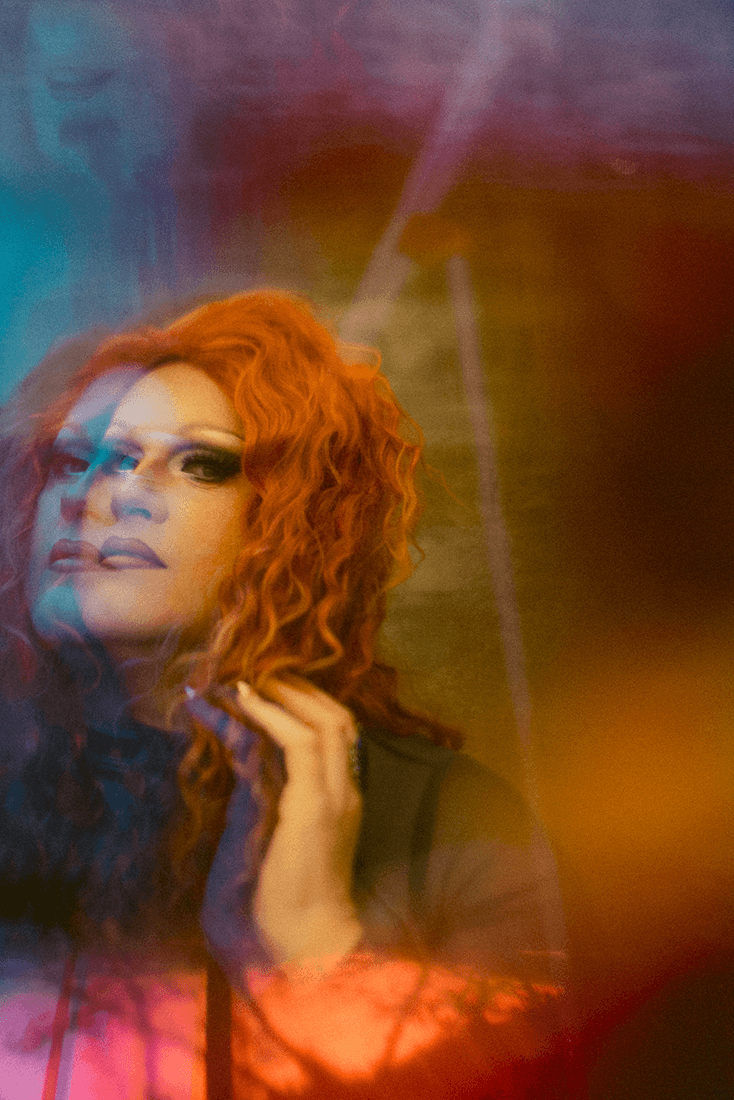
It’s been really fun to feel like I’m excavating parts of myself that have been dormant or suppressed for so long. [Drag] definitely changes the subject matter of what I’m writing about.
And it’s been there all along, I just haven’t allowed myself the pleasure and joy of exploring the range of my own gender identity, even the range of my physical voice. Being able to play with how I sing a song or a lyric, it’s opened up a world of songwriting to me. There are times now, when I’m writing, where I do think about what this is going to look and feel like on stage, in drag, in a big wig with sequins and glitter on my face and all of this.
I still love to write a gut-punch ballad; that’s one of my specialties. And I love doing that because that’s not really a thing you tend to associate with drag too much. That tends to be a more surprising moment for people in my concerts, when I get serious. People expect the fierceness and sass and qualities of drag that they’re used to.
Mostly it’s just a lot of fun. I really enjoy the opportunity to play with music in new ways.
It sounds like part of what you’re saying is that it offers an added element of creativity to a songwriting process, even in the “constraint” of writing as Flamy Grant.
That’s absolutely right, there is a constraining piece to it. Whatever music I put out, it’s going to be out under that name, Flamy Grant, and I know it’s going to be associated with drag.
In some ways it’s obviously pushing the boundaries of Christian music, but it’s also pushing the boundaries of what people might consider drag to be.
What has the response been like from the drag community?
I just got a message from a drag queen back in San Diego. Her drag name is Nadya Symone. I love this queen. She’s just one of the people I look up to. She’s a Southern queen who lives in San Diego now. She was there at my very first drag show; I was nervous, and she could tell. And she just said, “Baby, whatever happens, the show goes on. You make a mistake, you forget a lyric, you forget a line, your wig falls off, whatever — the show goes on.”
I just felt so taken in, included, and welcomed. And that’s never changed. The people who get [Flamy] the quickest are other drag performers. I don’t have to explain much to them. They’re like, “Oh you’re just bringing yourself to drag, which is what we all do.”
Anyway, the message that Symone sent me just yesterday was just, “I’m so proud of you, baby.” I don’t know what she had seen, but she’s still there and cheering me on. I had a lot of anxiety coming into this and a lot of imposter syndrome. Am I a real drag queen? Do I really belong in this community if what I want to do is write my own folk songs and sing them? And that has all been laid to rest by interacting with other performers.
Is there anything that you wanted to do differently between your first album, Bible Belt Baby, and your second album, CHURCH?
I’m so proud of Bible Belt Baby, but it did come together circumstantially and without a lot of intention. My initial conversation with my producer, Ben, who was my housemate in San Diego at the time, was, I think I want to sing in drag. And we were going to put together a five-song EP. I ran a Kickstarter, and we raised more than I expected. And it just continued to blossom and grow until it was a full album.
And in order to make it a full album, I was pulling from songs that predated Flamy. What was really cool about that was discovering that Flamy has been there all along, right?
But with CHURCH, I had the opportunity to really, for the first time, think about crafting a complete narrative. Thinking about themes that would all be contained on one record and writing, for the first time, a full album in Flamy’s voice intentionally.
The second thing was having the resources to go to Nashville and make a Nashville record with Nashville players. That was a really exciting prospect for me.
We sent them all the demos in advance. I, [pauses] I don’t know that they listened to them, but they didn’t need to. They heard the song one time, took a couple notes, went to their instruments, and five, six, seven takes later we had what we needed. It was wild to watch how, at the skill level of those musicians, they brought the songs to life in ways I could have only hoped for.
I really wanted a sound that was in this Nashville vein, but we also talked about how to make it still a drag record. How do we pull in some of this country disco feel? How do we make sure it stands on par with anything coming out of Nashville, but also uniquely Flamy. They did a phenomenal job.
[Lastly], with Bible Belt Baby, I didn’t know, up until a couple months before releasing it, whether I would even put it out as a Christian record. It wasn’t until we finished it that I was like, yeah, this absolutely belongs in the Christian genre.
Now, Christian music is largely worship music, which I personally don’t care for. I like music that tells someone’s story. I want to hear what an individual person has gone through in their life and how they got to where they are.
And that’s why I loved artists like Margaret Becker, or Jennifer Knapp, Caedmon’s Call, and folks famous for writing really personal. What’s that thing people say? We find the universal in the specific — that’s what I love about singer songwriters. I don’t know if I’ll continue to make Christian music forever or what the next album will look like yet, but for this album, I [wanted] to be really intentional with the messaging. I think the tagline for the Kickstarter was “Flamy Grant’s Big Gay Christian Record.”
Links: Romancing the Vote, Yarn, & More
by Amanda · Oct 2, 2024 at 2:00 pm ·
Good info regarding books that could be near and dear to hearts of readers, some other stuff, and Romancing the Vote helping to save democracy.
Good Review of Last Night’s Debate
with a transcript link.
Abhijit Naskar
Harris holds a big lead with Asian-American voters, new survey shows
Sep 24, 2024 Jennifer Gerson, Jasmine Mithani
Originally published by The 19th
Your trusted source for contextualizing abortion and Election 2024 news. Sign up for our daily newsletter.
More Asian-American voters are planning to support the Democrat at the top of the presidential ticket now that Vice President Kamala Harris is the nominee, according to the 2024 AAPI Voter Survey released Tuesday.
Harris, whose campaign has been specifically reaching out to Asian American and Pacific Islander (AAPI) voters, has a 38-point lead over Republican former President Donald Trump among Asian Americans. It’s a significantly wider advantage than the 15-point lead President Joe Biden had with Asian-American voters in a spring survey, before Biden dropped out of the presidential race and Harris became the Democrats’ standard-bearer.
In May, Biden led Trump 46 percent to 31 percent, with 23 percent undecided or backing a third-party candidate. Now, 66 percent of Asian-American voters back Harris, compared with 28 percent for Trump and just 6 percent for a third party.
It’s a return to 2020 levels of support for the Democratic ticket, according to Karthick Ramakrishnan, the executive director and founder of AAPI Data, one of the groups that conducted the survey. “When it comes to voter enthusiasm and intention to vote, we’re seeing levels on par with 2020, which was a historic election in terms of having record high turnout for Asian Americans. All these ingredients point toward Asian Americans having a pretty powerful role in the Harris candidacy.”
Harris’ favorability has also risen 18 points; it is 62 percent now versus 44 percent in the spring.
For Asian-American voters, Harris’ gender is more important (38 percent) than her Asian-American identity (27 percent). It’s noteworthy given that Harris’ mother was an immigrant from India.
It’s all the more surprising given the role that race has come to play in the campaign, especially since Trump has sought to center Harris’ race by questioning whether she is Black or South Asian. (She is both.) “Gender is not explicitly talked about as much in this campaign by Trump — it’s [Harris’] racial identity that’s being talked about a lot more. So I think it’s one of those things that seems under the radar compared to Hillary Clinton’s 2016 candidacy, but is emerging as a pretty powerful force,” Ramakrishnan said.
Christine Chen, a co-founder and executive director of APIAVote, added that AAPI voters’ attitudes on Harris’ gender reflect much of the grassroots organizing happening on her behalf. “South Asians for Harris, Chinese Americans for Harris, Korean Americans for Harris — we saw such activation coming from the community and partially, I think it is because of her ethnicity, but it was also driven by the women in those communities.”
AAPI women are more likely to support Harris (70 percent) than AAPI men (57 percent). Chen said much of this work, and excitement, also has to do with how Asian-American women are working with Black women and Latinas across organizing spaces, bringing together a racially diverse coalition of voters.
And these women have been organizing for a decade already, Ramakrishnan said.
“So you combine that with having the historic nature of her candidacy as not only the first Asian American but as the first woman and Asian-American woman, and that combines, I think, into a pretty potent combination,” he said.
The AAPI Voter Survey is a joint effort between AAPI Data and APIAVote, and was administered Sept. 3-9 by NORC at the University of Chicago. The survey was offered in English, Chinese dialects of Mandarin and Cantonese, Vietnamese and Korean, and oversampled citizens and registered voters. The margin of error is 4.7 percentage points.
The Harris campaign has been working to reach AAPI communities, and it appears to be paying off: 62 percent say they have been contacted by the Democratic Party, compared with 46 percent who have had the Republican Party reach out.
Last week, the Harris campaign released its third ad specifically targeting Asian-American voters, titled “My Mother.” It repurposes part of Harris’ acceptance speech from last month’s Democratic National Convention when she described her mom — “a brilliant 5-foot-tall Brown woman with an accent” — and said her mother taught her family “to never complain about injustice but do something about it.”
Meanwhile, when APIAVote had a presidential town hall earlier this summer, Republicans didn’t even send a surrogate, Chen said.
For many AAPI voters, Ramakrishnan said, the top issue is “racism and discrimination.” Seventy-two percent of AAPI voters said they wouldn’t be willing to vote for a candidate who doesn’t share their views on racism or discrimination.
Since first entering presidential politics in 2015, Trump has demonized immigrants. He also repeatedly referred to COVID-19 as the “China virus,” which was followed by a rise in discrimination and attacks against Asian Americans. Recently, Trump’s running mate, Sen. JD Vance of Ohio, has amplified racist conspiracy theories about Haitian immigrants in Springfield, Ohio, that he knows are false.
“Even if the Republican Party is investing in voter outreach, to the extent that party leaders continue to engage in talk that is perceived as xenophobic or racist, it’ll make it really difficult to win support among Asian-American voters,” Ramakrishnan said. “That’s just very real. Absolutely, the parties need to invest, but what party leaders say also matters.”
“I don’t want to ignore the role of racism and discrimination,” Ramakrishnan continued. “So the extent that you see both Trump and Vance not only dog whistling on race, but blowing their bullhorns on race, that’s something that will prevent the Republican Party from capitalizing on any frustration people have with not only Biden, but Harris.”
The Trump campaign did not respond to a request for comment on outreach to AAPI voters.
According to a separate survey released Tuesday by KFF, 45 percent of Asian immigrants say the way Trump talks about immigrants has negatively affected the way they’re treated. Just 7 percent said that about Harris. In fact, 30 percent of Asian immigrants said Harris’ rhetoric has had a positive effect on how they have been treated.
Chen pointed to Georgia as a state where AAPI voters — particularly newly registered voters — could make a difference. Biden won the state in 2020 by less than 12,000 votes in a year with about 39,000 first-time AAPI voters, she said.
Ramakrishnan said the second biggest issue for AAPI voters is abortion, which Harris has made a centerpiece of her candidacy.
“Asian Americans are some of the strongest supporters of abortion rights in this country,” Ramakrishnan said. “Support for abortion rights is high even among Asian Americans who are predominantly Catholic, like Filipinos. I think something very underappreciated is how much abortion plays a role in the public opinion of Asian American voters.”
Among AAPI voters in the survey, 63 percent said they would not vote for a candidate who does not share their view on abortion policy. There is a 20-point gender split — 72 percent of AAPI women and 52 percent of AAPI men — on the question.
Though there are six weeks until Election Day, Chen said the candidates would be wise to understand that for AAPI voters, the window to reach them is even shorter: in the 2022 midterms, 73 percent voted early or by mail.
To check your voter registration status or to get more information about registering to vote, text 19thnews to 26797.
Liberal Redneck interviews debate viewers
Well, all righty, then.
I’m OK with this.
By Samantha Riedel September 11, 2024
Donald Trump’s “transgender operations” line during this week’s presidential debate is already the talking point that launched a thousand memes — but what may have sounded like word salad managed to contain the barest hint of a real, honest-to-goodness fact.
During Trump and Vice President Kamala Harris’ first and potentially only debate on Tuesday evening, Trump accused the sitting vice president of approving “transgender operations on illegal aliens that are in prison.” Trump was ostensibly responding to a question about hydrofracking, though he veered wildly between other claims, including sensational and misleading allegations that protestors “burned down Minneapolis” in 2020. But for once, Trump’s comments about trans people weren’t entirely fabricated — although calling them “accurate” would be a stretch.
Trump’s claim about “transgender operations” can likely be traced back to a 2019 survey from the American Civil Liberties Union (ACLU), which the organization says it sent to all presidential candidates that year, CNN’s KFILE reported on Monday. In that survey, candidates were asked if they would use presidential authority to ensure that all trans people, including incarcerated people and undocumented immigrants, received “comprehensive treatment” for their transition “including all necessary surgical care.” Harris said she would do so. (snip-MORE)
Hey, Any Good Environmental News Lately? There IS?
Thanks Joe Biden.
DOKTOR ZOOM SEP 14, 2024
The presidential election has turned into a contest between a capable, smart woman who emphasizes what Americans can achieve when they work together for the common good, and a sundowning old racist creep who would be pathetic if he weren’t so dangerously close to returning to power.
In case you’re wondering what the difference looks like, compare the hate and division the old racist creep is spreading with some recent announcements from President Joe Biden’s administration, nearly all of them about programs funded by one or another of Biden’s big legislative packages. Just a little reminder of why elections matter, and of the legacy that Kamala Harris is committed to building on. For, y’know, the people.
Lots of news-go read! 🌞
 Scottie's Playtime