I can’t believe this month is past half over! Anyway, I think the guys here will particularly enjoy Bee’s selection for Wednesday, “Peace Somehow.” It sounds like it fits with other music the guys have posted, genre-wise.
As Bee participates in the bloggers’s Global Strike For Gaza, here is her Thursday Peace Music post early (not to us, of course, as it’ll be Thursday when this post goes up.) Bee’s message with this one is important for each of us to take to heart.
Bee’s post is eloquent! There is/was not a video in the post, but she named the song, and gives great background on the artist and the song. I checked YouTube, found the one I hope is the right one, and posted it beneath Bee’s entry here. She has posted this one in the past; I recall it. It’s beautiful and perfectly expressive. Well worth a repeat listen!
Last week when I was flying home I was scanning the ocean because I’m always certain that I’ll see Godzilla or a sea serpent if I look hard enough, but instead I saw a rainbow from the plane window and it was a perfect circle over the ocean. I was so excited I hit my head on the window and scared the person behind me. I didn’t have time to capture it on my phone but I shook Victor awake and was like, “YOU’LL NEVER BELIEVE WHAT I JUST SAW OUTSIDE THE WINDOW” and he said, “Was it a colonial woman churning butter on the wing?” and I was like, “…yep…that’s exactly what it was” because a circular rainbow feels anticlimactic after that guess.
Aaanyway, that leads to this week’s drawing, which I’m fairly certain counts as a scientific illustration:
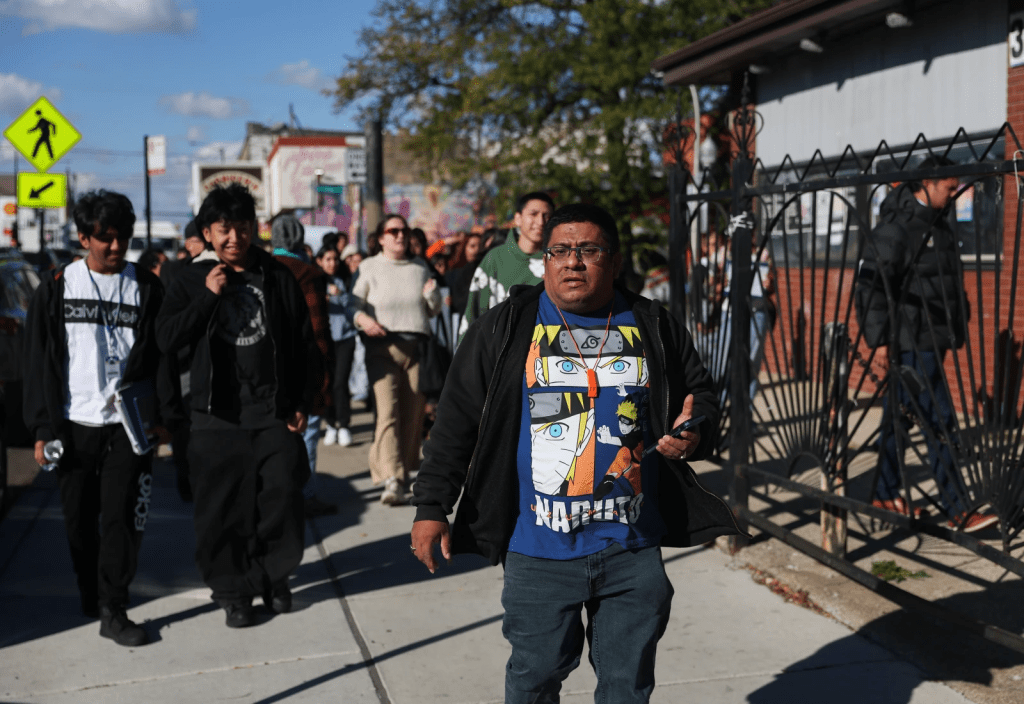
CHICAGO (AP) — Baltazar Enriquez starts most mornings with street patrols, leaving his home in Chicago’s Little Village on foot or by car to find immigration agents that have repeatedly targeted his largely Mexican neighborhood.
Wearing an orange whistle around his neck, the activist broadcasts his plans on Facebook.
“We don’t know if they’re going to come back. All we know is we’ve got to get ready,” he tells thousands of followers. “Give us any tips if you see any suspicious cars.”
Moments later, his phone buzzes.
As an unprecedented immigration crackdown enters a third month, a growing number of Chicago residents are fighting back against what they deem a racist and aggressive overreach of the federal government. The Democratic stronghold’s response has tapped established activists and everyday residents from wealthy suburbs to working class neighborhoods.
They say their efforts — community patrols, rapid responders, school escorts, vendor buyouts, honking horns and blowing whistles — are a uniquely Chicago response that other cities President Donald Trump has targeted for federal intervention want to model.
“The strategy here is to make us afraid. The response from Chicago is a bunch of obscenities and ‘no,’” said Anna Zolkowski Sobor, whose North Side neighborhood saw agents throw tear gas and tackle an elderly man. “We are all Chicagoans who deserve to be here. Leave us alone.”
Baltazar Enriquez, president of the Little Village Community Council, walks with a Chicago Public School’s student walkout in protest against U.S. Immigration and Customs Enforcement (ICE) agents around Chicago’s Little Village neighborhood, Wednesday, Oct. 29, 2025. (AP Photo/Talia Sprague)
The sound of resistance
Perhaps the clearest indicator of Chicago’s growing resistance is the sound of whistles.
Enriquez is credited with being among the first to introduce the concept. For months Little Village residents have used them to broadcast the persistent presence of immigration agents.
Furious blasts both warn and attract observers who record video or criticize agents. Arrests, often referred to as kidnappings because many agents cover their faces, draw increasingly agitated crowds. Immigration agents have responded aggressively.
Officers fatally shot one man during a traffic stop, while other agents use tear gas, rubber bullets and physical force. In early November, Chicago police were called to investigate shots fired at agents. No one was injured.
Activists say they discourage violence.
“We don’t have guns. All we have is a whistle,” Enriquez said. “That has become a method that has saved people from being kidnapped and unlawful arrest.”
By October, neighborhoods citywide were hosting so-called “Whistlemania” events to pack the brightly colored devices for distribution through businesses and free book hutches.
“They want that orange whistle,” said Gabe Gonzalez, an activist. “They want to nod to each other in the street and know they are part of this movement.”
Midwestern sensibilities and organizing roots
Even with its 2.7 million people, Chicago residents like to say the nation’s third-largest city operates as a collection of small towns with Midwest sensibilities.
People generally know their neighbors and offer help. Word spreads quickly.
When immigration agents began targeting food vendors, Rick Rosales, enlisted his bicycle advocacy group Cycling x Solidarity. He hosted rides to visit street vendors, buying out their inventory to lower their risk while supporting their business.
Irais Sosa, co-founder of the apparel store Sin Titulo, started a neighbor program with grocery runs and rideshare gift cards for families afraid of venturing out.
“That neighborhood feel and support is part of the core of Chicago,” she said.
Enriquez’s organization, Little Village Community Council, saw its volunteer walking group which escorts children to school, grow from 13 to 32 students.
Many also credit the grassroots nature of the resistance to Chicago’s long history of community and union organizing.
Trump’s “border czar” Tom Homan said Chicago area residents were so familiar with their rights that making arrests during a different operation this year was difficult.
So when hundreds of federal agents arrived in September, activists poured energy into an emergency hotline that dispatches response teams to gather intel, including names of those detained. Volunteers would also circulate videos online, warn of reoccurring license plates or follow agents’ cars while honking horns.
Protests have also cropped up quickly. Recently, high school students have launched walkouts.
Delilah Hernandez, 16, was among dozens from Farragut Career Academy who protested on a school day.She held a sign with the Constitution’s preamble as she walked in Little Village. She knows many people with detained relatives.
“There is so much going on,” she said. “You feel it.”
A difficult environment
More than 3,200 people suspected of violating immigration laws have been arrested during the so-called “ Operation Midway Blitz.” Dozens of U.S. citizens and protesters have been arrested with charges ranging from resisting arrest to conspiring to impede an officer.
The Department of Homeland Security defends the operation, alleging officers face hostile crowds as they pursue violent criminals.
Gregory Bovino, the Border Patrol commander who’s brought controversial tactics from operations in Los Angeles, called Chicago a “very non permissive environment.” He blamed sanctuary protections and elected leaders and defended agents’ actions, which are the subject of lawsuits.
DHS, which oversees CBP and Immigration and Customs Enforcement, has said operations won’t end in Chicago.
Interest nationwide
Alonso Zaragoza, with a neighborhood organization in the heavily immigrant Belmont Cragin, has printed hundreds of “No ICE” posters for businesses. Organizers in Oregon and Missouri have asked for advice.
“It’s become a model for other cities,” Zaragoza said. “We’re building leaders in our community who are teaching others.”
The turnout for virtual know-your-rights trainings offered by the pro-democracy group, States at the Core, doubled from 500 to 1,000 over a recent month, drawing participants from New Jersey and Tennessee.
“We train and we let go, and the people of Chicago are the ones who run with it,” said organizer Jill Garvey.
Awaiting the aftermath
Enriquez completes up to three patrol shifts daily. Beyond the physical exertion, the work takes a toll.
Federal agents visited his home and questioned family members. A U.S. citizen relative was handcuffed by agents. His car horn no longer works, which he attributes to overuse.
“This has been very traumatizing,” he said. “It is very scary because you will remember this for the rest of your life.”
My selection is one many young adults at the time took as an anthem; it was a very real every day concern then, and that concern does seem to be back with us now, though maybe people aren’t as concerned as before. There is good reason for concern, and for de-proliferation, and peace.
And now, the music. I’m putting both the German version (best one!) and the English language version, which is also just fine to dance to. “You can’t dance and stay uptight.”
Off Trøndelag’s coast, long lines of kelp now do double duty. They grow fast. They also lock away carbon. A new pilot farm near Frøya aims to turn that promise into measurable removal of CO₂ from the air, according to DNV.
The site spans 20 hectares and carries up to 55,000 meters of kelp lines. First seedlings went in last November. The goal is proof of concept, then scale.
How the Pilot Works
The three-year Joint Industry Project, JIP Seaweed Carbon Solutions, brings SINTEF together with DNV, Equinor, Aker BP, Wintershall Dea, and Ocean Rainforest, with a total budget of NOK 50 million, Safety4Sea reports.
Researchers expect an initial harvest of about 150 tons of kelp after 8–10 months at sea. Early estimates suggest that biomass could represent roughly 15 tons of captured CO₂. This is a test bed for methods that can be replicated and expanded, DNV explains.
There’s a second step, as kelp becomes biochar. That process stabilizes carbon for the long term and can improve soils on land, SINTEF’s team told Safety4Sea. The project is designed to test both the removal and the storage.
A Long History, A New Mission
Seaweed isn’t new here. Norwegians have cultivated kelp since the 18th and 19th centuries for fertilizer and feed. Scientists advanced modern methods in the 1930s, laying the groundwork for today’s farms, according to SeaweedFarming.com. Cold, nutrient-rich waters support species like Laminaria and Saccharina. They grow quickly and draw down dissolved carbon and nitrogen.
The country’s aquaculture backbone also helps. Norway already runs one of the world’s most advanced seafood sectors. That expertise now extends to macroalgae.
Policy, Permits, and Ecosystems
Commercial cultivation began receiving specific permits in 2014, and activity has expanded across several coastal counties, according to a study in Aquaculture International. Researchers detailed the risks that accompany scale: genetic interaction with wild kelp, habitat impacts, disease, and space conflicts. Integrated Multi-Trophic Aquaculture, where seaweed grows alongside finfish, can recycle nutrients from farms and reduce eutrophication pressures.
Engineering for Open Water
Getting beyond sheltered bays is crucial. One path is the “Seaweed Carrier,” a sheet-like offshore system that lets kelp move with waves in deeper, more exposed water. It supports mechanical harvesting and industrial output without using land, Business Norway explains. The same approach can enhance water quality by absorbing CO₂ and “lost” nutrients.
The Frøya project is small in tonnage but big in intent. It links Norway’s long kelp lineage with new climate tech: fast-growing macroalgae, verified carbon accounting, and durable storage as biochar. If these methods prove reliable at sea and on shore, Norway will have more than a farm. It will have a blueprint for ocean-based carbon removal that others can copy.
What did Trump know and when did he know it in regards to Epstein? Read on Substack
This caricature of Trump is the first drawing I have attempted since the stroke. Isn’t it crazy that I haven’t drawn anything in over a month? This was done with my left hand, and it was extremely difficult. I still don’t have enough stability with my right arm. I did hold a guitar pick for a few minutes today while strumming my Taylor 214. I’m not selling my guitars just yet. No, I do not plan to draw in the future with my left hand. Coincidentally enough, I drew it while waiting for an occupational therapist to arrive.
Trump and Epstein
Donald Trump is a horrible person. He is vile, corrupt, petty, mean, narcissistic, immature, greedy, dishonest, selfish, cruel, and evil, so naturally, he would be best friends with a pedophile.
“I have met some very bad people,” Jeffrey Epstein wrote in a 2017 email. “None as bad as Trump. Not one decent cell in his body.”
It’s not Epstein’s opinion of Trump that we should care about. After all, Jeffrey Epstein was a pedophile. Who cares about Trump’s opinion when he disses Joe Biden or Barack Obama? Does anyone really believe Jack Smith is a lunatic just because Trump says it? If we don’t care about Trump’s opinion about people, then we shouldn’t care about Jeffrey Epstein’s. I’m sure people don’t get worse than Jeffrey Epstein. So I don’t care about Epstein’s opinion; I care about his recollections.
Yesterday, House Democrats released emails in which Epstein wrote that Trump had “spent hours at my house” with one of his victims. And another email, Epstein wrote that Trump “knew about the girls.”
Speaker Mike Johnson no longer has a choice, and next week, the House will finally vote on whether or not to release all the investigative material it has on Jeffrey Epstein.
In one email to Ghislaine Maxwell, Epstein wrote, “I want you to realize that that dog that hasn’t barked is Trump.. [VICTIM] spent hours at my house with him.”
Epstein goes on to write that Trump “has never once been mentioned”, including by a “police chief”.
Maxwell replied, “I have been thinking about that.”
I wonder why Trump spent hours at Epstein’s house with one of his victims. But I don’t think it’s a mystery as to why Trump doesn’t want any of the investigative material to be released.
I believe Maxwell will have her sentence commuted when Trump believes it is politically safe to do so. She’s been given treatment for now until Trump feels he can make that commutation. This is an exchange for her not implicating Trump with Epstein’s pedophilia or labeling Trump as a pedophile himself.
Death by Lightning is a four-episode mini-series on Netflix about the assassination of James Garfield. If you are a history buff, such as myself, I believe you will thoroughly enjoy this show.
Did you know that November is Diabetes Awareness Month? Fortunately, for me, I am aware now that I have type 2 diabetes. So far, it’s not really that big of a deal for me. I mean, it’s a big deal that I’ve had to adjust my diet, nothing really tastes good anymore, I have to stick a needle in my stomach every night, I have to reward salt, as if I was a snail, and I may not ever have sushi with soy sauce, ever again, but other than that, it’s not a big deal. My goal at this point is that I do not ever lose a foot to it. But so far, my numbers have been good since I started managing it about a month ago. I am currently wearing a sensor on my arm, and my numbers have been low. I have lost weight since I found out, but that’s mostly because I spent half the month eating hospital food. As soon as I can walk again (and I’m taking baby steps), I will exercise more.
My appeal to you is that if you’re not aware whether or not you have diabetes, please get yourself checked out. I suspected I might be diabetic for a few years, but being the coward that I am, I refused to see a doctor until I had to. It was the same thing with my high blood pressure. I suspected it was bad, but I didn’t see a doctor until a stroke gave me no choice. If you suspect that you have high blood pressure, don’t ignore it like I did. I implore you to see a doctor and do something about it so that you don’t end up where I am right now. However, despite what happened, I am extremely lucky. It could’ve been worse.
Get yourself checked out. (snip-there is MORE on his substack, which deserves the clicks. He drew! *\0/* )





 Scottie's Playtime