1st Broadcast of NPR’s “All Things Considered,” Fire Hoses in Birmingham, and More in Peace & Justice History for 5/3

May 3, 1808
Civilians were executed by Napoleonic forces putting down a rebellion by the citizens of Madrid, Spain on Principe Pio Hill. The event was memorialized in the painting by Francisco de Goya, “The Third of May 1808: The Execution of the Defenders of Madrid.” Aspects of the painting inspired the design of the peace symbol by Gerald Holtom in 1958.
May 3, 1886

At Haymarket Square in Chicago, a rally was being held because of a strike at the McCormick Harvester plant, just two days after an enormous May Day turnout. Though the mass meeting was peaceful, a force of 176 police officers arrived, demanding that the meeting disperse. Someone, unknown to this day, then threw a bomb at the police.
In their confusion, the police began firing their weapons in the dark, killing at least three in the crowd and wounding many more. Seven police died (only one by the bomb), the rest probably by police fire.
Read more 
May 3, 1963
In Birmingham, Alabama, Public Safety Commissioner and recently failed mayoral candidate Theophilus Eugene “Bull” Connor used fire hoses and police dogs on children near the 16th Street Baptist Church to keep them from marching out of the “Negro section” of town.

With no room left to jail them (after arresting nearly 1000 the day before), Connor brought firefighters out and ordered them to turn hoses on the children. Most ran away, but one group refused to budge.
The firefighters turned more hoses on them, powerful enough to break bones. The force of the water rolled the protesters down the street. In addition, Connor had mobilized K-9 (police dog) forces who attacked protesters trying to re-enter the church.

Pictures of the confrontation between the children and the police were televised across the nation.
Read more about the Birmingham Campaign
May 3, 1968
More than 100 black students took over a building at Northwestern University in Evanston, Illinois. They were demanding attention to their advocacy for inclusion of African-American history, literature and art in the curriculum. Their efforts led to the establishment of an African-American studies department which now offers a doctoral program.
How it happened 
May 3, 1971
The Nixon administration ordered the arrest of nearly 13,000 anti-war protesters calling themselves the Mayday Tribe who had begun four days of demonstrations in Washington, D.C. on the first. They aimed to shut down the nation’s capital by disrupting morning rush-hour traffic and other forms of nonviolent direct action, skirmishing with metropolitan police and Federal troops throughout large areas of the capital.
The slogan of the Mayday tribe: “If the government won’t stop the [Vietnam] war, we’ll stop the government.“

Read more 
May 3, 1971
The first broadcast of National Public Radio’s evening news and public affairs program, “All Things Considered,” was aired on about 90 public radio affiliates around the country. The main story was the disruptive anti-Vietnam protests in Washington.It is now the fourth most listened-to radio program
in the U.S.


More about that first program 
May 3, 1980
Sixty thousand marched on the Pentagon to urge the end of U.S. military involvement in El Salvador.

https://www.peacebuttons.info/E-News/peacehistorymay.htm#may3

“Stripe-Headed Skulker”

Some Women’s Work in 1945

Women’s Work: Building Justice — The Women Behind the Nuremberg Trials

Where justice faltered, they persisted.

Tanya Roth

Clockwise from top left: Katherine Fite, Belle Mayer Zeck, Harriet Zetterberg, and Cecelia Goetz

When Katherine Fite arrived in London in the summer of 1945, her role in the post-World War II justice process was so novel that the New York Times took notice. “Woman joins staff of war crimes group,” the paper proclaimed. Fite told the Times that “she would not know the scope of her assignment until she had arrived overseas, but that she had been conversant with most phases of the work of the State Department on war crimes.” As the quest for postwar justice continued, Fite became one of just a few women lawyers participating in what became known as the Nuremberg Trials.

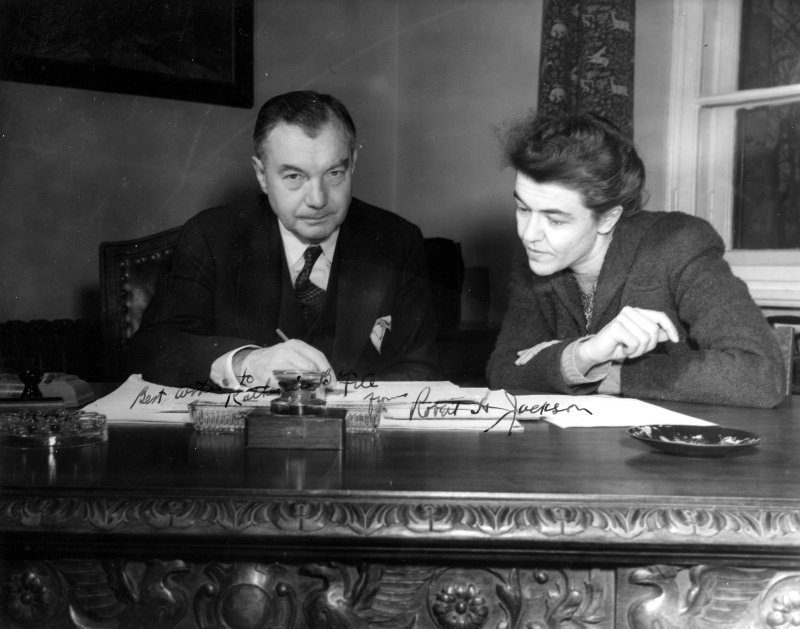
On May 2, 1945 — just six days before Victory in Europe, or V-E Day — Supreme Court Associate Justice Robert H. Jackson agreed to serve as chief prosecutor. That summer, as Europe emerged from the war, Jackson worked with his team and the Allies to prepare for the first ever international war crimes trials. Fite joined both the negotiations and legal research that led to the August 8 signing of the London Charter, creating the International Military Tribunal.

Katherine Fite (right) with Justice Jackson, ca. 1945 (National Archives)

Fite was the only woman lawyer present in the preparation phase. In September 1945, a month before the trials began, Fite toured Dachau Concentration Camp outside of Munich. She wrote home about the experience: “The gardens might well look fertile — human ashes were readily available for fertilizer.” A Polish-Jewish man who had survived Dachau showed her the gas chambers, disguised as shower rooms.

After the first trial, which lasted until October 1946, the United States launched 12 more trials that continued through 1949. Men dominated the courtroom — both as lawyers and as defendants — so women’s contributions were often overlooked. From the beginning, however, the American legal team relied on women’s work in key ways, from Fite’s work in the planning through the execution of the final trials, to Belle Zeck’s foundational work investigating German manufacturer I.G. Farben, to Cecelia Goetz’s key role prosecuting Krupp Industries.

Fite was not the only woman present at the Nuremberg Trials, but she was the highest-level female attorney in the early phases. Harriet Zetterberg was another early participant, the only woman lawyer assigned to the main prosecution team for the first Nuremberg trial, beginning in mid-August and lasting until June of 1946. Zetterberg arrived in Nuremberg in mid-September and prepared trial briefs, including one on slave labor and how it was used as a method to kill. Zetterberg felt the weight of the work, calling the six interrogations she witnessed “extremely interesting — one gets a sense of listening to history in the making.” (snip-MORE. This is really good.)

https://www.saturdayeveningpost.com/2025/04/womens-work-building-justice-the-women-behind-the-nuremberg-trials

This Is A Thing In Which I Am Very Interested

I’ve even made plans, presuming some of this becomes legal in the next 10 years where I live. I have high hopes for sky burials and terramation, at least those are my 2 favorites.) I have links to more info, but this is good for some who maybe haven’t thought of this aspect of the circle of life.

Think Outside the Coffin: Green Burials Gain Popularity

Green burials have been gaining favor for nearly 30 years, offering an eco-friendly way to say goodbye.

Chi Sherman

As Ben Franklin once said, “In this world, nothing can be said to be certain except death and taxes.” While the subject of taxes may be unpleasant, conversations about death don’t have to be.

“Most families are close enough to know what their loved ones want, [but] a lot of people don’t learn about death care until a loved one dies,” says B. Milton, a retired death care industry professional in Indiana. End-of-life discussions can be uncomfortable to broach — a lot of people don’t pre-plan, according to Milton — but having direction for your post-life care allows for peace of mind, both emotionally and financially.

As most people know, conventional burials — those that include options like a viewing, a funeral service, and burial in a casket — can be very expensive. The national median cost of a funeral with a burial in 2023 was $8,300, according to the National Funeral Directors Association. Caskets alone can cost thousands of dollars. Of course, the sentiment is wonderful; there is a true gift in being able to choose a beautiful vessel as a loved one’s final resting place. A growing number of people, however, prefer to keep funeral costs lower and more eco-friendly with green burial options, including burial shrouds, terramation, and aquamation.

Burial Shrouds

“Green burials are in their infancy,” says Russ Burns, director of All Saints Cemetery and The Preserve, a natural burial site in Michigan. “In 20 to 30 years, they’ll be up there with traditional burials,” noting that customers interested in green burial are well-informed and concerned less about themselves post-mortem and more about how the area where they will be interred will remain green.

A cenotaph wall at The Preserve. The wall is a collection of rocks engraved with names of those buried on the property. It offers a physical place for family and friends to visit their loved ones as graves are inaccessible after the burial service. (Image courtesy of Mt. Elliott Cemeteries)

The use of a burial shroud is simple: The deceased is placed in a shroud made of a biodegradable material like canvas and committed to the earth about three feet underground. The shallower depth allows for more oxygen flow than the standard six-foot depth for coffins, which helps the body decompose and return to the soil. The process takes about a year and costs, at the lower end, around $1,800.

Burns cautions customers to do their research and make sure they work with an organization that is fully funded and has “more than good intentions.” Following burial, the land continues to require maintenance you would expect, like mowing and landscaping, but may also need an environmental impact study or a controlled burn to get rid of invasive plant species.

Terramation

Terramation, to put it simply, is human composting. If you’ve ever joked about having a green thumb, now you can have green everything and quite literally be turned into soil.

The first stage of terramation takes about a month. The deceased is placed in a vessel and covered in organic materials like straw, alfalfa, and wood chips. Families who attend the preparation of the body also known as a laying-in ceremony — sometimes bring garden clippings and assist in the process. The vessel is then closed and stored while microbes break the body down to roughly one cubic yard (or several hundred pounds) of soil. The material is examined for any remaining organic matter like bone or non-organic matter like surgical implants and then left to cure. Before being released to the family, the soil must pass safe compost regulations, including tests for the presence of arsenic or lead.

The process of composting people has only been around for about 10 years and is currently legal in 12 states, including Minnesota, Arizona, California, Colorado, New York, and Washington state. Cost can range from $5,000 to $7,000. In the video below, mortician and green death advocate Caitlin Doughty chats with Katrina Spade, the founder and CEO of Recompose, a green funeral home near Seattle that specializes in terramation.

(snip-some MORE)

https://www.saturdayeveningpost.com/2025/04/think-outside-the-coffin-green-burials-gain-popularity

Children’s March in Birmingham, & Poor People’s Campaign in Peace & Justice History for 5/2

May 2, 1963
Hundreds of children ranging in age from six to eighteen were arrested in Birmingham, Alabama, as they marched from Kelly Ingram Park, across from 16th Street Baptist Church, to downtown singing, “We Shall Overcome.”Part of an ongoing effort to end segregation in that city, and following the arrests of many adults including Rev. Martin Luther King, Jr., the children had volunteered to minimize the threat to families if a breadwinner were jailed. A judge had issued an order preventing any of 133 civil rights leaders from organizing a demonstration.

Birmingham, the capital of Alabama, had been the site of 18 unsolved bombings in black neighborhoods over recent years, and the place where mobs had attacked Freedom Riders on Mother’s Day in 1961. Leaving the park in groups of fifty, the kids were put in vans by police, led by Eugene “Bull” Connor, until there were 959 filling the city jails.
May 2, 1968

The Poor People’s Campaign began with groups from several locations around the U.S. setting out for Washington, D.C., to draw attention to the living conditions of the poorest Americans. It was conceived and organized by Reverend Martin Luther King, Jr. and, following his assassination the previous month, led by his successor at the head of the Southern Christian Leadership Conference (SCLC), Reverend Ralph David Abernathy.
The first wave of demonstrators arrived in Washington on May 11. One week later, Resurrection City was built on the Washington Mall, a settlement of tents and shacks to house the protesters.


Resurrection CityA
Read more 
Note From Ali in 2025:
Not a dream, and while not yet fulfilled, the goal is not unfulfilled (“A Dream Unfulfilled” from the link above,) as The Poor People’s Campaign is still very active, operating in many US states. See if there’s a committee near you!

https://www.peacebuttons.info/E-News/peacehistorymay.htm#may2

Some more news items I want to share. These are only small quotes there is much more to each story if you follow the links

Trump’s Attack on ActBlue’s “Dark Money” Was Backed by Elon Musk’s Dark Money

Trump’s Attack on ActBlue’s “Dark Money” Was Backed by Elon Musk’s Dark Money

The billionaire helped fund an effort to gin up fraud claims against the Democratic donation platform.

Trump’s claim that he can order the Justice Department to investigate a fundraising platform used by his political foes based on vague allegations is part of his ongoing effort to use the government’s powers to target political enemies. It’s not a particularly realistic accusation—the fact sheet claims it’s targeting “straw donor” schemes, in which one person donates on behalf of another. Given the fairly strict limitations on campaign contributions, any straw donor scheme that wants to inject any noticeable amount of money into an electoral system that had $15.5 billion run through it is a great deal of tedious, high-risk work for a scammer.

On the other hand, in the post-Citizens United era, there are plenty of ways to inject unaccounted-for money—even, theoretically, foreign money—into the election. Super-PACs can accept unlimited donations from fairly easy-to-obscure sources, for instance, which makes the idea of anyone using a small-dollar conduit like ActBlue (or the GOP equivalent WinRed) fairly silly.

And notably, the funding for some of Trump’s “data” on an alleged ActBlue “fraud” seems to have come from just such a source: a super-PAC bankrolled by Elon Musk.

Last year, an opaque group called the Fair Election Fund began promising to pay “whistleblowers” who cited election fraud “with payment from our $5 million fund.” That never panned out, but the same organization found more success with a claim that 60,000 people who were named as small-dollar donors in the Biden-Harris campaign’s July Federal Election Commission report did not recall making the contribution when contacted by the Fair Election Fund.

As Mother Jones reported last year, the Fair Election Fund appears to have generated this finding by blasting out ominous-sounding texts and emails telling ActBlue donors that their donations had been “flagged,” then tallying people who responded—accurately or not—by checking a box saying they did not recall making the contribution.

More at the link above


Israel carrying out ‘live-streamed genocide’ in Gaza, Amnesty says

Amnesty accuses US President Donald Trump of committing a ‘multiplicity of assaults’ on human rights.

Israel is perpetrating a “live-streamed genocide” in Gaza, committing illegal acts with the “specific intent” of wiping out Palestinians, Amnesty International has said.

Israeli forces in Gaza have violated the United Nations Genocide Convention with acts that include “causing serious bodily or mental harm to civilians” and “deliberately inflicting conditions of life calculated to bring about their physical destruction”, the human rights organisation said in its annual report released on Monday.

Israeli air strikes have also frequently hit civilians who were following evacuation orders, while its forces continued to “arbitrarily detain and, in some cases, forcibly disappear Palestinians”, the rights group said.


DOGE has made a big impact on Washington. But government spending is up.

Elon Musk and his shadowy “tech support” team have ripped through Washington, reshaping the government and culling the federal workforce with astonishing speed and scope.

https://www.politico.com/news/2025/04/29/doge-impact-washington-spending-100days-00316587

Nearly a quarter of a million workers have or are expected to leave their federal jobs. That includes more than 112,000 federal workers who have opted into the deferred resignation program, according to a POLITICO analysis of previous reporting and conversations with administration officials. It also includes some 121,000 workers across agencies who have been fired, according to a CNN analysis.

DOGE has hollowed out or shut down 11 federal agencies and says it has terminated more than 8,500 contracts and 10,000 grants. It has wiped out foreign aid and volunteerism in the U.S., slashed education spending and made sweeping changes to the way the government makes procurements, hires contractors and shares data.

DOGE, after promising $2 trillion in savings, now says it has saved the government $160 billion. But even these reported savings, so far, have not led to any meaningful decline in total government spending this year, according to the nonpartisan Penn Wharton Budget Model, which tracks weekly Treasury data.

In fact, the government has actually been spending more compared to this time last year, the model found.

Total spending rose by 6.3 percent, or $156 billion since Trump took office, compared to the first four months of 2024, said Kent Smetters, a Wharton professor who directs the model. Even when accounting for inflation, the federal government has still added $81.2 billion more spending to its books compared to the same period last year, he added.

Just No.

May Day, Original Memorial Day, Emancipation Day, “Mission Accomplished” Day, and Much More, all 5/1 in Peace & Justice History

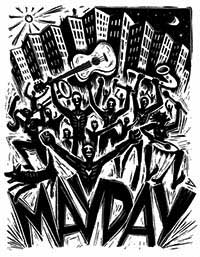
My annual May Day musical offering. Enjoy!

May 1, 1865
Memorial Day was started by former slaves in Charleston, South Carolina to honor 257 dead Union Soldiers who had been buried in a mass grave in a Confederate prison camp.
They dug up the bodies and worked for 2 weeks to give them a proper burial as gratitude for fighting for their freedom.
They then held a parade of 10,000 people led by 2,800 Black children where they marched, sang and celebrated.
 
More of the story 
May 1, 1886

May Day was called Emancipation Day in 1886 when 340,000 went on strike (though it was Saturday it was a regular day of work) in Chicago for the 8-hour workday.

May 1, 1890
May Day labor demonstrations spread to thirteen other countries; 30,000 marched in Chicago as the newly prominent American Federation of Labor threw its weight behind the 8-hour day campaign.
 
More May Day info 
May 1, 1933

Dorothy Day
The Catholic Worker newspaper was founded by Dorothy Day and Peter Maurin. Dorothy Day said, “God meant things to be much easier than we have made them,” and Peter Maurin wanted to build a society “where it is easier for people to be good.”

Peter Maurin

Read more about the Catholic Worker 
May 1, 1948

Senator Glen Hearst Taylor
Senator Glen Hearst Taylor (D-Idaho) was arrested in Birmingham, Alabama, for trying to enter a meeting through a door marked for “Negroes” rather than using the “whites only” door, and convicted of disorderly conduct.
Taylor was the Progressive Party candidate for Vice President, running mate of Henry Wallace. He was in Birmingham to address the Southern Negro Youth Congress.
May 1, 1965
Second Factory for Peace opened in Onllwyn, Dulais Valley, in south Wales, employing disabled miners. Tom McAlpine, active in the Committee for Nuclear Disarmament, and a supporter of cooperatives and industrial democracy, established Rowen Engineering in both Wales and Glasgow, Scotland.
May 1, 1966
500,000 Vietnamese marched for an end to the war dividing their country.
May 1, 1967
Soviet youths openly defied police and danced the twist in Moscow’s Red Square during May Day celebrations. In the early ‘60s the Twist had been banned in Buffalo, New York, and Tampa, Florida. The religious right claimed the Twist was actually a pagan fertility dance.

Are you old enough to remember Chubby Checker?
May 1, 1971
Five days of anti-war May Day protests began in Washington, D.C., resulting in over 14,000 arrests—the largest mass civil disobedience in U.S. history.
May 1, 1986
 
One million South Africans demonstrated their opposition to apartheid in a strike organized by the Congress of South African Trade Unions (COSATU)
COSATU: a brief history
May 1, 2003
President George W. Bush landed in a jet on the aircraft carrier USS Abraham Lincoln off the California coast and, in a speech to the nation, declared major combat in Iraq over. The banner his staff posted on the ship read, “Mission Accomplished.”

Since that presidential declaration more than 4500 American and allied troops and nearly 9000 members of Iraqi security and police forces (Jan. 2005 through July 2011) have lost their lives. In addition, tens of thousands (more than 32,000 Americans) injured in the hostilities.
The number of Iraqi civilian deaths is open to dispute, but minimally stands at well over 100,000.

Details of Iraq military casualties
 Civilian casualties 

https://www.peacebuttons.info/E-News/peacehistorymay.htm#may1

Two From Werd.io: About An EV, And More

 The $20,000 American-made electric pickup with no paint, no stereo, and no touchscreen

[Tim Stevens at The Verge]

It’s rare these days that I see a new product and think, this is really cool, but seriously, this is really cool:

“Meet the Slate Truck, a sub-$20,000 (after federal incentives) electric vehicle that enters production next year. It only seats two yet has a bed big enough to hold a sheet of plywood. It only does 150 miles on a charge, only comes in gray, and the only way to listen to music while driving is if you bring along your phone and a Bluetooth speaker. It is the bare minimum of what a modern car can be, and yet it’s taken three years of development to get to this point.”

So far, so bland, but it’s designed to be customized. So while it doesn’t itself come with a screen, or, you know, paint, you can add one yourself, wrap it in whatever color you want, and pick from a bunch of aftermarket devices to soup it up. It’s the IBM PC approach to electric vehicles instead of the highly-curated Apple approach. I’m into it, with one caveat: I want to hear more about how safe it is.

It sounds like that might be okay:

“Slate’s head of engineering, Eric Keipper, says they’re targeting a 5-Star Safety Rating from the federal government’s New Car Assessment Program. Slate is also aiming for a Top Safety Pick from the Insurance Institute for Highway Safety.”

I want more of this. EVs are often twice the price or more, keeping them out of reach of regular people. I’ve driven one for several years, and they’re genuinely better cars: more performant, easier to maintain, with a smaller environmental footprint. Bringing the price down while increasing the number of options feels like an exciting way to shake up the market, and exactly the kind of thing I’d want to buy into.

Of course, the proof of the pudding is in the eating – so let’s see what happens when it hits the road next year.

#Technology

[Link]

=====================

 Trump ‘Alarmists’ Were Right. We Should Say So.

[Toby Buckle at LiberalCurrents]

This resonates for me too.

About the Tea Party, the direction the Republican Party took during the Obama administration, and then of Trump first riding down the escalator to announce his candidacy:

“If you saw in any of this a threat to liberal democracy writ large, much less one that could actually succeed, you were looked at with the kind of caution usually reserved for the guy screaming about aliens on the subway.”

And yet, of course, it got a lot worse.

The proposal here is simple:

“I propose we promote a simple rule for these uncertain times: Those who saw the danger coming should be listened to, those who dismissed us should be dismissed. Which is to say that those of us who were right should actively highlight that fact as part of our argument for our perspective. People just starting to pay attention now will not have the bandwidth to parse a dozen frameworks, or work backwards through a decade of bitter tit-for-tat arguments. What they might ask—what would be very sensible and reasonable of them to ask—is who saw this coming?”

Because you could see it coming, and it was even easy to see, if you shook yourself out of a complacent view that America’s institutions were impermeable, that its ideals were real and enduring, and that there was no way to overcome the norms, checks, and balances that had been in place for generations.

What this piece doesn’t quite mention but is also worth talking about: there are communities for whom those norms, checks, and balances have never worked, and they were sounding the alarm more clearly than anyone else. They could see it. Of course they could see it. So it’s not just about listening to leftists and activists and people who have been considered to be on the political fringe, but also people of color, queer communities, and the historically oppressed. They know this all rather well.

#Democracy

[Link]

On The Phone-

Crank Yankers by Clay Jones

Cranking Trump’s Yank Read on Substack

Shedeur Sanders, who played quarterback for the University of Colorado, and his father, Deion Sanders, who is the head coach, was predicted by draft experts to be selected in the first round. Many saw him going to the Saints, who had the ninth pick, and who need not just a quarterback to build the franchise around, but also immediately. The concern for Saints fans, which I’m one of, was that he wouldn’t still be around at number nine.

On Thursday night, the Saints were on the board just as I was in line to get on my plane in Chicago. I was able to see who the Saints selected before my plane took off, and it was Kelvin Banks, an offensive tackle from the University of Texas. It will be his job in the near future to protect the Saints quarterback, who will NOT be Shedeur Sanders.

Then Sanders started falling and was even available to the Saints when their next pick came up, number 40 in the second round. And they did select a quarterback in the second…who was NOT Shedeur Sanders. They selected Tyler Shough from Louisville. The Saints selected four more players before Shedeur was taken in the fifth round by the Cleveland Browns.

During Shedeur’s free fall to the fifth round before the Browns ended his suffering, he got a phone call. He received a call during the second round from someone claiming to be Mickey Loomis, the general manager of the Saints, who said he was about to draft him.

It was a prank call.

Shedeur later said he knew it was a prank because no one is supposed to have his number, but he didn’t know. You see in the video that he’s clearly distressed from it while having a draft party with his friends and family. So, how did the prankster get the number? (snip-MORE)