It’s not only handwringing about what’s happening, it’s reportage of how what’s happening is being fought on We The People’s behalf.
Mary Trump Live: Two Weeks of Chaos by Mary L Trump
Donald’s Power Grab, Elon Musk’s Treasury Takeover, and the Future of DemocracyRead on Substack
Two weeks into Donald’s second term, while a demented old man plays emperor, Elon Musk—who has no authority, no votes, no confirmation—has effectively taken control of the U.S. Treasury.
Four years ago, in the lead-up to the 2020 election, I and many others warned that American democracy was on a knife’s edge. I also said that if Donald ever returned to power, it would mark the end of the American experiment. I desperately wanted to be wrong.
But here we are.
Tariff War: Chaos with Mexico and Canada
Donald’s 25% tariffs on Mexico and Canada, scheduled to take effect at 12:01 AM Tuesday, have been paused for 30 days after frantic negotiations.
Here’s what Mexico conceded:
10,000 National Guard troops deployed to Mexico’s northern border to combat fentanyl trafficking and illegal immigration.
The U.S. pledged to help Mexico curb weapons trafficking.
And here’s what Canada conceded:
A $1.3 billion border security plan was announced by Prime Minister Justin Trudeau.
Donald agreed to a 30-day pause to explore a broader economic deal.
This wasn’t a bluff. The tariffs were scheduled to happen tonight. Economists sounded the alarm, and the U.S. stock market opened nearly 450 points down over fears of rising prices and a trade war.
Donald, however, thrives in uncertainty. He emphasized that the tariff pause is conditional, stating that tariffs will proceed if a final deal isn’t reached within 30 days.
After speaking with Trudeau, Donald posted:
“Canada has agreed to ensure we have a secure northern border and to finally end the deadly scourge of drugs like fentanyl that have been pouring into our country, killing hundreds of thousands of Americans while destroying their families and communities. Canada will implement their $1.3 billion border plan, reinforcing the border with new choppers, technology, and personnel. I have also signed a new intelligence directive on organized crime and fentanyl and will be backing it with $200 million.”
Sure, Donald.
Of course, data shows minimal fentanyl smuggling at the northern border, but who needs facts when you can manufacture a crisis?
Elon Musk’s Hostile Takeover of USAID and the Treasury
Elon Musk—who holds no official government position—is shutting down USAID (United States Agency for International Development), an organization that has provided humanitarian assistance since the Kennedy administration.
Musk hates USAID, though it’s unclear why. Maybe because it helps starving children, funds education for war-torn Ukraine, or provides foreign aid that limits China and Russia’s influence.
Regardless, Marco Rubio—who, as Secretary of State, apparently has enough free time—was appointed as acting director of USAID.
“Secretary of State Marco Rubio has been named the acting administrator of the US Agency for International Development.” — CBS News
Yes, you read that correctly. The guy running the State Department now has a side gig managing foreign aid.
The reason for this? Donald’s administration is trying to dismantle USAID by placing it under the State Department’s direct control. Rubio has long criticized the agency for its “lack of responsiveness” to the State Department’s directives. Now, he’s in charge of gutting it.
But Democrats are fighting back.
Representative Jamie Raskin didn’t mince words:
“They have removed all evaluations from the USAID website. They have shut down, immediately, as of right now, all evaluations of USAID efforts across the world. This has nothing to do with evaluation—this is about termination and obliteration of the major foreign aid programs of the United States of America.”
Raskin also pointed out that USAID’s total budget is less than $40 billion, while the Pentagon budget is $900 billion—the very budget that defense contractor Elon Musk profits from.
The impact of USAID’s collapse is already being felt:
Emergency food programs and military aid to Israel and Egypt were exempted, but programs for refugees, HIV/AIDS treatment, and war-torn regions like Ukraine and Syria are now at risk.
In Zimbabwe, a U.S.-funded HIV program credited with saving millions of lives faces collapse—a death sentence for many patients.
China will step in to fill the vacuum, expanding its influence in Africa, Latin America, and the Pacific.
Senator Brian Schatz (D-HI) has responded by placing a hold on all of Donald’s State Department nominees, saying the move is illegal. His hold will force Republicans to spend valuable Senate time on confirmations, slowing Donald’s ability to install loyalists.
has been moving along rapidly, and I haven’t put much here because it’s moving so quickly that posting doesn’t keep up with the changes. Anyway, we’ve likely all heard of the non-government workers who are directed by an unelected, unsworn, non-government worker and are accessing US Treasury data bases and We The People’s personal and financial data. If not, well; it’s everywhere. Anyway, I spent a lot of time writing to my Rep, the one of my senators who’s not insane, and Sen. Chuck Schumer about this yesterday, and had more letters and calls (messages) about other business this morning. I’ve had 6 stories up to post only to find as I began to set up posts that something had changed, and they weren’t accurate news anymore. However, here’s a thing. Many people have been despairing of and finger-pointing to “the Dems” as being at fault for all of this. Here is where Dems’s actual momentum is at this time:
Senate and House Dem Presser Outside USAID Today (Video) – Please Watch And Share by Simon Rosenberg
Senate and House Dems forcefully challenge Trump/Musk’s illegal attacks on USAID and the US government Read on Substack
Above is the link to the video, and all of what Simon Rosenberg wrote. Here’s a snippet:
Friends,
I was really impressed with the House presser today and decided to send it along to all of you. Please watch and share with others you think might be interested. You all have wanted Dems to fight – well here you go!
Note that several speakers today talked about how important the calls are they’re receiving from constituents. These calls matter everyone. Keep working it!
(snip-go see everything, and if you’ve contacted your legislators, thanks and please keep it up! If not, I don’t know what it’s gonna take, but to me, we don’t want things to get worse than this, so now is the time. Unless you think this is all fine, of course, but I don’t think you’d be reading here if you did. Links to contact and phone numbers are right beneath.)
Here’s the only one of the tabs I was going to post, but it gives good background if someone needs a little more info in order to act: Musk’s Little Green Men
February 3, 1816 Paul Cuffee, a shipowner and a free negro (born to slave parents in Massachusetts), arrived in Sierra Leone with 38 African Americans intent on setting up a colony for free blacks from the United States. He had earlier set up the Friendly Society of Sierra Leone, a trading organization, to encourage commerce between England, the U.S. and the British colony on the Atlantic coast of Africa.
February 3, 1893 Abigail Ashbrook of Willingboro, New Jersey, refused to pay taxes because she was denied the right to vote because she was a woman.
February 3, 1964 In New York City, more than 450,000 students, mostly black and Puerto Rican, comprising nearly half the citywide enrollment, boycotted the New York City schools to protest the system’s de facto segregation. The Parents’ Workshop for Equality, led by Reverend Milton Galamison, had proposed a plan to integrate the city’s schools but it was rejected by the school board. Freedom Schools were set up for the kids during the one-day direct action.
February 3, 1973 Three decades of armed conflict in Vietnam officially ended when a cease-fire agreement signed in Paris the previous month went into effect. Vietnam had endured almost uninterrupted hostility since 1945, when a war for independence from France was launched. A civil war between the northern and southern regions of the country began after the country was divided by the Geneva Convention in 1954 following France’s military defeat and troop withdrawal. American military “advisors” began arriving in 1955. Between 1954 and 1975, 107,504 South Vietnamese government troops, approximately 1,000,000 North Vietnamese and National Liberation Front soldiers, and 58,209 American troops died in combat. The number of Vietnamese civilian deaths is unknown, estimated between one and four million killed, and millions more wounded or affected by defoliants such as Agent Orange.
February 3, 1973 President Richard Nixon signed the Endangered Species Act, intended to avoid species extinction, especially through loss of habitat.
February 3, 1988 The U.S. House of Representatives rejected President Ronald Reagan’s request for at least $36.25 million in aid to the Nicaraguan Contras, an insurgent group trying violently to overthrow the Sandinista government.
February 3, 1994 President Bill Clinton lifted the trade embargo against Vietnam, which had been in place since the end of the Vietnam war.
Good God, what a week. I’m guessing you’re ready for a little good news, and guess what? I’ve got some! Actually quite a bit. Remember: two things can be true at once. Things are very bad, AND good things also happened this week. Some of them are even outgrowths of the bad things.
So with no further ado, let’s take a look at what went right in a week that was otherwise exceedingly challenging. Please take this list in, savor it, and dwell on it for as long as you can. It isn’t doomscrolling, for a change — it’s goodscrolling! Enjoy! And then share this list with someone who needs the lift.
As usual, I’ve popped an 🪓 next to every item that everyday activists like you helped make happen, and a 🪣 next to every one that got done by lawmakers or administrations that we helped elect.
Read This 📖
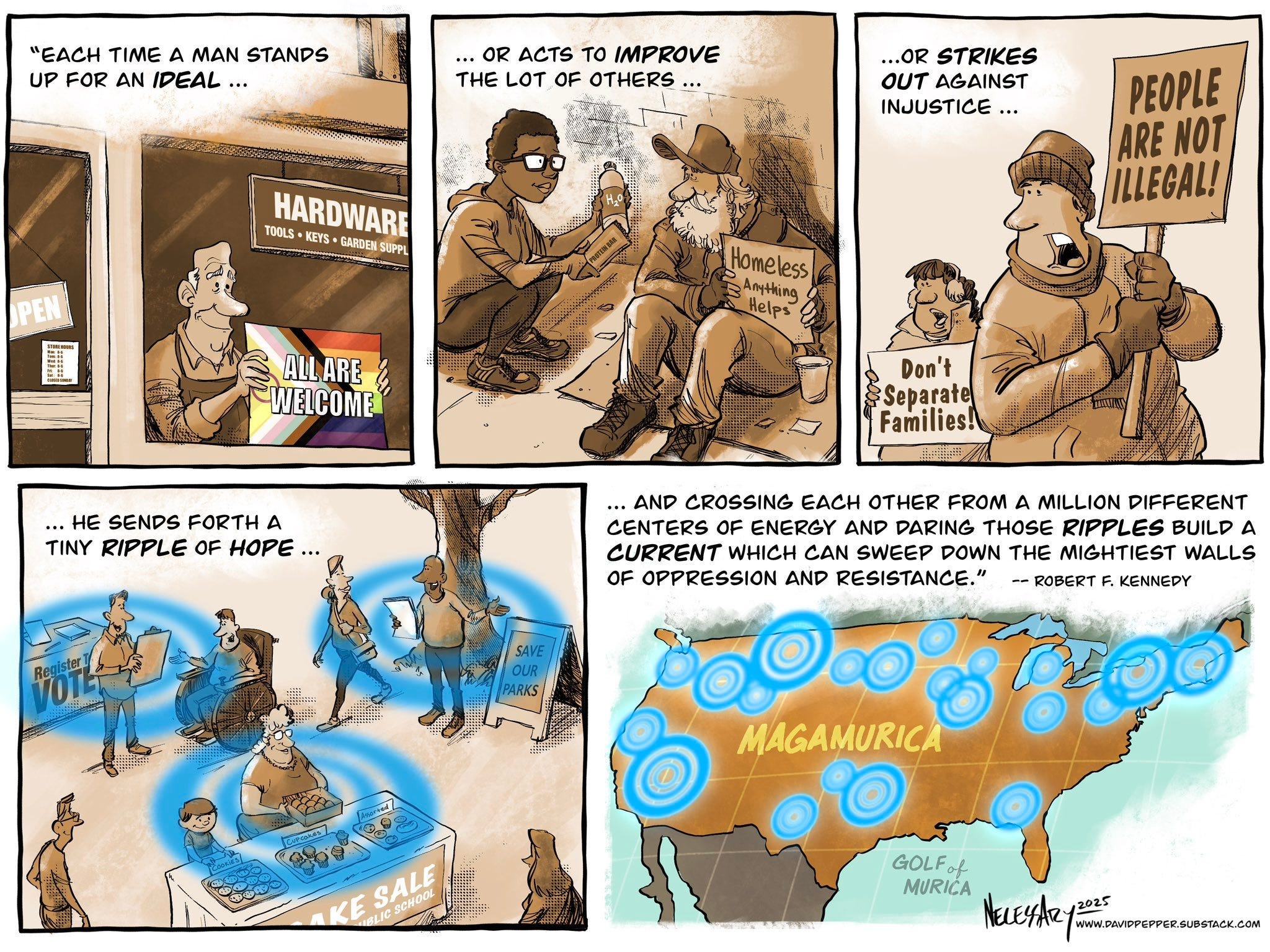
This hopeful cartoon is from editorial cartoonist Kevin Necessary. [H/T Nancy Davis Kho]
Celebrate This! 🎉
The Virginia Senate approved a proposed constitutional amendment that would restore voting rights to individuals with past felony convictions upon their release. If passed by both chambers next session, the amendment will go before voters for final approval. 🪣
Minnesota Attorney General Keith Ellison announced a settlement with Novo Nordisk, securing insulin products for $35 per month in the state for the next five years. 🪣
A coalition of non-profits, public health leaders, and small businesses sued to block OMB’s late night attempt to pause all agency grants and loans. 🪓
Jim Acosta resigned from CNN, issuing a statement that said, in part: “It is never a good time to bow down to a tyrant…Do not give in to the lies. Don’t give into the fear. Hold on to the truth and to hope.” He then launched a Substack, which already has over 150K subscribers. 🪓
A Nevada judge dismissed a right-wing lawsuit filed by the Public Interest Legal Foundation that challenged voter rolls in Washoe County.
The White House rescinded its illegal “freeze” after a day of ferocious backlash. Nice job, y’all. 🪓
Democrat Mike Zimmer flipped a state Senate seat in Iowa in a special election on Tuesday. Zimmer prevailed 53% to 47% in a district that Trump carried 60% to 39% in November. AMAZING! 🪓
The normally quiet Reddit thread of federal workers at rfednews has exploded with defiance — “We will NOT Resign, we took an oath and we will keep defending it against foreign and DOMESTIC enemies!!” 🪓
Democrats easily held a state Senate seat in Minnesota. Democrat Doron Clark won this Hennepin County seat 91% to 9%. In November, Harris had prevailed 83% to 14%. 🪓
The Burbank, CA city council voted unanimously in favor of a resolution to make Burbank a sanctuary city. 🪓 🪣
Solar and wind are now being installed at a rate that is five times faster than all other new electricity sources combined. 🪣 (Thanks, Joe Biden!)
In response to Trump’s announcement of 25% tariffs on Canadian goods, British Columbia Premier David Eby has directed the B.C. Liquor Distribution Branch to immediately stop purchasing American liquor from Republican-led “red states” and remove the top-selling brands from public liquor store shelves.
SCOTUS allowed the federal government to enforce a money-laundering law that protects consumers by increasing transparency in corporate ownership.
Three days before Trump was sworn into the presidency, a private equity firm with a growing monopoly on anesthesia practices agreed to a federal settlement requiring it to back off its anticompetitive roll-up scheme that has cost patients millions more for vital services. 🪣
After years of litigation that delayed payments designed to combat the national opioid crisis, Purdue Pharma and the billionaire Sackler family who own it agreed to pay $7.4 billion to settle lawsuits over the opioid manufacturer’s role in the crisis and give up their company ownership. 1
Sexual assault victims in New Jersey should be able to track their rape kits through the criminal justice system by late summer under a new law Gov. Phil Murphy signed last week. 🪣
Sacramento City Unified School District officials unanimously affirmed safety for undocumented students at their schools, saying they will refuse to cooperate with ICE or allow them on their campuses. 🪓 🪣
Senate Budget Committee Democrats boycotted the committee hearing on Russell Vought to protest his nomination. MORE LIKE THIS PLEASE!! 🪓 🪣
Costco is increasing pay for most of its hourly U.S. store workers to more than $30, per Reuters.
A New York appeals court restored the state’s Voting Rights Act, which expands voter protections, overturning a lower court’s decision striking it down.
China broke its own records for the installation of new solar and wind power last year, with installed capacity increasing by 18 and 45 percent, respectively.
Former New Jersey Democratic Sen. Bob Menendez was sentenced to 11 years in prison following his conviction on bribery and corruption charges.
Two unions–National Treasury Employees Union and Public Employees for Environmental Responsibility–are suing the president for his “Schedule F” executive order that would allow him to fire civil servants without due process. 🪓
A federal judge in Rhode Island granted a temporary restraining order to block Trump’s freeze on all agency grants and loans. The judge also barred the Trump administration from issuing any further directive that emphasizes a funding freeze. Oh and he’s a judge Biden appointed. 🪣
A group of Quaker meetings, represented by Democracy Forward, filed a lawsuit challenging the Trump administration’s plan to enable ICE agents to enter houses of worship for their immigration enforcement actions. 🪓
The first step towards creating a Celtic rainforest – a now extremely rare habitat that once covered large swathes of the west coast of Britain – has been completed in Devon, England.
A new report from the Yale Program on Climate Change Communication finds that most registered voters support climate-friendly policies, think the US should use more renewables and less fossil fuels in the future, and support US participation in the Paris Climate Agreement.
A Franklin County, MO woman pardoned for her participation in the U.S. Capitol insurrection on Jan. 6, 2021 was sentenced Wednesday to 10 years in prison for her role in a fatal drunk driving crash.
Economists at Georgia Tech reported in a paper published this month that by mid-2023, the 13 states with total abortion bans had suffered a combined net loss of an estimated 36,000 residents per quarter, or more than 144,000 per year.
A federal judge dismissed a lawsuit filed by several voters who sought to remove hundreds of allegedly ineligible voters from voter rolls in Marin County, California without evidence. The judge ruled the voters lacked standing.
Acting FBI Director Brian Driscoll refused a Justice Department order that he assist in the firing of agents involved in Jan. 6 riot cases, pushing back so forcefully that some FBI officials feared he would be dismissed (he wasn’t.) Courage—love to see it!
Officials have declared that the world’s largest hornet, dubbed the “murder hornet” for its killer stings, has been eradicated in the US five years after it was first spotted.
New York lawmakers are discussing a bill that would give Gov. Kathy Hochul more time to set dates for special elections, which could leave Republican Rep. Elise Stefanik’s red North Country seat empty until the summer.
Amazing PA rep Malcolm Kenyatta was just elected the Vice-Chair of the DNC! So was David Hogg! (The DNC has three vice-chairs.) Ken Martin will be the Chair, and although he wasn’t my choice he seems like he’ll be a competent leader. So the DNC has strong new leadership. No more “rudderless ship.” Yay!
Arizona Democratic Gov. Katie Hobbs appointed Maria Elena Cruz to the Arizona Supreme Court. The state appellate judge from rural Yuma County will become the first Latina and the first Black person chosen for the state’s high court
February 2, 1779 Anthony Benezet and John Woolman, both prominent Quakers (Society of Friends), urged refusal to pay taxes used for arming against Indians in Pennsylvania. Since William Penn established the state two generations earlier, the Friends had dealt with the Indian tribes nonviolently, and had been treated likewise by the native Americans. Benezet and the Quakers were also early and consistent opponents of slavery. More about Anthony Benezet
February 2, 1848 The Treaty of Guadalupe Hidalgo was signed in the Mexican city of the same name, ending the Mexican War. In 1845 Congress had voted to annex Texas, and President James K. Polk sent General Zachary Taylor and troops to patrol the border, newly defined by Congress as the Rio Grande, though it previously had been the Nueces River. Following an encounter between Mexican and U.S. troops, Polk called for Congress to declare war on Mexico. General Winfield Scott and troops eventually seized Mexico City.The treaty’s provisions called for Mexico to cede 55% of its territory (present-day California, Nevada and Utah, New Mexico, most of Arizona, and portions of New Mexico, Wyoming and Colorado), and to recognize the Rio Grande as the southern border of Texas, in exchange for fifteen million dollars in compensation for war-related damage to Mexican property. According to the treaty, U.S. citizenship was offered to any Mexicans living in the 500,000 sq miles (1.3 million sq km) of new U.S. territory. Land ceded to the U.S. after the Mexican War. The Treaty of Guadalupe Hidalgo
February 2, 1931 The first of well over 400,000 Mexican-Americans from across the country, some of them citizens and many of them U.S. residents for as long as 40 years, were “repatriated” as Los Angeles Chicanos were forcibly deported to Mexico. More on those deported, Los Repatriados
February 2, 1932 The Conference on the Reduction and Limitation of Arms, the world’s first disarmament meeting, opened in Geneva, Switzerland. Sponsored by the League of Nations, and attended by delegates from 60 nations, no agreement was reached. The U.S. delegation called for the abolition of all offensive weapons as the basis for negotiations but found little support.
February 2, 1966 The first burning of Australian military conscription papers as a protest against the Vietnam War occurred in Sydney, Australia.
February 2, 1970 Bertrand Russell later in life Bertrand Russell, mathematician, Nobel laureate in literature and philosopher of peace, died in Penryndeudreaeth, Merioneth, in Wales at age 97. Bertrand Russell at age 10 “Patriots always talk of dying for their country but never of killing for their country.” — Bertrand Russell More of Russell’s wisdom
February 2, 1980 Reports surfaced that the FBI had conducted a sting operation targeting members of Congress. In what became known as ”Abscam,” members suspected of taking bribes were invited to meetings with FBI agents posing as Arab businessmen, offering $50,000 and $100,000 payments for special legislation. Audio and video recordings of the meetings were made surreptitiously. Six members of the house were convicted of accepting bribes. Another member of the House and one senator were targeted but took no money. FBI agents in Abscam sting operation Actual FBI videotape of one attempted scam
February 2, 1989 Soviet participation in the war in Afghanistan ended as Red Army troops withdrew from the capital city of Kabul. They left behind many of their arms for use by Afghan government forces. They were driven out principally by the insurgent mujahadin, armed through covert U.S. funding. Read more “Charlie Wilson’s War” movie trailer
February 2, 1990 South African President F.W. De Klerk unbanned (lifted the legal prohibition on) opposition parties: the African National Congress (ANC), the Pan-Africanist Congress and the South African Communist party were officially considered legal. He also announced the lifting of restrictions on the UDF, COSATU and thirty-three other anti-apartheid organizations, as well as the release of all political prisoners and the suspension of the death penalty. This was the result of his negotiations with the imprisoned Nelson Mandela, a leader of the ANC. The ecstatic reaction to De Klerk’s beginning the end of apartheid on BBC video