
This is a must watch video. It totally destroys the anti-vaccine groups and the Idea that vaccines cause autism. This is a medial Scientist researcher with the greatest knowledge in the field of study and he has an autistic daughter. He knocks down and shows proof of the lies of the anti-vaccine people. He explains how it all became a political issue and power, and how it is killing people. Hugs
Category: Political / Governments / Nations / Countries /
Good News for People
Peace & Justice History for 12/31
| December 31, 1915 The U.S. branch of the International Fellowship of Reconciliation (FOR) was founded. FOR’s Mission StatementThe Fellowship of Reconciliation seeks to replace violence, war, racism and economic injustice with nonviolence, peace and justice. We are an interfaith organization committed to active nonviolence as a transforming way of life and as a means of radical change. We educate, train, build coalitions, and engage in nonviolent and compassionate actions locally, nationally, and globally. FOR’s website |
| December 31, 1970 The U.S. Congress repealed the Gulf of Tonkin resolution, which in 1964 authorized an increase in U.S. military involvement in Vietnam as a response to a reported attack on U.S. naval forces patrolling close to the North Vietnamese border. The reports of the attacks were later revealed to be fictitious. The resolution was used as the basis for the entire war which lasted until 1974 and took the lives of millions of Vietnamese and over 58,000 Americans.  What really happened in the Gulf of Tonkin |
https://www.peacebuttons.info/E-News/peacehistorydecember.htm#december31
Poetry for An Election
You know what to do to find out more.
Morning After The Election by Regie Cabico
I can’t control
the vanishing
of bees
but I can control
the honey I swallow
to soothe
the vocal cords
I can’t control boys
bully-tumbling
another boy
in the classroom
like they’re
in a mosh pit
but I can remember
rolling on hills
with boys being the bully
I can’t change my major
from drama to global peace
but I can write
similes of serenity
& poetic sermons
in temples
of matrimonial fanfare
I know the bombs, the explosives,
and Molotovs are overhead
and I can’t control
the lottery, the multiverses,
and tomorrow’s astrology
but whatever tarot card I pick
or whatever
gets thrown
at my face:
Hangman
or Fallen Towers
I can express
my weathering emotions
to sing while hoarse
to control air placement
to find the chakra
the right amount of air
to pass through my throat
oh sing with me
the octave between
blade & nectar
rubble & clouds
ash & mountain
Copyright © 2024 by Regie Cabico. Originally published in Poem-a-Day on December 30, 2024, by the Academy of American Poets.
Peace & Justice History for 12/30
(Their email program seems to be off for the holidays! I keep a link; here is today’s.)
| December 30, 1901 The worst year in the 20th century for lynching in the U.S. ended with a total of 130 victims (105 blacks, 25 whites). Ida Wells-Barnett had been a teacher and newspaper editor in Memphis, Tennessee, where she wrote against the evils of lynching in her columns in The Free Speech and Headlight. Forced from the South by threat of violence, she continued her efforts in Chicago. From a letter to President William McKinley from Barnett, published in the Cleveland Gazette April 9, 1898: Mr. President, the colored citizens of this country in general, and Chicago in particular, desire to respectfully urge that some action be taken by you as chief magistrate of this great nation, first for the apprehension and punishment of the lynchers of Postmaster Baker, of Lake City, S.C.; second, we ask indemnity for the widow and children, both for the murder of the husband and father, and for injuries sustained by themselves; third, we most earnestly desire that national legislation be enacted for the suppression of the national crime of lynching. For nearly twenty years lynching crimes, which stand side by side with Armenian and Cuban outrages, have been committed and permitted by this Christian nation. Nowhere in the civilized world save the United States of America do men, possessing all civil and political power, go out in bands of 50 and 5,000 to hunt down, shoot, hang or burn to death a single individual, unarmed and absolutely powerless. Statistics show that nearly 10,000 American citizens have been lynched in the past 20 years. To our appeals for justice the stereotyped reply has been that the government could not interfere in a state matter. Postmaster Baker’s case was a federal matter, pure and simple. He died at his post of duty in defense of his country’s honor, as truly as did ever a soldier on the field of battle. We refuse to believe this country, so powerful to defend its citizens abroad, is unable to protect its citizens at home. Italy and China have been indemnified by this government for the lynching of their citizens. We ask that the government do as much for its own. |
December 30, 1936 above: Workers sit down at GM  Supporters pass in food to sitdown strikers Members of the United Automobile Workers sat down at a General Motors plant in Flint, Michigan. GM, the world’s largest corporation at the time, had refused to recognize or negotiate with the union, despite passage of the National Labor Relations Act (Wagner Act) in 1935 which promised unions the right to organize. The local’s membership adopted a tactic developed by French workers. Instead of picketing outside a factory only to be ignored or forcibly cleared away, the sit-down strike enabled workers to halt production and seize the plant “from the inside.” The strike began just days after the end of a successful sit-down at Ford supplier Kelsey-Hayes. “Master Hands,” a corporate documentary about the Flint plant shot shortly before the strike |
| December 30, 1971 Daniel Ellsberg, a Defense Department analyst, and his colleague Anthony Russo were indicted by a federal grand jury for releasing the Pentagon Papers to the news media. The papers were part of a 7000-page, top-secret government history of the United States’ political and military involvement in the Vietnam War from 1945 to 1971, and described air strikes over Laos, raids along the coast of North Vietnam, and offensive actions taken by U.S. Marines well before the American public had been told that such actions had occurred.  The Most Dangerous Man in America: Daniel Ellsberg and the Pentagon Papers The Post – new movie (2017) watch trailer Why were they being prosecuted? |
| December 30, 1972 President Richard Nixon ordered an end to U.S. bombing of North Vietnam. The most recent air strikes had been retaliation for North Vietnam’s walking out of the peace negotiations in Paris and pressure to force it to submit to U.S. terms. Bombing of strategic targets and Hanoi (the North’s capital) and Haiphong lasted for eight days with a 36-hour break for Christmas. The 20,000 tons (18.1 million kg) of bombs killed just over 1600 North Vietnamese, and a dozen B-52s were lost. North Vietnam agreed to return to the bargaining table. |
| December 30, 1993 The state of Israel and the Vatican under Pope John Paul II agreed to extend diplomatic recognition to one another. |
https://www.peacebuttons.info/E-News/peacehistorydecember.htm#december30
Voter ID News
Yes, we lived through this. We do not advise it. If your state legislature starts in this direction, show them this.
Kansas once required voters to prove citizenship. That didn’t work out so well
By JOHN HANNAUpdated 10:44 AM CST, December 29, 2024Share
TOPEKA, Kan. (AP) — Republicans made claims about illegal voting by noncitizens a centerpiece of their 2024 campaign messaging and plan to push legislation in the new Congress requiring voters to provide proof of U.S. citizenship. Yet there’s one place with a GOP supermajority where linking voting to citizenship appears to be a nonstarter: Kansas.
That’s because the state has been there, done that, and all but a few Republicans would prefer not to go there again. Kansas imposed a proof-of-citizenship requirement over a decade ago that grew into one of the biggest political fiascos in the state in recent memory.
The law, passed by the state Legislature in 2011 and implemented two years later, ended up blocking the voter registrations of more than 31,000 U.S. citizens who were otherwise eligible to vote. That was 12% of everyone seeking to register in Kansas for the first time. Federal courts ultimately declared the law an unconstitutional burden on voting rights, and it hasn’t been enforced since 2018.
Kansas provides a cautionary tale about how pursuing an election concern that in fact is extremely rare risks disenfranchising a far greater number of people who are legally entitled to vote. The state’s top elections official, Secretary of State Scott Schwab, championed the idea as a legislator and now says states and the federal government shouldn’t touch it.
“Kansas did that 10 years ago,” said Schwab, a Republican. “It didn’t work out so well.”
Steven Fish, a 45-year-old warehouse worker in eastern Kansas, said he understands the motivation behind the law. In his thinking, the state was like a store owner who fears getting robbed and installs locks. But in 2014, after the birth of his now 11-year-old son inspired him to be “a little more responsible” and follow politics, he didn’t have an acceptable copy of his birth certificate to get registered to vote in Kansas.
“The locks didn’t work,” said Fish, one of nine Kansas residents who sued the state over the law. “You caught a bunch of people who didn’t do anything wrong.”
A small problem, but wide support for a fix
Kansas’ experience appeared to receive little if any attention outside the state as Republicans elsewhere pursued proof-of-citizenship requirements this year.
Arizona enacted a requirement this year, applying it to voting for state and local elections but not for Congress or president. The Republican-led U.S. House passed a proof-of-citizenship requirement in the summer and plans to bring back similar legislation after the GOP won control of the Senate in November.
In Ohio, the Republican secretary of state revised the form that poll workers use for voter eligibility challenges to require those not born in the U.S. to show naturalization papers to cast a regular ballot. A federal judge declined to block the practice days before the election.
Also, sizable majorities of voters in Iowa, Kentucky, Missouri, Oklahoma, South Carolina and the presidential swing states of North Carolina and Wisconsin were inspired to amend their state constitutions’ provisions on voting even though the changes were only symbolic. Provisions that previously declared that all U.S. citizens could vote now say that only U.S. citizens can vote — a meaningless distinction with no practical effect on who is eligible.
To be clear, voters already must attest to being U.S. citizens when they register to vote and noncitizens can face fines, prison and deportation if they lie and are caught.
“There is nothing unconstitutional about ensuring that only American citizens can vote in American elections,” U.S. Rep. Chip Roy, of Texas, the leading sponsor of the congressional proposal, said in an email statement to The Associated Press.
Why the courts rejected the Kansas citizenship rule
After Kansas residents challenged their state’s law, both a federal judge and federal appeals court concluded that it violated a law limiting states to collecting only the minimum information needed to determine whether someone is eligible to vote. That’s an issue Congress could resolve.
The courts ruled that with “scant” evidence of an actual problem, Kansas couldn’t justify a law that kept hundreds of eligible citizens from registering for every noncitizen who was improperly registered. A federal judge concluded that the state’s evidence showed that only 39 noncitizens had registered to vote from 1999 through 2012 — an average of just three a year.
In 2013, then-Kansas Secretary of State Kris Kobach, a Republican who had built a national reputation advocating tough immigration laws, described the possibility of voting by immigrants living in the U.S. illegally as a serious threat. He was elected attorney general in 2022 and still strongly backs the idea, arguing that federal court rulings in the Kansas case “almost certainly got it wrong.”
Kobach also said a key issue in the legal challenge — people being unable to fix problems with their registrations within a 90-day window — has probably been solved.
“The technological challenge of how quickly can you verify someone’s citizenship is getting easier,” Kobach said. “As time goes on, it will get even easier.”
Would the Kansas law stand today?
The U.S. Supreme Court refused to hear the Kansas case in 2020. But in August, it split 5-4 in allowing Arizona to continue enforcing its law for voting in state and local elections while a legal challenge goes forward.
Seeing the possibility of a different Supreme Court decision in the future, U.S. Rep.-elect Derek Schmidt says states and Congress should pursue proof-of-citizenship requirements. Schmidt was the Kansas attorney general when his state’s law was challenged.
“If the same matter arose now and was litigated, the facts would be different,” he said in an interview.
But voting rights advocates dismiss the idea that a legal challenge would turn out differently. Mark Johnson, one of the attorneys who fought the Kansas law, said opponents now have a template for a successful court fight.
“We know the people we can call,” Johnson said. “We know that we’ve got the expert witnesses. We know how to try things like this.” He predicted “a flurry — a landslide — of litigation against this.”
Born in Illinois but unable to register in Kansas
Initially, the Kansas requirement’s impacts seemed to fall most heavily on politically unaffiliated and young voters. As of fall 2013, 57% of the voters blocked from registering were unaffiliated and 40% were under 30.
But Fish was in his mid-30s, and six of the nine residents who sued over the Kansas law were 35 or older. Three even produced citizenship documents and still didn’t get registered, according to court documents.
“There wasn’t a single one of us that was actually an illegal or had misinterpreted or misrepresented any information or had done anything wrong,” Fish said.
He was supposed to produce his birth certificate when he sought to register in 2014 while renewing his Kansas driver’s license at an office in a strip mall in Lawrence. A clerk wouldn’t accept the copy Fish had of his birth certificate. He still doesn’t know where to find the original, having been born on an Air Force base in Illinois that closed in the 1990s.
Several of the people joining Fish in the lawsuit were veterans, all born in the U.S., and Fish said he was stunned that they could be prevented from registering.
Liz Azore, a senior adviser to the nonpartisan Voting Rights Lab, said millions of Americans haven’t traveled outside the U.S. and don’t have passports that might act as proof of citizenship, or don’t have ready access to their birth certificates.
She and other voting rights advocates are skeptical that there are administrative fixes that will make a proof-of-citizenship law run more smoothly today than it did in Kansas a decade ago.
“It’s going to cover a lot of people from all walks of life,” Avore said. “It’s going to be disenfranchising large swaths of the country.”
___
Associated Press writer Julie Carr Smyth in Columbus, Ohio, contributed to this report.
Colorado Man Accused Of Attacking Reporter, Saying ‘This Is Trump’s America Now’
The Colorado TV reporter told police that he believed he had been followed by the man because he is Pacific Islander.A Colorado man is facing possible bias-motivated charges for allegedly attacking a television news reporter after demanding to know whether he was a citizen, saying “This is Trump’s America now,” according to court documents.
Patrick Thomas Egan, 39, was arrested Dec. 18 in Grand Junction, Colorado, after police say he followed KKCO/KJCT reporter Ja’Ronn Alex’s vehicle for around 40 miles (64 kilometers) from the Delta area. Alex told police that he believed he had been followed and attacked because he is Pacific Islander.
After arriving in Grand Junction, Egan, who was driving a taxi, pulled up next to Alex at a stoplight and, according to an arrest affidavit, said something to the effect of: “Are you even a U.S. citizen? This is Trump’s America now! I’m a Marine and I took an oath to protect this country from people like you!”
Alex, who had been out reporting, then drove back to his news station in the city. After he got out of his vehicle, Egan chased Alex as he ran toward the station’s door and demanded to see his identification, according to the document laying out police’s evidence in the case. Egan then tackled Alex, put him in a headlock and “began to strangle him,” the affidavit said. Coworkers who ran out to help and witnesses told police that Alex appeared to be losing his ability to breathe during the attack, which was partially captured on surveillance video, according to the document.
According to the station’s website, Alex is a native of Detroit. KKCO/KJCT reported that he was driving a news vehicle at the time.
Egan was arrested on suspicion of bias-motivated crimes, second degree assault and harassment. He is scheduled to appear in court Thursday to learn whether prosecutors have filed formal charges against him.
Egan’s lawyer, Ruth Swift, was out of the office Friday and did not return a telephone message seeking comment.

Another Saturday meme post.






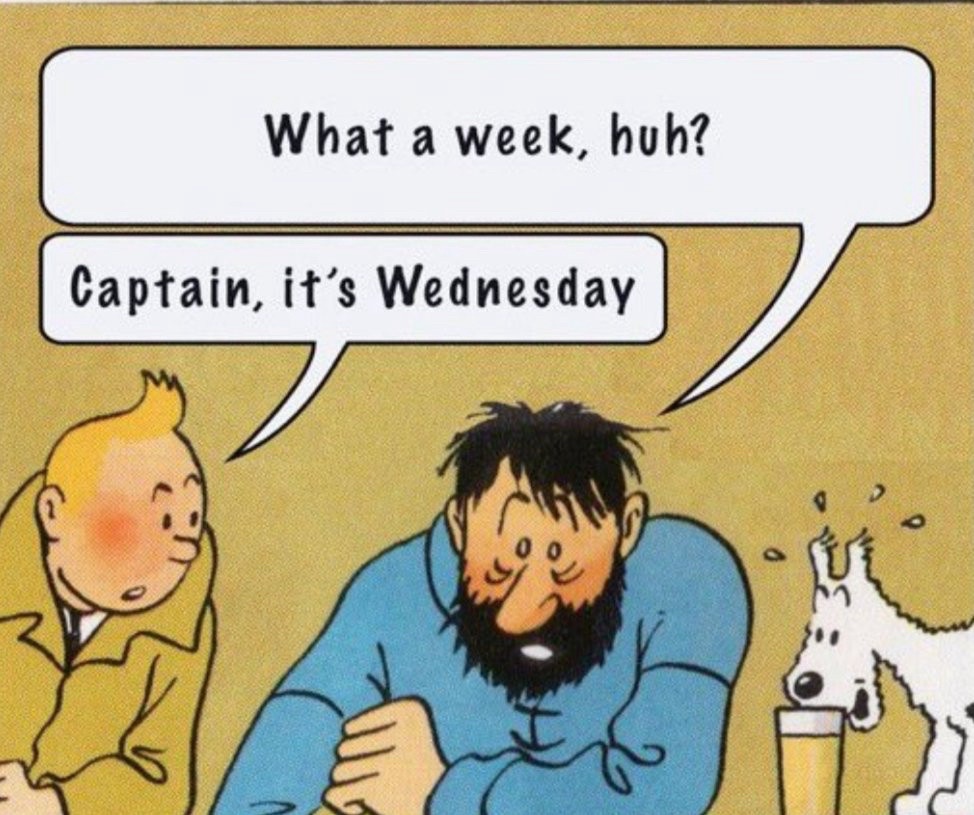


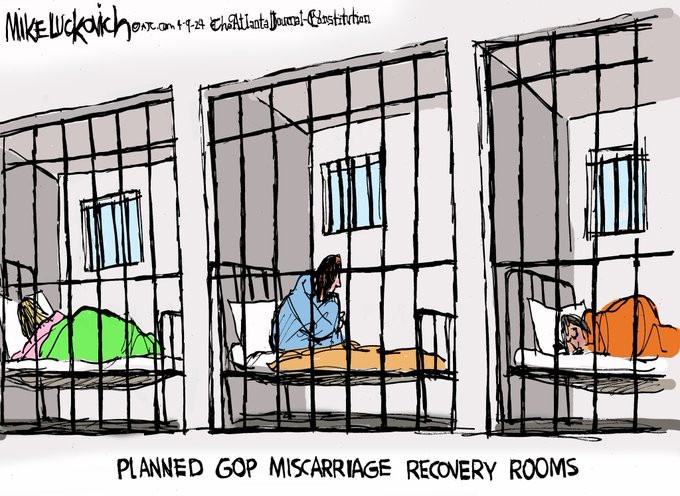
Billionaire tRump supporters running the government, running the newspapers, running pretty much everything now. Sounds familiar.


Ahhh…yes, Nancy Mace’s state.





“I object to being designated as the national bird on the eve of the country being handed over to turkeys.”









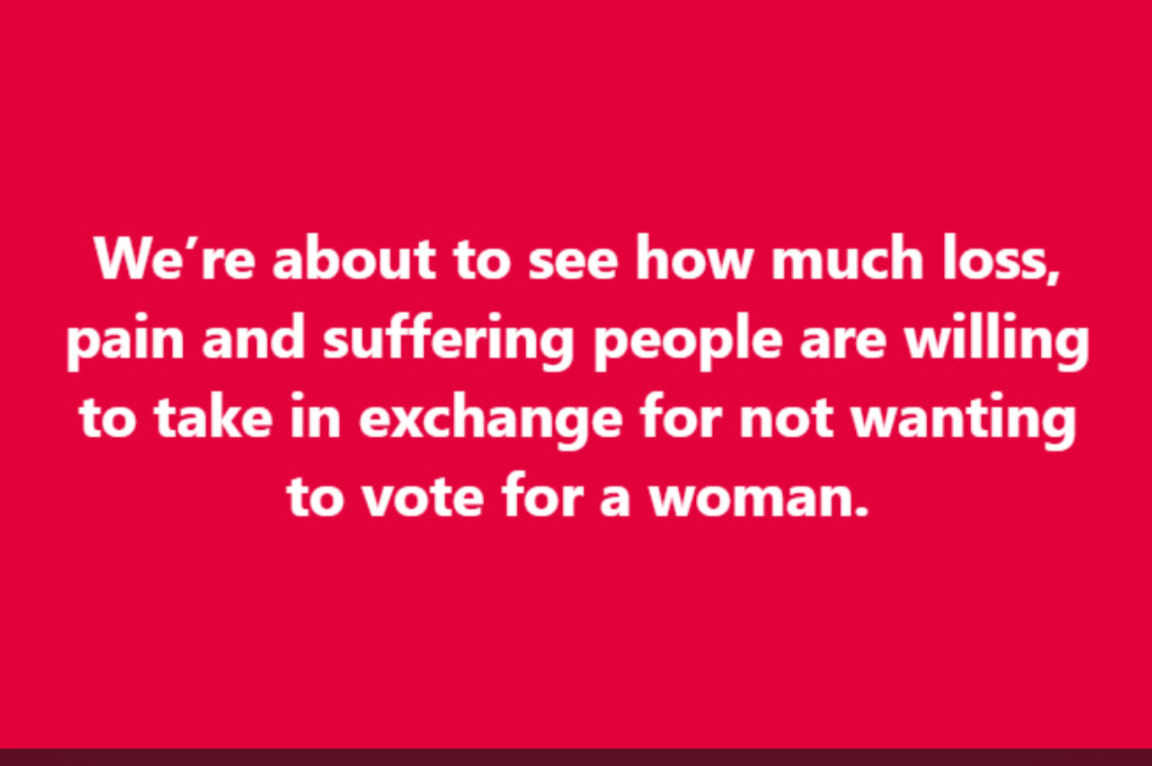
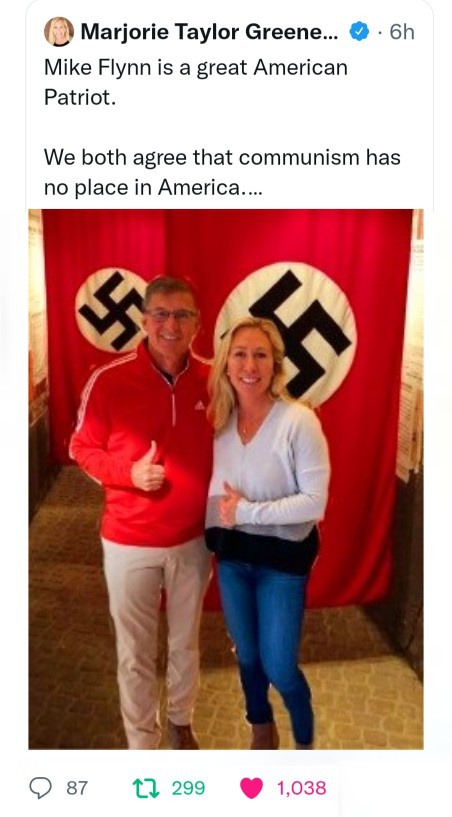

I screwed up with this post and I will look to see if there are others. This is an offense to trans people and I understand why. It is also offensive to gay men when they are depicted as submissive females. I really dropped the ball on this and thank Janet and Ali who called me out on it. Be low is Janet’s comment. I post it with her permission. I apologize for my error. Hugs
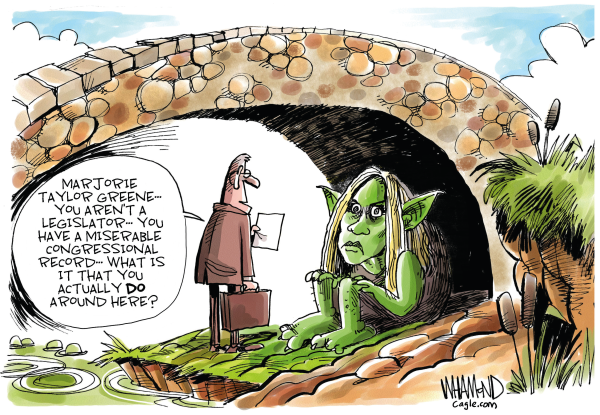






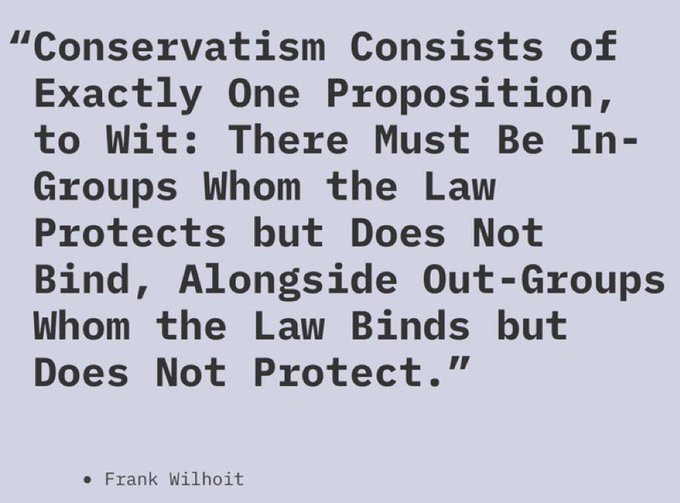
We Did Get Some Stuff Done
because we did the work.
It wasn’t all bad: Despite election defeat, progressives scored big wins in 2024
Organizers tell Salon how they pulled off major victories in a year marked by the rise of the far-right
By Tatyana Tandanpolie Staff Writer
Snippet:
For many on the political left, 2024 was disappointing.
Even as inflation ebbed, Americans still struggled with housing costs and necessary expenses. The U.S. role in enabling Israel’s war in Gaza sparked protests in the streets and on college campuses. The far-right continued to target marginalized groups, most notably immigrants, transgender people and women. To top it off, the mid-summer excitement at Vice President Kamala Harris’ entry into the presidential race following President Joe Biden’s eleventh-hour exit petered out with the election of President-elect Donald Trump — again.
But even as the political landscape appeared to grow bleaker, Americans still fended off at least some of the efforts to encroach upon their rights. At times, they even helped pass policies that not only protected core freedoms but could genuinely improve quality of life.
As they reflected on 2024 and looked ahead to 2025, when the Trump administration’s ultraconservative agenda is poised to make their work harder, advocates behind wins in LGBTQ+, labor and reproductive rights shared with Salon how they successfully organized against legislative efforts to roll their rights back and planted hope for a better future.
Abortion rights enshrined in seven states
Ballot measures seeking to establish or protect abortion rights were on 10 states’ ballots this year as organizers fought to protect access and reverse bans enacted in the wake of the 2022 overturning of Roe v. Wade. Seven of those states — Arizona, Colorado, Maryland, Missouri, Montana, Nevada and New York — would indeed pass measures to enshrine a right to abortion access in their respective constitutions.
Proposition 139 in Arizona provided a legal means to upend the state’s 15-week abortion restriction and established state constitutional rights to abortion access until viability and afterward if a healthcare professional deems it necessary for the pregnant person’s physical or mental health. The proposition also barred the state from penalizing any individual or entity “for aiding or assisting a pregnant individual in exercising the individual’s right to abortion.”
Arizona for Abortion Access, a seven-group coalition of reproductive health, rights and justice organizations, including Reproductive Freedom for All and Planned Parenthood Advocates of Arizona, led the campaign supporting the proposed amendment, which took effect almost immediately on Nov. 25.
“The passing of Proposition 139 speaks to the broad support — across the entire state, across all political parties, and across voters of all different backgrounds — for reproductive freedom,” Erika Mach, Planned Parenthood Arizona’s chief external affairs officer, told Salon. “People want the freedom to make medical decisions with their doctor and family, without government involvement.”
To place a constitutional amendment on the state’s ballot, the coalition had to obtain signatures from 15% of registered voters in the state — just under 384,000 signatures — and file the petition by early July, according to the Arizona Secretary of State’s website. (snip-MORE)
Diminished People Holding Elected Office
There’s a discussion on another post, and I think all of us have brought it up here at one time or another, and I know I’m too soft-hearted and worry about elder abuse, and now finally others are calling it out for the abuse of people that it is. I used to say it often before Trump finally left the White House, that he was being abused for nefarious reasons; he’s so disliked that few cared about him being abused. Here’s a story from a publication that’s been around for generations, always bringing me important info, first on recycled newsprint paper, now online. And I’m still pleased I spent 6 hours phone banking for Annie Kuster* a few years back, even though I’d hoped for her more liberal primary oppo. She’s been a fine US Rep. (I also phone banked for Marcy Kaptur under the same condition-different election, and it was time well spent. But Annie Kuster is one subject of this story, so I had to fix that. It was late when I scheduled this, my apologies.)
Elder Abuse Is No Way to Run a Government
The corridors of power increasingly resemble a nursing home—if not a hospice.
This year, two veteran members of Congress, Republican Representative Kay Granger from Texas and Democratic Representative Annie M. Kuster of New Hampshire, announced that they were retiring from public service, but the story of their last days played out very differently, illustrating the dangers of a political system that enables both gerontocracy and elder abuse.
In March, Granger, age 81, announced that she was stepping down from her powerful post as chair of the House Appropriation Committee and would not seek reelection, even though she would finish out her term. She cast her last vote on July 24, and has appeared in Washington only once since. For all intents and purposes, Granger had disappeared from public visibility.
On December 20, The Dallas Express, a conservative online publication, revealed that Granger had been living in an independent living facility. Prior to that discovery, Granger’s office was not returning phone calls to the Express or anyone else. Visiting her office, reporter Carl Turcios found “the door locked, the front door glass window covered, no one inside, and no sign of the office continuing to be occupied.”
Responding to these reports, the congresswoman’s son, Brandon Granger, stated that his mother suffered from “dementia,” a condition he claimed was diagnosed in September. Granger’s office shared a statement where she purportedly said that “since early September, my health challenges have progressed, making frequent travel to Washington both difficult and unpredictable. During this time, my staff has remained steadfast, continuing to deliver exceptional constituent services, as they have for the past 27 years.”
This version of Granger’s story, which places the onset of dementia in September, makes little sense, since, as Ken Klippenstein reports on his Substack, there is evidence that as early as March she had difficulty reading even from a prepared statement without painful effort. Further, she sold her home in early July, which indicates that her move to the independent living facility was already in the works at that time.
Granger eventually resigned her seat—but too late. If she had left public service a few years ago, she’d be remembered as a pioneer, the first Republican woman to lead the House Appropriations Committee. Now, there is a pall on her legacy since, as The New York Times reports, she has “brought renewed attention to how Capitol Hill is powered by a crop of septuagenarians and octogenarians, including some who refuse to relinquish power even far past their primes.”
Granger’s fellow congresswoman Annie M. Kuster, age 68, offers a telling contrast. In an interview with The Boston Globe, Kuster made clear that she is leaving Washington not just for personal reasons but also to show that lawmakers do in fact have the ability to reject gerontocracy. According to Kuster, “I’m trying to set a better example. I think there are colleagues—and some of whom are still very successful and very productive—but others who just stay forever.”
The Granger case, along with new reporting making clear that Joe Biden has served as a diminished president, is forcing gerontocracy onto the agenda in Washington. Aside from Biden and Granger, there are now increasing expressions of concerns about the advanced age and healthcare struggles of former House speaker Nancy Pelosi and outgoing Senate Republican leader Mitch McConnell (both of whom, despite formally giving up powerful posts, remain kingmakers in Washington). Questions have also been raised about Democratic Representative David Scott of Georgia, with even fellow Democrats expressing skepticism about his ability to serve. The decision to sideline young congresswoman Alexandria Ocasio-Cortez in the House Oversight Committee on behalf of Gerry Connolly, who is 74 and suffers from cancer, has been criticized even by centrist Democrats such as Jen Psaki as proof of entrenched gerontocracy.
This is a major shift from recent years, when a bipartisan code of silence protected elected officials and judges from being criticized even though there was ample evidence that age had made them incapable of serving.
Republican Representative Thomas Massie of Kentucky responded to the Granger story by tweeting, “I’m more concerned about the congressmen who have dementia and are still voting.”
Democratic Representative Ro Khanna of California tweeted:
Kay Granger’s long absence reveals the problem with a Congress that rewards seniority & relationships more than merit & ideas. We have a sclerotic gerontocracy. We need term limits. We need to get big money out of politics so a new generation of Americans can run and serve.
Khanna’s statement has the virtue of moving the discussion beyond just the individual choices of lawmakers and into the wider system that has made gerontocracy possible. Republican firebrand Kerri Lake, who rarely agrees with Khanna on anything—and is seldom a voice of reason—also offered a systemic analysis, tweeting, “Washington D.C. shouldn’t be a retirement home, but the entrenched forces there are so desperate to hold on to power that they will reject fresh voices while pulling stunts like this.”
Khanna and Lake are accurate in seeing the problem as entrenched systems. The rules of Congress reward seniority with more power, which also makes it logical for voters to keep voting for longtime lawmakers even past the decline in their capacity. Those lawmakers have staff who can make sure that the perks of power are still shared with constituents.


Re: President Musk and his First Lady
I would ask that we not misgender Trump. As much as I hate him, that is reinforcing of the root of anti-trans woman transphobia. That being feminine is “less than” is straight up misogyny. Never mind that the “man in a dress” imagery is direct from the anti-trans playbook.
I would ask that liberals not stoop to their level. I believe that you don’t mean it that way, but it nevertheless normalizes and reinforces that thought pattern.
The collection of memes is excellent otherwise.
Again I appreciate it when my viewers point out my own short sightedness, my own shortcomings. I also have much to learn but I admit that I did not catch this myself irritates me greatly. Hugs