Oh how I wish I could have watched something like this as a kid. But no I would have been beaten near to death if I had tried. I did not need another reason to be beaten or raped. My dogs that love gravy I am still suffering anxiety over talking on the phone from the beatings I took just touching the wall hanging phone as a kid. This a wonderful video that shows the bigotry that the right wing fundamentalist republicans want to return the US back to. Do we really want to return to this? Please everyone watch it. After the video I will post what I wrote on the longer this is what I am reading post, but to tell the truth I can not face writing it all again. Hugs
The VERY 1st Gay TEEN was the famous MOVIE STAR Ryan Phillippe! Check out the whole story here!
*** Editor note *** It was books that gave me my escape from my life. It was books that let me leave the life of abuse, hurt, and fear I was living constantly at home, in my home. It was books that let me understand I was not a horrible abomination in life that was going to do horrible things and die in a gutter as my adoptive parents (the ones beating and sexually abusing me and letting their kids do so) claimed long before they even knew I was gay, that I did not need to suffer in silence, (Which I did for most of my life). These books that these people are trying to ban and deny to the very kids that need them meant so much to me and other kids. Please do not let them. Look in the 1950s these people want to revert the social and country to there were no of these kinds of books, no positiverepresentatives in media, but gay, lesbian, and trans kids still existed. I am going to post a video about a old long time soap opera about gay people and the damage hate can do. Hugs.
Well the gun manufactures do make guns for kids now including pink guns for girls, and all the maga republicans take pictures for Christmas of their families where even the youngest children are holding guns. In Florida, you don’t need any kind of training or permit to buy and carry a gun, even to do concealed carry. This is the Clint Eastwood pretend wild west that never existed but in the mind of the hard core republicans. In the true history of the west, cities and towns had strict gun laws. Even the 1950’s TV shows had gun control in Dodge City. Again the right has rewritten history to please themselves and to create a white person fantasy. Hugs
Police in central Florida have arrested the father of a toddler who found a loaded handgun in his “Paw Patrol” backpack and fatally shot his mother while she was on a Zoom call for work.
Veondre Avery, 22, was arrested Tuesday and charged with negligent manslaughter and unsafe storage of a firearm, Altamonte Springs police said.
Investigators said the 2-year-old found the gun in the backpack on Aug. 11 and fired a single shot that hit his mother, Shamaya Lynn, in the head.
A woman who also was on the Zoom call dialed 911, reporting that she heard a noise and saw Lynn fall. The co-worker didn’t know how old Lynn was or where she lived, but meanwhile Avery also called 911, begging responders to hurry as he tried to help Lynn.
“I literally just got home and I come in the room… (and) my girlfriend who was working on the computer, she’s just laid back and there’s blood everywhere,” Avery said on the 911 call.
He told the dispatcher that Lynn wasn’t breathing, and he could not feel her heartbeat. She was pronounced dead at the scene.
Authorities said another child also was in the home during the shooting.
The Seminole County State Attorney’s Office said Avery is being held without bond. Records did not list an attorney who could speak on his behalf.
The Committee is a documentary film about the little-known Florida Legislative Investigative Committee of the State Legislature from 1956-1965. Florida Senator Charley Johns chaired the committee, and its aim was to root out communist and homosexual teachers and students from state universities. It was successful in either firing or expelling more than 200 suspected gay and lesbian citizens.
I wish I could post this short video. It is what DeathSantis is trying to recreate today in Florida and if he gets the presidency he will push this hard on the entire country. Hugs
Florida governor and presidential hopeful Ron DeSantis signed a bill Thursday that would allow for roads across Florida to be made with “radioactive” mining waste that has been linked to cancer.
The measure, brought forward by the state House, adds phosphogypsum to a list of “recyclable materials” that state officials say can be used in road construction.
The list already included ground rubber from car tires, ash residue from coal combustion byproducts, recycled mixed-plastic, glass and construction steel, which officials had previously determined are “part of the solid waste stream and that contribute to problems of declining space in landfills.”
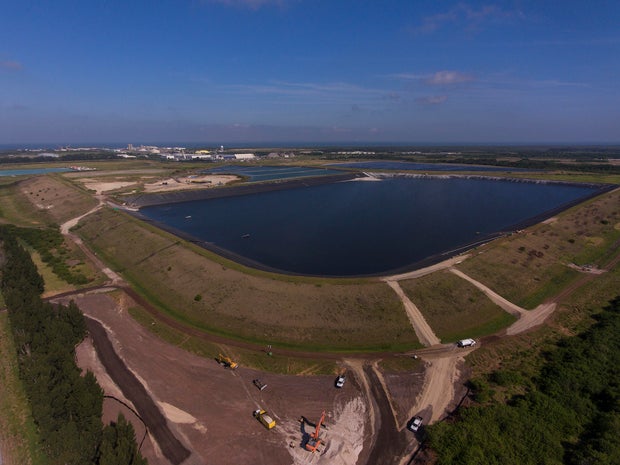
An aerial view of the partially drained New Gypsum Stack South wastewater reservoir at Piney Point in Palmetto, Florida, on May 4, 2021. The reservoir held about 480 million gallons of water in March and was in danger of collapsing and flooding the area. THOMAS O’NEILL/NURPHOTO VIA GETTY IMAGES
But unlike most of those products, phosphogypsum is not a material that is aggregated in landfills. It’s the remains left behind from mining phosphate, which is described by the EPA as being a “radioactive material” because it contains “small amounts” of uranium and radium.
Phosphate rock is mined to create fertilizer, but the leftover material, known as phosphogypsum, had decaying remains of those elements that eventually produce radon. That substance is known as a “potentially cancer-causing, radioactive gas,” a spokesperson for the EPA previously told CBS News. And because of that risk, phosphogypsum is federally required to be stored in gypstack systems – not landfills – in an attempt to prevent it from coming in contact with people and the environment.
“The Clean Air Act regulations require that phosphogypsum be managed in engineered stacks to limit public exposure from emissions of radon and other radionuclides in the material,” an EPA spokesperson previously told CBS News.
Before it can be used, the state’s Department of Transportation will need to conduct a study to “evaluate the suitability” of its use, the bill says, and “may consider any prior or ongoing studies of phosphogypsum’s road suitability in the fulfillment of this duty.” That task must be completed by April 1, 2024.
DeSantis has not yet publicly commented on the signing of this bill, and CBS News has reached out for a statement.
Elise Bennett, Florida and Caribbean director and attorney at the Center for Biological Diversity, said in a statement that the bill is a “reckless handout to the fertilizer industry.”
“Gov. DeSantis is paving the way to a toxic legacy generations of Floridians will have to grapple with,” Bennett said. “This opens the door for dangerous radioactive waste to be dumped in roadways across the state, under the guise of a so-called feasibility study that won’t address serious health and safety concerns.”
What makes phosphogypsum so risky?
Radon, the gas emitted from phosphogypsum, trails just smoking to rank as the second-leading cause of lung cancer, and is linked to about 21,000 lung cancer deaths every year in the U.S., according to the EPA. The agency also says it’s the “single greatest environmental source of radiation exposure.”
Because of this threat, the EPA has banned the use of phosphogypsum in projects for decades. However, a spokesperson for the agency previously told CBS News that it is permitted for agricultural and indoor research, with restrictions, and it can be approved for specific uses if the project “is at least as protective of human health as placement in a stack.”
In a statement to CBS News on Friday, the EPA said that the passing of the legislation, HB 1191, “does not affect EPA’s regulation of phosphogypsum,” noting the legislation specifies that the phosphogypsum be used “in accordance with the conditions” of the agency.
“Any request for a specific use of phosphogypsum in roads will need to be submitted to EPA,” the spokesperson said, “as EPA’s approval is legally required before the material can be used in road construction.”
If it is approved, the EPA previously told CBS News it would “open a public comment period, make any applications and our technical analysis of those applications publicly available, and seek input on the proposed decision.”
Florida’s history of phosphogypsum problems
Phosphate mining has been an ongoing source of contention within Florida for decades. This issue has most recently been seen in the controversy surrounding Piney Point, a former phosphate mining facility in the Gulf Coast’s Manatee County — that after several years of problems — had a nearly “catastrophic” breach in 2021 that resulted in 215 million gallons of water with environmentally toxic levels of nutrients ending up in Tampa Bay within just 10 days.
TOXIC LEAK: Residents near Piney Point retention pond in Manatee County, Florida were evacuated on Saturday as officials fear an "imminent" collapse of a local wastewater reservoir contaminated with material that could be radioactive. https://t.co/phrXuNUqdgpic.twitter.com/dQ9RCkYYBA
It was found to be a contributor to a red tide event and massive fish kill in the area in the following months. It lead to a lawsuit from the state’s Department of Environmental Protection, and prompted Florida lawmakers to budget $3 million to clean up the site.
Ragan Whitlock, a staff attorney for the Center for Biological Diversity, told CBS News when the bill was introduced that “history has shown wherever this waste goes, environmental contamination has followed.”
The state has 25 gypstacks, several of which have had leaks, sinkholes and other issues arise throughout their lifespans. In May, more than 20 organizations, including the Center for Biological Diversity, urged DeSantis to veto the bill.
“No environmentally conscious or ‘green’ governor worth his salt would ever sign a bill into law approving roadbuilding with radioactive materials,” Rachael Curran, an attorney with People for Protecting Peace River, said in the letter urging the governor’s decision.
And even with the promise of the state’s Department of Transportation looking at conducting a study or considering one that has already been done, Whitlock told CBS News he has “very little confidence” in the state’s “ability to manage this project.”
“The feasibility study that the Florida Department of Transportation would create is only aimed at addressing whether this would be a suitable construction material,” he said. “The Florida Department of Transportation is not in the position to make a finding about the health and safety of this product to Floridians and our environment.”
For more information on the damage to the Florida environment and the harm to residents, read the following. Sure will help get tourist dollars, won’t it. Hugs.
More than 300 hundred homes and multiple businesses in the area around Piney Point have been evacuated.
A state of emergency has been declared by Florida Gov. Ron DeSantis for Manatee, Hillsborough and Pinellas counties.
State and local officials are coordinating efforts.
Herald-Tribune journalists are covering the situation in Piney Point and possible impacts to the area, like we have for over 20 years. Local journalism like this is supported by our readers. If you’re a subscriber we thank you. And if you’d like to subscribe, please see our current offers here.
***
Last week, the Florida Department of Environmental Protection approved the pumping of wastewater into the Tampa Bay ecosystem from a retention pond at Piney Point – a former phosphate plant in Manatee County. A leak in the liner of the reservoir has caused a partial breach in one of the containment walls and officials hope that pumping more than 30 million gallons of wastewater out of the reservoir will relieve pressure on the walls and reduce the chance of an uncontrolled major breach.
More than 300 hundred homes and multiple businesses in the area around Piney Point have been evacuated. State and local officials are coordinating efforts and a state of emergency has been declared by Florida Gov. Ron DeSantis for Manatee, Hillsborough and Pinellas counties.
Share
The shoreline along Tampa Bay, just north of Port Manatee and Piney Point. Millions of gallons of wastewater are being pumped into Tampa Bay at Port Manatee in an effort to avoid a catastrophic failure of a containment wall at Piney Point.
MIKE LANG, SARASOTA HERALD-TRIBUNE
Share
This still image from video shows the breach in the containment wall of the Piney Point reservoir. United States Congressman Vern Buchanan toured Piney Point Monday, Apr. 5, 2021, getting a look at the breach in the containment wall, the pumping outflow and Port Manatee where the wastewater is being pumped into Tampa Bay.
MIKE LANG, SARASOTA HERALD-TRIBUNE
Share
Wastewater from Piney Point is flowing into Tampa Bay at this berth at Port Manatee. United States Congressman Vern Buchanan toured Piney Point Monday, Apr. 5, 2021, getting a look at the breach in the containment wall, the pumping outflow and Port Manatee where the wastewater is being pumped into Tampa Bay.
MIKE LANG, SARASOTA HERALD-TRIBUNE
Share
United States Congressman Vern Buchanan toured Piney Point Monday, Apr. 5, 2021, getting a look at the breach in the containment wall, the pumping outflow and Port Manatee where the wastewater is being pumped into Tampa Bay.
MIKE LANG, SARASOTA HERALD-TRIBUNE
Share
Wastewater being pumped from the Piney Point reservoir flows into Tampa Bay at Port Manatee, via this water-filled ditch in the center of this image. United States Congressman Vern Buchanan toured Piney Point Monday, Apr. 5, 2021, getting a look at the breach in the containment wall, the pumping outflow and Port Manatee where the wastewater is being pumped into Tampa Bay.
MIKE LANG, SARASOTA HERALD-TRIBUNE
Share
Wastewater from Piney Point is flowing into Tampa Bay at this berth at Port Manatee. United States Congressman Vern Buchanan toured Piney Point Monday, Apr. 5, 2021, getting a look at the breach in the containment wall, the pumping outflow and Port Manatee where the wastewater is being pumped into Tampa Bay.
MIKE LANG, SARASOTA HERALD-TRIBUNE
Share
Wastewater being pumped from the Piney Point reservoir flows into this ditch and into Tampa Bay. United States Congressman Vern Buchanan toured Piney Point Monday, Apr. 5, 2021, getting a look at the breach in the containment wall, the pumping outflow and Port Manatee where the wastewater is being pumped into Tampa Bay.
MIKE LANG, SARASOTA HERALD-TRIBUNE
Share
Wastewater being pumped from the Piney Point reservoir flows into this ditch and into Tampa Bay. United States Congressman Vern Buchanan toured Piney Point Monday, Apr. 5, 2021, getting a look at the breach in the containment wall, the pumping outflow and Port Manatee where the wastewater is being pumped into Tampa Bay.
MIKE LANG, SARASOTA HERALD-TRIBUNE
Share
The wastewater containment ponds at the old Piney Point fertilizer plant property in Manatee County. A breach in a containment pond wall led to more than 200 million gallons of polluted water being dumped into Tampa Bay. Florida lawmakers have included $100 million in the 2021-2022 budget for the Piney Point cleanup effort, among other budget earmarks targeted at projects in Sarasota or Manatee counties.
MIKE LANG/HERALD-TRIBUNE FILE
Share
Congressman Vern Buchanan got an aerial tour of the Piney Point reservoir breach, pumping outflow and Tampa Bay on Monday, Apr. 5th
MIKE LANG
What is the situation at Piney Point on Tuesday?
The strategy of the Florida Department of Environmental Protection and other agencies working on Piney Point is to reduce the amount water so that there is less pressure on the damaged reservoir retaining walls, in order to prevent a catastrophic breach that could send a massive wall of water into the surrounding area.
After pumping more than 30 million gallons of wastewater each day from Piney Point into Tampa Bay, the amount of water in the Piney Point retention pond has dropped to under 300 million gallons, down from approximately 480 million gallons last week at this time.
The addition of new federal and state resources should increase the rate at which water can be pumped out of Piney Point.
Is there a second breach in the Piney Point retention pond?
While the leaking wastewater containment pond wall at the old Piney Point fertilizer plant site continues to be a critical situation, the Florida Department of Environmental Protection said Monday that concerns about a possible second breach in the wall have proven to be unfounded.
Manatee County officials said that a drone equipped with thermal imaging equipment identified a possible second breach in the wall at 2 a.m. Monday. An investigation later determined that the area identified was not another wall failure, according to the DEP.
“Our technical team and our engineers came in and evaluated and determined there was no second breach,” said DEP Spokeswoman Shannon Herbon.
What are the environmental impacts of pumping Piney Point wastewater into Tampa Bay?
Environmental groups say they worry that recent releases from a Piney Point wastewater treatment facility will eventually fuel an algae bloom that could impact coastal Southwest Florida.
Nutrient-rich waters from the treatment facility will offset natural balances in the coastal estuaries and will eventually end up in the Gulf of Mexico, where red tide initiates.
The region was partially crippled during a 17-month red tide bloom that started in the fall of 2017 and lasted until the spring of 2019.
What will happen to Piney Point once this crisis is over?
State lawmakers are pushing a bill to fund a complete cleanup and closure of the phosphogypsum stacks at Piney Point with American Rescue Plan funds, an effort that could cost upwards of $200 million.
On Monday evening, Senate President Wilton Simpson (R-Trilby) announced that the Senate will consider a budget amendment on Wednesday when it considers Senate Bill 2500, known as the General Appropriations Act.
What about evacuations for people living near Piney Point?
More than 300 households and numerous businesses have been evacuated and those evacuation orders are still active.
On Monday, Manatee County Public Safety reported that the county has had to help relocate more people among the more than 300 households that were covered by the mandatory evacuation around the Piney Point wastewater reservoir. 102 residents have now been provided shelter at local hotels with the assistance of Manatee County and the Red Cross.
DeFascist can indeed get the country on a different path – Here’s what Ron DeFascist has accomplished –
– LGBT students cannot discuss their personal lives with teachers or counselors, making them feel marginalized, alone, and possibly increasing their risks of suicide. Some parents with LGBT family members are moving out of the state. State ACLU currently suing to end this.
– Universities are unsure what they can or cannot teach based on the whims of literally one man. GOP prefer students to be inculcated with cheap cheerleading America First nationalism (this shut down by a judge, results pending)
– History teachers can’t teach about the truth of American racism and black history because it might upset white people
– Some teachers are seeking employment in another state.
– A school principal had to resign because one of her teachers showed students a picture of Michelangelo’s David.
– A teacher is under investigation because she showed 13 year olds a Disney movie with a gay character.
– Women who discover they’re pregnant after 6 weeks, and are unable to have a child, can’t get an abortion in Florida, even though there should be retroactive abortion, Don Jr. lives there
– Property taxes and insurance costs are becoming unaffdable
– Million dollar contracts are given to DeFascist’s donors
– 87,141 people died of Covid in Florida. Less would have died had there been the slightest of protective measures taken, but DeFascist didn’t allow that.
– Hispanic farm and construction workers are not going to work out of fear of DeFascist’s draconian rules to punish undocumented workers and their bosses. Hispanic truckers are refusing to deliver to the state. Farm products are rotting while remaining unpicked.
– Students and companies who support diversity and inclusion are no longer allowed to do so.
– Trans children can no longer get medical care, use bathroom of pronouns of their choice (this shut down by a judge, results pending)
– a court could temporarily remove children from their homes if they receive gender-affirming care
– LGBT people who seek medical care can be denied it if they’re unlucky enough to have a religious fanatic doctor.
– Drag queens can be arrested for appearing in drag in public where children can see them. (this shut down by a judge, results pending)
– Any idiot can buy a gun without a permit, training, or with or without a criminal record.
– Disney, the state’s largest employer, is suing DeFascist because of politically motivated harassment after he started a fight with them because they don’t approve of his anti-LGBT laws. Disney cancelled a $1 billion construction project that would have brought the state over 2,000 jobs.
– More to come. White retirees probably love him because he’s getting rid of the blacks, gays, immigrants and other assorted annoyances. DeSantis calls Florida “the freest state in America.” Actually you’re free to move here, retire and die.
The SCOTUS ruled for the bigots! The religiously driven seriously old haters of the newer culture ruled it is OK to discriminate against the gays, if you have a sincerely held belief. I am hurting so bad seeing the US revert to a religiously driven theocracy that denies any progress in society since the 1950s. We fought these battles, we in the US are now going so far backward from the rest of the world. Hell even Nepal just approved same-sex marriage. The fundamentalist won’t stop even as they age out and become more of a minority until they rule us all with their hateful church doctrines based on words of people who did not even understand germ theory written 2,500 years ago. I am so upset at a country that claims all people are created equal that says because I am gay I have less or no rights if someone has a belief against my existence. On a prior case one of the Justices wrote that discrimination against religion is the worst kind of discrimination. Well you can choose your religion, you can change it or stop believing in any of them. I was born gay. I don’t have a choice in that. I am gay. But someone who can choose what myths they believe in that day can deny me services or rights due to that belief. Sad hugs.
The suit centers on Lorie Smith, a website designer who does not want to provide her services for gay weddings because of her religious objections. In 2016, she says, a gay man named Stewart requested her services for help with his upcoming wedding. “We are getting married early next year and would love some design work done for our invites, place, names etc. We might also stretch to a website,” reads a message he apparently sent her through a message on her website.
In court filings, her lawyers produced a copy of the inquiry. But Stewart, who requested his last name be withheld for privacy, said in an interview with the Guardian that he never sent the message, even though it correctly lists his email address and telephone number. He has also been happily married to a woman for the last 15 years, he said. In fact, until he received a call this week from a reporter from the magazine, Stewart says had no idea he was somehow tied up in a case that had made it to the Supreme Court.
“I’m not really sure where that came from,” he told me of the mysterious 2016 inquiry that used his name, email address, and cell phone number to request a wedding website for a same-sex marriage nearly a decade after he married a woman. He is a designer himself, something of a known quantity in design circles—he’s spoken at conferences and on podcasts, and has a “decent Twitter following,” he said.
The design world is small. But not small enough, he said, that he had heard of Lorie Smith—not until her case was already before the Supreme Court, and the design community began discussing its potential fallout. It didn’t make sense to him. Why would a web designer—as the website the inquiry referenced as his own made clear that he was—living in San Francisco, seek to hire someone in another state who has never built a wedding website, let alone a website for a same-sex wedding, to build his wedding website?
Photo: Alliance Defending Freedom president Michael Farris.
Hit the New Republic link for a very in-depth accounting of this story. As I’ve said many times, the ADF invents these businesses with sole intention of challenging local LGBTQ rights ordinances. The ruling in the case is expected tomorrow morning.
Truly insane story in which @melissagira called up the man named in the court filing as someone who requested a same-sex wedding website only to find out..he says he never sent such a request and is not gay.
They will have written their opinion based on the assumption that the plaintiff’s filing was true and correct. They won’t abandon it because the filing is being challenged now. Unlike in the case involving the athletic coach proselytizing on the field on school time, where the conservative justices MADE UP “facts,” or at best completely mischaracterized them, here no one could ask if the plaintiff’s “facts” were correct. There just was not enough information to argue with them. The real argument should have been over the plaintiff’s standing to pursue a case that had no real-world consequences since she was only contemplating entering the wedding web-design business.
Well, you know how the saying goes: Love the sinner. Hate the phony-sin-I-had-to-fabricate-because-I-have-never-really-experienced-discomfort-by-being-asked-to-do-anything-and-I’m-a-big-fat-liar.
I defend their right to live their lives according to a 2,000 year old book of myths and fairy tales (even though they fail to live according to it), but I object to them legislating my civil rights according to their 2,000 year old book of myths and fairy tales.
(Written, incidentally, by misogynistic men who owned other humans, and were puzzled by where the sun went at night.)
Tomorrow is the last day of the term; the Court convenes at 10 am, and this is one of only two argued cases remaining. This case was pretextual and flouted anything I was taught about standing and before-the-fact irreparable harm. Nonetheless, it got through the appellate process without being thrown out, and here it is.
Journalism is now officially dead if a case made it all the way to the Supreme Court and will have a the ruling tomorrow and this is just now being uncovered, how much other shit has gone to SCOTUS and nobody checked.
I also blame the Defense Attorneys for not doing their due diligence
Climate change United Nations Climate change refers to long-term shifts in temperatures and weather patterns, mainly caused by human activities, especially the burning of fossil fuels.
Thank my dogs that love gravy that this hateful right winger did not have a gun. But this attacks and violence is what the right wants, what the right wing media with their lies about anything dealing with gender or sexual orientation is grooming or sexualizing kids. The right wing media screaming PROTECT THE CHILDREN creates the anger, rage, and fear of the subject in their thuggish followers that leads to this. Attacks on the LGBTQ+ and their supporters is the goal! I am tired of it. Already a recent poll of self reporting republicans showed the first ever decline in acceptance of gay people. A drop of 14 points. This is the result of trying their best to demonize any mention of the LGBTQ+, rainbows, and pride flags. Calling teachers groomers, attacking the best medical practice advice of all the major medical organizations which calls for accepting and assisting trans kids. They do so using lies, myths, and just made up bullshit to attack a marginalized group. This has to stop. Hugs
A triple stabbing during a gender studies class at the University of Waterloo is believed to have been a hate-motivated attack, police said Thursday as they laid multiple charges against a 24-year-old former student. The Wednesday attack injured three people and shocked the university campus located about 100 kilometres west of Toronto.
Geovanny Villalba-Aleman [photo], a recently graduated international student, faces three counts of aggravated assault, four counts of assault with a weapon and two counts of possession of a weapon for a dangerous purpose, police said.
“Investigators have reason to believe that this was a planned and targeted attack motivated by hate related to gender expression and gender identity,” Waterloo Regional Police Chief Mark Crowell said at a Thursday news conference.
The police said that on Wednesday, at about 3:40 p.m., about 40 students were in a classroom when the suspect came in and stabbed three people: a 38-year-old female professor; a 20-year-old female student and a 19-year-old male student. All three were taken to the hospital with “serious but non-life-threatening” injuries, the police said.
In what he described as a “shocking attack,” James Rush, a vice president of the university, said in a statement on Thursday that the stabbing took place during a lecture in a class called Philosophy 202 — Gender Studies.
Chief Mark Crowell of the Waterloo Regional Police said at a news conference that the suspect had entered the classroom and spoke briefly to the professor, apparently to confirm the subject matter of the class. Then, he stabbed her with two knives, stabbed the other two students and attempted to stab a third.
Local, federal and provincial leaders have spoken out about the stabbing, condemning this violent act. Speaking to reporters in Brantford on Thursday morning, Premier Doug Ford said the stabbing at the University of Waterloo was “unacceptable” and expressed concern for the victims.
Prime Minister Justin Trudeau said news of the stabbing was “horrifying and unacceptable. This type of violence must always be condemned.” Marit Stiles, leader of Ontario’s NDP, said she was thinking of the students and staff affected, and called the news “horrifying.”
Hagey Hall reopened on Thursday after being temporarily closed Wednesday night and the campus is open for all scheduled activities, said university spokesperson Nick Manning.
UNIVERSITY OF WATERLOO STABBING ATTACK WAS HATE MOTIVATED: POLICE
"A 24-year-old recent graduate from the University of Waterloo is facing 10 charges after reportedly stabbing three people, including a professor, during a gender studies philosophy class."https://t.co/bBHlhETAio
Waterloo regional police say a 24 year old, international student has been charged in a hate-motivated crime related to gender expression & gender identity, in connection to a stabbing that injured three people during a gender studies class at University of Waterloo on Wednesday. pic.twitter.com/IVbSx91qK4
Gah, and it is so evident, too! What the hell is UP with that? It doesn’t even have to be our community, either. Look at Abbott and his “no water breaks” law. These people just seem to WANT more suffering in the world. I absolutely don’t get it.
Conservatives love to talk like libertarians until someone does something they don’t like. They want to be free to be assholes without consequences but how dare anyone even look at them disapprovingly!
But jesus christ and a half WHY do they WANT to be assholes? This baffles me. Anyone who chooses to be an asshole simply ADDS to the number of assholes in the world! Why would people want this?
I hear you, But the person’s responsible ARE making it up. They are ‘being’ themselves (sic). People full of potential, with dreams and hopes of being AUTHENTIC, are systematically being slaughtered.
Leaving the HATE alone, ignoring it, is no longer an option.
At least being in Canada he didn’t have easy access to a gun.
Hundreds of MAGAT/incels are making their presence known in the comment section of Canada’s national main stream, right wing newspaper suggesting they deserved it because of their woke ideals.
Because this was in Canada, three people were stabbed and all will live. If that had happened in the US dozens would be dead and we’d need DNA to identify some of the bodies.
As far as I’ve seen centrist comments have mainly been confined to ‘look what your inflammatory rhetoric made him do.’ This is directed at trans people and their allies rather than at the hatemongers, of course.
Jordan Peterson is called the Incel King for a reason and I bet when the cops look at this specimen’s computer, they’ll find videos, writings and 4/8 Chan like bullshit from people like Peterson, FOX, Shapiro et al. You can bet on it. It should be noted that while Peterson still has his Incels in Canada, he is seen as an intellectual pariah.
Seriously important, especially since the SCOTUS just ruled for a Christian mail carrier who refused to work Sundays. She took the job knowing it would be required, then demanded special accommodations for her religious faith. You know, something Christians feel they have a right to, yet no other religion should be given. The post office she worked for tried to accommodate her but due to staffing needs they had to schedule her to work Sundays and she threw an entitled fit. So the court ruled for her right to have her religion take priority over everyone else and any other needs. If I was an employer, I would be wary of hiring Christians. Seriously this court is creating a theocracy for Christians. No other religion or atheist need to apply. It is a scary time, and this bode bad for the upcoming case of a made up pretend business to challenge anti-discrimination laws requiring equal treatment for same-sex couples. Hugs
Emboldened by recent Supreme Court decisions upholding prayer in schools, crosses erected on public lands, and flying Christian flags on public buildings, right-wing activists intend to “go on offense” by pushing Christian nationalist policies at all levels of government and society.
Among those leading the charge is Kelly Shackelford, president of First Liberty, which was integral to laying the groundwork for the right’s spate of Supreme Court victories. During a recent appearance on an Intercessors For America broadcast, Shackelford announced that his organization has launched a Restoring Faith In America campaign to mobilize far-right Christians to rush into the spaces opened by these court rulings and “occupy it”
“Everywhere that crosses went down, they go back up,” Shackelford declared. “Everywhere the 10 Commandments was taken into the closet, it comes back out. Everywhere that prayer was taken out, it goes back in. Everything has changed.”
As you’ll hear in the video below, Shackleford’s group plans a “major push” to inflict Jesus on public schools in a “thousand different” ways and “occupy the land God won for us” through the US Supreme Court. He last appeared here in May 2022 when he raged to Fox News about employers “forcing” the COVID vaccine on workers. Of note, First Liberty Institute is the former employer of anti-LGBTQ Texas federal judge Matthew Kacsmaryk, who is attempting to ban abortion pills and PrEP insurance coverage.
And let’s remember: RELIGION is a LIFESTYLE CHOICE.
Yes, childhood experience is a strong factor, but there are plenty of churches, mosques, and other groups that are overjoyed to help you give up your false religion and adopt their true one.
Another example of hypocrisy: Dumb Idiot Ham bemoans “evolution” being shoved down the throats of kids in schools and churches everywhere while planning to shove down his own young earth creation fantasies down the throats of kids in schools and churches everywhere.
Is it any wonder why the number of people who identify as Christian or religious is shrinking
Christianity in the U.S. is quickly shrinking and may no longer be the majority religion within just a few decades, research finds https://www.cbsnews.com/new…
And as the numbers shrink amongst religions, those still within the faiths will be the most diehard, outspoken and obnoxious. I hope they continue to shrink until they are no longer relevant at all. That’s what is driving them nuts as it is…they are becoming less relevant and it hurts their feelings!
That’s the flaw in their plan. Back when prayer and religion were allowed in schools (the 50s), kids were a little more well-behaved/obedient/subservient as well as overall more religious. They were all mostly Protestant or Catholic. So it was easy just to fall in line. Now we have various religions represented in schools, and I am sure there will be maliciously complaint teachers who will have non-Christian prayers in their class.
It’s less about that so much as it’ll be clearer to kids something ugly’s being forced on them. Instead of just being able to think ‘It’s always been this way.’
The “religious freedom” crowd will now push their minority, theo-fascist “religious beliefs” down everyone else’s throats. And you will see there will be no tolerance of anyone whose faith (or no faith) is different from theirs.
I get the feeling that when these evangelicals say they are going to take the 10 Commandments back out of the closet, they mean the Protestant version of the 10 Commandments. Well, unlike the Catholic version, the Protestant version forbids graven images. (See commandment #2) So maybe they first should consider converting to Catholicism, since stone depictions of the 10 Commandments are themselves graven images, and are thus self-forbidding.