Banned Books

Site logo imageThe Bloggess

Read on blog or Reader

Today they banned my book. It was not the first. It won’t be the last. Here’s what I want you to know

.By thebloggess on March 25, 2026
This is not what I wanted to write. I wanted to write about how I’m about to go on book tour for my new book in a few days. Instead I am writing about the fact that I was just informed that my first book Let’s Pretend This Never Happened was banned from the high school library of a nearby town I love and visit often.

Honestly, I’m not that upset about my book being banned. I’ve had so many letters from young people who felt they’d been helped by my books but it does have some profanity and so I can understand the reasoning even if I disagree with it. What I am upset about is the stories about how New Braunfels ISD has pulled more that 1,500 books from their school library shelves after the Texas’ Republican-backed book banning law (senate bill 13) passed. The bill ordered all public school libraries to review books for “profane” and “indecent” content and I guess Let’s Pretend This Never Happened was deemed too dangerous for high schoolers.

Weirdly, my book was not on the original list of the 1,500 books triggered for review on March 13 but a week ago it was added to the New Braunfels ISD website as being removed for being “non-compliant”. (I’ve been called worse.) I guess 1,500 books weren’t enough. But then, it’s never enough for book banners.This is going to happen more and more. It used to be a rarer thing…almost a badge of courage to have a book banned. Now? It’s everywhere…this war against books and ideas and people. Reading is how you fall in love with people different from you, and how you develop compassion for them…because if you love them, you want to protect them. But there are some people who don’t want you to love others. They need you to fear them.

Books save lives. They have saved mine. Books are safety nets for so many of us, and right now those nets are being cut.The list of banned books is incredible in length and includes so many that I adore. Equally upsetting is the fact that so many classics that shaped me have been pulled from the shelves and placed into restricted sections where they can only be accessed by students enrolled in Advanced Placement Literature, because God forbid a normal high school student would want to read the works of dangerous writers like *checks the list* Jane Austen and Emily Brontë (whose name they misspelled).

Sometimes it feels like we’re living in A Brave New World (restricted) and that the book burning of Fahrenheit 451 (restricted) is closer than ever, with no Sense and Sensibility (restricted) about what this will cost. It feels like we’re going through The Crucible (restricted) and are caught in a Catch-22 (restricted) where we can’t convince people how terrible it is to ban books because they either don’t know the power of books or they absolutely know it and fear it. It’s An Absolutely Remarkable Thing (banned) how book banners go out on some kind of A Discovery of Witches (banned) and fight against Acceptance (banned) and of diversity, while we are losing All The Beauty in the World (banned). America is a Beautiful Country (banned) in so many ways, but we will lose so much of that beauty if we don’t make Changes (banned) to cherish and embrace and grow what makes us Educated (banned) and compassionate. The diversity of voices is necessary…it is a reflection of who we are and who we want to be. A plethora of ideas and voices and experiences…This Is What America Looks Like (banned). We can’t just pretend that Everything’s Fine (banned) and that this is just an overreaction of Anxious People (banned). Do you think this is what the founding fathers like Alexander Hamilton (banned) envisioned? I’m going to stop here because I’m sure you can see that this dumb paragraph is WAY TOO EASY TO WRITE because there are so many books they have issues with and you probably get the picture already but y’all….Jane Eyre? The Color Purple? The Odyssey? Crime and Punishment?? THIS IS WHAT WE’RE SAVING TEENAGERS FROM?

So what can you do? You can buy books that are being targeted, especially those written by the LGBTQ+ authors or authors of color because they are being targeted the most. Supporting those authors tells publishing to keep producing those books because they are needed. Publishers will lose money if libraries become afraid to purchase books and so we need to make sure that they know the audience is there and greedy for diverse voices. Get a library card and start checking out those books and more, to prove to the government that libraries need funding and that people care about reading. Read to your children. Read in front of your children. Talk online about the books that you love so that your passion ignites others. If you’re a parent you can get involved with your school to make sure this doesn’t happen in your school and you can protest it if it happens. You can vote out the people who seem to be obsessed with freedom, but mainly when it’s their freedom to take away yours and your children’s. You can run against school board members who are book banners and show up at the meetings. You can keep updated by following organizations like PEN AMERICA, or the Texas Freedom to Read Project or Authors Against Book Bans.

*deep breath*

This is probably filled with typos and is not really the sort of thing that I should be writing the day before I leave to start my book tour but it’s important. When books and thoughts and people are suppressed, we all lose. Keep fighting the good fight, friends. It’s worth it.


Comment

Interesting How Things Work Out…

Despite state bans and restrictions, the number of abortions in the U.S. holds steady

March 24, 202612:01 AM ET Heard on Morning Edition

Selena Simmons-Duffin

Since the reversal of Roe v. Wade in 2022, anti-abortion rights advocates have continuously pursued laws and court cases to make access to abortion more difficult.

report published Tuesday finds those efforts haven’t worked in one basic way: The number of abortions in the country hasn’t budged.

“There were an estimated 1,126,000 abortions provided by clinicians in the U.S. in 2025 — that’s pretty much unchanged from 2024,” says Isaac Maddow-Zimet, data scientist at the Guttmacher Institute, a nonprofit research organization that supports abortion access.

A key way that abortions are now happening despite all of the state restrictions is through telemedicine. In 2023, the Food and Drug Administration under President Biden allowed mifepristone — one of the medications used for abortion — to be prescribed without an in-person appointment.

At the same time, states that support abortion access have passed shield laws, which protect health care providers from legal risks when they prescribe to patients in states with bans.

What that meant last year is that more people in states with restrictions had abortions through telemedicine, and fewer people traveled across state lines for abortion, according to the Guttmacher report.

“It makes sense that we’d see a decline in travel because people accessing abortion care through telehealth in general then no longer need to travel for care,” Maddow-Zimet says.

Medication by mail

When Viv found out she was pregnant last January, she was three days past Georgia’s ban on abortion after six weeks of pregnancy.

Viv is 27 years old and lives in Atlanta. NPR agreed not to use her last name because she fears repercussions for talking about her experience. She went online and looked through posts on Reddit, trying to figure out what to do.

“I found out that I could get an abortion pill shipped to my house,” she says. “I didn’t want to travel. I didn’t want to take time off of work. I am pretty knowledgeable about women’s health, and I know that the abortion pill is a safe and effective way to have an abortion.”

She ended up reaching out to a group called The MAP in Massachusetts, and she says the process was very easy.

“You basically go on their website, you answer questions, and then you pay whatever fee you can afford, which I thought was really, really cool,” she says.

About a week later, she received the two medications in the mail: mifepristone and misoprostol. She says the instructions that came with the medication were very thorough.

“People contact you after to make sure everything’s good,” she says. “They even have people contact you like a month after to make sure that you’re not pregnant anymore.”

Viv says she’s grateful she was able to have an abortion without having to leave Atlanta. She also notes that Georgia has one of the highest maternal mortality rates in the country.

“If a woman doesn’t want to be pregnant, she should be able to have that right, and I think that should be the end of the story,” she says.

Frustration for ban supporters

Abortion-rights opponents view all of this as a huge problem. There are several legal challenges and a recent congressional bill that all aim to force the FDA to stop allowing mifepristone to be mailed to patients. (Misoprostol is a medication that has been on the market longer and is also used to prevent ulcers; it is harder to restrict.)

One of the court challenges was brought by Louisiana Attorney General Liz Murrill, who told a U.S. Senate committee in January that the FDA rules must be changed.

“Until then, Louisiana’s efforts to protect mothers and their unborn children and to hold out-of-state abortion pill traffickers accountable for the harm they inflict will be all but futile,” she said.

According to Guttmacher’s latest report, there were about 2,500 abortions in Louisiana in 2023, and last year there were more than 9,000. Overall, 91,000 patients in states with bans received telehealth abortions in 2025.

A federal judge is expected to rule in Louisiana v. FDA soon.

Peace & Justice History On Elton John’s Birthday

March 25, 1807
Great Britain abolished international trade in slaves. Emancipation of slaves in the country, however, did not occur until 1834, and persisted as unpaid apprenticeship for the technically emancipated for years after that.
The story of abolition in England 
March 25, 1872
Toronto printers went on strike for a 9-hour workday and a 54-hour workweek—the first major strike in Canada. When the editor of the Globe newspaper had thirteen of them arrested, 10,000 turned out to support them. Later that year unions were made legal in Canada.
March 25, 1894
In the midst of a depression that had begun the previous year, a millionaire businessman from Massillon, Ohio, Jacob Coxey, organized a march of an “industrial army” from Ohio to Washington, D.C. Congress had done little in response to the economic crisis and Coxey advocated a range of solutions, many considered radical at the time, such as building roads and other public works (known as infrastructure today).


Coxey’s Army passing through Mayland on their way to Washington.
Coxey is seated behind the horses looking at the camera.
“Coxey’s Army” gathered on the Capitol lawn but they were driven off and Coxey was arrested for trespassing when he tried to deliver his address to the crowd in violation of their first amendment rights “peacably to assemble, and to petition the Government for redress of grievances.”
March 25, 1911
The Triangle Shirt Waist Company, occupying the top floors of a ten-story building on New York’s lower east side, was consumed by fire.

147 people, mostly immigrant women and young girls working in sweatshop conditions, lost their lives.
Approximately 50 died as they leapt from windows to the street; the others were burned or trampled to death, desperately trying to escape via stairway exits illegally locked to prevent “ the interruption of work.”Company owners were charged with seven counts of manslaughter—but were found not guilty.The incident was a turning point in labor law, especially concerning health and safety. For three days prior, the company, along with other warehouse owners, had grouped together to fight the Fire Commissioner’s order that fire sprinklers be installed.


Protests in the wake of the Triangle Shirtwaist fire, button from the struggle
Comprehensive collection of materials on the tragedy from Cornell University’s labor school 
March 25, 1915
The Sisterhood of International Peace was founded in Melbourne, Australia, by Eleanor May Moore and Dr. Charles Strong.
March 25, 1965
Their numbers having swelled to 25,000, the Selma-to-Montgomery marchers arrived at the Alabama state capitol.Organized by the Southern Christian Leadership Conference (SCLC) and the Student Nonviolent Coordinating Committee (SNCC), the march was to bring attention to the denial of voting rights to black Americans in the state and elsewhere in the south. Twice the people had been turned back, denied the right to leave Selma peacefully.

Martin Luther King Jr. and wife Coretta lead march into Montgomery, Alabama.
Dr. King spoke to the crowd: “Yes, we are on the move and no wave of racism can stop us. (Yes, sir) We are on the move now. The burning of our churches will not deter us. (Yes, sir) The bombing of our homes will not dissuade us. (Yes, sir) We are on the move now. (Yes, sir) The beating and killing of our clergymen and young people will not divert us. We are on the move now.”
The Federal Voting Rights Act was passed within two months.

The Selma to Montgomery National Historic Trail 
March 25, 1965

Viola Liuzzo
Viola Gregg Liuzzo, a housewife and mother from Detroit, driving marchers back to Selma from Montgomery, was shot and killed by Ku Klux Klansmen from a passing car. She had driven down to Alabama to join the march after seeing on television the Bloody Sunday attacks at Selma’s Edmund Pettus Bridge earlier in the month. It was later learned that riding with the Klansmen was an FBI informant, Gary Rowe.
More about Viola Liuzzo
Viola Gregg Liuzzo
March 25, 1967
Reverend Martin Luther King, Jr. led an anti-war march for the first time in Chicago, opposing the Vietnam War by saying:
“Our arrogance can be our doom. It can bring the curtains down on our national drama . . . Ultimately, a great nation is a compassionate nation The bombs in Vietnam explode at home—they destroy the dream and possibility for a decent America . . . .”


Reverend King addresses rally at the end of the Chicago march
photo: Jo Freeman
March 25, 1969
The newly wed John Lennon and Yoko Ono-Lennon began their seven-day “bed-in for peace” against the Vietnam War in the presidential suite of the the Amsterdam Hilton in The Netherlands. Their doors were open to the media from 10am to 10pm. They invited all to think about and talk about creating peace.
“Yoko and I are quite willing to be the world’s clowns, if by so doing it will do some good”.
 
The Wedding and “Ballad of John and Yoko” 
March 25, 1972
30,000 participated in the Children’s March for Survival in Washington, D.C., sponsored by the National Welfare Rights Organization. They were supporting the Family Assistance Program, then pending in Congress (but never passed), which guaranteed a minimum income level for all families.
March 25, 1990
A new community, Segundo Montes, was started by campesinos in El Salvador who had lived for nine years as exiles in Honduras following the El Mozote Massacre, when 1000 civilians were killed by the U.S.-trained Salvadoran military. The town was named after a priest who had helped them in the Colomoncagua refugee camp on the border, and who was murdered along with four other Jesuit priests by the Salvadoran military.

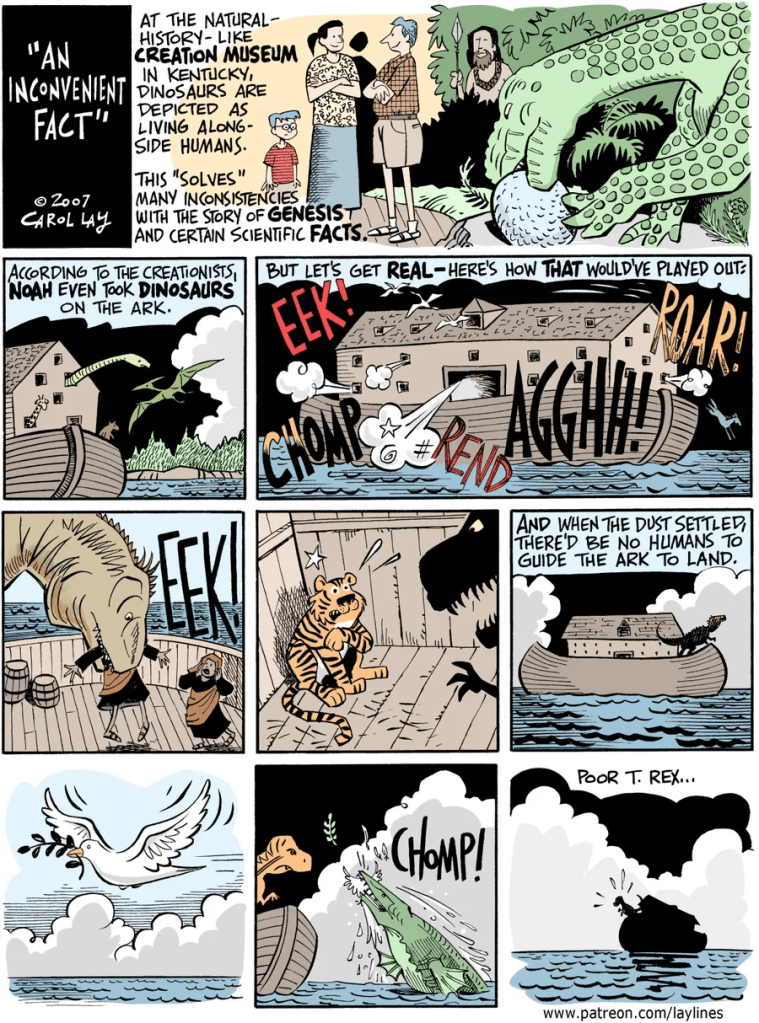
This Week’s “Lay Lines”

https://www.gocomics.com/lay-lines/2026/03/23

Some Unrushed Lunchtime Reading-

What Was Lost: A Queer Accounting of the NY Times Book Review, 2013-2022

Thirteen Essential Books by Trans and Queer Writers,
Reviewed by Trans and Queer Writers

Sandy Ernest Allen

Goodbye, Pamela Paul,” was the headline of Andrea Long Chu’s now-iconic, recently ASME-nominated New York Magazine farewell to the former NY Times Book Review editor, when Paul left the paper two years ago. For a little background, Paul was named editor of the NYTBR in 2013 and took over books coverage for the entire paper in 2016, effectively becoming the most powerful editor in literary criticism. In 2022 she moved to the paper’s opinion pages to publish her own ideas about the world, many of which became political lightning rods in a publishing community that had for years been beholden to her editorial decisions.

Particularly infamous was one explicitly anti-trans essay from July, 2022, which was widely criticized at the time. It also had many people wondering how Paul’s politics might have come into play in her decisions as the most important books editor in the world.

So at some point I began dreaming up an idea: to commission a whole package of reviews of books by trans and queer authors, folks whose projects weren’t covered by the NYT under Paul’s reign. I asked Maris Kreizman to collaborate and to my delight, she agreed. What followed became an exercise in thinking through what is lost—and perhaps can never be regained—when transphobes and their enablers rise to prominence as our most powerful cultural gatekeepers.

*

So, to the nuts and bolts of this project. First of all, the volume of seemingly great books published by queer and trans authors between 2013 and 2022, and not covered by the NYT, was intimidating. It took Maris and me a while to work through the many great pitches we received and arrive at our final lucky number of 13. (Funnily enough, in actually trying to commission these reviews, I felt surprising sympathy for book review editors like Paul who are no doubt constantly buried in new titles to consider.)

Our effort here offers reviews of a mere sliver of all those titles we might have covered, many of which would be worthy of inclusion if we had limitless time and resources. I’m immensely grateful to all who submitted ideas, especially to all the fellow authors who wrote to tell us about their books (some were even writers I’d call heroes). My to-be-read pile is now, as ever, impossibly tall.

On a personal note, this entire project has made me feel much less alone. I feel more connected to other trans and/or queer writers, who are doing this work despite the shitty odds we face, despite our society’s continued denial of our full humanity, despite the efforts to ban our words and to decimate our entire lives, despite the media and publishing industry’s failure to actually reckon with—let alone correct for—any of this.

What follows is hardly meant to be comprehensive. I hope it inspires others to write their own reviews of whatever books they’d wish might be covered. I’d love teachers to assign this as a group project to writing classes, as I’ve heard of at least one doing already. I hope this project won’t be perceived as anything except the start of a conversation—one I feel everyone with stakes in this must join us in having.

–Sandy Ernest Allen

Joyce Vance Takes Us Into

The Week Ahead

March 22, 2026

Joyce Vance

On Monday, March 23, 2026, the Supreme Court will hear oral argument in Watson v. Republican National Committee. It’s one of, if not the most important, cases in front of the Court this term.

Conservatives have long maintained that federal laws that refer to an election “day” trump state laws that permit mail-in ballots to count, even if they are received later, so long as they are postmarked by election day. They rely on provisions like 2 U.S.C. § 7 that provide that “The Tuesday next after the 1st Monday in November, in every even numbered year, is established as the day for the election, in each of the States and Territories of the United States.” Mississippi is one of the states that allows ballots cast and postmarked by election day but received by election officials shortly thereafter to count.

Mississippi is, oddly enough, defending its law, which allows a five-day grace period for ballots to arrive, against the attack from the Republican Party. The district court ruled in the state’s favor, holding that the election “day” established by Congress was intended to prevent elections from spanning several days, which would be cumbersome to administer and could result in undue influence from early results. The Judge held that allowing time for the Post Office to deliver ballots postmarked by Election Day does not implicate those concerns.

The Fifth U.S. Circuit Court of Appeals reversed. They held that Congress established an election “day,” and all ballots must be cast and received then. They relied on the Constitution’s Elections Clause, Article I, Section 4, Clause 1. It reads: “The Times, Places and Manner of holding Elections for Senators and Representatives, shall be prescribed in each State by the Legislature thereof; but the Congress may at any time by Law make or alter such Regulations, except as to the Places of chusing Senators.” The appellate court reasoned that a ballot is “cast” when the state “takes custody of it.” Five judges dissented from the en banc decision.

In defending its position, the state argues that federal law only requires that voters cast their ballots by Election Day; it does not require that election officials receive them that same day. The National Council for State Legislatures, a nonpartisan organization, reports that “Mississippi is one of 16 states, plus Guam, Puerto Rico, the Virgin Islands and Washington, D.C., that currently accept and count mailed ballots from any voter received after Election Day but postmarked on or before (sometimes only before) Election Day.” In addition, 29 states, including Mississippi, accept ballots from military and overseas voters sent before or on Election Day but received after, under certain circumstances.” Members of the military who are stationed away from their homes are among those whose ballots take advantage of the safe harbor.

Then on Tuesday, the Court takes up Noem v. Al Otro Lado, where the issue is whether the government can systematically turn back asylum seekers before they arrive at the border and make their asylum requests. Immigrants can request asylum when they arrive at or are physically present in the U.S. That request triggers asylum proceedings. In 2017, the Trump administration began using CBP officers to turn away immigrants who did not have valid travel documents before they reached the border and could apply for asylum.

When the case made its way to the Ninth Circuit Court of Appeals, the court rejected the government’s efforts to circumvent asylum proceedings. The three-judge panel held that people who were turned away from entering the country before they could present themselves to apply for asylum had “arrived in” the country once officials, on either side of that border, made contact with them. The full court declined the government’s request to reconsider that decision en banc; there was a 12-judge dissent from that denial of en banc, arguing for 126 pages that U.S. law could not be applied outside of the United States and that “aliens in Mexico” were not in the U.S.

The Solicitor General has asked the Supreme Court to adopt the dissent’s view. He also relies on a case called Sale v. Haitian Centers Council, where the Court ruled 27 years ago that Haitian refugees trying to reach the U.S. were not protected by immigration law when they were intercepted at sea before reaching the U.S. The Court held that the President had the power to deploy the Coast Guard to repatriate “undocumented aliens” intercepted on the high seas.

The case is in an unusual posture because DHS has discontinued “metering,” as the practice of intercepting asylum seekers before they reach the U.S. border with Mexico is called, during the Biden administration. But the Solicitor General is arguing that the government “seeks to retain the option of reviving the practice” if it is needed in the future, a rare move by the Trump administration to ask for permission first. The rule the government is advocating for could lead to desperate scrambles to cross the border in dangerous conditions by people who would otherwise be denied their lawful right to seek asylum. On Tuesday, we’ll learn how many votes there are on the Court to permit that.

Other developments to watch for this week include:

  • A hearing on Anthropic’s request for a preliminary injunction, in its lawsuit against the Department of Defense’s sudden rejection of the AI company when it drew a red line prohibiting the use of its models for fully autonomous weapons or domestic mass surveillance. We discussed the lawsuit when it was filed.
  • Following a delay from last week, former Venezuelan president Maduro and his wife, Cilia Flores, are expected in court on Thursday in the Southern District of New York. As we discussed a week ago, prosecutors say Maduro is not the legitimate leader of Venezuela and hasn’t been considered by the U.S. to be so for several years, and therefore may not use Venezuelan government monies to fund their defense. Maduro and Flores’ lawyers argue that the laws and traditions of the country permit it.
  • Friday, federal district Judge J.P. Boulee will hold a hearing in Atlanta in the election records seizure case. We discussed that here last week, when he set the date.
  • Also on Friday, legal papers are due for Epstein survivors’ proposed settlement with Bank of America. Reuters reports that “Lawyers for both sides are scheduled to submit legal papers about the ⁠settlement by March 27, and the judge scheduled a court hearing for April 2 to consider approving the deal.”

It’s going to be a busy week.

We’re in this together,

Joyce

A Little MidAfternoon Sumpin’-

Clown Show

Ronald McDonald, Jr.

Frosty McGillicuddy

The madman whose first name is Donald

Wants to dress up like Ronald McDonald

But he’s too fat to fit

An obese monstrous twit

For this we can blame Mitch McConnell.

McConnell, he should have impeached

And the fat fetid douche would be beached

But Mitch, he’s so bad

A coward, a cad

And the rest of us now have been leeched!

The women leading the farmworker movement won’t let it be defined by Cesar Chavez

The sexual abuse allegations against Chavez have rocked them. But their focus is still on protecting other women.

This story was originally reported by Chabeli Carrazana, Shefali Luthra and Marissa Martinez of The 19th. Meet Chabeli, Shefali and Marissa and read more of their reporting on gender, politics and policy.

Monica Ramirez has spent much of her life spotlighting the pervasiveness of sexual violence against women farmworkers. She, like many in that movement, considered civil rights leader Cesar Chavez an icon. 

Since allegations came to light this week that Chavez sexually assaulted women and girls as young as 12 — including fellow movement leader Dolores Huerta — Ramirez and the larger farmworker community have been left reeling. Now, they’re trying to reconcile how this man who so many revered — whose name is on streets, schools and even a holiday — could perpetrate the violence that has plagued women farmworkers for decades. 

The community has been “shaken to its foundation,” said Ramirez, the founder of Justice for Migrant Women, a civil rights organization focusing on farmworker and migrant women. She and other leaders are now trying to push forward the farmworker movement and continue the work that many women — not just Chavez — spearheaded. 

A woman with long dark hair wearing a white blazer stands against a black background, facing the camera with a serious expression.
Monica Ramirez, founder of Justice for Migrant Women, said the farmworker community has been “shaken to its foundation” by the allegations against Cesar Chavez. (Courtesy of Monica Ramirez)

“The farmworker movement is a leaderful movement, and women have always been part of that leadership,” Ramirez said. But their work has often been made invisible, sometimes by the very men who stood beside them in building worker power for Latinx people in the United States.

“In order to have a movement, in order to have a boycott, in order to organize any kind of action, it’s often women who are helping to organize the meetings, helping to bring their compañeras,” Ramirez said. 

Chavez was one of the most revered figures in the Latinx civil rights movement. The labor leader cofounded what became the United Farm Workers union alongside Huerta, and was most known for a series of strikes and protests that grew unionization efforts across California. After Chavez’s death in 1993, he was posthumously awarded the Presidential Medal of Freedom, the nation’s highest civilian honor. In 2014, former President Barack Obama designated his birthday, March 31, as a federal holiday to celebrate his legacy, which many states had already marked.

Now, many of those celebrations are being canceled or renamed after a bombshell, yearslong investigation published by The New York Times Wednesday found evidence of a pervasive pattern of sexual abuse perpetrated by Chavez. Two women said Chavez sexually abused them for years as girls, when the organizer was in his 40s and had already become a powerful global figure. Ana Murguia said Chavez first assaulted her when she was 13; Debra Rojas was 12. 

In the years following the abuse, both suffered from depression, panic attacks and substance abuse. 

“I feel like he’s been a shadow over my life,” Rojas told the Times. “I want him to stop following me around. It’s time.”

Huerta, the renowned activist who coined the rallying cry, “Sí, se puede,” spoke at length about emotional and physical abuse from her longtime organizing partner — a disclosure she had never made publicly. She told the Times that he raped her in a secluded grape field in 1966, and had pressured her to have sex with him another time during a work trip in 1960. Both encounters resulted in children. Huerta concealed the pregnancies and arranged for the baby girls to be raised by others. 

She was shaken upon hearing the allegations from other women, and told the Times she struggles to reconcile the man she knew and the one who assaulted her.

An older woman sits on a couch speaking to someone out of frame, wearing a black outfit with a colorful patterned jacket and gold jewelry, hands clasped as she listens intently.
Labor leader and civil rights activist Dolores Huerta sits during an interview in San Francisco, Saturday, June 8, 2024. Huerta revealed she was raped by Cesar Chavez and pressured into sex during their years organizing together, disclosures she kept private for decades while building the farmworker movement. (Stephen Lam/San Francisco Chronicle/AP)

In a statement released Wednesday, Huerta said she carried her secret for 60 years because “building the movement and securing farmworker rights was my life’s work. The formation of a union was the only vehicle to accomplish and secure those rights and I wasn’t going to let Cesar or anyone else get in the way.”

She said she spoke up because she learned there were others coming forward. 

“The farmworker movement has always been bigger and far more important than any one individual. Cesar’s actions do not diminish the permanent improvements achieved for farmworkers with the help of thousands of people,” she said. “We must continue to engage and support our community, which needs advocacy and activism now more than ever.”

Magaly Licolli knew exactly what Huerta was talking about in her statements about Chavez.

Licolli is the co-founder and executive director of Venceremos, an organization advocating for poultry workers in Arkansas, and she’s heard stories about sexual harassment and assault on women for years.

Before she started Venceremos, she was fired from another poultry worker organization after speaking up about multiple accusations of sexual harassment and assault against a well-known organizer.

“Women came forward and accused the organizer of sexually assaulting them or sexually harassing them. When I brought that to the board, they didn’t believe it,” Licolli said. “I had to stand with the women … I cannot do this work pretending I’m doing justice when I’m hiding injustice.” 

Licolli felt that echoed this week.

“Women of color, we are not trusted on what we go through. We have to prove with pictures, with testimony, our own stories for our own stories to be validated,” she said. “I’m happy that now it’s something that people are talking about, and I’m happy that people are now reflecting about what is the role of women in the movement and when we have to be silenced toward that kind of injustice to protect the work that we do.” 

A woman with long dark hair sits outdoors on a bench wearing a red and yellow patterned top and black skirt, looking directly at the camera with a composed expression.
Magaly Licolli, co-founder of Venceremos, pointed to a pattern in organizing spaces where women who report abuse are doubted, ignored or pushed out. (Courtesy of Magaly Licolli)

A growing share of farmworkers are women, according to the U.S. Department of Agriculture: about 26.4 percent in 2022, the most recent year for which data is available. Most are Latina.

A 2012 report by Human Rights Watch, an advocacy organization, found that women farmworkers are often at risk of sexual harassment or assault, with virtually every worker interviewed for the report saying they either had experienced harassment or assault or knew someone who had. Farmworkers work in mixed-gender settings, and they have limited worker protections But women typically lack avenues to report their experiences, the report’s authors wrote, in large part because of immigration status. As of 2022, most farmworkers were immigrants without U.S. citizenship.

“Sexual violence and harassment in the agricultural workplace are fostered by a severe imbalance of power between employers and supervisors and their low-wage, immigrant workers,” the report said. 

A 2024 review published in the Journal of Agromedicine suggested that as many as 95 percent of women farmworkers in the United States have experienced workplace sexual harassment. 

None of the women in the Times story spoke publicly until recently because of the shame and fear associated with reporting abuse against prominent organizers. 

But over the past decade, after the growth of the #MeToo movement and the release of millions of Epstein files that have implicated numerous people in powerful positions, survivors have been more willing to speak up about their experiences. 

Ramirez, who also founded the public awareness campaign known as the Bandana Project to raise awareness of sexual violence against farmworker women, said she now expects more women to come forward with their own stories. At an event Wednesday night shortly after the news broke, she said one woman came up to her to tell her how sexual assault was a problem in the fields where she worked as a teenager. 

“Now that we understand clearly that this issue of sexual violence is an endemic problem in our society … the question we have to answer is: Knowing that, how serious are we going to get in our commitment to ending the problem?”

California lawmakers already plan to change the name of Cesar Chavez Day on March 31 to “Farmworkers Day,” and efforts are underway to remove his name from landmarks. But the real work to come will be about investing resources and support to improve the culture that has protected perpetrators in organizing spaces over victims. 

Rep. Delia Ramirez, an Illinois Democrat who worked in organizing before entering politics, said it was “devastating” that the claims took so long to come out. She said when she became an executive director of a nonprofit at 21, she, too, had faced situations that in hindsight were not appropriate, and left the organization with a responsibility to create safer environments for other young women. 

“Oftentimes women, especially women of color, we end up having to hold so many things for the sake of the movement, family, community,” Delia Ramirez told the 19th. “I don’t believe that there is one hero for our movements. Movements are led by a collective, and you can’t create some pedestal for one person, because humans will always fail you.”

A woman speaks into a microphone at a rally, raising one finger as she addresses a crowd with signs and people behind her.
Rep. Delia Ramirez said movements are led by a collective and warned against placing any one individual on a pedestal. (Allison Bailey/NurPhoto/AP)

Moving forward, Monica Ramirez said people will be watching how leaders in the farmworker movement respond to the allegations. Do they take a defensive posture or question the veracity of the survivors’ accounts? The revelations about Chavez come at a time when sexual misconduct by powerful men has been in the spotlight, all while the country grapples with a wave of immigration enforcement actions that are targeting Latinx people. 

Licolli, the poultry organizer, said she has “never romanticized the immigrant community and the immigrant movement.” Sexual abuse happens in every movement and it doesn’t negate the work that’s been done to secure worker power, she said. 

And for the farmworker women who are leading this work, it feels more urgent than ever that they continue leading.

Rosalinda Guillen, a farmworker and organizer in Washington state, leads Community to Community Development, an explicitly feminist and women-led organization — a perspective that she said lends itself to advocating for workers who are also parents, and that she said offers space for women farmworkers to assert their needs. 

Guillen never met Chavez but was inspired to devote herself to organizing on behalf of farmworkers after his death. The news has been a “revision of everything that many of us know about the farmworker movement,” she said. 

Her organization is removing images of Chavez from its office, Guillen said. “We revisited our values and principles in how we work together, reiterating there is no room for that,” she said, referring to sexual misconduct.

On Wednesday, while staff were still processing the reports, five farmworkers walked in. They had just lost their jobs.

Her staff switched gears, turning to figure out what those workers needed and how they could support them.

“They walked in reminding us this is the focus,” Guillen said. “This is why we’re here: To protect farmworkers.”

Reblogging da-AL:

I Did A Thing

Cartoon One Two Four One

Culture

Josh Lieb Mar 18, 2026

Caption: SHAKESPEARE FOR KIDS. Child actors on stage in Elizabethan costume. One says: “The first thing we do, let’s eat all the ice cream.”

That’s relatable.

Ali Redford makes my day with this one two three seven:

I love the way she stages this — friends at a bar, from the back. That’s exactly where this conversation would take place. It doesn’t matter who’s saying it. And I think this might be the first time Ali has used color. I like it. Thanks, Ali!

Draw my comics. I’ll post them here.

(snip)