Some Peace & Justice History for 4/16 & 17:

April, 16, 1971
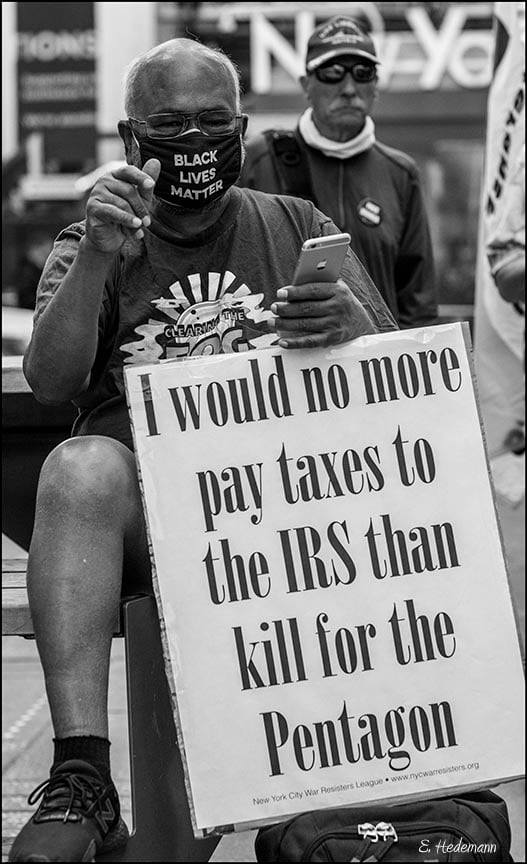
The Internal Revenue Service (IRS) estimated over 2,000 people openly refused to pay part or all of their income tax.
“If a thousand [people] were not to pay their tax bills this year, that would not be a violent and bloody measure, as it would be to pay them and enable the state to commit violence and shed innocent blood.”Henry David Thoreau on the Mexican War


National War Tax Resistance Coordinating Committee 
April 16, 2000
Between 10,000 and 20,000 activists blockaded meetings of the
World Bank and International Monetary Fund in Washington, D.C. Sitting down at intersections and locking arms to form human chains, the protesters were opposed to Bank and IMF policies that increased third-world indebtedness and did little to directly benefit the poor in those countries.


“The World Bank is subjugating our economic and social independence,” Vineeta Gupta, a doctor from the Punjab in India, said in a letter he delivered to World Bank President James Wolfensohn at his home. “It is time that we shut the bank down, and this boycott is a great start.”

War Tax Resistance

What is War Tax Resistance?

War tax resistance means refusing to pay some or all of the federal taxes that pay for war. While you can refuse income tax legally by lowering your taxable income, for many people war tax resistance involves civil disobedience.

In the U.S. war tax resisters refuse to pay some or all of their federal income tax and/or other taxes, like the federal excise tax on local telephone service. Income taxes and excise taxes are destined for the government’s general fund and about half of that money goes for military spending, including weapons of war and weapons of mass destruction.

People take many roads to war tax resistance. Most are motivated by a combination of reasons and actively work for peace in many other ways too. If you consider your motivations this will help you determine your method of resistance.

Refusing to pay federal income taxes is an act of civil disobedience with a long history in the U.S. America’s most well-known war tax resister was Henry David Thoreau, whose refusal to pay his poll tax because of the Mexican-American War earned him an night in jail and the experience that led him to write his influential essay, Civil Disobedience. While those of us who refuse to pay war taxes believe our refusal is just and imperative — and some of us cite international law to back up this belief — the government considers the refusal to pay these taxes to be illegal, and there are potential repercussions through the IRS collection system. For most of us who resist, the dire consequences of voluntarily paying for war are far worse that what the IRS and government can do to us. (snip-MORE)


April 17, 1959
22 were arrested in New York City for refusing to take shelter
during a civil defense drill.
April 17, 1960
Inspired by the Greensboro sit-in of four black college students at an all-white lunch counter, nearly 150 black students from nine states formed the Student Nonviolent Coordinating Committee (SNCC). Meeting in Raleigh, North Carolina, with Ella Baker, James Lawson and Martin Luther King, Jr., the founders set SNCC’s initial goals as overturning segregation in the South.

They also considered it important to give young blacks a stronger voice in the civil rights movement, as many had participated in sit-ins that had proliferated to dozens of cities over the previous three months.
At the Raleigh conference Guy Carawan sang a new version of “We Shall Overcome,” an adaptation of an old labor song. This song would become the national anthem of the civil rights movement.People joined hands and gently swayed in time singing “black and white together,” repeating over and over, “Deep in my heart, I do believe, we shall overcome some day.

What SNCC did to make change happen 
April 17, 1961

Cuban leader Fidel Castro during the Bay of Pigs invasion.
An army of 1500 anti-Castro Cuban exiles, mercenaries equipped and trained at a secret Guatemala base by the CIA, landed at Bahia de Cochinos (Bay of Pigs) in an attempt to “liberate” Cuba from Communist rule. Within three days, the invasion proved disastrous with nearly 1200 members of Brigade 2506 (who had been trained in the U.S.) taken prisoner. 

Known as Operation Zapata, it was conceived by Vice President Nixon, planned and approved by the Eisenhower administration, and executed shortly after President John Kennedy’s inauguration.

President Kennedy receives the Brigade 2506 flag in Miami
in 1962 and declares: “I promise to return this flag in a free Havana.”


Soviet General Secretary Nikita Kruschev sent a telegram to President Kennedy:
“Mr. President, I send you this message in an hour of alarm, fraught with danger for the peace of the whole world. Armed aggression has begun against Cuba. It is a secret to no one that the armed bands invading this country were trained, equipped and armed in the United States of America. The planes which are bombing Cuban cities belong to the United States of America, the bombs they are dropping are being supplied by the American Government . . . .”
What actually happened 
April 17, 1965

The first national demonstration against the Vietnam War took place in the nation’s capital. Students for a Democratic Society (SDS), the organizers, had expected about 2000 marchers; the actual count was 15,000–25,000. This was the largest anti-war protest ever to have been held in Washington, D.C. up to that time. The number of marchers approximately equaled the number of U.S. soldiers in Vietnam. Several hundred students in the protest broke away from the main march and conducted a brief sit-in at the U.S. Capitol’s door.
An exam prepared by SDS about the Vietnam War (answers available) 
April 17, 1965

Gay rights advocate Jack Nichols
The first demonstration promoting equal treatment of homosexuals, Jack Nichols, Barbara Gittings and others picketed in front of the White House.

There were no media present.

Read more (Go-it’s interesting!)
April 17, 1986
Reverend Jesse Jackson, future congresswoman Maxine Waters and others co-founded the Rainbow Coalition, initially intended as a progressive public-policy think tank within the Democratic Party.


Representative Maxine Waters, Harry Belafonte,
John Sweeney, President of the AFL-CIO,
Reverend Jesse Jackson, and Willie Nelson
August 6, 2005-Atlanta, Georgia.


Brief history of Rainbow Push Coalition
April 17, 1992
On Good Friday morning, about 50 people accompanied Fr. Carl Kabat and Carol Carson to Missile Silo Site N5 at Whiteman Air Force Base in Missouri, the same silo that Carl and other members of the Silo Pruning Hooks (see below) disarmed in 1984. They cut through a fence and, once inside, Carol used a sledgehammer on the concrete lid of the silo while Carl performed a rite of exorcism.
Eventually, the police arrived and arrested Carl and Carol. They were jailed and held until their court appearance. At that time, they made a preliminary agreement with federal prosecutors wherein they would plead “no contest” to trespass in exchange for the property destruction charge being dropped; they were sentenced to six and three months, respectively, in a halfway house.

Carl Kabat
A History of Direct Disarmament Actions 
About the Silo Pruning Hooks action 

Peace & Justice History On Elton John’s Birthday

March 25, 1807
Great Britain abolished international trade in slaves. Emancipation of slaves in the country, however, did not occur until 1834, and persisted as unpaid apprenticeship for the technically emancipated for years after that.
The story of abolition in England 
March 25, 1872
Toronto printers went on strike for a 9-hour workday and a 54-hour workweek—the first major strike in Canada. When the editor of the Globe newspaper had thirteen of them arrested, 10,000 turned out to support them. Later that year unions were made legal in Canada.
March 25, 1894
In the midst of a depression that had begun the previous year, a millionaire businessman from Massillon, Ohio, Jacob Coxey, organized a march of an “industrial army” from Ohio to Washington, D.C. Congress had done little in response to the economic crisis and Coxey advocated a range of solutions, many considered radical at the time, such as building roads and other public works (known as infrastructure today).


Coxey’s Army passing through Mayland on their way to Washington.
Coxey is seated behind the horses looking at the camera.
“Coxey’s Army” gathered on the Capitol lawn but they were driven off and Coxey was arrested for trespassing when he tried to deliver his address to the crowd in violation of their first amendment rights “peacably to assemble, and to petition the Government for redress of grievances.”
March 25, 1911
The Triangle Shirt Waist Company, occupying the top floors of a ten-story building on New York’s lower east side, was consumed by fire.

147 people, mostly immigrant women and young girls working in sweatshop conditions, lost their lives.
Approximately 50 died as they leapt from windows to the street; the others were burned or trampled to death, desperately trying to escape via stairway exits illegally locked to prevent “ the interruption of work.”Company owners were charged with seven counts of manslaughter—but were found not guilty.The incident was a turning point in labor law, especially concerning health and safety. For three days prior, the company, along with other warehouse owners, had grouped together to fight the Fire Commissioner’s order that fire sprinklers be installed.


Protests in the wake of the Triangle Shirtwaist fire, button from the struggle
Comprehensive collection of materials on the tragedy from Cornell University’s labor school 
March 25, 1915
The Sisterhood of International Peace was founded in Melbourne, Australia, by Eleanor May Moore and Dr. Charles Strong.
March 25, 1965
Their numbers having swelled to 25,000, the Selma-to-Montgomery marchers arrived at the Alabama state capitol.Organized by the Southern Christian Leadership Conference (SCLC) and the Student Nonviolent Coordinating Committee (SNCC), the march was to bring attention to the denial of voting rights to black Americans in the state and elsewhere in the south. Twice the people had been turned back, denied the right to leave Selma peacefully.

Martin Luther King Jr. and wife Coretta lead march into Montgomery, Alabama.
Dr. King spoke to the crowd: “Yes, we are on the move and no wave of racism can stop us. (Yes, sir) We are on the move now. The burning of our churches will not deter us. (Yes, sir) The bombing of our homes will not dissuade us. (Yes, sir) We are on the move now. (Yes, sir) The beating and killing of our clergymen and young people will not divert us. We are on the move now.”
The Federal Voting Rights Act was passed within two months.

The Selma to Montgomery National Historic Trail 
March 25, 1965

Viola Liuzzo
Viola Gregg Liuzzo, a housewife and mother from Detroit, driving marchers back to Selma from Montgomery, was shot and killed by Ku Klux Klansmen from a passing car. She had driven down to Alabama to join the march after seeing on television the Bloody Sunday attacks at Selma’s Edmund Pettus Bridge earlier in the month. It was later learned that riding with the Klansmen was an FBI informant, Gary Rowe.
More about Viola Liuzzo
Viola Gregg Liuzzo
March 25, 1967
Reverend Martin Luther King, Jr. led an anti-war march for the first time in Chicago, opposing the Vietnam War by saying:
“Our arrogance can be our doom. It can bring the curtains down on our national drama . . . Ultimately, a great nation is a compassionate nation The bombs in Vietnam explode at home—they destroy the dream and possibility for a decent America . . . .”


Reverend King addresses rally at the end of the Chicago march
photo: Jo Freeman
March 25, 1969
The newly wed John Lennon and Yoko Ono-Lennon began their seven-day “bed-in for peace” against the Vietnam War in the presidential suite of the the Amsterdam Hilton in The Netherlands. Their doors were open to the media from 10am to 10pm. They invited all to think about and talk about creating peace.
“Yoko and I are quite willing to be the world’s clowns, if by so doing it will do some good”.
 
The Wedding and “Ballad of John and Yoko” 
March 25, 1972
30,000 participated in the Children’s March for Survival in Washington, D.C., sponsored by the National Welfare Rights Organization. They were supporting the Family Assistance Program, then pending in Congress (but never passed), which guaranteed a minimum income level for all families.
March 25, 1990
A new community, Segundo Montes, was started by campesinos in El Salvador who had lived for nine years as exiles in Honduras following the El Mozote Massacre, when 1000 civilians were killed by the U.S.-trained Salvadoran military. The town was named after a priest who had helped them in the Colomoncagua refugee camp on the border, and who was murdered along with four other Jesuit priests by the Salvadoran military.

Music For Peace

For this post, Bee went in a different peaceful direction with music. I really enjoy this song.

I went in a different direction, too. It’s a retelling of the WWI Truce story. We don’t have to fight.

Music For Peace

Bee brings us another song for peace; the video is not available in some areas, but she’s transcribed the lyrics in her post below. I think you’ll appreciate her entire post.

For my selection: this is not the usual rock or folk that I’ve been posting; it’s very beautiful, all the same. I’ve been curious about it since Bee began the Peace Song Challenge, so today’s the day! I hope you enjoy it as much as I do.

Sarah’s Scribbles

I saw this the other day, but didn’t have time to do a post. It’s still up, and I think it’s cool, also pertinent. Enjoy!


Sarah’s Scribbles by Sarah Andersen for September 14, 2024

Sarah's Scribbles Comic Strip for September 14, 2024

https://www.gocomics.com/sarahs-scribbles/2024/09/14

Why Does God Change?