This is long but serious, I strongly recommend reading this report. I thank Ali for the link. The DeathSantis people assaulted and detained a 15 year old who asked the candidate a question that embarrassed DeathSantis. After that the staff and security targeted the young man at future public events, photographing him and adding ominous captions, security not only followed him but blocked him several times while ordering him not to move for extended periods of time, preventing him from joining friends and family, and after manhandling him refused to let him go to his parents and blocked his mother from getting to him. These are all illegal as they are illegally detaining someone which in some states is kidnapping, they put their hands on him, grabbed his shirt yanking him around which is assault. Then DeathSantis wife told the boy’s mother that the boy was lying when the mother made a complaint, even though the boy’s version was backed up by witnesses and texts from people around him. The DeathSantis team think that they can get away with this because it is a teenager but they will do this to others if they are not punished for this action. However I doubt the boy will file a legal complaint because he wants more access to candidates to ask questions and do interviews, so he has to keep them on good terms.
We all know DeathSantis is an authorities wannabe king. He is a fascist who will not allow anyone to question him. He made his name being a thug to the press and anyone who dared to not agree with him. He wields authority as a club to beat down everyone else to make him superior to everyone in his own view of the world. Think of this man with the control over the levers of power of the presidency? Think how he would weaponize the federal government against anyone who displeases him? He has shown how he would govern the country in how he governs Florida. As I told Ali, this is very scary? Hugs.
The Florida governor’s operation went to extraordinary lengths to intimidate a high school sophomore—all for a question about Donald Trump.
Jake Lahut
Politics Reporter
Charles Krupa/AP
Quinn Mitchell has seen at least 35 presidential candidates in person since 2019, when he first started showing up at New Hampshire primary events to ask them questions.
Not a single one of them had ever treated the now-15-year-old as if he were a threat—until Ron DeSantis came to town.
It all started with a straightforward question. In June, when DeSantis stopped for a town hall event in Hollis, Mitchell raised his hand in the crowd.
“Do you believe that Trump violated the peaceful transfer of power,” the teenager asked the governor, “a key principle of American democracy that we must uphold?”
DeSantis dodged the question and said Americans shouldn’t get stuck in the past, but not before remarking—in a somewhat impressed, incredulous tone—on Mitchell’s age. “Are you in high school?” the governor asked.
The moment went viral, with DeSantis’ non-answer encapsulating how even Donald Trump’s lead primary rival could not bring himself to acknowledge the former president’s efforts to undo the 2020 election. CNN even played it during an interview with Chris Christie to tee up a question to the Trump foe.
For Mitchell, however, the exchange kicked off a series of events that deeply rattled him and his family.
Speaking about it for the first time in an interview with The Daily Beast, Mitchell says that he was grabbed and physically intimidated by DeSantis security at two subsequent campaign stops, where the candidate’s staffers also monitored him in a way he perceived as hostile.
The experience, Mitchell said, was “horrifying” and amounted to “intimidation.”
At a Fourth of July parade DeSantis attended, Mitchell was swarmed by security and physically restrained after a brief interaction with the governor—with his private security contractors even demanding Mitchell stay put until they said so.
With his mother alarmed, the situation escalated to such a degree that the candidate’s wife, Casey, spoke directly with her—but to suggest her son was being dishonest about what happened, according to Mitchell.
Then, at an August 19 event—where Mitchell was tailed closely by two security guards—an attendee told The Daily Beast they saw a staffer for DeSantis’ super PAC, Never Back Down, take a photo of the teenager on Snapchat before typing out an ominous caption: “Got our kid.”
Seven other sources corroborated Mitchell’s version of events, either by sharing contemporaneous communications with the family or recounting what they witnessed in person at DeSantis events, including the Fourth of July parade. The teenager and his family say they have yet to receive any kind of apology from DeSantis.
The DeSantis campaign and Never Back Down did not return multiple requests for comment from The Daily Beast.
As astute an observer of the state’s politics as any, Mitchell had a blunt assessment of the fiasco over DeSantis’ treatment of him. “Really stupid,” he said, “in a small state like New Hampshire.”
‘I Just Want to Ask My Question’
As the DeSantis campaign’s summer from hell comes to an end, the governor is not much closer to seriously threatening Trump for the GOP nomination. Amid concerns over his stagnant polling numbers, his fundraising performance, and unsustainable spending, the DeSantis operation has seen substantial turnover, including the ouster of his campaign manager.
Across all of the reboots and turmoil, a consistent thread apparently remained: the DeSantis team’s willingness to go to unusual lengths to prevent a teenage boy from having a chance to follow up with the candidate on his question—and, to hear Mitchell tell it, personally express regret that he made the governor look bad.
More broadly, the teenager’s story distills some key reasons why DeSantis’ presidential bid is struggling: a candidate with clear difficulty making personal connections, a team obsessed with managing every detail on the campaign trail, and a pervasive anxiety over the idea of alienating Trump voters.
Combined together, those factors may ensure DeSantis gets nowhere near the White House in 2024. In New Hampshire, they’ve already pushed a precocious and passionate teenager to consider quitting politics altogether.
“I may be older now and know I can handle this a lot more, but if they had done that to me a few years back, I don’t know if I could have handled that,” Mitchell said. “It’s unfortunate, because I just want to ask my question.”
In the nation’s first primary state, where individual voters can have an outsized impact on the process, Mitchell made himself a staple of the New Hampshire political scene before he was even a teenager.
A self-described political independent who loves history and politics, Mitchell sees it as his “civic duty” to show up to ask questions, especially on behalf of “people who live in other states and the people who want to ask those questions,” who “don’t always get the opportunity.”
Before DeSantis, presidential candidates have not just tolerated the teenager but seemed to genuinely appreciate him. In the 2020 Democratic primary, Sen. Amy Klobuchar (D-MN) met with Mitchell and later worked his enthusiasm for politics into her stump speech.
More recently, Christie not only gave him a shoutout during the CNN interview—“he goes to every town hall meeting… he asks really tough questions”—but was quoted in a recent USA Today profile of Mitchell. “Quinn, remember me when you are president,” the former New Jersey governor quipped.
‘They’re Watching You’
After his question about Jan. 6 blew up on DeSantis, Mitchell—who was not intending to land a punch on the governor—said he “genuinely felt bad about it.” A few days later, he woke up early for the hour-and-a-half drive to Merrimack, where he intended to personally say as much to DeSantis at the town’s Fourth of July parade.
Once there, the high level of security around the governor’s contingent stood out to Mitchell and other observers. Staffers for the super PAC, Never Back Down, “were nudging the security guys and pointing at me,” Mitchell said. “I actually had a reporter come up and just say, ‘They’re pointing at you and they’re watching you.’”
Unfazed, Mitchell patiently walked along as the candidate crossed from curb to curb, shaking hands with voters; each time he came close to DeSantis, however, the security guards would hold their arms out in front and parry him away.
Finally, Mitchell was able to get within earshot of the governor. When he passed by, he told him, “I’m so sorry that I got you in all that trouble,” and offered him a chance to give a different or more detailed answer to the question.
According to Mitchell, DeSantis nodded in response, at least acknowledging his question, and the two had a quick handshake. That’s when things went south: right after the handshake, Mitchell recalled his shock when he felt a firm tug on his shirt, pulling him away from DeSantis. Suddenly, all he could see were the outstretched arms of security guards and plain clothed aides.
“Usually what they do is they don’t push you or anything, but they put their hands out and kind of body you, so you just don’t move, basically,” Mitchell said, describing a shuffling motion more akin to an offensive line on a football team than a presidential candidate’s security detail.
If that were not startling enough, right after the fracas, a DeSantis security guard cornered Mitchell and ordered him not to move from the spot for another five minutes. In response, he did what almost any 15-year old would do.
He texted his mom.
Toward the end of the parade, Mitchell’s mother reunited with her son and then demanded an explanation from DeSantis for why his security detail was putting their hands on her boy, an interaction that was observed by a Boston Globe reporter on the scene.
What the Globe didn’t catch was the involvement of the second most important person in the DeSantis campaign: Casey, the governor’s wife and arguably his top political adviser.
Instead of diffusing the situation, however, the Florida First Lady suggested to Mitchell’s mother that she was overreacting—and that her son was fibbing.
“Well, I’m a mother, too,” Casey said, according to Mitchell and other witnesses, along with multiple sources who shared contemporaneous communications on the incident with The Daily Beast. “I know what you’re experiencing, and we’re all very afraid for our children—even if they’re exaggerating.”
As for the candidate himself, DeSantis told Mitchell he would “get to the bottom” of the one-sided encounter with security, and even told the teenager to come to his next event.
‘Got Our Kid’
Ahead of their August 19 event, a staffer for Never Back Down reached out to Mitchell. USA Today let the PAC know that a photographer wanted to come photograph Mitchell for the upcoming profile. The staffer just wanted to confirm he would be in attendance.
The teenager obliged. But after walking into the event, held in a firearm factory in Newport, he noticed something odd.
It wasn’t just that he saw a pair of security guards flanking him as he made his way to the far side of the venue. The weird part was that Never Back Down staffers were taking photos of him. It was notable to Mitchell, even before he learned of the ominous caption—“got our kid”—that one staffer was seen attaching to a Snapchat photo.
The governor kept audience questions to a tight 15 minutes, throwing Mitchell a glance but ignoring his outstretched hand, though the teenager now stands over 6 feet tall.
Security kept their defensive posture as Mitchell tried to make his way to stage right—where DeSantis was attempting to chat with voters and take selfies—blocking him from getting toward the group of voters waiting to chat with the candidate.
Even after Mitchell gave up on his months-long pursuit of a follow-up question to DeSantis about his views on Trump and the transfer of power, security prevented him from crossing the room to see a family friend, until they eventually relented.
Since the incidents, Mitchell has not heard from the DeSantis campaign, or the PAC, though he expected to. He could not reach an in-state contact for the governor’s team himself.
“The campaign, they could have called and said, ‘We’re so sorry, this should have never happened, we’ll get to the bottom of it,’” Mitchell said. “Never got a call like that. They never apologized to us for any of it.”
Mitchell often says that it’s a privilege to live in New Hampshire, a state where even a determined teenager can have the power to influence the presidential election in a small way. His dream is to become a political reporter, but he said the DeSantis events almost made him want to hang it up for good.
Whatever happens, Mitchell is likely to keep up his rigorous primary schedule—even if he’s unlikely to try to see DeSantis again anytime soon. But the teenager said if he ran into him “at conventions or a multiple candidate event, I will do my best to press him.”
Still, the political history buff came away with one silver lining after the last DeSantis event.
“I actually got a free hat that day,” Mitchell said, a fine collector’s item, even if it was for the Never Back Down PAC and not the DeSantis campaign proper.
For a 15-year-old who sacrificed more than a few dog days of summer—and more than a few hours of Minecraft—to be treated as a security threat by a major presidential candidate, a free Never Back Down hat selling for nearly $30 online was, he quipped, “probably the only good thing that happened that day.”
There is more election news in the article at the link, but this is the end of the coverage of the campaigns attempt to intimadate, manhandle, and detain a 15 year old boy asking good tough questions of adults. Hugs
Jon Stewart confronts Republican Senator Nathan Dahm on the insane record of dead children due to gun violence and the lack of gun control in America in general.
By my doges that love gravy, this is perfectly spot on. The only issue is that by Russia, the creator means both the USSR that was then ruled by Russia and what Putin is trying hard to recreate today.
Side note. I am very sore and torn up. The last few days I had a bug / light flu. I have been sick to my stomach, very tired, diarrhea, and lots more pain. But today I felt better, woke up a little before 2 AM, snuggled Ron for an hour, got up and started my day. But I spent about 4.5 hours doing dishes while helping Ron understand / find stuff for my new office. Sadly by 5 PM I couldn’t stand upright and lost the ability to walk more than a few steps unsupported.
After eating the wonderful supper Ron made of burgers with all the fixings including he made sautéed mushrooms and a cheese sauce, I am finishing this up and going to bed. Because I am struggling to walk, Ron fixed my food and delivered to me, and took everything away after. He has been very attentive once he realized how much I pushed myself and how bad I was. Ron has already said he will help me to the bedroom and getting into bed, but he has warned me I can not delay much longer, as he doesn’t want to hear me crying tonight in bed. Night to all and hugs
Let’s be clear urban sprawl, cars, and the needed roads are destroying our country. Here in Florida we have to fight to get any mass transit and it is not planned in the county development plans at all. Every attempt at mass transit and fast trains is destroyed. Also let’s be honest it also was driven not just by profit for big oil and car manufacturers, but also by racism. When I was in Germany in the 1980s I was stunned how towns with housing, shops, everything a person would need including bars were closely clustered in to a small area with lots of land for growing crops or animal pastures around them. Plus I could go anywhere by mass transit, train, subway, or trolley. All fast and convenient. Most soldiers that were transferred in to the country never used their cars that they paid to have shipped. I came from a small cow town and we drove 30 minutes to the nearest big town. Here in Florida, about 30 minutes from where I live by highway is a completely new development based on the model in the video. It has shops, theaters, restaurants on ground floors, business offices above and lots of apartments, even doctor’s offices, and single family town houses, all confined into one place and walkable to everything. The only problem the residents have is all of us outsiders driving our cars in coming in to shop or go to medical appointments and they have very limited parking. If I could afford to live there I would. It simply works and is easy not just for the young but especially us older or disabled people. Give the video a watch please and thank Ten Bears for posting it. Hugs
I screwed up! Yes, let me say it again louder, I screwed up! What is worse I started this post late last night not having done all the crap I got early this morning and have been working all day with only a few minutes ago finding and fixing the problem that started this that had I had half the brain I had decades ago or even the eyesight I use to have I might have spotted it right away.
Please indulge me this might get really long as it started yesterday at about 4 or 5 PM. Also as Nan can loudly attest I am never short of words but use as many as possible to say what I want. The saga started at with Ron being unable to sit and watch his TV shows including his apple box, Netflix, HBO Max, Amazon Prime, and a subscription to an oriental video channel he loves. But he gets like that … often. So he decided we had to get out the two new monitor arms we bought for when we moved me into the new room … hold on don’t get ahead of me I got a lot of stupids to go through first. He wanted to set one up and that went to wanting to try them on a monitor.
Well the instructions, which I had a real issue with Ron even bothering to look at as he is sure he understands these things, said first we had to put together the base and then to attach it to the desk, forward from there including putting a monitor on the arm which was what Ron really wanted to do. Well I could see where this was going so … I started shutting things down and getting read to unhook everything.
So Ron was all excited, and he thought it was a great time to clean off the desk and move it into the new office, even though he was not finished working in there. So why fight the inevitable that will happen? I agreed.
So after I unhooked everything Ron helped me remove everything from heavy from the desk and I removed the papers and other small stuff scattered all over the desk. The Ron cleaned and washed the desk of all the dust, dirt, food, and cat food pieces that gather on a place where I let cats stay and so much daily work is done.
One thing, I have said and will say many more times that “Ron cleaned …” . And that is because Ron doesn’t mind cleaning stuff, doing the detailed work of getting cat fur and other debris off stuff. I hate it, and Ron understands this. I will wash dishes now that we don’t have the dishwasher, I will clean toilets and showers, I will do the floors until my torn up dying shoulders give out. But detailed cat hair / fur removal and other stuff like that I hate including cleaning, dusting, and wiping stuff down. I have not done it so far in my 60 years except a few years in the military, and if I can keep my wonderful hubby happy I won’t have to.
So I guess now I have to explain what my desk is. In 1998 we bought another new home because Ron insisted for the many times again we move … I now understand why, but then we did not have a diagnosis of his anxiety issues. That would come many decades and a lot of lost money later. The prior owner was selling everything in the house including a wooden table with the ability to expand to about 84 inches and was 31 1/2 wide. I loved it. The owner wanted 100 dollars for it and we paid that. There is a further story about the table, but everything worked out for us after my adoptive father tried to screw me, again.
Long story short, after all the damage to the home and my office from hurricane Ian my desk in my office was destroyed and to get my computer system up online the guys took the eating table we had so they could quickly get me set up. But after using it for a while and having very … large Odie sprawled on it, we realized it was so much better for that than my other desks. It was decided not to buy another desk but I would keep this table as my desk. Fast forward to last night … again.
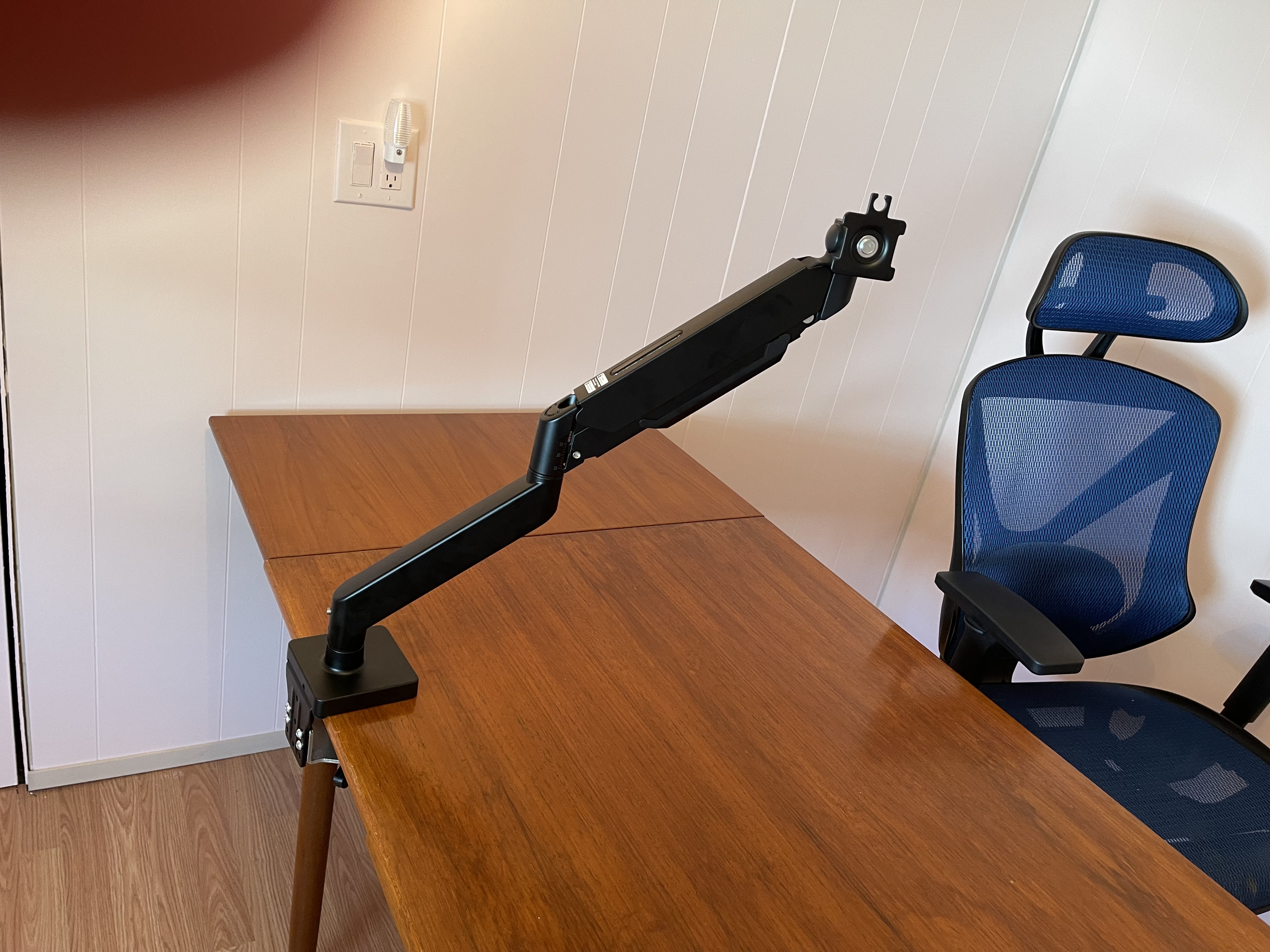
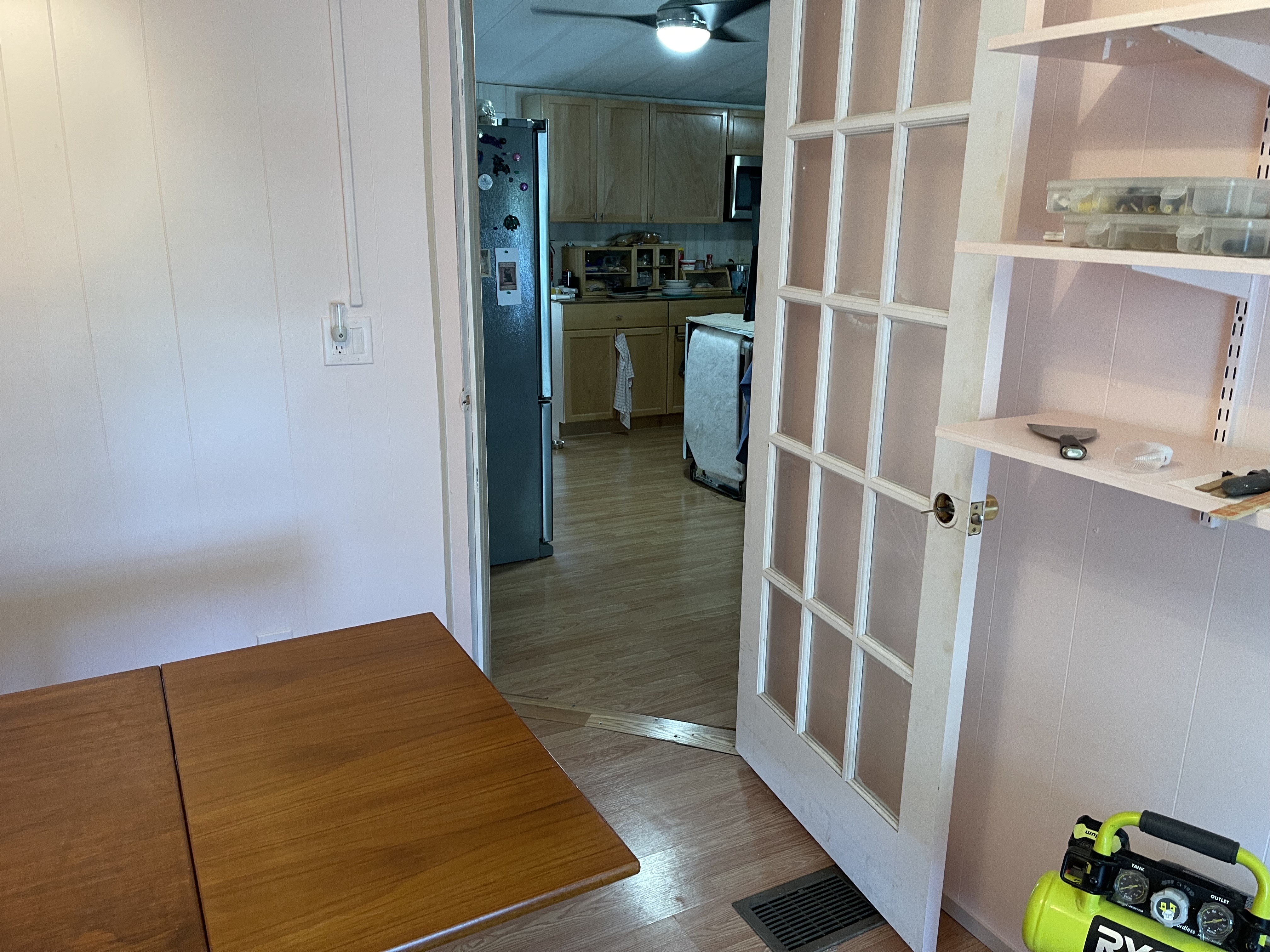
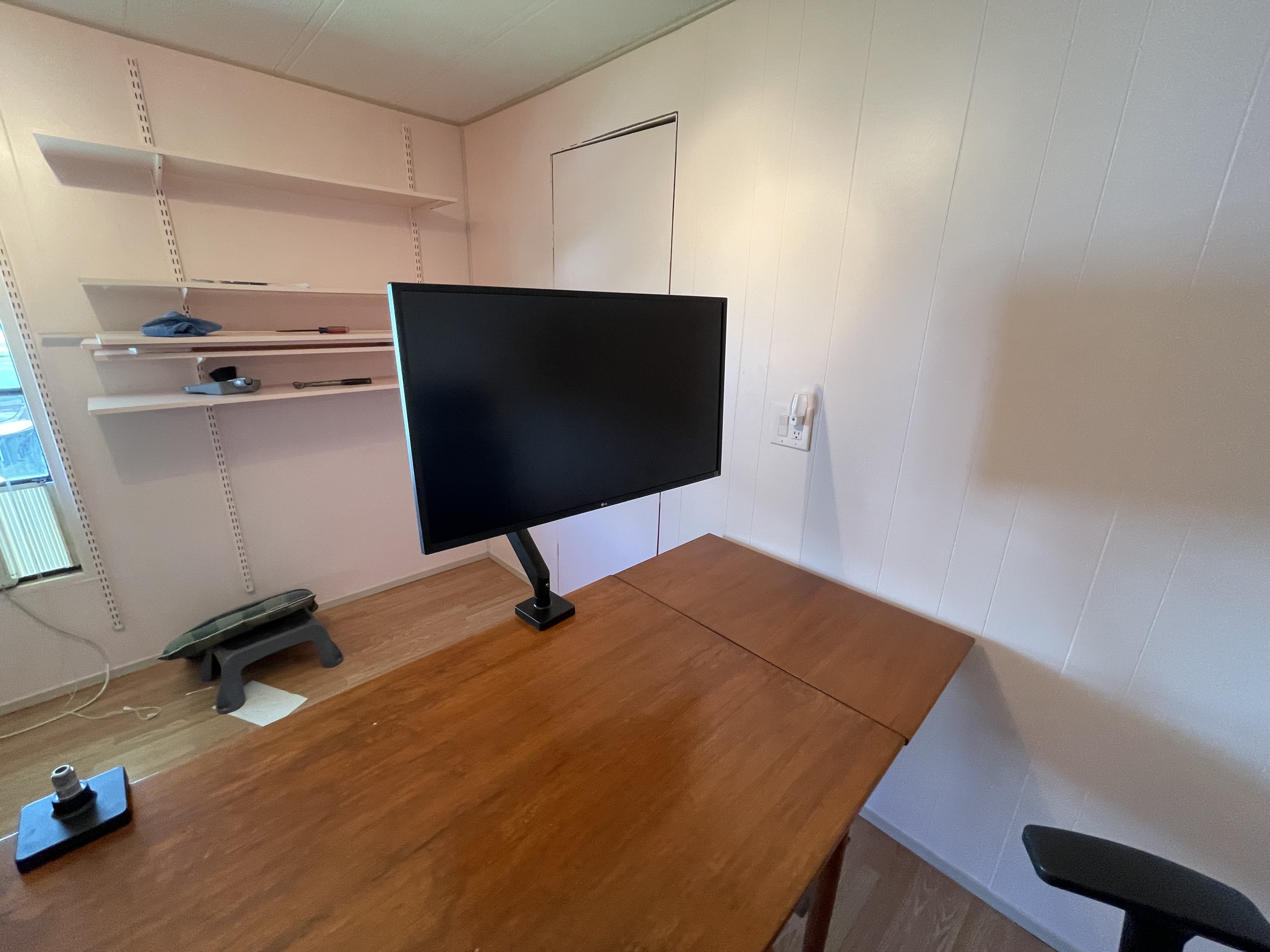
Last night we cleaned off the desk, removed the middle top, took it into the room and expanded it and put the top back in. Remember this was a sudden decision due to Ron not being able to settle down and wanting to see how the new monitor arms worked, Then we added the arms that we put together haltingly and without any missteps. Added the monitors and adjusted the arms so I could move them. Ron still needs to loosen then some more so it is easier for me to move, right now I have to get up and use a lot of effort to move them. When I told him he was agreeable but said he was only trying to keep the monitors from falling, but remember the arms we bought are for monitors larger and heavy than mine as Ron thinks I might want / need bigger ones in the future. My eyes are still getting worse.
Then after the monitors it was time to put the computers he wiped off and cleaned but that also became a small issue. When I was in this room as my office originally I had each computer up off the floor which keeps them much cleaner and healthier. In the old large front room office Ron was always going to build something to get them off the floor but never did find time to do it, and in that room and the living room my computers sat on the floor. One on each side of the desk, on the side of their monitor. This important as you will see later. The important thing to know is the side of each monitor changed. They are reversed.
With the Logitech program and devices I have I can switch computers with just moving the mouse to the edge of the computer screen and it switches to the other computers. So blogging computer is always computer one and video computer is always computer two with any laptop or other thing I am working on being number three. On the keyboard I use number three for my phone so I can text easier. I never had an issue with changing my set-up before. What I did not realize is they changed the program so simply resetting the flow settings did not change the computer arrangement to match the current set up. That is important as you will see and how I totally became stupid and caused my self two days of extra work.
So we set up monitors, computers on the desk moving their position to better salve my OCD about size and placements, we put the battery backups on the floor, ran the new power cables and plugged stuff in, and started to hook the other stuff up. Then came the last part, the ethernet cables. We had not moved the modem or router so the cat cables I was using before were too short. I dug boxes out of my closet of older cables and stuff. I found a few that are more than long enough and ran them along the walls and into the room to the computers. But they are not cat 6 such as the ones I was using, so when everything gets put into the room I will take the measurements of the lengths I need and order them at that time.
I should mention that somewhere at this point Friday night I still did not know what was keeping my mouse and keyboard from switching / working properly as I had written about so much of this much of this post. I closed it down to go to bed at like 9:15 PM which is very late for me only to find that this morning I had lost the entire post. I had not yet dumped either computer which I was planning to do and then reinstall all the programs hoping that cleaned up what every was keeping the issue. Remember the point is to move the mouse to the edge of the monitor and the cursor jumps to the next monitor. To be continued tomorrow morning.
Writting this on Sunday morning!
So Saturday morning I got up early and wanted to dump the computers because I was still sure the problem was a registry issue. So instead of just running the registry cleaners I thought to dump them, that way cleaning them up really well. But I had a major problem. I still had 61 open tabs saved for comments and websites I want to get to. If I dumped both computers I would forever lose them. So I was stuck doing them one at a time dragging the process out and maybe keeping the same issue with the mouse / keyboard program switching monitors / computers. I decided to do the video computer first.
I had done all the prep work yesterday so all I had to do Saturday morning was to run the recovery program telling the computer to clean all the drives and redownload and install the Windows 10 OS. Then after about 20 minutes or less I started the tedious work of going through and adjusting all the settings, renaming the computers, setting things up to give me the max privacy and performance mix. That takes far longer than doing the recovery. Then I started with the programs reinstall. I do Chrome first, then Nortons security and utilities, then NordVPN, and lastly I install Ashampoo Winoptimizer 26. I set all of them to give the max security and max privacy. Also Both NordVPN and Adblock Plus in Chrome stops any advertisements except those I allow. Plus NordVPN and Nortons both work to prevent malware and scan for viruses. Then I add in the sound programs, camera programs and other odds and ends programs I use. That takes hours, but I can still use the computer while doing it.
Next I used the history of devices on Chrome to open all 61 of the saved open tabs that my blogging computer had open. I then did all the recovery steps on the blogging computer that I had just done on the video computer. During this Ron got up so I started up his computer and used it to also load the 61 open tabs so I would be sure not to lose them.
During this time I was checking to see if the newly installed Logi Options+ to see if it seen the computers in the right order and would work by moving the mouse to the left edge of the right screen moving the mouse cursor to the left screen and to go back to the right screen I would move the mouse cursor to the right edge of the left monitor. It wouldn’t switch, still not working. But in frustration I moved the cursor all the way to the right edge of the right monitor and suddenly the cursor showed up on the left monitor. Wait how did that happen. I did a few more times, and it worked like it should. Except to the program the monitors were in the possitions they were before the move. I did not make sence to me. I open the program on both computers and reset the flow part of the program. Same thing. I was getting so frustrated! Then know I needed a break I left my mouse cursor on one of the monitors in the open flow part of the program and went to get a soda.
When I returned I noticed a tip message I never seen or had appear before because I never left the cursor on one of the monitors on the program that names the monitor / computer for each ones connect with the program.
The message said “Drag to rearrange”. WTF
By my dogs that love gravy could it really be that easy? Could it be the solution was to simply move the monitors in the program. Then I looked at the names on the monitors displayed in the program. I had not bothered because I knew both of mine were there so why take the effort to really look closely at the names on the monitors displayed. Son of a deer tick, on the screen the monitors were PlayBlogger on the left and PlayVideo on the right. But I had switched the order in the move. Now the monitor for the PlayBogger was on the right and Play Video on the left. I dragged the displayed monitors in the program to show the current positions of the monitors. Then I moved the cursor to the left edge of the right monitor and it jumped to the left monitor. It worked! Just the way it is supposed to. All that work, and two days lost from blogging and read blogs / news. All because I did not know that I could change the monitors on the screen and I DID NOT LOOK AT WHAT THE DISPLAY SAID THE MONITOR ORDER WAS.
But by the time I figured it out it was far too late in the day and I was very tired. I decided to get a shower and go to bed. Ron had acid reflux again in the early part of the night and was up most of the night. I couldn’t sleep either so we got up about 3:30 AM and while having coffee I am finishing writing this post. Before the morning news shows I have to move my rolling TV entertainment stand into the new office so I can watch the Sunday news shows that are on broadcast. And I have to now go open and save all the last few days of comments and blogs I missed. Hugs
Nearly half of all LGBTQ+ youth feel unsafe in school settings, and over half said they had been bullied due to their queer identities, a new report from the Human Rights Campaign(HRC) found.
But even though over half of queer respondents also showed signs of anxiety and depression, majorities of LGBTQ+ youth have also come out to their families and feel hopeful for the future nonetheless.
————————————————————-
RELATED STORIESAnti-LGBTQ+ legislation is making 66% of queer youth more anxious & suicidal
A recent survey suggested several ways to help LGBTQ+ youth, too.
The HRC’s 2023 LGBTQ+ Youth Report surveyed over 13,000 LGBTQ+ youth between the ages of 13 and 17, from all 50 states and Washington, D.C.
Approximately 54% of transgender and gender-expansive youth and 46% of LGBQ+ youth surveyed said that they felt unsafe in at least one school setting. Nearly 60% of all LGBTQ+ youth said that they had been “teased, bullied, or treated badly” at school over their LGBTQ+ identities.
Only one in five LGBTQ+ youth reported school bullying to a school staff member. While 23.3% of these kids said the adult “didn’t help me at all,” 20.0% said the adult “helped me a lot.”
Additionally, 55.1% of survey respondents screened positive for depression, 63.5% screened positive for depression, and 64.7% rated their ability to manage stress as “fair” or “poor.” These rates were on average five points higher for transgender and gender-expansive youth. 48.9% of LGBTQ+ youth had received therapy in the prior year.
The HRC noted that these findings have likely been affected by the spike in anti-LGBTQ+ legislation nationwide. During the most recent legislative session, 10 have passed transphobic “bathroom bills,” 23 states have passed transphobic “sports bans,” six have passed “forced outing” bills requiring schools to out trans and gender-expansive youth to their parents, and six have passed “Don’t Say LGBTQ+” bills banning queer content from classrooms.
Despite this, 90.3% of LGBTQ+ youth said they were proud to be part of the LGBTQ+ community, and nearly 83% of queer youth said that they had come out to at least one member of their immediate family.
Trans and gender-expansive youth who feel free to express their gender identity around their families and those whose family members use their correct pronouns and names also reported the lowest levels of depression and anxiety among trans and gender-expansive youth.
Additionally, 56.8% of LGBTQ+ youth said they somewhat or strongly agree that “the LGBTQ+ community is accepted more and more every day.”
If you or someone you know is struggling or in crisis, help is available. Call or text 988 or chat at 988lifeline.org. The Trans Lifeline (1-877-565-8860) is staffed by trans people and will not contact law enforcement. The Trevor Project provides a safe, judgement-free place to talk for youth via chat, text (678-678), or phone (1-866-488-7386). Help is available at all three resources in English and Spanish.
But notice what book they don’t submit to the bot scan is the bible, which includes everything they programmed into it for getting rid of LGBTQIA inclusive material.
Official: “It is simply not feasible to read every book” for depictions of sex.
In response to recently enacted state legislation in Iowa, administrators are removing banned books from Mason City school libraries, and officials are using ChatGPT to help them pick the books, according to The Gazette and Popular Science.
The new law behind the ban, signed by Governor Kim Reynolds, is part of a wave of educational reforms that Republican lawmakers believe are necessary to protect students from exposure to damaging and obscene materials. Specifically, Senate File 496 mandates that every book available to students in school libraries be “age appropriate” and devoid of any “descriptions or visual depictions of a sex act,” per Iowa Code 702.17.
But banning books is hard work, according to administrators, so they need to rely on machine intelligence to get it done within the three-month window mandated by the law. “It is simply not feasible to read every book and filter for these new requirements,” said Bridgette Exman, the assistant superintendent of the school district, in a statement quoted by The Gazette. “Therefore, we are using what we believe is a defensible process to identify books that should be removed from collections at the start of the 23-24 school year.”
To determine which books fit the bill, Exman asks ChatGPT: “Does [book] contain a description or depiction of a sex act?” If the answer is yes, the book will be removed from circulation.
The district detailed more of its methodology: “Lists of commonly challenged books were compiled from several sources to create a master list of books that should be reviewed. The books on this master list were filtered for challenges related to sexual content. Each of these texts was reviewed using AI software to determine if it contains a depiction of a sex act. Based on this review, there are 19 texts that will be removed from our 7-12 school library collections and stored in the Administrative Center while we await further guidance or clarity. We also will have teachers review classroom library collections.”
Unfit for this purpose
In the wake of ChatGPT’s release, it has been increasingly common to see the AI assistant stretched beyond its capabilities—and to read about its inaccurate outputs being accepted by humans due to automation bias, which is the tendency to place undue trust in machine decision-making. In this case, that bias is doubly convenient for administrators because they can pass responsibility for the decisions to the AI model. However, the machine is not equipped to make these kinds of decisions.
Large language models, such as those that power ChatGPT, are not oracles of infinite wisdom, and they make poor factual references. They are prone to confabulate information when it is not in their training data. Even when the data is present, their judgment should not serve as a substitute for a human—especially concerning matters of law, safety, or public health.
“This is the perfect example of a prompt to ChatGPT which is almost certain to produce convincing but utterly unreliable results,” Simon Willison, an AI researcher who often writes about large language models, told Ars. “The question of whether a book contains a description of depiction of a sex act can only be accurately answered by a model that has seen the full text of the book. But OpenAI won’t tell us what ChatGPT has been trained on, so we have no way of knowing if it’s seen the contents of the book in question or not.”
It’s highly unlikely that ChatGPT’s training data includes the entire text of each book under question, though the data may include references to discussions about the book’s content—if the book is famous enough—but that’s not an accurate source of information either.
“We can guess at how it might be able to answer the question, based on the swathes of the Internet that ChatGPT has seen,” Willison said. “But that lack of transparency leaves us working in the dark. Could it be confused by Internet fan fiction relating to the characters in the book? How about misleading reviews written online by people with a grudge against the author?”
Indeed, ChatGPT has proven to be unsuitable for this task even through cursory tests by others. Upon questioning ChatGPT about the books on the potential ban list, Popular Science found uneven results and some that did not apparently match the bans put in place.
Even if officials were to hypothetically feed the text of each book into the version of ChatGPT with the longest context window, the 32K token model (tokens are chunks of words), it would not likely be able to consider the entire text of most books at once, though it may be able to process it in chunks. Even if it did, one should not trust the result as reliable without verifying it—which would require a human to read the book anyway.
“There’s something ironic about people in charge of education not knowing enough to critically determine which books are good or bad to include in curriculum, only to outsource the decision to a system that can’t understand books and can’t critically think at all,” Dr. Margaret Mitchell, chief ethicist scientist at Hugging Face, told Ars.
Hey everyone. I know I am late to the party as they say on a lot of posts, but as I work my way through the backlog of fellow posters whose content I love, Jill again made a post I want to share. Even if everyone already seen it, the cartoons are so spot on, Jill’s post deserves another viewing. Hugs
Thanks to Ali for the link. This cartoon really says it all. Please go to the link above and read the two few paragraphs that fill in the cartoon’s backstory. It is important. I am going to post the cartoon so you get a taste of it, but the two short stories of how the same care is approached when a young person is cis vs when they are trans. Hugs