If you see this post, can you please help spread this information?#ASafeChoice is a referral network of physicians who provide medication abortion services ACROSS THE US.People everywhere need to know about this option. These doctors have capacity to help more women! Let’s spread word! ❤️✊
I have so much to say about today’s case, legal analysis, and more.But the most powerful thing today was watching Chase Strangio argue in front of the court as the first trans attorney to do so.You could feel history, and nobody will ever take that away.
I just ran into the main plaintiff and their family in the hallway of the Supreme Court in the skrimetti case today, and we all hugged and now I’m in tears in the press room.I thanked them profusely.Trans people deserve equal protection. We deserve to live like anyone else.
Chase Strangio walks out of the court to cheers after he becomes the first trans attorney to present a case to SCOTUS.Video too big in size but will post later.
I also can't get over the conservative justices favorably citing European laws about transgender health care when they vociferously refuse to consider other nation's laws and traditions when dealing with issues on which the U.S. is an outlier, like gun violence and the death penalty.
Ran into what I assume was one of the far right people in the bathroom line who said “I thought the men’s bathroom was on the other side” at SCOTUS.Thankfully the rest of the line were people who knew me and my reporting and I didn’t even dignify it with a response.
This should be said everywhere. Allowing discrimination like this against trans people undermines bedrock principles of constitutional rights across the board.
Chris is correct. Everyone stop saying landslide or mandate now. And let’s get to work blocking their most extreme plans.[Repost: https://buff.ly/41pxuOu%5D
"Repeat after me: there was no 'landslide'. There was no 'blowout'. There was no 'sweeping' mandate given to Trump by the electorate. The numbers don’t lie."My new Guardian op-ed on the new GOP election lie – and why it's important to rebut it! I brought (lots of) receipts:
"Trump won the crucial blue wall states… by 231,000 votes? So if just 116,000 voters across those three swing states – or 0.7% of the total – had switched from Trump to Harris, it is the vice-president who would have won the electoral college … and the presidency" – me for the Guardian:
“Both Tesla and SpaceX quite likely would not exist as successful businesses if it were not for the use of public funding, either through subsidies, through the electric car industry, or through actual government contracting in the case of SpaceX,” Ramaswamy said in 2022 on a Fox News podcast.
The paragraph below shows that what happened then is happening again now. It was scary for me as a teen back then. Gay people in deep country settings in the backwoods, especially gay teens desperately trying to keep people from finding out. Especially abused gay kids who felt that abuse was written all over them for people to see. I was so happy to see that time gone for most of the school kids by the 2010s. Kids accepted in their class by their peers, the fellow students. That very acceptance terrified the conservative religious, but I have never understood why? Why is terrifying and hurting kids so pleasing to them? But the quote from the article below says it all. Hugs
The late 1970s was a somber, frightening time in queer history. The rise of a Christian right – branding themselves the “moral majority” – in conjunction with an energized Republican party began a culture war against women, people of color and queer people. The combination of religious rhetoric, nationalism and economic conservatism – Reaganomics, in other words – created a groundswell of contemporary far-right politicking that became the template for our contemporary political world.
Randy sent me this. This is what I have been talking about. I hope you will take the time to watch the short one and the 3:31 minute video. Not the most riveting I admit. But it is designed for little kids. Did you spot any mention of the sex of the penguins? In all the book there is only one small hint and little kids won’t notice it. I went looking for it because I wanted to know how so many people were sure the penguins were a same sex couple. One word, one made up word not even in the writings or spoken in the video. Hint it is on the cover of the book. The name of their home and where they baked the cakes. Pengrooms. One other clue is the rainbow colored boards on the tree. Yup for that the book must never be seen or read ever. It is a sin, a horror for kids to see or hear. It is a cute little kids book. Randy informed me that enough people contacted Amazon about the fake negative comments that they were removed.
See it is not about protecting kids, it is not about sexualizing kids, it is not about confusing kids that these people fear and hate. It is about acceptance and tolerance of something different from them that they don’t agree with. To them there is no live and let live. There is no you do your thing and I will do me. To them the world and all in it must be just as they are, do as they do, believe as they believe. And most important worship who they worship. They demand a bland world where only the things they celebrate are seen and heard, where their way is superior to all others.
It is about removing all mention of LGBTQ+ from society. It is about removing everything not straight cis from media of any type. The misnamed one million moms who is one lady with a computer and a printer along with a few thousand followers on social media complains bitterly about any commercial that has even the hint of a same sex couple in it, even a hint. It is hurting the children see. The goal is making sure LGBTQ+ kids, and yes there are LGBTQ+ kids, don’t see or know anyone like themselves anywhere. It is so they don’t feel accepted. They feel they must hide who they are and tell no one. They want those kids who are born different and feel that difference to be deep in the closet and stay there, never to come out and be happy as their true selves. These groups pushing this hate want no anti-bullying programs as they want kids who are different to be picked on, harassed, and beat up. They do not want them accepted by their peers, teachers and fellow students. No they want them beaten up. I know this because one of the co-authors of the Florida don’t say gay bill said it was why he helped write the bill. That gay kids, that trans kids could be accepted by classmates and treated fairly drove him to tears. Yes tears. I saw him weep as he spoke of those kinds of kids finding acceptance in the classroom.
One guy using social media has already gotten a dozen big name companies to roll back and remove their DEI programs and support for the LGBTQ+ including pride merchandise and parades. Because he and the others like him threaten these companies with the threat of accusing them of harming kids and trying to hurt their businesses they give in. One guy is spearheading this but there are others. They are driven to remove us from society, in this guy’s case so his god will love him and give him an afterlife. We need to stand up against this guy and these haters. We have to do that. We must not let them drive the country back to 1950 not even to 1980. We must remain visible and fight for the rights of all of us. We don’t drop a letter here or there from our community to please the haters. We have seen in history they never stop with just the one group, they work to get rid of them all. We must get vocal, we must fight back. Hugs
November 30, 1215 Pope Innocent II, in a papal bull (or major sacred pronouncement of canon law), ordered that Jews, “whether men or women, must in all Christian countries distinguish themselves from the rest of the population in public places by a special kind of clothing.” The rule was interpreted as requiring a badge on clothing as determined by each country. In England, for example, the tablets with the 10 commandments were used. Read more
November 30, 1967 Senator Eugene McCarthy (D-Minnesota) announced that he would run on an anti-Vietnam war platform against President Lyndon Johnson for the nomination of the Democratic Party. McCarthy, though a contender to be Johnson’s running mate in 1964, had since become increasingly disenchanted with U.S. policy toward Vietnam, and opposed the war in his campaign.
McCarthy on the campaign trail
“I am not for peace at any price, but for an honorable, rational and political solution to this war; a solution which I believe will enhance our world position, encourage the respect of our Allies and our potential adversaries, which will permit us to get the necessary attention to other commitments . . . and leave us with resources and moral energy to deal effectively with [the] pressing domestic problems of the United States itself.” Read more, see photosJo Freeman
November 30, 1993 The Brady Handgun Violence Prevention Act became law. It provided for a waiting period before the purchase of a handgun, and for the establishment of a national instant criminal background check system to be used by firearms dealers before the transfer of any handgun.The law was named for James Brady, President Ronald Reagan’s press secretary, who became a paraplegic after being shot in the assassination attempt on Reagan. Following his recovery, he and his wife, Sarah, became leading proponents of controlling the proliferation of handguns. James Brady watches President Clinton sign the bill
November 30, 1999 Tens of thousands of activists, students, union members and environmentalists demonstrating for global justice shut down the World Trade Organization (WTO) summit in Seattle, Washington. International media coverage ignored both the blockade and the police riot (and an enormous labor-sponsored rally and march), focusing instead on minor property damage committed by a few dozen self-described anarchists. photo Elaine Brière What the protests were about
NORTHEAST HARBOR, Maine (AP) — When Donald Trump was elected president earlier this month, Caroline Pryor’s mind turned immediately to the man who lives down the road — Leonard Leo.
The success moved Leo out of the shadows, turning him into a hero to conservatives and a villain to liberals. But for his neighbors on a sparsely populated island off the coast of Maine, the equation is more complicated. Leo and his family moved to Mount Desert Island in 2020, seeking a relatively anonymous life among its unpretentious year-round residents. A refuge it has not turned out to be.
The conservative’s presence — despite significant charitable giving to local nonprofits and big spending locally — has generated fissures in a place known for tranquility. That anxiety has only spiked since Trump’s victory.
“It feels very personal,” said Pryor, a 65-year-old who has lived on the island for four decades. “He comes to a small quiet community in the very northeast corner of the country and does this evil, far-reaching work that is going to affect so many millions of people, but he wants to just live this anonymous, quiet life.”
Leo draws protesters
Those feelings were on display on a brisk morning in October, just two weeks before November’s election. With sunlight flickering through the yellowing leaves, Pryor and a dozen other people — mostly women — gathered outside Leo’s estate to protest during the island’s annual marathon.
They came armed with a cartoonish life-sized puppet of Leo, a rainbow arch for runners to pass through and blue and pink chalk with which they scribbled slogans — “You Are Amazing, Leonard Leo Is Not” — across the road. They rang cowbells as a boombox blasted Dolly Parton, Taylor Swift and Queen.
“We are making people on the island aware of who he is, and they might question taking his money,” Mary Jane Schepers, one of the protesters, said as she urged runners to flip off Leo’s home. “They are taking dirty money.”
Leo, in response to a series of written questions, said he “had never really thought about” whether his move to the island would spur opposition.
“While I disagree with them and with what some of them do and say, they are people created by God with dignity and worth and their presence has been an invitation to pray for them,” Leo wrote. He declined an interview request.
Money sparks controversy
Leo, 59, and his family for decades have vacationed on Mount Desert Island, an idyllic island known for its rocky beauty, windswept beaches and the famed Acadia National Park.
In 2018, he purchased a $3.3 million, 8,000-square-foot Tudor-style estate in Northeast Harbor, one of Mount Desert Island’s wealthiest towns. Some of the country’s most influential and wealthy people — scions like John D. Rockefeller Jr., billionaires like Mitchell Rales and celebrities such as Martha Stewart — have sought privacy and anonymity on the island. Backlash swiftly followed Leo’s arrival. The next year, protesters descended on his home as he hosted a fundraiser for Republican Sen. Susan Collins. He soon drew more protests when he was invited to introduce the then-president of The Heritage Foundation, a conservative think tank, at a nearby college, leading the institution to rescind the invitation.
The protests grew near the end of Trump’s first term and spiked after the conservative-dominated Supreme Court in 2022 overturned the constitutional right to abortion.
The activist’s initial goal was lofty: Convince Leo to leave. When that failed, they turned their focus to informing residents about the man in the Tudor-style mansion.
“He felt he could come here, and it would be a place to get away” from the negative attention he gets for his politics, said Murray Ngoima, a regular protester. “We have managed to draw attention to what he is doing. And that is a problem for him.”
The protests have compelled Leo to step up security at his estate. A protester was arrested in 2022, a confrontation with police that led to a lawsuit and $62,500 settlement over First Amendment violations.
Amid the protests, Leo has stepped up his charitable giving, telling The Associated Press that the activists have “strengthened our conviction to be as active as possible in helping various institutions on the island.” That has meant tens of thousands of dollars to local nonprofits.
He and his wife, Sally, gave over $50,000 in 2020 to the Island Housing Trust, an organization seeking to boost the amount of affordable housing on the island, according to the trust’s annual giving report that also listed Leo as a member of the group’s leadership committee. They made similar donations over the next three years, trustrecordsshow, consistently ranking them among the group’s top donors. Leo and his wife were also listed as donors to the Mount Desert Island Hospital. The Leos have also been listed as regulardonorsto theNortheast Harbor Library.
Some residents are suspicious of Leo’s donations
Those donations have raised suspicion, with protesters urging the groups to return the money and comparing the donations to the way Leo has used the money to influence Republican politics.
“He is a wolf in sheep’s clothing,” said Susan Covino Buell, an island resident. “We can’t just act like he is a regular person in our community.”
Buell, 75, resigned her position on the housing nonprofit’s campaign committee when Leo got involved with the charity. She had tried to convince the nonprofit to reject the money “because I just felt it was so tainted,” Buell said.
The trust’s executive director did not respond to the AP’s request for comment.
A group of anti-Leo activists also penned an open letter urging the hospital to return the donation because of Leo’s role in ending federal abortion protections.
Mariah Cormier, a hospital spokesperson, said the institution accepts “charitable donations that aid in strengthening the health and vibrancy of our community.”
Leo dismissed the idea his donations were aimed at buying acceptance from a skeptical community, saying people “can judge for themselves why I do what I do.”
It isn’t just Leo’s philanthropy that is controversial. His business at local establishments presents a quandary for shop owners and service workers. Many said they oppose Leo’s political positions, but they need his money to sustain their enterprises, allowing shops and restaurants that once closed during frigid winters to stay open longer.
Leo is such a sensitive topic that multiple shop owners declined to be interviewed about the wealthy conservative lawyer, explaining they did not want to damage their relationship with him by discussing how his views conflicted with their own and the internal conflict his business causes.
Leo, a devout Roman Catholic, has also used money to influence the island’s Catholic churches.
Sacred Spaces Foundation, a nonprofit that counts Leo as its president and sole member, purchased St. Ignatius of Loyola Catholic Church in Northeast Harbor for $2.65 million in 2023 from the Roman Catholic Bishop of Portland, according to records obtained from the county government. The church now holds one service a week during the summer, when Northeast Harbor is busiest.
Leo is a regular at another parish, Holy Redeemer, a large stone sanctuary in Bar Harbor where his wife is the head of the music ministry. His presence has driven off some longtime congregants, residents said.
Lindy Stretch, an 80-year-old who converted to Catholicism at Holy Redeemer over a decade ago, left the congregation because of what she said was Leo’s growing influence in the church. “I just couldn’t stand to watch that,” Stretch said.
Asked about people leaving the island church, Leo wrote he was “thankful for every person who takes the time to come to Holy Redeemer and is striving to be in union with the church and Christ, regardless of what they do or believe in their private lives.”
’He isn’t going anywhere’
Not everyone is upset about Leo’s Maine move. Though the island’s population is liberal — over 70% of residents voted against Trump in 2024 — Republicans in the state have come to Leo’s defense.
House Republican Leader Billy Bob Faulkingham, who represents a district just off the island, excoriated the protesters in an op-ed and heralded Leo in an interview for “sticking to his beliefs and donating to the causes he believes in.”
Those donations have only deepened the opposition to Leo among his most frequent protesters, they said.
Most who gathered in October to protest during the marathon have lost count of how often they have met outside Leo’s estate. They have come so frequently they have a routine — each standing in the same place, chanting the same slogans and waving the same signs.
Though energized, they have come to accept they may never drive Leo from the island.
“He is succeeding,” admitted Bo Greene, a 63-year-old who lives in Bar Harbor, citing the way nonprofits have taken his money. “We are making him uncomfortable, and he hates us,” she said. “But he is still here.”
After the last marathoner had plodded by, the women collected their trash and packed away their puppet and signs before heading home.
A few hours later, it was like they had never even been there.
Not even their chalk slogans on the road remained: Someone had washed them away.
___
AP researcher Rhonda Shafner in New York contributed to this report.
I am sorry but how does this protect any student or adult … it also includes higher education. Notice this part … About 3% of high school students identify as transgender, according to recent data from the Centers for Disease Control and Prevention. That is in a country of 337 million people.
This is only a hate bill based on the absurd idea that trans women want to assault girls. Notice it is always trans girls / women they talk about never trans boys or trans men. It is a made up problem that never happened so they have to destroy a small minority of people’s lives to prove a point of their bigotry. I am so sick of this posturing on the part of republicans trying to do to trans what they couldn’t do to the gays 30 years ago. It is the same tactics and hate they promote. If you want to know the real cost listen to the trans students who quit school because they had nowhere to go to the bathroom, or the trans students who were given approved bathrooms so far from their classes that they missed some and got bad marks for simply needing to pee before the class started. These bills have real world consequences for young people in every state. It is not just the bathroom issue but it makes a trans person a target even if there is a “trans bathroom” assigned. It means any student using it is outing themselves to the ones that want to target them for abuse.
Again this solves no problem but does promote hate and bigotry … and it is driven by religious bigotry because of the fundamentalist belief that their god created them male and female only. They are demanding we run our society, or 2024 understands on the book written by religious leaders 2,500 years ago. Think about it, these people had no idea of everything we take for granted today, yet the fundamentalist who demand we ;deny rights to trans people do it based on that book of people who did not even understand germs! These bills are designed to promote a religion and a religious view of life / morality in the public life. I am an old gay man, this still affects me. Because bigotry against one group’s rights is bigotry against all people’s rights! If these people get the right to exclude trans people from bathrooms what is next? Gay people on the same idea that we are a threat? Or hell watch about the old segregation idea that blacks are a threat to whites in bathrooms? See this is the same playbook. This is not different from black people shouldn’t be in white people’s bathrooms. Hugs
Ohio Gov. Mike DeWine has signed a bill into law banning transgender students from using school bathrooms and locker rooms that match up with their gender identity.
The law requires people at Ohio K-12 schools and universities use the restroom that aligns with their gender assigned at birth. It also bans students from sharing overnight accommodations with people of the opposite sex from their assigned sex at birth at K-12 schools.
This does not prevent a school from having single-occupancy facilities and does not apply to someone helping a person with a disability or a child younger than 10 years old being assisted by a parent, guardian or family member.
The law will take effect 90 days after DeWine signed the bill.
Several transgender Ohioans, allies and educators called on DeWine to veto the bill. The Ohio Capital Journal recently talked to a family who plans on moving out of Ohio because of anti-transgender legislation at the Statehouse.
The bathroom ban (House Bill 183) was added to a bill that revises College Credit Plus (Senate Bill 104) in the eleventh hour of a House Session at the end of June before the lawmakers went on an extended break.
The American Medical Association officially opposes policies preventing transgender individuals from accessing basic human services and public facilities consistent with gender identity.
Slightly more than half of transgender and nonbinary youth in Ohio considered suicide in 2022, according to the Trevor Project.
About a third of LGBTQ+ students were prevented from using the bathroom that aligned with their gender and slightly more than a quarter were stopped from using the locker room that aligned with their gender, according to Ohio’s 2021 state snapshot by GLSEN, which examines the school experiences of LGBTQ middle and high school students.
Ohio Gov. Mike DeWine gives his 2024 State of the State address in the Ohio House chambers at the Ohio Statehouse on Wednesday afternoon. (Pool photo by Barbara J. Perenic, Columbus Dispatch.)
Forty-two percent of transgender and nonbinary students were unable to use the bathroom that aligned with their gender and 36% couldn’t use the locker room that aligned with their gender, according to the Ohio GLSEN report.
Transgender youth who can’t use the bathroom that aligns with their gender are at a greater risk of sexual violence, according to a 2019 study published in the journal Pediatrics.
Florida, Oklahoma, Idaho, and Tennessee’s laws have all been challenged. The U.S. Court of Appeals for the 9th Circuit blocked Idaho’s law last year.
North Carolina made history in 2016 by becoming the first state to ban bathroom access to transgender people. The law was quickly appealed in 2017 and settled in federal court in 2019, but the state ended up losing hundreds of millions of dollars as the NBA All-Star Game and NCAA events were moved out of state.
This is the hyper Fundamentalist Christian who is radically against trans people and the entire LGBTQ+. He has made it his mission in political life to push bigotry and hate to anything he thinks the Christian god hates while trying to promote Christianity as a state religion at every turn. So here he is trying to shut down a homeless shelter. Really what Jesus would ask his followers to do, right? No this is not based on religion or faith, this is about profit and who gives him money. He pushes religious stuff because his main benefactor and political protector is a billionaire fundamentalist Christian preacher who thinks the government should force every person to be a Christian with his views. And what about the homeless shelter … Well local business don’t like the look or the congestion so more donations to remove them … Get the point. The point is the wealthy people who support this … Ultra Christian simply don’t like the poor around. They want them to go away and never be seen. Hugs.
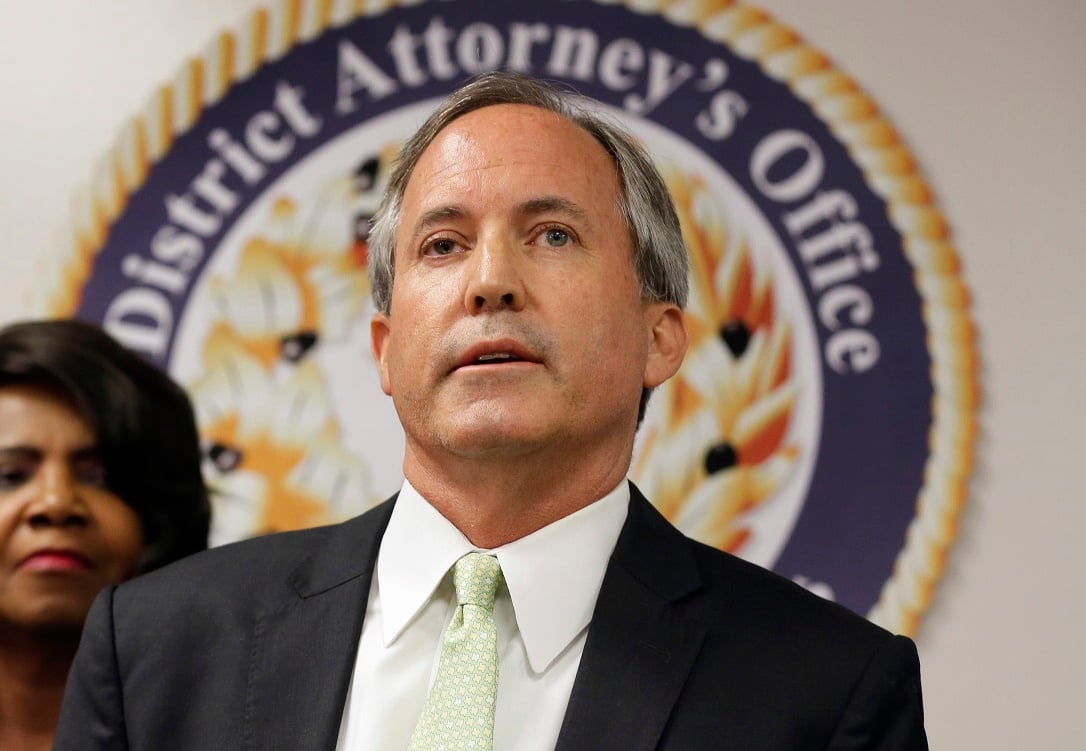
In this June 22, 2017, file photo, Texas Attorney General Ken Paxton speaks at a news conference in Dallas. (AP Photo/Tony Gutierrez, File)
Texas Attorney General Ken Paxton filed a lawsuit Tuesday seeking to shut down an Austin, Texas, homeless center, calling the charity a public nuisance.
The Sunrise Homeless Navigation Center says it’s the largest provider of homeless services in Travis County. According to its website, the center provides a number of services, including physical and mental health care, substance abuse care, harm reduction, housing interventions and benefits enrollment. The center has received over a $1 million from the city of Austin, according to Paxton’s complaint.
“In South Austin, a once peaceful neighborhood has been transformed by homeless drug addicts, convicted criminals, and registered sex offenders,” Paxton says in the complaint, filed in Travis County District Court. “These people do drugs in sight of children, publicly fornicate next to an elementary school, menace residents with machetes, urinate and defecate on public grounds, and generally terrorize the surrounding community.”
In his complaint, Paxton notes the center’s location across the street from an elementary school. The Texas Attorney General’s Office said in a statement on the lawsuit that the school has been forced into lockdown repeatedly due to violent behavior from people receiving services at the center.
Paxton also takes issue with the center allowing a clean syringe distribution program on its property, which he says amounts to facilitating drug use. Part of a “harm reduction” philosophy, clean syringe programs aim to help people who are already using intravenous drugs do so more safely. In Texas, such programs operate in a legal grey area, as they are not authorized by the state and Texas law criminalizes the possession of drug paraphernalia.
“Drug activity and criminal behavior facilitated by this organization have hijacked an entire neighborhood,” Paxton said in a statement. “By operating a taxpayer-funded drug paraphernalia giveaway next to an elementary school, this organization is threatening students’ health and safety and unjustly worsening daily life for every single resident of the neighborhood. We will shut this unlawful nuisance behavior down.”
Paxton seeks an injunction requiring the center to close for a year and prohibiting it from conducting operations within 1,000 feet of a school, playground or youth center. But in a statement, the center’s executive director Mark Hilbelink said the services will continue.
“It is regrettable that Attorney General Paxton took this route, especially during the week of Thanksgiving, but Sunrise intends to keep offering services to people in our community who need them,” Hilbelink said in a statement. “We are committed to being a good neighbor. We will continue to work, every day, to support Joslin Elementary School, our neighborhood, and our entire community.”
He also noted the center is a ministry of Sunrise Community Church and is therefore protected by the First Amendment, the U.S. Religious Land Use and Institutionalized Persons Act and the Texas Religious Freedom Restoration Act.
“These laws have been tested in court on multiple occasions, always with the same result: churches are protected to do work that is an expression of their religious practice,” Hilbelink said.
The Texas committee that examines all pregnancy-related deaths in the state will not review cases from 2022 and 2023, the first two years after Texas’s near-total abortion ban took effect, leaving any potential deaths related to abortion bans during those years uninvestigated by the 23 doctors, medical professionals and other specialists who make up the group.
Leaders of the Texas Maternal Mortality and Morbidity Review Committee said the change was made to “be more contemporary” — allowing them to skip over a backlog of older cases and review deaths closer to the date when they occurred, and therefore offer more relevant recommendations to policymakers. At least three women have died in Texas because of delays in care related to the abortion bans, according to reporting from ProPublica.
Ten Bears has made me Jealous. I wish I had found this first. But to give credit I think he can do more with it. If you don’t know ask him his work out regiment. If anyone who claims to be male thinks their bigotry can out male his actual being … I hope they never tell that to him face to face. I was in the military and even in my best fitness I don’t think I could have kept up with his regimen. Hugs