
Thoughts on the stupid lies Donald Trump and Republicans are telling to demonize LGBTQ+ people with only 46 days until the election – by Evan Hurst
I’ve been thinking this week about some of the absolutely stupid garbage conservative, culture-war-obsessed MAGA people believe, or claim to believe, for the purposes of demonizing people and making people hate the same people they hate. The most glaring current example is obviously Donald Trump, J.D. Vance and their media mouthpieces attacking innocent Haitian immigrants in Springfield, Ohio, with lies about them stealing and eating family pets.
But there are a bunch more.
There are the abortion lies Trump and Republicans love to tell — which many of them truly believe — about how Democrats love to let babies be born, at which point they lay them on the table and decide whether or not they’re going to execute them. Trump is sure it’s happening, because he saw on TV that the previous governor of Virginia (or is it West Virginia? Trump is never sure) totally said that, and if it’s on TV, it’s true.
Every election cycle lately, there’s a crop of the country’s stupidest Republican politicians babbling out loud that they have a friend whose pastor told them at the local elementary school there are children who identify as “furries” and demand to poop in litterboxes. It’s amazing watching them tell that one with a straight face.
Of course, Republican lies, blood libels and conspiracy theories often have a tiny element of 0.2 percent truth in them, something they can use to insist that the ridiculously stupid thing they say is happening really is happening. In the Virginia abortion story Trump tells, the nugget of truth was former Governor Ralph Northam talking about palliative care in grievously tragic situations where a newborn infant has no chance of surviving.
There actually have been litterboxes in classrooms. It’s so that if there’s a mass shooter in the school and classrooms are locked down for hours, poor little kids who can’t hold it might not have to be humiliated by wetting their pants.
(Did I ever mention that white conservative MAGA Republican politicians, pundits and influencers are extremely sick, evil liars?)
And then there’s the right-wing Christian Republican war on LGBTQ+ kids.
This week, Fox News tweeted a video featuring failed swimmer/anti-trans hatemonger Riley Gaines — remember her from my post about the Paris Olympics? — on “Fox & Friends,” spreading some the vile lies she so loves to tell. The clip caught my attention and pissed me the fuck off, and that’s why I’m talking about that this week instead of Mark Robinson. (I’ll get to him in due time, I’m sure.)
Here’s the video: (embedded on the page.)
Fox explained in its tweet that Gaines was “react[ing] to a California judge banning a school district from imposing a policy that would have required teachers and staff to notify parents if their student declares they want to change their name or pronouns.”
In the video Gaines bellyaches that such rulings are the government saying “they know your children better than you do. They don’t believe that these are your kids. They believe that these are the government’s kids.”
Elon Musk, who has apparently never met a conspiracy theory he wasn’t stupid enough to amplify — and who judging from all available evidence has a particular hate in his heart for transgender people, including his own trans child — retweeted Gaines’s video, saying simply, “The Dems want to take your kids.”
To which I reply, oh, go fuck yourself, Elon. Same message goes for Riley Gaines.
I want to talk about the California law in question and what it really does, and how that ties into how Donald Trump and Republicans are demonizing LGBTQ+ kids as part of their hate campaign against America, but I also want to tell y’all a story, so I’m going to try to do both.
Storytime!
Two nights before Joe Biden dropped out of the presidential race, I was standing in line in the wee hours in the lobby of a prominent hotel in downtown Atlanta, with a bunch of fellow weary travelers. It was Friday, the first day of the CrowdStrike update that borked the entire global internet, and all our Delta flights had been canceled.
I struck up a conversation with the guy in front of me, a handsome young guy from El Paso. His wife and small children were somewhere in the expansive lobby, exhausted, while Dad tried to get hotel rooms sorted. They were coming from Disney. I was on my way back from the Republican convention in Milwaukee. We made small talk.
But we were in line for over an hour, so the conversation actually got surprisingly deep. He was a second-generation immigrant from Mexico, with parents who only speak Spanish. We talked about what life is really like along the border these days for people who actually literally live right on it. He described himself as a conservative, but not extreme, and not super-political. He freely offered that he couldn’t stand Donald Trump, but probably would vote for him, not that he was enthused about it.
But one thing that was bothering him, big time, was this law that had just been signed by Governor Gavin Newsom in California, to protect gay and trans kids from rogue school personnel who would out them to their parents without their consent. I was a bit surprised this Texas guy, who again didn’t seem that political, was so in tune with something California’s governor had done five days prior. But there we were.
He made extra-clear from the beginning that he doesn’t consider himself anti-gay or anti-trans. But it was immediately clear to me that this very kind-seeming guy was getting all his information on this issue filtered through the Christian nationalist bullshit machine of right-wing media.
The California law was passed directly in response to school districts in red areas of the state enacting policies forcing schools to notify parents if a child asked to be referred to with a different name or pronouns. The legislature acted to protect those kids.
But to this dad, it sounded like California was trying to put one over on parents, to usurp their parental role, stealing and indoctrinating their kids. (Hey, Riley Gaines! How did your shitty, vile hate get in this nice man’s brain?)
It was 1:00 a.m., so I wasn’t about to start bickering, and also y’all would be amazed how gentle and diplomatic I am in person. But I did try to get on this dad’s side and maybe help him see it from a different perspective. He had gathered that I was gay, or maybe I told him.
“You obviously love your kids,” I said, “and you wouldn’t reject them for any reason, no way, no how.” He agreed.
“That law isn’t about hiding things from good, loving parents like you,” I told him. “It’s about protecting kids who don’t have parents like you, kids who are frightened of what would happen if their parents knew who they were, kids who don’t feel safe, kids who come from of abusive homes.” It could be the religious kind of abuse, and/or the non-religious kind of abuse.
He understood what I was talking about and several times reiterated how very not-anti-gay and not-anti-trans he was.
There have been memes going around lately along the lines of, if your child is gay or trans and they don’t want you to know, there’s probably a good reason for that, and likely it’s you. The problem is you.
I was trying to help this dad see, though, that he was not the problem. But he was still uncomfortable with it. He felt he would want the school to tell him. He grudgingly agreed that if one of his kids thought they were trans, he would absolutely want to make sure they had the best medical care and guidance they could get, that he would want to do whatever was best for his child.
But he wasn’t convinced this law wasn’t out to get people like him. You don’t fix the constant lava flow of conservative Christian right-wing fascist propaganda and lies in one sleepy night when all anybody wants to do is get a fucking hotel room and then fly the hell out of Atlanta the next day.
That dad is a good example of why Trump and Vance and Fox News and the rest of the Republican machinery are so committed to demonizing all LGBTQ+ people, but especially trans people, this election season.
This is a strategy, and it works on a whole bunch of people.
‘Think about it, your kid goes to school and comes home a few days later with an operation.’
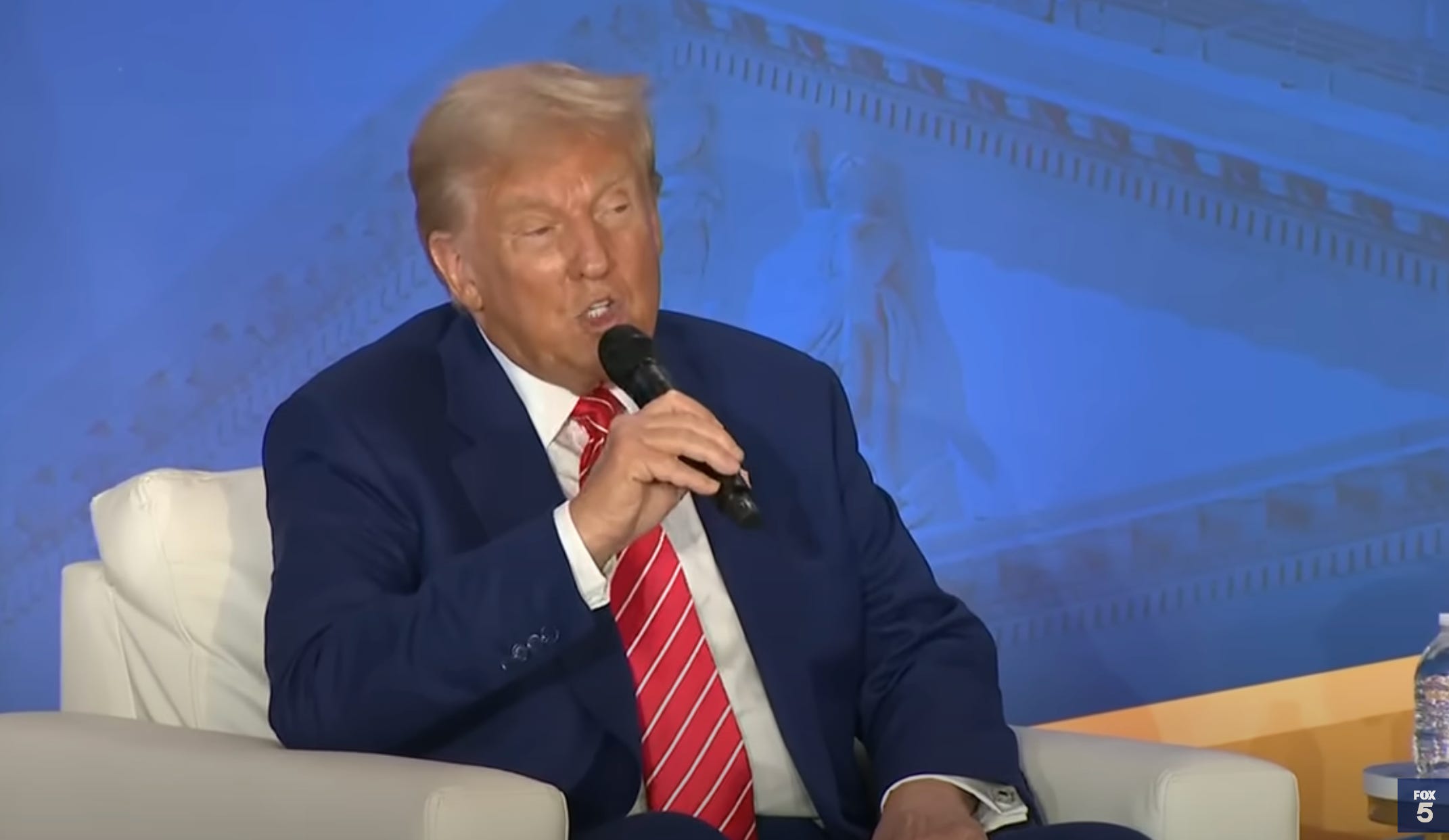
Donald Trump has been saying that on the campaign trail lately. He is absolutely full of shit. He repeated the lie at a Moms For Liberty circle jerk recently, and Moms For Liberty was nail-spitting furious that CNN deigned to factcheck Trump’s obvious lie.
(Trump also memorably screamed at the debate that Kamala Harris “wants to do transgender operations on illegal aliens that are in prison!” He gets confused about his conspiracy theories sometimes.)
Reality check: there is no school nurse in the country doling out top surgeries or bottom surgeries, either for trans-identifying kids, or for kids who come in after they skin their knees on the playground. (That would be real fucked up!)
Schools aren’t going gender-affirmation surgeries and kids aren’t demanding litterboxes because they say they’re “furries.” The baby isn’t being born so they can put it on the table and decide to execute it, and Haitians in Springfield aren’t eating Whiskers. Not even the best Obamacare money can buy has a plan where kids can walk in to the school nurse, without their parents’ consent, sign up for surgery, and then reappear at their parents’ house days later with a brand new set of genitals.
But Moms For Liberty got so mad at CNN for debunking Trump’s dementia lies. It was very important to them that Trump be out there demonizing transgender people, in general, regardless of whether Trump’s babbling about children getting on the school bus and coming back “a few days later with an operation” was literally true.
They angrily sent CNN a bunch of examples of lawsuits filed in various states, all focused on “parental rights” and, in particular, schools letting kids transition socially — as in, come out as trans or non-binary, etc. — without running off to tattle to their parents. Letting kids use different pronouns if that’s what they’re feeling is right for them. Etc.
Of course, because it’s Moms For Liberty, their missive to CNN — and the pissy PR email they sent to tell everybody about it — was full of hallucinatory conspiracy theory babblings about schools “secret[ly] social-transitioning … minor children” and, quoting one lawsuit from Massachusetts, “encourag[ing] minor children to hide key components of who they are from their parents, while actively encouraging children to disobey and ignore their parents’ wishes, and while actively deceiving parents and hiding information about their own children from them.” Moms For Liberty co-founder Tiffany Justice even suggested that schools are “legally allowed to assign a new pronoun without parental knowledge.”
As if it’s the schools initiating these actions. As if schools are handing out pronouns with seating charts. (“Aw fuck, bro! Did you get she/her? Bro that sucks!” — common elementary school conversation now.)
They also straight up lied and said Minnesota allows gender-affirmation surgeries for minors without parental consent. It does not.
(Again I ask, on what fuckin’ insurance plan? Have I mentioned lately that these people are delusional weirdos?)
But as I said, pretty much everything Moms For Liberty was mad about, even when they were totally misrepresenting things, was social transitioning. Because that’s the slippery slope to hormones and surgery, and they’re not telling their parents, AIIIIYEEEEEEEE!
So they were fine with Donald Trump straight-up lying and saying schools are doing transgender surgeries on kids, because sometimes you have to make up really fucked up lies to con people into hating the same people you hate. Isn’t that right, Republicans?
What did J.D. Vance just say about his and Trump’s blood libel lies about Haitian immigrants? “If I have to create stories so that the American media actually pays attention to the suffering of the American people, then that’s what I’m going to do.” And by “suffering of the American people,” he meant things he’s a total Nazi about.
Or as one white fascist Christian put it on Twitter this week:
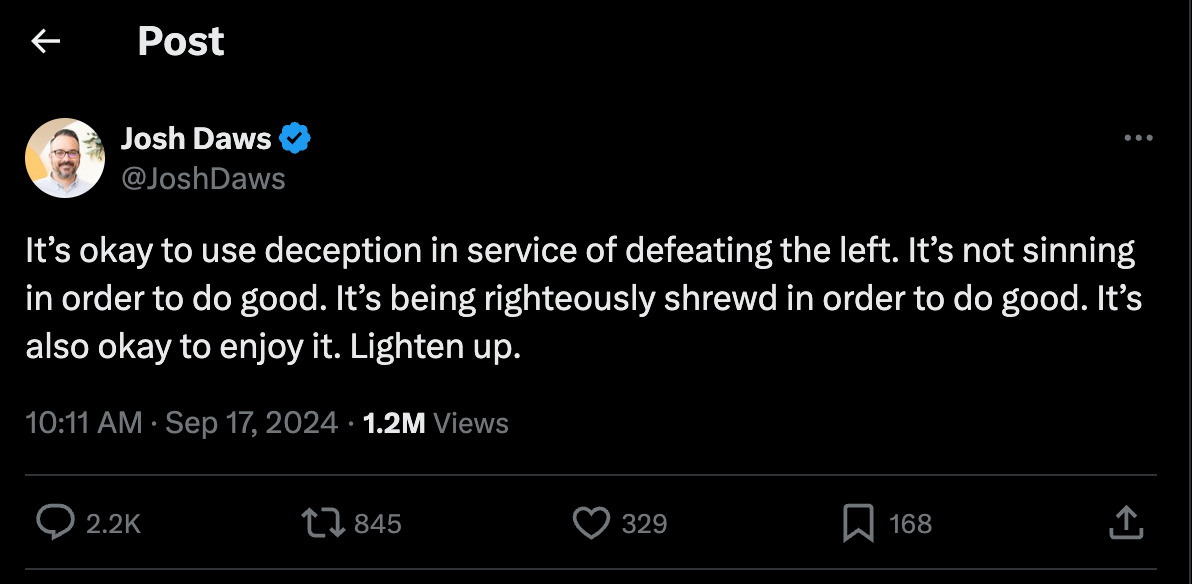
Lying for Jesus! It’s been around a long time, yet it’s never done by people who actually reflect the character of Jesus in any way, shape or form.
(One of these days I’m going to write y’all a full Bible study on Matthew 7:23, AKA Jesus’s personal candygram to conservative white Christians.)
MAGA Republicans are absolutely counting on conning enough people with these absurd, demonizing lies and libels, about trans people and immigrants and abortion and anything else they can think of that deserves a good Two Minutes Hate. In Texas, it was reported this week that congressional Republicans are spending millions targeting Democrats with anti-transgender ads.
It’s literally all they have to run on. And they know it works, at least on some people.
In summary and in conclusion, and back to what pissed me off so much in the first place.
Riley Gaines griped to “Fox & Friends” that “[t]hey don’t believe that these are your kids. They believe that these are the government’s kids.”
We’ve been over this before, how these MAGA Christian fascist creeps (and their ideological compatriots) think they literally own their children. They believe they own them until they transfer ownership of their daughters to their husbands, or in the case of their sons, when they become wife-owning patriarchs in their own right.
It offends them when it’s pointed out that actually, their kids are their own people, and they own themselves.
Now, when the kids are minors, sure, their parents have custody and responsibility for them, and the schools have a part to play in that, both as partners with the parents and just in general, in preparing them to be respectable, functioning adults. Schools have a responsibility to let parents know when their kids’ grades are slipping; if they’re getting in fights, or getting bullied; if they’re acting out in school; if they’re doing something illegal, or dangerous, to themselves or others. And so forth.
This shouldn’t have to be said, but coming out of the closet — as gay, as bi, or as somewhere on the gender spectrum other than that which they were assigned at birth — DOES NOT FALL UNDER ANY REASONABLE CATEGORY OF “MISBEHAVIOR” FOR WHICH A SCHOOL WOULD NEED TO NOTIFY PARENTS.
Being LGBTQ+ is not dangerous, it’s not immoral, and it’s not “I found meth in your kid’s backpack.” It’s simply a thing. If a child is excelling and getting along well socially and in grade seven they decide to try on some new pronouns, that doesn’t warrant a phone call home.
It doesn’t warrant tattling.
But that’s what these evil fascist creeps want. They want schools to be their abusive morality Gestapo when they’re not around, to shame and punish their children in their absence, and to call a parent-teacher conference if they suspect a child has come down with the Woke Mind Virus.
By the way, schools do have another responsibility when it comes to kids, and that’s to spot abuse and neglect, and to intervene for the welfare of the child if they suspect the child is in danger at home.
And that — dearly beloved MAGA fascist assholes — is the category under which this falls.
If a kid comes out as gay, or starts socially transitioning, but they say “Hey, my parents don’t know, and I need them not to,” then there’s a reason that kid — the actual owner of their own body, mind and soul — is saying that. Maybe they’re just not ready! Maybe they’re getting their sea legs with their friends before they go home to their parents. Maybe they’ll tell them next year.
But it’s also possible that they don’t feel safe with their parents, and fear their reaction. It might be a reasonable fear. Fundamentalist Christian homes are notoriously abusive to LGBTQ+ children, oftentimes disowning them or kicking them out, oftentimes subjecting them to physical, psychological and religious abuse. There’s a reason states all over the country have been passing bans on fully discredited, fully ineffective and uniformly harmful “ex-gay” and “ex-trans” religious torture for minors for over a decade now. (Congratulations, Kentucky! You have a good governor.)
They might be scared their parents will ship them off to “pray away the gay” or “pray away the trans.”
Laws like the one in California protect those kids.
The parents bitching about this and filing lawsuits and publicly demonizing LGBTQ+ people — including their own children — they are demonstrating precisely why these laws need to exist.
That’s what this is about.
It’s not about hiding things from good and loving parents. It’s about protecting kids from parents who are monsters.
In the next 46 days, you might encounter people who say they can’t vote for Kamala Harris and against Donald Trump for truly stupid reasons. This is one of them. (And the abortion thing and the Haitian immgirants thing and the litterboxes and oh God, so many more.)
Tell them their reasons are stupid reasons.
How loving and diplomatic you decide to be about it, that’s up to your own best judgment.


 Scottie's Playtime