There are many on Food Network’s site, and I’m just certain I’ve seen someone create a pseudo-seafood dish with it, so it should be here: https://www.foodnetwork.com/search/jackfruit-recipes- , but it’s not. There is no jackfruit seafood recipe, and but one recipe for vegan seafood, Vegan Sushi. I almost got lost on the site, though. I love that channel except on Fridays and Saturdays! 🌞
Meanwhile, the bad news; here’s the allergen info for jackfruit. It’s comprehensive, so you’ll be able to know if you should have it or not, after you read the beginning of it, and there’s more info from there. https://www.annallergy.org/article/S1081-1206(18)31144-X/abstract (For instance, latex gives me an open rash, so I need to avoid jackfruit, I’m gonna say.)
This was gonna be a really pretty post, too! Ah, well. Enjoy some forest instead.
A few months ago, Substack generously invited thirty or so of their writers to NYC for the opportunity to create some ads for our blogs. I really didn’t know what to expect, but the experience itself with Cash Studios (cashstudios.co) was delightful.
For about an hour, I worked with the staff in their studio on various ideas they had, all of which I found interesting. Moreover, I was quite impressed with their creativity and professionalism. They were kind, curious about my work, and really wanted to bring out my authenticity.
A few days ago, the ads were sent out to all of us, and I was quite blown away by the care and thoughtfulness put into creating them. I feel that Cash Studios did an exceptional job in capturing what I try to do with Charlotte’s Web Thoughts, and I’m thankful to the folks at Substack for this level of investment in my work.
They cut four ads, and I want to share them with all my subscribers, with a humble request: if you have friends, family, colleagues, or whomever you think might connect with my writing, send them one of these ads. Tell them that it’s free to subscribe to the blog, that all they need is an email, and that I don’t spam.
US researchers have developed a chalk-based coating that can reduce the temperature under fabric by roughly 5°C.
The researchers say their environmentally benign substance could be used to coat any type of fabric and turn it into a radiative cooling textile.
“We see a true cooling effect,” says Evan Patamia, a graduate student at the University of Massachusetts Amherst.
“What is underneath the sample feels colder than standing in the shade.”
Patamia presented the team’s invention at the American Chemical Society’s 2024 Fall Meeting earlier this week.
Substances that can both reflect sunlight, and allow body heat to escape, are well-known to chemists. But they generally require costly or environmentally dangerous materials to make.
“Can we develop a textile coating that does the same thing using natural or environmentally benign materials?” summarises chemist Trisha Andrew, also at Amherst, of the work done by her and her colleagues.
Inspired by crushed limestone, which is used to cool buildings, the researchers tried solutions of calcium carbonate – the main component in limestone and chalk – as well as barium sulphate.
They used squares of fabric treated with a process called chemical vapour deposition, which added a layer of a carbon-based polymer onto the textiles.
When dipped in the solutions, the fabrics built up a chalky matte layer of crystals which could reflect UV and infrared light.
They tested the treated fabrics outside on a warm afternoon, and air underneath them was about 5°C cooler than the ambient temperature, and roughly 9°C cooler than air under untreated fabrics.
The coating is also resistant to laundry detergents.
“What makes our technique unique is that we can do this on nearly any commercially available fabric and turn it into something that can keep people cool,” says Patamia.
“Without any power input, we’re able to reduce how hot a person feels, which could be a valuable resource where people are struggling to stay cool in extremely hot environments.”
Andrew is now part of a startup aiming to test the process on larger bolts of fabric, to see if it can be scaled to industry.
A hydrogel has learned to play the 1970s video game “Pong” and improved its ability to hit the ball by 10% with some practice.
Dr Hayashi, a biomedical engineer at the University of Reading in the UK, says: “Our research shows that even very simple materials can exhibit complex, adaptive behaviours typically associated with living systems or sophisticated AI.
“This opens up exciting possibilities for developing new types of ‘smart’ materials that can learn and adapt to their environment.”
The research is described in a paper published in Cell Reports Physical Science.
Video link, an example run of a hydrogel playing Pong.
Credit: Cell Reports Physical Science/Strong et al.
What is a hydrogel?
A hydrogel, like gelatine or agar, is made of a 3D network of polymers that become jelly-like when water is added.
The hydrogel in this study is an “ionic electro-active polymer”, where the media surrounding the polymer matrix contains charged particles, in this case hydrogen ions.
As a result, it can deform when an electric current is applied to it.
Stimulation by an electric field causes the hydrogen ions migrate and, as they move, drag water molecules with them, causing areas to swell.
“The rate at which the hydrogel de-swells takes much longer than the time it takes for it to swell in the first place, meaning that the ions’ next motion is influenced by its previous motion, which is sort of like memory occurring,” says first author and University of Reading robotics engineer, Dr Vincent Strong.
“The continued rearrangement of ions within the hydrogel is based on previous rearrangements within the hydrogel, continuing back to when it was first made and had a homogeneous distribution of ions.”
It’s this property the researchers exploited to teach the hydrogel to play Pong.
How does a hydrogel play Pong? (snip-More on the page)
NASA is about to launch a helium balloon carrying a telescope, to test its ability to see exoplanet atmospheres.
The Exoplanet Climate Infrared Telescope (EXCITE) is eventually destined to fly around the poles, collecting data above much of the Earth’s atmosphere, but its first test flight is due to happen from the USA in the next few months.
It will be launched for the first time from the Columbia Scientific Ballooning Facility in New Mexico.
EXCITE (EXoplanet Climate Infrared TElescope) hangs from a ceiling at the Columbia Scientific Balloon Facility’s location in Fort Sumner, New Mexico. The mission team practiced taking observations ahead of flight by looking out the hanger doors at night. Credit: NASA/Jeanette Kazmierczak
“EXCITE can give us a three-dimensional picture of a planet’s atmosphere and temperature by collecting data the whole time the world orbits its star,” says principal investigator Peter Nagler, from NASA’s Goddard Space Flight Center. (snip-More on the page)
The state is one of the epicenters of the moral panic and anti-trans rhetoric that have dominated campaigns and media cycles during the presidential election. Under the guise of fighting the “indoctrination of our children”, Republicans have made restricting trans rights a focus of their platforms. Donald Trump has vowed to stop “the leftwing gender insanity” while a leading Missouri Republican has celebrated residents leaving the state due to anti-trans policies, saying: “We are better if they are gone.”
The toxic discourse has fomented fear and anger among conservatives about trans people’s increasing visibility in society and created deep anxiety and distress for queer and trans people and their families.
Parents of trans youth across the St Louis region interviewed for this article said they were desperately trying to protect their kids’ health and wellbeing as politicians have zeroed in on their children. They are rationing medications and traveling hours out of state for care. Some are counting the days until their kids turn 18 and the laws don’t apply; “We are truly doing what we can to keep our children alive,” said one mother of a trans boy.
“Kids are being told by their government that they have to be eradicated from public life,” said Chelsea Freels, a recent high school graduate from St Louis, who has become a vocal advocate for trans youth like herself. “I’m 18 now. I can handle it – ish. But I have to help the kids who are younger. It’s like Sisyphus pushing a boulder up a hill. You can help them get better, but then it’s gonna go back down.”
In Missouri, less than 1% of young people identify as trans, but lawmakers have made control over their lives an increasing priority.
“It’s stressful and physically and mentally exhausting,” said Corey Hyman, an 18-year-old trans man who has been testifying against anti-trans bills for roughly five years. “These legislators really didn’t take me seriously as a young kid, and they don’t see me as human. I just wish they’d give up.”
Republicans have long sought prohibitions on puberty blockers and hormone therapy, treatments that allow children to medically transition, which families can consider when trans youth are persistent and consistent about their gender identities. The treatments are part of the gender-affirming care model, which is endorsed by the American Academy of Pediatrics, American Medical Association and othermajor US medicalgroups. There has been growing global scrutiny of the medications, including in the UK, which recently adopted restrictions, but they remain part of the recommendedstandards of care in America.
In Missouri, Republicans’ efforts were boosted last year by a media firestorm at a St Louis clinic for trans youth. Jamie Reed, a former caseworker at the Washington University (WashU) transgender center at St Louis Children’s Hospital, publicly denounced the clinic in February 2023, alleging youth who might not actually be trans were being rushed into treatments. A group of patients publicly rebutted the claims, sayingthe care was methodical and vital. Families argued lawmakers should stay out of their private medical decisions, but the GOP governor last June adopted a law banning gender-affirming treatments for minors.
The law said youth already receiving treatments could continue. WashU, however, ceased prescribing medications to all trans youth, meaning families could no longer continue treatment at a top children’s hospital.
Christine Hyman, Corey’s mom, recalled listening to the Senate hearing in her car when the ban passed: “I’ll never forget that feeling. First I was screaming, then I was crying. I sat in my car for half an hour when I got home, thinking, ‘How do I tell my son?’”
Living under the anti-trans laws
In the backyard of their St Louis house, Danielle Meert and James Thurow have a luscious garden of herbs and fruit trees that has become their oasis – a respite from the anxiety of trying to raise a trans boy in Missouri. “To be in the garden, not distracted by the bullshit that has consumed us for the past four years has been wonderful,” Thurow said, sitting in his living room one recent afternoon.
“Then there’s the guilt.”
That guilt, the couple said, comes from feeling they could always be doing more to stop anti-trans bills and protect their son Miles, who was turning 18 the following day.
WashU prescribed Miles hormones at age 15, and the treatment had obvious benefits, he said: “I feel comfortable in public. I don’t feel out of place with my friends who are dudes. It just feels good for people to view you as you are.”
Meert said the family was prepared for the healthcare ban. “We’ve been stockpiling medication and hiding it around town with friends and families in case child services shows up and raids our house. People say we’re overreacting or being hysterical, but these Republicans think I belong in jail, that my child is the downfall of America … He’s just a happy kid living his best life.”
They had rationed Miles’s medications so he had enough for his final year underage, but during that time, he lost access to his doctor; the law threatens revoked licenses for practitioners.
Miles said he had become adept at managing stress from anti-trans bills, joking of the sports bans: “It’s not like trans and gay people are known for their athleticism.” He knows how to calm his mother when she suffers panic attacks. He extends grace to those who oppose his rights, saying he understands people have questions about something unfamiliar.
He felt “very relieved” to turn 18, making his care lawful again. But he worries about younger kids.
Republican lawmakers in Missouri have made it one of the most hostile states in the nation for trans youths. Photograph: Hudson Heidger/Missourian
One St Louis mother of a 12-year-old trans boy has spent months talking to clinics in Illinois, Maryland, Minnesota and Michigan to try to find care for her son, who had been seen by WashU.
At a young age, the boy had repeatedly spoken of dying. “He didn’t want to grow up because he knew what that would look like,” said the mother, who requested anonymity to protect her son’s privacy. Once he started living as a boy and received gender-affirming treatment, his anger issues dissipated and he excelled at school, she added.
She scoffed at the media narrative that parents were trying to turn their kids trans. “You wouldn’t wish this upon anyone – for your child to feel uncomfortable in their body. But you do have to give freedom to children to tell you if something is wrong. You have to be loving and affirming and open to your child’s journey.”
In November, WashU sent her a letter expressing “deep regret” that a former staffer had publicly discussed her family’s treatment – an apparent reference to Reed, the former caseworker, who seemed to suggest in the media that this mother was rushing treatments.
“I was working with world-class doctors and the brightest minds in this science – how can that be wrong, how can that be illegal, how can that be bad parenting? I’m not denying my child medical care. I’m making sure I comply with the best practices,” said the mother, who provided records indicating there were roughly three years of appointments before her son got puberty blockers, which doctors recommended.
Her boy will soon need additional treatment. She has scheduled an initial appointment in Chicago, but she is anxious about travel costs and worried she will have to take medical leave. “This has robbed us of joy,” she said. “I hate counting the years until my son is 18 and he can move where he wants and go get care. I hate that I’m rushing his young, beautiful life to beat the legislative actions mandating what he can do.”
Reed declined to comment on the mother’s story and criticisms of her efforts, but has previously stood by her claims and continued to argue that the “clinic was harming kids” with medical interventions.
A ‘nightmare’ at schools
Missouri Republicans’ efforts have not stopped at healthcare. Earlier this year, lawmakers proposed bills to end legal recognition of trans people, prevent trans people from using facilities that match their gender identity in schools and workplaces and criminalize teachers who use trans students’ pronouns.
The bills did not pass, but LGBTQ+ families say the demeaning debates and news cycles have taken a toll. Some said they encountered bullying at school, hateful comments from neighbors and casual transphobia at social gatherings. Others said they were forced to cut off relatives who had absorbed misinformation or refused to use correct names and pronouns. Some outspoken advocates said they feared for their safety. Several parents said the stress had made them physically ill.
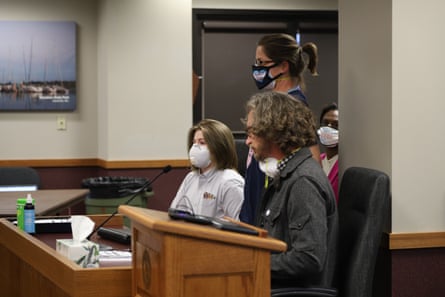
At one school board meeting last month in St Charles county, a more conservative county neighboring St Louis, queer and trans youth and their supporters sat through a lengthy discussion surrounding a proposal to make it easier for civilians to challenge potentially “obscene” materials – a move seen as an effort to increase censorship of LGBTQ+ content. Some attendees held “trust our teachers and librarians” signs and a trans pride flag, applauding when a student criticized the removal of queer characters from shelves; another speaker said kids shouldn’t be exposed to “sexual scenes”.
Toward the end of the meeting, a board member gave a speech about her disdain for trans youth using locker rooms, an item not on the agenda.
Youth protesters and parents of trans kids gathered at the end of the meeting to commiserate.
“The trans community is burning to the ground here. It’s a nightmare. Where are the national LGBTQ+ organizations?” said Kim Hutton, who has a trans son.
“They frame these policies as ‘protecting the children’, but they’re really just hurting specific marginalized groups. It’s not fun to see when you’re part of those marginalized groups,” said Hannah Yurkovich, a 17-year-old St Louis high schooler at the meeting. “I grew up here, I love St Louis, but I can’t be part of it, if it’s going to keep being against who I am.”
Her friend, Rohan Webb, 18, attended a neighboring high school that adopted gender-neutral bathrooms to better support LGBTQ+ students and had queer support groups. “To see this school district move in the exact opposite direction is saddening,” they said. “To see them getting to make students’ lives so much worse is infuriating.”
‘Will Democrats throw us to the fire?’
Trans Missourians and their families say they have endured by leaning on each other. Families carpool to government hearings. A regional summer camp provides a safe haven for LGBTQ+ youth. Rene and Kyle Freels, the parents of Chelsea, the recent high school graduate, run a support group for trans kids and parents, and they have organized “Transgiving” potlucks for Thanksgiving.
Chelsea has dedicated significant time to supporting trans youth who don’t have the resources she has had. Over breakfast at a queer-friendly cafe with her parents, she described how she assists others in legally changing their name, saying she had just received a court alert about a case she was managing.
“It’s all in the bucket of preventing suicidality,” Chelsea said matter-of-factly. “That is what worries me the most about going to college, because sometimes I have to talk them down … What happens if I’m not in St Louis?” She said she has been fighting to stop friends’ suicides since she was 15 and learned to always gets friends’ addresses in cases of emergencies.
“The public only hears from trans people in the positions of the highest of privileges. I have supportive parents, I’m white, I’m 18, I got healthcare – later than I needed it, but I got it. But my story is one aspect of the trans story, and it’s one of the better ones, and even it is filled with sadness.”
Chelsea, who is leaving the state for college and is interested in coding and liberal arts, said she felt disillusioned with politics. On the Republican side, people were using “genocidal rhetoric” to talk about trans people, she said, referencing calls for the “eradication of transgenderism” at last year’s Conservative Political Action Conference and demonization of trans people in the Trump-aligned Project 2025.
On the Democratic side, candidates defend trans rights, but it feels fragile, she said.
“The Democrats in Missouri are our allies, they’re the best support we have in the chamber, but there’s an anxiety they won’t always be that way. When shit hits the fan, they’ll say, is it worse to be out of office and standing on your morals, or is better to just throw a little bit to the fire? But the thing they’re throwing to the fire are my friends and family.”
The Freels considered relocating to Illinois last year, but couldn’t afford it.
“There will always be trans kids and they will be out and asserting themselves,” Rene Freels said. “We’re part of this leftover crew that is super mad and stubborn and wants to see this resolved and want our kids to have full civil rights.”
(From L-R) Rene, Chelsea and Kyle Freels pose for a photo. ‘There will always be trans kids and they will be out and asserting themselves,’ says Rene Freels. Photograph: Sam Levin/The Guardian
Miles, who hopes to become a teacher or work with youth, said leaving is not an option: “I’ve always wanted to stay here. It sounds weird, but I really love Missouri. I have so many memories here and I could see myself raising my kids here.”
Missouri is where he spent his whole life, where his favorite restaurants and hiking trails are, where his girlfriend and her family live, where he had his first date, he said.
He can’t imagine moving away from his elderly grandparents, who he stays with on a weekly basis. “I have a plan for my life,” he said, “and I couldn’t imagine doing it somewhere else.”
Throughout Meert and Thurow’s home are objects they have repurposed from friends who left the state due to anti-trans laws.
In the garden, the couple recently put up a sign saying they had planted beans “in remembrance of the 50+ families we know that have left Missouri”. But the number of departures is greater, she said. They’ve lost count.
The integration of artificial intelligence into public health could have revolutionary implications for the global south—if only it can get online.
(Whew! It’s a long one. Maybe read it in part, then come back and read some more. Or read it all at once, it’s not insurmountable. I’m interested what people here think about this.)
The transformative potential of digital connectivity became a global game changer more than two decades ago. Mobile phones reshaped telecommunications, enabling connectivity even in homes without landlines. Digital health quickly leveraged these innovations, making remote patient-doctor communication, digital payments, care coordination, and online peer support networks possible.
Artificial intelligence (AI) has undoubtedly sparked another phase of digital innovation. Although the field’s origins date to the mid-twentieth century, recent advancements in large language models (LLMs) have thrust it into the spotlight. Reflecting this growing relevance, the World Health Organization (WHO) dedicated a session at its World Health Assembly (WHA) in early 2024 to AI’s implications for global health, convening regional, national, academic, and international health organizations and actors to examine this matter.
AI Applications in Global Health
The literature generally presents four key use cases for artificial intelligence in health in low- and middle-income countries: disease diagnosis, risk assessment, outbreak preparation and response, and planning and policy-making. As the 2021 WHO report on AI in healthcare indicates, several AI applications are already in use or in development for diagnosis and assessment, such as in India for rapidly creating encephalograms in six minutes; in Rwanda and Pakistan for patient navigation; in Uganda, for malaria diagnosis; and in Nigeria for monitoring vital signs in mothers and children, and detecting infant asphyxia. On a broader scale, the advancement of DeepMind’s AlphaFold system in predicting the three-dimensional shape of proteins holds promise for enhancing our understanding of diseases and accelerating treatments.
Use cases in outbreak surveillance and response are also prominent. Google Flu Trends used search engine queries to predict influenza activity, but its overestimation of flu prevalence demonstrated the need for continuous algorithm updates. Tools like HealthMap have also proven valuable, detecting early signs of vaping-related lung disease and issuing an early bulletin about the novel coronavirus in Wuhan.
AI is also being used in planning and policy making, such as in South Africa where machine-learning (ML) models were used to predict how long recruited health workers’ would commit to their placements in rural communities; and in Brazil where artificial neural networks were used to create a method to geographically optimize resources based on population health needs.
Could AI Represent a Sea-Change in Global Health?
The integration of AI in public health is still evolving and being cautiously assessed in some cases, but it’s poised to transform key health functions. Evidence generation, the foundation of health policies and practices, is undergoing significant change. Traditionally, systematic reviews, a cornerstone of evidence synthesis, may take months or even years to complete. Now tools like Eppi-Reviewer use ML for more efficient screening, while platforms like Open Evidence are able to summarize existing studies rapidly. As AI becomes capable of handling technical aspects such as quality appraisal, meta-analysis, and synthesis with high rigor and fidelity, its role in evidence generation will expand. This advancement will enable more cost-effective and timely production of health guidelines, with leading bodies already creating guidelines for AI use in evidence synthesis.
Data collection and analysis are also experiencing transformative changes. AI-powered tools enable rapid analysis of both structured and unstructured data, marking a significant shift from traditional paper-based methods and conventional fieldwork. This capability has a remarkable impact on public health strategies centered on behavior change. AI can allow for the creation of highly targeted health promotion campaigns with unprecedented speed and precision. Moreover, sentiment analysis tools can assess public perceptions in real-time, enabling agile adjustments to ongoing health campaigns.
The healthcare workforce is also expected to evolve as AI-human partnerships are normalized. For instance, Hippocratic AI’s generative models can perform certain care management functions, while Google’s Med-Gemini provides real-time feedback on medical procedures, including surgeries. As they improve and are adopted by practitioners, these tools will have the potential to enhance the cost-effectiveness and precision of healthcare delivery.
As of May 2024, the FDA had authorized 882 AI- and ML-enabled medical devices. The rising volume of such AI-enabled devices as well as the rise in registered clinical trials related to their use underscores how much the field has embraced such tools.
A Changing Actor Landscape
The integration of AI in healthcare is not only transforming practices but also reshaping the landscape of global health actors. Historically, global health was a multilateral activity, dominated by international non-governmental organizations and national governments alike. The early twenty-first century saw the emergence of influential philanthropic actors like the Gates Foundation. Now, we are entering a phase where private-sector AI companies are poised to become increasingly influential in this arena.
While open-source models and government-developed AI systems exist, the predominance of private-sector AI models, such as OpenAI’s ChatGPT and Google’s Gemini, raises critical questions about data governance in global health. Unlike existing cross-national commercial influences on health such as the fast food or tobacco industries, AI systems present more nuanced concerns. For instance, if private models become integrated into existing multilateral health initiatives, how can we ensure their compliance with global health objectives? How do we address potential conflicts of interest when companies hold influence over health data and decision-making?
Regional and national guidelines are emerging to govern this evolving landscape. The European Health Data Space, discussed at the World Health Assembly, offers one such example. This initiative aims to create a single data space across the twenty-seven EU member states, empowering patients to control their health data while establishing a framework for safe data reuse and AI deployment. It also includes provisions for rigorous evaluation of high-risk AI systems in healthcare.
Similarly, the African Union recently launched its Continental AI Strategy, with a stated aim “to harness artificial intelligence to meet Africa’s development aspirations and the well-being of its people, while promoting ethical use, minimizing potential risks, and leveraging opportunities.” Monitoring measures like this as they develop will be instructive for the future deployment of AI in global health initiatives.
Building Foundational Infrastructure
Another factor to consider is that advances in AI mean little for health systems at an insufficient level of maturity. Progress in AI depends heavily on a strong foundation of digital health architecture, which encompasses secure data management, interoperability between health information systems, and comprehensive digital strategies. While most countries have digital health strategies, their implementation varies widely, with progress in resource-limited settings often lagging. Several countries have neither sufficient health workers to regularly input data nor dependable electricity and Wi-Fi to support a transition from paper to digital records. The lack of foundational infrastructure presents a significant barrier to AI implementation.
Initiatives like the Precision Public Health Initiative, led by the Rockefeller Foundation in collaboration with the WHO, UNICEF, global health funding agencies, ministries of health, and technology companies aim to strengthen AI use in low- and middle-income countries (LMICs). With initial funding of US$100 million, it aims to extend the use of AI and data science in LMICs, providing the latest technology to under-resourced parts of the world. Initiatives like this will need to concentrate resources on foundational health system strengthening functions such as the training and supportive supervision of staff and resource management.
Ethical Implications
As AI advances, ethical considerations must keep pace. These challenges can be broadly categorized into privacy and surveillance concerns, data misuse, algorithmic biases, and issues of transparency and liability. Recent cases highlight the urgency of addressing these matters proactively.
As the research report Ethics and Governance of Artificial Intelligence for Health: WHO Guidance explains, during the COVID-19 pandemic, China’s Alipay introduced a “Health Code” that used collected data to determine exposure risks. This system, which determined individuals’ mobility based on their assigned color codes, raised concerns about privacy, rights, and the potential for mass surveillance. Another case discussed in the WHO guidance report is Dinerstein vs. Google, in which the University of Chicago shared patient records stripped of identifying information with Google to develop machine-learning tools for predicting medical events. A class action complaint was filed, alleging that records could be re-identified, threatening patient privacy.
Several cases other cases in the WHO guidance report highlight the critical issue of bias in AI systems. In Argentina, an AI system designed to predict adolescent pregnancy faced criticism when it was found to have flawed methodology and to violate the privacy of adolescents. Similarly, a study in the US revealed racial biases in an algorithm that resulted in Black patients receiving less medical attention than equally sick white patients.
Additionally, an AI technology designed to detect potentially cancerous skin lesions was trained primarily on data from lighter-toned individuals in Australia, Europe, and the US, highlighting its inadequacy for darker-skinned populations.
The “black box” nature of many AI algorithms also raises critical questions about informed consent and liability. If an AI system recommends a specific drug dosage, but the underlying algorithm is opaque to the physician, who bears responsibility for adverse outcomes?
A Case Study
To illustrate how the various considerations of AI in global health converge, the WHO’s Smart AI Resource Assistant for Health (S.A.R.A.H.) project provides a recent and relevant case study. Launched in April 2024, S.A.R.A.H. is a video-based generative AI assistant designed to address gaps in health information accessibility. Developed in partnership with Soul Machines Biological AI, this initiative represents, in the words of WHO Director-General Dr. Tedros Adhanom Ghebreyesus, “how artificial intelligence could be used in future to improve access to health information in a more interactive way.”
The potential for LLMs in health promotion must be viewed against the backdrop of the burden placed on health systems. For example, Sub-Saharan Africa and South Asia have an estimated 0.2 and 0.8 doctors per 1000 people, respectively, compared to 4.3 in the European Union and 3.4 in North America. A map of travel time to health facilities reveals that it’s not uncommon to spend a day traveling to see a doctor in several regions such as North Africa. Even when they can see a doctor, more than a billion people are driven into poverty each year because of exorbitant health care costs. In such contexts, LLMs can complement the health promotion efforts currently being provided by community health workers. They can also enhance supervision and training.
S.A.R.A.H. stands out for its efforts to tailor recommendations to local contexts. For example, it offers meal recommendations based on regional dietary habits. It also uses visual emotional cues to display empathy. Like its WhatsApp-based chatbot predecessor for sharing COVID-19 information, S.A.R.A.H.’s reach will probably expand through partnerships with telecommunications providers and social networks, supporting its broad dissemination.
However, S.A.R.A.H. faces some challenges that mirror broader issues in AI for global health. Users have noticed errors in the information S.A.R.A.H. has provided; it incorrectly stated, for example, that a drug for Alzheimer’s was still in clinical trials when the drug had been approved in 2023. This highlights the critical need for AI systems to keep pace with rapidly evolving medical knowledge.
While S.A.R.A.H. offers a wider range of languages than many existing tools (including French, Russian, English, Spanish, Hindi, Portuguese, Arabic, and Chinese), this still represents only a fraction of global languages, potentially limiting its reach. Also, the success of video-based tools like S.A.R.A.H. depends on robust digital infrastructure and access to smartphones with video capabilities, which are hardly universally available.
The processing of users’ video data also raises important privacy considerations. While not yet available, the WHO has committed to making the training materials and the evidence base for S.A.R.A.H. publicly accessible, aligning with its principles on LLM use. Transparency in how S.A.R.A.H. processes and uses data will be crucial in maintaining trust and offering insights for this emerging space.
Conclusion
As noted by WHO Director-General Dr. Tedros at the WHA, AI represents a transformative advancement in global health akin to past innovations such as the introduction of vaccines, penicillin, MRI machines, and human genome mapping, all of which revolutionized the field. As reported in the above-linked 2021 WHO report on AI in healthcare, the integration of AI into health systems presents immense potential with projections noting that the top ten AI applications in health could result in an estimated US$150 billion in savings by 2026.
While the potential of AI is undeniable, the critical question remains: can it fulfill the promise of improving health outcomes worldwide? This hinges on several factors, including building foundational infrastructure, addressing ethical considerations, and effectively governing the evolving landscape of actors, which are no small feats.
(And of course you should listen to “Supermassive Black Hole” by Muse while enjoying this article. It’s the real only way. 😉)
August 21, 2024 Evrim Yazgin
Astrophysicists at Melbourne’s Monash University have generated the first simulation which accurately depicts what happens when a star ventures too close to a supermassive black hole.
The research, published in Astrophysical Journal Letters, is a technical milestone in our attempts to understand these mysterious cosmic giants.
First author Daniel Price, a professor at Monash, tells Cosmos that there are about 100 events which have been observed over the past decade-and-a-half which astronomers believe fit the bill to be a star being destroyed by a supermassive black hole, also called a tidal disruption event (TDE).
Not X-ray vision
But these observations have thrown up some odd measurements which haven’t been explained until now.
“If you dump a bunch of material close to black hole and form an accretion disk around that black hole, there’s a prediction for where the material should land,” Price says. “The material at that location should be more than a million degrees in temperature. It should generate X-rays.
“So, if you have unobscured stuff feeding a black hole, you get X-ray emission. For example, the black hole sources in the galaxy, they’re all X-ray emitters.”
Stars falling into supermassive black holes, however, do not result in emission of X-rays. They emit light in the visible, or optical, spectrum.
Current theories can only speculate why such events lead to material being flung toward us at 20,000km per second – about one-fifteenth the speed of light.
An eating analogy – but not in the way you think
Price explains that the simulation illuminates why it is optical light, not X-rays, which we observe when our telescopes pick up stars falling into supermassive black holes.
“The analogy with me eating is that you don’t see my stomach. You’re not seeing the thing that’s generating the energy, you’re seeing it reprocessed through my skin,” Price says. “If you look at my light curve, you see that I’m a constant temperature of 38°C all day.
“My light curve is very much like a disruption event. The temperatures are pretty much constant. Luminosity changes a bit, but you infer that’s because the size of the objects changing, but the temperature evolution is very flat. So, it looks like exactly like me, just a lot warmer and a lot bigger.”
In fact, this size of the photosphere – the object which emits the optical rays – itself is surprising, says Price.
The photosphere in the simulation, which matches observations, is about 100 astronomical units (AU), where 1 AU is the distance from the Earth to the Sun (roughly 150 million kilometres).
Price says the simulations confirm a theoretical explanation for these unexpected observations called the Eddington envelope.
“That’s the concept that you’re stuffing material down towards the black hole faster than it can process it,” Price says. “By process, I mean like the sun processes the energy from its core – it just kind of gently radiates it away. So the black hole can’t radiate away the stuff that you’re trying to feed it. And, so, it has to literally blow it away.”
This material “smothers” the black hole, absorbing the X-rays that the black hole emits and re-emitting it as optical light.
Price extends the eating analogy to an unpleasant place.
“Basically, it’s like stuffing your stomach. You’re going to vomit eventually. That’s pretty much what happens.”
The power of a simulation
“That’s the exciting thing in simulations. People have speculated for a long time and drawn illustrations and this kind of thing, but there’s no physics in that. That’s just what we call phenomenology. That’s how it must be to explain this phenomena. But we don’t know what produces that kind of envelope or layer, or reprocessing layer,” Price says.
The simulation, Price says, just requires the initial conditions – the star – the fluid mechanics governing the star, and the rules of general relativity.
“Then it’s just a technical challenge,” he says.
“In a lot of simulation work, you’re kind of guessing what might have happened,” he adds. “But in this case, we’re pretty sure what happens. It’s really nice to get that connection to the observations of transients from just chucking a star at a computer.”
Price explains that the simulation will set astrophysicists and astronomers up to be able to understand such phenomena much better as more observations are expected to be made soon.
“The first optical transient was only detected in 2010, but what’s coming is the Rubins observatory being built in Chile. That’s expected to boost the population of these things into the thousands.
“Having a good theoretical understanding of what the kind of phenomena is sets us up really well for that future flood of observations. It’s not just some theoretical speculation. There’s really something we can go after and understand by looking at it.”
Scientists have compiled a library of hailstones to help fine-tune hailstorm simulations and make weather forecasts more accurate.
To make calculations more simple, conventional scientific hailstorm modelling assumes all hailstones are perfectly spherical. In reality, they’re a little more complicated than that.
A hailstone, flecked with black paint to assist in 3-D scanning, is weighed as part of processing for the hail library. Credit: UQ
“Hail can be all sorts of weird shapes, from oblong to a flat disc or have spikes coming out – no two pieces of hail are the same,” says Dr Joshua Soderholm, honorary senior research fellow at University of Queensland and research scientist at the Bureau of Meteorology in Australia.
In their new study in the Journal of the Atmospheric Sciences, Soderholm and collaborators explored whether compiling a reference library of non-spherical, natural hail shapes could change the outcomes of hailstorm modelling.
“Our study used data from 217 hail samples, which were 3-D scanned and then sliced in half, to tell us more about how the hailstone formed,” says Soderholm.
“This is effectively a dataset to represent the many and varied shapes of hailstones.”
According to lead researcher Yuzhu Lin, a PhD candidate at Pennsylvania State University in the US, the differences were dramatic.
“Modelling of the more naturally shaped hail showed it took different pathways through the storm, experienced different growth and landed in different places,” she says.
Dr Joshua Soderholm photographing a hailstone. Credit: UQ
“It also affected the speed and impact the hail had on the ground. This way of modelling had never been done before, so it’s exciting science.”
While the modelling is currently only used by scientists studying storms, Soderholm says the end game is to be able to predict how big hail will be and where it will fall in real-time.
“More accurate forecasts would of course warn the public so they can stay safe during hailstorms and mitigate damage,” he says.
“But it could also significantly benefit industries such as insurance, agriculture and solar farming which are all sensitive to hail.”






 Scottie's Playtime