July 27, 1919 A riot began in Chicago when police refused to arrest a white man who was responsible for the death of a young black man, Eugene Williams. The 29th Street Beach on Lake Michigan was used by both black and white Chicagoans. But the man had been throwing stones at the black boys swimming there before hitting Williams. The Coroner’s report on the riot described the events as follows: “Five days of terrible hate and passion let loose, cost the people of Chicago 38 lives (15 white and 23 colored), wounded and maimed several hundred, destroyed property of untold value, filled thousands with fear, blemished the city and left in its wake fear and apprehension for the future . . . .” The city’s booming economy, especially jobs in the stockyards, had drawn many blacks during the Great Migration from the South, more than doubling their population in just three years. Only one policeman died in the chaos, Patrolman John Simpson, 31, an African American working out of the Wabash Avenue Station. Gangs and the 1919 Chicago Race Riot.
July 27, 1953 After three years of bloody and frustrating war leading to stalemate, the United States, the People’s Republic of China and North Korea agreed to a truce, bringing the Korean War—and America’s first experiment with the Cold War concept of “limited war”—to an end (South Korean President Syngman Rhee opposed the truce and refused to sign). U.S. President Dwight Eisenhower had taken office six months earlier, and Soviet leader Josef Stalin had died that March. Korean War Memorial photo: Heather Stanfield The armistice signed this day ended hostilities and created the 4000-meter-wide (2.5 miles) demilitarized zone (DMZ), a buffer between North and South Korean forces, but was not a permanent peace treaty. It also set up a system for exchanging prisoners of war: 12,000 held by the North, 75,000 by South Korea, the U.S. and the U.N. allied forces. There were four million military and civilian casualties, including 16,000 from countries which were part of the U.N.-allied forces; 415,000 South and 520,000 North Koreans died. There were also an estimated 900,000 Chinese casualties. 36,516 died out of the nearly 1.8 million Americans who served in the conflict.
July 27, 1954 The democratically elected Guatemalan government of Jacobo Arbenz Guzmán, after receiving 65% of the vote, was overthrown by CIA-paid and -trained mercenaries. There followed a series of military dictatorships that waged a genocidal war against the indigenous Mayan Indians and against political opponents into the ’90s. Nearly 200,000 citizens died over the nearly four decades of civil war. “They have used the pretext of anti-communism. The truth is very different. The truth is to be found in the financial interests of the fruit company [United Fruit, which controlled more land than any other individual or group in the country. It also owned the railway, the electric utilities, telegraph, and the country’s only port at Puerto Barrios on the Atlantic coast.] and the other U.S. monopolies which have invested great amounts of money in Latin America and fear that the example of Guatemala would be followed by other Latin countries . . . I took over the presidency with great faith in the democratic system, in liberty and the possibility of achieving economic independence for Guatemala.” Jacobo Arbenz More about Arbenz The real coup story through official U.S. documents
July 27, 1996 Trident sub being loaded Known as the “Weep for Children Plowshares,” four women were arrested for pouring their own blood on weaponry at the Naval Submarine Base at Groton, Connecticut, on the morning of the launch of the last-built Ohio-class submarine, the U.S.S. Louisiana. The 18 such submarines carry about half of the U.S. nuclear deterrent – 24 Trident I & II missiles with a range of 7400 km (4600 miles), each with several warheads known as MIRVs (multiple independently targeted re-entry vehicles). Details of the action
Sayfollah Musallet, a Palestinian-American born in Florida, was visiting family in the West Bank town of Al-Mazra’a ash-Sharqiya when Israeli settlers brutalized him, beating him unconscious and blocking an ambulance from reaching him, according to the victim’s family. The young Palestinian-American was pronounced dead by the time he arrived at a hospital.
And although days have passed since Sayfollah was apparently killed by Israeli settlers, no one from the White House has contacted the family. No one from Congress. No one who represents Florida, where Musallet hails from.
Kamel Musallet, Sayfollah’s father, spoke with Zeteo’s political correspondent Prem Thakker about the lack of accountability from both US and Israeli officials over the ongoing settler violence in the West Bank. “An American has been killed by Israeli violence… Israeli settler terrorism,” Kamel told Prem.
Sayfollah is the seventh American killed by Israeli forces or settlers in the past 21 months. Most US politicians remain conspicuously silent about the widespread violence carried out by Israeli settlers.
This video was released earlier on Zeteo.com, if you want to get earlier access, make sure you subscribe: zeteo.com/subscribe
July 26, 1953 In his first move to overthrow the U.S.-backed dictatorship of Cuban leader Fulgencio Batista, 26-year-old Fidel Castro led 134 other young revolutionaries to unsuccessfully attack the Moncada military barracks in Santiago de Cuba. Castro had concluded that armed struggle was the only way to unseat Batista, who had taken power in a military coup in 1952. The Cuban Revolution is known as the July 26 Movement, and is celebrated annually there. The Moncada Barracks, still showing a few bullet holes and pockmarks from that fateful early morning assault in 1953, is now both a historic site and an elementary school.
July 26, 1967 H. Rap Brown, then head of the Student Nonviolent Coordinating Committee (SNCC) was ordered arrested by then-Governor Spiro Agnew, who accused him of inciting a riot through his speech two days earlier at a civil rights rally in Cambridge, Maryland. At the event, Brown declared, “Black folks built America, and if America don’t come around, we’re going to burn America down . . . If Cambridge doesn’t come around, Cambridge got to be burned down.” Shortly after the speech, Brown was hit in the head by buckshot from a policeman’s shotgun. That night the segregated elementary school on the black side of town and 20 businesses burned down (there was no looting), some along Race Street, the racial divide which neither black nor white were expected to cross. H. Rap Brown following the disturbances in Cambridge, Maryland. What happened in Cambridge
July 26, 1990 The Americans with Disabilities Act (ADA) was signed into law by President George H.W. Bush. It prohibited discrimination based on disability in employment, in public accommodation (e.g., hotels, restaurants, retail stores, theaters, health care facilities, convention centers), in transportation services, and in all activities of state and local governments. The law did not go into effect until January 26, 1992.
Video from Kenny Laynez-Ambrosio, 18, puts fresh scrutiny on the harsh tactics used to reach the Trump administration’s ambitious enforcement targets
‘You’ve got no rights’: teenage US citizen records violent arrest by immigration officers – video
On the morning of 2 May, teenager Kenny Laynez-Ambrosio was driving to his landscaping job in North Palm Beach with his mother and two male friends when they were pulled over by the Florida highway patrol.
In one swift moment, a traffic stop turned into a violent arrest.
A highway patrol officer asked everyone in the van to identify themselves, then called for backup. Officers with US border patrol arrived on the scene.
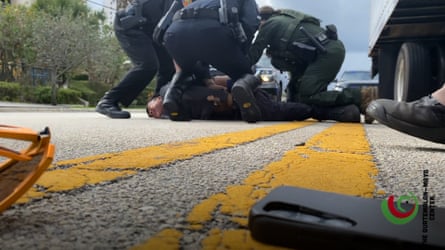
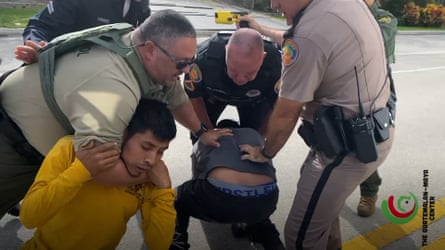
Video footage of the incident captured by Laynez-Ambrosio, an 18-year-old US citizen, appears to show a group of officers in tactical gear working together to violently detain the three men*, two of whom are undocumented. They appear to use a stun gun on one man, put another in a chokehold and can be heard telling Laynez-Ambrosio: “You’ve got no rights here. You’re a migo, brother.” Afterward, agents can be heard bragging and making light of the arrests, calling the stun gun use “funny” and quipping: “You can smell that … $30,000 bonus.”
“The federal government has imposed quotas for the arrest of immigrants,” said Jack Scarola, an attorney who is advocating on behalf of Laynez-Ambrosio and working with the non-profit Guatemalan-Maya Center, which provided the footage to the Guardian. “Any time law enforcement is compelled to work towards a quota, it poses a significant risk to other rights.”
Chokeholds, stun guns and laughter
The incident unfolded at roughly 9am, when a highway patrol officer pulled over the company work van, driven byLaynez-Ambrosio’smother, and discovered that she had a suspended license. Laynez-Ambrosio said he is unsure why the van was pulled over, as his mother was driving below the speed limit.
Laynez-Ambrosio hadn’t intended to film the interaction – he already had his phone out to show his mom “a silly TikTok”, he said – but immediately clicked record when it became clear what was happening.
The arrest of an undocumented man in Florida, as caught on video by Kenny Laynez-Ambrosio on 2 May 2025. Photograph: Screengrab from video by Kenny Laynez-Ambrosio/Courtesy of the Guatemalan-Maya Center
The video begins after the van has been pulled over and the border patrol had arrived. A female officer can be heard asking, in Spanish, whether anyone is in the country illegally. One of Laynez-Ambrosio’s friends answers that he is undocumented. “That’s when they said, ‘OK, let’s go,’” Laynez-Ambrosio recalled.
Laynez-Ambrosio said things turned aggressive before the group even had a chance to exit the van. One of the officers “put his hand inside the window”, he said, “popped the door open, grabbed my friend by the neck and had him in a chokehold”.
Footage appears to show officers then reaching for Laynez-Ambrosio and his other friend as Laynez-Ambrosio can be heard protesting: “You can’t grab me like that.” Multiple officers can be seen pulling the other man from the van and telling him to “put your fucking head down”. The footage captures the sound of a stun gun as Laynez-Ambrosio’s friend cries out in pain and drops to the ground.
Laynez-Ambrosio said that his friend was not resisting, and that he didn’t speak English and didn’t understand the officer’s commands. “My friend didn’t do anything before they grabbed him,” he said.
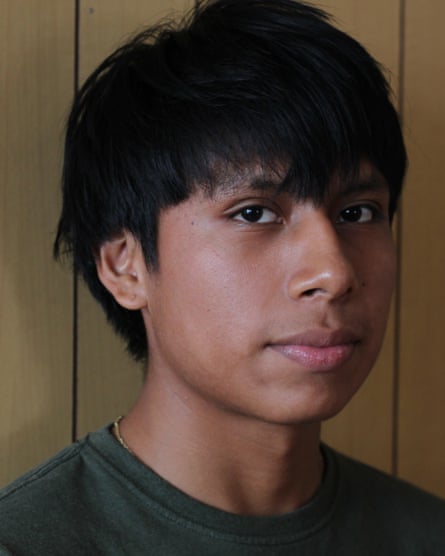
Kenny Laynez-Ambrosio, 18, filmed his own arrest in Florida. Photograph: The Palm Beach Post/Reporter Valentina Palm
In the video, Laynez-Ambrosio can be heard repeatedly telling his friend, in Spanish, to not resist. “I wasn’t really worried about myself because I knew I was going to get out of the situation,” he said. “But I was worried about him. I could speak up for him but not fight back, because I would’ve made the situation worse.”
Laynez-Ambrosio can also be heard telling officers: “I was born and raised right here.” Still, he was pushed to the ground and says that an officer aimed a stun gun at him. He was subsequently arrested and held in a cell at a Customs and Border Protection (CBP) station for six hours.
Audio in the video catches the unidentified officers debriefing and appearing to make light of the stun gun use. “You’re funny, bro,” one officer can be overheard saying to another, followed by laughter.
Another officer says, “They’re starting to resist more now,” to which an officer replies: “We’re going to end up shooting some of them.”
Later in the footage, the officers move on to general celebration – “Goddamn! Woo! Nice!” – and talk of the potential bonus they’ll be getting: “Just remember, you can smell that [inaudible] $30,000 bonus.” It is unclear what bonus they are referring to. Donald Trump’s recent spending bill includes billions of additional dollars for Ice that could be spent on recruitment and retention tactics such as bonuses.
Laynez-Ambrosio said his two friends were eventually transferred to the Krome detention center in Miami. He believes they were released on bail and are awaiting a court hearing, but said it has been difficult to stay in touch with them.
Laynez-Ambrosio’s notice to appear in court confirms that the border patrol arrived on the scene, having been called in by the highway patrol. His other legal representative, Victoria Mesa-Estrada, also confirmed that border patrol officers transported the three men to the border patrol facility.
The Florida highway patrol, CBP, and Immigration and Customs Enforcement did not respond to requests for comment before publication.
‘We are good people’
Trump officials increasingly recruit local police for immigration enforcement despite ‘red flags’
Read more
Laynez-Ambrosio was charged with obstruction without violence and sentenced to 10 hours of community service and a four-hour anger management course. While in detention, he said, police threatened him with charges if he did not delete the video footage from his phone, but he refused.
Scarola, his lawyer, said the charges were retaliation for filming the incident. “Kenny was charged with filming [and was] alleged to have interfered with the activities of law enforcement,” he explained. “But there was no intended interference – merely the exercise of a right to record what was happening.”
In February, Florida’s governor, Ron DeSantis, signed an agreement between the state and the Department of Homeland Security allowing Florida highway patrol troopers to be trained and approved by Ice to arrest and detain immigrants. While such agreements have been inked across the US, Florida has the largest concentration of these deals.
The arrests of 2 May 2025. Photograph: Screengrab from video by Kenny Laynez-Ambrosio/Courtesy of Guatemalan-Maya Center
Father Frank O’Loughlin, founder and executive director of the Guatemalan-Maya Center, the advocates for Laynez-Ambrosio, says the incident has further eroded trust between Florida’s immigrant community and the police. “This is a story about the corruption of law enforcement by Maga and the brutality of state and federal troopers – formerly public servants – towards nonviolent people,” he said.
Meanwhile, Laynez-Ambrosio is trying to recover from the ordeal, and hopes the footage raises awareness of how immigrants are being treated in the US. “It didn’t need to go down like that. If they knew that my people were undocumented, they could’ve just kindly taken them out of the car and arrested them,” he said. “It hurt me bad to see my friends like that. Because they’re just good people, trying to earn an honest living.”
The Guardian is granting anonymity to Laynez-Ambrosio’s mother and the men arrested in the footage to protect their privacy
Dashcam footage of a 22-year-old driver pulled over in a Jacksonville, Fla. traffic stop has left lots of viewers with questions about police and excessive force.
Video of a traffic stop in Jacksonville, Fla., has gone viral. And although the incident occurred nearly six months ago, thousands of outraged viewers are now raising questions about what they believe to be excessive force used on a young Black man.
According to an arrest report obtained by News4JAX, Will McNeil Jr. was pulled over just after 4:00 pm on February 19 because his car “did not have its headlights or tail lights illuminated in inclement weather.” The report reads that McNeil Jr. was not wearing his seat belt and became “verbally combative” with the officer when he was asked to show his identification.
But recently released dash cam video paints a different picture and has many on the internet seeking justice for the 22-year-old driver. The footage shows McNeil Jr. was wearing his seat belt at the time he was pulled over and asked officers to call their supervisor to explain why he was being held when there was no rain or fog at the time he was stopped.
According to First Coast News, officers reported giving McNeil Jr. several warnings that they would break his window if he did not step out of his car. Although those warnings cannot be heard in the video, officers can be seen breaking the driver’s side window and striking McNeil Jr. in the head several times before he was forcibly removed from his car and forced to the ground.
McNeil Jr. told News4JAX that the incident left him with several injuries, including a concussion.
“I suffered a chipped tooth; my tooth went through my lip, and they slammed me on the ground and on the concrete. I had to get nine stitches. I also had a concussion and now I suffer from short-term memory loss,” he said.
In a statement on X, the Jacksonville Sheriff’s Office acknowledged the incident and said they are conducting their own investigation into the events leading up to the young man’s arrest.
“We are aware of a video circulating on social media showing a traffic stop represented to be from February 19, 2025. We have launched an internal investigation into it and the circumstances surrounding this incident. We hold our officers to the highest standards and are committed to thoroughly determining exactly what occurred,” it reads.
But social media has been flooded with comments from people who believe the proof that the police department is in the wrong is in the video.
“You saw exactly what happened because it was completely recorded. Your own officers stated the reason for his arrest in the video, and he was not resisting. The force used was completely unnecessary. This was a blatant abuse of power. The City of Jacksonville should be ashamed,” wrote someone on X.
Attorney Ben Crump, who will be representing McNeil, told News4JAX that the video evidence is clear that the police were out of line, “It should be obvious to anyone watching this video that William McNeil wasn’t a threat to anyone. He was calmly exercising his constitutional rights, and they beat him for it.”
July 25, 1898 With 16,000 troops, the United States invaded Puerto Rico at Guánica, asserting that they were liberating the inhabitants from Spanish colonial rule, which had recently granted the island’s government limited atonomy. The island, as well as Cuba and the Philippines, were spoils of the Spanish-American War which ended the following month. Puerto Rico remains a U.S. commonwealth today. N.Y. 17th Volunteer Regiment marching through Puerto Rico Famed American poet Carl Sandburg saw active service in Puerto Rico, beginning with the invasion in Guánica. Sandburg wrote about these experiences in his book entitled “Always the Young Strangers” (New York: Harcourt, Brace, 1953). More on the invasion
July 25, 1946 The first underwater atomic device was detonated at Bikini Atoll, one of the Marshall Islands in the South Pacific. It was the second of two bombs, Able and Baker, that comprised Operation Crossroads; each weapon had a yield equivalent to 23,000 tons of TNT (23 kilotons).The U.S. Navy conducted the tests to determine the effect of such weapons on ships at sea. More than 130 newspaper, magazine and radio correspondents from seven nations were present for the tests. More on Operation Crossroads
July 25, 1947 The National Security Act of 1947 was passed by Congress, uniting the armed forces under control of the National Military Establishment, which soon became Defense, the only cabinet-level military department, in place of separate ones for War, Army and Navy. The law also created the National Security Council, the Central Intelligence Agency, and gave statutory responsibility to the Joint Chiefs of Staff.
July 25, 1963 The Limited Test Ban Treaty was initialed following 10 days of intense negotiations among the the U.S.S.R.*, U.S. and United Kingdom. The treaty prohibits nuclear weapons tests “or any other nuclear explosion” in the atmosphere, in outer space, or under water; it does not ban underground tests. The nuclear powers (only three then, nine today) accepted as a common goal “an end to the contamination of man’s environment by radioactive substances.” 185 countries have signed the treaty so far but Israel, Pakistan, Iran and North Korea never signed or later withdrew. * Union of Soviet Socialist Republics, commonly referred to as the Soviet Union, included Russia and 14 countries and was dissolved in the early ‘90s. Status of Nuclear Weapons States and Their Nuclear Capabilities
July 25, 1965 Martin Luther King, Jr., participated in protests against housing segregation in Chicago. His Southern Christian Leadership Conference (SCLC) joined with the Coordinating Council of Community Organizations (CCCO), led by Al Raby, a black schoolteacher, in the Chicago Freedom Movement. More on the CCCO Martin Luther King talks to Al Raby of Chicago’s Coordinating Council of Community Organizations (CCCO)as they lead the march down State Street.To King’s right is Jack Spiegel of the United Shoeworkers, and to Raby’s left is King assistant Bernard Lee.
Luis Leon of Allentown, who his family says was taken into custody by ICE in Philadelphia in June. The family had no idea of his whereabouts and even believed for a time that he was dead before finding out he is in a hospital in Guatemala, according to his granddaughter. (Contributed by the Leon family)
Relatives of 82-year-old Allentown resident Luis Leon are headed to a Guatemalan hospital Saturday in hopes of reuniting with the man they say disappeared without a trace into the American immigration system a month ago — and who, for a time, they thought was dead.
The last time anyone in the family saw Leon was June 20, when he went with his wife to a Philadelphia immigration office to have his lost green card replaced.
There, the family says, he was handcuffed by two officers, who led him away without explanation. His wife, who speaks little English, was left behind and kept in the building for 10 hours until she was released to her granddaughter, the family says.
Repeated inquiries to immigration officials, prisons, hospitals and even a morgue yielded no information. Leon’s name was not in ICE’s online database of detainees.
Finally, on Friday, a relative from Leon’s native Chile was told he had been taken first to a detention center in Minnesota and then to Guatemala. The hospital, citing privacy rules, would not verify his presence there when contacted by The Morning Call.
Leon was granted political asylum in 1987 after surviving torture at the hands of Chilean dictator Augusto Pinochet’s regime, according to his granddaughter, Nataly, who asked that her surname not be used because she fears U.S. government retribution against her and her relatives.
In Allentown, he lived a quiet life, raising four children and enjoying retirement after years working at a leather manufacturing plant.
It all fell apart, Nataly said, when he lost the wallet holding his green card and made the fateful appointment to replace it at the U.S. Citizenship and Immigration Services office on 41st Street in Philadelphia.
Frustration at not knowing Leon’s whereabouts turned to grief July 9, when a caller informed Leon’s wife that he had died, Nataly said.
An ICE official said Friday the agency is investigating the matter but would share no other information, refusing even to confirm that Leon was at the Philadelphia office in June.
Nataly, for her part, has run the gamut from confusion to grief to frustrated rage — often in the course of a few hours — as she has tried to learn her grandfather’s fate.
On Friday, after hearing he was in Guatemala, she tearfully said she wants the world to know how he’s been treated by the immigration system.
“I can see all my family is in pain right now,” she said.
The mystery surrounding Leon’s ordeal goes beyond ICE. Just days after his arrest, a woman claiming to be an immigration lawyer placed an unsolicited call to Leon’s wife and said she could help get Leon out on bail, but didn’t say where he was or how she learned about the case.
It was this woman who called to tell his wife that Leon was dead. A week after communication from the purported lawyer ceased, the family finally received word that Leon had been in detention in Minnesota and then transferred to a hospital in Guatemala City.
Nataly said she intended to fly to Guatemala on Saturday to see her grandfather, whose condition is unknown. He suffers from diabetes, a heart condition and high blood pressure, among other conditions, she said.
Nataly said the man she calls abuelo — Spanish for grandfather — is a well-liked figure around his Allentown neighborhood. He gardens, goes fishing with a close friend and, because he is skilled with tools, functions as a handyman for neighbors who need minor repairs.
The Trump administration’s aggressive deportation program was initially supposed to be directed at undocumented residents who have committed crimes. However, the Transactional Records Access Clearinghouse, which gathers data on federal immigration enforcement, says the vast majority of people in ICE detention as of July 13 — 40,643 out of 56,816, or 71.5% — have no criminal convictions.
Many of those with convictions were for minor offenses, including traffic violations, the organization said.
Leon, according to his family, never had so much as a parking ticket — a contention borne out by court records.
Staff writer Anthony Salamone contributed to this report.
Mario Guevara reports from a local police traffic enforcement area in Stone Mountain, Georgia, on 29 April 2025. Photograph: Erik S Lesser/EPA
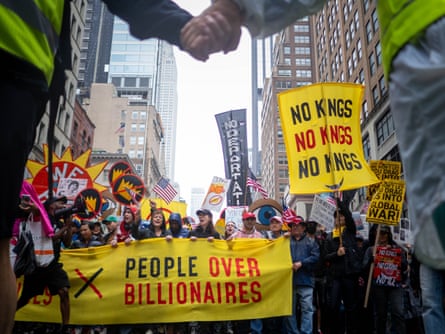
‘No Kings Day’ protests have swept the US as over 100,000 rally in New York City against the Trump administration’s policies on 14 June 2025.
Photograph: Carlos Chiossone/ZUMA Press Wire/Shutterstock
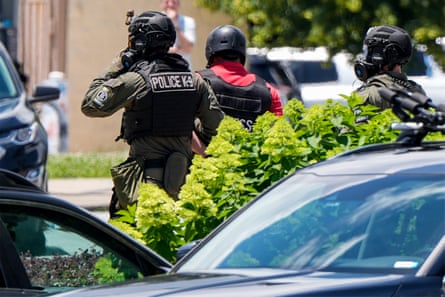
Law enforcement officers patrol as a ‘No Kings Day’ protest takes place in Dekalb county, Georgia, on 14 June 2025.
Photograph: Mike Stewart/AP
A Salvadorian reporter with an audience of millions, Mario Guevara was arrested while livestreaming a protest against Trump in June – and is still struggling for freedom
Prosecutors dropped the last remaining charges against Atlanta-area journalist Mario Guevara last week after he was arrested while livestreaming a protest in June. But the influential Salvadorian reporter remains penned up in a south Georgia detention center, fending off a deportation case, jail house extortionists and despair, people familiar with his situation told the Guardian.
Donald Trump’s administration has been extreme in unprecedented waysto undocumented immigrants. But Guevara’s treatment is a special case. Shuttled between five jail cells in Georgia since his arrest while covering the “No Kings Day” protests, the 20-plus-years veteran journalist’s sin was to document the undocumented and the way Trump’s agents have been hunting them down.
Today, according to the Committee to Protect Journalists,he’s the only reporter in the United States sleeping in a prison cell for doing his job.
‘No Kings Day’ protests have swept the US as over 100,000 rally in New York City against the Trump administration’s policies on 14 June 2025. Photograph: Carlos Chiossone/ZUMA Press Wire/Shutterstock
“For the first time in my life, I’m seeing what absolute power can do,” said Guevara’s attorney, Giovanni Díaz. “Power that doesn’t care about optics. Power that doesn’t care about the damage to human lives to achieve a result I’ve only heard about as some abstract thing that we heard about in the past, usually talking about other governments in the way that they persecute individuals. This is powerful.”
Around Atlanta, Guevara has been the person that immigrants call when they see an Immigrations and Customs Enforcement (Ice) raid going down in their neighborhood.
Guevara had been working for La Prensa Gráfica, one of El Salvador’s main newspapers, when he was attacked at a protest rally held by the leftwing group Farabundo Martí National Liberation Front (FMLN) in2003. The former paramilitary organization viewed reporters from his paper as aligned with the rightwing government, and threatened his life. He fled to the United States in 2004, seeking asylum with his wife and daughter, entering legally on a tourist visa.
He has been reporting for Spanish-language media in the United States ever since, riding a wave of Latino immigration to the Atlanta suburbs to career success and community accolades. He began reporting on immigration crackdowns under the Obama administration, one of the few reporters to note a tripling of noncriminal immigration arrests in the Atlanta area, as noted in a 2019 New York Times video profile of his work.. He meticulously documented cases and interviewed the families of arrestees. People around Atlanta began to recognize him on the street as the journalist chasing la migra.
His work continued through the Trump administration, drawing an audience of millions that followed him from Mundo Hispánico to the startup news operation he founded last year: MGNews or Noticias MG.
“It’s a unique niche that was met by Mario’s innovation and entrepreneurialism, if you will,” said Jerry Gonzalez, executive director of the Georgia Association of Latino Elected Officials and GALEO Latino Community Development Fund. “He developed a really strong relationship with the community. He developed significant trust with much of that community. And because of that, his eyeballs started increasing.”
An immigration court judge denied Guevara’s asylum claim in 2012 and issued a deportation order. Guevara’s lawyers appealed, and the court granted administrative closure of the case. He wasn’t being deported. But he wasn’t given legal residency either. Instead, the government issued him a work permit, his lawyer said. With a shrug, he went back to work.
Guevara is arguably the most-watched journalist covering Ice operations in the United States, a story that the English-language media had largely been missing, Gonzalez said. And local police were well aware of his work. He has been negotiating with them for access to immigration enforcement scenes for more than a decade.
“Mario Guevara is well known – sometimes liked sometimes not – but definitely well known by law enforcement agencies, particularly in DeKalb county and Gwinnett county, and also with federal agents, and particularly immigration agents,” Gonzalez said.
Gonzalez, among others, believes this put a target on his back in the current administration.
“It seems like law enforcement coordinated and colluded with the federal agents,” Gonzalez said. Gonzalez points to the misdemeanor traffic charges laid by the Gwinnett county sheriff’s office shortly after Guevara’s arrest in DeKalb county by the Doraville police department as evidence.
“The facts and the timeline indicate that pretty clearly to anybody that’s been following this,” he claimed. “In this regard it’s particularly troubling, given that he is a journalist and his situation. He had no reason to have been targeted for his arrest.”
The Department of Homeland Security has not responded to a request for comment about their relationship with local law enforcement. The Gwinnett county sheriff’s office said in a response to a lawmaker’s inquiry that it cooperates with Ice when deemed “mutually beneficial” but has not responded to requests for additional comment.
Doraville’s police chief, Chuck Atkinson, has not replied to an email seeking answers and fled from questions about the case at a city hearing. But Doraville’s mayor, Joseph Geierman, denied a connection between Ice and Doraville’s arrest of Guevara.
On 14 June, the day of his arrest, in Atlanta’s DeKalb county, Guevara darted around a Doraville police truck. A group of riot cops nearby took note. One shouted “last warning, sir! Get out of the road!”
Guevara was helmeted and wearing a black vest over his red shirt with the word “PRESS” in white letters. James Talley, an officer with the Doraville police department, was wearing an olive drab Swat jumpsuit with a helmet and gas mask.
A masked demonstrator set off a smoke bomb near the cops. Guevara ran into the street with a stabilized camera in hand to capture the police reaction and the crowd scampering out of the way, as was shown on a police body camera video.
Police had issued a dispersal order and were kettling protesters out of Chamblee-Tucker Road. They chased the suspected bomb thrower into the crowd, to no avail. But Guevara was in front of them on a grassy slope.
Police from DeKalb county managing the raucous protest had been taking verbal abuse from demonstrators for a while – a sharp contrast from other protests around Atlanta held that day. The protest was winding down. Body camera video from the event suggests Talley was in an arresting mood.
“Keep your eye on the guy in the red shirt,” Talley said to another Swat officer from Doraville. “If he gets to the road, lock his ass up.”
Talley pulled another police officer aside. “If he gets in the road, he’s gone,” Talley said. “He’s been warned multiple times.”
The other officer drew a finger across his chest. “The press?” Yep, Talley replied.
The three of them waited about 50ft away as a DeKalb county police officer approached Guevara on the hill, ordering him to get on the sidewalk. Guevara backed away from the officer, his attention focused on the recording, took two steps into the street, and the Doraville police pounced.
Guevara pleaded for the police to be reasonable.
“I’m with the media, officer!” Guevara said. “Let me finish!”
People shouted at the officers “That’s the press!” as they walked him handcuffed to a vehicle. “Why are you all taking him! He didn’t do nothing.”
More than one million people were watching Guevara’s livestream when he was arrested.
Trump has stepped up his rhetorical attacks on journalists since his inauguration. Last week, he described a reporter asking about warnings and emergency response in the Texas flooding disaster as “an evil person”, an epithet he has turned to with increasing frequency.
The Guevara case is a sign of increasing hostility toward a free press, said Katherine Jacobsen, a program coordinator for the Committee to Protect Journalists. She traced a through line from the Associated Press being barred from government briefings after it refused to accept the renaming of the Gulf of Mexico to the “Gulf of America”, then lawsuits and investigations reopened against media companies, then attacks on journalists covering protests in Los Angeles, then Australian writer Alistair Kitchen’s deportation seemingly in relation to his reporting on student protests.
“Next thing you know, we have Mario Guevara, a long time Spanish-language reporter in the Atlanta metro area, who is in Ice detention,” she said. “It’s growing increasingly concerning by the day.”
Guevara’s audience views it as more than an attack on press freedom, though. They view it as an attack on themselves.
“He’s a test case to push the envelope for legal immigrants that have committed no crime, to trump up charges against them,” GALEO’s Gonzalez said. “And the second piece is how to target journalists.”
Guevara’s arrest set off an immigration nightmare akin to the kind he has spent the last decade documenting.
His arrest on a Saturday led to a weekend in DeKalb county’s decaying jail and a bond hearing that Monday. A magistrate court judge granted Guevara a no-dollar bond, but by then Ice had become aware of the arrest and placed Guevara on a hold. The jail released him into Ice custody, and held him briefly in a metro Atlanta facility.
The next day, Gwinnett county charged Guevara with three misdemeanor traffic offenses, claiming that they were related to Guevara livestreaming a law enforcement operation a month earlier. The charges would be sufficient to keep him in jail and provide Ice an argument for his deportation at a federal bond hearing. The Gwinnett county sheriff’s office said Guevara’s livestreaming “compromised” investigations.
Guevara’s attorneys tried to work quickly, Diaz said. “The detained dockets are so backed up, and the immigration detention centers are so overwhelmed that what used to take us two or three days to get a bond hearing now is taking about a week,” he said.
Attorneys working for immigration enforcement argued in court that Guevara’s reporting constituted a “threat” to immigration operations.
Jacobsen with CPJ was listening to the hearing when the government made that argument.
“We felt a sense of alarm,” she said. “Alarm bells were raised by the government’s argument, as well as the judge not necessarily pushing back against the government’s argument that live streaming poses a danger to threaten law enforcement actions.”
Law enforcement officers patrol as a ‘No Kings Day’ protest takes place in Dekalb county, Georgia, on 14 June 2025. Photograph: Mike Stewart/AP
The immigration judge granted Guevara a $7,500 bond for the immigration case. But Guevara’s family was not allowed to pay it because government attorneys appealed the bond order to the board of immigration appeals. But it took seven days for the court to issue a stay to the government’s appeal. Meanwhile, Ice began playing musical jail cells with Guevara.
Over the course of the next three weeks, Ice shuttled Guevara between three different counties around Atlanta and eventually to the massive private prison Ice uses in Folkston, Georgia, 240 miles south-east of Atlanta on the Florida line.
“We weren’t surprised that they appealed, because the government’s reserving and in most cases appealing everything, even stuff where they shouldn’t appeal because they’re wasting everybody’s time,” Diaz said. “But we didn’t really know the breadth of what they were trying to do to him.”
Earlier this week, Todd Lyons, Ice’s acting director, issued a memo changing its policy on bond hearings, arguing that detainees are not entitled to those hearings before their deportation case is heard in court. Immigration advocates expect to challenge the move in court.
But Guevara is not facing a criminal charge. The Gwinnett county solicitor’s office dropped the traffic charges last week, noting that two of them could not be prosecuted because they occurred on private property – the apartment complex – and the third lacked sufficient evidence for a conviction.
For now, Ice has mostly kept Guevara in medical wards in jails even though he is healthy, Diaz said. “From the beginning, they’ve been keeping Mario under a special segregation because they’re claiming he’s a public figure. They want to make sure nothing happened to him.”
Doraville is a municipality of about 10,800 in DeKalb county with a separate police force, and had been asked to assist managing the protest in the immigrant-heavy Embry Hills neighborhood nearby. Protests have become a regular occurrence in DeKalb county since the Trump administration’s immigration raids began.
Doraville’s cops have displayed a more cooperative relationship with immigration law enforcement than many other metro Atlanta departments, and observers have raised questions about whether its police department arrested Guevara to facilitate an Ice detainer.
Geierman, the mayor, denied those accusations.
“The Doraville police department was not operating under the direction of, or in coordination with, US Immigration and Customs Enforcement (Ice) during the June 14th protest,” he said in a statement. “To the department’s knowledge, no Ice personnel were present at the event. Doraville officers were on site to support the DeKalb county sheriff’s office as part of a coordinated public safety effort.”
Observers have also questioned Guevara’s charges from Gwinnett county – ignoring traffic signs, using a communication device while driving, and reckless driving – that stemmed from an incident that occurred in May, a month before his arrest.
“Mario Guevara compromised operational integrity and jeopardized the safety of victims of the case, investigators, and Gwinnett county residents,” the department said in a statement.
But Gwinnett’s belated prosecution left his attorneys gobsmacked.
“In the narrative that they put out, they say he was livestreaming a police operation, and he was interfering,” Diaz said. “But when they went to a judge to get warrants, the only warrants the magistrate was able to sign for them was for traffic violations. I mean, that’s kind of telling.”
“I think the whole thing is suspicious,” he added. “From the beginning, just everything seemed they were really making efforts to make it difficult for him to go free.”
Marvin Lim, a Filipino American state representative whose district contains the apartment complex in Gwinnett in Guevara’s citation, has asked the sheriff’s office a detailed set of questions about the department’s relationship with federal immigration enforcement. He has not received an adequate response, he said in an open letter to the sheriff.
An array of six advocacy organizations challenged Gwinnett’s sheriff, Keybo Taylor, in a letter Tuesday over Guevara’s arrest and the sheriff’s posture toward immigration enforcement, demanding details about the relationship. GALEO, among them, also issued a separate letter Wednesday calling on Taylor to be transparent about the Guevara arrest.
Ice ‘politically targeted’ farm worker activist Juarez Zeferino, colleagues say
Read more
Guevara “was arrested while doing the vital work that journalists in a democracy do”, GALEO’s letter states. “Not only do the circumstances surrounding his incarceration and subsequent immigration detainment stir serious civil rights concerns, but they also build upon an expanding sense of fear and confusion in Georgia’s most diverse county.”
“I am being persecuted,” Guevara wrote in a 7 July letter seeking humanitarian intercession from, of all people, Nayib Bukele, El Salvador’s rightwing president.
“I am about to complete a month in jail, and I need to get out in order to continue with my life, return to my work, and support my family,” Guevara wrote. “I have lived in the United States for nearly 22 years. I had never been arrested before. In these past three weeks, I have been held in five different jails, and I believe the government is trying to tarnish my record in order to deport me as if I were a criminal.”
Guevara’s American-born son turned 21 this year, permitting him to sponsor Guevara’s green card and eventual citizenship. His application is pending, Diaz said. It may not matter.
“This is the first time I’ve ever seen a stay filed for someone who has no convictions, has almost no criminal history in 20 years, and only had pending traffic violations,” Diaz said.
“It’s clear that everybody’s working really hard to keep him detained.”





 Scottie's Playtime