Good Clay Jones

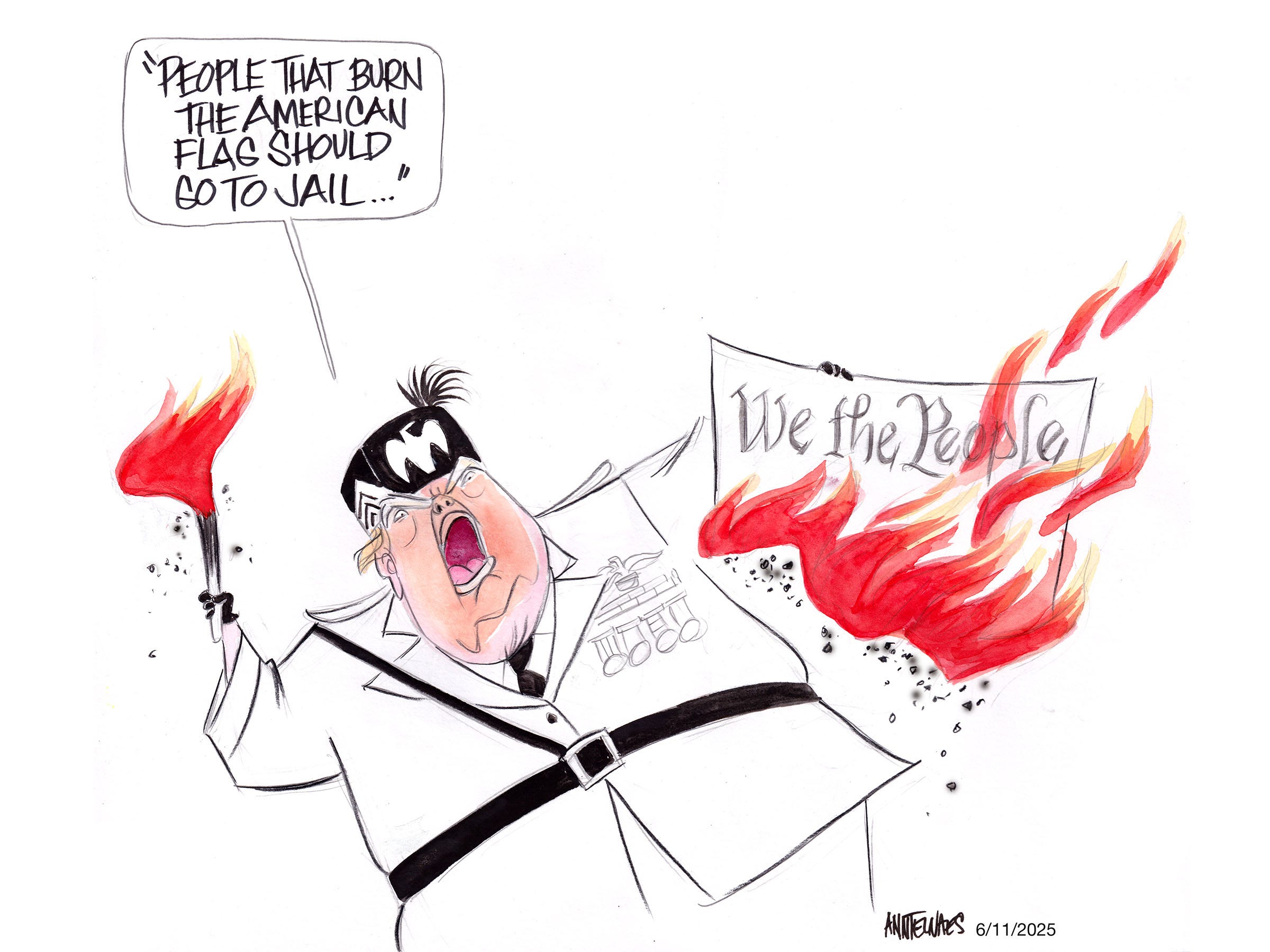
Sith and Boogers by Clay Jones

Another bad pick in the Oval Office Read on Substack

Elon Musk visited Donald Trump in the Oval Office yesterday and was a total disgrace.

Elon, who was in all black, wearing a black T-shirt and a black MAGA hat, said he was “open” and “honest” in his work finding waste and fraud in federal spending.

When asked about his lie that $50 million was spent on condoms for Gaza, Elon said, “Some of the things that I say will be incorrect and should be corrected. Nobody’s going to bat 1.000.” A good example of “some” of the things he says that are incorrect is his statement that DOGE was “open” and “honest.”

Before you tell a lie, like Elon’s condom bullshit, you can easily look up the facts, like when Elon lied about the last budget and claimed it included $300 billion for a football stadium in Washington DC, Congress would get a 40 percent pay increase, or that it funded bioweapons labs. Elon could have looked all this shit up before posting about it on his platform X/Twitter…over 100 times within 24 hours.

Unfortunately, we can’t fact-check Elon’s claims that the federal bureaucracy had been corrupted by cheats and officials who had approved money for “fraudsters.”

We can’t fact-check his claim that officials at USAID were taking “kickbacks.”

We can’t fact-check his claim that some officials “managed to accrue tens of millions of dollars in net worth while they are in that position.”

We can’t fact-check his claim that some people were receiving Social Security benefits at the age of 150.

We can’t fact-check his statement, “There are quite a few people in the bureaucracy who have ostensibly a salary of a few hundred thousand dollars but somehow managed to accrue tens of millions of dollars in net worth while they are in that position.”

The reason we can’t fact-check any of that is because Elon didn’t provide any proof of his claims and DOGE is operating in secret. There is no transparency with DOGE. None, nada, zip, zip, zippity-doo-dah, none.

Here’s a case of irony: The employee Musk claims made millions off the government had to file a financial disclosure form. Elon does not because Trump designated him a “special employee.” So just as we can’t see Trump’s tax returns, we can’t see Elon’s either.

When asked about the conflict of interest of him scouring billion-dollar contracts while his company Space X has billion-dollar contracts with the government, he said, “First of all, I’m not the one filing the contract. It’s the people at SpaceX or something.” As Sarah Marshall said in the great film Forgetting Sarah Marshall, “bullshit, bullshit, bullshit, bullshit.” It’s still a conflict of interest, even if he’s not lying.

Elon said, “I don’t know of a case where an organization has been more transparent than the DOGE organization. He also said, “We are actually trying to be as transparent as possible,” and then some more crap came out of his mouth when he said, “So all of our actions are maximally transparent.”

Bullshit, bullshit, bullshit, bullshit.

Without exhibiting any self-awareness, Elon said the bureaucracy is an “unelected, fourth, unconstitutional branch of government, which has, in a lot of ways, currently, more power than any elected representative. That might be the only thing Elon said that is true other than when he said, “There are boogers in my ears.” We’ll get to that.

Elon also lacked self-awareness when he said this bureaucracy “does not match the will of the people.” That’s true because nobody voted for Elon.

A lot of Elon/Trump defenders say we did vote for Elon because Trump said Elon was going to find government waste if he won the election. What Trump did NOT say was that Elon would fire people himself, cut government spending himself, gain access to all our financial information, or hire Nazis to help (which he has rehired after momentarily firing him).

Elon also really really really really really lacked all fucking self-awareness when he said, “The goal is to “restore democracy. If the bureaucracy’s in charge, then what meaning does democracy actually have?”

People like Musk and Trump don’t know the meaning of words like “democracy.” When they say “democracy,” they mean fascism. When they say “patriot,” they mean traitor beholden to Vladimir Putin, whom Trump surprised with a phone call today because it’s two days before Valentine’s. And when Trump says “vegetable,” he means ketchup.

Every MAGAt who defends Elon’s claims is too stupid to realize they don’t see any evidence of his claims. A few days ago, an Elon-defending MAGAt asked me, “What do you have against transparency?”. Again, total lack of awareness. People who defend Elon and Trump take them at their word, which is bizarre because they’re both huge sack-of-shit liars.

Trump and Elon talk about fraud and theft in the federal government while taxpayers are paying millions for Trump to sleep in his own bed at his bedbug-ridden golf resorts. Remember when Trump tried to host an international summit at one of his golf clubs? If you believe that was the best venue in the nation for a G7 summit, then let me sell you some golf club memberships and some bridges.

The only person who didn’t lie to the press in the Oval Office yesterday was Elon’s booger-mining kid, named X. At one point, X, who is Elon’s 11th child, stuck his fingers in his father’s ears…the same fingers he was picking his nose with. Trump seemed very uncomfortable with the kid in the room, probably because he’s jealous that X has at least outgrown his diapers. X can probably also hold a water bottle with one hand.

Elon wants to cut funding to feed children living in poverty, but his little trust-fund baby has so much White privilege that he gets to pick his nose in the Oval Office because his dad has so much White Privilege that he’s not required to wear a suit and tie in the Oval and instead can come dressed as a Bond villain.

Now there will have to be DNA experts to figure out which boogers under the Resolute Desk belong to Little X…and which belong to Trump.

Drawn in 30 seconds: (snip-go watch)

More Brain-Clearing Fun… 💃

Read it when you get a chance, and get a good look at those covers! Holy cow-

Two More Poems I Ran Across Yesterday,

posted in observance of Black History Month. The titles link to the pages with more info about the poet and their works.

Surrender

Angelina Weld Grimké 1880 – 1958

We ask for peace. We, at the bound  
O life, are weary of the round  
In search of Truth. We know the quest  
Is not for us, the vision blest  
Is meant for other eyes. Uncrowned,  
We go, with heads bowed to the ground,  
And old hands, gnarled and hard and browned.  
Let us forget the past unrest,— 
               We ask for peace.

Our strainéd ears are deaf,—no sound 
May reach them more; no sight may wound 
Our worn-out eyes. We gave our best,  
And, while we totter down the West,  
Unto that last, that open mound,— 
               We ask for peace.

This poem is in the public domain. Published in Poem-a-Day on February 8, 2025, by the Academy of American Poets.

=============================

Expectancy

William Moore

I do not care for sleep, I’ll wait awhile 
For Love to come out of the darkness, wait
For laughter, gifted with the frequent fate
Of dusk-lit hope, to touch me with the smile 
Of moon and star and joy of that last mile 
Before I reach the sea. The ships are late
And mayhap laden with the precious freight
Dawn brings from Life’s eternal summer isle.

And should I find the sweeter fruits of dream—
The oranges of love and mating song—
I’ll laugh so true the morn will gayly seem 
Endless and ships full laden with a throng 
Of beauty, dreams and loves will come to me 
Out of the surge of yonder silver sea.

This poem is in the public domain. Published in Poem-a-Day on February 9, 2025, by the Academy of American Poets.

Here’s An Important Resource!

Sunday AM Poetry Courtesy of Janet

Mid Century Women’s Publications Did Important Medical Work

It reminds me of how “Cosmopolitan” was one of the early ‘mainstream’ magazines honestly discussing the AIDS virus, where to find care, and knowledge to avoid contracting it. They knew and reported early on that any- and everyone can catch what we now know as HIV. This piece is about early cancer info dissemination.

How Midcentury Women’s Magazines Fought Cancer

At a time when people wouldn’t even say the word, journalists at Good Housekeeping, Redbook, and other women’s magazines were informing readers how to recognize, protect against, and talk about cancer.

Meg Heckman

Maxine Davis wrote about plenty of tough topics during her long career in journalism, but none of them frightened her as much as the assignment she received in the spring of 1940. Her editors at Good Housekeeping wanted her to cover cancer, a disease so cloaked in stigma that Davis, like many other Americans, was afraid to say its name out loud.

The sweeping series of articles she produced that year changed her thinking. “My research has dispelled that terror,” she wrote in an article that appeared in Good Housekeeping’s April 1940 issue, declaring that cancer could be cured especially if it was caught early through education and hypervigilance. Cancer, she explained, was “sneaking, insidious. Only you and you alone can guard yourself against it.”

At the time Davis wrote these words, cancer was a taboo topic. The term itself wouldn’t be spoken on the radio until 1945. Rumors about its causes were rampant. (Many Americans at the time believed it to be contagious or a sign of poor character.) Physicians routinely withheld cancer diagnoses from patients to spare them shame. Although it wasn’t always a death sentence, the treatments we rely on today were nascent or nonexistent. And yet, the editors at Good Housekeeping still decided to devote pages and pages to in-depth coverage of the disease.

This is one example of how, during the 1940s and 1950s, women’s magazines played a vital and largely forgotten role in educating average Americans about burgeoning efforts to prevent and treat cancer. It was a pivotal era for modern medicine thanks to scientific advancements and increased attention to public health. Cancer was among the leading causes of death, and rates were increasing in part because people were living longer. Print media in all its forms played a major role in normalizing public conversations about cancer, but women’s magazines took a unique approach. They made disease prevention personal, calling upon women to become cancer watchdogs for themselves and their families.

Mortality rates from selected cancers among women in the United States, 1930–2008 (Surveillance, Epidemiology, and End Results Program 2013National Library of Medicine)

Davis was among the best-known of the women’s magazine journalists covering cancer. By the early 1940s, she had reported on the League of Nations, driven all over the United States to research a book about American youth, and founded a wire service aimed at explaining politics to women. Her cancer stories for Good Housekeeping launched her to a new level of prominence, one akin to modern day health influencers. Her editors promoted her work heavily, framing her as a lay expert with carefully cultivated sources. “Doctors like to work with her,” they wrote in an introduction to her spring 1940 cancer series, “and they give her all the help they can.”

Writing in May of 1940, Davis introduced readers to the basics of cancer treatment, explaining in plain language how surgery, X-rays, and radium were being used to help patients.

Sometimes X-ray, radium, and surgery are all used to treat a malignant condition. Take the case of Ada Johnson. Ada put off going to hospital longer than she should have after she felt a lump in her breast; but the doctor didn’t think the situation was hopeless. This is what he did:

First, there was a surgical operation. When that had been successfully accomplished, the specialist in cancer of the breast applied radium to the chest wall. That wasn’t all. The doctor then used deep X-ray therapy on Ada’s breast and armpit….This was repeated for thirty-five treatments. Ada is perfectly well today.

Davis was not, however, the only women’s magazine reporter working the cancer beat at midcentury. Seventeen magazine’s beauty editor Jean Campbell urged her young readers to get involved in efforts to bring specialized cancer to more communities. “Demand them,” she wrote in the April 1948 issue, “and raise funds for them.” That same year Miriam Zeller Gross deftly described the history of stomach cancer treatment in a gripping feature story that appeared in Better Homes and Gardens. In the early 1950s, Redbook’s Collie Small encouraged women to overcome “false modesty” and allow physicians to screen them for breast cancer. Women’s magazines were publishing hundreds of articles on cancer by dozens of writers. Women also wrote about cancer for general magazines including The Saturday Evening Post, which featured a handful of stories in the 1950s by female cancer survivors.

Stories about cancer were far less common before World War II, but they did sometimes appear in women’s magazines. Ladies Home Journal has been credited by medical historians with publishing the very first general interest article about cancer detection in 1913. Others, including Good Housekeeping, featured occasional educational columns by physicians during the 1920s.

While less common, articles about cancer did appear in women’s magazines in the early 20th century, such as this piece by Dr. Harvey W. Wiley in the November 1922 issue of Good Housekeeping. (Cornell University Library)

In addition to becoming quick experts on complex medical topics, these journalists managed often-fraught relationships with health professionals who tended to distrust journalists. It became common practice during this time for physicians to review stories before they were published. Sometimes, one of those physicians would write a sidebar: In 1955, American Cancer Society vice president Dr. Charles S. Cameron had reviewed a draft of an April 1955 article on cervical cancer by health journalist Gladys Denny Shultz for Ladies Home Journal, and wrote a public note of thanks, proclaiming that the magazine was “offering its readers a great service by publishing this excellent article. It should be a means of saving thousands of lives.”

While most of the bylines atop women’s magazine stories about cancer belonged to female journalists, editors did occasionally invite physicians, almost always men, to contribute. Cosmopolitan published a 14-page essay by Walter Alvarez, who had just retired from clinical practice to pursue a second career in medical writing. The piece, which appeared in January of 1953, sprawled across 14 pages under the headline “Danger Signals in Your Life” and includes tips to spot illnesses like cancer in children, teens, and adults. Alvarez assured readers he wasn’t out to scare them. Instead, he hoped to save “wise persons from avoidable illness or death.”

Much of this coverage was driven by coordinated public relations campaigns initiated by the American Cancer Society and similar organizations. In addition to connecting journalists with expert sources and organizing junkets to prominent research centers, such campaigns included advertising blitzes promoting new treatments, championing medical breakthroughs, and reminding Americans of the importance of cancer screenings. Women’s magazines were a popular venue for such ads, so it wasn’t uncommon for some issues to feature a reference to cancer on nearly every page.

While groundbreaking, the cancer coverage provided by midcentury women’s magazines was imperfect. Race and class were seldom addressed because these publications — like much of the news media — assumed their audience was white and financially stable. Some coverage also illustrates the era’s rudimentary and fast-evolving scientific knowledge. One example is a story that appeared in Parents magazine in 1943. Written by journalist Constance J. Foster and prominently endorsed by the New York City Cancer Committee, the article proclaimed that “cancer is not hereditary.” A piece that appeared in Redbook a decade later explained new research showing that some forms of cancer do run in families.

The role of women’s magazines in the fight against cancer is a fascinating chapter in media history, one laced with a type of gender politics that feels familiar today. The cancer beat gave women journalists like Davis access to male-dominated sectors like medicine, public policy, and journalism, but it also kept them firmly tethered to domestic matters and subservient to male physicians. Their work, while educational, put undue pressure on individual women to spot the signs of cancer. But it also brought hope to families facing a terrifying diagnosis. As Davis wrote in the October 1948 issue of Good Housekeeping, “Cancer is not necessarily fatal. Cures do exist.”

Northeastern University student Elsa O’Donnell contributed archival research for this article.

Late-breaking Poetry

And Another One

It’s an excellent poem, with more background on the page, of interest to us here. Click the title.

After

Youna Kwak

I never feel so alive as when I am    
writing and have no right    
answer for what this means   
for the lives of others, how

to live in the after which after    
all means the now of our living   
together when together    
means death for all

those forbidden from   
entering the home so    
methodically built until after   
they are dead. Only 

after will locked doors    
swing amply open to   
admit the murdered    
into rooms of vast

crushed comfort, whose    
inhabitants eat and sleep   
on furnishings carved   
with corpses, stepping

with hospitable sorrow   
around the bodies of the   
dead, speaking dirges   
into the phantom

darkness. What happens 
in the quiet grave where  
the living make themselves   
at home, where noisily

they intend to thrive, where  
the poem itself concedes 
to suffering so it might persist   
in blazing against it.

Copyright © 2025 by Youna Kwak. Originally published in Poem-a-Day on February 5, 2025, by the Academy of American Poets.

Enjoy Some Harlem Renaissance Poetry This Morning:

Click the poem title for more about this poet and her poem.

Things Said When He Was Gone

Blanche Taylor Dickinson 1896 – 1972

My branch of thoughts is frail tonight
As one lone-wind-whipped weed.
Little I care if a rain drop laughs
Or cries; I cannot heed

Such trifles now as a twinkling star, 
Or catch a night-bird’s tune. 
My whole life is you, to-night,
And you, a cool distant moon.

With a few soft words to nurture my heart
And brighter beams following love’s cool shower
Who knows but this frail wind-whipped weed
Might bear you a gorgeous flower!

This poem is in the public domain. Published in Poem-a-Day on February 2, 2025, by the Academy of American Poets.

Julia Hare in “Wee Pals” Today

Wee Pals Comic Strip for February 02, 2025

https://www.gocomics.com/weepals/2025/02/02