Astronomy Pic Of The Day

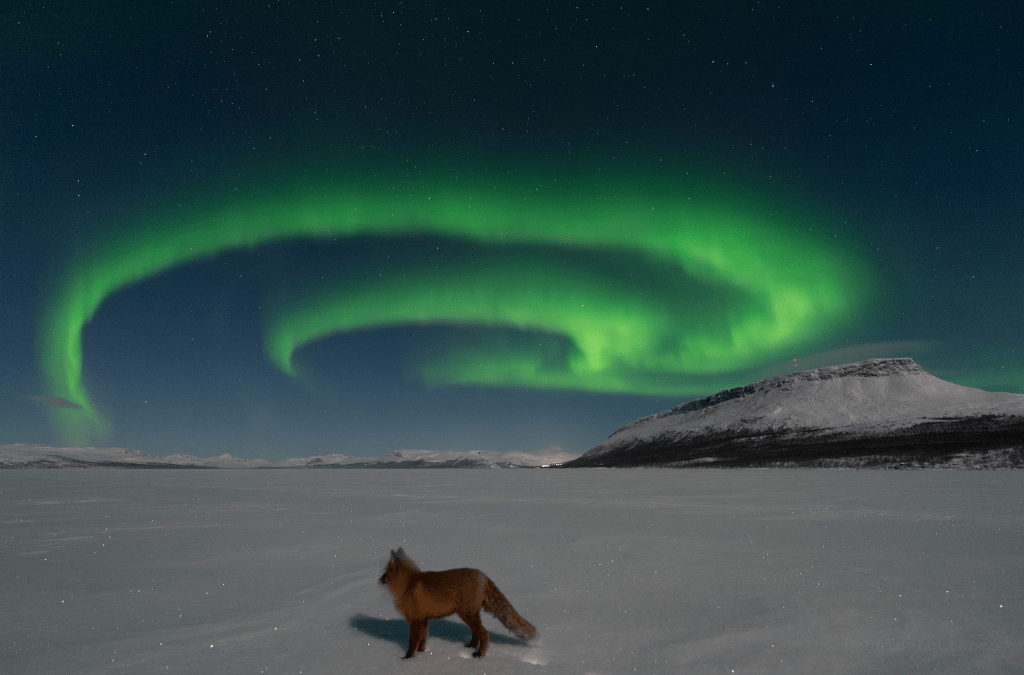
Northern Fox Fires
Image Credit & Copyright:Dennis Lehtonen

Explanation: In a Finnish myth, when an arctic fox runs so fast that its bushy tail brushes the mountains, flaming sparks are cast into the heavens creating the northern lights. In fact the Finnish word “revontulet”, a name for the aurora borealis or northern lights, can be translated as fire fox. So that evocative myth took on a special significance for the photographer of this northern night skyscape from Finnish Lapland near Kilpisjarvi Lake. The snowy scene is illuminated by moonlight. Saana, an iconic fell or mountain of Lapland, rises at the right in the background. But as the beautiful nothern lights danced overhead, the wild fire fox in the foreground enthusiastically ran around the photographer and his equipment, making it difficult to capture in this lucky single shot.

Tomorrow’s picture: ocean of storms

Astronomy Pic Of The Day Today

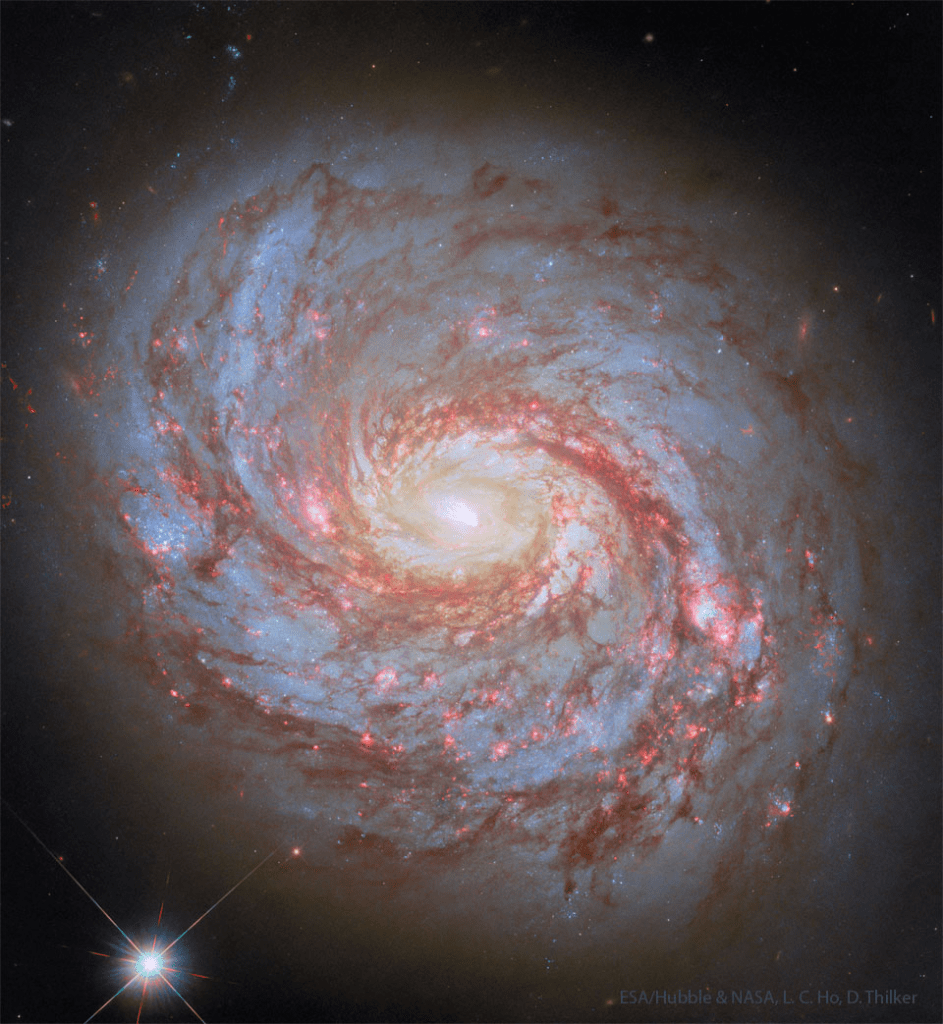
M77: Spiral Galaxy with an Active Center
Image Credit: HubbleNASAESAL. C. HoD. Thilker

Explanation: What’s happening in the center of nearby spiral galaxy M77? The face-on galaxy lies a mere 47 million light-years away toward the constellation of the Sea Monster (Cetus). At that estimated distance, this gorgeous island universe is about 100 thousand light-years across. Also known as NGC 1068, its compact and very bright core is well studied by astronomers exploring the mysteries of supermassive black holes in active Seyfert galaxies. M77’s active core glows bright at x-rayultravioletvisibleinfrared, and radio wavelengths. The featured sharp image of M77 was taken by the Hubble Space Telescope. The image shows details of the spiral’s winding spiral arms as traced by obscuring red dust clouds and blue star clusters, all circling the galaxy’s bright white luminous center.

https://apod.nasa.gov/apod/astropix.html

Whatever Else May Come

from the end of the shutdown,-and I have huge hope that we the people will continue to stand together to help each other through the days!-we do get the Astronomy Photo of the Day again!

Orion and the Running Man
Image Credit & Copyright:R. Jay Gabany

Explanation: Few cosmic vistas can excite the imagination like The Great Nebula in Orion. Visible as a faint, bland celestial smudge to the naked-eye, the nearest large star-forming region sprawls across this sharp colorful telescopic image. Designated M42 in the Messier Catalog, the Orion Nebula’s glowing gas and dust surrounds hot, young stars. About 40 light-years across, M42 is at the edge of an immense interstellar molecular cloud only 1,500 light-years away that lies within the same spiral arm of our Milky Way galaxy as the Sun. Including dusty bluish reflection nebula NGC 1977, also known as the Running Man nebula at left in the frame, the natal nebulae represent only a small fraction of our galactic neighborhood’s wealth of star-forming material. Within the well-studied stellar nursery, astronomers have also identified what appear to be numerous infant solar systems.

Tomorrow’s picture: pixels in space

Astronomy Picture of the Day

Discover the cosmos! Each day a different image or photograph of our fascinating universe is featured, along with a brief explanation written by a professional astronomer.

(These fill me with wonder almost every day. There are far worse ways to start the day!)

2024 September 8
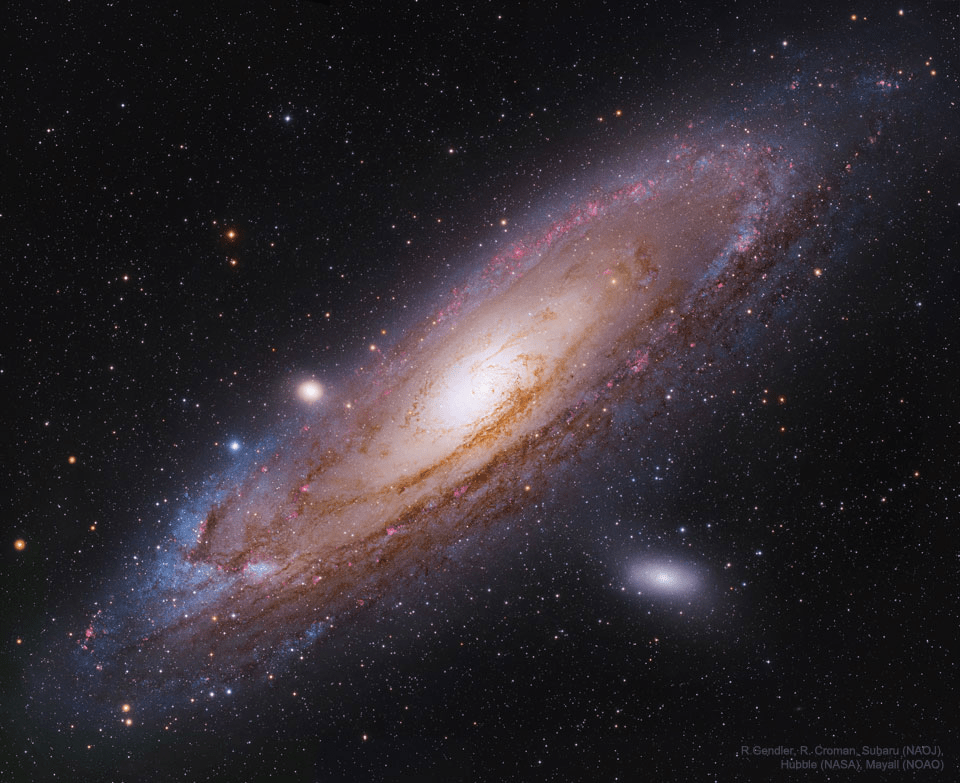
M31: The Andromeda Galaxy
Image Credit: Subaru (NAOJ), Hubble (NASA/ESA), Mayall (NSF);
Processing & Copyright: R. Gendler & R. Croman

Explanation: The most distant object easily visible to the unaided eye is M31, the great Andromeda Galaxy. Even at some two and a half million light-years distant, this immense spiral galaxy — spanning over 200,000 light years — is visible, although as a faint, nebulous cloud in the constellation Andromeda. A bright yellow nucleus, dark winding dust lanes, and expansive spiral arms dotted with blue star clusters and red nebulae, are recorded in this stunning telescopic image which combines data from orbiting Hubble with ground-based images from Subaru and Mayall. In only about 5 billion years, the Andromeda galaxy may be even easier to see — as it will likely span the entire night sky — just before it merges with, or passes right by, our Milky Way Galaxy.

Teachers & Students: Ideas for using APOD in the classroom
Tomorrow’s picture: dark moon, red planet

Starry, Starry Nights at Dark Sky Preserves

Dark sky tourism is on the rise as travelers head to remote destinations to catch a glimpse of the dazzling night sky.

Crai S. Bower

Some time ago, many animals, including saber-toothed tiger and woolly mammoth, failed in their attempts to rid the community of grizzly bear, whose mean-spirited behavior had upset nature’s balance. That is until the birds, led by robin, pierced grizzly’s heart. Grizzly’s blood reddened the robin’s breast and, as he shook in pain, cloaked the autumn leaves in red and orange.

“The Creator placed the grizzly bear constellation in the night sky to remind us that bullying others carries consequences,” says Matricia Bauer, an Indigenous Knowledge Keeper from Sturgeon Lake Cree Nation. “Our creation story also tells of the star woman falling from the sky to become our people.”

It’s a brisk March evening, and I’m sitting with Bauer by the fire beside Beauvert Lake in Jasper, Alberta, waiting for the gunmetal-colored sky to darken and reveal a palette of seemingly infinite stars. I’m visiting to explore the most accessible and second-largest Dark Sky Reserve in the world.

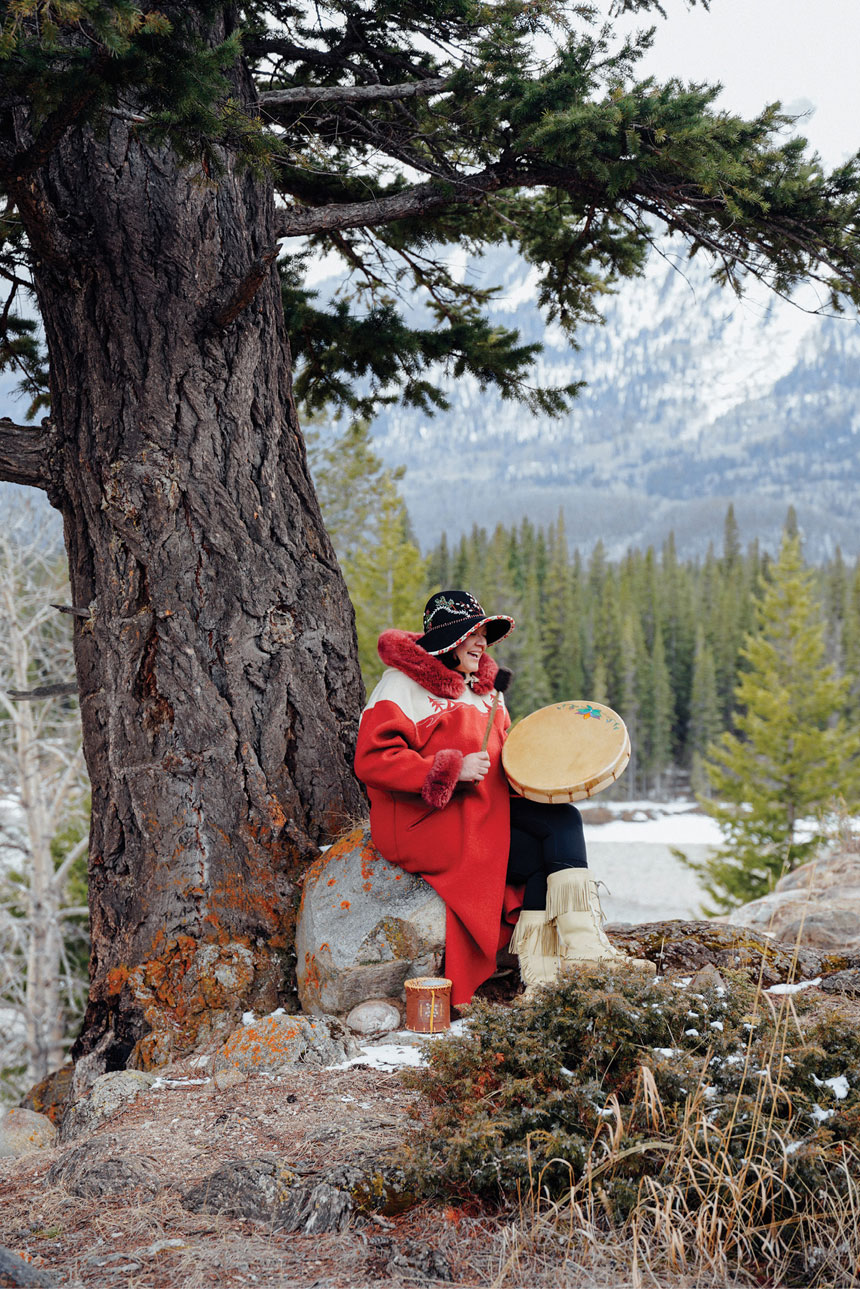
Shining star: Matricia Bauer, Indigenous Knowledge Keeper from Sturgeon Lake Cree Nation, leads Warrior Women, a collective presenting cultural education through drum and song. (Courtesy Tourism Jasper)

“An elder taught me that when you used to look at the night sky and see all the stars, the Creator also looked down on Earth and saw our fires in reflection. Today, instead of fires sparkling across the landscape, our continents are outlined by the glare of artificial light. People must travel to find the night sky.” (snip-MORE )