Trump’s claims about Haitians draw from a centuries-long narrative. These women explain why.

The former president’s debunked comments that Haitian immigrants are eating household pets in Springfield, Ohio, is just the latest in a long history of smears against them, experts say.

Originally published by The 19th

Your trusted source for contextualizing race and Election 2024 news. Sign up for our daily newsletter.

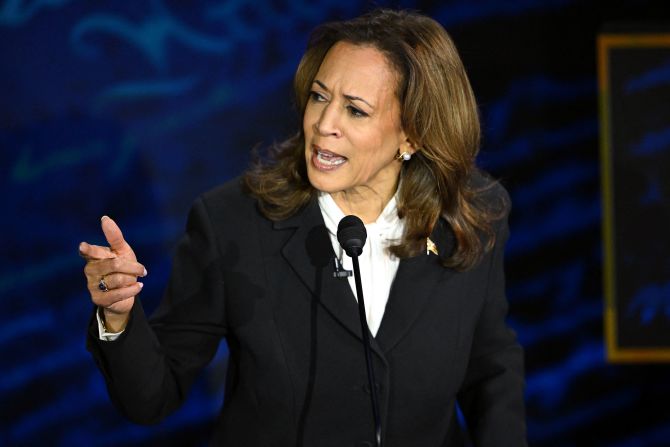
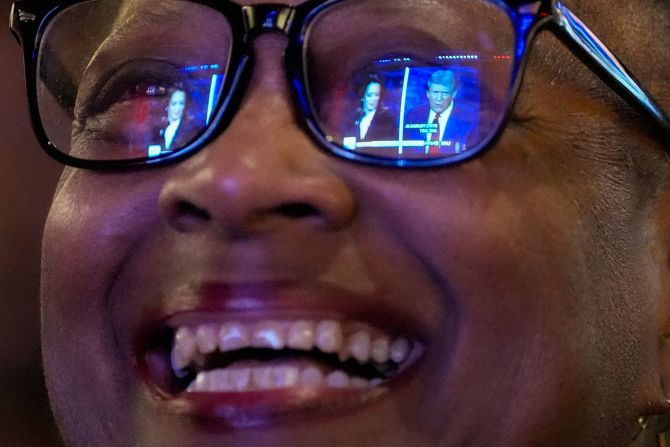
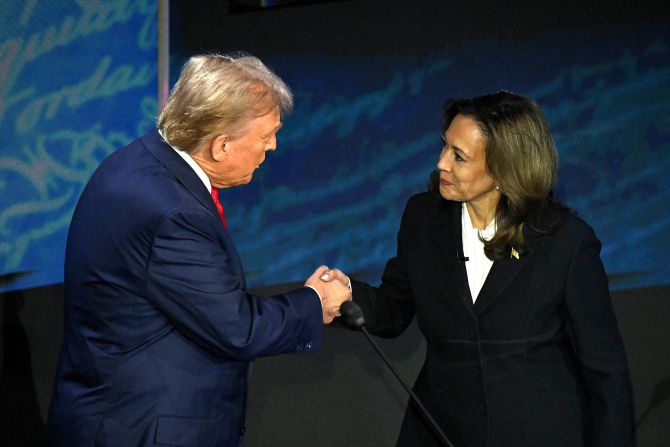
Call it a mother’s intuition. After former President Donald Trump repeated a vicious smear about Haitians in Springfield, Ohio, during his September 10 debate with Vice President Kamala Harris, many parents in that community instinctively kept their children home from school. They were right to be concerned. In the days following Trump remarking on national television that these immigrants are eating household pets — a debunked rumor that first spread on social media — the threats rolled in. 

The bomb and mass shooting threats that started shortly after the debate and continued through the weekend forced evacuations and closures of government buildings, hospitals, a university and schools in Springfield. Although Trump’s words have imperiled Haitian immigrants, he has not withdrawn his claim; he has doubled down on it. On Thursday, while campaigning, he suggested Haitians had ruined “beautiful Springfield” and were not in the city legally, although Ohio Gov. Mike DeWine said they are living and working there lawfully. Trump also insinuated the immigrants are involved in sexual violence against “young American girls,” continuing his pattern of linking immigration to the predation of White women and girls

The targeting of Haitians in the smalltown Midwest has led to an outcry of support from the public, policymakers and immigration advocates. The National Parents Union, a woman-led organization made up of parent advocacy groups fighting for equity in education, criticized “the reckless and irresponsible comments” from Republican leaders and announced that it “stand[s] with the families of Springfield” in a statement on Friday. 

But no one empathizes with Springfield’s Haitian community like Haitian Americans themselves, they say. The 19th spoke with scholars and immigrant advocates, mostly women of Haitian heritage, about the repercussions of Trump’s words. They contend that his claim — and the hate before and after it — are nothing new: Due to the unique ways race, religion and resistance have intersected in Haiti’s history, immigrants from the Caribbean nation have experienced a specific brand of xenophobia in the United States, even as Black immigrants in this country lack visibility.

“This kind of narrative has been going on since at least the middle of the 19th century,” said Danielle N. Boaz, professor of Africana Studies at the University of North Carolina at Charlotte. “We can connect all of this back to the thing that Haitians did that was unforgivable to people of European heritage, which is they had this . . . rebellion that started in the 1790s and culminated in what historians have sometimes called the only successful slave rebellion in history, where they were able to defeat not only the French but other foreign powers.”
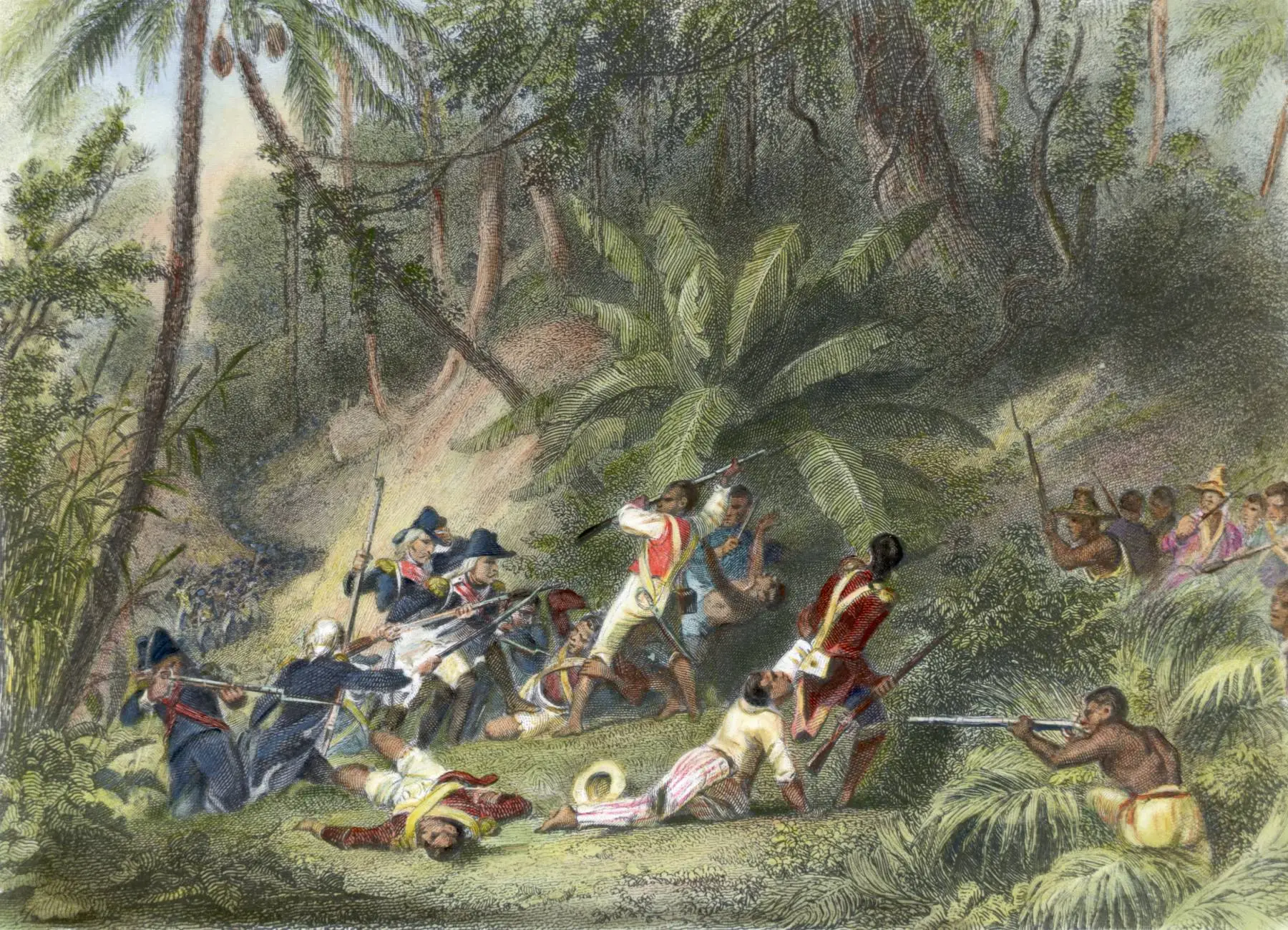
Illustration depicting Francois Dominique Toussaint L'Ouverture participating in the successful revolt against French power in St. Dominique (Haiti). Hand-colored engraving.
Illustration depicting Francois Dominique Toussaint L’Ouverture participating in the successful revolt against French power in St. Dominique (Haiti). Hand-colored engraving. Bettman/Getty

The 1804 creation of Saint-Domingue, later Haiti, left slaveholding societies terrified that the human beings they held in bondage would also rebel. For securing their freedom, Haitians were demonized, with the Vodou religion often used to make wild claims against them, Boaz said.

“So, over the years, the narrative just kind of increases about how Haiti is this barbaric place,” she said. “It’s run only by Black people.” 

Trump reinforced the barbarism messaging by implying Thursday that Haitians are “savage criminal aliens.” 

Despite Springfield Police denying any “credible reports or specific claims” of Haitians abusing animals or committing other crimes, Trump’s allegations have reverberated nationally. Christopher Rufo, who has led the national push against critical race theory in schools and is a trustee for the New College of Florida, where hundreds of books on gender and diversity were discarded last month, offered a $5,000 “bounty” to anyone with evidence of Haitian immigrants in Springfield eating cats. In Florida and New York — the states with the largest Haitian-American communities — Haitian-American leaders condemned Trump’s remarks and similar statements by his running mate, Sen. JD Vance of Ohio. 

The bomb and shooting threats targeting Haitians disproportionately place pressure on mothers, said Taisha Saintil, senior policy analyst for the UndocuBlack Network, which advocates for Black immigrants. Often children’s primary caregivers, women rearrange work schedules, stay home or make childcare plans when schools close, losing household income in the process.
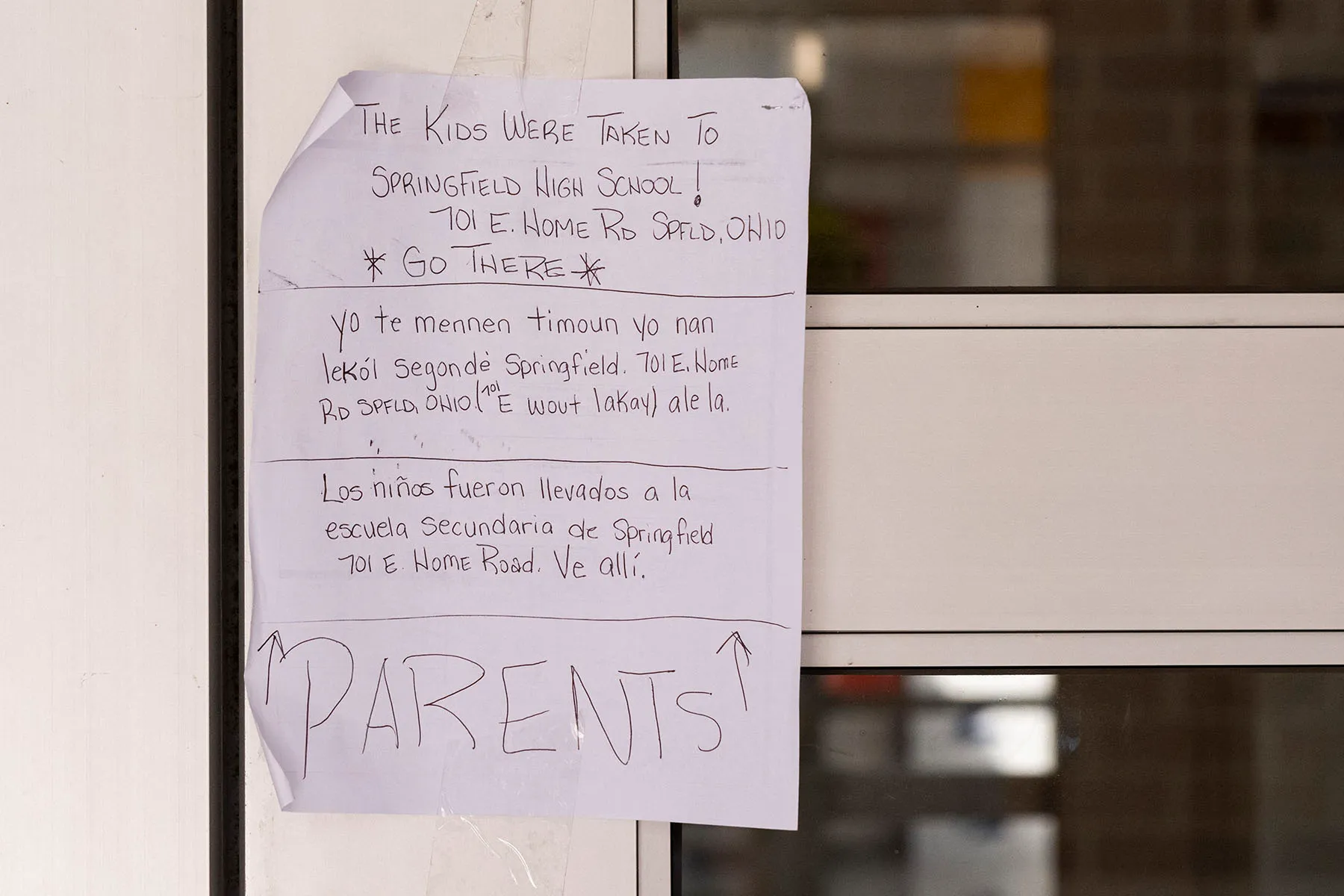
A note on the front door of Fulton Elementary School directs parents to a nearby school for pick-up after the building was evacuated due to bomb threats earlier in the day.
A note on the front door of Fulton Elementary School directs parents to a nearby school for pick-up after the building was evacuated due to bomb threats earlier in the day in Springfield, Ohio, on September 12, 2024. (Roberto Schmidt/AFP/Getty Images)

“Women are often the ones managing the day-to-day fears, picking up and dropping off children, and trying to shield them from the psychological trauma of these threats,” Saintil said. “This gender dynamic adds another layer to the stress, as women feel pressure to keep things normal for their families while silently shouldering the weight of their own fear and frustration.”

Having immigrated to Florida from Haiti in 2006 at age 9, Saintil said that she feels for Springfield’s Haitian community. Before moving to diverse Fort Lauderdale, Florida, she briefly lived in a White community where she said her classmates taunted, spat on her and called her a cat-eater. 

“I remember . . . the fear, waking up every single day knowing that I’m going to get bullied, nobody wanting to talk to me, sitting at the lunch table by myself,” Saintil said. “When I compare it to what is happening now to the newly arrived kids, I think about just how . . . the bullying will mark them for the rest of their lives.”


Lured by manufacturing jobs, an estimated 15,000 Haitian immigrants have settled in Springfield — a mostly White town of just under 60,000 people — starting in about 2017. Before then, Springfield experienced an economic downturn caused, in part, by population decline. Then, the immigrants arrived, giving the city an economic boost.

Valerie Lacarte, a senior policy analyst with the Migration Policy Institute’s U.S. Immigration Policy Program, said that immigrants typically settle in areas because they know they can find reliable employment or their ethnic community already lives there. Springfield wasn’t previously home to a Haitian community, but state officials reportedly advertised the city’s livability and jobs, news that attracted migrants.

“You have employers who are hiring these people, so from the job market perspective, that’s a good thing. You have a match,” Lacarte said. 

But this mutually beneficial development did not prevent tensions, which, last year, worsened after a Haitian immigrant crashed into a school bus, killing one child, Aiden Clark, and hurting nearly 30 others. Still, Nathan Clark, Aiden’s father, spoke out at a city commission meeting last week to denounce immigration foes for exploiting his son’s death. Anti-immigrant residents, meanwhile, have complained that Springfield lacks the infrastructure for population growth.

“It’s tempting to think the growth of immigrants, that’s what’s causing the problems,” said Karthick Ramakrishnan, coauthor of “Framing Immigrants: News Coverage, Public Opinion, and Policy” and a University of California, Berkeley, researcher. “It’s the politicization of immigrants, and especially in places that have significant Republican voting populations, the scapegoating of immigrants tends to be higher. This is an issue we’ve seen time and again in the American heartland, places that are depopulating, places that are short of workers, that actually benefit from immigrant workers, but you have people . . . tapping into these national dynamics, when it comes to race and xenophobia, to win elected office.”

Officials must “be intentional about social cohesion” to avoid conflict between the longtime residents and the Haitian transplants, said Lacarte, the daughter of Haitian immigrants. It’s important to make sure that both the U.S.-born and foreign-born community members get the attention and resources needed to grow together as a diverse community.

Longtime residents may misunderstand why people who look and sound different from them are moving in, Lacarte said. They witness the demographic shift, but they don’t realize these changes can be helpful. Then, bad actors deepen anxieties by spreading disinformation about immigrants. 

“Immigrants have been not only filling these jobs and helping grow the economy. They have their own demand for goods and services,” Lacarte said. “They send their kids to school. They even, in some cases, create businesses . . . and that grows the economy.”

During the presidential debate, Trump did not portray foreign-born workers as a positive but as a threat to Americans, accusing immigrants of taking jobs from Black workers. This framing overlooks that immigrants fill jobs the native-born population doesn’t pursue, Lacarte said, and that more workers are needed as birth rates decline and the White population ages. It also belies the fact that Black immigrants exist. 

About one in five Black people are immigrants or the children of Black immigrants, the Pew Research Center reported in 2022. Africans have driven Black immigrant growth; their population increased by 246 percent between 2000 and 2019. In 2005, The New York Times reported that more Africans were entering the United States than since the slave trade. Today, Africans make up 42 percent of the Black foreign-born population, while Caribbean immigrants make up 46 percent. Of the latter, most come from two countries: Jamaica and Haiti. 

A United States Border Patrol agent on horseback tries to stop a Haitian migrant from entering an encampment on the banks of the Rio Grande near the Acuna Del Rio International Bridge in Del Rio, Texas on September 19, 2021. The United States said Saturday it would ramp up deportation flights for thousands of migrants who flooded into the Texas border city of Del Rio, as authorities scramble to alleviate a burgeoning crisis for President Joe Biden's administration.
A United States Border Patrol agent on horseback tries to stop a Haitian migrant from entering an encampment on the banks of the Rio Grande near the Acuna Del Rio International Bridge in Del Rio, Texas on September 19, 2021. The United States said Saturday it would ramp up deportation flights for thousands of migrants who flooded into the Texas border city of Del Rio, as authorities scramble to alleviate a burgeoning crisis for President Joe Biden’s administration. PAUL RATJE/AFP

After footage of Border Patrol agents on horseback confronting Haitian migrants in Del Rio, Texas, went viral in 2021, Saintil said she received multiple messages disclosing, “I did not know there were Black immigrants. Where did they come from?” She assumed, due to her profession, that people knew the United States had Black immigrants.

“Most of my work now has been to raise visibility of Haitian and Black immigrants,” Saintil said. “We’re the most detained, the most placed in solitary confinement. Our bail bonds are higher. So, the same things that are happening to African Americans in the criminal justice system are happening to Black immigrants in the detention center. Our asylum claims are the most denied because immigration judges don’t trust our pain.”

Long before the debate, Trump disparaged Black immigrants. In 2017, he reportedly said that Nigerians lived in “huts” and Haitians “all have AIDS.”  The following year, he labeled Haiti, African nations and El Salvador “shithole countries.” In Springfield, local Republicans have echoed Trump’s remarks. In addition to the pet-eating allegations, they’ve accused immigrants of being in gangs, spreading disease and practicing “voodoo” rituals, claims police have denied.

As Haiti became the yardstick for measuring whether Black people could participate in society equally, attacks on its character escalated. By the 1880s, stories spread about Haitians engaging in cannibalism and human sacrifice, especially of White children, Boaz said. Told repeatedly, these stories inform the rumors about Haitians in Springfield today, and they may jeopardize women.

“Historically, women in marginalized communities, whether immigrants, ethnic minorities, or refugees, have been specifically targeted for intimidation,” Saintil said. “This may be because some view them as ‘easier’ to attack or harass than men. . . . In this context, when Haitian women are being targeted for threats, harassment or even racial slurs in public spaces, the consequences are far-reaching. This not only creates an atmosphere of terror for women but can also ripple through the entire family.”


Haitian-American anthropologist Gina Athena Ulysse, a professor of humanities at the University of California, Santa Cruz, said that she’s tired of defending her personhood and identity. Following the 2010 Haiti earthquake, Ulysse wrote a book called “Why Haiti Needs New Narratives: A Post-Quake Chronicle” because she found the dehumanizing remarks about Haitians then disturbing. 

“We’re always having to refute as opposed to having an identity that is an affirmed one,” Ulysse said. “There is a profound disappointment that in 2024 that I am listening to someone who is running to be the president of the highest nation in the land say something this surreal, this absurd. But I’m also someone as a Black woman, as a social scientist, as someone who understands race and racial construction, what that is meant to do, and that is to paint Haitians as the ultimate ‘others,’ cannibalists and otherwise, so that it can keep fueling this narrative that’s necessary to strip people of their humanity.” 

Ulysse said that the broader immigrant community faces xenophobia, too. One study concluded that the level of anti-immigrant rhetoric in the Republican Party today rivals anti-Chinese sentiment during the late 1800s, a period that restricted Chinese immigration. Chinese immigrants have also been accused of consuming dogs and cats, insults revived during the onset of COVID-19, which Trump called the “China virus.” 

“He’s gone from talking about Mexican immigrants as predominantly being criminals and rapists to then talking about immigrants as vectors of disease and and now using similar kinds of dehumanizing language to talk about . . . not just what they eat, but the kind of the social threat they supposedly pose to American society,” Ramakrishnan said. “I think the kinds of emotions it’s supposed to evoke are emotions of disgust, of othering and reduced empathy, and also support for drastic measures like rounding up and deporting people who are not deemed to be American.”

If Harris becomes president, she would not only be the first woman in the Oval Office but also the first person of South Asian and Caribbean heritage. Might that change perceptions and policies related to Caribbean immigrants? 

“No matter how well meaning one person may be, they’re part of a social structure and a system that makes decisions,” Ulysse said. “She’s not going to make decisions by herself, so what difference does it make that she’s from the Caribbean? She’s got advisors. She’s got to think about Congress. She’s got to think about the Senate. She’s got to think about geopolitics and history.” 
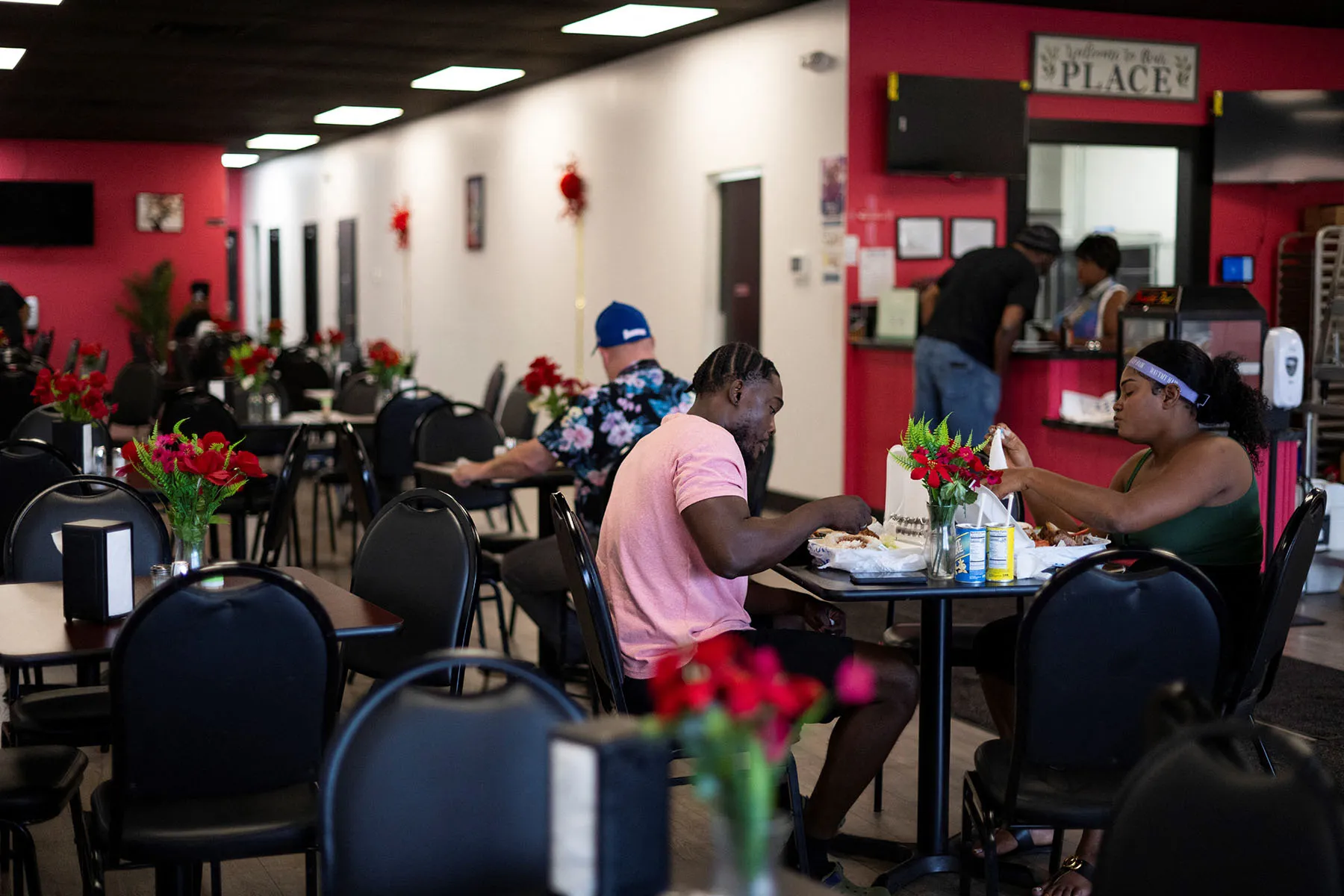
Community members eat at a Haitian restaurant in Springfield, Ohio.
Community members eat at a Haitian restaurant in Springfield, Ohio, on September 12, 2024. (Roberto Schmidt/AFP/Getty Images)

When Trump took aim at Haitian immigrants during the debate, Harris laughed in apparent disbelief but did not rebuke him. Ulysse finds it disturbing that many people laughed at Trump’s claims because, as absurd as they are, they’re endangering Haitians. 

On Friday, President Joe Biden called the attacks on Haitians “simply wrong,” noting that White House Press Secretary Karine Jean-Pierre is “a proud Haitian American.”

Along with being terrified and traumatized, Saintil said the Haitian children and parents impacted by the threats and smears likely feel betrayed. 

“You’re getting it from a country that you thought you could be safe in,” she said. “You’re getting it in a country that you’ve been hoping to be in because you thought your life would be better, but now you’re being treated worse than dirt. You’re being called a savage . . . How do you go on from there?”
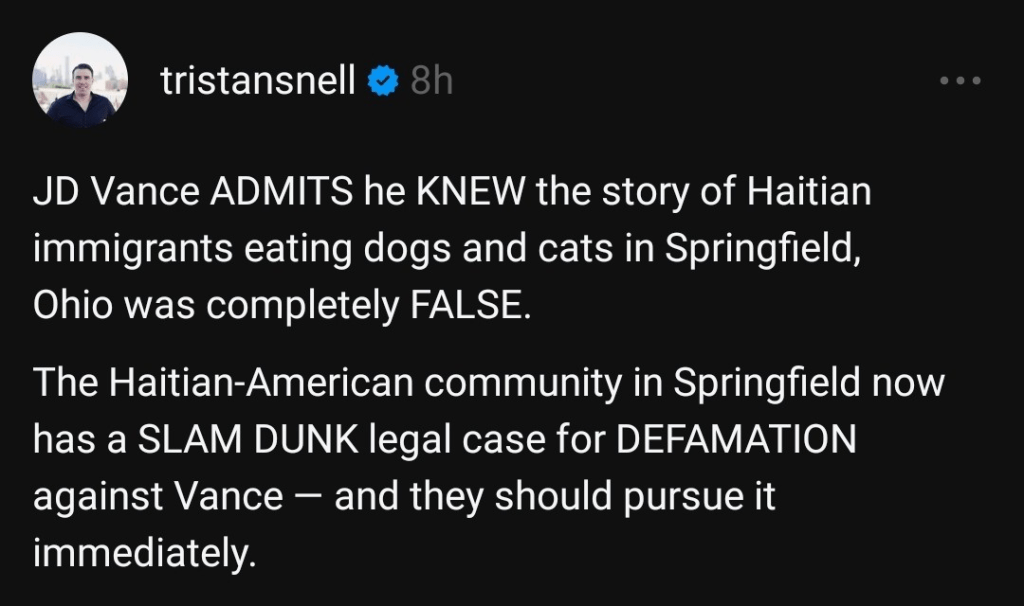
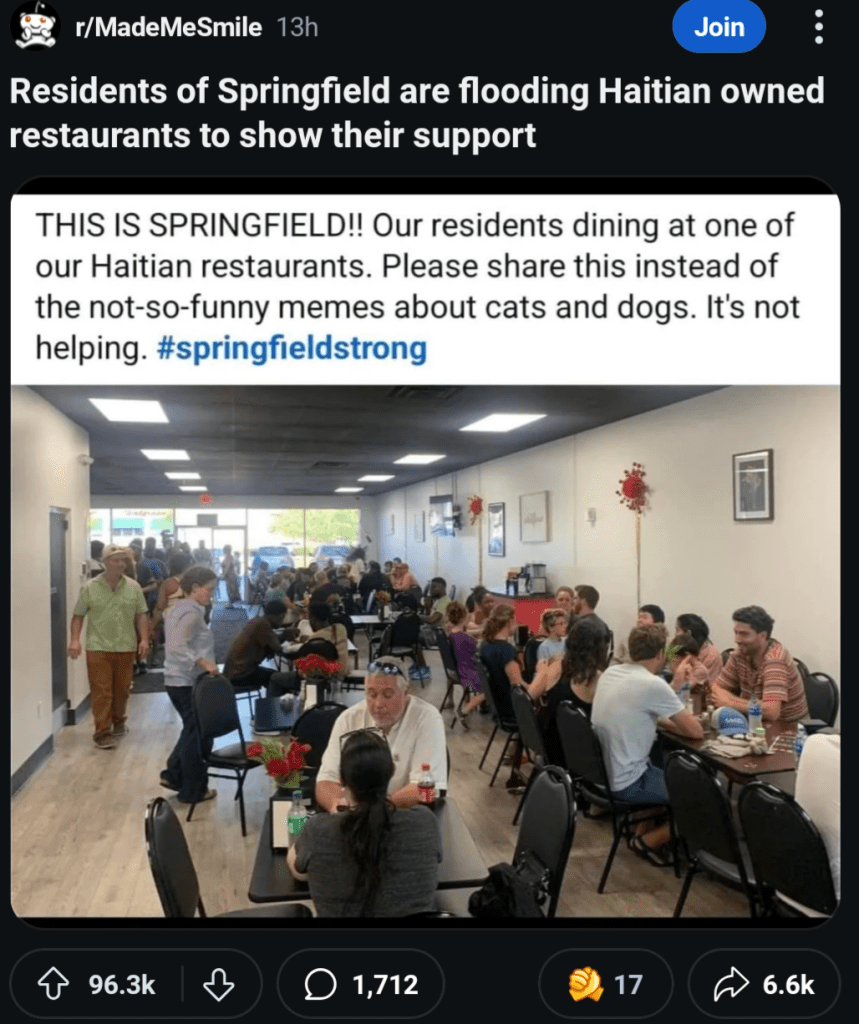
Haters are going to hate, Republicans are going to try to spark hate everywhere. Lies are not a bad thing to them as long as they win so they can continue to hate.

A day after a Springfield school and other public buildings were evacuated and closed due to bomb threats, and the same day that two other Springfield elementary schools were evacuated and one middle school closed due to a new, separate bomb threat, Husted posted a photo of two geese on X Friday morning with the comment, “Most Americans agree that these migrants should be deported.” Husted’s spox has refused to comment. He first appeared here in 2012 when as Ohio secretary of state he eliminated extended hours for early voting.
“When people ask me…What’s gonna happen if the Flip – Flopping, Laughing Hyena Wins?? I say…write down all the addresses of the people who had her signs in their yards! Sooo…when the Illegal human ‘Locust’ (which she supports!) Need places to live…We’ll already have the addresses of the their New families…who supported their arrival!” Zuchowski wrote.

Read the full article. Replies to his post are turned off. Zuchowski made news several years ago for a rant about the name change for the Cleveland Indians, which he claimed was “erasing our heritage.”

“I’ve seen the guns myself and all, and, yeah, they had a lot of guns and stuff over there, and, yeah, a lot of people were afraid of him back in the day,” she said.

“These are people that want to destroy our country. It is called the enemy from within. They are the real threat. They do it with a combination of rhetoric and lawsuits they wrap me up in.

Indeed, he should resign.

But he’s a Republican, so he won’t. This is really good. Zorba linked it on Politicians are Poody Heads.

From MPS:

Taylor Swift and immigrants drive right wing men to madness

Elon Musk, JD Vance and others are fighting a losing battle to put them in their place.

Marisa Kabas September 12, 2024

Aubrey Plaza, Taylor Swift, Linda Rondstadt

In the flurry of post-debate spin and endorsements you may have missed what is, to my eye, one of the most disgusting things a man has ever said to a woman.

Despite a dominant performance by Vice President Harris followed by the ringing endorsement of Taylor Swift to her 283 million Instagram followers, we were quickly reminded that misogyny will always try to win the day. Elon Musk, a scumbag who needs no introduction, took to his cesspool of a platform in the moments following Swift’s post in an attempt to put her in her place. 

(The tweet embed code doesn’t work here; I’m not on Twitter, so I can’t do much. You can see it on Marisa’s page, linked below, or I transcribed it; it is from Mr. Musk, who says, “Fine Taylor … you win … I will give you a child and guard your cats with my life” )

Understanding these 17 words requires a bit of context which I’m loath to repeat but feel duty-bound to explain. (Swift has not made any public comment regarding the tweet so far.)

First, let’s look at Swift’s endorsement of the Harris/Walz campaign. After explaining her process of researching and watching the presidential debate, she wrote: 

“I will be casting my vote for Kamala Harris and Tim Walz in the 2024 Presidential Election. I’m voting for @kamalaharris because she fights for the rights and causes I believe need a warrior to champion them. I think she is a steady-handed, gifted leader and I believe we can accomplish so much more in this country if we are led by calm and not chaos. I was so heartened and impressed by her selection of running mate @timwalz, who has been standing up for LGBTQ+ rights, IVF, and a woman’s right to her own body for decades.

She then reminded people to register to vote and to vote early if possible, providing links to resources in her Instagram story. And she signed it “With love and hope, Taylor Swift, Childless Cat Lady.” This was, of course, a reference to Trump’s veep candidate JD Vance saying the Democratic party is run by these sorts of women—meaning they couldn’t possibly care about the future of [white] children in this country. 

Swift’s endorsement was a seminal moment in the too-close-for-comfort-and-sanity race between Harris and Trump, and one many have been breathlessly waiting for. While a Swift endorsement doesn’t mean everything, it certainly means something to a lot of people: In the 24 hours following her post, 406,000 people had visited Vote.gov via Swift’s custom link. 

Now let’s break down Musk’s disgusting tweet piece by piece:

“Fine Taylor”

Right off the bat, I’m pissed. The Taylor in question is obviously Swift, arguably the most famous celebrity in the world. She’s an artist, a brand and an economy all at once. I may not be a Swiftie but I’ll be damned if the most divorced man of all time doesn’t show her a little respect. You’re not on a first name basis with her, you creep. She does not know you. But we’ll get back to that later.

“you win”

Winning implies that Swift willingly entered into some sort of bet or game with Musk, one in which he’s been forced to concede. As far as we know, Swift and Musk have never communicated in any capacity. In fact, as one Twitter user pointed out, Musk has replied to her a number of times over the years to no avail. Nevertheless, he persisted.

“I will give you a child”

This is where things get really dark. As established in the first two points, these two people do not know each other. Yet Musk is offering to impregnate Swift which, again, is not something she has ever expressed wanting. In fact, impregnating someone against their will is a heinous crime. 

Musk has long shown that the rules don’t apply to him, and so far he’s right. From tanking the value of every company he’s touched to saying heinous things about immigrants, he remains a free man and a billionaire with no consequences to speak of. He’s the father of at least 12 children with at least three women, one of whom is an executive at Neuralink, his company that creates chips to be implanted in the brains of humans.

(There is a tweet here on the page; the embed code doesn’t work. See below, or here it is transcribed. “Doing my best to help the underpopulation crisis. A collapsing birth rate is the biggest danger civilization faces by far.” )

He quite literally thinks spreading his seed will save humanity, and Musk thinks he’d be doing Swift a favor—saving her life and giving it meaning, even!—by getting her pregnant. For any man to presume such a thing is vile; for a deadbeat dad with a white supremacy problem, it’s unconscionable. 

“and guard your cats with my life”

As if being a predatory misogynist wasn’t enough, Musk decided to throw in some casual racism which also served as a callback to one of Trump’s most unhinged moments in the debate. Trump, echoing claims first trumpeted by Vance, furthered the total and complete lie that Haitian migrants in Springfield, Ohio are eating white people’s pets. It started with an accident last year wherein a Haitian migrant drove into a school bus and killed an 11-year-old white boy, sparking a racist backlash against the migrant community that has rapidly grown in Springfield since 2020. The boy’s parents have told Trump and Vance to stop using their son to spread “incessant hate.”

In Musk’s telling, not only does Swift need to be impregnated to fight against a non-existent population crisis, but her beloved pet cats need protection from the non-existent cat-hungry migrants.

Dave Rubin, a far-right media personality who works for Tenet Media (the company that it was revealed unwittingly worked for the Russian government) managed to somehow take Musk’s threat a step further.

(The tweet embed code doesn’t work. It’s awful, but transcribed, it says, “Dave Rubin asks Taylor Swift to reconsider her endorsement: ‘Taylor Swift, you are a young pretty girl, do you know what the gang members from Venezuela do to young pretty girls? It ain’t pretty!'”. Or, go to Marisa’s page to read; it’s all there.)

The mention of Venezuela was a reference to another anti-immigrant remark Trump made during the debate. Here Rubin deftly combines racism with a rape fantasy, though a different one than Musk had in mind. These are the minds of deeply troubled men.

Following Musk’s post, his estranged daughter Vivian Jenna Wilson bravely posted on Threads about it. 

Wilson has recently started speaking out against her father who claimed his child was, in his view, “dead, killed by the woke mind virus,” because she’s transgender. In her first-ever public interview, Wilson told NBC News of Musk in late July, “He was cold. He’s very quick to anger. He is uncaring and narcissistic.” 

That narcissism reared its ugly head this week, making even his most fervent supporters uneasy.

While far right zealots have the luxury of laughing off Trump, Vance and Musk’s cruelty, the migrant community in Springfield remains at active risk. On Thursday multiple city buildings and schools were forced to shut down after receiving a bomb threat.  The Haitian Times reports that some families have been afraid to send their kids to school since they became caught in the racist crosshairs, with cars being vandalized and Haitian residents considering moving elsewhere. This is all despite the fact that, as a PBS Newshour report demonstrated, Springfield’s businesses are thriving thanks to the town’s newest residents. 

Meanwhile, the childless cat (and dog) ladies are assembling: From Swift to Stevie Nicks, Linda Rondsadt and Aubrey Plaza, famous women are using their platforms to tell the wannabe dictators of the Republican ticket that they have no control over us or our bodies. Not now, not ever.

And in the coming days as conservatives continue to direct hate at immigrants in Springfield and beyond, it’s incumbent upon those with large followings to stand in solidarity with them—because we’re all fighting the same monsters.

https://www.thehandbasket.co/p/cat-ladies-immigrants-taylor-swift-elon-musk

Fact-checking the ABC News presidential debate

Peace & Justice History for 9/12:

September 12, 1977
Steve Biko, the leader of the black consciousness movement, and probably the most influential young black leader in South Africa, died while being held by security forces in Port Elizabeth; he was the forty-first person to die while in police custody in South Africa.
The Death of Stephen Biko

 
September 12, 1998
A group later known as the Cuban Five was arrested after infiltrating groups which had previously executed terrorist attacks on Cuban soil.They were convicted of conspiracy to commit espionage against the U.S. Their conviction was overturned by a three-judge panel of the 11th Circuit Court, then reinstated by the full court; an appeal to the Supreme Court is planned.
The United Nations Commission on Arbitrary Detentions has characterized their imprisonment as arbitrary detention.


Who are the Cuban 5? 
September 12, 2002

President George W. Bush told skeptical world leaders at the United Nations to confront the ”grave and gathering danger” of Saddam Hussein’s Iraq, or to stand aside as the United States acted. 

https://www.peacebuttons.info/E-News/peacehistoryseptember.htm#september12

A thoughtful post by Suze Hartline

Did I just duplicate a post?

As a reminder, Trump has publicly floated Loomer to be his next White House press secretary and he has reposted hundreds of her tweets on Truth Social.

Molson Coors joins Ford, Harley Davidson, Lowes, Tractor Supply, John Deere, and the maker of Jack Daniel’s in retreating from diversity and pro-LGBTQ programs.

Coors beer, once the subject of a nationwide boycott by gay bars over its founder’s anti-LGBTQ stance, has been prominent at Pride events in recent years. Last year, for example, Coors Light was the main sponsor of Denver Pride despite attacks by the cult.

In 2015, when the company was called MillerCoors, its chairman and then-US Senate candidate Pete Coors, dropped out of a speaking gig at the convention of Legatus, the ex-gay and pro-ex-gay torture Catholic group, after widespread criticism.

The company’s current brands include Coors, Coors Light, Blue Moon, Icehouse, Miller, Miller Light, Keystone, Molson, and dozens of others.

Barbara Gittings: Mother of the Gay Rights Movement

(From the link on Peace History.)

Day 2 of the Pride 30 Project for Pride Month, 2018.

Jeffry J. Iovannone published in Queer History For the People Jun 2, 2018

Barbara Gittings was a lover of books. She realized, from a young age, that she also loved girls. So when, in 1949, she left Wilmington, Delaware to attend Northwestern University, she did what any bookish young lesbian would do: research homosexuality in the school’s library. What Gittings found was not comforting. The vast majority of sources were written by medical professionals and described homosexuality as an illness or a perversion. She became so consumed with spending time in various Chicago libraries that she neglected her coursework and flunked out of school. But as a result of the discouraging information she found, an activist was born. With passion, determination, and what she would come to refer to as “gay gumption,” Gittings would spend the rest of her life working, in various ways, to correct those lies she found in the pages of books and scientific journals on the library shelves.

Gittings moved to Philadelphia in 1950 and supported herself with part-time clerical work. She continued to read everything she could find on homosexuality and, as part of her search, discovered Donald Webster Cory’s The Homosexual in America: A Subjective Approach, originally published in 1951. Gittings was particularly impressed with Cory’s arguments that gays and lesbians constituted a large unrecognized minority who deserved civil rights and his attempts to cultivate empathy in his readers by outlining the difficulties faced by American homosexuals. She wrote to Cory’s publisher and discovered he lived in New York City. The two met on several occasions, and Cory informed Gittings of a newly-formed gay organization in Los Angeles: the Mattachine Society, founded in 1950 by Harry Hay.

In the summer of 1956, when she was on vacation from her office job, Gittings boarded a plane to Los Angeles and visited the office of ONE, Inc., a homophile organization who had amicably split from the Mattachine Society in 1952. The members of ONE, Inc. informed her of the existence of a San Francisco-based organization for lesbians, the Daughters of Bilitis (DOB), founded in 1955 by lesbian partners Del Martin and Phyllis Lyon.

Gittings once again boarded a plane, this time bound for San Francisco. The DOB were, fatefully, having a meeting that very evening in a member’s apartment. The meeting was the first time in her life Gittings would interact with a group of lesbians outside of a bar setting. Two years later, in 1958, Gittings officially joined the DOB and was tapped by Martin and Lyon to start an East Coast chapter of the organization based in New York City. With her co-founder, Marion Glass, Gittings built the chapter into the largest in the country.

In 1963, Gittings, whose enthusiasm and knowledge of literature left an impression on Martin and Lyon, was tapped to be the editor of The Ladder, the DOB’s national magazine for gay women. Gittings transformed The Ladder from what was essentially a newsletter to a national magazine respected within gay circles. With the help of her partner, Kay “Tobin” Lahusen, whom she met in 1961 at a DOB picnic in Rhode Island, Gittings replaced the amateurish illustrations that typically adorned the cover of The Ladder with photographs taken by Lahusen of actual lesbians who appeared confident and happy.

Gittings began to take The Ladder in an increasingly militant direction, reporting on protests, questioning the merits of various activist strategies such as picketing, and engaging in debates with so-called “experts,” arguing that homosexuality was a social and cultural problem, not a psychological problem. The activist bent of The Ladder under Gittings’ editorship alarmed the West Coast leadership of the DOB. When Gittings, amidst her many activities on behalf of gay rights, was late with the August 1966 issue, Martin and Lyon used her tardiness as an excuse to oust her as editor.

Gittings would also find a kindred spirit in Frank Kameny, who she credited as the first person to articulate a fully coherent philosophy of gay rights. She and Lahusen partnered with Mattachine Washington, of which Kameny was a co-founder, working alongside other lesbians and gay men to directly challenge the federal government. Gittings participated in the first picket of the White House for homosexual rights on April 17th of 1965.

Gittings worked with Kameny and other activists to lobby the American Psychiatric Association (APA) to remove homosexuality as a diagnostic category from the Diagnostic and Statistical Manual (DSM). At the APA’s 1972 conference, held in Dallas, Texas, Gittings, Kameny, and Lahusen created a display entitled “Gay, Proud, and Healthy: The Homosexual Community Speaks.” The exhibit, which featured photographs of gay couples taken by Lahusen, was adorned with the word “LOVE” in bold letters and portrayed gay people as healthy and happy, not as patients who were tormented and in need of a cure. In December of 1973, the APA board of trustees voted to pass a resolution to remove homosexuality from the DSM, effectively declassifying it as a mental illness.

Gittings was a lifelong bibliophile, and though she recognized the importance of taking on the federal government and institutions such as the APA, she never lost sight of the “lies in the libraries” she discovered as a college freshman and the importance of gay representation. In 1970, she joined the American Library Association’s (ALA) newly-formed Task Force on Gay Liberation (TFGL). The TFGL, whose mission was to provide support for gay librarians within the profession and increase gay representation in libraries, was glad to have a veteran activist like Gittings join their ranks.

With the help of Israel Fishman, the first coordinator of the TFGL, Gittings organized a gay kissing booth — titled “Hug-a-Homosexual: Free Kisses” — for the 1971 ALA conference in Dallas, Texas. While the group could have created a nice display featuring gay books, periodicals, and their bibliography, they instead decided to make their presence known by showing gay love live. The publicity was better than Gittings and the TFGL could have imagined, and continued to spark discussions within the ALA over the next year.

In 1999, in honor of her contributions to create more visibility for gays and lesbians in libraries and in the profession, Gittings was awarded a lifetime membership at the annual ALA conference, held that year in New Orleans, Louisiana. The ALA also named an award after Gittings as part of their Stonewall Book Awards, sponsored by the Gay, Lesbian, Bisexual, and Transgender Round Table (GLBTRT), the contemporary iteration of the TFGL. The Stonewall Book Award-Barbara Gittings Literature Award is given annually for works of fiction that exhibit “exceptional merit relating to the LGBT experience.”

Barbara Gittings died on February 18th, 2007 at the age of 74 after a long battle with breast cancer. In a 1999 interview with American Libraries magazine, she summarized her career as a gay activist with the wit and wisdom she was known for:

“As a teenager, I had to struggle alone to learn about myself and what it meant to be gay. Now for 48 years I’ve had the satisfaction of working with other gay people all across the country to get the bigots off our backs, to oil the closet door hinges, to change prejudiced hearts and minds, and to show that gay love is good for us and for the rest of the world too. It’s hard work — but it’s vital, and it’s gratifying, and it’s often fun!”