How a Native elections official is breaking down voting barriers in Arizona

Sep 03, 2024, Jessica Kutz

Originally published by The 19th

Your trusted source for contextualizing Election 2024 news. Sign up for our daily newsletter.

About a month before Arizona’s July primary, Pima County Recorder Gabriella Cázares-Kelly and her older sister Elisa Cázares were driving around Three Points, a rural community between Tucson and where they grew up on the Tohono O’odham Nation, dropping off flyers for the recorder’s reelection campaign. Some 5,000 people live in Three Points, which leans conservative. The properties, an assortment of mobile homes and ranch-style houses, are separated by chain link fences, but their yards blend into the Sonoran desert landscape of mesquite trees, saguaros and chollas. 

They stopped at a trailer whose address popped up on a canvassing app on Cázares-Kelly’s phone, programmed to scan voter rolls and identify homes of registered Democrats who voted in the last election. Old Volkswagens were rusting in the yard. There was a “beware dog” sign attached to the fence. No one came out to greet them, so Cázares-Kelly left her campaign materials wedged outside. Her sister made a note of it on the phone as a “lit drop.” 

At the second stop, Cázares-Kelly — dressed in tennis shoes, distressed jeans and a black shirt that says “Elect Indigenous Women” in big white letters — had just tucked fliers under a car’s windshield wiper when a little girl opened the door of the house, followed by a woman sporting a slightly wary expression.

“Hi. My name is Gabriella. I’m actually the county recorder. I’m running for reelection and just sharing some information about my campaign,” Cázares-Kelly said warmly through the fence, the sun beating down on her long black hair. 

Cázares-Kelly, who is Pima’s first Indigenous person to hold a countywide seat, quickly explained that part of her job is to be responsible for early voting, mail-in voting and voter registration. She was there soliciting voters for herself and also canvassing for her best friend April Ignacio, who was running for a Pima County Board of Supervisors seat. They grew up together on the Tohono O’odham Nation and got into politics to bring more rural and Indigenous representation to a county where about 4 percent of the residents identify as Indigenous and whose votes could help decide a closely-contested November election in a battleground state. 

Over the loud barks of two dogs, the woman explained that she can’t vote because she has felonies on her record. Cázares-Kelly’s demeanor shifted as she began talking about her favorite subject: voting rights. She told the woman about a free legal clinic provided by the county’s public defenders where she might be able to restore her voting rights and that all the information is on the recorder’s website.  

“Oh really?” the woman responded, her eyes lighting up. “That’s the only reason I haven’t is because it costs so much money.” 

“They’ll help you fill out the paperwork,” Cázares-Kelly said reassuringly. 

Cázares-Kelly headed back to the car and reported to her sister about the possible voter education win. “That was cool,” she said.

Her sister noted the interaction in the app and looked for the next address. 

Most stops resulted in lit drops at homes whose residents don’t seem to trust strangers walking up to their doors. At one, Cázares-Kelly was already on the front steps when the word “shotgun” on a sign caught her eye. She turned to the Ring camera and explained why she was there before briskly getting off the porch, entering the car and telling her sister to book it. 

To Cázares-Kelly, each conversation feels like a small victory. It’s rare to have politicians canvas in these harder-to-reach communities, including those on Indigenous lands; almost everyone perks up once she explains who she is and what she’s doing. 
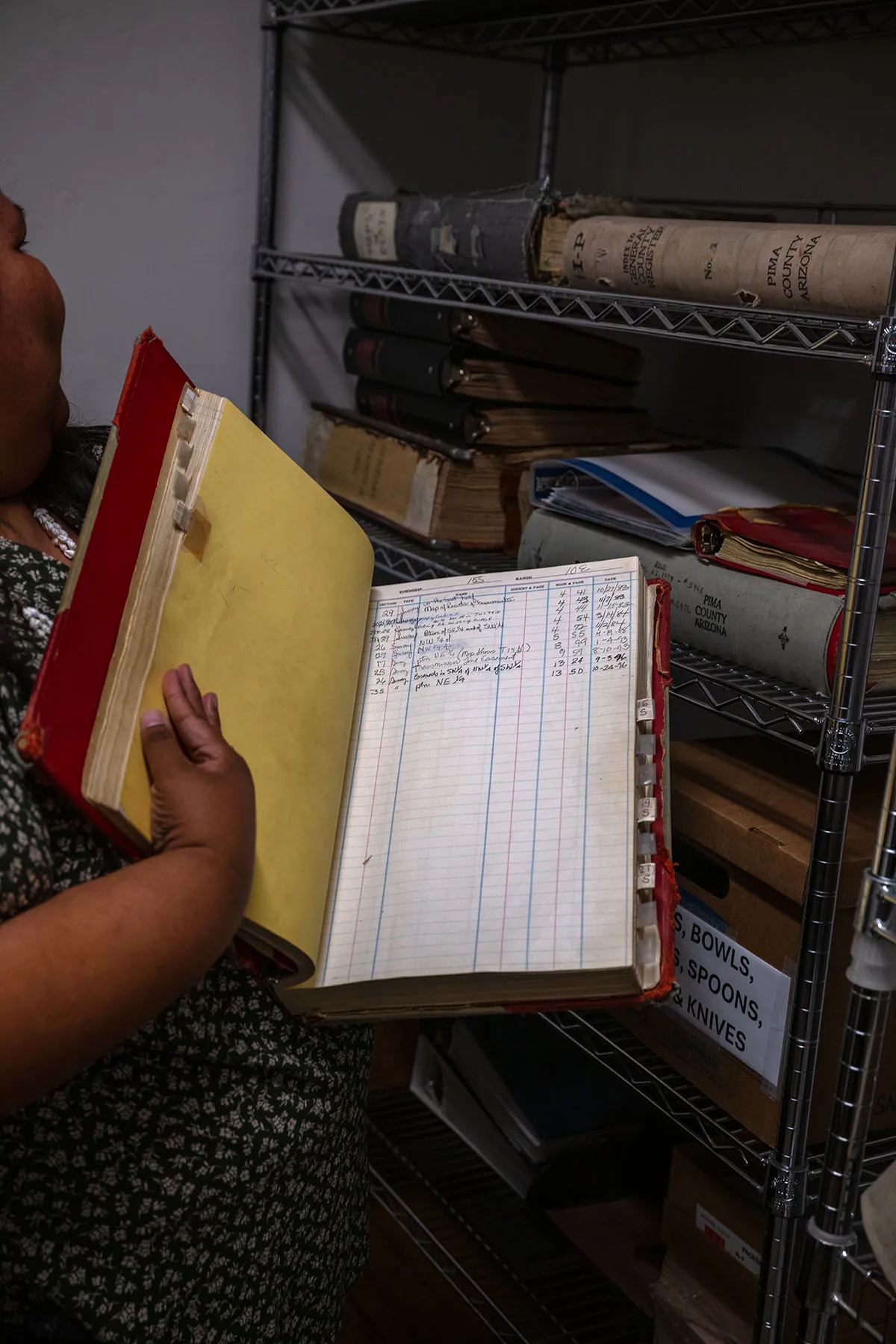
Gabriella Cázares-Kelly, partially visible, holds an open, large ledger book filled with handwritten entries. She stands in front of shelves filled with old, worn books and binders in a storage room.
Gabriella Cázares-Kelly goes through old Pima County records at her offices in Tucson, Arizona. (Ash Ponders for The 19th)

She doesn’t really need to get the vote out to be reelected; in solidly Democratic Pima County, it’s extremely unlikely that a Republican would flip her seat. But as a member of the Tohono O’odham Nation, whose broad territory extends along 62 miles of the U.S.-Mexico border, she knows the obstacles to participating in elections. It’s the whole reason she ran in 2020: to represent people who were being ignored by the democratic system and denied the right to vote. 

But Indigenous voters can swing election results in this battleground state, home to 22 federally recognized tribes. In 2020, President Joe Biden won Arizona by just 10,457 votes. That year, Democrats garnered 10,657 more votes from inside Native American reservations than they had in 2016. 

Now, as a presidential election draws near, Cázares-Kelly is working to ensure that every eligible resident has a chance to cast their ballot. 

At one of the last homes she approached that day, an older woman named Ann Gail opened the front gate to chat, her eyes shielded by dark sunglasses. She said she stopped believing in mail-in ballots after the fake narrative of a stolen election pushed by former President Donald Trump and his Republican allies took hold in 2020. When it comes to her own ballot, she said, “I feel like it needs to be counted and I need to see it.”

Cázares-Kelly tried to reassure her. “Vote by mail is very safe,” she said. “But I absolutely respect your decision to vote on Election Day.” 

“As an elected official, and as a candidate, we need people to trust in the system and to recognize it’s non-partisan,” Cázares-Kelly continued. “Today I’m here on a partisan basis, but when I’m working, it is not partisan. It is about everybody voting.”

Gail assured her that she’ll be voting and will “get everybody in my neighborhood” to vote, too,” she said. “It’s so important. My grandson turns 18 in July, and I’ve told him, ‘You have to vote.’” 


Cázares-Kelly jokes that she got into voting rights work by accident. In 2016, she was an academic adviser at the Tohono O’odham Community College when her friend and colleague Daniel Sestiaga, a member of the Fort Yuma Quechan Indian Tribe, approached her about a favor. He had been recruited by the American Indian Higher Education Consortium, which represents the interests of tribal colleges across the country, to register students to vote. He asked Cázares-Kelly if she could help. She knew all the students by name and was “just like a changemaker on campus,” he said. 

On the first registration day, Sestiaga got pulled into a meeting, so Cázares-Kelly had to do the work by herself. Despite not having any training, she thought, “It’s probably not that hard. I’ve registered myself and other people. Like, it’ll be fine.”

Instead, she recalled, “It turned out to be really hard.” 

One of the challenges is that voter registration isn’t set up for the realities of tribal land. “The problem on the reservation is if you’re asked for your physical address, you just kind of make it up,” she said. “Because there is nothing you can really reference.” Instead of a street name, one might describe where they live in relation to a landmark or a mile marker. For example, the college’s address was Highway 86, milepost 125-and-a-half, she said. 

The form also includes a spot to draw where you live. “Well, my nation is the size of Connecticut,” Cázares-Kelly said. “Are you asking for the shape of my nation and a star? Like, what are you looking for here?” 

All of this can create confusion for residents who sometimes just list their PO boxes, which don’t count as physical addresses. That will delay their registration, Cázares-Kelly said.

Non-native students had issues, too, particularly if they were from out of state. Some students didn’t have driver’s licenses. “Every single person’s situation was so completely different,” she said. “It ended up being incredibly complex.” 

She took her questions to the office of then-recorder F. Ann Rodriguez. She had so many that, at one point, she bumped her sister’s number off her speed dial list and replaced it with the number for Rodriguez’s office. 

And the work was just beginning. “People started getting the voter registration cards back, getting their voter IDs in the mail, and they were so excited to show me or thank me for helping them register,” she said. But then it became, “My mom wants to register now, my auntie, my boyfriend, my uncle. How do I get them a form?” Cázares-Kelly realized she didn’t know. “It was like I pulled a thread from a sweater and all of a sudden this sweater started unraveling.”

One of the things she learned is that the post office on the reservation should have voter registration forms available, but hadn’t stocked them in years. “Having no influence and no title and no anything, I reached out to the postmaster, I reached out to the recorder’s office, and I connected the two,” she said. Soon, the forms were where they should have been all along. 

Cázares-Kelly’s voting advocacy quickly turned into an obsession, Sestiaga said. One day, he recalled, “We were cruising through the village on a lunch break or something and she said, ‘If there was a way that I could make a full-time job out of getting people registered to vote, I would do it.’” Teasing her, he told her she’d just have to become the next county recorder. “She was like, ‘Get out of here! Like, I have no interest in politics. I have no interest in campaigning.’” 

But she also recognized there was a need for better outreach, particularly on the Nation, he said. So when Rodriguez announced in 2019 that she was going to retire after 28 years of service, it felt a little bit like fate to Sestiago. A lot of other people who knew Cázares-Kelly had a feeling she would go for the seat. “I remember seeing that headline, and I just thought to myself, ‘Oh my goodness, she’s going to run for this,’” her husband, Ryan Kelly, said.

Cázares-Kelly wasn’t sold yet. She was, first and foremost, an educator. She had no desire to be a politician, and the thought of raising campaign money made her uncomfortable. 

But it nagged at her how long it had taken to build a relationship with the current recorder’s office. She thought about having to do that all over again once Rodriguez left office. And what if the new recorder was anti-Native? “I was worried,” she said. “Eventually, I recognized that I care about this office and I understand a lot about the needs that are not being met, and I have a sense of duty to at least try.” 
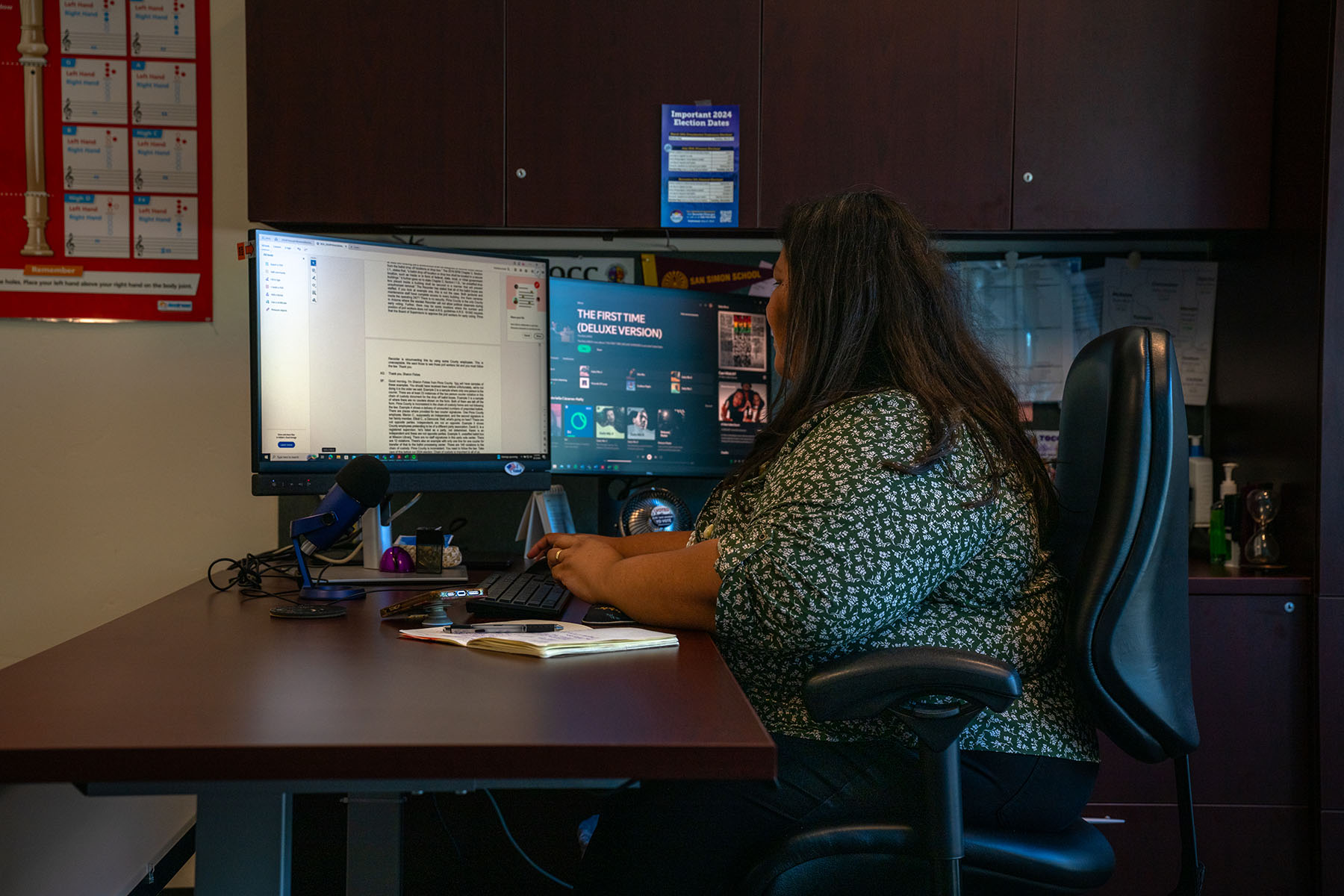
Gabriella Cázares-Kelly sits at her office desk, typing on a computer.
Gabriella Cázares-Kelly works in her office in Tucson, Arizona. (Ash Ponders for The 19th)
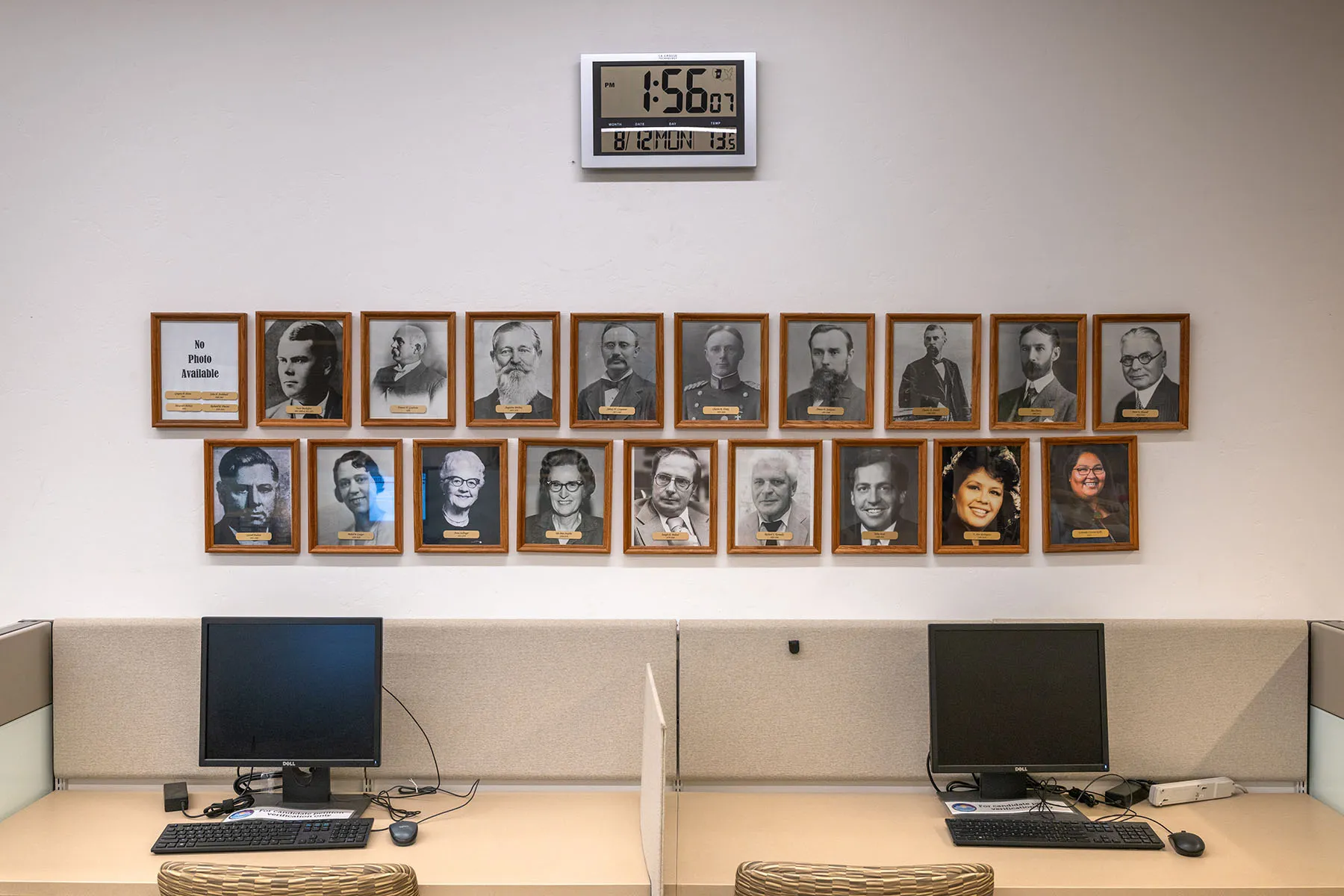
A wall in an office space displays framed portraits of county recorders, including Gabriella Cázares-Kelly, whose photo is in the bottom row. A digital clock above the frames shows the current time.
A wall displays framed portraits of Pima County Recorders, including Cázares-Kelly, at her offices. (Ash Ponders for The 19th)

She launched her campaign in 2020, right at the start of the COVID-19 pandemic. That meant having to canvass neighborhoods with social distancing measures in place, doing no-contact lit drops and outreach through Zoom forums and virtual fundraisers.

Worse, a candidate who wanted to win her community would need to do a lot of driving — and her car was having engine problems. She needed money to get back on the road. When she was registering voters, she sold banana bread to pay for gas. But fixing the car would take a much bigger sum, and she felt bad asking for money from people who might not have any to spare. A friend assuaged her guilt: “I think you’re saying, ‘Hey, community, I’ve invested in you,’” she recalls him telling her. “Now you’re asking, ‘Can you invest in me?’”  

She set up a GoFundMe for $3,500 and quickly met the goal. “It was just shocking to me that people would give me money,” she said. But it didn’t surprise her husband, a former teacher who is now a labor organizer with the AFL-CIO. Because she never wanted to get into politics, she had won community support just by being herself, he said. “Gabby walked into the race already having so many meaningful community relationships,” he said.

Those ties had deepened in 2017, when she, her longtime friend April Ignacio and a few others co-founded an advocacy organization called Indivisible Tohono. They have organized everything from sock drives to candidate forums to Pride events on the Nation.

That network of friends was ready to spread the word about her campaign. It helped that she made a TikTok video that went viral, showing her speeding by the National Mall in Washington, D.C. on an electric scooter while wearing a traditional red dress and yelling, “Excuse me, I’m Indigenous, coming through!” That moment became part of her campaign slogan and bumper sticker design. 

So when Election Day came, her supporters were hopeful that she might have a shot. “We had a good group of people who are really all rooted in the community,” her husband said. “I think we quietly suspected that it was going to be a landslide victory.” 

And they were right. She beat her opponent by more than 80,000 votes.  

Ignacio said it was a barrier-breaking moment for Cázares-Kelly. “As a rez girl growing up, we didn’t have the idea that we could do this. We didn’t have people in our community who were doing things like this,” she recalled. “For me to watch my best friend make history, it’s still very emotional. And I think that she’s the star who she’s always been.” 


Cázares-Kelly followed the canvassing in Three Points with a Juneteenth event in Tucson, where she gave the land acknowledgment at the opening ceremony, recognizing tribes like her own that have stewarded the land. Then she stayed to mingle with the crowd. As she strolled by the booths — some selling lemonade, others representing the gun reform group Moms Demand Action and the African American Democratic Caucus — people stopped her to shake her hand and fangirl about meeting her. 

She’s something of a local celebrity, which she didn’t expect as an elected official doing an administrative job. When she ran, “it wasn’t a sexy position,” she said. “Most people didn’t care about the recorder’s office.” 

Two things contributed to her popularity. One is that Cázares-Kelly, despite her initial shyness, is charismatic and funny and beloved by Pima County voters, who cast more votes for her than any other Democratic countywide candidate in the July primary. The other, a more somber reality, is that the 2020 election raised the profile of county recorders after the Trump administration spread unfounded conspiracy theories that votes in Arizona weren’t being counted. 

That fundamentally changed how she had to run her office. She immediately created a communications team to counter disinformation and teach people how voting works. In May, they invited a small group of community members and journalists into a highly restricted part of the office to see how ballots are counted. She also recently hosted a series with the Pima County Interfaith Council, visiting five churches to talk about a “day in the life” of the ballot. She draws inspiration from educational programs like “Mr. Rogers” and the “How It’s Made” videos about crayons or peanut butter. “I think people just want to know those types of things,” she said. 

She also uses social media to spread information about voting, tailoring the messages to the medium. Twitter is for journalists and other “nerds,” as she put it, so she tends to be wonkier there. Facebook and Instagram are for people like her sister, who don’t really care about the granularity of politics, but might be enticed if she can explain what her office does. 
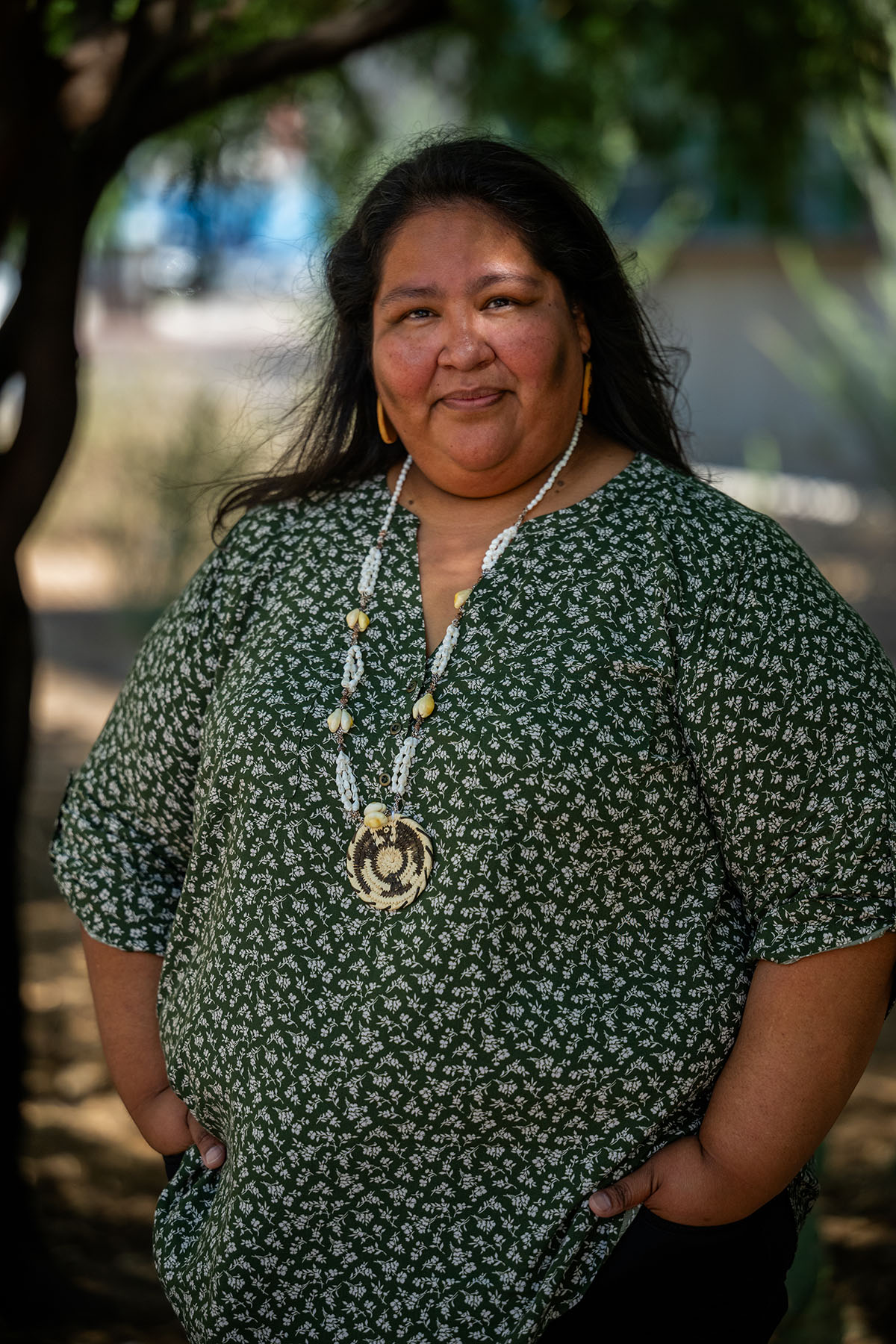
Gabriella Cázares-Kelly stands outdoors, wearing a green patterned blouse and a beaded necklace with her hands in her pockets. She smiles slightly, and trees create dappled light on her face and clothing.
Pima County voters cast more votes for Cázares-Kelly than any other Democratic countywide candidate in the July primary. (Ash Ponders for The 19th)

“I think people have for a really long time been very dismissive of social media,” she said. “But we can very much see a parallel between what happens on Twitter and Instagram and what happens in person.” For example, she said, when Kari Lake, a far-right Republican who ran for governor in 2022 and is now running for the U.S. Senate, sent out a tweet suggesting ballot counting was being slow-rolled to prevent her from winning, “it results in physical phone calls to my office.” 

Voter outreach will matter a lot this year, in what former recorder F. Ann Rodriguez describes as a “big election” for both the county and the nation. She points out that Pima is Arizona’s second most-populated county, after Maricopa, which happens to be one of the fastest-growing counties in the United States. And several hot-button issues will bring out voters: This year both abortion rights and the wages of restaurant workers are on the Arizona ballot.

For now, a lot of Cázares-Kelly’s work happens at events like this one, where she can answer questions in person. At the booth for NextGen America, which focuses on getting out the youth vote, she chatted about how the work was going and offered a pro tip learned from years of dealing with registration hassles: Instead of asking if someone is registered to vote, ask if they are registered at their current address. (Sometimes people move without updating it.)

Two booths down, at the Saavi Services for the Blind tent, she talked to Mohammed Falah about a tool called a ballot marking device — a machine that helps people with disabilities vote. It can read a ballot to a person through headphones, offers functions for large print or color contrast and has a controller that people with hand mobility issues can use to select their voting option. She said her office would be happy to demonstrate it for his organization. 

The county had the machines before she came into office, but, she said, much of the staff didn’t know how to use them. “They were like a nice decorative thing on the side of the room and if somebody asked to use it, [staff] would have to take out the instruction booklet and troubleshoot,” she said. “Then that person’s having to wait. And often it would lead to people feeling discouraged and embarrassed. And, you know, they may choose not to participate.” 

Listening to what the community needs, Cázares-Kelly said, “makes it better for everybody.” Sometimes it’s as simple as having a table with chairs at early voting locations. Older people started requesting that accommodation, she said, “but then we would see people who come in with a boot on their foot.” Once, she watched a mom sit down to breastfeed her child while voting.  

Her office has taken other accessibility measures, like making sure that PDF documents are compatible with a screen reader, a tool that can read text aloud or translate it into Braille. All of her social media communications include an image description for the same reason. 

As of 2016, there were about 175,600 visually impaired people in Arizona, and the population is aging, Falah said. This means more people will soon need these accommodations. “We are a retirement state,” he said. “If we do not tackle it now, then when?” 


A few weeks later, Cázares-Kelly was standing in front of a class of soon-to-be graduates from a training program that helps Indigenous people overcome the unique challenges they’ll face while running for office. Native politicians are often some of the first from their communities to either run or hold their positions and that usually comes with a fair amount of pushback or skepticism. 

Cázares-Kelly opened her talk by greeting the students in the Tohono O’odham language. Switching back to English, she said, “You are on O’odham land.” Then she added, with a smirk, “So — you’re welcome.” The group burst into laughter. It felt like a cheeky inside joke for a group of people who’ve likely been asked to do land acknowledgements for non-Native audiences. But the lighthearted moment quickly turned serious as Cázares-Kelly launched into the story of how she became involved in voting rights work thanks to her earliest influence, her grandmother. 

Cázares-Kelly grew up in two different communities in the Tohono O’odham Nation. One is called Kupk, a remote place where she spent her summers. The rest of the year, she lived in the village of Pisin’ Mo’o, which had some services, like a bus stop. She lived next door to her grandmother, Catherine Josemaria. Cázares-Kelly refers to her affectionately as her Hu’uli-bat, which is O’odham for “my dearly departed mother’s mother.”

They would communicate across their two languages, her grandmother in her broken English and Cázares-Kelly in her broken O’odham. They were always together, she said. Her grandmother showed her how to harvest traditional foods and she recalls watching her grind corn and clean tepary beans in the kitchen. 

But she also remembers another tradition: her grandmother’s voting ritual. It was a right Josemaria did not have until she was 30 years old. She was born in 1918 and granted citizenship six years later, but it wasn’t until 1948 that Native Americans won the right to vote. Even then, for decades, voting barriers like literacy tests specifically disenfranchised non-White and Indigenous people. 

But that didn’t stop Josemaria from being politically active. “She was a brilliant woman and she was a community leader,” Cázares-Kelly told the group. “We had visitors every single day of my youth, people wanting to hear her stories and her gossip — she was the gossip queen — and get her advice and have political discussions with her.”

On election days, Cázares-Kelly would comb and braid her grandmother’s long gray hair and pin it up in a bun. Her grandmother would don a dress and a little purse, and Cázares-Kelly would help her into the passenger seat of her car. Cázares-Kelly was too young to legally drive, but it was pretty common to start driving young on the reservation — and extremely important to get her grandmother to the polls. It only occurred to her later that what her grandmother was doing was a big deal, an act of defiance. “She would not have had the full freedom of having a language translator until the mid 1970s, which isn’t that long ago,” she said.

Once they returned home, her grandmother would go to her bedroom and tack her “I voted” sticker on the vinyl faux wood wall next to other stickers she had collected over the years. The oldest ones, Cázares-Kelly remembers, were yellow and worn. 

The importance of those stickers stayed with her. They serve as reminders to vote and are a source of pride. It’s part of the reason why in 2022, Cázares-Kelly’s office released new stickers for early voters with the words “I voted” written in English, Spanish and O’odham, one on top of the other. 

Her office has also expanded the role of the Tohono O’odham outreach coordinator to spend more time in the field talking to tribal residents and made it a priority to reinstate an early voting site for the Pascua Yaqui Tribe. The tribe had sued the previous county recorder after she closed the site in 2018 just a few weeks before an election. (A judge sided with the decision to close the site, saying there wasn’t evidence that closing it made it harder to vote.) 

Sestiaga recently told Cázares-Kelly how crucial that voting center has been for him. Even though he’s not a member of that tribe, voting at a site where people look like him makes him feel safer. He used to vote at a church in a predominantly White neighborhood and “going in as the young, Brown-skinned, darkest person in the room, I got looked at. I felt like people were watching me, like I was getting judged.” 

Sestiaga is able to vote at that site due to a change the county government made in 2022: Instead of having to go to a specific precinct, a resident can vote at any center in the county. Eleven other Arizona counties use this model and its popularity is spreading. According to the Voting Rights Lab, an advocacy organization, voter centers are more convenient, widely popular and could increase turnout. 

The centers also make voting easier for people on the reservation. As with any rural area, if someone shows up at the wrong precinct, it can be a long drive to the right one. And not everyone can afford that kind of error, said Cázares-Kelly. Many people don’t have cars or can’t afford to spend extra money on gas. Public transportation systems aren’t reliable, if they exist at all. 

As she wound down her speech at the leadership conference, Cázares-Kelly reminded the students that running for office is about advocating for their communities — not just when it comes to voting rights, but other policy decisions that are shaped by elected officials, like in health care or infrastructure.

“It’s our duty to protect our community,” she told them. “And if that means that we’re not doing it in the traditional way, but we’re having to learn the language of government and policy and funding to protect our people, then it’s our duty to at least try.” 


A few weeks after she announced she would run for president, Kamala Harris held a rally in Glendale, Arizona, a sprawling suburb just outside Phoenix. As she watched one of the opening speakers, the governor of the Gila Indian River Community, come up to the stage, Cázares-Kelly exclaimed, “There’s hella Natives up in this piece!” 

Harris and vice presidential nominee Tim Walz talked about some of the most pressing issues in Arizona: immigration and abortion restrictions. Harris also promised to pass the John Lewis Voting Rights Advancement Act, which would strengthen protections against discriminatory voting practices.

Cázares-Kelly was happy to hear it. But on the drive back home, she said that some of the things she heard at the rally didn’t resonate with her, like when Arizona Sen. Mark Kelly talked about the “army” Democrats need to win the next election. Her tribe, whose ancestral lands straddle both sides of the border, is heavily surveilled by the border patrol, which has a history of harassing and even deporting tribal members. The military rhetoric, she said, “doesn’t make me feel safe.”

Though she is a registered Democrat and a delegate at the Democratic National Convention, she stands to the left of the Harris-Walz ticket and has felt conflicted by its more moderate stances. Also, as an Indigenous person, her identity is inherently political. One of her idols, Minnesota Lieutenant Governor Peggy Flanagan, a citizen of White Earth Band of Ojibwe, once put it this way: These political systems were not designed to include people like her, but to eradicate and assimilate Indigenous people. 

Gabriella Cázares-Kelly stands on the steps inside an arena filled with people attending a campaign rally for Vice President Kamala Harris. She wears a black patterned top and smiles, while attendees around her are engaged in conversations or looking around.
Gabriella Cázares-Kelly poses for a portrait before a Harris Walz campaign rally at Desert Diamond Arena in Glendale, Arizona. (Caitlin O’Hara for The 19th)

“So we’re still fighting the structure of white supremacy and anti-Indigenous sentiment and all of these other issues,” Cázares-Kelly said, “and we’re having to change the culture about what our role is in that.”

Eventually, the conversation turned to her own political future. Already, people have been speculating about whether she’d consider a higher office, but she promised herself she’d stay in the role for at least two terms. “I don’t know how I’ll feel in another four years, but four years has flown by for me,” she said.

It was past 10 p.m. and she was still making her way home. But the long day hadn’t sapped the energy in her voice or her enthusiasm for the job.

“There is so much work to do,” she said. 

To check your voter registration status or to get more information about registering to vote, text 19thnews to 26797.
Hate Preacher Shows Us How To Hate God’s Word

I was not going to post another video, especially not of the Rev Ed Trevors.  But … this one touched my heart.  He refutes using the bible against the gay and trans community.  In fact he slams using the bible against anyone, that is not its purpose.  In this video he takes on a hate preacher bashing gay men.  He is reasonable and well reasoned.  Hugs.  Scottie

Israelis erupt in protest to demand a cease-fire after 6 more hostages die in Gaza

Snippets:

TEL AVIV, Israel (AP) — Tens of thousands of grieving and angry Israelis surged into the streets Sunday night after six more hostages were found dead in Gaza, chanting “Now! Now!” as they demanded that Prime Minister Benjamin Netanyahu reach a cease-fire with Hamas to bring the remaining captives home.

The mass outpouring appeared to be the largest such demonstration in 11 months of war and protesters said it felt like a possible turning point, although the country is deeply divided.

Israel’s largest trade union, the Histadrut, further pressured the government by calling a general strike for Monday, the first since the Oct. 7 Hamas attack that started the war. It aims to shut down or disrupt major sectors of the economy, including banking, health care and the country’s main airport. (snip-MORE)

https://apnews.com/article/israel-palestinians-gaza-hamas-war-hostages-hersh-netanyahu-29496f50a9b1740bd3905035ffd23052

(Meanwhile, democracy in Israel doesn’t seem to be the system anymore, US Republicans’s statements regardless-) (This narrative runs current to the top. There’s a good feature at the bottom here.)

07.58 EDT

Arnon Bar-David, the chair of Histadrut Labour Federation, Israel’s main trade union which launched the strike, said he respects the decision by the labour court to end the strike at 14:30 (local time) 12.30 BST, according to the Times of Israel.

It reports him saying in a statement:

It is important to emphasise that the solidarity strike was a significant measure and I stand behind it. Despite the attempts to paint solidarity as political, hundreds of thousands of citizens voted with their feet.

I thank every one of you – you proved that the fate of the hostages is not right-wing or left-wing, there is only life or death, and we won’t allow life to be abandoned.

Meanwhile, the newspaper reports that the Hostages and Missing Families Forum encourages the public to continue the demonstrations despite the ruling. “This is not about a strike, this is about rescuing the 101 hostages that were abandoned by [prime minister Benjamin] Netanyahu with the cabinet decision last Thursday,” the forum says, referring to the vote by ministers backing the IDF’s continued presence on the Philadelphi Corridor.Share

Updated at 08.11 EDT

07.42 EDT

The labour court’s ruling that today’s strike must end was welcomed by Israel’s finance minister Bezalel Smotrich.

In a post on X, Smotrich praised the decision to end what he called a “political and illegal strike.”

The Times of Israel reports he said in his statement that Israelis went to work today “in droves,” proving they are no longer slaves to “political needs.”

He added: “We won’t allow harm to the Israeli economy and thereby serve the interests of [Yahya] Sinwar and Hamas.”

06.41 EDT

‘Strike was not as powerful as people expected’ – dispatch from Tel Aviv

Julian Borger

Julian Borger is the Guardian’s world affairs editor

Tel Aviv this morning did not feel like a society about to bring its government down.

The debris had been removed from last night’s demonstration on the Ayalon Highway, the motorway which passes through the city centre, and traffic was moving normally.

Protesters stopped traffic at a couple of junctions around the city but for the most part, the traffic flowed. The national rail line was working, though some buses and light railway lines stopped.

Private companies gave their staff the day off, but it was more in the spirit of some sombre holiday rather than the start of an existential struggle with the government.

Ben Gurion airport only closed for a few hours, and it was announced that the whole general strike would end at 6pm. It is not government-ending stuff.

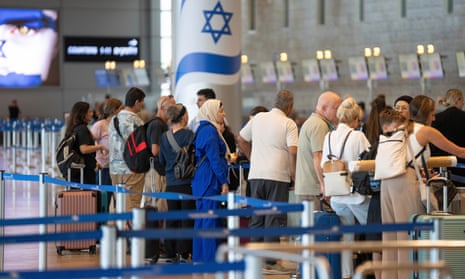
Travellers line up at Ben Gurion International Airport near Tel Aviv.
Travellers line up at Ben Gurion International Airport near Tel Aviv. Photograph: Ohad Zwigenberg/AP

The mood can best be described as bitterly realistic on Hostages Square, the name given to the plaza between the national library and the Tel Aviv Museum of Art, where hostage families and their supporters gather every day.

“I’m not sure the strike was as powerful as people expected,” said Debbie Mason, a social worker for the Eshkol regional council, the area of southern Israel abutting Gaza.

She made a distinction between what she hoped would happen and what she believed would happen, the latter being that nothing would change for the hostages.

“Unfortunately, there are too many things that are going to obstruct a deal, whether it’s on our side, whether it’s on Hamas’ side, it just doesn’t seem to be in anyone’s interest, that something should happen,” Mason said.

Hostage Square, established in the plaza between the National Library, the Tel Aviv Museum of Art and the Tel Aviv District Court. Buses arrive here daily with youth groups from the kibbutzes, moshavs and towns from the area of southern Israel invaded by Hamas on 7 October 2023.
Hostage Square, established in the plaza between the National Library, the Tel Aviv Museum of Art and the Tel Aviv District Court. Buses arrive here daily with youth groups from the kibbutzes, moshavs and towns from the area of southern Israel invaded by Hamas on 7 October 2023. Photograph: Julian Borger/The Guardian

Rayah Karmin, who comes from Mabu’im, a village near Netivot, near the Gaza border, agreed that a one-day strike would change little.

“Only a longer strike will make the people in government understand that the economy of Israel is going to go down,” Karmin, a vitamin supplement salesperson, said.

She pointed out that all the demonstrations and strikes were up against an immovable political fact. If a ceasefire is agreed, the far-right members of the coalition, notably Itamar Ben-Gvir and Bezalel Smotrich, will walk out and the government will fall.

“Smotrich and Ben-Gvir will leave Netanyahu, and then he will be without a coalition, and he will have to go home,” Karmin said. “And he knows that next time he won’t be elected, so he wants to stay as long as he can.”

“Bibi is a magician, a really big fucking magician,” Aaron, a 28-year-old legal adviser in a pharmaceutical corporation, said. He had been out on the streets for Sunday’s mass protests, but he had no illusions about who they were up against.

“If there’s a hostage deal, the government will fall, so they are not interested in a deal,” Aaron said. “What Ben-Gvir wants and what Smotrich wants, they get, because Bibi doesn’t want to go to jail. He doesn’t want to lose power, because Bibi will be voted out in the first election if the government falls.”

https://www.theguardian.com/world/live/2024/sep/02/israel-gaza-war-live-israel-faces-nationwide-general-strike-amid-public-anger-over-hostage-deaths-and-failed-ceasefire-talks

Georgia moves forward with bills to outlaw Pride events & trans people

https://www.lgbtqnation.com/2024/07/georgia-moves-forward-with-bills-to-outlaw-pride-events-trans-people/

This is what the fundamentalist religious / maga right want to do in the US notice the reason why they feel they need to pass this law.  Because it is changing tradition.  Tradition is peer pressure from dead people.  The right wing straight cis people like the way things are and don’t want to include other ideas or ways.  Just a warning.  Hugs.  Scottie

 
TBILISI, GEORGIA - MAY 17, 2018: Family day. People attend a rally marking the Day of Family Purity and opposing the International Day Against Homophobia and Transphobia
TBILISI, GEORGIA – MAY 17, 2018: Family day. People attend a rally marking the Day of Family Purity and opposing the International Day Against Homophobia and TransphobiaPhoto: Shutterstock
 

Georgia’s parliament on Thursday pushed ahead a sweeping package of bills that would effectively outlaw LGBTQ+ identity in the former Soviet republic.

The set of bills proposed by the ruling pro-Putin Georgian Dream party bans depictions of same-sex relationships in the media, outlaws gender-affirming surgery, and will make Pride events and the public display of the Pride flag in Georgia a thing of the past.

Parliamentary speaker Shalva Papuashvili describes the bills as necessary to control “LGBT propaganda,” which he said was “altering traditional relations.”

The first reading of the bill titled “On the Protection of Family Values ​​and Minors,” which draws heavily from Russia’s anti-LGBTQ+ “propaganda” law passed last year, drew widespread support among Georgia Parliament deputies. The bill is scheduled for second and third readings in the fall.

In addition to outlawing public gatherings “promoting” same-sex relationships, the legislation would also limit adoption to heterosexuals, ban gender changes on official identification, and outlaw “LGBT propaganda” in education.

Georgian Dream MPs have also proposed introducing “genetic” requirements in establishing legal marriage, whereby marriage would be a union of a “genetic woman” and a “genetic man.”

The Constitution already bans same-sex marriage in Georgia, where the deeply conservative Orthodox Church holds outsized influence in the government and public sphere.

Georgia enjoyed decades of progress on human and LGBTQ+ rights following the Rose Revolution in 2003, as a majority of citizens supported a pro-Western turn and integration into the European Union and NATO.


The rise of the Georgian Dream party in the last ten years, however, has seen the government reorienting toward Russia, with the Church encouraging the rapprochement.

Georgia’s version of Putin’s draconian “LGBT propaganda” law seems designed not only to roll back progress on LGBTQ+ rights but to scuttle any hope of Georgia entering the European Union, with its strict requirements upholding civil liberties and personal freedoms.  

The introduction of the anti-LGBTQ+ legislation follows the Georgia Parliament’s passage of another Russian-inspired law to label Western NGOs “foreign agents,” teeing up a harassment campaign aimed at expelling human rights and other groups that far-right conservatives and the Orthodox Church have accused of infecting Georgia and other countries with “degeneracy.”


Speaking of opponents of the nascent legislation in March, Mamuka Mdinaradze, leader of the Georgian Dream parliamentary majority, said, “Even if they brand the law against LGBT ‘propaganda’ not Russian, but Soviet, we will follow it through, given that it is the biggest challenge of modern times.”

Anti-LGBTQ+ sentiment runs high among extremists in the onetime Soviet vassal. In 2021 and 2023, violent mobs shut down Pride marches in the capital Tbilisi.

Organizers say foreign agents, delivered by Russian President Vladimir Putin, joined far-right fascist political gangs and members of the Georgian Orthodox church to sabotage the peaceful demonstration. Hundreds were injured in the two incidents.

Rights groups and supporters described the attacks as “pogroms.”

The News Out of TX from Janet

Transgender Adults Being Cut From Care After Florida Court Ruling by Erin Reed

by Erin Reed

After a court ruling from the 11th Circuit Court of Appeals allowed an anti-trans law in Florida targeting youth and adults go back into effect, many providers were forced to end care. Read on Substack

*With thanks to Janet.*

Several transgender youth and adults are being told their care will be terminated following a ruling from the 11th Circuit Court of Appeals by a majority-Trump appointed panel. The court ruled that a 2023 law, which restricts transgender care at any age, can go back into effect after being permanently blocked in June 2024.

The ruling, released late Monday, stated that transgender people are not a “quasi-suspect class,” meaning they do not receive the same level of equal protection under the Constitution as other categories such as race, ethnicity, religion, or sex. This decision implies that laws discriminating against transgender people are likely to be considered valid and constitutional by the 11th Circuit Court.

One such law, SB254, was passed in 2023. The law banned gender-affirming care for transgender youth but went further than similar legislation passed in several Republican-led states that year by also restricting care for transgender adults. The bill mandated that care for transgender adults could only be provided by physicians and required that patients receive forms outlining the “risks” of gender transition. Many proposed versions of these forms are filled with disinformation about transgender care.

The physician requirement has proven especially burdensome for transgender adults, as the majority of their care is provided by nurse practitioners. This is because the number of transgender adults far exceeds the capacity of physicians who offer gender-affirming care. Planned Parenthood, the largest hormone therapy provider in the United States, explains, “Most gender-affirming hormone care is provided at PPSP by advanced practice providers (physician assistants, certified nurse midwives, and nurse practitioners) in our health centers or over telemedicine.”

Now, with the law fully in effect, transgender adults who previously had access to care are being notified that their care will no longer be provided.

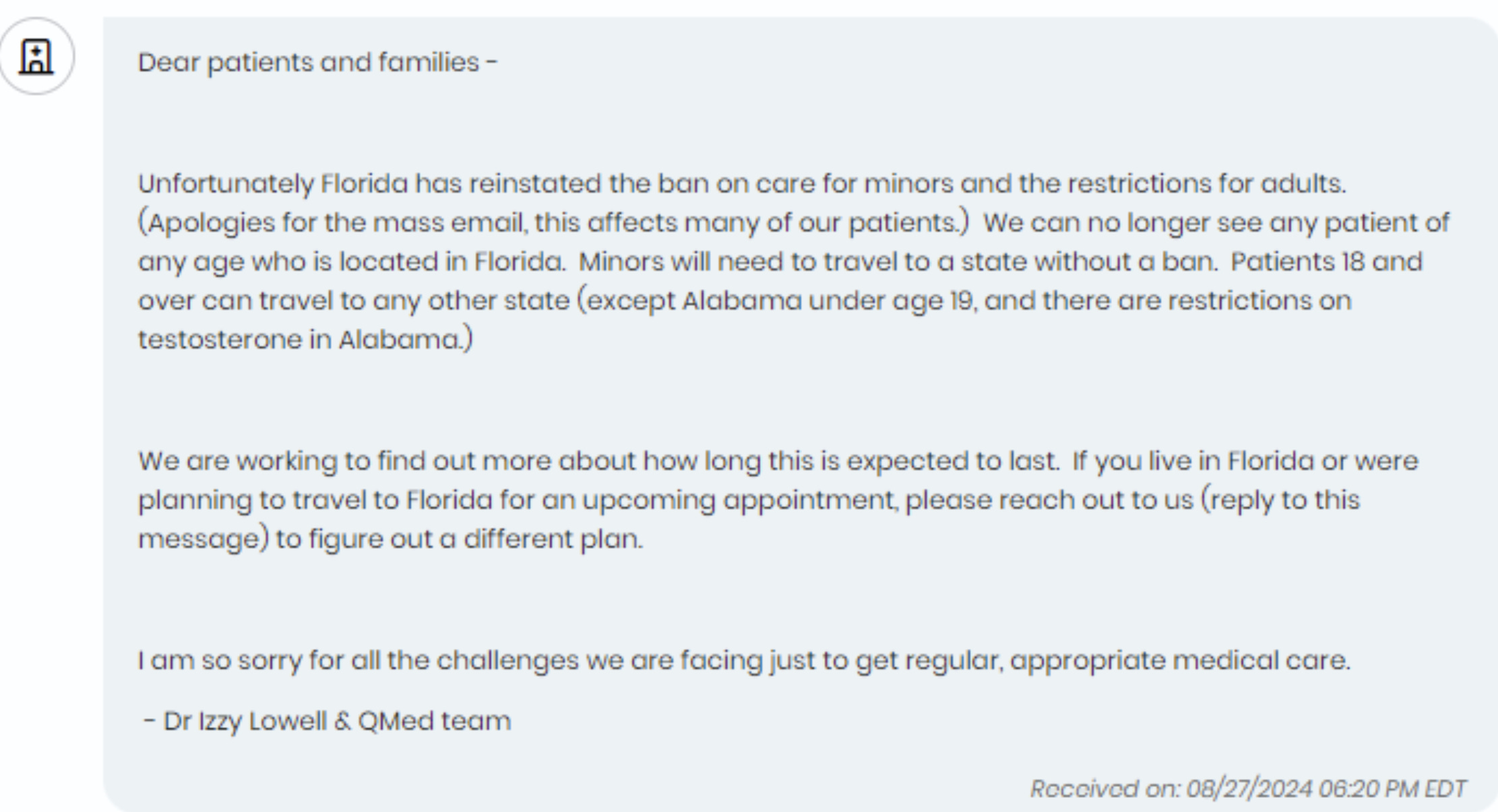
One anonymous patient shared an email from their provider, QueerMed, which stated, “Unfortunately, Florida has reinstated the ban on care for minors and the restrictions for adults… We can no longer see any patient of any age who is located in Florida.”

See that email here:

Email provided from a QueerMed Patient

Spektrum, a major provider in Florida, was also forced to terminate care and cancel new patient appointments. However, during the period when the law was blocked, the organization reportedly took steps to ensure patients were well-supplied with medication in case the law went back into effect:

“During this little freedom period as I call it … we made good use of that time to make sure all of our patients were well supplied with medication. Although I had hoped that it wouldn’t have been necessary, at least now we can say, I’m glad we did all the things that we did,” said Joseph Knoll, a nurse practitioner at the clinic, as reported by the Associated Press.

Healthcare bans are currently a contentious issue in courts across the United States, with some courts blocking bans on transgender healthcare coverage or provision. A major point of contention is whether discrimination against transgender people qualifies as sex discrimination, which would subject these laws to higher scrutiny regarding their constitutionality.

The Supreme Court is poised to rule on such questions later this year in a case stemming from Tennessee’s trans care ban. If the Supreme Court were to rule that transgender people are not entitled to equal protection under the law, many forms of discrimination against transgender youth and adults could be deemed fully legal.

For trans people in Florida, many cannot afford to wait for such a decision, and many have already fled the state. For those unable to leave, disruptions to their care will likely have significant impacts on their mental and physical health.

“We are deeply disappointed by this decision and the panel’s disregard for the district court’s careful findings and adherence to the Eleventh Circuit’s recent precedent. Allowing these discriminatory restrictions to go back into effect will deny transgender adults and adolescents lifesaving care, and prevent Florida parents from making medical decisions that are right for their children. As the district court found based on voluminous evidence, the record shows that these extraordinary restrictions were based on disapproval of transgender people and serve no purpose other than to harm transgender Floridians. The plaintiffs in this case are considering their options and will take every step possible to protect their right to equal treatment under Florida’s laws, which these restrictions egregiously violate. We will continue fighting for transgender Floridians and their families, and for everyone’s right to make healthcare decisions without government interference,” said the organizations representing the plaintiffs in the case.

US President for 4 years, yet has no clue about anything presidential. None at all.

In Praise of the Hardest Job in Arlington National Cemetery by Charlotte Clymer

It’s not what you think. Read on Substack

We practiced with caskets that were stored outside our barracks building. To simulate the weight of honored remains, we’d toss several full sandbags into the belly of the casket, and then, for hours and hours, we’d go through our exact movements.

Over and over and over and over.

Those were hot and humid D.C. summers, and it didn’t matter. Drink water. And then back at it. We’d march up crisply, pick up the casket, go through the entire funeral protocol—with an earned coordination that would rival any synchronized swimming team—and then do it again.

The first summer I was in the 3rd U.S. Infantry Regiment (The Old Guard), the A/C stopped working in our barracks. Think of the most depressing college dorm you’ve ever seen and remove air conditioning. We’d wake up in sweat in the middle of the night and open the fridge and stick in our face for a little relief.

We’d run through flag-folding drills at night in those hot barracks. We’d stand in the hallway in our casket teams, and we’d fold and fold and fold until we could do it in our sleep. Whatever you’ve seen in movies doesn’t come close. It is an exacting choreography. No movement wasted or erred.

Does the flag look perfect in presentation? Are the red and white stripes hidden? Are the stars symmetric? Is the cloth tight in the final form? No? Why the hell not? You’d give this to a mourning relative? Do it again. We will be here all goddamn night until you get this right.

Your exhaustion doesn’t matter. Better get some sleep. No excuses. I arrived at the unit as a 19 year-old Army private, not even being close to knowing that I didn’t know what I didn’t know. You sure as hell better learn and quick. Figure it out. Get yourself right. Pray if you’re the praying type.

Because families are flying in from all across the country for what will be one of the absolute worst days of their lives, shattered, maybe beyond repair, and all we can meagerly offer them is choreographed dignity in place of irreparable loss. It will never be close to enough. Perfection is never enough.

We’d spend so much time on our uniforms. There were presses in the basement. You think your barracks room is hot? Go downstairs and be hugged by steam. Learn how to use the press. Get those creases sharp. Eradicate all wrinkles. Ignore the sweat dripping into your eyes.

We carried micrometers with us to ceremonial details to ensure our uniforms were right — down to the centimeter. We’d shine every metallic surface on our bodies. What are fingerprints? We don’t know. We’d coat the soles of our shoes with edge dressing to turn them from grey to black.

I can’t believe I’m saying this now, but learning rifle manual and element marching was taking a break from everything else. Tedious as all hell. We wore steel plates on our shoes to click as we marched. They’d bang into our ankles at times, and you’d try not to swear. That was our break.

It was constant stress, all day, every day, and yet, we had it easy. If you want hard, go volunteer for the Tomb Guards. Go ahead and throw yourself into the actual deep end and find out if you can swim. Just raise your hand when they ask for volunteers.

Go to the Tomb, and work 18-hour days for months and months. You will learn everything there is to know about Arlington. You will memorize pages and pages of information. You will recite it all from memory, or you will fail. You will barely get sleep. You will have no life. There is only the Tomb.

I knew, deep down, I wasn’t ready for that. I respected it too much to raise my hand. I didn’t volunteer. My roommate volunteered. It was a curious decision on his part given that he struggled more than any other private. He definitely wasn’t ready, but God bless him for stepping up.

It takes nine months to earn the Tomb Badge, which, at the time, in terms of rarity within the U.S. military, was second only to the Astronaut Badge. Only 500 military personnel have earned the Astronaut Badge. Only 864 have earned the Tomb Badge. Walk in space or walk in front of the Tomb. That’s rarity.

My roommate was back with us in three months. He didn’t make the cut. Sink or swim at the Tomb. There is one standard: it is perfection and that’s all there is to it. He came back to us and had the sharpest, most squared away uniform in our entire company until the day he got out.

But the truth is that the Tomb Guards had it easy, too. We all had it easy. Because the hardest job in Arlington National Cemetery doesn’t involve wearing a uniform. The hardest job is being a cemetery official who is given the impossible task of bringing comfort to families.

I arrived at the unit in April of 2006. In January of 2007, Pres. Bush announced a dramatic increase in troop deployments to Iraq, now known as the Surge.

For three consecutive months that year—April, May, and June—there were over 100 U.S. military fatalities in Iraq — the deadliest year for U.S. service members in the Global War on Terror.

They came back in transfer cases on a C-130 at Dover Air Force Base, and I honestly don’t know how many of them wound up buried in Arlington. But I know there were a lot. I know we were pretty busy. All day carrying caskets or leading the caisson horses or marching behind them.

That’s not including the many fatalities in Afghanistan. That’s not including the old veterans who had passed and long ago earned the right to be buried there or their family members who qualified for burials, too. Funerals, funerals, and more funerals. That sums up 2007 for The Old Guard.

Who leads on caring for the families on one of the worst days of their lives? Who plays the painful combination of clergy and therapist to the aggrieved? Who does whatever they can for the ceremonial units? Who enforces respect for that hallowed ground?

Cemetery officials.

Day after day, month after month, year after year, it’s the cemetery officials, the civilians, some of them veterans, who undertake the ludicrously impossible task of cobbling together comfort and dignity for families who have had their hearts ripped out and stomped on by tragedy.

I can’t imagine doing what they do. If I were forced to make a choice between the public service they carry out for grieving families OR putting on a uniform to join a marching element, I’m going back to the steam room. At least in that procession, there’s an available freedom to be numb.

On Monday, according to reporting by NPR’s Quil Lawrence and Tom Bowman, a cemetery official was allegedly assaulted and harassed by members of Donald Trump’s presidential campaign because the official was enforcing a common sense regulation restricting filming or taking photographs.

Cemetery officials had issued clear guidance that only Arlington personnel are permitted to take video or photos in Section 60, the final resting place for those service members who were killed in Iraq or Afghanistan. Trump campaign staffers thought it didn’t apply to them. They were wrong.

Moreover, Arlington National Cemetery released a public statement confirming a report had been filed over the incident and included this bit:

“Federal law prohibits political campaign or election-related activities within Army National Military Cemeteries, to include photographers, content creators or any other persons attending for purposes, or in direct support, of a partisan political candidate’s campaign. Arlington National Cemetery reinforced and widely shared this law and its prohibitions with all participants.”

What were Trump’s campaign staffers attempting to do that was so flagrantly in violation of this law that a cemetery official, in the midst of all their other necessary responsibilities, felt it necessary to step in and put a stop to it?

This comes almost two weeks after Trump, during remarks at a campaign stop, called the Presidential Medal of Freedom “better” than the Medal of Honor, a moment so completely and weirdly disrespectful that the VFW National Commander issued a statement condemning him.

This comes almost four years, nearly to the day, after reporting by The Atlantic that Trump had called American war dead “losers” and “suckers,” which was corroborated by several other news organizations, a senior official in the Defense Department, and a senior Marine Corps officer.

This comes more than eight years after Trump attacked and insulted the parents of U.S. Army Captain Humayun Khan, who was killed in a roadside bomb in Iraq in 2004, drawing widespread condemnation from leaders in his own party.

This comes more than nine years after Trump slandered the military service of the late Sen. John McCain, who spent five-and-a-half years in captivity as a prisoner of war, being tortured, refusing to sell-out his fellow service members.

As you’ll probably recall, Trump stated: “He’s not a war hero. He was a war hero because he was captured. I like people who weren’t captured.”

I fully admit to being a partisan, but for me, none of this is about politics because none of the Republicans or conservatives I have ever known would so much as consider showing anything but respect and admiration for our service members, our veterans, and their families.

This is not about favor for any party or campaign because the moment you enter Arlington, politics are to be left at the gate. It’s not about you or me or anyone other than those buried in that ground and their loved ones who will never see them again because of their collective sacrifices.

But Donald Trump is unwilling or unable to understand that because he cannot conceive of offering the highest degree of selfless service to our nation. The concept of “all gave some, some gave all” is entirely incomprehensible to him. And therefore, he cannot extend proper respect to our military.

I cannot wait for the time to come when this self-absorbed coward will permanently exit public life into a tarnished and thoroughly mediocre legacy that will haunt him for the rest of his days.

‘Legislators don’t see me as human’: Missouri trans youth fight to survive anti-LGBTQ+ bills

GOP lawmakers have made the state hostile for trans youth. These teens and their parents vow to ‘assert themselves’

https://www.theguardian.com/us-news/article/2024/aug/24/missouri-trans-youth-anti-lgbtq-bills

Some parents have stockpiled medications in hidden locations. Some have stopped socializing with neighbors. Some have made plans to flee the state.

In Missouri, transgender youth and their families are grappling with an onslaught of attacks on their rights. Last year, Republican lawmakers outlawed critical healthcare treatments for trans youth and banned many trans athletes from school sports. Local school districts worked to censor LGBTQ+ books and prohibit trans children from using bathrooms that match their gender identity.

And the state’s attorney general has become a national leader in anti-trans policy, seeking to gain access to trans kids’ medical recordsfighting to restrict trans adults’ healthcare and attacking trans adults who use public locker rooms.

The state is one of the epicenters of the moral panic and anti-trans rhetoric that have dominated campaigns and media cycles during the presidential election. Under the guise of fighting the “indoctrination of our children”, Republicans have made restricting trans rights a focus of their platforms. Donald Trump has vowed to stop “the leftwing gender insanity” while a leading Missouri Republican has celebrated residents leaving the state due to anti-trans policies, saying: “We are better if they are gone.”

The toxic discourse has fomented fear and anger among conservatives about trans people’s increasing visibility in society and created deep anxiety and distress for queer and trans people and their families.

Parents of trans youth across the St Louis region interviewed for this article said they were desperately trying to protect their kids’ health and wellbeing as politicians have zeroed in on their children. They are rationing medications and traveling hours out of state for care. Some are counting the days until their kids turn 18 and the laws don’t apply; “We are truly doing what we can to keep our children alive,” said one mother of a trans boy.

“Kids are being told by their government that they have to be eradicated from public life,” said Chelsea Freels, a recent high school graduate from St Louis, who has become a vocal advocate for trans youth like herself. “I’m 18 now. I can handle it – ish. But I have to help the kids who are younger. It’s like Sisyphus pushing a boulder up a hill. You can help them get better, but then it’s gonna go back down.”

‘Legislators don’t see me as human’

Republicans in nearly every region of the US began introducing anti-trans legislation in 2021 as Joe Biden took office and the GOP and conservative legal groups made trans people a central target of their culture wars. The campaigns were fueled by false claims that trans girls were taking over women’s sports and kids were regularly undergoing “mutilating” surgeries to transition.

In Missouri, less than 1% of young people identify as trans, but lawmakers have made control over their lives an increasing priority.

“It’s stressful and physically and mentally exhausting,” said Corey Hyman, an 18-year-old trans man who has been testifying against anti-trans bills for roughly five years. “These legislators really didn’t take me seriously as a young kid, and they don’t see me as human. I just wish they’d give up.”

Republicans have long sought prohibitions on puberty blockers and hormone therapy, treatments that allow children to medically transition, which families can consider when trans youth are persistent and consistent about their gender identities. The treatments are part of the gender-affirming care model, which is endorsed by the American Academy of PediatricsAmerican Medical Association and other major US medical groups. There has been growing global scrutiny of the medications, including in the UK, which recently adopted restrictions, but they remain part of the recommended standards of care in America.

In Missouri, Republicans’ efforts were boosted last year by a media firestorm at a St Louis clinic for trans youth. Jamie Reed, a former caseworker at the Washington University (WashU) transgender center at St Louis Children’s Hospital, publicly denounced the clinic in February 2023, alleging youth who might not actually be trans were being rushed into treatments. A group of patients publicly rebutted the claims, saying the care was methodical and vital. Families argued lawmakers should stay out of their private medical decisions, but the GOP governor last June adopted a law banning gender-affirming treatments for minors.

The law said youth already receiving treatments could continue. WashU, however, ceased prescribing medications to all trans youth, meaning families could no longer continue treatment at a top children’s hospital.

Christine Hyman, Corey’s mom, recalled listening to the Senate hearing in her car when the ban passed: “I’ll never forget that feeling. First I was screaming, then I was crying. I sat in my car for half an hour when I got home, thinking, ‘How do I tell my son?’”

Living under the anti-trans laws

In the backyard of their St Louis house, Danielle Meert and James Thurow have a luscious garden of herbs and fruit trees that has become their oasis – a respite from the anxiety of trying to raise a trans boy in Missouri. “To be in the garden, not distracted by the bullshit that has consumed us for the past four years has been wonderful,” Thurow said, sitting in his living room one recent afternoon.

“Then there’s the guilt.”

That guilt, the couple said, comes from feeling they could always be doing more to stop anti-trans bills and protect their son Miles, who was turning 18 the following day.

WashU prescribed Miles hormones at age 15, and the treatment had obvious benefits, he said: “I feel comfortable in public. I don’t feel out of place with my friends who are dudes. It just feels good for people to view you as you are.”

Meert said the family was prepared for the healthcare ban. “We’ve been stockpiling medication and hiding it around town with friends and families in case child services shows up and raids our house. People say we’re overreacting or being hysterical, but these Republicans think I belong in jail, that my child is the downfall of America … He’s just a happy kid living his best life.”

They had rationed Miles’s medications so he had enough for his final year underage, but during that time, he lost access to his doctor; the law threatens revoked licenses for practitioners.

Miles said he had become adept at managing stress from anti-trans bills, joking of the sports bans: “It’s not like trans and gay people are known for their athleticism.” He knows how to calm his mother when she suffers panic attacks. He extends grace to those who oppose his rights, saying he understands people have questions about something unfamiliar.

He felt “very relieved” to turn 18, making his care lawful again. But he worries about younger kids.

People sit in a government hearing for a bill
Republican lawmakers in Missouri have made it one of the most hostile states in the nation for trans youths. Photograph: Hudson Heidger/Missourian

One St Louis mother of a 12-year-old trans boy has spent months talking to clinics in Illinois, Maryland, Minnesota and Michigan to try to find care for her son, who had been seen by WashU.

At a young age, the boy had repeatedly spoken of dying. “He didn’t want to grow up because he knew what that would look like,” said the mother, who requested anonymity to protect her son’s privacy. Once he started living as a boy and received gender-affirming treatment, his anger issues dissipated and he excelled at school, she added.

She scoffed at the media narrative that parents were trying to turn their kids trans. “You wouldn’t wish this upon anyone – for your child to feel uncomfortable in their body. But you do have to give freedom to children to tell you if something is wrong. You have to be loving and affirming and open to your child’s journey.”

In November, WashU sent her a letter expressing “deep regret” that a former staffer had publicly discussed her family’s treatment – an apparent reference to Reed, the former caseworker, who seemed to suggest in the media that this mother was rushing treatments.

“I was working with world-class doctors and the brightest minds in this science – how can that be wrong, how can that be illegal, how can that be bad parenting? I’m not denying my child medical care. I’m making sure I comply with the best practices,” said the mother, who provided records indicating there were roughly three years of appointments before her son got puberty blockers, which doctors recommended.

Her boy will soon need additional treatment. She has scheduled an initial appointment in Chicago, but she is anxious about travel costs and worried she will have to take medical leave. “This has robbed us of joy,” she said. “I hate counting the years until my son is 18 and he can move where he wants and go get care. I hate that I’m rushing his young, beautiful life to beat the legislative actions mandating what he can do.”

Reed declined to comment on the mother’s story and criticisms of her efforts, but has previously stood by her claims and continued to argue that the “clinic was harming kids” with medical interventions.

A ‘nightmare’ at schools

Missouri Republicans’ efforts have not stopped at healthcare. Earlier this year, lawmakers proposed bills to end legal recognition of trans people, prevent trans people from using facilities that match their gender identity in schools and workplaces and criminalize teachers who use trans students’ pronouns.

The bills did not pass, but LGBTQ+ families say the demeaning debates and news cycles have taken a toll. Some said they encountered bullying at school, hateful comments from neighbors and casual transphobia at social gatherings. Others said they were forced to cut off relatives who had absorbed misinformation or refused to use correct names and pronouns. Some outspoken advocates said they feared for their safety. Several parents said the stress had made them physically ill.

At one school board meeting last month in St Charles county, a more conservative county neighboring St Louis, queer and trans youth and their supporters sat through a lengthy discussion surrounding a proposal to make it easier for civilians to challenge potentially “obscene” materials – a move seen as an effort to increase censorship of LGBTQ+ content. Some attendees held “trust our teachers and librarians” signs and a trans pride flag, applauding when a student criticized the removal of queer characters from shelves; another speaker said kids shouldn’t be exposed to “sexual scenes”.

Toward the end of the meeting, a board member gave a speech about her disdain for trans youth using locker rooms, an item not on the agenda.

Youth protesters and parents of trans kids gathered at the end of the meeting to commiserate.

“The trans community is burning to the ground here. It’s a nightmare. Where are the national LGBTQ+ organizations?” said Kim Hutton, who has a trans son.

“They frame these policies as ‘protecting the children’, but they’re really just hurting specific marginalized groups. It’s not fun to see when you’re part of those marginalized groups,” said Hannah Yurkovich, a 17-year-old St Louis high schooler at the meeting. “I grew up here, I love St Louis, but I can’t be part of it, if it’s going to keep being against who I am.”

Her friend, Rohan Webb, 18, attended a neighboring high school that adopted gender-neutral bathrooms to better support LGBTQ+ students and had queer support groups. “To see this school district move in the exact opposite direction is saddening,” they said. “To see them getting to make students’ lives so much worse is infuriating.”

‘Will Democrats throw us to the fire?’

Trans Missourians and their families say they have endured by leaning on each other. Families carpool to government hearings. A regional summer camp provides a safe haven for LGBTQ+ youth. Rene and Kyle Freels, the parents of Chelsea, the recent high school graduate, run a support group for trans kids and parents, and they have organized “Transgiving” potlucks for Thanksgiving.

Chelsea has dedicated significant time to supporting trans youth who don’t have the resources she has had. Over breakfast at a queer-friendly cafe with her parents, she described how she assists others in legally changing their name, saying she had just received a court alert about a case she was managing.

“It’s all in the bucket of preventing suicidality,” Chelsea said matter-of-factly. “That is what worries me the most about going to college, because sometimes I have to talk them down … What happens if I’m not in St Louis?” She said she has been fighting to stop friends’ suicides since she was 15 and learned to always gets friends’ addresses in cases of emergencies.

“The public only hears from trans people in the positions of the highest of privileges. I have supportive parents, I’m white, I’m 18, I got healthcare – later than I needed it, but I got it. But my story is one aspect of the trans story, and it’s one of the better ones, and even it is filled with sadness.”

Chelsea, who is leaving the state for college and is interested in coding and liberal arts, said she felt disillusioned with politics. On the Republican side, people were using “genocidal rhetoric” to talk about trans people, she said, referencing calls for the “eradication of transgenderism” at last year’s Conservative Political Action Conference and demonization of trans people in the Trump-aligned Project 2025.

On the Democratic side, candidates defend trans rights, but it feels fragile, she said.

“The Democrats in Missouri are our allies, they’re the best support we have in the chamber, but there’s an anxiety they won’t always be that way. When shit hits the fan, they’ll say, is it worse to be out of office and standing on your morals, or is better to just throw a little bit to the fire? But the thing they’re throwing to the fire are my friends and family.”

The Freels considered relocating to Illinois last year, but couldn’t afford it.

“There will always be trans kids and they will be out and asserting themselves,” Rene Freels said. “We’re part of this leftover crew that is super mad and stubborn and wants to see this resolved and want our kids to have full civil rights.”

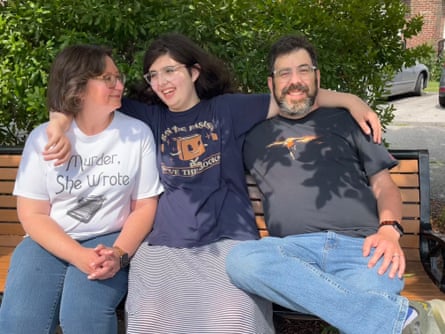
A family of three smile while embracing each other and sitting on a park bench
(From L-R) Rene, Chelsea and Kyle Freels pose for a photo. ‘There will always be trans kids and they will be out and asserting themselves,’ says Rene Freels. Photograph: Sam Levin/The Guardian

Miles, who hopes to become a teacher or work with youth, said leaving is not an option: “I’ve always wanted to stay here. It sounds weird, but I really love Missouri. I have so many memories here and I could see myself raising my kids here.”

Missouri is where he spent his whole life, where his favorite restaurants and hiking trails are, where his girlfriend and her family live, where he had his first date, he said.

He can’t imagine moving away from his elderly grandparents, who he stays with on a weekly basis. “I have a plan for my life,” he said, “and I couldn’t imagine doing it somewhere else.”

Throughout Meert and Thurow’s home are objects they have repurposed from friends who left the state due to anti-trans laws.

In the garden, the couple recently put up a sign saying they had planted beans “in remembrance of the 50+ families we know that have left Missouri”. But the number of departures is greater, she said. They’ve lost count.

Peace & Justice History

for 8/22

August 22, 1958
President Dwight Eisenhower announced a voluntary moratorium on nuclear weapons testing. A report outlining a system for monitoring and verifying compliance of a complete ban on such testing had been released just the day before. The Conference of Experts, as it was known, had been meeting in Geneva, Switzerland, to work out the details on detection of violations of such a treaty. The U.S. delegation was led by Nobel physics laureate Ernest Lawrence from the University of California (the Lawrence Livermore National Laboratory is named after him).
Eisenhower predicated his moratorium on U.S.S.R. and U.K. agreement to the same limitations. All three countries agreed to the one-year halt in testing and to begin negotiations on a complete test ban at the end of October; all three performed last-minute (atmospheric) tests before the opening of talks.
August 22, 1964
Fannie Lou Hamer, leader of the Mississippi Freedom Democratic Party (MFDP), testified in front of the Credentials Committee at the Democratic National Convention. She was challenging the all-white delegation that the segregated regular Mississippi Democrats had sent to the presidential nominating convention.

Singing at a boardwalk demonstration: Hamer (with microphone), Stokely Carmichael (in hat), Eleanor Holmes Norton, Ella Baker
.
Mississippi’s Democratic Party excluded African Americans from participation. The MFDP, on the other hand, sought to create a racially inclusive new party, signing up 60,000 members.
The hearing was televised live and many heard Hamer’s impassioned plea for inclusion of all Democrats from her state.The hearing was televised live and many heard Hamer’s impassioned plea for inclusion of all Democrats from her state. In her testimony she spoke about black Mississippians not only being denied the right to register to vote, but being harassed, beaten, shot at and arrested for trying. Concerned about the political reaction to her statement, President Lyndon Johnson suddenly called an impromptu press conference, thereby interrupting television broadcast of the hearing.

Hear her testimony   Link to photo gallery 
August 22, 1971

The FBI (Federal Bureau of Investigation) arrested twenty in Camden, New Jersey, and five in Buffalo, New York, for conspiracy to steal and destroy draft records. Eventually known as the Camden 28, most were Roman Catholic activists, including four priests, and a Lutheran minister. “We are not here because of a crime committed in Camden but because of a war committed in Indochina….” Cookie Ridolfi The Camden 28 
August 22, 1972
Rhodesia’s team was banned from competing in the Olympic Games with just four days to go before the opening ceremony in Munich, Germany. The National Olympic Committees of Africa had threatened to pull out of the games unless Rhodesia was barred from competing. Though the Rhodesian team included both whites and blacks, the government was an illegal one, controlled by whites though they represented just 5% of the country’s population. It had broken away from the British Commonwealth over demands from Commonwealth member nations that power be yielded to the majority.
Read more 
August 22, 1986

The Kerr-McGee Corporation agreed to pay the estate of the late Karen Silkwood $1.38 million ($2.68 in 2008), settling a 10-year-old nuclear contamination lawsuit. She had been active in the Oil, Chemical and Atomic Workers union, specifically looking into radiation exposure of workers, and spills and
leaks of plutonium.

The story of Karen Silkwood 

Scientists saved crocs from cane toads by making them sick

August 17, 2024 Imma Perfetto

https://cosmosmagazine.com/australia/scientists-saved-crocs-from-cane-toads-by-making-them-sick/

(I know cane toads are an abhorrent, invasive species, being moved [by humans!] from their original place on the planet to another place, to try to control another species. However, there is a YA novel about cane toads that ended up being a “banned book” one year. The then-kid was really into banned books, so we bought it, and it was a bit of a tear-jerker and I have a tiny soft spot for them, since it wasn’t their faults they got transplanted; they were only doing the best they could. Anyway, here’s this.)

Scientists have successfully saved freshwater crocodiles from toxic cane toads invading northern Australia with an unusual new tactic – doctored cane toad carcases.

By teaching freshwater crocodiles (Crocodylus johnstoni) to associate cane toads (Rhinella marina) with a bout of food poisoning, they reduced death rates by at least 95%.

Across the dry season (May to October) between 2019 and 2022, Macquarie University scientists worked on the project with Bunuba Indigenous rangers and the Department of Biodiversity, Conservation and Attractions (DBCA) in Western Australia.

They collected cane toads, removed the poisonous parts, and injected the bodies with a nausea-inducing chemical that caused the crocs eating them to feel temporarily sick.

A black and white photograph of a crocodile sticking its head out of the water. It is about to eat a piece of meat hanging from a stick next to the shoreline
Freshwater crocodile taking doctored cane toad bait. Credit: Georgia Ward-Fear

It’s a behavioural ecology method known as conditioned taste aversion, and it worked remarkably well.

“The first three days we noticed the crocodiles were taking the cane toads, then they would go away,” says Bunuba ranger coordinator Paul Bin Busu, whose team set up hundreds of bait stations across 4 large gorge systems in the Kimberley region of north-western Australia.

The doctored cane toads were deployed alongside chicken meat control baits to monitor the effectiveness of the training.

“Then we noticed they would smell the cane toad before eating, and on the last day we noticed that it was mostly the chicken necks getting eaten,” says Bin Busu.

The team used nocturnal ‘spotlighting’ surveys and remotely triggered wildlife cameras to monitor crocodile and toad numbers following the intervention.

“Our baiting completely prevented deaths in areas where cane toads were arriving and decreased deaths by 95% in areas where toads had been for a couple of years,” says Macquarie’s Dr Georgia Ward-Fear, who is lead author of the report detailing the findings in Proceedings of the Royal Society B.

A black and white photograph of a crocodile sticking its head out of the water. It is about to eat a piece of meat hanging from a stick next to the shoreline
Freshwater crocodile taking doctored cane toad bait. Credit: Georgia Ward-Fear

Ward-Fear says these effects continued in the years following.

Some populations of freshwater crocodiles in tropical Australia have fallen by more than 70% due to ingesting cane toads.

“Freshwater crocs can be heavily impacted as their river systems dry out during the late dry season,” says Ward-Fear.

“They end up congregating in large numbers with very little food, and as toads begin to use these waterbodies for rehydration, the two come into contact and we see large numbers of crocodile deaths over a few months.”

Now, conditioned taste aversion interventions can be planned both ahead of and behind the cane toad invasion front in areas with similar ecology.