Hi I woke at 12:30 am and the cat Tupac was yowling. I thought he wanted food. But he only wanted attention. So I was now awake and dressed, sometimes I just put on my shoes as I don’t mind being nude in my home, but when I put down food for him … he went back down the hall meowing for me to follow him.
So long story short, I have been up since 12:30 am and after talking to Ron about supper I somehow got roped into making a red tomato sauce with the fixings. I may be back later. Ok I admit it may be a bit my mistake … I wanted some. But he did do a few pounds of meat and other things like mushrooms and beef and peepers and onions. Hugs and loves.
With two weeks until the election, Jon Stewart sifts through the increasingly weird and surreal election news: from Trump’s ramble about Arnold Palmer’s d*ck, to his shift at McDonald’s, to Kamala Harris’s campaign event with Liz Cheney. Plus, he breaks down the GOP’s reaction to Trump’s “enemy within” comment.
There are many on Food Network’s site, and I’m just certain I’ve seen someone create a pseudo-seafood dish with it, so it should be here: https://www.foodnetwork.com/search/jackfruit-recipes- , but it’s not. There is no jackfruit seafood recipe, and but one recipe for vegan seafood, Vegan Sushi. I almost got lost on the site, though. I love that channel except on Fridays and Saturdays! 🌞
Meanwhile, the bad news; here’s the allergen info for jackfruit. It’s comprehensive, so you’ll be able to know if you should have it or not, after you read the beginning of it, and there’s more info from there. https://www.annallergy.org/article/S1081-1206(18)31144-X/abstract (For instance, latex gives me an open rash, so I need to avoid jackfruit, I’m gonna say.)
This was gonna be a really pretty post, too! Ah, well. Enjoy some forest instead.
(I had a Substack from Jose’ Andres with a ceviche recipe, but after setting the post up, it turns out it’s a paid article, and I’m a free subscriber. Still, it sounded so perfect, especially for a day when someone might not have much appetite, so here’s a recipe from another place online I like to read. You may do the same thing I do: if I want something today, and don’t have an ingredient or two, or some ingredient doesn’t agree with me, I improvise with what I have/will eat. If I do that, I may not call it, say, ceviche, but just a thing I made. No worries! -A)
When the heat of summer sets in I just want to eat meals that will cool me down. My relationship with soups, stews, and basically anything that comes out of the oven is on hold for these next few months. I prefer easy summer dinners that come together quickly when I don’t feel like cooking.
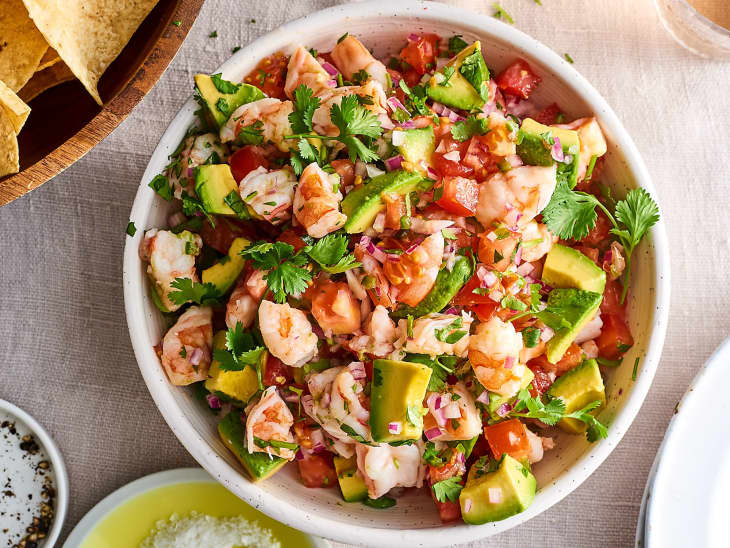
Needless to say, this shrimp ceviche is on heavy rotation. The shrimp are gently poached first, then marinated in freshly squeezed lime and lemon juice with ripe summer tomatoes, red onion, jalapeño, and fresh cilantro. Add creamy, diced avocado right before serving. It’s tangy and refreshing, perfect for those hot summer days.
The shrimp are perfectly cooked. Instead of relying on citrus juice to “cook” the shrimp, we’re poaching the shrimp quickly in hot water. Poaching the shrimp gently cooks them for the best texture, then they’re marinated in fresh lime and lemon juice.
It’s bright and fresh; full of zesty lime, buttery avocado, juicy tomatoes, with a kick of jalapeño. Serve it as a snack, lunch, or light dinner. Whichever way you choose, be sure to have crunchy tostadas or tortilla chips nearby for scooping.
Key Ingredients in Easy Shrimp Ceviche
Peeled and deveined raw medium shrimp: Unless you’re buying shrimp fresh off the boat, it’s most likely been frozen at some point. Frozen shrimp is the best choice because you can find them already peeled and deveined in the frozen aisle at most grocery stores.
Citrus juice: Marinate the cooked shrimp in freshly squeezed lemon juice and lime juice.
Red onion: Finely chopped red onion gives the shrimp ceviche some bite.
Jalapeño pepper: Add finely chopped jalapeño for a bit of heat.
Cilantro: Chop both the leaves and tender stems, which are edible.
Avocado: Add the diced avocado right before serving.
How to Make Easy Shrimp Ceviche
Cook the shrimp. Bring a large pot of salted water to a boil over high heat. Turn off the heat, add the shrimp, poach until the shrimp are opaque and just cooked through, drain, and set aside until cool enough to handle.
Combine the ingredients. Chop the cooked shrimp into 1/2-inch pieces and place in a large bowl. Add the lemon juice, lime juice, tomatoes, red onion, jalapeño, cilantro, and salt, and toss to combine. Cover and refrigerate for at least 1 hour.
Add the avocado right before serving. Just before serving, dice the avocado, add to the ceviche, and gently toss to combine. Serve with tostadas or tortilla chips.
Helpful Swaps
Use frozen cooked shrimp. To save time, you can use frozen cooked shrimp instead of frozen raw shrimp. Thaw the frozen cooked shrimp completely and drain well before using.
Use serrano peppers. Use serrano peppers instead of jalapeño if you like a spicier ceviche.
Is Ceviche Safe to Eat?
We cook the shrimp for this ceviche, which means you don’t have to worry as much about obtaining the freshest raw shrimp possible, which can be a challenge depending on where you live and what’s easily accessible.
Storage Tips
Leftovers can be stored in an airtight container in the refrigerator for up to 1 day.
Easy Shrimp Ceviche Recipe
Prep time 15 minutes to 20 minutes, Cook time 2 minutes to 3 minutes
Serves 4 to 6
Ingredients
1 pound peeled and deveined raw medium shrimp, thawed if frozen
1/4 cup freshly squeezed lemon juice (from 2 lemons)
1/4 cup freshly squeezed lime juice (from 2 to 3 limes)
2 medium tomatoes, seeded and chopped
1/2 small red onion, finely chopped
1 medium jalapeño, seeded and finely chopped (about 3 tablespoons)
1/2 cup chopped fresh cilantro leaves and tender stems
1/2 teaspoon kosher salt
1 medium avocado
Tostadas or tortilla chips, for serving (optional)
Instructions
Bring a large pot of salted water to a boil over high heat. Turn off the heat, add 1 pound peeled and deveined raw medium shrimp, and poach until the shrimp are opaque and just cooked through, 2 to 3 minutes. Drain the shrimp and set aside until cool enough to handle, about 10 minutes.
Chop the shrimp into 1/2-inch pieces and place in a large bowl. Add 1/4 cup freshly squeezed lemon juice, 1/4 cup freshly squeezed lime juice, 2 chopped tomatoes, finely chopped red onion, 1 finely chopped medium jalapeño, 1/2 cup chopped cilantro, and 1/2 teaspoon kosher salt, and toss to combine. Cover and refrigerate for at least 1 hour or up to 4 hours.
Just before serving, dice 1 medium avocado, add to the ceviche, and gently toss to combine. Serve with tostadas or tortilla chips, if desired.
Recipe Notes
Storage: Leftovers can be stored in an airtight container in the refrigerator for up to 1 day.
If you know one thing about me…you know I absolutely love the sea and everything that comes from it. Over the last couple of years (we passed our two year mark here at Longer Tables and I didn’t say anything! Happy anniversary, friends!) I’ve told you about my love of oysters, and crabs, and octopus, and all kinds of fish, as well as the beauty of drinking seafoam, and watching the stars from the beach at night, and sailing across the ocean on a tall ship. So you know this is true!
And you know something else about me, which is that I love Vegas. It’s a city where anything can truly happen…there’s magic, there’s mystery, there’s great energy, and of course there’s some of the best dining in the world.
So friends—I’m thrilled to be able to share with you the news that my team and I, we are bringing two of my favorite things together: we are opening Bazaar Mar in Vegas! I don’t know if any of you were able to make it to Bazaar Mar in Miami when it was open in Brickell from 2016 to 2019, but I’m not lying when I tell you it was one of my favorite restaurants we ever opened (no offense to the others, of course! I love them all…). The design, these beautiful blue and white tiles everywhere, the art from my friend Sergio Mora, the feeling like you’re under the sea, were amazing. And the menu! We did some of our best R&D there, and served some incredible seafood to happy guests. I was so sad we had to close it five years ago.
But now, it’s as if it’s rising again from the ashes, crossing the country to become a beautiful oasis of seafood in the middle of the Nevada desert.
Friends—Bazaar Mar is back, and I couldn’t be happier.
If you’ve never been to a Bazaar, I’ll tell you this: it’s a place of discovery, of wonder, of surprise. You can visit a Bazaar multiple times and still find new things. Think of exploring a spice bazaar or a market in a new city: what do you think you’ll find? What will you taste, what will you smell, what will you see? There’s always something new around the corner!
Some of you know that I also have Bazaar Meat in Vegas, which celebrates everything carnivorous, from jamón to suckling pig to thick grilled chuletón steaks. Steak is great, but sometimes you need to go to the open ocean! I hope that Bazaar Mar is that place of wonder and surprise for everyone who’s excited to explore a bit deeper below the surface..
Chef Manny and Chef Daniela, with Chef Victor from Bazaar NY!
Enough talk, José, more food! Okay, okay, so what am I excited to eat there? Well, I know what I’m excited to have, but I also spoke with two of my chefs from the restaurant—Daniela Romero, the restaurant’s head chef, and Manny Echevarri, the head chef of all of the Bazaars. Like me, they both loved Bazaar Mar in Miami, and are so excited to be able to open the restaurant again in an amazing city like Vegas. Here are a few of our favorites!
Got friends in Vegas, or someone who always seems to be there?
River Trout Cone: Every Bazaar has a unique cone—which, if you’ve never been to any of my restaurants, is a little beautiful crunchy two-bite snack that can be savory or sweet. The one we’ve made for Bazaar Mar has a flower made of a very very special trout from Virginia, raised by the Walker family in a 1930s-era fishery (I’ll tell you more about Ty and Shannon Walker and their trout sometime!). It’s got a little preserved Meyer lemon and dill on it…an amazing way to start the meal.
Cobia Rosa Ceviche: Have you ever had the fish called Cobia? It’s an amazing mild, buttery, firm fish, absolutely perfect with leche de tigre (the very famous Peruvian lime dressing for ceviche). This was one of my absolute favorites from The Bazaar in Miami, and I’m so happy to be bringing it back (a bit updated from the earlier version, and still amazing). Oh, and the Cobia is coming from Panama, from Open Blue, a project promoting the sustainability of this delicious fish.
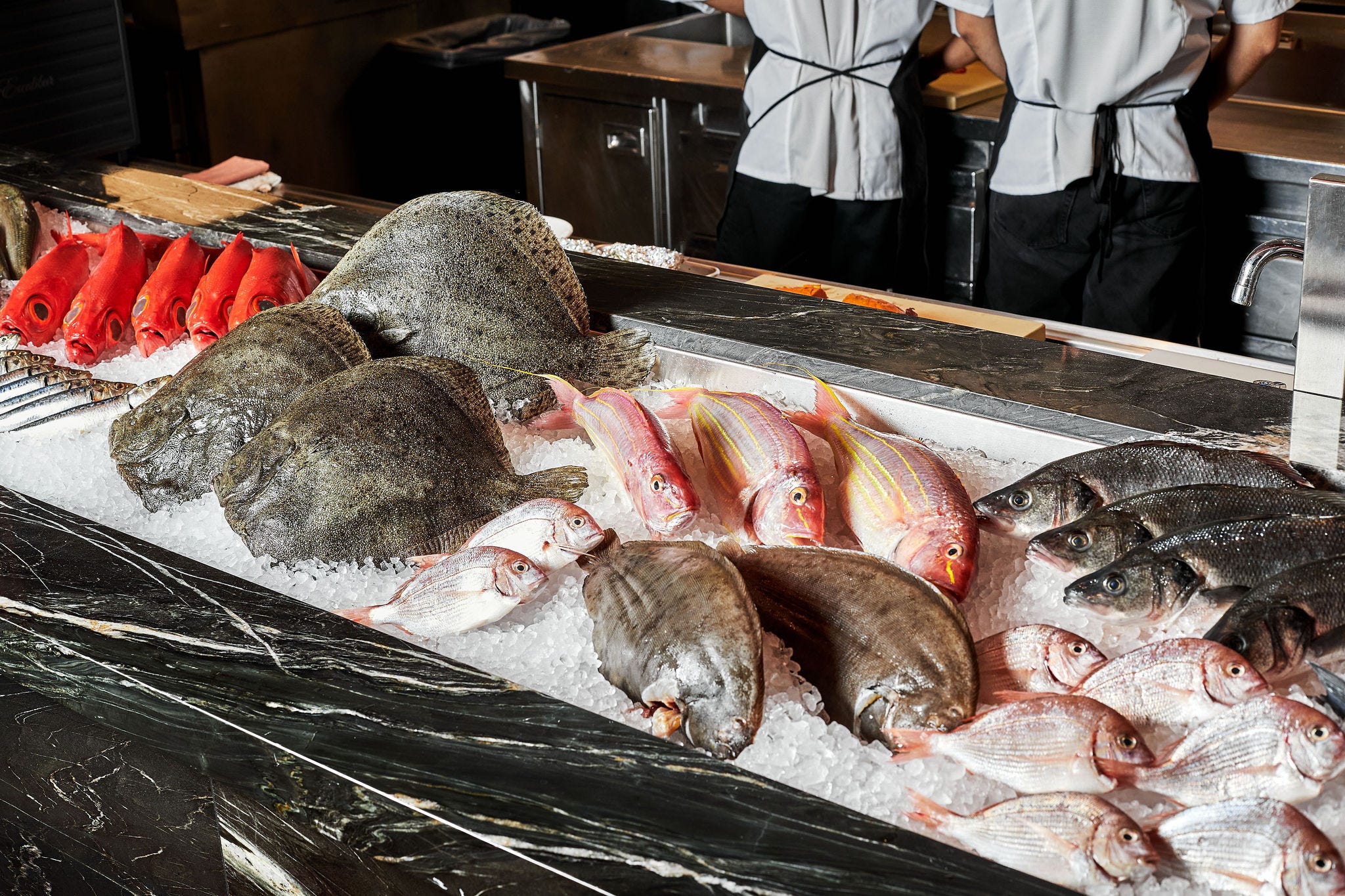
Salt-Baked Whole Fish, served tableside: It’s just what it sounds like…just as theatrical and amazing as you can imagine. You’ll be able to pick your fish of choice, whether it’s turbot, lubina, red snapper, sea bream, or whatever we have from the fishers that day, and you can tell us how to prepare it: fried, like they do it in Ibiza; grilled over wood; Donostiarra-style (which you know how to do at home!) or baked in salt. I don’t know if I have a favorite, but I do know that to have a salt-baked fish prepared for me by a great server is an amazing thing! By the way, we won’t have this available immediately at opening, but we’ll be introducing it soon after!
Maybe you can tell—the fish we are serving is from the very best places in the country and the world. We care so much about the ingredients we’re serving, so we’ve found the best. And of course, fish, like produce, is seasonal…so you won’t always find the same dishes on the menu.
Okay, enough of me telling you guys what I love about this restaurant. I’m getting so excited thinking about it, and I hope you are too! I know maybe not everyone goes to Vegas very often, but I think maybe it’s time to give it a visit, just to feast for a few days…? You don’t even need to gamble!
Bright future for medicines and farming after fluorine discovery
July 30, 2024 Ellen Phiddian
US researchers have figured out an environmentally friendly way to mix fluorine into carbon molecules using enzymes and light.
The discovery illuminates a path for safer and more ecologically sound materials, particularly pharmaceuticals and agricultural chemicals.
“This work could pave the way for new, greener technologies in chemical production,” says senior researcher Professor Huimin Zhao, from the University of Illinois at Urbana-Champaign.
Fluorine atoms can be very powerful additions to bioactive materials. They can make medicines easier to absorb, more stable in biological systems, and better at interacting with other proteins. About 20% of pharmaceuticals on the market contain fluorine.
But these organic (carbon-containing) molecules all typically need a bond between a fluorine atom and a carbon atom to work.
This bond is rare in nature, and difficult to make in a lab. At the moment, most fluorine-containing substances are made using super-toxic hydrogen fluoride, which can be fatal with just a small splash to the skin.
This has spurred chemists to hunt for other ways to fluorinate molecules.
In this research, the scientists used a protein that responds to light, called a photoenzyme.
Using this enzyme, they were able to add fluorine to a class of molecules called olefins. These carbon-containing molecules are widely used as a feedstock in the chemical industry, because they’re easy to turn into a range of other molecules.
The reaction is also “stereoselective”: it can differentiate between molecules that are chemically identical, but optically different. This is a difficult property to achieve in a lab, but crucial to the pharmaceutical and agricultural market because biological organisms can react differently to optically different molecules.
Maolin Li (seated) and Huimin Zhao in the lab. Credit: Center for Advanced Bioenergy and Bioproducts Innovation (CABBI)
“Our research opens up fascinating possibilities for the future of pharmaceutical and agrochemical development,” says Dr Maolin Li, a postdoctoral researcher at the University of Illinois at Urbana-Champaign.
“By integrating fluorine into organic molecules through a photoenzymatic process, we are not only enhancing the beneficial properties of these compounds but also doing so in a manner that’s more environmentally responsible.
“It’s thrilling to think about the potential applications of our work in creating more effective and sustainable products for everyday use.”
n the quaint district of Milho Verde, it’s impossible to go without hearing about Geralda Francisca dos Santos and her biscoito de polvilho (a cassava flour and cheese puff). At 81, Dona Geralda is one of the region’s traditional cooks of quitanda, pastries typical of Brazil’s food culture, especially in the state of Minas Gerais.
Ahead of festivities like the Three Kings’ Day and the Feast of Our Lady of the Rosary, her daughters and granddaughters — even those living in other districts — join her in the kitchen, surrounding the termite mound, clay, and tile shard oven that Dona Geralda built. They aim to help the matriarch meet the extraordinary demand, but these gatherings always mean something else.
“When my mother and I cook around her oven, she tells me stories of Milho Verde and our family that I didn’t know about,” Silvana Aparecida Santos, 38, who learned the quitanda alchemy from a very young age by watching and listening to her mother, tells Refinery29 Somos. “When we cook quitanda together, we shorten distances between us.”
“Quitanda goes beyond the kitchen. Before the dish became a local culinary symbol, it helped fuel a resistance movement.”
BEATRIZ MIRANDA
For many women like Aparecida Santos and Dona Geralda, quitanda goes beyond the kitchen. Before the dish became a local culinary symbol, it helped fuel a resistance movement. The tradition of cooking these pastries has crossed generations of women workers (predominantly in Minas Gerais), with the food continuing to represent the means to a better living. Quitanda is the technology through which artisanal cooks build their self-esteem, identity, community belonging, financial autonomy, and female networks of mutual support.
According to scholar Juliana Bonomo, quitanda originated in the 18th century when lords sent women enslaved workers to the nearest urban centers to generate complementary income. The word “quitanda” derives from the Kimbundu language, alluding to the tray where one sells food. But back in those days, it referred, as Bonomo explains, “to everything from haberdashery items to snacks.”
PHOTO: NEREU JR.
To this day, despite industrialization, most quintandeiras use no artificial ingredients. These snacks blended local ingredients (such as coconut, corn, peanuts, and cassava) with Portuguese recipes (cakes, biscuits, and pastries) and African techniques, rites, and beliefs. “Quitanda is a multicultural food,” Bonomo adds. “Pastry would often be prepared in silence. One couldn’t hit the pan with the spoon because it would bring bad luck.”
But it’s this move from the private to the public sphere that transformed this slave lord-run business into something revolutionary.
“As these women left their lords’ houses to work on the streets, they started learning and sharing ideas about freedom with other quitandeiras and their own customers — many of them also enslaved workers,” the researcher says, pointing to Luiza Mahin, a quitandeira from Bahia State who played a pivotal role in the Revolta dos Malês (1835), the biggest uprising of enslaved workers in Brazil. Once authorities perceived them as a threat to the slavery system, the first quitandeiras faced persecution.
“As these women left their lords’ houses to work on the streets, they started learning and sharing ideas about freedom with other quitandeiras and their own customers — many of them also enslaved workers.”
JULIANA BONOMO
However, quitandas ultimately emancipated many women. “By finding a way to sell quitanda, they were able to buy manumission for themselves and their relatives,” Bonomo says. The food ensured dignity for women in the 18th and 19th centuries, something that resonates in the lives of quitandeiras even today.
“The selling of quitanda helped me raise my 10 children,” says Dona Geralda, who grew up in the Ausente quilombo, a community that descends from enslaved workers who fought the system. Even though Aparecida Santos runs a bar in Milho Verde, she cites quitanda as a major source of income.
PHOTO: MARCELO RAMOS.
In the historical village of Congonhas (home to Minas Gerais’s biggest quitanda festival), Raquel Ramalho tenderly recalls her first memories with the pastries. “When I close my eyes, I can visualize my grandmother making biscoito de polvilho for us in the wood-burning stove before we went to school,” she says.
While quitanda has always been intrinsic to her identity, Ramalho’s life changed 15 years ago when she established herself as a professional quitandeira. “I used to be a housewife and felt excluded from social life. As I started working with quitanda, I started traveling to promote my work in other places, meeting new people, and conquering my own space,” she says. “It raised my self-esteem and gave me autonomy.” The 47-year-old now has a dedicated YouTube channel to share her quitanda knowledge with the world.“
“By finding a way to sell quitanda, they were able to buy manumission for themselves and their relatives.”
JULIANA BONOMO
Quitanda is also a protagonist in the life of 60-year-old Angela Resende, who wakes up every day at 4 a.m. to cook. In the last 20 years, she has spent many of her mornings preparing quitanda in the Minas Gerais city of Paracatu, where she serves customers a homemade breakfast in her yard. In spite of the hard work, Resende asserts she wouldn’t choose any other profession.
“People used to think that we were quitandeiras because we had no option because we didn’t go to university,” she says. “There used to be this prejudice.”
For Bonomo, this misunderstanding of quitandeiras stems from the patriarchal work division that prevails in society. “Professions that have historically been connected to domestic work (like cooking) are still seen as not real work,” she says, pointing out how empowering the role is. “[With her income], the quitandeira is responsible for buying her son’s school uniform, for example, or helping pay the family’s food expenses.”
PHOTO: MARCELO RAMOS.
Being a quitandeira can also be a lifeline. “When my grandfather became physically disabled, my grandmother became the breadwinner,” says Mariana Gontijo, 40, a culinary school professor born in Moema. “By selling quitanda and washing and ironing clothes, she provided for a family of seven people.”
After years of working as a lawyer, Gontijo returned to her roots. “My first source of research was my mother’s cookbook, where I reconnected to recipes that have accompanied me through my whole life,” Gontijo says. An advocate of local traditional cooking, she now runs O Tacho, a food consultancy company, and Roça Grande, a restaurant in the capital of Minas Gerais that celebrates the food of her land.
For Gontijo, quitanda is a tradition that has long represented a means of survival and emancipation for many women. Or simply put, “quitanda is an act of resistance.”
“Quitanda is an act of resistance.”
MARIANA GONTIJO
It also requires a profound knowledge of nature and themselves. “By using corn flour, banana tree leaves, and even their own arms to measure the temperature of the wood-burning stove, they ensure the food preparation is on point,” she says. “These are purely empirical and poetic techniques that shouldn’t be taken for granted.
Gontijo continues: “Before we look to international cuisine, we need to understand, respect, and value what we have here — like the quitanda culture. If you don’t know where you come from, you don’t know where to go.”
Along with feeding and organizing mass feeding of weather-and war-ravaged countries and regions, and putting out cookbooks to help fund World Central Kitchen’s missions, Chef Andres writes a Substack.
A celebration in Tijuana honors the 100th anniversary of the Caesar salad
Hola friends! I’m still smiling from all the amazing sports victories for Spain—between my friend, Sergio Garcia, winning the most recent LIV golf event, Spain becoming the Euro 2024 champion, and Carlos Alcaraz taking home his second consecutive Wimbledon trophy, I’m so proud of my home country!
Today, I want to talk about a very interesting anniversary that was just celebrated on July 4th (no, not America’s birthday)! I’m talking about the 100th anniversary of the creation of one of the most famous salads, if not THE most famous salad in the world…the Caesar salad! There is something that is always so satisfying about a pile of ice-cold, crispy romaine leaves coated in a tangy, garlicky, savory, light but also just creamy enough dressing. Maybe you add some croutons for crunch, maybe you add some thickly sliced parmesan. Maybe you “hug” the salad to bring it all together, like my friend Jamie Lee Curtis, or maybe it’s prepared for you tableside at a steakhouse.
However you Caesar, let’s raise a glass to 100 years of this amazing salad, and let’s learn a little more about where it came from.
The original Caesar at Caesar’s
Like so many things with legendary status, there are still some questions around the origin of Caesar salad. Counter to what some might think, It’s not named for the famous Roman emperor, Julius Caesar. The Caesar in question here is Cesare Cardini, an Italian immigrant who came to the U.S. in 1913 from a small town in Piedmont, in northern Italy. He worked in a few different restaurants in California before moving to San Diego. When he arrived in San Diego, he noticed lots of Americans who were crossing the border for nice dinners with cocktails and wine, which was illegal in the US because of Prohibition. So he saw an opportunity to open a restaurant in Tijuana. (snip-more)
But I can vouch for Jennifer’s Greek & French yogurt breads and cakes-they work wonderfully, and are easy and quick. Link in the comments. Also I need to read up on using Categories, as I cannot seem to input them correctly. 🤷♀️🙃
4 Ingredient French Yogurt Cake
Servings: 10 slices
Prep Time: 5minutes minutes
Cook Time: 50minutes minutes
Total Time: 55minutes minutes
Course: Dessert
Cuisine: French
This 4-ingredient yogurt cake is a wonderfully simple dessert that’s perfect for any occasion. This cake is moist, fluffy, and full of flavor. The yogurt adds a subtle tang and extra moistness, making each bite melt in your mouth. Whether you’re looking for a quick dessert to whip up or a light, sweet treat to enjoy with your coffee, this yogurt cake is a go-to recipe that you’ll love.
Ingredients
1 1/3 cups (309 g) vanilla whole milk French yogurt
3/4 cup + 2 tbsp (173 g) granulated white sugar
7 tbsp (3.5 fl oz/104 ml) canola oil
2 cups (262 g) self-rising flour (see note before starting)
Instructions
Preheat your oven to 350°F (175°C). Line an 8 x 4 inch loaf pan with parchment paper.
In a large bowl, add the yogurt, sugar and oil. Use a whisk to mix until you have a smooth and uniform batter.
Add the flour and use a spatula to fold in the flour. Only use a spatula and do not overmix. You want to fold until the flour is completely incorporated and there are no unmixed pockets of flour. However, you do not need to mix until the batter is smooth. It is okay if there are some small lumps.
Pour the batter into the prepared pan and spread it evenly. Bake in the preheated oven for 50-60 minutes, or until a toothpick inserted into the center comes out clean. The surface of the cake should also bounce back if you apply light pressure. Allow the cake to cool completely before cutting and serving.
Notes
We recommend using French-style yogurt. It is sold in little glass pots/jars in the supermarket. French yogurt is very creamy, thick and not as tangy as regular yogurt so you won’t really taste any tang in the cake. If you use another type of yogurt, you will taste the tangy yogurt flavor more. If you can’t find French yogurt, you can substitute with other brands of thick-style not strained whole milk vanilla yogurt, such as Noosa brand. Make sure to use a regular whole milk yogurt and not a Greek yogurt.
We used Oui by Yoplait vanilla whole milk French-style yogurt for this recipe.
Self-rising flour: Make sure to use a self-rising flour that has 3 grams of protein per 1/4 cup. There are some brands with lower protein and some with higher protein and they will not work well for this recipe. We used Gold Medal Self-Rising flour.
Homemade self-rising flour: Combine 2 cups of all purpose flour, 1 tbsp baking powder and 1 tsp salt. Whisk to evenly combine. Make sure the all purpose flour you are using contains 3 grams of protein per 1/4 cup.
We don’t recommend substituting canola oil with other oils because you want to use a neutral flavor oil for this cake so that you don’t taste the oil flavor.
This cake is only lightly sweetened. If you prefer a sweeter cake you can add a glaze on top.
The cake does not need a glaze and French yogurt cake is usually left plain or dusted with a little powdered sugar. However if you do want a glaze, here is the one I used in the photos.
Optional Vanilla Glaze: Combine 1 cup powdered sugar, 1/2 tsp vanilla, and 1 tbsp whole milk. Whisk until smooth. If glaze is too thick, add a splash more of milk. If it’s too thin, add a little more powdered sugar. Drizzle glaze over cake if desired.
The nutrition information provided are only estimates based on an online nutritional calculator. I am not a certified nutritionist. Please consult a professional nutritionist or doctor for accurate information and any dietary restrictions and concerns you may have.









 Scottie's Playtime