
Getting on with it.
| November 7, 1837 Abolitionist, clergyman and editor Elijah P. Lovejoy, 34, was murdered by a pro-slavery mob in Alton, Illinois, as he defended his newly delivered printing press.  Elijah P. Lovejoy Elijah P. LovejoyHe had lost two other presses to mob attacks, but refused to surrender this one, which had been contributed by the Ohio Anti-Slavery Society. For this he was shot five times in the fatal attack. Lovejoy had moved 20 miles to Alton from St. Louis where, after denouncing the lynching and burning of a black man, a mob tore down his office.  Warehouse with Lovejoy’s press set ablaze by mob; “We must stand by the Constitution and laws, or all is gone.” Elijah Lovejoy, The Observer Read more |
| November 7, 1862 1700 members of the Dakota Sioux, mostly women, children and the eldersly, were force-marched 150 miles (240 km) to a concentration camp at Fort Snelling in Minnesota. The four-mile-long (6.5 km) procession was subject to physical abuse by white residents of towns along the way. Governor Alexander Ramsey had committed himself to ridding the state of all the Dakota, raising the bounty on an Indian scalp to $200. 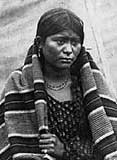 One of the prisoners at Fort Snelling One of the prisoners at Fort SnellingSimultaneously, 300 Dakota men were tried summarily (as many as 40 cases in a single day) and marched to another camp in Mankato. They had surrendered to the U.S. Army at the end of the Dakota War, expecting to treated as prisoners of war. Little War on the Prairie (This American Life) More on this forced march |
| November 7, 1916 Jeannette Rankin, a Republican from Missoula, Montana, became the first woman elected to the U.S. Congress. American women in 19 states had no voting rights whatsoever until passage of the 19th amendment four years later. Female Montanans had full voting rights even before statehood (in 1889). Read more |
| November 7, 1919 Hundreds, presumed to be members of the Union of Russian Workers, were arrested in New York and other cities across the country on the second anniversary of the Russian Revolution. President Woodrow Wilson’s attorney general, A. Mitchell Palmer, and Intelligence Division chief, John Edgar Hoover, used the Sedition and Espionage Acts to thwart what they saw as a Communist plot to overthrow the government. This was but one many assaults on radicals in what was known as the Palmer Raids. Thousands were arrested and thousands deported. It had been a year of significant labor unrest including steel, coal, and Boston police strikes, and a Seattle general strike. There was high unemployment in the wake of the demobilization after World War I. Around May Day there had been dozens of mail bombs, most of them intercepted, and a suicide bomber died outside Palmer’s Washington residence. The Palmer Raids The first mass arrest of immigrant workers Attorney General Mitchell’s view |
| November 7, 1973 New Jersey became the first state to allow girls to play Little League Baseball. |
https://www.peacebuttons.info/E-News/peacehistorynovember.htm#november7
 Scottie's Playtime