June 20, 1960 Nobel Prize-winner in Chemistry Linus Pauling [for study of the nature of the chemical bond and the determination of the structure of molecules and crystals] defied the U.S. Congress by refusing to name circulators of petitions calling for the total halt of nuclear weapons testing. Pauling later won a second Nobel, a Peace Prize, for his work championing nuclear disarmament. Linus Pauling Interview with Linus Pauling on the peace movement, 1983
June 20, 1965 Hundreds protested following a military coup in Algiers, the capital of Algeria. The military, under chief of the armed forces Colonel Houari Boumedienne and his National Revolutionary Council, had deposed President Ahmed Ben Bella, the first president of an independent Algeria (following the withdrawal of French colonial control). On the news at the time
June 20, 1967 Boxer Muhammad Ali was convicted in Houston, Texas, of violating the Selective Service law by refusing induction into the U.S. Army (during the Vietnam War). The World Heavyweight Champion had claimed conscientious objector status on the basis that he was a Muslim minister. The conviction, for which Ali was sentenced to five years in prison and a $10,000 fine, was later overturned by the Supreme Court. “I ain’t got no quarrel with those Vietcong.”
June 20, 1982 2500 were arrested during a two-day blockade of Lawrence Livermore National Laboratory, about 50 miles east of San Francisco, the principal American nuclear weapons research facility, operated by the University of California.
June 20, 1995 Shell Oil gave in to international pressure and abandoned its plans to dispose of the Brent Spar oil-drilling platform and its contents into the North Atlantic. The environmental group Greenpeace spearheaded the effort to prevent Shell from sinking the rig, its members boarding and occupying it as a tactic to stop the deep sea disposal, and to call attention to the issue peacefully. Shell’s plan would have dumped toxic and radioactive sludge into the ocean just west of the British Isles. A month later, at the Oslo and Paris Commission (OSPARCOM) meeting, 11 out of 13 countries agreed to a moratorium on the “dumping” of offshore installations, pending agreement on an outright ban. Greenpeace climbers on Brent Spar platform Shell ships use water cannons against Greenpeace activists on board the rig. Read more about Greenpeace and Brent Spar
June 20, 2002 The U.S. Supreme Court declared executing mentally retarded individuals convicted of capital crimes to be unconstitutionally cruel [Atkins v. Virginia]. Besides being in line with a consensus among state legislatures, the court found that “Their deficiencies [the mentally retarded] do not warrant an exemption from criminal sanctions, but diminish their personal culpability.”
June 15, 1917 Emma Goldman and Alexander Berkman were arrested and charged with conspiracy to obstruct the draft for America’s recent declaration of war with Germany in World War I. They held a number of rallies to discourage young men vulnerable to the new draft from cooperating. They laid out their position in the nearly 100,000 fliers they distributed with their NoConscription League Manifesto. “. . . this democratic country makes no such provision for those who will not commit murder at the behest of the war profiteers. Thus the ‘land of the free and the home of the brave’ is ready to coerce free men into the military yoke.” The Emma Goldman Papers The No-Conscription League Manifesto Alexander Berkman biography
June 15, 1942 The Congress of Racial Equality (CORE) was founded in Chicago by a group of students including James Farmer and Bayard Rustin. They found inspiration in Mahatma Gandhi—and his nonviolent victory over British colonial rule of India—for their struggle to achieve full legal rights for African Americans. CORE history Read more about CORE
June 15, 1966 The James Meredith March Against Fear [see June 6, 1966] arrived in Granada, Mississippi, and was met by hundreds of members of the local Negro (African-American) community. A rally was then held in the town square to encourage voter registration. During the rally, a representative of the Southern Christian Leadership Conference (SCLC) placed a small American flag on a Confederate War Memorial (it was later removed, considered a desecration by the local white population). Grenada County had recently hired four Negro voter registrars and, following the rally, and again following a speech that night by Reverend Martin Luther King, Jr., ßhundreds lined up at the courthouse to register to vote, 160 just on this day, a total of 1300 over the next two. Shortly thereafter, however, the Negro registrars were fired, and 700 registrations were invalidated for alleged technical violations of the local ordinance.
June 15, 1970 The U.S. Supreme Court ruled in U.S. v. Sisson that conscientious objectors, those who refuse military service or to bear arms for moral or religious reasons, need not base their beliefs on the tenets of an organized religion. Visit the Central Committee for Conscientious Objectors
June 15, 2011 Three months after the meltdown at the local nuclear power plant, the Fukushima, Japan, city government announced it would give dosimeters (devices that measure the intensity of radiation) to 34,000 preschool, elementary and junior high school students.
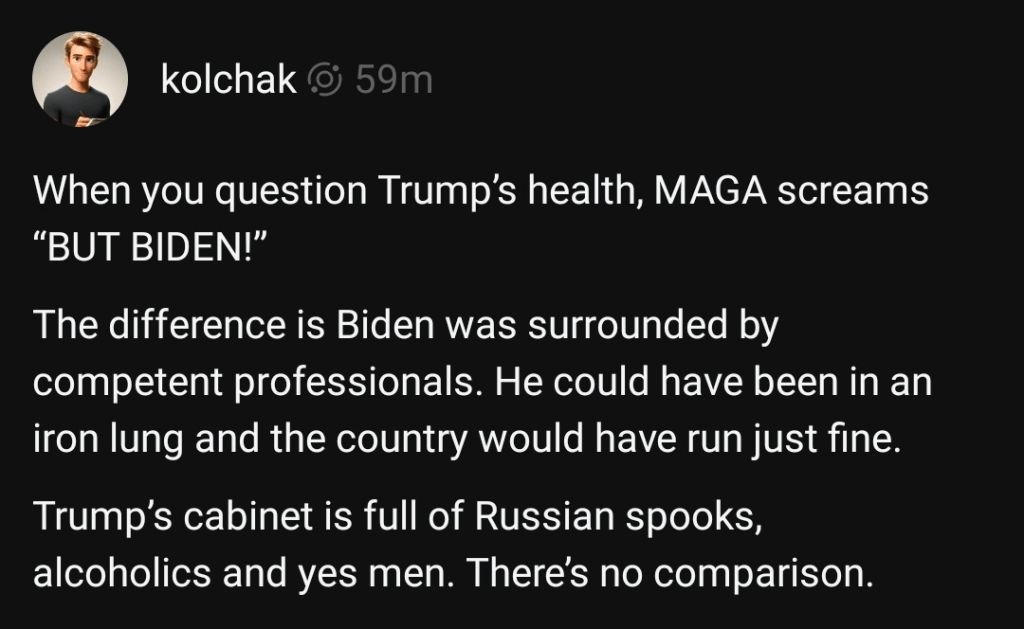
Remember when the right freaked out because bike riding Biden fell on the Air Force 1 stairs as he ran up them? Where are they now? Remember when tRump needed a General to walk him down the ramp? Well now tRump has falling on the Air Force 1 stairs. So where is the outrage on the right? tRump rides a gold cart on the green so he is supper fit, but Bide riding and exercising Biden in their mind was a feeble old man days into his term. Hugs
June 11, 1962 Students for a Democratic Society (SDS) held its founding convention in Michigan and issued The Port Huron Statement, laying out its principles and program. “In social change or interchange, we find violence to be abhorrent because it requires generally the transformation of the target, be it a human being or a community of people, into a depersonalized object of hate. It is imperative that the means of violence be abolished and the institutions—local, national, international—that encourage non-violence as a condition of conflict be developed.” Complete text of the Port Huron Statement (it’s a .pdf, in case you’re on a phone) Students for a Democratic Society: A Graphic History: Paul Buhle, Editor
June 11, 1963 Thich Quang Duc, a Buddhist monk from the Linh-Mu Pagoda in Hue, Vietnam, burned himself to death (self-immolation) in front of the U.S. embassy in downtown Saigon (now known as Ho Chi Minh City) to protest the the South Vietnamese regime the U.S. supported, and the war the Americans were waging. A painting of the scene on the street as Thich Quang Duc self-immolates in protest of the government and war in Vietnam
June 11, 1963 Vivian Malone (later Jones) preparing to enroll at Alabama with Deputy Attorney Gen, Nicholas Katzenbach (L) at her side. Alabama Governor George C. Wallace stood in the doorway of the University of Alabama in order to prevent the admission of two negro students in a failed attempt to maintain segregation in educational opportunities. He was forced to step aside later in the day when Vivian Malone and James Hood were registered as students.
June 11, 1968 Daniel Cohn-Bendit, known as Danny the Red, arrived in Britain, stirring up fears of campus unrest. The 23-year-old Paris law student had been given permission to remain in the U.K. just 24 hours, but immediately threatened to defy the authorities and out-stay his official welcome [his visit was later legally extended to 14 days]. Cohn-Bendit, a German citizen, had been expelled from France in May for being an organizer of the French student and worker demonstrations which almost brought that country to a standstill the previous month. Daniel Cohn-Bendit and a Paris policeman in 1968. “I don’t know how long I will stay. I think it’s a free country” -Daniel Cohn-Bendit He currently sits as a Green Party deputy in the European Parliament. The news at the time Daniel Cohn-Bendit today
June 11, 1970 Representative Martha Griffiths (D-Michigan) filed a discharge petition signed by a majority of all members of the U.S. House of Representatives, a seldom used parliamentary move, to bring the Equal Rights amendment to the House floor for consideration. She saw this as the only way to get the constitutional amendment out of the Judiciary Committee where it had been held by its chairman, Emmanuel Cellar (D-New York), who had refused to even hold hearings on the matter. Representative Griffiths had introduced the amendment every year since 1948. Representative Martha Griffiths from Detroit’s west side
June 11, 1988 100,000 marched from United Nations headquarters in New York City to Central Park during the 3rd U.N. Special Session on Disarmament. Though there had been progress in recent years on disarmament, the U.N. meeting yielded nothing but stalemate. Read more
June 11, 2010 Scientists studying the scale of the then-ongoing BP oil spill in the Gulf of Mexico doubled the previous estimate of the scale of the flow of oil into the Gulf. Initially, BP and the government had said that no more than 1000 barrels (42 U.S. gallons per barrel) per day were leaking, later raised to 5000. The fine for oil spills was $4300 per barrel. The new estimate was between 20,000 and 40,000 barrels per day. If the spill had been stopped that day (the well was not capped until early August), it would have exceeded the Exxon Valdez spill by a factor of eight.
Before the word ‘transgender’ existed, icon Bambi already danced for the stars
The moment which changed queer history occurred on a sweltering summer day in early 1950s Algeria. An effeminate teenage boy named Jean-Pierre Pruvot stood mesmerized as traffic halted and crowds swarmed around a scandalous spectacle unfolding in the conservative Algiers streets. (AP Video: Oleg Cetinic)Published 11:32 PM CDT, May 22, 2025.)
(And let me interject that I know that sometimes I’m a language/punctuation police officer, but I despise the term “reverse discrimination.” Either discrimination has happened, or it hasn’t, to be proven to whoever decides. There is no “reverse discrimination”. grr. Also, this is not a spoiler nor my opinion on the case, it’s simply that I guess it’s good for some people that I do not sit upon the SCOTUS, because I’d want to dismiss and tell them to use appropriate words so that the court could accurately decide based upon the evidence of discrimination, without being distracted by superfluous words. Please be at liberty to laugh at me about this. Then read all the following. -A)
It’s June 1, and that means we’re starting the last month, more or less, of this Supreme Court term. The cases the Court has had briefing on and heard oral argument in will all be decided by the end of this month, although some years it spills over into the first week of July.
We never know which cases are coming next. The Court doesn’t decide them in the order they hear them argued. But usually the biggest, most impactful cases aren’t decided until the end.
This week for “The Week Ahead,” I’ve got a scorecard with some of the most important still-undecided cases for this term on it. The goal is to give you some background to refer to, so when you hear the Court has announced a decision in a certain case you’ll be prepared to understand its significance.
Here they are, in order of when they were argued, although that’s likely to have little to nothing to do with when we will see opinions.
U.S. v. Skrmetti
The issue in this case is whether states can ban gender-affirming care for trans youth in the context of a 2023 Tennessee law that bans gender-affirming care, like puberty blockers and hormone therapy, for transgender patients who are minors. The Biden administration intervened in the case and was a party along with three transgender teens and their parents. That changed with the change in administrations. The Trump Justice Department, as you would expect, is on the other side of the case.
A key issue in the case is whether denying treatment to trans youth that is available to their gender conforming peers violates the Constitution by denying them equal protection under the law. A federal district court judge held that it did. But the Court of Appeals reversed. About 25 other Republican dominated states have similar laws. The result in this case will apply beyond Tennessee.
At oral argument, the conservative Justices seemed disinclined to accept the argument that this law is a form of sex discrimination, even though cisgender kids will be able to access treatment that transgender people won’t be able to receive if these laws stand. But the votes seemed to be in place to permit Tennessee and other states to keep their restrictive laws in place.
Free Speech Coalition v. Paxton
The case involves a 2023 Texas law that is supposed to keep minors from accessing pornography online. It requires websites to verify a person’s age before they are admitted to the site. But an industry group that calls itself the Free Speech Coalition sued, claiming the law violates the rights of adults who want to access the content, an impermissible burden on free speech. The ACLU is on their side in the case.
There was at least some indication at oral argument that the Justices are aware we no longer live in a world of dial up internet connections and want to revisit the standards that are used to “protect kids.” The technical legal issue is whether the court of appeals used the wrong legal standard to decide the case. Instead of using the highest standard of review and requiring the Texas law to pass “strict scrutiny” before it could burden the adults’ right to have access to protected speech, they only required that there be a “rational basis” connecting the law to its intent to protect minors.
Ames v. Ohio Department of Youth Services
The Court’s decision in this case could potentially signal a sea change in reverse discrimination employment litigation. The case involves a straight woman who claims she faced “reverse discrimination” on the job because she wasn’t gay, leading her to be passed over for promotion opportunities. The issue is whether a plaintiff who is a member of a majority group has to show that her employer is the “unusual” one who discriminated against the majority, before bringing a case under Title VII of the Civil Rights Act of 1964. If she wins, this sort of reverse discrimination case could become easier to bring.
The plaintiff lost out on a promotion to a lesbian woman. She was subsequently demoted and the position she was removed from was given to a gay man. All of this started 13 years into her employment, after a new boss, who was a gay woman, became her supervisor.
There was speculation following oral argument that the plaintiff might win unanimously. Justice Sotomayor seemed to say she thought the plaintiff might have a valid claim, noting that based on the record before the Court, there was “something suspicious” about what happened. The consensus among the Justices seemed to be that everyone had to be treated equally.
Smith & Wesson Brands v. Estados Unidos Mexicanos
There are two technical legal issues in this case, but together, they add up to an answer to the question of whether Mexico can sue U.S. gunmakers for what it has long maintained is their responsibility for the epidemic of gun violence within its borders. Mexico argues that a number of U.S. gunmakers made it possible for traffickers to illegally purchase firearms in the U.S., only for them to be provided to Mexican drug cartels.
The Court will decide: (1) Whether the production and sale of firearms in the United States is the proximate cause of alleged injuries to the Mexican government stemming from violence committed by drug cartels in Mexico; and (2) whether the production and sale of firearms in the United States amounts to “aiding and abetting” illegal firearms trafficking because firearms companies allegedly know that some of their products are unlawfully trafficked.
If the Court decides in Mexico’s favor, its lawsuit against U.S. gun manufacturers will move forward.
Louisiana v. Callais
This is the Louisiana redistricting case. The issues revolve around whether a Louisiana congressional district created to comply with the Voting Rights Act resulted in an unconstitutional gerrymander that discriminates based on race. The Callais plaintiffs are a group of “non-African Americans” who say the redistricted map violates the Constitution because it takes race into account in violation of the 14th Amendment.
Although the Court may be inclined to do away with the Voting Rights Act at some point, this case is reminiscent of a 2023 gerrymandering case out of Alabama, where a 5-4 majority that included Chief Justice Roberts and Justice Kavanaugh upheld the Voting Rights Act and forced Alabama to comply with it, rejecting maps drawn by the state legislature that made it all but impossible for Black citizens to elect candidates of their choice to Congress.
This case might have a similar outcome. It has similarly complicated facts and an up-and-down history on appeal. It comes down to whether Louisiana, whose population is about 1/3 Black, will have a second Black opportunity district. The technical issues involve whether a three-judge district court in this case was mistaken when it ruled that race predominated in the Louisiana legislature’s decision on maps, whether it erred in finding those decisions couldn’t pass the strict scrutiny test and a set of preconditions known as the Gingles factors, and whether the case is the sort of “non-justiciable” matter that should be resolved through the political process, not decided in the courts.
Mahmoud v. Taylor
The issue here is whether religious parents’ rights are violated when a school board doesn’t give them the ability to opt out from having LGBTQ-themed books available to their children in elementary school. The issue is presented as: Whether public schools burden parents’ religious exercise when they compel elementary school children to participate in instruction on gender and sexuality against their parents’ religious convictions and without notice or opportunity to opt out.
At oral argument, the Court’s conservative majority seemed sympathetic toward the parents.
Trump v. CASA, Inc. (consolidated with Trump v. Washington and Trump v. New Jersey)
This is the birthright citizenship case that was argued only earlier this month. We discussed it here. The issue isn’t whether Trump can end birthright citizenship. Rather, it’s whether the Supreme Court should stay the district courts’ preliminary injunctions except as to the individual plaintiffs and identified members of the organizational plaintiffs or states while the litigation works its way through the courts.
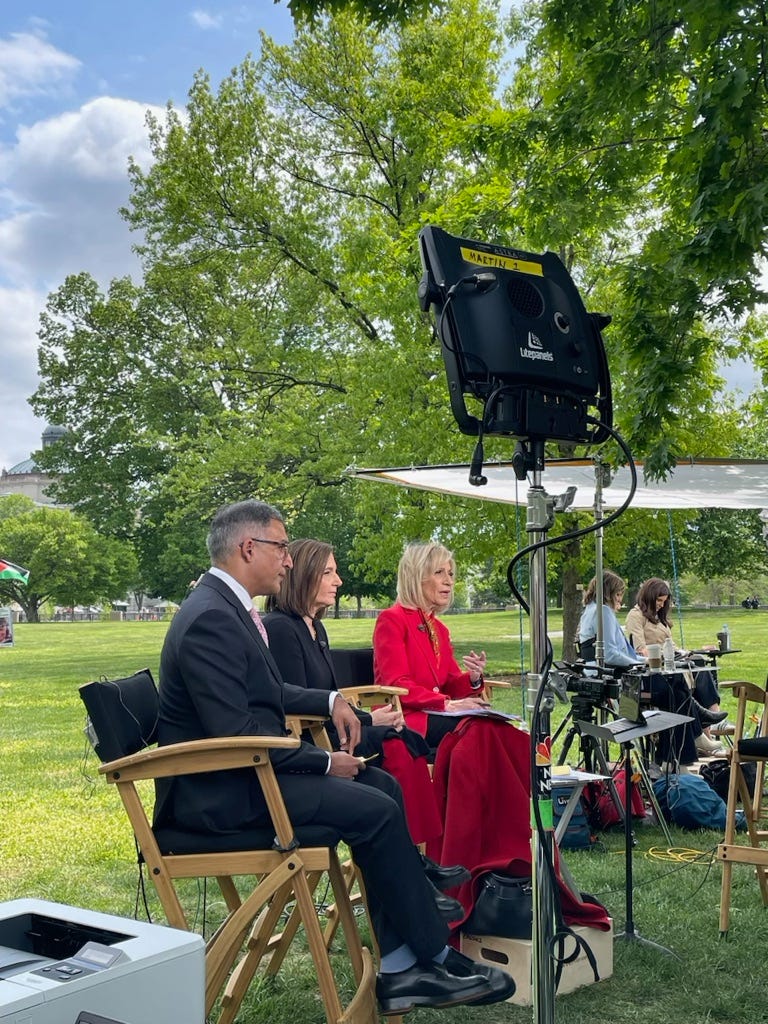
It’s hard to believe that it was just over a year ago that I sat outside, across the street from the U.S. Supreme Court building in the Senate Swamp, listening to the oral argument and preparing to comment on it in real time. (snip)
At the time, I wrote, “The case is all about Donald Trump and whether he can be prosecuted for the most serious of his crimes against the American people, trying to hold onto power after losing the 2020 election. It’s also about the legacy of the Roberts Court and whether history will view the already unpopular Justices as the Court that gave away democracy.”
Overall, there are more than 30 cases remaining on the Court’s dockets. There are also a number of procedural and other issues pending in cases that haven’t been fully briefed for a decision on the merits this term. This is the so-called shadow docket, where litigants ask the courts to make decisions in cases characterized as emergencies. Cases involving deportations and DOGE are among them. And also, the wild card, a number of cases still percolating through the lower courts where the issues aren’t yet ripe enough to be before the Supreme Court, but could become so in the next few months, at least enough to merit a trip to the shadow docket and interfere with the Supreme Courts’ summer break. The biggest question that remains for me is whether this Court will continue down the path it set itself upon last term, or will tell Trump no in a meaningful way?
Welcome to the new week. Thanks for being with me at Civil Discourse as we approach our third anniversary.






 Scottie's Playtime