
Tag: Health
This Is Nice-
via The Bee.
“Are We Being Punished For A Feminist Utopia That Never Even Happened?”
And how long is this ‘masculinity crisis’ going to last? Read on Substack
by Rebecca Schoenkopf

Last week, I watched Girls Gone Wild: The Untold Story on Peacock, which, unsurprisingly, was fairly disturbing on a number of levels, starting with the fact that most people at the time thought “getting young women extremely drunk and then convincing them to take their tops off on camera” was a fairly normal, “boys will be boys!” thing to do.
The thing that really struck me, though, was the fact that it remained “normal” until about 2011, when creator Joe Francis was arrested for false imprisonment and assault, after he brought three women home after a night out and refused to let them leave, ultimately attacking one of them and bashing her head into the floor. Francis had long been Public Enemy #1 for feminists (along with, on the other end of the spectrum, the Christian patriarchs who fake-married their daughters at Purity Balls), but at that point, no one was really paying any attention to us.
The reason I bring this up, the reason it struck me, is because I don’t think I really realized until just then what an incredibly short time period it was between the end of that era — this era where bro culture was celebrated, where rape culture was celebrated, where women’s sexuality was a thing within their control whichever way they chose to control it, in which beautiful female celebrities were excoriated for being a size four in public — and the era we are now in.
Because we hear a lot about it from their end, right? The story, as they tell it, is that there were all these ostensibly “liberal” men who “voted for Obama,” but then the Left “just went too far” and drove them into the loving, misogynistic arms of Andrew Tate and Donald Trump. And now they’re lonely and they don’t know how to be men and it is a full-on crisis! A crisis I tell you! And an epidemic!
The way they talk, you would think that they had been forced to live in this horrible matriarchal world for years, during where they weren’t allowed any free speech, were constantly accused of rapes they didn’t commit, were told constantly by everyone that they were garbage and that they had to apologize for being born male.
But let’s piece together this timeline, shall we?
2011: Joe Francis arrested, “Entourage” ends.
2012: During a stand-up set, comedian Daniel Tosh starts talking about how rape jokes are “always” funny — causing a woman in the audience to yell, “Actually, rape jokes are never funny!”, to which he responds, “Wouldn’t it be funny if that girl got raped by like, five guys right now? Like right now? What if a bunch of guys just raped her?”
— Also, Tucker Max, who was celebrated for having written a book called I Hope They Serve Beer In Hell, in which he tells multiple stories of having sex with extremely intoxicated women, “retires” from being Tucker Max.
2013: We have the rape joke discourse, led by then-Jezebel writer Lindy West. On the one hand, you have feminists saying “This shit isn’t actually funny,” and on the other, approximately 87 million op-eds about how we must protect the sanctity of rape jokes.
— The campus rape discourse begins. Women who have been raped on campus discuss both the problem of rape on campus and the tendency of school officials to do nothing about it, asking people to take it more seriously and criticizing men who have sex with women when they are too intoxicated to consent. This is followed by years of people complaining that we can’t take these women seriously, because what if they are just having day-after regrets because the man didn’t send them flowers or call them back or something?
2014: In May, incel Elliot Rodger kills six people because he is angry that women won’t have sex with him.
— In August, Gamergate begins — starting out as a rage against progressive videogame developer Zoë Quinn from gamers who believe that she only got good reviews for a game she made that they didn’t like because she had a sexual relationship with a video game reviewer (who never actually reviewed her game). It turns into unfettered rage and harassment against women who dare to criticize games for being misogynistic, and then against all “Social Justice Warriors” in general.
— We have the street harassment discourse, started by Black women on social media, in which women publicly discussed the general unpleasantness of not being able to walk to the grocery store without some guy yelling “Nice tits!” at us. This is quickly followed by approximately 87 million “How are men even supposed to talk to women if they can’t yell at them while they walk down the street?” and “But it’s a compliment!” and “I’m a woman and it makes me feel pretty when men I don’t know compliment my ass!” op-eds.
— The height of the affirmative consent discourse, in which people discuss why it’s important to have affirmative and enthusiastic consent at each stage of sexual activity. Some states implement “Yes Means Yes” laws — so that, instead of asking campus rape victims whether they were clear enough that they did not want to have sex with someone, accused rapists will be asked how they obtained consent, This was, naturally, followed by lots of complaining that it will ruin sex.
2015: Donald Trump begins his presidential campaign, ultimately winning in part due to a backlash to “social justice” activism — feminist activism and rape culture discourse in particular.
So let’s just stop there for now. This is not meant to be an exhaustive list, because I know we had a few more discourses and we certainly had a lot more incel mass murders. But it doesn’t need to be, because the main thing I want to point out is that, at the very most, we had a few years of public discussions of things women had grown real fucking sick of, each of which was swiftly followed by an inevitable “Has feminism gone too far?!?” backlash from those who thought everything was fine the way it was and had been — mostly from those with bigger platforms and more power than we ever had.
This, frankly, has been the case for all social justice movements that have occurred over the last few years — not just feminism and rape culture, but also racism, police brutality and trans rights. You see a groundswell of actual people talking about their experiences and how best to change things so that other people don’t have to go through them, and a swift and terrible backlash from those who say they would like those other people to shut up, please.
Donald Trump was elected again this year, and again we were all told “This is all because you all just went too far! They just couldn’t take it anymore!”
But like, in the end, what did they have to take? People talking publicly on social media? People making art, movies, television shows, music, video games, etc. that they don’t like? Or publicly criticizing things they do like or behavior they enjoy engaging in?
That’s nothing. Especially when compared to everything that everyone else was expected to go through and shut up about. I’d like to point out that, quite notably, taking rape more seriously did not lead to any epidemic of men being sent to prison for not sending flowers or calling the day after.
One of the most jarring points of the “Girls Gone Wild” documentary is one in which a girl recounts how she ended up in a video when she was 17 years old (making it, legally, child pornography), and one of the male teachers at her high school responded by asking her to autograph a copy for him. That’s just one moment, one small snapshot of what was meant to be acceptable back then.
And, you know, at no point did anyone back then publicly wonder or wring their hands about “Is the patriarchy going too far?” Rather, then, as now, most public discussion was about what was wrong with the girls who were doing this, not the men who produced it.
It’s not at all surprising to me that men living in that social environment felt “safe” voting for Barack Obama, or felt like they were totally liberal because they wanted to legalize weed and didn’t care if people were gay or not. Because they could vote for Obama and feel like a good liberal while chanting “Iron my shirt!” at Hillary Clinton. Everything was going really well for them and no one was really challenging the status quo, at least not anyone they were paying any attention to. This is part of what they mean when they say “the Left left me!”
(And, again, that’s just the feminist side of it. They were also “totally fine” with Black people until Black people started bringing up police brutality and racism, and fine with LGBTQ+ people when they thought that civil rights push would end with marriage.)
We’re being punished right now for a feminist utopia we never even had. We went straight from the Girls Gone Wild Era to the Gamergate/Incel mass murder era to the the Trump era. And while a whole lot has changed in terms of what we are willing to put up with or be quiet about, the only thing that has actually changed about the patriarchy has been the flavor it takes on.
Peace & Justice History 12/15
| December 15, 1791 The Bill of Rights became law when Virginia ratified the first 10 amendments to the United States Constitution. Read The Bill of Rights The Bill of Rights Defense Committee (emphasis mine -A. It’s an important site these days!) |
December 15, 1930  Albert Einstein, 1930 Albert Einstein urged militant pacifism and the creation of an international war resistance fund. Einstein stated in New York that if two percent of those called for military service were to refuse to fight, and were to urge peaceful means of settling international conflicts, then governments would become powerless since they could not imprison that many people. He struggled against compulsory military service and urged international protection of conscientious objectors. He concluded that peace, freedom for individuals, and security for societies depended on disarmament; otherwise, “slavery of the individual and the annihilation of civilization threaten us.” Einstein on Peace and World Government |
| December 15, 1946 Vietnamese leader Ho Chi Minh sent a note to French Premier Leon Blum congratulating him for his selection as French Premier and asking for peace talks. France had exercised colonial power over the Vietnamese as part of French Indochina, formed in October 1887 from the provinces of Annam, Tonkin, Cochin China, and the Kingdom of Cambodia; Laos was added in 1893. Vietnamese nationalists, however, had demanded independence for the three provinces at the end of World War II. |
December 15, 1973 The American Psychiatric Association reversed its long-standing position and declared that homosexuality is not a mental illness and “…deplores all public and private discrimination in such areas as employment, housing, public accommodation…” Read the APA policy on discrimination against [gays] |
| December 15, 2000 The Chernobyl nuclear power plant was shut down 14 years after becoming the site of the world’s worst nuclear accident ever. Nearly nine tons of radioactive material – dozens of times as much as the Hiroshima and Nagasaki bombs – were released in the explosion. The radioactive fallout affected 23% of Belarus, with 4.8% of Ukrainian territory and 0.5% of Russia. The Belarussian government spends 30% of its annual budget dealing with the aftermath of Chernobyl. |
https://www.peacebuttons.info/E-News/peacehistorydecember.htm#december15
“Shore Lark”
Click through to hear its song while it eats snow!
Enjoy Some Comics on Friyay


Peace & Justice History for 12/12
December 12, 1870 Joseph H. Rainey (R-South Carolina) took his seat in the U.S. House of Representatives, becoming the first African-American Member of Congress. More about Rainey |
| December 12, 1916 Dr. Ben Reitman was arrested in Cleveland for organizing volunteers to distribute birth control information at an Emma Goldman lecture on birth control. He was sentenced to six months in jail and a $1,000 fine plus court costs.  Dr. Ben Reitman |
| December 12, 1947 The United Mine Workers union withdrew from the American Federation of Labor over the AFL’s failure to organize workers in mass production industries such as textiles, automobiles, steel and rubber. |
| December 12, 1969 The Philippine Civic Action Group, a 1350-man contingent from the Army of the Philippines, left South Vietnam. The contingent had been part of the Free World Military Forces, an effort by President Lyndon Johnson to enlist allies for the United States and South Vietnam, similar to President George Bush’s “Coalition of the Willing,” the multi-national force in Iraq. |
| December 12, 1983 Seventy people were arrested in Boston outside a hotel where a “New Trends in Missiles” trade conference was being held. Inside the hotel, over 1,000 cockroaches were released to symbolize the likely survivors of nuclear war.  |
December 12, 1986 From a pershing plowshares action 1984 Plowshares activists disarmed a Pershing missile launcher in West Germany. In a statement of intent the four said, “With awareness of our responsibility we understand that we are the ones who make the arms race possible by not trying to stop it.” Details of their action in Pershing to Plowshares |
https://www.peacebuttons.info/E-News/peacehistorydecember.htm#december12
Not Good News In FL
so probably in TX, KS, AR, and more red states, soon. sigh Just when you think they can’t make being in prison worse.
New Florida Prison Policy on Trans Health Care ‘Like Conversion Therapy’
With new restrictions on gender-affirming care, prisons confiscate underwear from trans people and compel them to cut their hair.
Earlier this fall, Florida officials ordered transgender women in the state’s prisons to submit to breast exams. As part of a new policy for people with gender dysphoria, prison medical staff ranked the women’s breast size using a scale designed for adolescents. Those whose breasts were deemed big enough were allowed to keep their bras. Everyone else had to surrender theirs, along with anything else considered “female,” such as women’s underwear and toiletry items.
This article was published in partnership with the Tampa Bay Times.
The examinations came after people who had been diagnosed with gender dysphoria by the prison system’s own providers were brought into meetings at the end of September and told of the prisons’ new policy, which would make it nearly impossible for them to get hormone therapy and other gender-affirming medical care, according to interviews and emails with more than a dozen transgender women who said they attended the meetings.
Josie Takach, who is incarcerated in a men’s facility south of Tallahassee, said a male doctor told her to lift up her shirt, then glanced at her breasts and wrote something down without saying a word. When she tried to ask a question, a nurse “told me not to ask any questions and to just shut up and do what I’m told,” she recalled.
“It felt like I was being treated less than human,” she said.
The state’s chapter of the ACLU sued Florida’s Department of Corrections, which operates the prisons, in late October, calling the policy draconian and arguing it amounts to an unconstitutional ban on gender-affirming care. The new policy is the latest maneuver in the culture war around transgender people’s civil rights in the Sunshine State. Florida Gov. Ron DeSantis championed a raft of anti-trans legislation, including a law passed last year that prohibited children with gender dysphoria from accessing treatments like puberty blockers and hormone therapy. A similar law in Tennessee was the subject of arguments in a case before the U.S. Supreme Court last week.
In Tallahassee Monday, a federal judge held a preliminary hearing in the ACLU case. The state had asked the judge to dismiss the lawsuit altogether, and the ACLU asked him to stop the state from enforcing the new rules. The judge is expected to issue a ruling on these questions in the coming weeks.
The Florida Department of Corrections’ media office did not respond to multiple emails and phone calls with detailed questions, but in court papers responding to the ACLU’s lawsuit, the department’s lawyers argued that the new rules are “a carefully crafted policy that creates an individualized course of treatment for each inmate based on scientific evidence and clinical judgment.”
Under the new policy, the Department of Corrections stated that the prisons will only provide those with gender dysphoria with psychotherapy — and not cross-gender hormones — except “in rare instances … if necessary to comply with the U.S. Constitution or a court decision.” The policy argues that “unaddressed psychiatric issues and unaddressed childhood trauma could lead to a misdiagnosis of gender dysphoria,” and that cross-gender hormones “may be requested by persons experiencing short-termed delusions or beliefs which may later be changed and reversed.”
Florida has the country’s third-largest state prison system, with more than 87,000 people incarcerated at the end of September. Of those, 181 have been identified by the department as transgender, and about 100 received hormone treatment, according to documents state officials filed with the courts in the ACLU case.
The new policy was announced in meetings in several prisons across the state at the end of September. Transgender women who attended the meetings said they were told by officials that everyone identifying as transgender would be “re-evaluated” to assess whether they can have continued access to the care and accommodations they had been receiving, such as permission to grow their hair long. Officials have not told the women whether and under what circumstances they will be allowed to stay on the hormones they have been receiving.
Since then, more than a dozen transgender people said corrections officers ordered them to cut their hair. Mariko Sundwall told The Marshall Project that she was given a disciplinary infraction and spent 10 days in solitary confinement for refusing to cut her hair before officers put her in handcuffs and led her to the prison barber where her hair was cropped short.
“[Before] my hair was long enough for a ponytail. Now I have a buzz cut,” said Jada Edwards, incarcerated in Dade Correctional Institution south of Miami. “I’m very sad and depressed. I feel like they’re taking away my identity.”
Scores of women also had their breasts examined, according to filings in the suit and interviews with some of the women. A medical provider for the state assigned each transgender woman a rating on the Tanner scale, a system used by pediatricians to assess the development of adolescents during puberty. Several of the women said they weren’t told what stage was required for permission to keep their bras, but that almost everyone they knew had theirs taken away.
Some report hiding bras or sewing makeshift underwear — although now women’s undergarments are considered contraband and could result in disciplinary charges — because they feel naked and exposed without them.
“I feel like I’m 12 years old again, sneaking around wearing a bra,” said Takach, after her female undergarments were confiscated.
The new policy, which requires psychotherapy to treat underlying issues rather than treating the dysphoria, “comes off like conversion therapy,” says Daniel Tilley, the lead attorney from the ACLU of Florida. “We’re trying to change your fundamental nature to get you to stop being who you are.”
Sarah Maatsch, who is incarcerated in a men’s prison south of Orlando, said she was told that the gender dysphoria diagnosis she received from corrections department doctors in 2019 would now be considered a serious psychiatric illness. If she wants to continue her treatment, she said she was told, she would have to move to a more restrictive prison with more psychiatric services, but fewer work and programming opportunities.
“We are all devastated,” said Maatsch. “There are good days, bad days and the very bad days where a part of you hopes you have a heart attack.”
The new policy is the latest change in health care for transgender people in Florida after a 2023 law said any “governmental entity” in Florida “may not expend state funds … for sex-reassignment prescriptions or procedures.” It did not name prisons specifically, but the Department of Corrections’ new policy says it “shall comply” with this law.
Shortly after DeSantis’ anti-trans bills were passed, transgender people in state prisons began reporting that medications were abruptly changed or delayed with little or no explanation.
Courts have held that prisons are required under the U.S. Constitution to provide gender-affirming hormones as needed. Dan Karasic is a psychiatrist at the University of California, San Francisco who helped develop international standards for treatment of transgender people and who has testified against bans on gender-affirming care in Florida and elsewhere. He read Florida’s new guidelines at The Marshall Project’s request and called them “a fig leaf on their efforts to ban gender-affirming care. They are really trying to skirt the law, as determined by multiple courts, that gender-affirming medical and surgical care must be provided when medically necessary.”
The Florida prison system’s program to treat prisoners with gender dysphoria began in 2017, after Reiyn Keohane sued the state. The federal judge in the case said that the Department of Corrections’ refusal to provide Keohane with hormones and social accommodations, like women’s clothing and haircuts, caused her “to continue to suffer unnecessarily and poses a substantial risk of harm to her health.” During the course of the lawsuit, the state began providing gender-affirming hormone therapy, access to makeup, women’s clothing and other social accommodations within its prisons.
Behind the scenes, Danny Martinez, the state prison system’s medical director, began revising the state’s gender-affirming care program in 2020, he said in a court declaration in response to the ACLU’s recent lawsuit. As many as one-third of the people on hormones in Florida’s prisons were not attending group or personal therapy sessions, he said. “I observed no decrease, and in fact an increase in grievances to the medical and mental health staff from inmates receiving hormone therapy, indicating to me that the treatment solely based on hormone therapy without additional mental health treatment produced limited success,” he wrote. An email to Martinez seeking comment was not returned.
Martinez said he designed the new program based on a 2022 report by Florida’s Medicaid organization that found “insufficient evidence” that medical interventions for gender dysphoria are safe or effective. The report led to the state’s Medicaid program banning coverage of gender-affirming medical care. But a federal judge, in striking down the Medicaid ban last year, found that the report was “a biased effort to justify a predetermined outcome, not a fair analysis of the evidence,” and the report’s conclusion was “not supported by the evidence and was contrary to generally accepted medical standards.”
So far, none of the transgender women incarcerated in Florida have reported being taken off their hormones, but the looming threat has led to widespread anxiety.
“If they took away my hormone therapy treatment, I would be ready to end my life. I’m at that point,” said Sasha Mendoza, who is incarcerated in a men’s prison near Miami, in a declaration filed in the ACLU case. “It may sound drastic. But FDC just let me start my transition and I was doing so well, and now they are making me stop. I’m halfway there and halfway not there.”
Delightful Poetry On Thursday
Just click the title to read more about the poet and the poem.
In a Grain of Sand by Jesús Papoleto Meléndez
To see a world in a grain of sand …
—from “Auguries of Innocence” by William Blake
We are Starseeds
every one of us –
you & me,
& me and you
& him & her,
& them
& they
& those
Who know of this
are truly blessed …
True for all
living beings,
beings living –
not humans only,
but ants & trees
& the open breeze,
things that breathe
air or fire,
water, earth
all kinds of dust
& dirt,
particles
a part of all,
all a part
of
Everything
that is
in everything;
Thus, it Sings!!!
& its song
is Life,
& Life
is!!! …
a seed of Stars,
the dust of Suns
& Moons
rocks & dust
& outer smoke
in outer space
Floating
in a bath of timelessness,
counted, measured
numbered
by some species –
others caring not;
Science & Mathematics
trying to plot
Poetry in motion,
Motion
in a Helix’s curve,
And Life
on Earth
becomes visible
to You
through the naked I!
Copyright © 2024 by Jesús Papoleto Meléndez. Originally published in Poem-a-Day on December 11, 2024, by the Academy of American Poets.
So, I Did A Thing (again) The Other Day-
Cartoon Nine Four Seven by Josh Lieb
Injection Read on Substack
Santa’s bedroom. Santa, looking very scrawny, is trying on his red suit. The jacket is way too big and the pants are falling down. Mrs. Claus, annoyed, says: “I told you not to get those stupid shots.”
Some people just look better fat.
Ali Redford ends a long, long drought of reader art by submitting this wonderful nine four six:
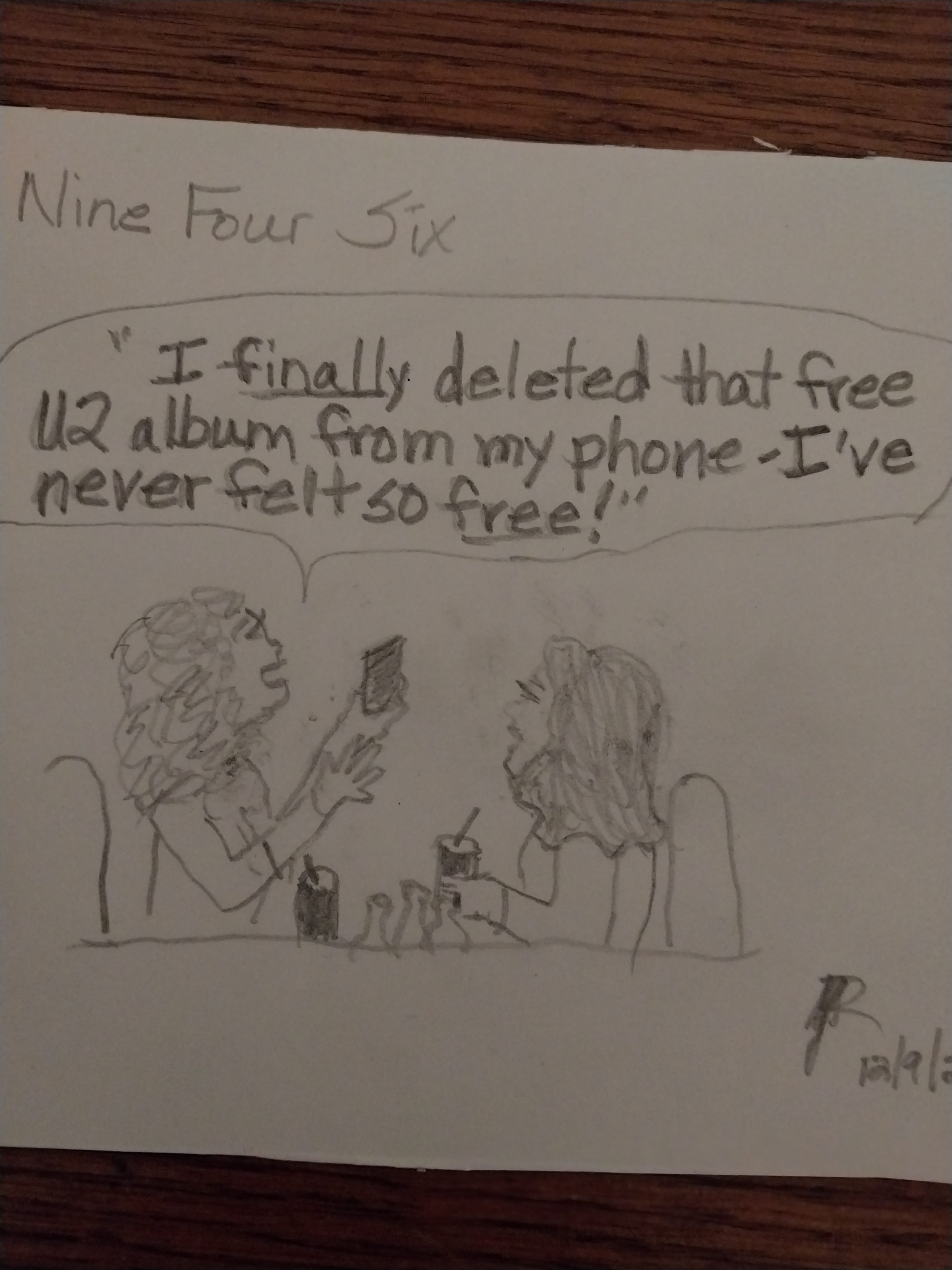
Ali thought my cartoon was funny even though, she confesses, she’d never previously heard about the free U2 album that mysteriously appeared on peoples’ phones ten years ago. It occurred to me while I was writing it that I might mystify some of my younger readers. So yeah, while they were rolling out a new iPhone a decade ago, Apple and U2 rather presumptuously “gave” all iPhone users this new U2 album. Everyone woke up with it on their phone and just felt… invaded. Even U2 fans were a little put off. I think it bothered people to discover that they were not in charge of their own phone.
Most people deleted the album (or kept it and enjoyed it). Then there were people like me, who had the unwanted album follow them, from phone to phone, for a decade.
Ali, I love the cartoon you drew — it’s maybe your best yet. The women feel very real, and the speaker’s sense of liberation is palpable. Thank you!
The rest of you: get to work drawing my cartoons.
(snip)
 Scottie's Playtime