Peace & Justice History for 8/7

August 7, 1904
Ralph Bunche, born this day in Detroit, spent a remarkable life in vigorous service to academia, his community, the nation and the world.

Ralph Bunche
Head of the Howard University Political Science Department for over twenty years, he was one of the first African Americans to hold a key position at the U.S. State Department. He went on to the United Nations and served as its mediator on Palestine. He was the recipient of the Nobel Peace Prize for negotiating the 1948 armistice agreements between Israel and the Arab states. He worked with Martin Luther King in the civil rights struggles of the ‘50s and ’60s.
Succinct biography of Ralph Bunche
August 7, 1958
The D.C. Court of Appeals reversed playwright Arthur Miller’s conviction for contempt of Congress following a two-year legal battle. He had been charged for refusing to tell the House Un-American Activities Committee (HUAC) the names of alleged Communist writers with whom he attended five or six meetings in New York in 1947.

Arthur Miller in front of HUAC
Read more 
August 7, 1964
After a reported U.S. confrontation with North Vietnamese forces that, it was later discovered, never occurred, the U.S. Congress nearly unanimously passed the Gulf of Tonkin resolution.The resolution gave President Lyndon Johnson broad powers in dealing with North Vietnam, including sending U.S. troops.
News coverage relied almost entirely on official U.S. government sources so Americans assumed the North had in fact launched an unprovoked attack. Two courageous senators, Wayne Morse (D-Oregon) and Ernest Gruening (D-Alaska), provided the only “no” votes.


“I rise to speak in opposition to the joint resolution. I do so with a very sad heart. But I consider the resolution . . . to be naught but a resolution which embodies a predated declaration of war . . . .” –Senator Wayne Morse
The media and the Gulf of Tonkin 
The facts of the incident uncovered by the National Security Archive
August 7, 1995
Four experienced Plowshares activists, Michele Naar-Obed, Erin Sieber and Rick Sieber, hammered and poured their blood on the U.S.S. Greenville, a fast-attack submarine in production at the Newport News, Virginia, shipyard.

https://www.peacebuttons.info/E-News/peacehistoryaugust.htm#august7

Peace & Justice History for 5/19

May 19, 1934
10,000 participated in a “No More War” march in New York City.
May 19, 1952
Playwright and activist Lillian Hellman advised the U.S. House Committee on Un-American Activities (HUAC) that she refused to testify against friends and associates, saying, “I cannot and will not cut my conscience to fit this year’s fashions.”

Lillian Hellman
Learn more about Lillian Hellman 
Text of her letter to HUAC 
May 19, 1997
Two international human rights workers, Mario Calderón and Elsa Alvarado, as well as her father, were shot dead in Bogotá, Colombia, by a paramilitary gang.
Their one-year-old was hidden and thus spared, her mother wounded. The couple worked for the Center for Investigation and Popular Education (Centro de Investigación y Educación Popular, or CINEP), a non-governmental organization founded by the Jesuits (the Roman Catholic Society of Jesus) to foster education, understanding, justice and sustainable development in Colombia.

Mario Calderón and Elsa Alvarado
CINEP’s peace program 

https://www.peacebuttons.info/E-News/peacehistorymay.htm#may19

Peace & Justice History for 11/24

November 24, 1859
British naturalist Charles Darwin published On the Origin of Species, which explained his theory of evolution.The basis for the theory is natural selection, the process by which organisms change over time as a result of changes in heritable (genetically based) physical or behavioral traits. Such changes allow an organism to better adapt to its environment and help it survive and have more offspring.
Evolution is now universally accepted among scientists, and is the organizing principle upon which modern biological and related sciences are based.


Darwin and “On the Origin of Species” 
November 24, 1869
Women and men from 21 states met in Cleveland to organize the American Women Suffrage Association, led by Lucy Stone, Henry Blackwell, Thomas Wentworth Higginson, and Julia Ward Howe. The group’s approach to enfranchisement for women was through acquiring the right to vote state-by-state.
Those in Cleveland had broken with Susan B. Anthony and Elizabeth Cady Stanton of the National Women Suffrage Association over the 15th amendment to the Constitution, which had granted the vote to black male Americans following the end of slavery, but had not enfranchised women, whether white or black. Anthony and Stanton protested the protection of black rights over universal suffrage.

Original document from AWSA in the National Archives 
November 24, 1947
A group of writers, producers and directors that became known as the “Hollywood 10” were cited for contempt of Congress when they refused to cooperate at hearings about alleged Communist influence in the movie industry.

The Hollywood 10
Following their appearance in front of the House Un-American Activities Committee (HUAC) under Representative John Parnell Thomas (R-New Jersey), the House of Representatives voted 346-17 for the citations. All were convicted and sentenced to 6-12 months in prison. The charges were upheld by the U.S. Supreme Court. Invoking their 5th Amendment right not to be witnesses against themselves, and their 1st Amendment right to freely associate with whom they choose, the Hollywood 10 refused to answer the question, “Are you a member of the Communist Party or have you ever been a member of the Communist Party?”
Others cooperated: the mother of actor and dancer Ginger Rogers testified her daughter had been asked to say in a film, “Share and share alike, that’s democracy,” a line from a script written by the blacklisted Dalton Trumbo. Rogers said this was “definitely Communist propaganda.”


Free The Hollywood 10 demo 
Read more  (2 links)
November 24, 1970
14 American students met with Vietnamese in Hanoi to plan the “Peoples’ Peace Treaty” between the peoples of the United States, South Vietnam and North Vietnam.

It begins, “Be it known that the American people and the Vietnamese people are not enemies. The war is carried out in the names of the people of the United States and South Vietnam, but without our consent. It destroys the land and people of Vietnam. It drains America of its resources, its youth, and its honor.”
The treaty was ultimately endorsed by millions.

Read the treaty 
November 24, 1983
On Thanksgiving Day seven Plowshares activists hammered and poured blood on B-52 bombers converted to carry cruise missiles at Griffiss Air Force Base near Syracuse, New York.
Bloody handprint on missile.
Watch Plowshares history video 
Read
more  (2 links)
November 24, 1987
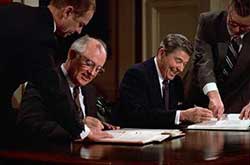
The United States and the Soviet Union agreed to scrap short- and medium-range missiles in the first superpower treaty to eliminate an entire class of nuclear weapons. The Intermediate Nuclear Forces (INF treaty), signed by Reagan and Gorbachev, was the first to actually reduce the number of nuclear weapons held by the two sides.
November 24, 1993

Queen Lydia Liliuokalani
Congress voted to formally apologize to Hawaii for the 1893 overthrow of the government of Queen Lydia Liliuokalani.
What the apology was for 
Read the apology 
An Hawaiian Declaration of Independence 

https://www.peacebuttons.info/E-News/peacehistorynovember.htm#november24