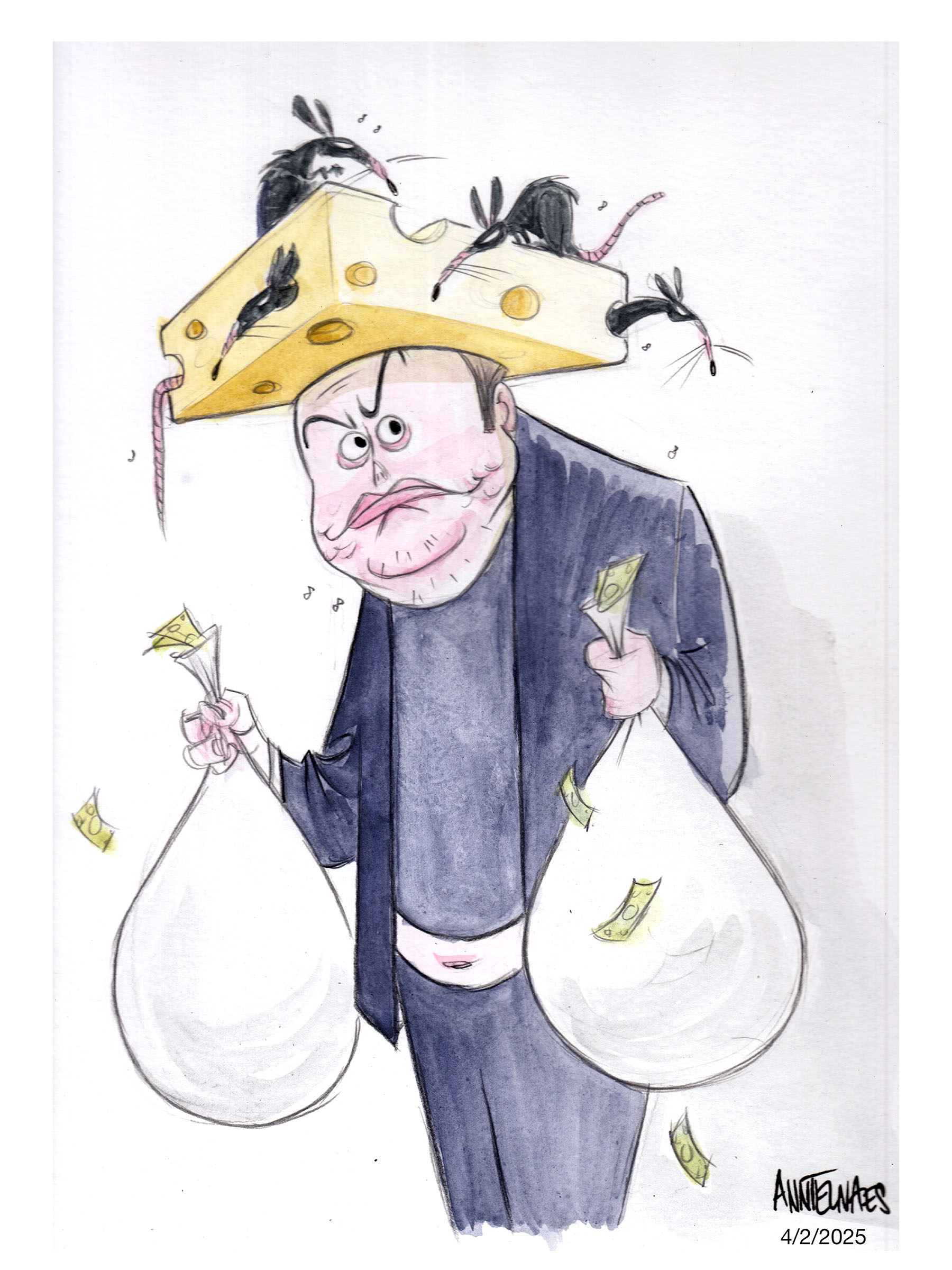
I subscribe to a newsletter by author Courtney Milan. In it, she writes of one of my reasons for living, tea, but also, to put it briefly, coping and some activism. It’s a good newsletter, and I’ve often wanted to share parts of it, but never got it done. This one, that I’ve only read today (so 1 day late for Hands Off! but there are plenty of times and places for us to rock on,) has good information, and activism we can take while in grocery lines or waiting rooms or wherever we are. Here’s the tea (without actual tea, but if you want to see her tea entry, let me know in comments and I’ll bring it here):
NORMIE TARIFF EXPLAINER
I had started writing something yesterday about Cory Booker, and was interrupted by Donald Trump announcing massive, sweeping tariffs that will send the global economy into a tailspin.
One of the problems with things like this is that a lot of people simply don’t know what tariffs are, or don’t know that Trump is lying about the tariffs other countries are imposing. They certainly don’t understand what the impact will be, and so I decided to make an extremely basic Trump Tariff Explainer to pass out to friends/family/at protests, etc, because if there’s one thing that extremely normie and/or not online people may pay attention to, it might be something like “everything is about to cost a lot more money.”
Even if they don’t believe that this will happen, I think it’s important to put it in their brains that if it does happen, the people to blame are Donald Trump and his cabinet.
So I have made a website and downloadable PDF sheet for the normal person in your life.
You can download the PDF here. I’m printing several hundred of these and bringing them to distribute at the protest this Saturday–the more people who see this information, the faster we can try to turn the tide.
These tariffs are going to be terrible for everyone, but they’ll be especially horrific for the poor, the disabled, and the marginalized both in the US and around the world world. The faster we can turn things around, the more lives we will save, and hopefully more people knowing what is happening will help us turn things around faster.
April 6, 1712 The first major slave rebellion in the North American British colonies took place in New York City. One out of every five New Yorkers was enslaved at the time. Twenty-three black slaves set fire to buildings, killed six white British subjects and wounded six others. More on the rebellion and its aftermath Slavery in New York
April 6, 1909 Robert Peary, his negro servant, Matthew Henson, and four Eskimos reached the geographic North Pole for the first time. Matthew Peary at the White House, 1954 Stamp issued 2005 Though Henson was alongside Peary, widely hailed as a courageous explorer, during that and subsequent Arctic expeditions, Henson achieved little notice until much later in life. Article about the unsung hero of the polar expedition
April 6, 1968 Dozens of major cities in the United States experienced an escalation of rioting in reaction to the assassination of Martin Luther King, Jr. two days before. At least 19 people had already died in the arson, looting and shootings. Several hundred had also been injured and about 3,000 arrested—most of those in Washington, D.C.
April 6, 1968 Bobby Hutton, the 17-year-old first member of the Black Panther Party was gunned down by officers of the Oakland Police Department. Police opened fire on a car of Black Panthers returning from a meeting. The Panthers escaped their vehicle and ran into a house. Police attacked the house with tear gas and gunfire. After the building was on fire, the Panthers tried to surrender. Hutton came out of the house with his hands in the air. Bobby Hutton But a police officer shouted, “He’s got a gun.” This prompted further police gunfire that left Hutton dead and Panthers co-founder Eldridge Cleaver wounded. Police later admitted that Hutton was unarmed. More about Bobby Hutton
April 6, 1983 President Ronald Reagan’s interior secretary, James Watt, banned all rock ‘n’ roll groups from the Fourth of July celebration on the Washington Mall.The bands scheduled to play included the Beach Boys, generally considered very wholesome. But Watt said such acts attracted the “wrong element.” ”We’re not going to encourage drug abuse and alcoholism as was done in the past.” The president’s wife, a fan, complained directly to Secretary Watt, but he claimed never to have heard of the band.
April 6, 1996 Eleven were arrested at the main post office near Capitol Hill in Washington, D.C., for attempting to mail medical supplies to Iraq in defiance of the U.S.-led embargo. Between 1990 and 1995 with the first Gulf War and the sanctions regime imposed by the U.S., its coalition and the U.N., infant and under-5 mortality rates in Iraq had more than doubled. More about Voices in the Wilderness
USA Fencing says it is standing by its decision to disqualify a cisgender fencer who forfeited a tournament match against a transgender opponent last week, an act the organization says violated international competition rules.
On March 30, USA Fencing (the country’s governing body for youth and adult competitive fencing) oversaw the annual Cherry Blossom tournament at the University of Maryland. During the Division 1 Women’s Foil event, cis fencer Stephanie Turner knelt in front of her opponent Redmond Sullivan, removed her protective mask, and refused to begin the match. A referee then showed Turner a black card to disqualify her.
A black card is the harshest penalty in fencing, one that is usually deployed in cases of egregious unsportsmanlike conduct. In a statement to the Irish Star this week, USA Fencing said that Turner’s conduct violated rules for competition set by the International Fencing Federation (FIE).
“[Turner’s] disqualification was not related to any personal statement but was merely the direct result of her decision to decline to fence an eligible opponent, which the FIE rules clearly prohibit,” USA Fencing’s statement read in part. FIE’s Technical Rules bar athletes from competing if they “refuse to fence against any other fencer whatsoever […] correctly entered in the event.”
“USA Fencing is obligated to follow the letter of those rules and ensure that participants respect the standards set at the international level,” the organization’s statement continued. “We remain committed to inclusivity within our sport while also upholding every requirement dictated by our governing body.”
USA Fencing also told the Star that it will “always err on the side of inclusion,” but that its leaders “respect the viewpoints on all sides” and would consider changing their trans and nonbinary athlete policy should Olympic policies change or new “relevant evidence-based research” be conducted. The organization’s current policy allows adult trans and nonbinary people to compete in men’s or women’s divisions depending on their stated gender identity, with restrictions based on an athlete’s testosterone levels; trans women must complete a year of testosterone suppression to be eligible for women’s competition, while trans men who take testosterone are automatically disqualified from women’s events.
Sullivan went on to finish 24th overall in the field of 39 competitors (including Turner), with seasoned competitor Shuang Li picking up the fifth gold medal of her career. Of course, Li received no accolades from right-wing media outlets, much less self-proclaimed defender of women’s sports J.K. Rowling, who focused on denigrating Sullivan and uplifting Turner on Elon Musk’s X social media platform. Rowling wrote in one post that Turner is “what a heroine looks like,” after sharing another post from former tennis star turned anti-trans campaigner Martina Navratilova, who said she was “fuming” and shamed USA Fencing for “throw[ing] women under the gender bullshit bus.”
Current scientific research has not shown that trans women hold significant biological advantages over cis women in competitive sports. In fact, a study backed by the International Olympic Committee last year found that trans women who suppress their testosterone may face significant disadvantages in some athletic metrics like vertical leap. But conservatives in the U.S. have insisted that it is “common sense” to ban trans women and girls from women’s sports, which has now become a rallying cry for the second Trump administration, as officials use trans athletes as a cudgel to withhold funding from states like Maine by claiming they are violating federal civil rights law.
In 2022, the NCAA tightened restrictions on trans athletes’ eligibility following the success of then-college swimmer Lia Thomas. NCAA president Charlie Baker said in February that the organization would voluntarily shift its policies to align with Trump’s executive order calling for sports to be separated based on the president’s definition of “biological sex.” The new participation policy specifically states that a “student-athlete assigned male at birth may not compete for an NCAA women’s team.” It’s not clear based on USA Fencing’s statement this week whether the organization will alter its own policy to match the NCAA updates.
April 5, 1910 Emil Seidel was elected mayor of Milwaukee and became the first socialist mayor of a major city in the United States. During his administration the first public works department was established, the first fire and police commissions were organized, and a city park system came into being. In 1912, the Socialist Party nominated Emil Seidel as their vice presidential candidate to run with Eugene Debs. Emil Seidel Read more about Emil Seidel Milwaukee’s Socialist Era
April 5, 1930 Mohandas Gandhi and his followers reached the end of their 400 km (240 mile) march to the Indian Ocean coast at Dandi. He had left his ashram with 78 satyagrahis (“soldiers” of peaceful resistance), but the procession grew over the 23 days of traveling on foot until it stretched more than 3 km (2 miles). When they arrived at the seaside, Gandhi made salt by allowing seawater to evaporate. This simple task was an act of civil disobedience because the British Raj, the governing colonial authority, had made salt-making a monopoly and a crime for others; additionally, there was a tax on salt, a necessary element of the Indian diet. Gandhi picking up salt. Gandhi had chosen this issue to demonstrate how British control affected all Indians, regardless of ethnicity, religion or caste. The nature of this “crime” allowed him to resist that power without violence. And the British were faced with potentially arresting millions who might now be willing to flout the Salt Laws. He had written to Lord Irwin, the Viceroy of India, a month earlier: “Dear Friend, I cannot intentionally hurt anything that lives, much less fellow human beings, even though they may do the greatest wrong to me and mine. Whilst, therefore, I hold the British rule to be a curse, I do not intend to harm to a single Englishman or to any legitimate interest he may have in India . . . .” Read Gandhi’s letter
April 5, 1972 The Harrisburg Seven case ended in mistrial after 11 weeks.The Seven were charged with plotting to kidnap Secretary of State Henry Kissinger, among other alleged crimes. The defense attorney, recent former U.S. Attorney General Ramsey Clark, asked by the presiding judge to call his first witness said, “Your Honor, the defendants shall always seek peace. They continue to proclaim their innocence. Elizabeth McAllister and Philip Berrigan, two of the Harrisburg Seven The defense rests.” Only Philip Berrigan and Sister Elizabeth McAllister were declared guilty—of smuggling letters in and out of prison. They later married, co-founding Baltimore’s Jonah House. Visit Jonah House
April 5, 1977 Demonstrations and sit-ins began at regional offices of the U.S. Department of Health, Education & Welfare (HEW, now Department of Health & Human Services) urging HEW Secretary Joseph Califano to implement an extension of civil rights that included the disabled. Since non-discrimination protection had been part of the Rehabilitation Act of 1973, the department had failed to agree to regulations (under Section 504) that would give the law practical effect in the lives of those it intended to protect. Discrimination on the basis of disability was to be illegal in any program which received federal funds. At all the offices the demonstrators left at the end of the working day, except two: Washington, DC and the San Francisco regional headquarters. Though negotiations were continuing between the Carter administration and the American Coalition of Citizens with Disabilities, those in San Francisco, led by Judith Heumann, held their ground until Califano signed the Sec. 504 regulations on April 28. It had been the longest sit-in of a federal office in history. Judith Heumann, Advisor for Disability and Development. sign from the campaign Short film about the sit-in (“Recalling an invigorating act of civil disobedience”) How Section 504 became law and how its supporters prevailed
April 5, 1982 Dublin, Ireland, declared itself a nuclear-free zone by vote of its City Council.
April 5, 1985 Columbia University students occupied Hamilton Hall to demand divestment by the university of its assets invested in companies doing business with South Africa. The selling off was intended to pressure the racially separatist government to eliminate its racially separatist policy of apartheid.
April 5, 1989 Solidarity (Solidarnosc in Polish) became the first independent labor union given legal status in Poland. It started out as a strike committee among shipyard workers advocating democratic reforms during the summer of 1980 in Gdansk (FKA Danzig). A very high percentage of the Polish workers, a broad representation of the political and social opposition to the communist military regime, became members despite the union’s having been declared illegal in October of 1982. Solidarity’s legacy
April 5, 1992 The March for Women’s Lives, in support of women’s reproductive rights and equality, drew several hundred thousand people to Washington, D.C. There were students representing 600 college campuses. Part of the huge turnout taking part in the March for Women’s Lives
One of the largest protests ever in the nation’s capital, the pro-choice rally occurred as the U.S. Supreme Court was about to consider the constitutionality of a Pennsylvania law that limited access to abortions.Many abortion-rights advocates feared that the high court, with its conservative majority, might find the Pennsylvania law constitutional, or even overturn the 1973 Roe v. Wade ruling that made abortion legal. Read more about this march
April 5, 1996 54 were arrested in a Good Friday protest at Livermore Nuclear Weapons Laboratory in California.
A goodly number of events have happened on April 4.
April 4, 1958 Aldermaston March, 1st Day, 1958. Four thousand began the first of eleven consecutive annual Easter protest marches. It took three days on foot from London to Aldermaston AWRE (Atomic Weapons Research Establisment) base in England. Watch one of the marches Interviews with participants ——————————————————————————————— April 4, 1967 Reverend Martin Luther King, Jr., head of the Southern Christian Leadership Conference, in a speech to Clergy and Laity Concerned at the Riverside Church in New York City, called for common cause between the civil rights and peace movements. The Nobel Peace Prize winner proposed the United States stop all bombing of North and South Vietnam; MLK delivering the important speech …declare a unilateral truce in the hope that it would lead to peace talks; set a date for withdrawal of all troops from Vietnam; and give the National Liberation Front a role in negotiations.” . . . this war is a blasphemy against all that America stands for . . . .” Read the speech Or listen Impact of the speech ———————————————————————————– April 4, 1968 Martin Luther King, Jr., 39, was assassinated in Memphis, Tennessee, where he had come to help with a strike by sanitation workers. Reverends Ralph Abernathy, Jesse Jackson, and King on the balcony of the Lorraine Motel shortly before he was shot. Riots in reaction to the assassination broke out in over a hundred cities across the U.S., lasting up to a week; cities included Chicago, Baltimore, Washington, DC, Cincinnati, Boston, Detroit, Philadelphia, San Francisco, Toledo, Pittsburgh, and Seattle. The federal government deployed 75,000 National Guard troops. 39 people died and 2,500 were injured. In Indianapolis, Indiana, Senator Robert F. Kennedy (D-New York) was campaigning for president. Learning about the assassination just before speaking to a large rally, he said,“we can make an effort, as Martin Luther King did, to understand and to comprehend, and replace that violence, that stain of bloodshed that has spread across our land, with an effort to understand, compassion and love.” Indianapolis experienced no rioting that night. Senator Robert Kennedy speaking to a large, mostly African-American rally about the death of Dr. Martin Luther King, Jr.
Video and text of Kennedy’s speech The building now houses the National Civil Rights Museum; visit the museum James Earl Ray confessed to the slaying, was sentenced to 99 years in prison, but later recanted. Numerous people originally involved in investigating him have raised serious doubts about his involvement; after Ray’s death, a 1999 civil jury trial in Memphis concluded that Ray did not act alone. —————————————————————————————- April 4, 1969 CBS cancelled “The Smothers Brothers’ Comedy Hour,” a television show which featured edgy political satire and such rock bands as the Beatles, the Who, Jefferson Airplane and the Doors. Smothers brothers The brothers had refused to censor a comment made by Joan Baez. She wanted to dedicate a song to her husband, David, who was about to go to jail for objecting to the draft during the Vietnam War. David Harris and Joan Baez More about the show Joan Baez and the Smothers Brothers sing Dylan’s “I Shall Be Released” ————————————————————————————————— April 4, 1984 The women of the main peace camp at Greenham Common in Berkshire, England, were evicted by British authorities. They had been encamped for over two years to oppose the presence of U.S. nuclear-armed cruise missiles at the military base there. They said their eviction would not end their protest. Read more
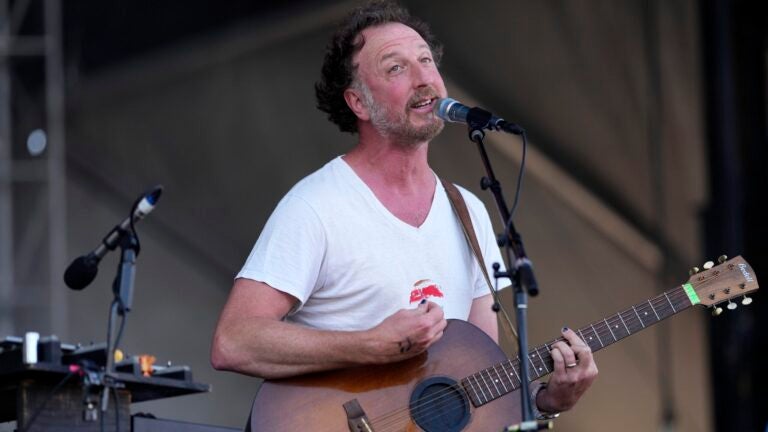
Guster welcomed the cast of the children’s musical “Finn” to the Kennedy Center over the weekend after the center’s Trump-appointed board canceled its national tour.
Guster shared the Kennedy Center stage with the cast of children’s musical “Finn” on Saturday, March 29. Charles Sykes/Invision/AP
After opening at the Kennedy Center to strong reviews in November and December 2024, the Kennedy Center-commissioned musical was supposed to begin a national tour this year. “Finn” — about a young shark who “wants to let out his inner fish” — was co-created by Chris Nee, the openly gay creator of the popular children’s TV show “Doc McStuffins.”
But after President Donald Trump took over as chairman of the arts institute in February — firing its board of trustees and installing allies including White House Deputy Chief of Staff Dan Scavino and Fox News hosts Laura Ingraham and Maria Bartiromo in their place — the planned national tour for “Finn” was canceled.
“We will soon announce a new Board, with an amazing Chairman, DONALD J. TRUMP!” Trump wrote on Truth Social in February. “Just last year, the Kennedy Center featured Drag Shows specifically targeting our youth — THIS WILL STOP.”
According to Deadline, the new regime at the Kennedy Center cited financial considerations when canceling the musical’s planned tour, but “the musical’s theme of tolerance and acceptance – the young gray shark named Finn ultimately decides to let out his ‘inner fish’ by adopting a vibrantly colored and glittery new appearance – has been widely interpreted as at least a contributing factor in the tour’s axing.”
During Friday evening’s show, Guster brought the cast of “Finn” on stage to accompany the band on its song “Hard Times.”
Guster lead singer Ryan Miller addressed the audience before bringing the cast on stage, talking about his friendship with “Finn” co-creator Michael Kooman.
“As the new administration has made abundantly clear, ‘Finn’’s themes of inclusivity, love, and self-acceptance aren’t going to be welcome in this building while they are in control,” Miller said. “Tonight our band is here to say our stage is your stage. We are your allies, we stand with the LGBTQ community, and we want you to sing with us.
“Please welcome the cast of ‘Finn’ and composer Michael Kooman,” Miller concluded. “They belong here.”
In a Facebook post on Monday, the band wrote that it left the Kennedy Center “imbued with energy, purpose, and righteousness.”
“Reflecting on the weekend and feeling so grateful for our fans,” the band wrote. “Many of you were hesitant to enter the charged atmosphere at the Kennedy Center but trusted us to navigate these shows with purpose and showed up as your fullest most spirited selves.”
“I think all of us, and it’s like 5000 of us over the weekend, left that venue feeling the power of music to heal and refresh,” the post continued. “And the power of community to overcome. (snip unembeddable Facebook post)
In the shadow of Wednesday, April 3rd, 2025 circum 4 p.m. EST, the idea of liberation unfolds with all its complexities, its light and its shadow. The declaration, bold and unyielding, seeks to redefine the pillars on which trade and economic power rest, claiming to usher in an era of self-reliance and prosperity. Yet, as with all acts of change, the effects are far-reaching, unpredictable, and deeply personal.
From the bustling markets of India to the quiet farmlands of Iowa, the world absorbs the shockwaves of an economic strategy that promises protection but risks isolation. In homes and factories, the air is thick with speculation—what will these tariffs bring? A renaissance of domestic manufacturing or a tightening of belts for families already stretched thin?
Global markets shift like tectonic plates beneath the surface, each country recalibrating its position in this delicate dance. Some see an opportunity to assert their own independence, while others grapple with the economic turbulence caused by disruption. The landscape becomes a chessboard, nations maneuvering for advantage, each move echoing through the corridors of diplomacy and trade.
And amidst this vast interplay of economies and geopolitics stands the human spirit. For the individuals whose lives are touched by these decisions, liberation is not just a political or economic act—it is deeply personal. It is the parent deciding how to stretch a paycheck further in the face of rising costs. It is the worker who watches as their factory doors reopen, bringing hope to their community. It is the farmer who wonders if their crop will find a buyer in a world now reshaped by tariffs.
Liberation, then, becomes a question of perspective. For some, it is a moment of pride, an assertion of independence in a globalized world. For others, it is a reminder of vulnerability, the realization that no nation or individual exists in isolation. It is the tension between self-sufficiency and interdependence, between the desire for control and the inevitability of connection.
As the world moves forward from this day of declaration, the real measure of “Liberation Day” will not be found in the speeches or the headlines—it will be in the lives it changes, the challenges it creates, and the resilience it inspires. For in the end, liberation is not just the act of breaking free—it is the courage to forge a path in the uncharted territories that freedom brings. However, as a Canadian, my speak 🗣️
Wednesday, April 3, 2025, the sun rises not simply over land and water but over a tapestry woven with threads of commerce, diplomacy, and shared destinies. Across the expanse of North America, two neighbors—Canada and the United States—stand as towering pillars of trade, their economies entwined like the roots of ancient oaks. Their shared border, stretching like an endless promise, hums with the rhythm of industry, each heartbeat pulsing with goods and ideas that flow seamlessly between them.
But today, the pulse quickens, and the air grows dense with the weight of a proclamation. “Liberation Day,” declared boldly, aims to sever dependence, a bid for sovereignty through tariffs as high as mountain peaks. The United States, seeking refuge from the vulnerabilities of interdependence, turns inward, its gaze fixed on rekindling domestic sparks. Factories stir with newfound hope, their machines roaring with ambition, while farms stretch toward the horizon, bracing for winds of change.
Canada watches, its heart a blend of steel and shadow. From Ottawa to Alberta, the land whispers of resilience—a quiet determination to adapt and endure. Trade routes that have thrived for centuries suddenly feel fragile, threatened by the force of protectionist winds. Yet in this fragility lies the essence of ingenuity, the spark that drives nations to seek partnerships beyond familiar shores. Diversification becomes Canada’s anthem, a melody sung to the world, a testament to its strength.
Across fields and highways, rivers and rails, the individual stories unfold. In bustling Toronto, a worker questions the fate of their factory, now tethered to uncertain exports. In rural Saskatchewan, a farmer gazes at their wheat, their crop a silent plea for markets that may no longer welcome it. In Michigan, an assembly line thrums with renewed vigor, yet the workers pause, wondering how long the momentum will last. It is here, in the lives of ordinary people, that the consequences of Liberation Day resonate most deeply.
The Canada-U.S. trade relationship—a partnership that has weathered storms and celebrated triumphs—now stands at a crossroads. It is a reflection of the paradox of liberation: to free oneself from dependency is to risk isolation; to assert sovereignty is to acknowledge vulnerability. Yet, amid the challenges, hope persists. It whispers through the rustle of maple leaves and echoes across the Rockies, a reminder that change, though disruptive, breeds possibility.
As the sun will set, painting the sky in hues of amber and ash, the world holds its breath. Liberation is not a moment—it is a journey, one of adaptation and resilience, of finding strength in the struggle and light in the uncertainty. Canada and the United States, like two dancers navigating a shifting melody, move forward—not as rivals but as partners, bound by history, trade, and the human spirit that seeks meaning even in the face of transformation. Is it long live freedom?
Republican lawmakers in the Sunshine State are advancing a suite of bills making it easier for employers to exploit society’s most vulnerable.
Snippet (there’s much more, also about other subjects, on this page -A):
Make labor law feudal again. The Florida legislature is rapidly advancing a suite of bills allowing employers to underpay subminimum-wage workers — including children. One measure proposes undoing key child labor restrictions, like rules regulating maximum hours per week, banning overnight shifts, and guaranteeing teens get meal breaks. Another bill would permit employers to misclassify full-time workers as interns and apprentices to circumvent the state’s new minimum wage law. Both bills are part of the business lobby’s long war to decimate labor rights in the state; proponents are citing ongoing labor market disruptions caused in part by the Trump administration’s mass deportation program.
Florida didn’t want this. In 2020, a supermajority of Floridians voted to pass a ballot initiative to raise the state’s minimum wage from $8.56 to $15 an hour by 2026. But business interests have tried to stop that law from ever fully going into effect. Last year, the legislature passed a carve-out for minor league baseball players, and this year, the business community is coming back with a more sweeping overhaul. The new bill exempts interns, apprentices, and work-study programs from the new wage standards, despite the fact that a minimum wage is supposed to raise the floor for the lowest-paid segments of the labor force.
Internships forever. Critics of the legislation point out that the bill text does not define any criteria for what differentiates an employee from an intern or apprentice. Without clear guardrails, employers could use this exemption to underpay just about any entry-level position that requires some training. All they’d need to do is require the employee to sign a form waiving their right to the state minimum wage.
Thanks, Florida Man. In a committee hearing earlier this month, the bill’s sponsor, state Rep. Ryan Chamberlin (R-Belleview), acknowledged that retailers like Target may exploit these loopholes as written. “It’s certainly not intended for Target to be able to do that,” he said in response to a Democratic lawmaker’s concerns, without denying that it’s a possibility. Meanwhile, critics argue that the legislation is patently unconstitutional and suspect that it’s meant to push for a ruling from the state’s high court, which is stacked with loyalists of Gov. Ron DeSantis (R), who has opposed the minimum-wage law. With a favorable ruling, business groups could weaken the law and undermine a guaranteed state minimum wage. (snip)
Donald Trump continues to bully one of the America’s longest allies.
Donald Trump just made the rationale for his tariff “Liberation Day” crystal clear: revenge.
In a post on Truth Social late Tuesday, the president said that the tariffs were his administration’s “fight” against Democrats’ “wild and flagrant push to not penalize Canada for the sale, into our Country, of large amounts of Fentanyl, by Tariffing the value of this horrible and deadly drug in order to make it more costly to distribute and buy.”
Approximately 0.2 percent of American fentanyl seizures occur at the Canadian border, according to federal statistics.
But Trump’s aggressive rhetoric and high levies on Canada have practically shattered the two neighbors’ long-standing allyship. On Thursday, Canadian Prime Minister Mark Carney announced that his country’s cozy relationship with the U.S. had come to an end, and that Canada would wean itself off American products and services “at speeds we haven’t seen in generations.”
Trump singled out four Republican senators in particular who have pushed back against his tariffs. “They are playing with the lives of the American people, and right into the hands of the Radical Left Democrats and Drug Cartels,” he said, referring to Mitch McConnell, Susan Collins, Lisa Murkowski, and Rand Paul.
“The Senate Bill is just a ploy of the Dems to show and expose the weakness of certain Republicans, namely these four, in that it is not going anywhere because the House will never approve it and I, as your President, will never sign it,” Trump said. “Why are they allowing Fentanyl to pour into our Country unchecked, and without penalty. What is wrong with them, other than suffering from Trump Derangement Syndrome, commonly known as TDS?”
Trump and his allies have frequently accused anyone that critiques their work of being mentally ill, effectively undermining the legitimacy of critical thought in the groupthink of his already sycophantic base.
“Who can want this to happen to our beautiful families, and why? To the people of the Great States of Kentucky, Alaska, and Maine, please contact these Senators and get them to FINALLY adhere to Republican Values and Ideals,” Trump said. “They have been extremely difficult to deal with and unbelievably disloyal to hardworking Majority Leader John Thune, and the Republican Party itself. MAKE AMERICA GREAT AGAIN!”
(I find it rich that Trump thinks those Senators have not adhered to Republican values and ideals, especially McConnell and Collins. Paul is in a world of his own, most decidedly a Libertarian world. Sheesh. -A.)